
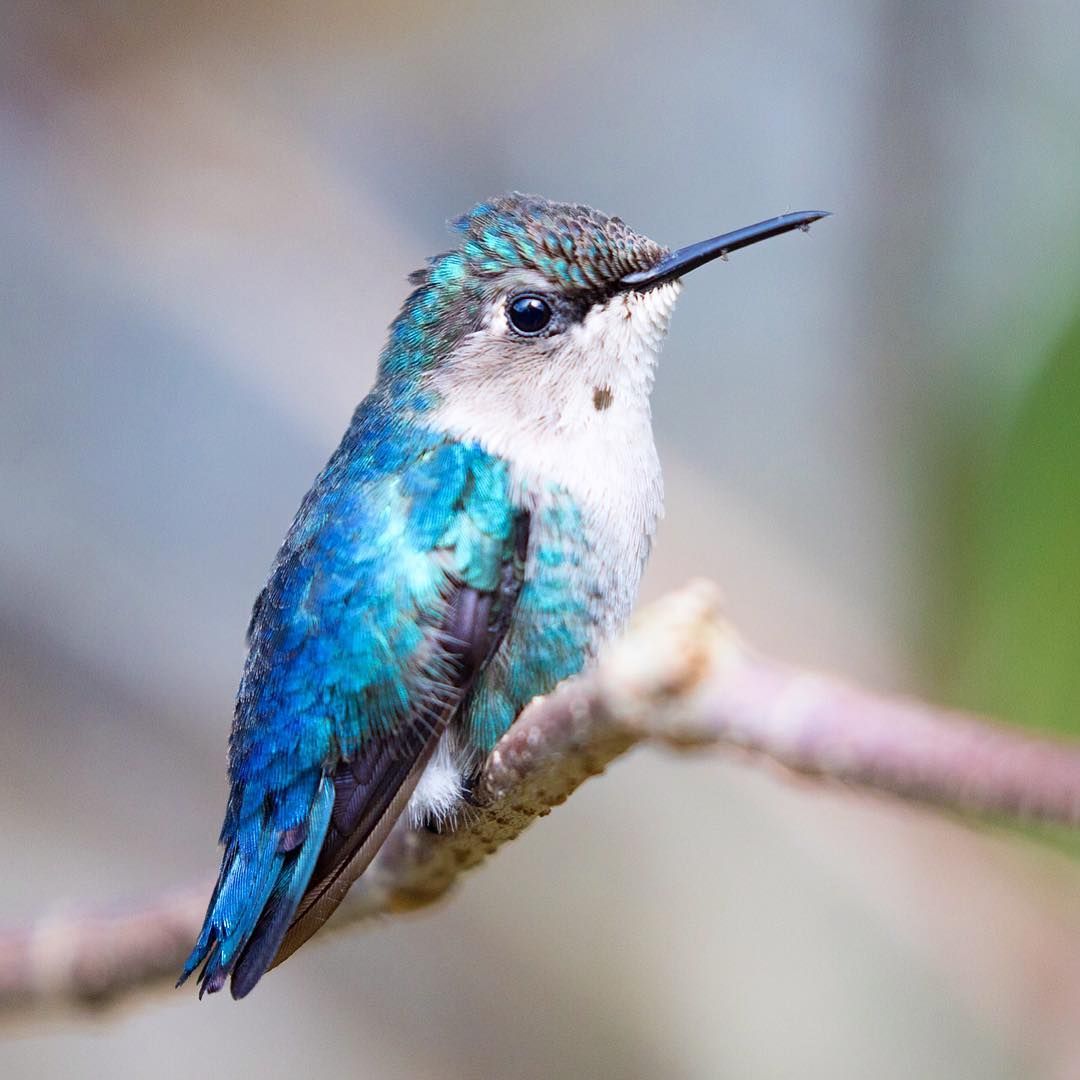
The bee hummingbird is the smallest bird alive on Earth. An adult male weighs under two grams and measures barely five centimetres from bill tip to tail - small enough that on first sight many observers assume they are watching a large bumblebee rather than a vertebrate.
Endemic to Cuba and the nearby Isla de la Juventud, Mellisuga helenae compresses the full architecture of a warm-blooded, feathered, egg-laying animal into a body lighter than a one-cent coin, and then drives that body through one of the most demanding metabolisms ever measured in the animal kingdom.
This guide covers every major aspect of bee hummingbird biology and ecology: size and structure, the mechanics of flight at the absolute lower edge of bird anatomy, diet and co-evolution with a narrow range of Cuban flowers, the record-setting nest, torpor, courtship, conservation status, and the relationship between bee hummingbirds and the human communities who share their island.
It is a reference entry, not a summary - so expect specifics: grams, hertz, kilometres, beats per minute, and verified records.
Etymology and Classification
The scientific name Mellisuga helenae combines two layers of history. The genus Mellisuga is a Latin coinage that translates roughly to 'honey-sucker', an early European label for hummingbirds based on their nectar feeding. The species epithet helenae was assigned in the nineteenth century in honour of Helena Booth, the wife of the naturalist who first prepared specimens for European science. The species was formally described in 1850 by Juan Lembeye based on birds collected in western Cuba.
The bee hummingbird belongs to the order Apodiformes, a group whose Latin name means 'without feet' and whose members share the trait of tiny, weak, near-vestigial legs. Inside Apodiformes the family Trochilidae contains about 360 described hummingbird species, all confined to the Americas.
The genus Mellisuga contains just two species: the bee hummingbird and the larger vervain hummingbird (Mellisuga minima) of Jamaica and Hispaniola. The two are close relatives but differ enough in size, range, and flower preferences to function as distinct species.
Cuba's isolation as a large Caribbean island has produced a high rate of endemic bird species, of which the bee hummingbird is the most famous. Molecular evidence suggests the species diverged from its mainland ancestors within the last few million years as the Greater Antilles drifted into their current position and as hummingbird lineages radiated throughout the Caribbean basin.
Size and Physical Description
The bee hummingbird is the smallest bird species in the world by both length and mass. No other bird comes close. The next-smallest species, the vervain hummingbird, is roughly half again as heavy; most small songbirds are four to ten times heavier.
Body dimensions:
- Total length: 5-6 cm from bill tip to tail
- Wingspan: 6-7 cm
- Bill length: 1-1.5 cm, straight, slender, black
- Weight: 1.6-2.0 g in males, 2.0-2.6 g in females
Sex differences:
- Males: smaller, with iridescent fiery red-pink gorget, extended throat feathers forming lateral plumes, and a short, forked tail
- Females: slightly larger and heavier, with pale underparts, plain throat with fine streaks, and a rounded tail tipped with white
- Juveniles: resemble females with slightly duller plumage
Unlike most birds, female bee hummingbirds are larger than males. This reversal is common in hummingbirds and is thought to reflect the female's greater investment in nest building, incubation, and chick feeding, all of which benefit from a slightly larger body with more fat reserves.
The feet are almost vestigial, as they are across Apodiformes. The legs are too short and weak for walking, hopping, or serious gripping at an angle. A bee hummingbird can latch onto a twig tightly and can shuffle sideways for a few centimetres, but on flat ground it is helpless. Flight handles all major tasks: feeding, travel, courtship, even bathing by flying briefly through waterfall spray or fine rain.
The wing is built like a miniature rigid propeller. The shoulder joint rotates almost 180 degrees, letting the wing invert between strokes so that lift is generated on both the forward and the backward half of each beat. Wing beat frequency averages around 80 hertz in ordinary hovering flight and can climb toward 200 hertz during the male's courtship dive - among the highest frequencies ever measured in a vertebrate.
Built for Extreme Metabolism
The bee hummingbird pushes vertebrate physiology to the mathematical edge of what warm-blooded biology can sustain. Its tiny body has a surface-to-volume ratio so unfavourable for heat retention that maintaining a typical avian body temperature of about 40 degrees Celsius requires running the furnace at full power almost constantly.
Metabolic benchmarks:
- Heart rate at rest: several hundred beats per minute
- Heart rate in active flight: up to 1,260 bpm
- Heart rate in torpor: drops sharply, typically to 50-80 bpm
- Breathing rate at rest: approximately 250 breaths per minute
- Body temperature active: ~40 C
- Body temperature in torpor: can fall by 20 C or more
To fuel this metabolism the bee hummingbird consumes roughly 5 grams of food per day - about five times its own body weight in nectar and small insects combined. Put in human terms, a 70 kilogram adult would have to eat 350 kilograms of food every day to match the bee hummingbird's mass-specific intake.
This is only sustainable because the bird feeds almost continuously during daylight, visits well over a thousand flowers per day, and combines high-sugar nectar with small amounts of high-protein arthropods.
The heart itself occupies a disproportionate share of total body volume - on the order of 2 to 3 per cent, compared with under one per cent in most birds. Flight muscles are equally hypertrophied: the paired pectoralis and supracoracoideus together account for roughly a quarter to a third of body mass, giving the bird enough power to accelerate vertically from a dead hover and to hold a stationary position in moderate wind.
Oxygen delivery to these muscles is extreme. Mitochondrial density in bee hummingbird flight muscle is among the highest recorded in any vertebrate. Capillaries saturate the tissue so completely that nearly every muscle fibre is in direct contact with a blood vessel. This is the only way to supply the oxygen required by sustained hovering, which would be unsustainable over minutes in most vertebrates yet continues for hours per day in this species.
Another surprising feature of bee hummingbird anatomy is the relative volume of the eye. The eyes are extremely large in proportion to the skull and together occupy more volume than the brain. This is an adaptation to the bird's flower-tracking lifestyle, which demands fine motion detection, rapid depth perception, and colour discrimination across a visual field that spans nearly 360 degrees.
Hovering, Backward Flight, and Aerial Control
Like other hummingbirds, the bee hummingbird can hover in true stationary flight, fly backward under full control, pivot on its axis, and briefly fly upside down. What distinguishes it is the sheer efficiency demanded by operating at extreme small size. Drag, turbulence, and Reynolds number effects that a larger hummingbird can shrug off become physical challenges at two grams of body mass.
Aerodynamic features that enable flight at two grams:
- Shoulder joint rotates nearly 180 degrees, allowing the wing to invert between strokes
- Rigid wing acts as a reciprocating propeller rather than a traditional flapping aerofoil
- Lift is generated nearly symmetrically on up- and downstrokes, unlike the ~75/25 split in typical birds
- Wing beat frequency tunes from roughly 70 Hz in cruise to ~200 Hz during courtship dives
Typical flight speeds:
| Flight mode | Speed |
|---|---|
| Hovering | 0 km/h |
| Forward cruise | 25-40 km/h |
| Courtship dive | estimated 45-50 km/h |
| Backward flight | ~1-2 m/s |
| Lateral flight | ~2 m/s |
During courtship, male bee hummingbirds climb a few metres above a perched female and plunge in a steep arc that generates a loud buzzing sound from airflow over the tail feathers. The wings meanwhile beat at up to 200 hertz, producing a sharp insect-like hum. The bird's display pattern is tightly choreographed: climb, dive, pull out centimetres above the female, climb again.
Males repeat the dive up to a dozen times in quick succession, sometimes alternating with lateral pendulum swings and the flaring of the fiery gorget directly into the female's line of sight.
Diet and Co-evolution with Cuban Flowers
Bee hummingbirds are nectarivores in daily practice and facultative insectivores out of necessity. Their narrow island range has driven a tight co-evolutionary relationship with a small suite of native Cuban flowering plants. Fewer than twenty flower species matter, and a bird's daily routine revolves around finding and revisiting the best ones in its territory.
Preferred nectar sources:
- Hamelia patens (scarlet bush, firebush)
- Solandra grandiflora (chalice vine)
- Chrysobalanus icaco (coco plum)
- Native Cuban bromeliads
- Pavonia and Hibiscus species
- Tabebuia flowers during bloom periods
Many of these flowers show classic features of hummingbird pollination syndrome - ornithophily - including tubular shape, red to pink to orange colour, daytime opening, copious dilute nectar, and little or no scent. Flower tubes closely match bee hummingbird bill length. Nectar concentrations cluster around 20-25 per cent sucrose, the range that hummingbird tongues and digestive physiology handle most efficiently.
Some flowers have evolved shapes and positions that exclude larger hummingbirds and favour access by this smallest species.
The tongue itself is one of the most refined feeding structures among vertebrates. It is forked at the tip, with the outer edges curling inward to form two parallel grooves lined with hair-like lamellae. High-speed video research has shown that the tongue does not simply suck nectar.
Instead, as the tongue is extruded it compresses and flattens; when the tip touches nectar, the tongue snaps open and the lamellae unfurl, trapping liquid between them; the nectar is drawn back into the bill as the tongue retracts. The cycle repeats about 15-20 times per second.
Insect prey:
- Small flies and gnats
- Fruit flies
- Aphids
- Tiny spiders gleaned from webs and foliage
- Leafhoppers
- Midges
Adult bee hummingbirds capture flying insects on the wing and glean stationary prey from leaves and bark. Nestlings eat almost nothing but arthropods for their first days of life. The female visits the nest every 15 to 20 minutes during daylight to regurgitate a meal of partly digested insects and a trickle of nectar. A single bee hummingbird visits well over a thousand individual flowers in a typical day, which collectively add up to a meaningful pollination service across its island range.
Life Cycle and Reproduction
Bee hummingbird breeding is compressed into a few warm months of the Cuban year, typically March through June. Males establish territories centred on a reliable nectar source, sing from high exposed perches, and perform aerial displays to any female that enters airspace. Males play no role beyond mating. Females carry the full burden of nest construction, incubation, and chick rearing.
Nest construction:
- Location: forked twig 1-5 m above ground, often above water or dense undergrowth
- Material: plant down, cobwebs, lichen flakes, bark fragments
- Size: roughly 2 cm across and 2-3 cm deep - the smallest known bird nest
- Camouflage: lichens stuck to the outside make the nest resemble a natural bump on the twig
Spider silk is the structural secret, as in other hummingbirds. It binds the soft plant fibres, anchors the nest to the branch, and allows the walls to stretch elastically as the nestlings grow. A newly built nest holds two white eggs about the size of coffee beans - each weighing well under half a gram - snugly. Two and a half weeks later the same nest has expanded to accommodate two chicks many times heavier.
Breeding timeline:
- Clutch size: 2 eggs (rarely 1)
- Incubation: 14-19 days, female only
- Nestling period: 18-22 days
- Fledgling dependence: 7-12 days after first flight
- Broods per season: 1-2
Incubating females leave the nest roughly every 10 minutes to feed and return quickly, because their tiny body cannot go long without fuel even while incubating. This generates one of the most energetically costly forms of parental care among birds. Nest success rates depend heavily on hurricane activity, predator pressure, and the availability of nectar-producing flowers within a short flight of the nest.
Nightly Torpor
Bee hummingbirds solve the night-time energy problem with controlled hypothermia. Each evening, after the last feeding session, a bird retreats to a sheltered twig, grips tightly, turns its bill up at an angle, fluffs its feathers, and closes its eyes. Over the next half hour, the body systematically shuts down.
Physiological changes during torpor:
- Heart rate: drops from several hundred bpm to around 50-80 bpm
- Breathing: from ~250 per minute to near undetectable
- Body temperature: drops by 20 C or more
- Metabolism: reduced by up to 95 per cent
Torpor is not sleep. It is a true regulated hypothermia, with the hypothalamus setting a much lower temperature target. A bee hummingbird in torpor appears dead to a human observer. The bird ignores light touches and can be handled carefully without waking. Arousal is deliberate and expensive: at dawn, the bird shivers as muscle contractions generate heat and re-warm the core. Full alertness is usually reached within twenty minutes of first movement.
Without torpor a two-gram bird with a resting metabolism of several hundred heartbeats per minute simply could not store enough fuel to survive even a warm Caribbean night. The mechanism becomes even more critical during cool spells or after days of poor feeding, when a bird may approach dusk with almost no reserves.
The Gorget: Structural Colour
The adult male bee hummingbird's defining feature is the iridescent gorget that runs from the base of the bill across the throat and flares into pointed lateral plumes. Depending on angle and light, the colour can appear fiery red, rose pink, magenta, or - in other angles - close to black. In some populations and under certain light conditions the feathers take on turquoise or violet edges.
Structural mechanism:
- Gorget feather barbules contain stacks of melanin-filled platelets
- Platelets are separated by microscopic air-filled spacers
- Light hits the stack at varying angles
- Wavelengths reinforce or cancel based on geometry
- At the correct angle, red-pink wavelengths dominate
- At other angles, the feather appears dull black or grey
This is the same physical principle that gives peacock feathers, morpho butterflies, and soap bubbles their colour. Unlike pigment, structural colour is viewing-angle dependent. A male bee hummingbird looks nondescript from most angles and blinding from one specific direction. During courtship, the male positions himself so that the female sees the gorget at peak reflection. Against a brightly lit background the same feathers broadcast a clear visual warning to rival males.
Females and juveniles lack the gorget entirely, showing pale underparts with fine streaking on the throat. First-year males begin to develop scattered gorget feathers late in their first year and complete the adult plumage over their first full moult.
Conservation Status and Threats
The IUCN Red List classifies the bee hummingbird as Near Threatened with a decreasing population trend. The species is not yet endangered, but its global population is confined to a single island and a small offshore island, making it unusually vulnerable to habitat loss, pesticide use, hurricanes, and introduced predators.
Primary threats:
- Habitat loss. Cuba has experienced centuries of deforestation, especially in lowland coastal zones that provide ideal bee hummingbird habitat. Sugar cane, citrus, and cattle pasture have replaced much of the original forest.
- Fragmentation. Remaining forest is often patchy, forcing bee hummingbirds to commute between shrinking flower resources.
- Pesticide use. Agricultural pesticides reduce the insect prey that nestlings depend on and can also contaminate nectar.
- Invasive predators. Introduced rats and domestic cats near human settlements take nestlings, fledglings, and incubating females.
- Hurricanes. A single intense hurricane can strip flowers from a region for months, pushing local populations into food scarcity.
- Climate shifts. Changes in rainfall and bloom timing can decouple breeding from peak nectar availability.
Several protected areas safeguard core populations, including the Zapata Swamp national park, Alexander von Humboldt National Park in the east, and various reserves across the western mogote country of Pinar del Rio. Cuban ornithology programs have also promoted garden plantings of bee hummingbird favourite flowers in rural communities, which is measurably supporting edge populations.
The species is not currently at immediate risk of extinction, but its narrow range and specialised diet mean that a few bad decades could change that quickly. Long-term survival depends on maintaining forested habitat across the Cuban archipelago, limiting pesticide loads in agricultural lowlands, and continuing to recognise the bird as a cultural and ecological treasure of the island.
Bee Hummingbirds and Humans
Bee hummingbirds have been known to the people of Cuba long before European contact. The Taino people called them by names that are partly preserved in modern Cuban Spanish, and the bird features in local folklore as a symbol of smallness achieving the impossible. Today the bee hummingbird - locally known as zunzuncito, a diminutive of the verb 'to hum' - is a national natural symbol of Cuba and features on tourism materials, stamps, and guidebooks across the country.
Rural Cuban households have long encouraged bee hummingbirds by planting firebush, hibiscus, and other favourite nectar plants around houses and courtyards. This traditional practice continues to support local populations alongside formal conservation measures. Sugar-water feeders of the sort common in North America are less widely used in Cuba but are gaining traction in some ecotourism settings.
Modern ornithology keeps finding surprises in Mellisuga helenae. Research since 2000 has clarified tongue mechanics, courtship acoustics, energetics, and the precise structural physics of the gorget. The bird remains a frontier subject for physiologists studying the absolute lower limit of vertebrate size.
A bird cannot be much smaller than two grams and still carry a working heart, lungs, eyes, brain, gut, and reproductive system - which means that the bee hummingbird probably sits near a hard physical floor imposed by vertebrate biology itself.
Related Reading
- Ruby-throated Hummingbird
- Hummingbird: Fastest Wings in the Animal Kingdom
- Hummingbird Hover Flight Physics
- Hummingbirds: Nature's Tiny Flying Machines
References
Relevant peer-reviewed and governmental sources consulted for this entry include the Cornell Lab of Ornithology's Birds of the World account for Mellisuga helenae, BirdLife International species factsheets, IUCN Red List assessments (2023 and 2024), Cuban ornithological surveys published by the Instituto de Ecologia y Sistematica, and research in Journal of Experimental Biology, Proceedings of the Royal Society B, The Auk, and Nature.
Specific physiological and morphological values reflect consolidated figures from hummingbird energetics research published between 2000 and 2024.
Frequently Asked Questions
How small is the bee hummingbird?
The bee hummingbird (Mellisuga helenae) is the smallest bird species alive on Earth. Adult males measure 5-6 cm from bill tip to tail and weigh just 1.6-2.0 grams, lighter than a US penny. Females are slightly larger at 2.0-2.6 grams, reversing the size pattern typical of most birds. The eggs are about the size of a coffee bean and the nest is only around 2 cm across - the smallest known bird nest.
In flight a bee hummingbird can easily be mistaken for a large insect, and its scientific genus name Mellisuga literally means ‘honey-sucker’, reflecting the early impression that it sat somewhere between bee and bird.
Where does the bee hummingbird live?
Bee hummingbirds are endemic to Cuba and the adjacent Isla de la Juventud. They occur nowhere else on Earth. Preferred habitats include coastal forests, forest edges, dense mogote scrub, swampy woodland, and increasingly gardens in rural and suburban Cuban communities. The species requires year-round access to the 10-15 native flowering plants with which it has co-evolved, which keeps it close to mature mixed vegetation rather than monoculture farmland.
Isolated populations persist in the Zapata Swamp, across the western mogotes of Pinar del Rio, and in eastern forests in Holguin and Guantanamo provinces.
What does the bee hummingbird eat?
Bee hummingbirds are primarily nectarivores that depend on a narrow set of roughly 10-15 native Cuban flower species whose tubular shape, nectar concentration, and bloom timing match their bills and metabolism. Favoured plants include species of Hamelia, Solandra, Chrysobalanus, and native bromeliads.
A single bee hummingbird visits up to 1,500 flowers per day and ingests about 5 grams of nectar and insects combined - roughly five times its own body weight. Insects and small spiders supply the protein, amino acids, and minerals that nectar lacks. Nestlings depend entirely on arthropods brought back by the female during the first days of life.
How fast do bee hummingbirds beat their wings?
Bee hummingbirds beat their wings approximately 80 times per second during normal level flight, fast enough to produce a high-pitched hum that resembles a bee in flight. During the male’s courtship display the rate climbs toward 200 beats per second, among the fastest wingbeat frequencies recorded in any vertebrate.
The wing pivots almost entirely at the shoulder and moves in a flattened figure-eight pattern, generating lift on both the forward and backward halves of each stroke. This lets the bird hover in stationary flight, fly backward, pivot on its axis, and hold position against moderate breezes - all while burning through the sugar equivalent of its body weight several times a day.
How does the bee hummingbird's metabolism work?
The bee hummingbird runs one of the most extreme metabolisms in the vertebrate world. Its heart can reach 1,260 beats per minute during active flight and its breathing rate exceeds 250 breaths per minute at rest. To fuel this, the bird consumes roughly 5 grams of food daily - about five times its own body weight in nectar and insects combined.
At night, to avoid starving to death in the dark, the bee hummingbird enters torpor: heart rate, breathing, and body temperature drop sharply, cutting energy use by up to 95 per cent. This controlled hypothermia resembles a brief hibernation and is the only reason such a small, hot-running animal can survive cool Caribbean nights.
What is the bee hummingbird's nest like?
Bee hummingbirds build the smallest known bird nests. The structure is only about 2 cm across and 2-3 cm deep, woven from cobwebs, plant down, lichen flakes, and bark fragments, and lashed to a thin twig or fork usually 1-5 metres above ground. Spider silk gives the walls their tensile strength and allows them to stretch as the chicks grow. The clutch consists of two white eggs, each about the size of a coffee bean.
Incubation lasts 14-19 days and is carried out by the female alone. Chicks fledge roughly 18-22 days after hatching. Males play no role after mating.
How long do bee hummingbirds live?
Bee hummingbirds typically live 7 to 10 years in the wild if they survive their first year. First-year mortality is high because fledglings must learn to feed, avoid predators, and build adequate fat reserves in a narrow island habitat.
Once through that bottleneck, adult annual survival is comparatively good because the birds never undertake long migrations - unlike many continental hummingbirds, bee hummingbirds are year-round residents of Cuba and never cross open water in bulk. Predators include large spiders, praying mantises, small hawks, kestrels, and introduced rats and cats near human settlements.
Is the bee hummingbird endangered?
The IUCN Red List classifies the bee hummingbird as Near Threatened with a decreasing population trend. The species is vulnerable for several structural reasons: its entire global range lies on a single island and one small offshore island, its diet depends on a narrow set of co-evolved flowering plants, and Cuba has experienced extensive deforestation and agricultural expansion over the last century.
Primary threats include habitat loss, fragmentation, the spread of monoculture, pesticide use that reduces insect prey, invasive predators, and hurricanes that can damage key flowering habitat in a single night. Protected areas in the Zapata Swamp and the western and eastern mountain reserves currently hold the core of the global population.