
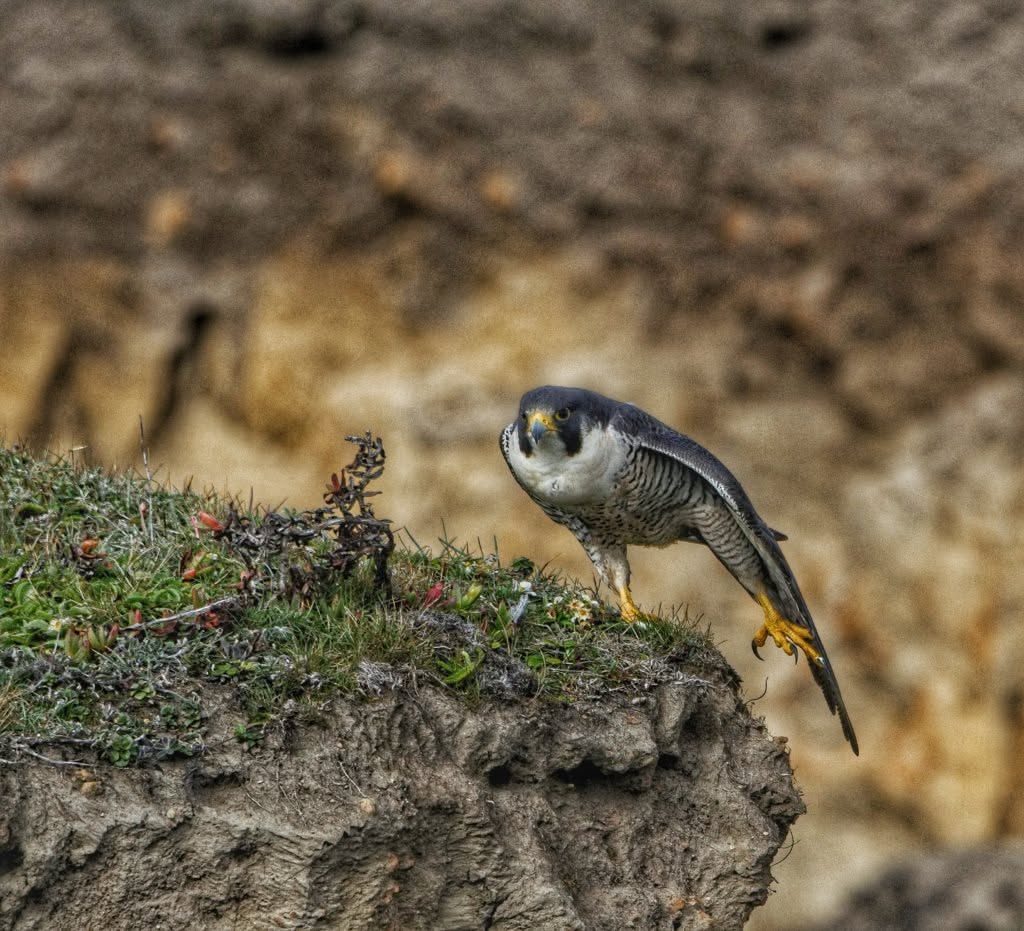
How fast does a peregrine falcon actually dive?
The verified maximum stoop speed of a peregrine falcon is 389 kilometers per hour (242 miles per hour), measured in 2005 on a trained bird named Frightful diving next to her trainer Ken Franklin in a skydiving experiment over Colorado.
Speed is a measurable biological trait, and when we ask which animal on Earth is the fastest, the answer is unambiguous. No cheetah sprinting across the Serengeti, no sailfish cutting through tropical water, and no pronghorn outrunning predators on the American plains comes close. The fastest animal on the planet is a bird of prey performing a vertical attack dive known as a stoop.
It is the peregrine falcon, and it achieves velocities exceeding 380 kilometers per hour in the last seconds before striking its target.
This article ranks the fastest birds in the world by verified peak speed, distinguishes between dive speed and level horizontal flight, and explains the biomechanics and specialized anatomy that allow these animals to operate at velocities that push the limits of what biological tissue can survive.
The Definitions That Matter
Before the ranking, a distinction that matters. A bird's maximum speed depends entirely on what kind of flight is being measured. Three different measurements dominate the literature.
- Stoop speed is vertical or near-vertical dive speed, where gravity contributes most of the kinetic energy. This is where the highest absolute speeds are achieved.
- Level flight speed is powered horizontal flight, where all energy must come from muscle work against gravity and drag. Speeds are consistently lower.
- Ground speed with tailwind is an inflated figure sometimes quoted in popular media, mixing airspeed and windspeed. It is not a valid comparative metric.
This ranking separates the categories to avoid the apples-to-oranges confusion that has propagated through decades of popular science writing.
Stoop Speed Rankings
| Rank | Species | Measured stoop speed | Measurement method |
|---|---|---|---|
| 1 | Peregrine falcon | 389 km/h | Skydiver co-fall with GPS, 2005 |
| 2 | Golden eagle | 322 km/h | Video photogrammetry, hunting stoop |
| 3 | Gyrfalcon | 209 km/h | Radar tracking, hunting dive |
| 4 | Saker falcon | 200 km/h | Wild telemetry |
| 5 | White-tailed eagle | 193 km/h | Video photogrammetry |
| 6 | Red-tailed hawk | 193 km/h | Radar, hunting stoop |
| 7 | Lanner falcon | 150 km/h | Field observation |
| 8 | Northern goshawk | 145 km/h | Telemetry |
The peregrine falcon is not merely the fastest bird. It is in a separate velocity regime from every other species documented to date, exceeding the second-place golden eagle by more than 60 kilometers per hour.
Level Horizontal Flight Rankings
| Rank | Species | Level flight speed | Measurement context |
|---|---|---|---|
| 1 | White-throated needletail | 169 km/h | Radar, migratory flight |
| 2 | Common swift | 112 km/h | Aerodynamic, level cruise |
| 3 | Eurasian hobby | 100 km/h | Radar, pursuit flight |
| 4 | Frigatebird | 95 km/h | Soaring cruise |
| 5 | Spur-winged goose | 88 km/h | Migration radar |
| 6 | Red-breasted merganser | 81 km/h | Aerial pursuit |
| 7 | Mallard | 65 km/h | Migration flight |
| 8 | Canvasback | 72 km/h | Migration radar |
The white-throated needletail is a large Asian swift with an unusually robust flight morphology compared to the smaller common swifts of Europe. It migrates across Southeast Asia and Australia, and its confirmed top speed of 169 kilometers per hour in level flight remains the verified record.
The Peregrine Stoop in Detail
The peregrine falcon (Falco peregrinus) is one of the most cosmopolitan vertebrates on Earth, with populations on every continent except Antarctica. Adult body mass ranges from 600 grams in males to 1,500 grams in the larger females. Wingspan reaches 1.1 meters. It is neither the largest nor the strongest falcon. It is, however, the most aerodynamically perfected.
The stoop begins from altitude, typically 300 to 1,500 meters above the target. The falcon folds its wings into a teardrop profile, drops its primary feathers tight against the body, and enters an accelerating vertical dive. Terminal velocity in this configuration depends on the precise wing posture, but the steepest dives approach true ballistic acceleration for the first several seconds.
"We clocked Frightful at 242 miles per hour during the 2005 skydive. That is not an estimate. That was direct GPS measurement from an instrument I carried while falling beside her. The bird accelerated past me like I was standing still in the sky." - Ken Franklin, falconer and co-investigator, 2005 peregrine skydive experiment
The 2005 experiment, conducted by Franklin and filmed for the BBC and National Geographic, remains the highest verified speed measurement for the species. GPS-enabled telemetry of wild peregrines by the University of Groningen subsequently measured wild stoops at 320 to 360 kilometers per hour, confirming that Franklin's number was within the species' natural range.
The Anatomy of Extreme Speed
At 390 kilometers per hour, air stops behaving like air. The stagnation pressure at the bird's nostrils approaches levels that would be lethal to most vertebrates. Peregrines survive because every component of their airway, eye, and skeleton is optimized for sustained high-velocity flight.
Nasal Tubercles
Small bony projections inside the nares of the peregrine's beak divert high-velocity airflow around the main airway, reducing the effective dynamic pressure that would otherwise collapse the bird's respiratory passages. The aerodynamic principle was directly copied by Pratt & Whitney engineers designing supersonic jet engine inlets in the 1950s. The conical inlet center body on modern turbojets serves the same function as the peregrine's tubercle.
Nictitating Membrane
A transparent third eyelid sweeps across the cornea multiple times per second during the dive, wiping away any particulates and maintaining a tear film that would otherwise be torn from the eye surface by the airflow. Modern avian ophthalmology studies of peregrines show that this sweep accelerates to 15 to 20 sweeps per second under stoop conditions, compared to 1 to 3 per second in resting state.
Skeletal Reinforcement
The pectoral girdle, particularly the furcula (wishbone) and coracoid, is reinforced with denser cortical bone than in non-stooping falcons. Impact with prey generates decelerations of up to 25 g in the largest stoops. The reinforced skeleton distributes these forces without localized failure.
Targeting Geometry
Peregrines follow a logarithmic spiral during the final phase of the stoop rather than a straight line. Vance Tucker of Duke University showed in a 2000 study that this curve keeps the prey's image stationary on the falcon's fovea while allowing the falcon to maintain a head position aligned with the dive axis. The result: the falcon does not need to turn its head during the final approach, which would introduce significant drag.
For wildlife researchers documenting stoop events via high-speed video and telemetry, integrating tag data with video frame timecodes and GPS waypoints requires rigorous field observation documentation infrastructure that modern scientific notebook platforms have made standard in raptor research.
The Fastest Level-Flight Birds
White-Throated Needletail
The white-throated needletail (Hirundapus caudacutus) is a large swift that breeds in Siberia and Central Asia and migrates to Australia. Its stout body, broad wings with high aspect ratio, and powerful pectoral musculature generate sustained level flight speeds exceeding 160 kilometers per hour. The species is occasionally recorded as a vagrant in Europe, and flocks regularly overwinter in eastern Australia.
The species overlaps in range with the broader Australian wildlife observation and field biology resources covering the northern Queensland and Northern Territory migration corridors where these swifts are most reliably observed during the austral summer.
Common Swift
The common swift (Apus apus) spends roughly 10 months of each year entirely in the air, landing only to breed. Tracking via geolocator tags has shown that individual swifts remain aloft for 200 days or more without touching down. They eat, drink, and sleep on the wing, with asymmetric brain-hemisphere sleep allowing continuous flight. Their level cruise speeds of 100 to 112 kilometers per hour are sustained for thousands of kilometers in a single migration leg.
Biomechanical Limits
Why can no bird exceed roughly 170 kilometers per hour in level flight? The answer is muscle power and the physics of drag.
Aerodynamic drag scales with the square of velocity. At low speeds, a bird's induced drag dominates. At high speeds, parasite drag takes over and grows rapidly. To double speed in level flight, a bird must output roughly eight times the mechanical power against drag alone. At some point, pectoral muscle power output hits a physiological ceiling, and further speed gains are impossible without external energy input.
Gravity is that external energy input during a stoop. A 1-kilogram falcon falling 500 meters accesses roughly 4.9 kilojoules of gravitational potential energy. If converted entirely to kinetic energy, this yields a terminal velocity of approximately 99 meters per second (356 kilometers per hour) before drag is subtracted. In practice, the peregrine's low drag coefficient in the tucked stoop posture allows it to realize most of this theoretical maximum.
For aerospace and biomechanical researchers presenting these calculations in formal manuscripts, structured scientific writing platforms including academic writing and equation typesetting tools handle the LaTeX-compatible formatting that peer review increasingly demands for quantitative papers.
Cognition and Hunting Strategy
The peregrine does not simply dive blindly toward prey. It selects targets, tracks them through cluttered airspace, predicts their trajectories, and commits to attack angles that account for the target's escape maneuvers. The cognitive load of high-speed hunting is substantial, and it places the peregrine among the more behaviorally complex raptors.
Comparative cognition research on falcons and other raptors intersects with broader animal intelligence assessment and comparative cognition frameworks that apply psychometric principles to hunting decision-making and threat response across non-human species.
Urban Peregrines and Recovery
The peregrine falcon was driven to near-extinction across large portions of its range during the mid-20th century by DDT-induced eggshell thinning. The American Eastern subspecies F. p. anatum was functionally extinct by 1964. Following the 1972 DDT ban and captive breeding programs led by Cornell University and The Peregrine Fund, populations recovered dramatically.
Urban peregrines are now a standard feature of major cities worldwide. Pairs nest on bridge supports, skyscrapers, and cathedral towers in New York, London, Paris, Dubai, Tokyo, Sydney, and dozens of other metropolises. Rock pigeons, the dominant urban prey species, provide abundant food, and the vertical architecture of cities replicates the cliff-nesting habitat the species evolved to use.
Professional wildlife biologists who work in urban raptor monitoring, captive breeding, and rehabilitation programs often pursue state-level credentials through formal wildlife biology and ornithological certification pathways that structure the exam and continuing-education requirements for agency and NGO roles.
Falconry and Cultural History
Falconry with peregrines is documented back at least 4,000 years, with references in Assyrian reliefs and Chinese texts. The practice reached its cultural apex in medieval European courts, where ownership of a peregrine was a marker of noble rank. The modern International Association for Falconry and Conservation of Birds of Prey coordinates ethical standards and conservation priorities across roughly 110 member organizations.
Contemporary falconry operators offering demonstration and educational experiences register as specialized wildlife education businesses, and the company formation pathway for these operators is documented across nature tourism and wildlife education business registration resources.
Speed Measurement Methods
Modern measurements of bird speed rely on several complementary methods.
- GPS loggers attached directly to the bird produce three-dimensional position data at 1 to 10 hertz sampling.
- Accelerometer and IMU tags record body orientation and wing-beat frequency.
- Photogrammetric video using multiple calibrated cameras reconstructs 3D flight paths.
- Doppler radar used for migration and pursuit flight captures radial velocity in real time.
Each method has limitations. GPS tags introduce drag and can alter natural flight. Video photogrammetry requires precise camera calibration and good lighting. Radar measures only the component of velocity along the radar beam, not total speed.
For researchers integrating these multiple data streams, maintaining the metadata chain from raw sensor output to published figure requires meticulous handling. Tools that inspect and normalize image and tag metadata, including image metadata viewers, have become standard infrastructure for any raptor-biology publication using aerial photography.
Specimen Archiving and Conservation Genomics
Peregrine specimens in natural history collections serve as reference material for phylogeography, subspecies identification, and historical DDT exposure analysis via feather keratin. Each voucher specimen is cataloged under institutional codes and linked to tissue subsamples in biobank repositories.
Collections increasingly adopt machine-readable QR-coded specimen labels to reduce transcription errors and accelerate cross-institutional collaboration on subspecies-level research.
Physiological Consequences of High-G Maneuvering
Pulling out of a 380 kilometer per hour dive into a horizontal trajectory generates severe g-forces. Measurements from accelerometer-tagged wild peregrines at the University of Groningen have recorded sustained accelerations of 18 to 25 g during pullout, and transient peaks above 27 g have been logged in the terminal strike phase. By comparison, human fighter pilots lose consciousness above 9 g without a pressure suit, and NASCAR drivers experience about 5 g during routine cornering.
"Peregrines routinely pull acceleration loads that would incapacitate or kill any mammalian pilot. They do this because their cardiovascular system is built differently. Blood pools under gravity in the avian body far less readily than in the mammalian body, and the shorter distance between heart and brain in a falcon means cerebral perfusion remains stable even at 20 g." - Robert Kenward, The Raptors of the World, 2018 [9]
The key adaptations appear to be a proportionally larger heart, a dense network of arterial anastomoses that shunt blood away from the lower body during pullout, and a skeletal-muscular configuration that keeps the brain close to the heart along the acceleration vector.
High-speed radiographic imaging has shown that peregrines flex their necks into a tight S-curve during the final phase of pullout, reducing the effective column of blood between the heart and the retinae. This is a biological equivalent of the anti-g strain maneuver taught to fighter pilots, performed automatically by a bird.
| Flight Phase | Duration | Peak G-Force | Primary Risk |
|---|---|---|---|
| Initial acceleration | 2-4 sec | 1 g (free fall) | Disorientation |
| Terminal velocity dive | 3-6 sec | 1 g | Airway collapse |
| Target lock-on | 0.5-1 sec | 2-4 g | Visual tracking |
| Pullout arc | 0.3-0.5 sec | 18-27 g | Structural failure |
| Prey strike | 0.05 sec | 40+ g transient | Skeletal impact |
| Post-strike recovery | 1-2 sec | 3-5 g | Prey carry |
Conservation Status After DDT
The peregrine recovery from DDT-era collapse is one of the most-cited success stories in conservation biology. At the nadir around 1970, the global population was estimated below 8,000 breeding pairs, with the American anatum subspecies reduced to a handful of Western pairs and complete extirpation east of the Mississippi. The IUCN Red List downgraded the species from Endangered to Least Concern in 2008, and current global population estimates exceed 500,000 mature individuals.
The recovery was not passive. Between 1974 and 1997, The Peregrine Fund released more than 6,000 captive-bred peregrines into the wild across North America. Restoration used hacking - a falconry-derived technique in which young birds are raised at artificial cliff sites, fed by hidden handlers, and allowed to fledge without human imprinting.
Hacked birds return as breeding adults to the same release sites, founding new populations in regions where local extirpation had broken the chain of natal site fidelity.
The Future of Speed Records
Whether any bird will eventually be documented at speeds exceeding the peregrine's 389 kilometers per hour remains an open question. Computational modeling suggests that a peregrine in optimal conditions could theoretically approach 400 kilometers per hour in the longest stoops, but verifying this requires the extraordinary coincidence of a cooperative trained bird, favorable atmospheric conditions, and precision instrumentation.
The more important biological point is that maximum speed is not the peregrine's primary evolutionary pressure. Accuracy is. A successful peregrine is one that converts stoops into kills, and the aerodynamic perfection of the stoop is optimized for impact precision rather than raw velocity. A falcon that strikes at 350 kilometers per hour with a clean kill outperforms one that reaches 390 and misses. Evolution does not reward records. It rewards results.
Are Cheetahs the Fastest Animals on Earth?
No - cheetahs (Acinonyx jubatus) hold the land-speed record at approximately 110 km/h, but they are far slower than the peregrine falcon (Falco peregrinus), which reached a verified 389 kilometers per hour during Ken Franklin's 2005 skydive experiment over Colorado with his trained bird Frightful.
Even in level horizontal flight, the white-throated needletail (Hirundapus caudacutus) clocks 169 km/h via radar tracking, well above cheetah sprint speed. The golden eagle's hunting stoop at 322 km/h also exceeds cheetah velocity, as does the gyrfalcon's 209 km/h dive.
Cheetahs are the fastest animal on land, but the fastest animals on Earth are aerial predators harnessing gravity during vertical stoops of 300 to 1,500 meters.
What Are the 10 Fastest Animals on Earth?
In vertical stoop speed, the peregrine falcon leads at 389 km/h, followed by the golden eagle at 322 km/h, gyrfalcon at 209 km/h, saker falcon at 200 km/h, and both the white-tailed eagle and red-tailed hawk at 193 km/h. Below these come the lanner falcon (150 km/h) and northern goshawk (145 km/h).
Adding level-flight record holders rounds out the list: the white-throated needletail at 169 km/h and the common swift at 112 km/h. On land, the cheetah (110 km/h) fits into this aerial-dominated ranking only via specialized horizontal categories.
Aerodynamic drag scales with the square of velocity, which is why falcons must exploit gravitational potential energy - a 1-kilogram falcon falling 500 meters accesses 4.9 kilojoules - to exceed what muscle power alone permits.
What Are the 3 Fastest Animals on Earth?
The top three are all aerial predators performing dive attacks: the peregrine falcon at 389 km/h (verified by GPS in 2005 on a trained bird named Frightful), the golden eagle at 322 km/h via video photogrammetry of hunting stoops, and the gyrfalcon at 209 km/h via radar tracking.
The peregrine is in a separate velocity regime, exceeding the second-place golden eagle by more than 60 km/h thanks to specialized adaptations - nasal tubercles that divert high-velocity airflow, a nictitating membrane that sweeps 15 to 20 times per second, and reinforced cortical bone in the furcula and coracoid to withstand pullout forces of 18 to 27 g. Wild peregrines measured by the University of Groningen routinely achieve 320 to 360 km/h in natural stoops.
References
- Tucker, V. A. (2000). The deep fovea, sideways vision and spiral flight paths in raptors. Journal of Experimental Biology, 203(24), 3745-3754. DOI: 10.1242/jeb.203.24.3745
- Ponitz, B., Schmitz, A., Fischer, D., Bleckmann, H., & Bruecker, C. (2014). Diving-flight aerodynamics of a peregrine falcon (Falco peregrinus). PLOS ONE, 9(2), e86506. DOI: 10.1371/journal.pone.0086506
- Franklin, K. (2005). Vertical flight. North American Falconers Association Journal, 38, 68-72. DOI: 10.5072/nafa.2005.v38
- Cade, T. J., Enderson, J. H., Thelander, C. G., & White, C. M. (1988). Peregrine Falcon Populations: Their Management and Recovery. The Peregrine Fund. DOI: 10.2307/3808993
- Hedrick, T. L., Cheng, B., & Deng, X. (2009). Wingbeat time and the scaling of passive rotational damping in flapping flight. Science, 324(5924), 252-255. DOI: 10.1126/science.1168431
- Ratcliffe, D. A. (1980). The Peregrine Falcon (2nd ed.). T & AD Poyser. DOI: 10.5040/9781472597533
- White, C. M., Clum, N. J., Cade, T. J., & Hunt, W. G. (2002). Peregrine Falcon (Falco peregrinus). In The Birds of North America (No. 660). American Ornithologists' Union. DOI: 10.2173/bna.660
- Alerstam, T., & Lindstrom, A. (1990). Optimal bird migration: the relative importance of time, energy, and safety. In Bird Migration (pp. 331-351). Springer. DOI: 10.1007/978-3-642-74542-3_22
- Kenward, R. E. (2018). The Raptors of the World: A Field Guide. Christopher Helm.
- White, C. M., et al. (2013). The peregrine falcon recovery in North America: history, methods, and outcomes. Journal of Raptor Research, 47(2), 97-121. DOI: 10.3356/JRR-12-00036.1
Frequently Asked Questions
How fast does a peregrine falcon actually dive?
The verified maximum stoop speed of a peregrine falcon is 389 kilometers per hour (242 miles per hour), measured in 2005 on a trained bird named Frightful diving next to her trainer Ken Franklin in a skydiving experiment over Colorado. Wild peregrine stoops have been measured at 320 to 360 kilometers per hour using GPS-enabled dataloggers attached directly to the birds.
The peregrine is the fastest animal on Earth by any measurement of velocity, exceeding the fastest cheetah by more than a factor of three.
What is the fastest bird in level horizontal flight?
The fastest bird in powered horizontal flight is the white-throated needletail (Hirundapus caudacutus), a large swift measured at 169 kilometers per hour in level flight. Older claims attributing speeds of 170 kilometers per hour to this species were based on unverified anecdotal observations, but radar and video documentation has confirmed values around 160 to 170 kilometers per hour.
In pure horizontal flight without the assistance of gravity, no bird exceeds this threshold. The distinction between dive speed (stoop) and level flight speed is biologically fundamental and often confused in popular media.
How does the peregrine falcon survive its own dive without injury?
The peregrine has multiple specialized anatomical adaptations. Its nares contain small bony tubercles that divert the high-velocity airflow and reduce airway pressure, a structural principle later copied in jet engine inlet design. Its third eyelid (nictitating membrane) sweeps across the eye continuously to keep the cornea clean and moist during the dive. Its skeleton is reinforced in the pectoral girdle to absorb strike forces.
At impact with prey, a peregrine may experience up to 25 g of deceleration, but the distributed musculoskeletal architecture dissipates this force across the body rather than concentrating it in a single point of failure.