
Why did some birds lose the ability to fly?
Birds lost flight through a combination of evolutionary pressures, most commonly on islands or continents where ground-based predators were absent. Without the need to escape aerial or terrestrial hunters, the enormous metabolic cost of maintaining flight muscles - which can account for 15 to 25 percent of a flying bird's body weight - became an unnecessary energy drain.
Flight is the defining miracle of birds. It is the adaptation that allowed a lineage of feathered dinosaurs to colonize every landmass, cross every ocean, and dominate the skies for 150 million years. And yet, across the long arc of avian evolution, dozens of bird species have independently abandoned it. They traded the sky for the ground, the ocean, or the forest floor - and in doing so, became some of the most extraordinary creatures on Earth.
Flightless birds are not evolutionary failures. They are specialists. From the 9-foot ostrich sprinting across the African savanna at 45 mph to the kiwi probing the New Zealand forest floor with nostrils at the tip of its bill, these birds reveal what happens when the selective pressure to fly disappears and new pressures take its place. Their stories span continents, cross millions of years, and include some of the most dramatic extinction events and conservation battles in natural history.
Understanding flightless birds means understanding evolution itself - the costs and tradeoffs of adaptation, the consequences of isolation, and the devastating impact humans have had on species that evolved without us in mind.
Why Birds Lost Flight: The Economics of Wings
Flight is expensive. Maintaining the musculature, skeletal structure, and metabolic machinery required for powered flight demands extraordinary energy. The pectoral muscles of a flying bird can account for 15 to 25 percent of total body mass. The keel - the enlarged breastbone to which flight muscles anchor - is a massive skeletal investment.
The high metabolic rate needed to power flight means flying birds must eat frequently and cannot afford to grow beyond a certain size without compromising their ability to get airborne.
When the need for flight disappears, all of that energy becomes available for other purposes. And evolution, being ruthlessly economical, redirects it.
The most common pathway to flightlessness is island isolation. When birds colonize islands that lack terrestrial predators, the survival advantage of flight diminishes rapidly. There is nothing to flee from on the ground. Meanwhile, birds that invest less energy in flight muscles and more in body size, foraging efficiency, or reproduction gain a competitive edge.
Over thousands of generations, wings shrink, keels flatten, and flight muscles atrophy. The bird becomes grounded - not because flight broke, but because it was no longer worth paying for.
"Flightlessness is not a loss. It is a reallocation of resources - an evolutionary decision that the cost of flight exceeds its benefits in a given environment." - Dr. Alan Cooper, ancient DNA researcher, University of Adelaide
The second major pathway is predator absence on large landmasses. In the ancient supercontinent Gondwana and its fragments - Africa, South America, Australia, New Zealand, Madagascar - the absence or scarcity of large mammalian predators allowed birds to grow to enormous sizes and abandon flight. The ratites (ostriches, emus, cassowaries, rheas, kiwis) are the most prominent examples, though they achieved flightlessness through different evolutionary routes than island birds.
Energy savings are substantial. A flightless bird of the same body mass as a flying relative typically has a basal metabolic rate 20 to 30 percent lower, allowing it to survive on less food and devote more energy to growth and reproduction. This is why flightless birds often evolve larger body sizes than their flying ancestors - a pattern called island gigantism when it occurs on islands, though the same principle applies on continents.
The Ostrich: Largest Living Bird on Earth
The common ostrich (Struthio camelus) is a superlative machine. Standing up to 9 feet (2.7 meters) tall and weighing as much as 340 pounds (154 kg), it is the largest and heaviest living bird on Earth. It lays the largest eggs of any living species - each one weighing approximately 3 pounds and equivalent in volume to roughly 24 chicken eggs. And it is, by a wide margin, the fastest bird on land.
An ostrich in full sprint reaches sustained speeds of 45 mph (72 km/h), with recorded bursts approaching 60 mph. Each stride covers up to 16 feet (5 meters). Its legs are built for speed in ways that parallel the engineering of modern sprinters: two toes per foot (the only bird with just two), with the larger inner toe bearing a thick nail that functions like a sprinting spike.
Elastic tendons in the legs store and release energy with each stride, reducing the metabolic cost of running - a mechanism similar to the one that makes kangaroos such efficient bounders.
But the ostrich is not merely fast. It is powerful. A single kick from an ostrich can deliver approximately 2,000 newtons of force - enough to kill a lion. The forward-directed kick, powered by massive thigh muscles, is the ostrich's primary defense against predators. Lions, hyenas, and even leopards have been killed or seriously injured by ostrich kicks. Farmers and handlers who underestimate this capability frequently end up in hospitals.
Ostrich Farming and Commercial Use
Ostrich farming became a significant industry in the late 19th century, initially driven by the Victorian-era fashion demand for ostrich plumes. South Africa's Klein Karoo region, centered around the town of Oudtshoorn, became the global capital of ostrich farming, and at the peak of the feather boom around 1913, ostrich feathers were the fourth most valuable South African export after gold, diamonds, and wool.
The feather market collapsed after World War I, but ostrich farming persisted and diversified. Today, ostriches are farmed in over 50 countries for leather (considered among the finest and most durable in the world), meat (lower in fat and cholesterol than beef), eggs, and feathers used in cleaning dusters and fashion accessories. A single ostrich hide can sell for $200 to $500, and the global ostrich farming industry generates an estimated $500 million annually.
The Emu: Australia's Giant and the War It Won
The emu (Dromaius novaehollandiae) is Australia's largest bird and the second-tallest living bird after the ostrich, standing up to 6.2 feet (1.9 meters) tall and weighing up to 130 pounds (60 kg). It is found across most of mainland Australia, from coastal scrublands to arid interior deserts, and is one of the most adaptable large birds on the planet.
Emus are nomadic, following rainfall patterns across vast distances in search of food. They can travel over 300 miles (500 km) in a single migration, walking at a steady pace of about 4 mph but capable of sprinting at 30 mph (48 km/h) when threatened. Their diet is omnivorous - seeds, fruits, insects, small vertebrates, and significant quantities of plant matter. They are also important seed dispersers, passing viable seeds through their digestive tracts and depositing them across wide areas.
The Great Emu War of 1932
In 1932, the Australian government declared war on emus. This is not a metaphor. It was an actual military operation, and the emus won.
The background was agricultural distress. Following World War I, thousands of Australian soldiers had been granted farming land in the wheat belt of Western Australia under soldier settlement schemes. By the early 1930s, these farmers faced a dual crisis: the Great Depression had crushed wheat prices, and approximately 20,000 emus were migrating through the region after breeding season, destroying crops and damaging fencing that kept out rabbits.
The farmers petitioned the government for help. The Minister of Defence, Sir George Pearce, authorized the deployment of soldiers from the Royal Australian Artillery, armed with two Lewis guns and 10,000 rounds of ammunition, under the command of Major G.P.W. Meredith. The operation began on November 2, 1932.
It was a fiasco. The emus proved impossible to engage effectively. They scattered at the sound of gunfire, running in small groups that made the Lewis guns - designed for massed targets - largely useless. When soldiers mounted a gun on a truck to pursue them, the emus outran the vehicle over rough terrain. After six days and approximately 2,500 rounds expended, the military had killed an estimated 50 to 200 emus out of a population of 20,000.
Major Meredith withdrew, returned with reinforcements, and tried again. The second campaign, lasting until December 10, claimed approximately 986 confirmed kills, though Meredith reported "many more" unconfirmed. The operation was widely mocked in the Australian and international press. Ornithologist Dominic Serventy later remarked that the emus had demonstrated "guerrilla tactics" and that "the machine gunners' dream of point-blank fire into serried masses of emus was never realized."
The military never fought emus again. Instead, the government instituted a bounty system, which proved more effective. By 1934, over 57,000 bounties had been claimed.
The Cassowary: The Most Dangerous Bird Alive
The southern cassowary (Casuarius casuarius) is a creature that looks like it was designed by a committee that included both a dinosaur enthusiast and a nightmare. Standing up to 6 feet (1.8 meters) tall and weighing up to 130 pounds (58 kg), it inhabits the tropical rainforests of northeastern Australia, New Guinea, and surrounding islands.
The cassowary's most fearsome feature is its feet. Each foot bears three toes, and the innermost toe is equipped with a dagger-like claw up to 5 inches (12 cm) long. This claw is straight, rigid, and sharp enough to disembowel a predator - or a human - with a single kick. Cassowaries can run at 31 mph (50 km/h) and are powerful swimmers. They are territorial, unpredictable, and have been responsible for hundreds of documented attacks on humans in Australia.
"If you were to design a dinosaur with a built-in switchblade, you would end up with something very like a cassowary." - Dr. Christopher Kofron, wildlife biologist, Queensland Parks and Wildlife Service
The most recent confirmed fatal attack on a human occurred in April 2019 in Alachua County, Florida, when a 75-year-old man was killed by his pet cassowary after falling in its enclosure. In Australia, where cassowaries live wild in the Daintree Rainforest and Wet Tropics region, attacks are more common but fatalities are rare, with the last confirmed Australian fatality occurring in 1926.
Ecological Role: The Rainforest Gardener
Despite their fearsome reputation, cassowaries are ecologically critical. They are among the most important seed dispersers in Australian and New Guinean tropical rainforests. Over 230 species of rainforest plants depend on cassowaries to disperse their seeds, and some have fruits so large that no other animal can swallow them whole. Cassowary droppings can contain hundreds of seeds, deposited far from the parent tree along with a ready-made pile of fertilizer.
Research conducted in the Wet Tropics of Queensland has demonstrated that certain rainforest tree species experience significantly reduced germination rates in the absence of cassowary gut passage. The cassowary's digestive system scarifies the seed coat just enough to allow water penetration and germination. Without cassowaries, these forests would slowly change in composition, losing species that depend on this dispersal mechanism.
The Kiwi: New Zealand's Improbable National Icon
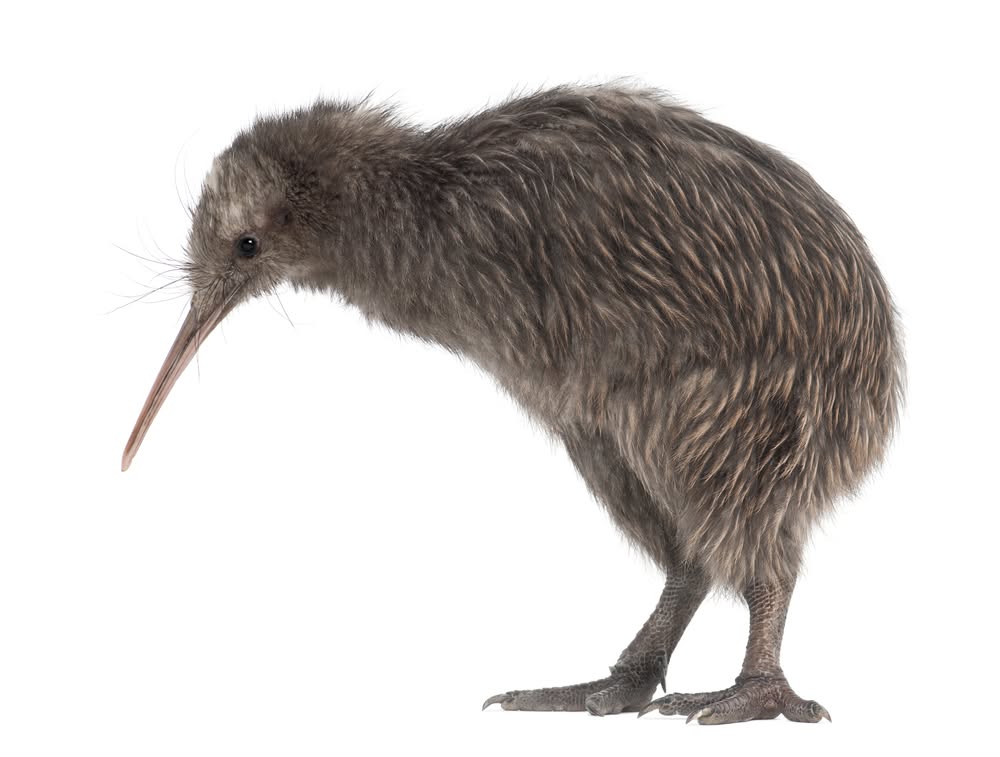
The kiwi - five species in the genus Apteryx - is among the most unusual birds on Earth. About the size of a chicken, covered in hair-like feathers, virtually wingless, nocturnal, and equipped with nostrils at the very tip of its long bill (unique among birds, whose nostrils are typically at the base), the kiwi is a creature that seems to have been assembled from spare parts.
Kiwis evolved in New Zealand, an island chain that separated from Gondwana approximately 80 million years ago and lacked terrestrial mammals until humans arrived roughly 700 years ago. In this predator-free environment, kiwis evolved to fill an ecological niche occupied by small mammals elsewhere - foraging on the forest floor for invertebrates, using their extraordinary sense of smell rather than vision.
The kiwi's sense of smell is the most developed of any bird. Its brain has an enlarged olfactory bulb, and the nostrils at the bill tip allow it to detect earthworms, insect larvae, and other soil invertebrates by scent alone, probing the leaf litter and soil like a feathered shrew.
Perhaps the kiwi's most remarkable feature is its egg. A female kiwi produces an egg that weighs approximately 25 percent of her body weight - the largest egg-to-body-size ratio of any bird. By comparison, an ostrich egg is about 2 percent of the mother's body weight.
The evolutionary reason for this enormous egg is debated, but the leading hypothesis is that the kiwi's ancestors were much larger birds, and as the species shrank over evolutionary time, the egg size did not decrease proportionally.
Kiwi populations have declined severely since human settlement. Introduced predators - stoats, cats, dogs, and rats - kill an estimated 27 kiwi chicks per week across New Zealand. Without intervention, kiwis could be extinct within two generations. New Zealand has invested heavily in predator control, kiwi sanctuaries, and the ambitious Predator Free 2050 initiative, which aims to eradicate all introduced mammalian predators from the country.
Penguins: Flight Traded for the Ocean
Penguins (family Spheniscidae) are the most successful aquatic flightless birds on Earth. All 18 species are found exclusively in the Southern Hemisphere, from the Antarctic ice of the emperor penguin to the tropical Galapagos penguin straddling the equator. They did not lose flight because they stopped needing it - they lost flight because they found something better to do with their wings.
Penguin wings evolved into flippers - rigid, paddle-like structures powered by the same pectoral muscles that once drove flight. Underwater, penguins "fly" through the water with extraordinary efficiency. The emperor penguin can dive to depths exceeding 1,800 feet (550 meters) and hold its breath for over 20 minutes. The gentoo penguin is the fastest swimmer among penguins, reaching speeds of 22 mph (36 km/h) underwater.
The tradeoff between aerial and aquatic locomotion is stark. Biomechanical studies have shown that the wing shape optimal for flying through air is fundamentally incompatible with the wing shape optimal for flying through water. Water is approximately 800 times denser than air, requiring a stiffer, shorter, more paddle-like wing. Once penguin ancestors began optimizing for underwater propulsion, they crossed a point of no return - the wings became too heavy and rigid for aerial flight.
| Species | Height | Weight | Notable Feature |
|---|---|---|---|
| Ostrich | 9 ft (2.7 m) | 340 lbs (154 kg) | Fastest running bird, 45 mph |
| Emu | 6.2 ft (1.9 m) | 130 lbs (60 kg) | Survived a military campaign |
| Southern Cassowary | 6 ft (1.8 m) | 130 lbs (58 kg) | 5-inch dagger claw, most dangerous bird |
| Greater Rhea | 5.6 ft (1.7 m) | 88 lbs (40 kg) | Largest bird in the Americas |
| Emperor Penguin | 3.8 ft (1.15 m) | 88 lbs (40 kg) | Dives to 1,800 ft depth |
| Kiwi (brown) | 1.3 ft (0.4 m) | 7.3 lbs (3.3 kg) | Egg is 25% of body weight |
| Kakapo | 2 ft (0.6 m) | 9 lbs (4 kg) | Only flightless parrot, 250 individuals |
The Kakapo: The Only Flightless Parrot
The kakapo (Strigops habroptilus) is one of the most endangered and most peculiar birds alive. It is the world's only flightless parrot, the world's heaviest parrot (up to 9 pounds / 4 kg), and the only parrot that is entirely nocturnal. It is also, by some accounts, one of the friendliest wild birds toward humans - a trait that historically proved nearly fatal for the species.
Kakapos evolved in New Zealand's predator-free forests, where they had no reason to fly and no reason to fear anything that walked on the ground. Their defense mechanism is to freeze and rely on cryptic green-brown plumage for camouflage - effective against the eagles that were their only predators, but catastrophically useless against introduced cats, stoats, and rats that hunt by scent.
By the 1990s, the kakapo population had crashed to just 51 individuals. A desperate conservation program, the Kakapo Recovery Programme, relocated every surviving bird to predator-free offshore islands (Whenua Hou/Codfish Island and Anchor Island). Intensive management includes supplementary feeding, nest monitoring with infrared cameras, artificial insemination, and hand-raising of chicks when necessary.
As of 2024, the kakapo population has recovered to approximately 250 individuals. Every single bird has a name and a transmitter. It is the most intensively managed species on Earth, and its survival hangs on continued human intervention.
Rheas: The South American Ostriches
The greater rhea (Rhea americana) and the lesser rhea (Rhea pennata) are the largest birds in the Americas. The greater rhea stands up to 5.6 feet (1.7 meters) tall and weighs up to 88 pounds (40 kg). Found across the grasslands, pampas, and scrublands of Brazil, Argentina, Uruguay, Paraguay, and Bolivia, rheas are the ecological equivalent of ostriches in the New World.
Rheas are fast runners, reaching speeds of approximately 37 mph (60 km/h), and use a distinctive zigzag running pattern when pursued that makes them difficult for predators to follow. Their wings, while useless for flight, serve as stabilizers during high-speed turns and are spread wide during courtship displays.
An unusual aspect of rhea biology is their polyandrous mating system. A single male attracts multiple females to his nest, and each female deposits eggs in the communal nest before moving on to mate with other males. The male then incubates and raises the chicks alone, sometimes tending a nest of 50 or more eggs from as many as 12 different females. This reversal of typical bird parenting roles is shared with a few other ratites, including emus and kiwis.
Elephant Birds and Moas: The Giants We Destroyed
The largest birds that ever lived are gone, and humans killed them.
Elephant birds (family Aepyornithidae) of Madagascar were the heaviest birds in recorded history. Vorombe titan, the largest species, stood approximately 10 feet (3 meters) tall and weighed an estimated 1,600 pounds (730 kg). Their eggs - the largest single cells ever produced by any animal - had a volume of roughly 2 gallons (7.5 liters), equivalent to approximately 160 chicken eggs.
Elephant birds were herbivores, browsing the forests and scrublands of Madagascar for millions of years before humans arrived around 1,000 to 1,500 years ago. Within centuries of human settlement, they were extinct - hunted for meat, their eggs collected, and their habitat burned for agriculture. The last elephant birds likely disappeared by the 17th century.
Moas (order Dinornithiformes) of New Zealand were equally impressive. Nine species ranged from the turkey-sized upland moa to the South Island giant moa (Dinornis robustus), which stood up to 12 feet (3.6 meters) tall with neck extended - the tallest bird that ever existed. Moas were the only birds to have completely lost even the vestigial wing bones; they had no wings at all, not even stubs.
The Maori people arrived in New Zealand around 1280 CE and encountered a land dominated by moas and the massive Haast's eagle (Hieraaetus moorei), which preyed on moas and had a wingspan of up to 10 feet. Within approximately 100 to 200 years of human arrival, every moa species was extinct.
Archaeological evidence shows intensive hunting - moa bone middens containing the remains of thousands of individuals have been found across both islands. The Haast's eagle, deprived of its primary prey, went extinct shortly after.
The Dodo: Extinction's Most Famous Symbol
No extinct bird is more iconic than the dodo (Raphus cucullatus) of Mauritius. A large, flightless pigeon weighing approximately 23 to 47 pounds (10 to 21 kg), the dodo evolved in isolation on the volcanic island of Mauritius in the Indian Ocean, where it had no terrestrial predators for millions of years.
Dutch sailors first encountered the dodo in 1598. By 1681 - less than a century later - it was extinct. The causes were multiple: direct hunting by sailors, who found the tame, flightless birds trivially easy to kill; habitat destruction from deforestation; and, most critically, predation by introduced animals - pigs, rats, monkeys, and dogs - that raided dodo nests and ate eggs and chicks. The dodo had no evolutionary preparation for any of these threats.
The dodo's extinction was so rapid and so complete that by the 19th century, many people doubted it had ever existed. The only substantial physical remains are a partial skeleton at the Oxford University Museum of Natural History, a skull and foot at the Natural History Museum in Copenhagen, and scattered subfossil bones recovered from Mauritius.
De-Extinction: Could the Dodo Return?
In 2023, the biotechnology company Colossal Biosciences announced a project to de-extinct the dodo using ancient DNA techniques, CRISPR gene editing, and surrogate breeding through the Nicobar pigeon - the dodo's closest living relative. The project aims to reconstruct a functional dodo genome from preserved specimens and engineer living embryos that could be gestated by modified pigeon surrogates.
The scientific community remains deeply divided on de-extinction. Proponents argue that restoring the dodo could help rehabilitate Mauritius's degraded forest ecosystems, where the dodo played a role in seed dispersal. Critics counter that the resulting animal would be a genetic approximation rather than a true dodo, that the habitat it evolved in no longer exists, and that de-extinction funding would be better spent protecting species that are still alive but critically endangered.
Ratite Evolution: Convergence or Common Ancestor?
The great flightless birds - ostriches, emus, cassowaries, rheas, kiwis, and the extinct moas and elephant birds - are collectively known as ratites, named for the flat, raft-like breastbone (Latin ratis, meaning "raft") that lacks the keel found in flying birds.
For over a century, the prevailing theory held that ratites descended from a single flightless ancestor that lived on the supercontinent Gondwana before it fragmented into Africa, South America, Australia, Antarctica, India, and Madagascar. As the continents drifted apart, this ancestral bird was carried to separate landmasses, diversifying into the ratite species we see today. This was the vicariance hypothesis - geography, not flight loss, explained the distribution.
Modern molecular phylogenetics has overturned this elegant narrative. DNA studies published in Science and Molecular Biology and Evolution in the 2000s and 2010s revealed that ratites are not a single lineage. Instead, flightlessness evolved independently multiple times within the group.
The kiwi's closest relative is not the moa (as geography would suggest, since both lived in New Zealand) but the elephant bird of Madagascar - two islands separated by thousands of miles of ocean. This relationship is only explicable if the ancestors of both kiwis and elephant birds could fly and colonized their respective islands independently before each lineage separately lost flight.
The tinamous - small, partridge-like flying birds of South America - nest phylogenetically within the ratites, further confirming that the ancestral ratite could fly and that flightlessness is a derived condition that evolved convergently.
The ratite story is now understood as one of convergent evolution on a grand scale: similar environmental pressures (large body size advantage, absence of mammalian predators) produced similar outcomes (loss of flight, keel reduction, leg enlargement) in separate lineages on separate continents.
This revised understanding has profound implications for evolutionary biology. It demonstrates that evolution is remarkably repeatable - given similar conditions, natural selection produces similar solutions, even in lineages separated by millions of years and thousands of miles.
The Future of Flightless Birds
The pattern is grim. Of the roughly 60 flightless bird species known to have existed in the last 1,000 years, more than half are now extinct - virtually all driven to extinction by human activity, whether through direct hunting, habitat destruction, or introduced predators. The surviving flightless species face ongoing threats: cassowary populations in Australia are estimated at fewer than 4,600 individuals; kakapos number 250; several kiwi species are classified as vulnerable or endangered.
Yet there are reasons for cautious optimism. New Zealand's Predator Free 2050 initiative represents the most ambitious predator eradication program ever attempted. Kakapo numbers are slowly increasing. Ostrich and emu populations, bolstered by farming, are stable. Penguin conservation programs operate across the Southern Hemisphere.
Flightless birds remind us that evolution is not a ladder leading upward toward some ideal form. It is a process of constant adaptation to present conditions. Flight was lost not because these birds became lesser, but because they became something else - something perfectly suited to a world that, in many cases, no longer exists. Their survival now depends on whether we can protect the worlds they have left.
References
[1] Cooper, A., et al. "Complete mitochondrial genome sequences of two extinct moas clarify ratite evolution." Nature, vol. 409, 2001, pp. 704-707.
[2] Yonezawa, T., et al. "Phylogenomics and morphology of extinct paleognaths reveal the origin and evolution of the ratites." Current Biology, vol. 27, no. 1, 2017, pp. 68-77.
[3] Worthy, T.H., and Holdaway, R.N. The Lost World of the Moa: Prehistoric Life of New Zealand. Indiana University Press, 2002.
[4] Hume, J.P., and Walters, M. Extinct Birds. Second edition, Bloomsbury Natural History, 2012.
[5] Kofron, C.P. "Attacks to humans and domestic animals by the southern cassowary (Casuarius casuarius johnsonii) in Queensland, Australia." Journal of Zoology, vol. 249, no. 4, 1999, pp. 375-381.
[6] Robertson, H.A., et al. "Conservation status of New Zealand birds, 2021." New Zealand Threat Classification Series 36, Department of Conservation, 2021.
[7] Colossal Biosciences. "The Dodo De-extinction Project." Colossal.com, 2023. Accessed 2025.
Frequently Asked Questions
Why did some birds lose the ability to fly?
Birds lost flight through a combination of evolutionary pressures, most commonly on islands or continents where ground-based predators were absent. Without the need to escape aerial or terrestrial hunters, the enormous metabolic cost of maintaining flight muscles - which can account for 15 to 25 percent of a flying bird’s body weight - became an unnecessary energy drain.
Over millions of years, natural selection favored individuals that redirected that energy toward larger body size, stronger legs, or more efficient foraging on the ground. This process, called secondary flightlessness, occurred independently in dozens of bird lineages across every continent.
How fast can an ostrich run?
The ostrich is the fastest bird on land, capable of sustained running speeds of approximately 45 mph (72 km/h) and short bursts approaching 60 mph. This makes it faster than most horses and nearly every terrestrial predator in Africa. Its speed comes from uniquely adapted legs with two-toed feet that function like sprinting spikes, powerful thigh muscles, and elastic tendons that store and release energy with each stride.
A single ostrich stride can cover up to 16 feet (5 meters), allowing it to outpace lions and cheetahs over distance.
Are cassowaries actually dangerous to humans?
Cassowaries are widely regarded as the most dangerous bird in the world, and the threat is real. The southern cassowary possesses a dagger-like inner claw on each foot measuring up to 5 inches (12 cm) long, capable of inflicting deep lacerations and puncture wounds with a single kick. They can run at speeds up to 31 mph and are known to charge when they feel threatened or cornered.
The most recent confirmed human fatality occurred in 2019 in Florida, when a captive cassowary killed its owner. In Australia, hundreds of cassowary attacks have been documented, though fatalities remain rare.