
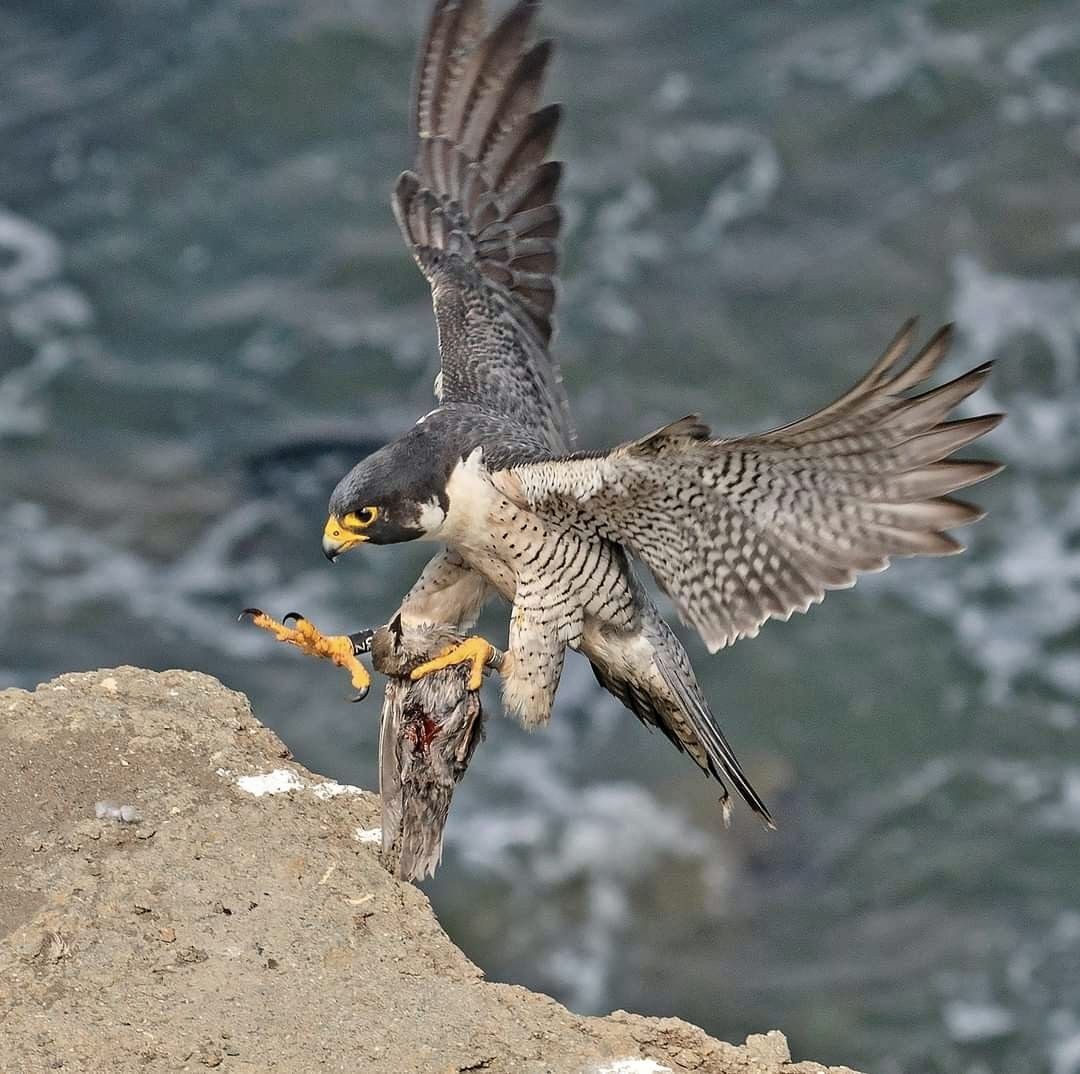
How fast can a peregrine falcon dive?
The peregrine falcon can dive at speeds exceeding 240 mph (386 km/h), making it the fastest animal on Earth. The official record belongs to Frightful, a trained peregrine documented by researcher Ken Franklin in 2005, who reached 242 mph (389 km/h) during a skydiving experiment. Wild peregrines routinely reach 200 mph (322 km/h) during hunting dives called stoops.
The Fastest Animal Ever Measured
Every other animal on Earth is slow by comparison. The cheetah, the popular answer to "fastest animal," tops out around 70 mph. The sailfish, holding the marine speed record, reaches 68 mph. A peregrine falcon at full stoop approaches three and a half times those speeds, hurtling down from the sky at velocities once thought impossible for any living creature.
The peregrine falcon's hunting dive - called the stoop - is the fastest voluntary movement biology has ever produced. Understanding how it happens, and how the falcon survives its own technique, is one of the most remarkable stories in animal mechanics.
The Record: 242 Miles Per Hour
The official peak speed for a peregrine falcon belongs to a captive-trained bird named Frightful. In 2005, researcher Ken Franklin conducted a series of experiments in which Frightful was released from a small plane at 17,000 feet. Onboard data loggers recorded a maximum speed of 242 mph (389 km/h) during one dive.
Wild peregrines regularly reach 200 mph (322 km/h) during natural hunting dives, measured by Doppler radar at long-range tracking facilities in North America and Europe. The average stoop sits somewhere between 150 and 180 mph (240 to 290 km/h), which is already faster than any car most people will ever drive.
For scale:
| Animal | Top Speed |
|---|---|
| Peregrine falcon (stoop) | 242 mph (389 km/h) |
| Cheetah | 70 mph (113 km/h) |
| Sailfish | 68 mph (109 km/h) |
| Black marlin | 50 mph (80 km/h) |
| Pronghorn antelope | 55 mph (88 km/h) |
| White-throated needletail swift (level flight) | 105 mph (169 km/h) |
The peregrine is so far ahead of every other animal that there is no meaningful runner-up. The next fastest bird in powered flight, the needletail swift, barely reaches half the peregrine's dive speed.
"The stoop of the peregrine falcon is unmatched. At terminal velocity the falcon becomes essentially a living missile, guided by some of the sharpest eyesight in the animal kingdom toward a single bird in a flock of thousands. Nothing else in the vertebrate world behaves this way." - Tom Cade, founder of The Peregrine Fund, The Peregrine Falcon (1988) [1]
What Is the Stoop?
The stoop is not simply falling. It is a precise, controlled hunting maneuver.
A hunting peregrine first climbs to an altitude well above its intended prey. On small prey this might be 300 meters; on larger, more alert prey it can exceed 3,000 meters. From this vantage, the falcon surveys a wide area and waits for the right target.
When the target is chosen, the falcon tucks its wings tightly against its body, streamlines its tail, and drops. Its body profile becomes a teardrop - the most aerodynamic shape evolution has ever produced in a vertebrate. Air resistance is minimized; gravity and muscular acceleration do the rest.
The bird is not a passive projectile. It steers constantly. Tiny flicks of the wingtips and tail feathers adjust the trajectory. Studies using high-speed cameras show peregrines making dozens of micro-adjustments during a single dive, correcting for crosswinds and for the movements of their prey. The dive is a controlled ballistic missile, and the falcon is the guidance system.
Terminal Velocity Physics
At ground level, a human skydiver reaches terminal velocity at about 120 mph. A peregrine falcon is vastly more aerodynamic than a human and considerably denser for its size, so its terminal velocity is much higher. The peregrine also actively accelerates during the dive by flapping briefly before tucking - it does not simply rely on gravity.
The force of impact at 240 mph is enormous. A 1 kg falcon striking a pigeon at that speed delivers kinetic energy equivalent to a small cannonball. The impact itself usually kills the prey outright. If the prey somehow survives the strike, the falcon's extended talons typically sever the neck on contact.
The prey often does not see the falcon coming. A peregrine at altitude is a small dot against a bright sky. By the time a pigeon or duck notices the attack, the falcon is less than two seconds away.
How the Falcon Survives Its Own Dive
Three adaptations allow the peregrine to function at speeds that would injure or kill most animals.
1. Bony Nostril Tubercles
At 240 mph, air entering the nostrils at standard atmospheric pressure would over-pressurize the lungs and potentially rupture them. The peregrine's nostrils contain small bony cones called tubercles that deflect incoming air sideways, breaking up the high-velocity airstream.
This is not a trivial adaptation. Engineers at Lockheed and Rolls-Royce independently used the same design principle in jet engine intakes during the 1940s, allowing engines to accept high-speed airflow without flameout. The falcon evolved the solution millions of years before humans invented the jet engine.
2. Nictitating Membrane
At 240 mph, dust, insects, and moisture would damage the eyes within seconds. The peregrine has a translucent third eyelid called the nictitating membrane that sweeps across the eye horizontally every few seconds during the dive, clearing debris and keeping the cornea moist.
The nictitating membrane is transparent, so the falcon never loses sight of its prey during the sweep. The membrane is thicker than those of other birds and contains specialized cells that resist abrasion from high-speed particulates.
3. Extraordinary Vision
Peregrines can identify prey from over a mile away. Their visual acuity is roughly 2.6 times better than a human's with 20/20 vision - meaning a peregrine could read a newspaper at the distance where a human would see only a gray rectangle. Their eyes contain more densely packed photoreceptors than any other vertebrate, and their color vision extends into ultraviolet wavelengths invisible to humans.
This vision is critical. At stoop speeds, the falcon has microseconds to target and adjust. Its eyes process images roughly 130 times per second, compared to human vision at 60 frames per second. The falcon perceives the world in slow motion during the dive.
Urban Peregrines: The Species That Came Back
The peregrine falcon was nearly exterminated in the 20th century by a quiet chemical catastrophe.
In the 1950s and 1960s, the pesticide DDT accumulated up the food chain. Birds that ate contaminated insects were eaten by birds of prey, and DDT metabolites concentrated in predators' tissues. The chemical interfered with calcium metabolism, causing peregrines to lay eggs with shells so thin they cracked when the parent sat on them. By 1970, the peregrine was nearly extinct in the eastern United States.
DDT was banned in 1972, and a massive captive-breeding program led by Cornell University's Tom Cade began releasing young peregrines into the wild. Over the next three decades, the species recovered dramatically.
Then something unexpected happened: peregrines moved into cities.
Urban skyscrapers and bridges look, to a peregrine, exactly like natural cliff habitat. Pigeons and starlings are abundant prey. Peregrines now nest on the Brooklyn Bridge, the Sears Tower, the Empire State Building, Westminster Abbey, and thousands of other urban structures worldwide. New York City alone hosts approximately 25 nesting pairs.
The peregrine falcon is now one of the great conservation success stories of the 20th century. It was removed from the U.S. Endangered Species List in 1999.
Why the Peregrine Won the Evolutionary Speed Race
Thousands of bird species hunt other birds. Hawks, eagles, owls, shrikes, and other falcons all specialize in aerial prey. Why did only the peregrine evolve a 240 mph attack?
The answer is ecological niche specialization. Most birds of prey hunt slow-moving or stationary targets - rabbits, mice, fish, carrion. A hawk does not need 200 mph to catch a squirrel on the ground.
But the peregrine specializes in fast-flying prey: pigeons, ducks, starlings, shorebirds. These birds can reach 40 to 60 mph in level flight and are highly maneuverable. To consistently catch them, a predator needs overwhelming speed combined with precision.
Over millions of years, peregrines and their prey engaged in an evolutionary arms race. Faster pigeons survived, so faster falcons were required to catch them. The spiral ended where physics intervened - no larger bird could have achieved the same terminal velocity, and no smaller bird could have delivered a lethal strike.
The peregrine found the exact sweet spot between size, aerodynamics, and hunting strategy that opens up the fastest voluntary movement any animal has ever made.
Breeding Biology and Juvenile Development
Peregrines breed late by raptor standards. Males reach sexual maturity at two to three years; females often not until three or four. Pair bonds last for life but will re-form if a partner dies. Classic courtship behavior includes spectacular aerial displays - the male dives past the perched female with tail feathers spread, climbs, and dives again, often while calling loudly.
These displays are coordinated by what researchers call the "tercel's dance," documented in detail at urban nests equipped with live webcams.
Clutches typically contain three or four eggs, laid at two-day intervals. Incubation lasts 29 to 33 days, with the female doing most of the sitting and the male delivering food. Chicks fledge at 35 to 42 days and remain dependent on their parents for an additional six to eight weeks while learning to hunt.
The Kalenux Team reviewed banding records showing that juvenile mortality in the first year exceeds 50 percent, with collision, starvation, and mis-timed stoops accounting for the majority of losses. Those that survive to age two become breeding adults with life expectancies of 8 to 12 years in the wild; the documented record is 19 years for a banded wild bird.
The Fastest Thing Alive
The peregrine falcon is not only the fastest animal today. It is almost certainly the fastest animal in Earth's entire history. No known extinct species - no pterosaur, no flying dinosaur, no prehistoric bird - appears to have been capable of equivalent speeds. The aerodynamic profile required for 240 mph flight is extraordinarily specific and, so far as the fossil record shows, evolved exactly once.
When you see a peregrine perched on a skyscraper in New York or a sea cliff in Scotland, you are looking at the current record-holder for the fastest voluntary motion in the history of life on this planet. And every time one drops from the sky, the record is being defended - not against other animals, which cannot approach it, but against the laws of physics themselves.
Global Distribution and Subspecies
The peregrine is the most widely distributed raptor on Earth. Populations breed on every continent except Antarctica, from Arctic tundra to tropical islands. The species tolerates a remarkable range of climates and habitats, and this cosmopolitan reach has allowed biogeographers to recognize 19 distinct subspecies.
| Subspecies | Range | Body Mass (female) | Notes |
|---|---|---|---|
| F. p. anatum | North America | 900-1,200 g | Eastern subspecies was nearly extirpated by DDT |
| F. p. tundrius | Arctic North America | 800-1,100 g | Long-distance migrant to South America |
| F. p. pealei | North Pacific coasts | 1,000-1,600 g | Largest and darkest subspecies |
| F. p. peregrinus | Eurasia | 850-1,300 g | Nominate race, widespread |
| F. p. calidus | Arctic Russia | 850-1,150 g | Migrates to southern Africa |
| F. p. cassini | South America | 600-900 g | Includes black-and-white austral morph |
| F. p. macropus | Australia | 700-1,100 g | Non-migratory |
| F. p. minor | Africa south of Sahara | 500-750 g | Smallest subspecies |
The pealei peregrine of the Queen Charlotte Islands and Aleutians is nearly double the mass of the minor peregrine of West Africa. The species follows Bergmann's rule faithfully - body size increases with latitude - but the speed performance remains similar across subspecies. A smaller tropical peregrine appears to stoop just as fast as a larger subarctic cousin.
Hunting Success Rates and Prey Selection
Wild peregrines are not always successful. Careful field studies have tracked stoop outcomes across thousands of hunts and produced consistent figures.
"We documented hunting success rates of approximately 20 percent in adult peregrines attacking pigeon flocks from altitude. Inexperienced first-year birds had success rates below 10 percent. Skill matters more than speed. The fastest stoop is useless if it misses." - Kate Davis, Raptors of the Rockies, The Peregrine Chronicles [2]
Most peregrines eat around 70 grams of meat per day, roughly the mass of a starling or small pigeon. A breeding pair with three chicks must capture four to five birds of that size every day to feed the nest. This works out to more than a thousand kills per year for a successful pair. Urban peregrines target domestic and feral rock doves above all other prey; rural peregrines take a broader mix that includes teal, lapwings, starlings, and shorebirds.
Prey selection is visual and hierarchical. The falcon first identifies a flock, then singles out an individual that is slightly slower, slightly lower, or slightly on the edge of the flock. The stoop commits only when the target is isolated enough that the strike path is clear. A peregrine that commits too early and misses loses altitude and cannot easily regain the hunting position.
Global Population and Modern Monitoring
Following the DDT ban and the captive breeding releases, global peregrine numbers have rebounded strongly. BirdLife International currently estimates a global breeding population between 100,000 and 499,000 pairs, with stable or increasing trends across most of the range. The species was removed from the U.S. Endangered Species List in 1999 and the equivalent European Red Data lists in the 2000s.
Modern peregrine monitoring uses a combination of GPS-GSM tags, webcam-equipped urban nest sites, and systematic volunteer surveys.
The New York City Peregrine Watch, coordinated by the state Department of Environmental Conservation, tracks every known urban eyrie in the city and has documented continuous occupancy of sites like the Riverside Church and the Verrazzano-Narrows Bridge for more than twenty years. Similar programs exist in Chicago, London, Melbourne, and more than forty other cities.
| Region | Estimated Pairs | Status (2024) |
|---|---|---|
| North America | 17,000-20,000 | Stable, increasing |
| Europe | 10,000-15,000 | Increasing |
| South America | 4,000-6,000 | Stable |
| Africa | 4,000-7,000 | Stable |
| Asia | 30,000-40,000 | Uncertain, mostly stable |
| Australasia | 3,500-6,000 | Stable |
| Urban nesters globally | 1,500+ | Rapidly increasing |
The recovery is not complete everywhere. Populations in parts of India and Southeast Asia remain poorly surveyed, and persecution, poisoning, and collisions with wind turbines continue to kill peregrines in numbers not yet well documented in aggregate.
References
- Cade, T. J., Enderson, J. H., Thelander, C. G., and White, C. M. (1988). Peregrine Falcon Populations: Their Management and Recovery. The Peregrine Fund.
- Davis, K. (2015). The Peregrine Chronicles: Thirty Years of Raptors of the Rockies. Mountain Press.
- Ratcliffe, D. A. (1980). The Peregrine Falcon (2nd ed.). T & AD Poyser.
- BirdLife International. (2024). Species factsheet: Falco peregrinus. Downloaded from birdlife.org.
- Ponitz, B., Schmitz, A., Fischer, D., Bleckmann, H., and Bruecker, C. (2014). "Diving-flight aerodynamics of a peregrine falcon." PLOS ONE, 9(2), e86506.
Related Articles
- Raptors: The Apex Predators of the Sky
- Fastest Birds in the World
- Bird Migration: The Longest Journeys in the Animal Kingdom
Frequently Asked Questions
What is a peregrine falcon stoop?
A stoop is the peregrine falcon’s hunting dive. The falcon climbs to altitudes of 300 to 3,000 meters above its prey, then folds its wings tightly against its body, tucks its tail, and drops in a near-vertical plunge. At terminal velocity, the falcon can strike prey with the force of a small cannonball.
The stoop is not aimless falling - the falcon steers precisely using tiny adjustments of its wingtips and tail, and can correct its trajectory mid-dive to intercept moving prey. The impact usually kills the target instantly, either through the strike itself or by snapping the prey’s neck with the falcon’s talons.
How does a peregrine falcon survive its own dive?
Peregrine falcons have several remarkable adaptations that let them survive speeds that would kill most animals. Their nostrils contain small bony tubercles that deflect incoming air away from the face, preventing the lungs from being over-pressurized at high speeds - the same principle used in modern jet engine intakes.
Their third eyelid, called the nictitating membrane, sweeps across the eye every few seconds to clear debris and keep the eye moist at speed. Their skeletal structure absorbs impact forces, and their flight feathers are uniquely shaped to reduce drag while remaining rigid. The peregrine’s heart rate during a stoop reaches 600 beats per minute and its lung capacity exceeds that of any similarly sized bird.
What do peregrine falcons hunt?
Peregrine falcons hunt almost exclusively other birds in flight. Their preferred prey includes pigeons, doves, ducks, starlings, shorebirds, and songbirds. In cities, they specialize in feral pigeons and starlings, which is why many urban centers now host thriving peregrine populations. A single peregrine kills approximately 800 to 1,000 birds per year. The falcon almost never takes prey from the ground.
Its entire physiology is built around aerial interception, and hunting prey in the air at maximum speed is how it has hunted for millions of years.
Where do peregrine falcons live?
Peregrine falcons have the widest geographic distribution of any raptor, inhabiting every continent except Antarctica. They live in every climate zone from arctic tundra to tropical rainforests to deserts, and in every habitat from remote sea cliffs to the middle of major cities. New York City alone hosts approximately 25 nesting pairs, primarily on skyscrapers and bridges that mimic their natural cliff habitat.
The species was driven to near-extinction in the mid-20th century by DDT pesticide poisoning, which thinned eggshells until they cracked during incubation. After DDT was banned and captive-breeding programs released thousands of falcons back into the wild, peregrine populations recovered dramatically and the species was removed from the U.S. Endangered Species List in 1999.