
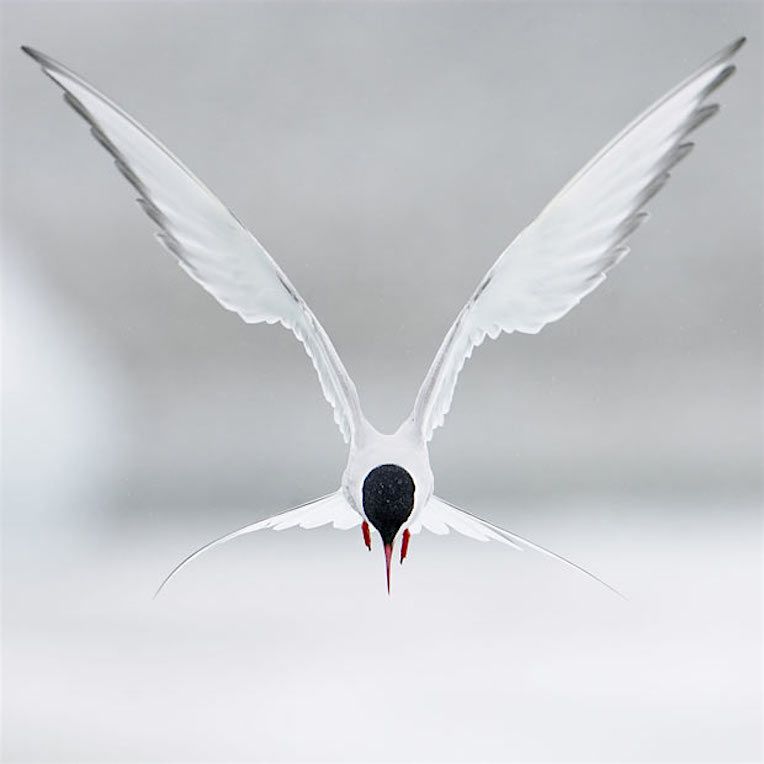
The Arctic tern is the long-distance champion of the animal kingdom. No other species - not the humpback whale, not the monarch butterfly, not any albatross or shorebird - covers the distance that Sterna paradisaea clocks every single year. Tracked individuals fly between 70,000 and 90,000 kilometres annually, bouncing between the Arctic summer and the Antarctic summer and seeing more daylight over a lifetime than any other creature on Earth.
This guide covers the biology, ecology, and strange edges of the Arctic tern: its size and anatomy, its pole-to-pole migration and the winds that shape it, its diet and plunge-diving technique, its colony life and fearsome defensive behaviour, its long monogamous pair bonds, and its conservation outlook in a warming ocean. It is a reference entry, not a summary - so expect specific numbers: kilometres, grams, degrees, population figures, and the verified records that anchor them.
Etymology and Classification
The scientific name Sterna paradisaea was coined by the Danish zoologist Erik Pontoppidan in 1763. The genus name Sterna is an old Northern European word for "tern" that goes back through Old English stearn to a common seabird name in Germanic languages. The species epithet paradisaea means "of paradise", a romantic nod to the bird's long-distance wanderings that seemed to reach every corner of the world known to eighteenth-century naturalists.
In English the bird is called the Arctic tern, but across its range it carries local names that reflect long familiarity. Icelanders call it kria, an onomatopoeic rendering of the piercing alarm call. Faroese fishermen call it terna. Inuit across the circumpolar Arctic have long recognised the species as a harbinger of spring, arriving shortly after ice break-up and leaving as soon as chicks can fly.
Taxonomically the Arctic tern sits in the family Laridae, which groups it with gulls and other terns, and in the order Charadriiformes, the great seabird and shorebird order that also contains auks, skuas, plovers, and sandpipers. The closest relatives within the genus Sterna are the common tern (S. hirundo), the Antarctic tern (S. vittata), and the roseate tern (S. dougallii).
DNA work and careful morphological comparison show Arctic terns diverged from their common tern relatives on the order of two to three million years ago, tracking the cooling climates of the late Pliocene and Pleistocene that opened polar foraging niches.
Size and Physical Description
Arctic terns are small, light, and exquisitely proportioned for long-distance flight. They are the smallest of the classic "sea terns" in the northern hemisphere by some measures and the most aerial by almost every measure.
Adult measurements:
- Body length: 33-36 cm from bill tip to tail tip
- Wingspan: 76-85 cm
- Weight: 86-127 g (roughly the mass of a deck of cards plus a lemon)
- Bill length: 2.7-3.6 cm
Plumage (breeding adult):
- Black cap from forehead to nape
- Pale grey upperparts and wings
- White underparts with a faint grey wash on the belly
- Long, deeply forked white tail streamers
- Blood-red bill with no black tip (a key feature distinguishing it from the common tern)
- Short, coral-red legs
Juveniles and non-breeding adults lose most of the black cap, retain a dark half-mask behind the eye, and show barred grey-and-white upperparts. Bills and legs turn blackish outside the breeding season.
The proportions are functionally extreme. Wings are narrow and pointed - a high aspect ratio that favours efficient, gliding flight at low cost. The body is short and light, so wing loading (mass per unit wing area) is among the lowest of any seabird of comparable size. Tail streamers add manoeuvrability in flight and serve as display features on the breeding grounds.
Arctic terns can be distinguished from the similar common tern by the all-red bill, shorter legs, longer tail streamers, and the translucent primary feathers that glow when backlit against a pale sky. In mixed colonies experienced observers tell them apart by flight silhouette alone.
Built for Endless Flight
Almost every feature of the Arctic tern's biology is an answer to the same engineering problem: how do you fly for 90,000 km a year without stopping to rest for longer than a few hours at a time?
Energy economy features:
- Low wing loading means the bird can glide for long stretches at minimal muscular cost.
- Hollow bones and air-sac anatomy reduce skeletal mass without sacrificing strength.
- A flexible pectoral muscle architecture allows both sustained flapping and efficient gliding.
- Feather structure combines water-shedding outer vanes with insulating downy bases.
Flight behaviour:
- Arctic terns cruise at roughly 40-45 km/h in still air and exploit tailwinds to push ground speeds well above 60 km/h.
- They rarely fly higher than a few hundred metres, staying close enough to the sea surface to feed opportunistically.
- They glide in long, shallow arcs above waves, using dynamic soaring where wind shear allows.
- They can sleep on the wing in short bouts, shutting down one cerebral hemisphere at a time - a pattern called unihemispheric slow-wave sleep, shared with frigatebirds and several other seabirds.
The consequence of this design is an animal whose life is almost entirely airborne. Outside of the breeding season, Arctic terns may go weeks without landing on solid ground. When they do rest, it is usually on a floating piece of debris, a small iceberg, or the edge of the Antarctic pack ice. They cannot swim well - the legs are short and the feet only lightly webbed - so resting on open water is not a comfortable option.
Thermal regulation across a pole-to-pole life is handled mostly by plumage. The same dense feather coat that insulates the bird at minus ten degrees Celsius on the Antarctic pack ice also protects it from the relentless UV of the Arctic midnight sun. Bare parts - legs, bill, and face - carry enough specialised vasculature to handle both environments without frostbite or heat stress.
The Longest Migration on Earth
The Arctic tern's migration is the headline fact of the species and the reason it appears in almost every textbook on bird movement. The scale has only become clear in the last fifteen years, since miniaturised geolocator tags made it possible to track individuals through an entire annual cycle.
Headline numbers:
| Metric | Value |
|---|---|
| Typical annual round trip | 70,000-90,000 km |
| Longest tracked individual | ~96,000 km in a single year |
| Daily travel in peak migration | 330-500 km |
| Flight speed in still air | 40-45 km/h |
| Typical altitude | 10-500 m above sea surface |
| Estimated lifetime distance | ~2.4 million km (3 trips to Moon) |
The route is not a straight line. Geolocator data from Greenland and Iceland colonies published in 2010 and refined in follow-up studies show two dominant southward paths from the North Atlantic. One arcs out across the middle of the Atlantic, feeds along the productive waters of the Sargasso, then dives down toward the coast of Africa.
The other, flown by many Greenland birds, crosses to the European coast, spirals down past West Africa, and makes a long westward crossing toward South America before continuing south to Antarctic waters.
Northbound in spring, most individuals fly a long figure-8 through the Atlantic rather than retracing the southbound route. The figure-8 exploits the prevailing wind systems - westerlies at mid-latitudes, trade winds in the tropics - to generate tailwinds on both legs of the year. Birds that try to fight headwinds burn unsustainable amounts of fat; birds that ride the wind can cover hundreds of kilometres a day at very low energetic cost.
Pacific-route birds, including those breeding in Alaska and eastern Siberia, fly their own distinct pattern down through the central Pacific toward New Zealand and on to Antarctic waters. The details are still being mapped as more tags are deployed across more colonies.
The most important single insight from tracking work is that Arctic terns do not navigate by geography. They navigate by productivity. Their routes follow the bands of ocean where upwelling, temperature fronts, or current convergence concentrate zooplankton and small fish. The figure-8 and the spiral are not ornamental; they are the shortest path that keeps the bird inside food-rich water for the longest possible time.
Diet and Feeding Behaviour
Arctic terns are surface-feeding piscivores with a secondary appetite for krill and other small invertebrates. Their whole hunting strategy is built around the plunge dive.
Primary prey:
- Sand eels (Ammodytes spp.) in North Atlantic waters
- Capelin (Mallotus villosus) in Arctic waters
- Juvenile cod, herring, and sprat where available
- Euphausiid krill in Antarctic waters
- Amphipods and other small crustaceans year-round
Secondary and opportunistic prey:
- Insects swept off tundra ponds during breeding
- Small squid in oceanic waters
- Fish offal from trawlers, opportunistically
Plunge-diving technique:
- The tern flies 1-10 m above the water, head angled down, scanning.
- When a fish is spotted near the surface, the bird hovers briefly, bill aligned vertically.
- It folds its wings and drops in a rapid, almost ballistic dive.
- At the moment of impact the wings extend partially to break the fall and the tern strikes with the bill.
- The bird lifts off almost immediately, rarely submerging deeper than half a metre.
Dives are shallow and fast - the whole sequence typically takes less than two seconds. Arctic terns cannot dive like auks or gannets; their bones are too light and their plumage not water-tight enough for deep immersion. They compensate with precision and speed, and by hunting in flocks where individuals benefit from the disturbance other birds create in fish schools.
During the breeding season, adults ferry whole fish back to chicks one at a time, held crosswise in the bill. A chick being provisioned well may receive 50-70 fish per day from both parents combined. Fish-carrying is a persistent problem in wind, and many fish are dropped or stolen by kleptoparasitic gulls and skuas before reaching the nest.
Breeding Season and Colony Life
The Arctic tern's breeding life is compressed into about ten weeks of continuous daylight near the top of the world. Everything has to happen fast.
Annual breeding cycle:
- May to early June: arrival at colony, courtship, pair re-formation
- Mid-June: egg laying (clutch of 1-3 eggs, usually 2)
- Mid-June to mid-July: incubation (21-24 days), shared by both parents
- Early to late July: chicks hatch, rapid growth on a fish-heavy diet
- Late July to early August: fledging at 21-24 days after hatch
- August: southward migration begins
Nests are simple scrapes - shallow depressions in gravel, sand, short tundra vegetation, or moss - lined sparsely with small stones, bits of shell, and dry plant material. Colonies form wherever suitable substrate and access to fishing grounds align: offshore islands are preferred because they reduce predation by foxes and weasels.
Colony sizes range from a few dozen pairs in marginal locations to tens of thousands of pairs in productive regions like the Farne Islands off England, parts of Iceland, and specific sites in the Canadian high Arctic. Nest spacing is tight - often less than a metre between scrapes - because colony density itself is a defence against predators.
Defensive behaviour is one of the most striking features of Arctic tern life. When a potential predator - an Arctic fox, a great skua, a herring gull, a researcher - enters the colony, the response is immediate and coordinated. Alarm calls escalate. Adults launch into the air in a swirling cloud. The nearest birds dive at the intruder's head, striking with the bill and sometimes defecating on impact.
Strikes frequently draw blood from unprotected scalps. Researchers working in Arctic tern colonies universally carry a stick held above the head or wear hard hats, and even then the harassment is unrelenting.
Chick Development and Parental Care
Arctic tern chicks hatch after 21 to 24 days of incubation, fully down-covered and able to walk within hours. They are semi-precocial - mobile and alert at hatching but still dependent on parental feeding.
Growth milestones:
- Day 0: hatch weight 15-20 g, eyes open within hours
- Day 3-5: chicks leave the scrape and hide nearby in vegetation
- Day 10-14: wing feathers emerging, body mass 50-70 g
- Day 21-24: first flight, fledging mass 80-100 g
- Day 30-40: independence from parents, beginning to catch own fish
Both parents feed the chicks, with one parent typically guarding the nest while the other hunts. Fish size and species are adjusted as chicks grow - tiny larval fish at first, then larger sand eels and capelin as the chicks can swallow them whole.
Chick mortality is high. Starvation in poor fish years is the dominant cause, followed by predation (mostly by large gulls and skuas), chilling during bad weather, and flooding of low-lying nests during storm surges. A successful breeding season might see 0.5 to 1.2 fledged chicks per pair on average. In catastrophic years - driven usually by sand eel collapse - whole colonies can fledge zero chicks.
Chicks remain with their parents during southward migration, which is one of the most striking facts in bird biology: a three-month-old Arctic tern makes the full 20,000-kilometre flight to Antarctic waters in its first few weeks of independent life. The route is learned, not innate, and juveniles travel with experienced adults who guide the flock along the productive lanes.
Populations and Distribution
Arctic terns are among the most widely distributed breeding birds on Earth. Any tundra coast, gravel island, or low-lying rocky shoreline within the Arctic and sub-Arctic is a potential colony site.
Breeding distribution by region:
| Region | Approximate breeding pairs | Notes |
|---|---|---|
| Canada and Alaska | ~350,000 | Widely scattered across tundra coasts |
| Greenland | ~100,000 | Important source of geolocator tracking data |
| Iceland | 250,000-500,000 | Long-term declines linked to sand eel collapse |
| Faroe Islands | ~20,000 | Stable |
| Scandinavia | ~200,000 | Norway, Sweden, Finland combined |
| Russian Arctic | ~200,000 | Patchy monitoring; trends uncertain |
| British Isles | ~50,000 | Farne Islands, Shetland, Orkney strongholds |
| Northeast United States | ~5,000 | Southern range edge, locally threatened |
Global population estimates sit around two million individuals in total. The IUCN Red List classifies the Arctic tern as Least Concern based on range size and overall numbers, while noting regional declines and the ecological sensitivity of the species to ocean change.
During the non-breeding season the population concentrates in a relatively narrow belt along the edge of the Antarctic pack ice, from the Weddell Sea around to the Ross Sea. Birds from different breeding populations mix on the wintering grounds, so the non-breeding distribution does not mirror the breeding distribution geographically.
Conservation Status and Threats
The Arctic tern is listed as Least Concern globally, but beneath the headline status sit several serious long-term pressures.
Primary threats:
- Climate-driven prey declines. Sand eel populations in the North Sea and around Iceland have collapsed in repeated years since the late 1990s, tracking rising sea temperatures. Sand eels are the primary food of breeding Arctic terns across much of the Atlantic. Colonies in Iceland, Shetland, and Orkney have experienced repeated near-total breeding failures as a direct result.
- Storms during migration. Arctic terns rely on predictable wind systems. Increasing storm intensity and shifting wind patterns in the Atlantic and Pacific push migrating birds into unfavourable conditions, driving up mortality on the southward and northward legs.
- Plastic pollution and marine debris. Arctic terns ingest small plastic fragments that resemble fish, and chicks are fed contaminated fish. Long-term effects on body condition and reproduction are still being quantified.
- Invasive predators. Introduced mink, rats, and cats on island colonies have destroyed whole breeding sites. Eradication programmes in the British Isles, Iceland, and Alaska have recovered some colonies but invasive species remain a chronic pressure.
- Oil pollution and shipping disturbance. Arctic sea routes are opening. Oil spills at sea, chronic hydrocarbon exposure, and vessel disturbance at breeding sites add to pressure.
- Human disturbance at colonies. Tourism, photography, and casual visits to accessible colonies cause abandonment during the brief breeding window. Well-managed reserves mitigate this; unmanaged sites often do not.
Conservation measures:
- International protection under the Agreement on the Conservation of African-Eurasian Migratory Waterbirds (AEWA) and related bilateral treaties.
- Site protection through national seabird reserves across the breeding range.
- Invasive predator eradication projects on specific islands.
- Fisheries management of sand eel and capelin stocks - the most important lever in the North Atlantic.
The long-term outlook depends on ocean ecosystems more than on local colony management. Healthy sand eel and krill populations, stable wind systems, and intact pack ice together determine whether two million Arctic terns continue to cross the planet each year.
Arctic Terns and Humans
The Arctic tern has no direct economic role in most cultures. It is too small to eat, too fast to catch easily, and too aggressive to approach without pain. It features in North Atlantic folklore as a harbinger of spring and an icon of wildness. Icelandic children grow up being told to stay out of krigg colonies during June; adults enjoy the same warning delivered by a bleeding scalp.
For biologists the Arctic tern has become one of the most important animals in the study of animal movement. The first geolocator study of the species, published in 2010 by Carsten Egevang and colleagues, reshaped textbook understanding of migration distance overnight.
Subsequent tracking work from colonies around the Atlantic and Pacific has turned the species into a model for testing ideas about wind-assisted migration, lifetime distance accumulation, and the ecology of polar-connected marine systems.
For ordinary observers Arctic terns offer a yearly reminder that small animals can do enormous things. A bird that weighs less than a hundred grams flies the equivalent of the Earth's circumference roughly twice a year, year after year, for thirty years.
Related Reading
- Bird Migration: How Animals Navigate Continents
- Seabirds of the Polar Regions
- Longest Animal Migrations on Earth
- How Birds Sleep on the Wing
References
Relevant peer-reviewed and governmental sources consulted for this entry include Egevang et al.
(2010) "Tracking of Arctic terns Sterna paradisaea reveals longest animal migration" in Proceedings of the National Academy of Sciences, subsequent geolocator studies published in Marine Ecology Progress Series and Journal of Avian Biology, IUCN Red List assessments for Sterna paradisaea, BirdLife International species factsheets, and long-term colony monitoring reports from the Icelandic Institute of Natural History, the Farne Islands (National Trust), and the Alaska Department of Fish and Game.
Population figures reflect consolidated estimates from the most recent BirdLife International assessment.
Frequently Asked Questions
How far does the Arctic tern migrate each year?
Arctic terns (Sterna paradisaea) migrate between breeding grounds in the Arctic and wintering grounds in Antarctica every year. Geolocator studies published from 2010 onward put the annual round-trip distance at 70,000 to 90,000 km, depending on colony and route. The longest individual tracked travelled approximately 96,000 km in a single year. This is the longest documented migration of any animal on Earth.
Birds do not fly in a straight line - they follow prevailing winds, jet streams, and bands of ocean productivity, which adds tens of thousands of kilometres compared with a direct great-circle route.
How long do Arctic terns live?
Wild Arctic terns typically live 20 to 30 years. Many birds do not survive their first migration, but those that establish themselves in breeding colonies often reach their twenties. The oldest banded Arctic tern on record lived to 34 years.
Lifespan combined with annual migration distance produces the species’ most striking statistic: a single bird can log roughly 2.4 million km of flight over its life, equivalent to three round trips between Earth and the Moon. Age at first breeding is typically 3-4 years, and most adults successfully rear chicks in most years once established.
What do Arctic terns eat?
Arctic terns are specialist fish- and krill-eaters. Their diet is dominated by small schooling fish - sand eels, capelin, herring, juvenile cod - plus euphausiid krill, amphipods, and other small crustaceans. During the southern summer in Antarctic waters they feed heavily on krill swarms. Arctic terns catch prey by plunge-diving from 1 to 10 m above the water, striking with a sharp beak and swallowing small items whole.
During breeding, adults ferry whole fish to chicks one at a time, carried crosswise in the bill. Insects and terrestrial invertebrates are eaten only occasionally, mostly on the breeding grounds.
Where do Arctic terns breed and where do they winter?
Arctic terns breed in the circumpolar Arctic and sub-Arctic: northern Canada, Greenland, Iceland, Svalbard, Scandinavia, Russia, Alaska, and locally as far south as the British Isles, Massachusetts, and the Aleutian Islands. Colonies form on coastal tundra, low offshore islands, gravel beaches, and even some inland tundra ponds.
After breeding they fly south to spend the austral summer around the Antarctic pack-ice edge and the productive waters of the Southern Ocean. By living through the Arctic summer and then the Antarctic summer, Arctic terns experience more daylight than any other animal on Earth.
Why do Arctic terns dive-bomb people?
Arctic tern colonies are intensely defensive, because their nests are simple ground scrapes with no shelter from predators. When a potential threat - a fox, gull, skua, dog, or human - comes within roughly 100 metres of active nests, adults launch coordinated aerial attacks. They scream, hover, and strike the intruder’s head with their beaks, often drawing blood.
Researchers working in Arctic tern colonies routinely wear hard hats or carry sticks held overhead so the birds strike the stick instead of the scalp. This aggression is effective: colonies with strong tern defence have measurably higher chick survival than those without.
How do Arctic terns drink water at sea?
Arctic terns drink seawater directly. Like other seabirds, they have specialised supraorbital salt glands located above the eyes. These glands filter excess sodium and chloride out of the bloodstream and excrete a concentrated saline solution through the nostrils, which the bird shakes or flicks off the bill. The kidneys of seabirds cannot produce urine salty enough to handle ocean water, so the salt glands do the work.
This adaptation is why Arctic terns can spend months over open ocean, thousands of kilometres from any fresh water, without dehydration.
Are Arctic terns endangered?
The IUCN Red List classifies the Arctic tern as Least Concern. The global population is estimated at roughly two million individuals across the circumpolar breeding range. However, several regional populations are in measurable decline. Iceland and parts of the North Sea have seen breeding failures linked to reduced sand eel stocks, which in turn track ocean warming.
Climate-driven changes to prey distribution, storms during migration, plastic pollution, and colony disturbance by predators like introduced mink and rats are the most important threats. Arctic terns are protected under international migratory bird agreements across their range.
Do Arctic terns mate for life?
Arctic terns form long-term pair bonds and are often described as mating for life. Paired birds typically reunite at the same colony, sometimes at the exact same nest scrape, year after year. Courtship rituals - aerial chases, fish presentations, and synchronised posturing - are repeated each spring even in established pairs.
True lifetime fidelity is hard to confirm in a species with 30-year lifespans and pole-to-pole migrations, but banding studies show divorce rates are low and most pairs persist until one bird fails to return. Both parents incubate the eggs and feed the chicks.