
How far does the arctic tern migrate?
Arctic terns (Sterna paradisaea) migrate approximately 70,000-90,000 km (44,000-56,000 miles) per year, the longest migration of any animal on Earth. They breed in the Arctic during the northern summer, then fly to Antarctica for the southern summer, experiencing two summers annually and more daylight than any other creature. Some individuals have been tracked covering 96,000 km in a single year.
Three Round Trips to the Moon
An arctic tern weighs about 100 grams - roughly the mass of a deck of cards. It has a wingspan of 80 cm. It looks like any medium-sized white seabird you might see at any beach.
Every year, this small bird flies from the Arctic Circle to Antarctica and back - a round trip of approximately 70,000 kilometers. Over its 30-year lifespan, a single arctic tern covers 2.4 million kilometers of flight distance. That is equivalent to three round trips between the Earth and the Moon.
The arctic tern holds the record for longest migration of any animal on Earth. Understanding how a 100-gram bird achieves this feat reveals biology pushed to the absolute limits of what animal design allows.
The Route
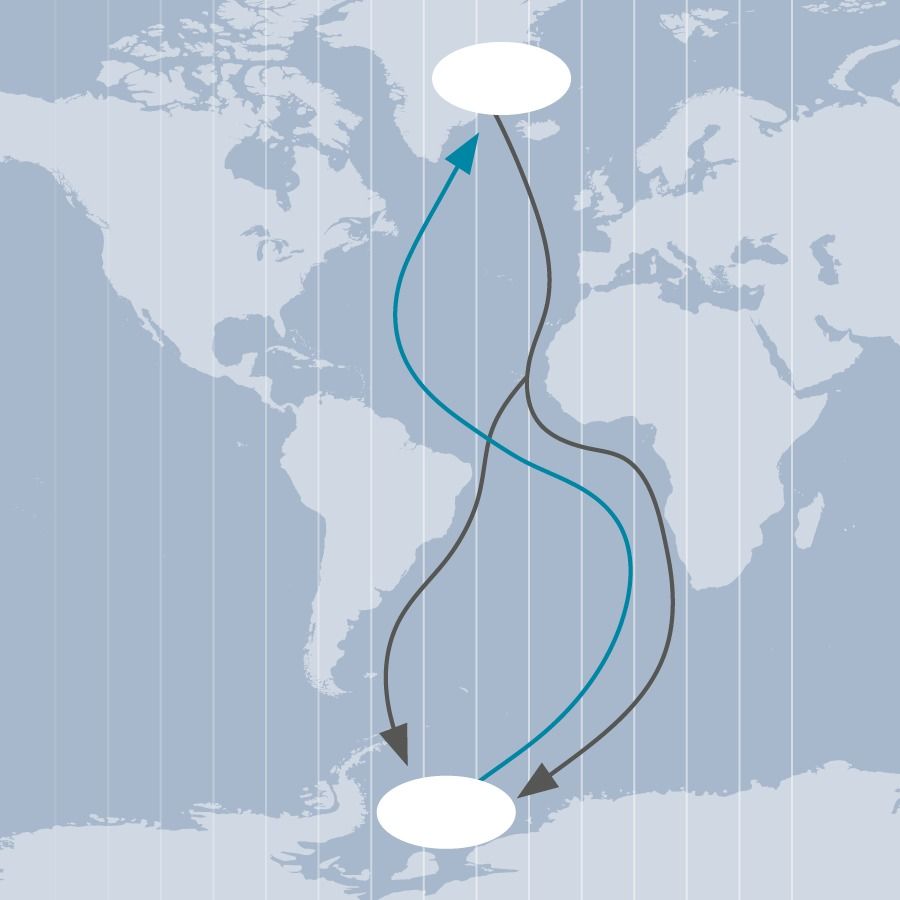
Arctic terns do not fly in straight lines between their Arctic breeding grounds and Antarctic feeding grounds. Their actual routes follow complex paths that maximize wind assistance and food availability.
The journey (simplified):
August-September: Leave Arctic breeding colonies (Greenland, Iceland, northern Canada, northern Russia, Svalbard, Alaska). Fly south across the North Atlantic.
October-November: Cross the equator, typically along one of several routes through the tropical Atlantic or Pacific. Some terns pass through the Indian Ocean.
December-January: Arrive in Antarctic waters. Feed and rest along the edge of the Antarctic ice pack throughout the southern summer.
March-April: Begin northward return migration. Follow different routes than southbound (often passing through different ocean basins).
May-June: Arrive back at Arctic breeding colonies. Begin breeding cycle.
Total distance: 70,000-90,000 km per year, with some individuals tracked at over 96,000 km.
Why This Route?
The arctic tern migration is not arbitrary. Every component serves specific purposes.
Endless summer:
By migrating pole-to-pole, arctic terns experience two summers each year and avoid two winters. They see more daylight than any other animal on Earth - roughly 8-9 months of continuous or near-continuous daylight annually.
Summer at high latitudes produces intense biological productivity. Long daylight hours drive phytoplankton blooms, which support zooplankton, which feed small fish, which feed terns. Both the Arctic and Antarctic become extraordinarily productive during their respective summers.
Avoiding polar winters:
Winter at high latitudes is harsh. Low light reduces food production. Cold temperatures increase energy costs. Sea ice covers feeding areas. By leaving before winter arrives, terns avoid the conditions that make high-latitude winters deadly for many species.
Using wind systems:
Arctic tern migration routes exploit predictable ocean wind patterns. Terns follow trade winds and westerlies that provide tailwinds for most of the journey. Flying with wind assistance reduces energy costs enormously compared to flying against or across prevailing winds.
Following productivity waves:
As one hemisphere's summer fades, the other's begins. Arctic terns essentially ride the wave of seasonal productivity around the planet, always feeding in summer-level abundance.
How They Fly So Far
Long-distance migration at pole-to-pole scales requires specific biological adaptations.
Wing efficiency:
Arctic terns have long, narrow wings optimized for sustained soaring flight. Their aspect ratio (wing length relative to width) is high, similar to gliders. This design minimizes energy cost per unit distance.
Soaring and gliding:
Terns rely heavily on dynamic soaring over ocean waves, using wind gradients at different heights above the water to extract energy from air currents. This reduces flapping flight requirements and conserves energy.
Feeding during migration:
Arctic terns feed while migrating. They plunge-dive for small fish and crustaceans along their route. This continuous feeding means they do not need to stockpile huge fat reserves before departure.
Minimal rest:
Terns can sleep while flying, apparently using the same half-brain sleep strategy used by dolphins and some other bird species. They land on water or on floating objects for short rest periods but can continue flying for days if conditions require.
Low energetic cost of flight:
Per gram of body mass, soaring seabird flight is among the most energy-efficient forms of animal locomotion. Terns burn calories slowly enough that their stored fat, plus feeding along the way, can sustain the entire migration.
Navigation
How does a 100-gram bird find its way across 70,000 km of ocean?
Multiple navigation systems:
Arctic tern navigation uses multiple redundant systems working simultaneously.
Magnetic sense:
Terns detect Earth's magnetic field using specialized cells containing magnetite (iron oxide) crystals. These cells are found in the beak and around the eyes. The magnetic sense provides directional information similar to a compass.
Birds can also detect the inclination angle of magnetic field lines, which varies predictably with latitude. This allows them to determine how far north or south they are based on magnetic field properties alone.
Solar compass:
During daylight, terns use the sun's position for direction. They compensate for the sun's movement through the sky over the course of the day (called time-compensated sun compass), using their internal biological clock to know how far the sun has moved from its apparent noon position.
Stellar compass:
At night, terns use stars for orientation. Polaris (North Star) sits approximately above the North Pole, providing a fixed reference for northern navigation. Southern Hemisphere birds use patterns of southern stars.
Polarized light:
Even on cloudy days, the pattern of polarized sunlight through the atmosphere provides directional cues. Birds can detect polarization patterns that are invisible to humans.
Landmark recognition:
Terns remember specific coastline features, islands, and current patterns from previous migrations. Experienced adult terns have detailed mental maps of their traditional route.
Innate programming:
Young arctic terns making their first migration do not learn the route from parents. They use innate directional programming - genetically encoded instructions that tell them which way to fly based on environmental cues. This programming gets refined with experience as they age.
Breeding in the Arctic
Arctic terns breed in colonies across the high Arctic and sub-Arctic from May through July.
Colony life:
Arctic tern colonies can range from a few dozen pairs to thousands of pairs. Large colonies provide protection - many adults can collectively drive off predators, including foxes and large birds.
Nesting:
Nests are scrapes in sand, gravel, or short vegetation. No structures are built. Camouflage protects eggs from visual predators.
Egg laying:
Females typically lay 1-3 eggs. Both parents incubate, taking turns during the approximately 21-day incubation period.
Chick rearing:
Hatchling chicks can walk within hours and are fed by both parents. They fledge at approximately 21-24 days of age. Within weeks, young terns must be strong enough for their first migration to Antarctica.
Fierce defense:
Arctic terns are famous for aggressive colony defense. They dive-bomb anything approaching nests, including humans, with painful strikes from sharp beaks. Anyone visiting an arctic tern colony quickly learns to wear a hard hat.
Summer in Antarctica
After flying from the Arctic, arctic terns spend 3-4 months feeding in Antarctic waters.
Feeding grounds:
Terns concentrate along the edge of the Antarctic ice pack, where upwelling currents bring nutrients to the surface and drive massive plankton blooms. The resulting food chain produces abundant krill, small fish, and other prey.
Behavior:
During the Antarctic sojourn, arctic terns do not breed. They rest, feed, replenish fat reserves, and undergo the annual molt (replacing all flight feathers over several months).
Conditions:
Antarctic summer is cold but benign compared to Antarctic winter. Continuous daylight provides nonstop feeding opportunities. Storm systems periodically disrupt feeding but generally do not threaten adult terns.
Return timing:
As Antarctic summer ends in March-April, terns begin their return journey north. Timing is critical - they must arrive in the Arctic during peak summer productivity, not too early (when Arctic still has snow and cold) or too late (missing the breeding season).
Longevity
Arctic terns live surprisingly long lives for birds of their size.
Lifespan:
Typical lifespan: 20-30 years. Some individuals recaptured through leg-band records have been confirmed at 34+ years.
Why so long?
Long lifespan is necessary for the arctic tern's breeding strategy. They lay only 1-3 eggs per year. Juvenile mortality is high - first-year terns face enormous challenges during their initial migration.
Birds that survive their first 2-3 years, however, have very high annual survival rates. Adult arctic terns face few natural predators (their flying ability keeps them safe from most threats) and live stable, long lives if they can complete initial migrations.
Lifetime migration distance:
30 years at 70,000 km per year = 2,100,000 km minimum. Some long-lived individuals probably exceed 2.5 million km lifetime migration distance.
For comparison:
- Earth's circumference: 40,075 km
- Distance to the Moon: 384,400 km
- Distance to Mars at closest approach: ~54 million km
An arctic tern's lifetime migration equals 52 times around the Earth, or 6 round trips to the Moon, or about 4 percent of the distance to Mars at closest approach.
Tracking the Journey
Scientific understanding of arctic tern migration has exploded with modern tracking technology.
Early estimates:
Before the 2000s, arctic tern migration was estimated based on where birds were seen at different times of year. Estimates suggested migrations of 40,000-50,000 km per year.
Geolocator revolution:
In the 2000s, researchers began attaching tiny archival tags (geolocators) to arctic terns. These devices record light levels, from which the bird's approximate location can be calculated.
The first comprehensive geolocator study (published 2010) revealed average migrations of 70,900 km per year - far longer than previously estimated.
Extreme individuals:
Later tracking studies have documented individual terns covering over 96,000 km in a single year, including extensive detours following wind patterns and food availability.
GPS tracking:
Smaller GPS transmitters now provide precise real-time location data. These have revealed the highly complex, non-linear nature of tern migration routes.
Climate Change and the Arctic Tern
The arctic tern migration system depends on specific climate conditions at both ends of the journey.
Threats:
Arctic warming: Changing Arctic conditions affect breeding success. Timing mismatches between breeding and peak food availability are beginning to appear.
Antarctic changes: Antarctic sea ice dynamics affect the productivity of summer feeding grounds. Reduced sea ice could alter the krill populations that support the Antarctic food web.
Ocean acidification: Changes in ocean chemistry may affect the plankton and small fish that arctic terns eat along migration routes.
Wind pattern changes: Arctic tern migration exploits specific wind systems. Climate-driven changes in prevailing winds could make the migration more energetically expensive.
Conservation status:
Arctic terns are currently listed as Least Concern - populations appear stable globally. However, specific regional populations are declining, and the species' long-term future depends on maintaining productive conditions at both poles.
The Meaning of Migration
The arctic tern migration represents an extreme expression of a universal biological pattern. Countless species migrate to track seasonal changes in resources. Whales, caribou, monarch butterflies, wildebeest, salmon - all move periodically to exploit changing conditions.
What makes arctic terns special is not that they migrate but how far. They have pushed the migration strategy to its absolute planetary limit. There is no further to go - from the Arctic to Antarctica is as long as any migration can possibly be on Earth.
And they do it twice every year, for decades, weighing 100 grams.
Every time you see a small white seabird skimming over coastal waters, consider: that bird may have been flying, almost continuously, between opposite ends of the planet, for longer than many human lives have lasted. The arctic tern proves that extreme biological feats do not require extreme body size, extreme brain size, or extreme adaptations visible to casual observation.
Sometimes extreme capability is packed into a body no larger than a dinner roll - carried aloft by adaptations so subtle that evolution took tens of millions of years to produce them.
Comparing the Great Migrations
The arctic tern leads the table of verified animal migrations, but several other species push the limits of what a migrating body can do. Tracking technology over the past twenty years has rewritten the record books in several taxa at once. The Kalenux Team compiled the current verified records below.
| Species | Annual Round-Trip Distance | Body Mass | Key Mechanism |
|---|---|---|---|
| Arctic tern (Sterna paradisaea) | 70,000-96,000 km | 110 g | Pole-to-pole flight, wind riding |
| Sooty shearwater (Ardenna grisea) | 64,000 km | 800 g | Figure-eight Pacific loop |
| Bar-tailed godwit (Limosa lapponica baueri) | 30,000 km | 350 g | Single 13,500 km non-stop flight |
| Humpback whale (Megaptera novaeangliae) | 16,000-25,000 km | 30,000 kg | Tropical breeding, polar feeding |
| Leatherback turtle (Dermochelys coriacea) | 20,000 km | 500 kg | Jellyfish pursuit across basins |
| Monarch butterfly (Danaus plexippus) | 8,000 km (multigenerational) | 0.5 g | Generational hand-off |
| Caribou (Rangifer tarandus) | 5,000 km | 180 kg | Tundra-taiga seasonal shift |
"The arctic tern's migration is more than twice the length of what anyone believed possible before geolocators made precise tracking feasible. Every year we learn that the upper envelope of animal performance is farther out than we thought." - Carsten Egevang, Greenland Institute of Natural Resources, PNAS, 2010 [1]
The remarkable point is not that the arctic tern outdistances its nearest competitor; it is that the 100-gram tern outdistances a 30-tonne humpback whale by a factor of three or four. Mass is no predictor of migration distance. What matters is whether a species can feed in flight, harvest wind energy, and sustain continuous low-cost locomotion for months at a time.
The Geolocator Studies That Changed the Story
Prior to 2007, arctic tern migration was known only in broad strokes. Birds were seen leaving Greenland in late summer and were seen again in Antarctic waters in December, but the path between these endpoints was mostly guesswork. The revolution came with miniaturized light-level geolocators (GLS tags) weighing less than 1.5 grams - light enough to be safely worn by a 100-gram tern without significantly affecting flight performance.
In a landmark study led by Carsten Egevang and published in Proceedings of the National Academy of Sciences in 2010, researchers attached geolocators to 11 arctic terns breeding in Greenland and 50 breeding in Iceland. The retrieved tags revealed, for the first time, the actual path the birds fly.
Key findings from the study and its follow-ups:
- Greenland-breeding terns took detours of 12,000 kilometers along the African coast, catching southern trade winds that carry them across the Atlantic toward Antarctic waters.
- Some birds stopped in the mid-Atlantic for a period of weeks to feed, before continuing south.
- Return routes were different from outbound routes, typically swinging through the western Atlantic on the northbound leg to exploit different prevailing winds.
- The total distance averaged 70,900 kilometers per bird per year, with the longest route measuring 81,600 kilometers.
A Dutch study of terns breeding in the Netherlands later documented a single individual covering 96,000 kilometers in one annual cycle, still the verified record.
"It took us three centuries to appreciate that our familiar coastal tern was hiding the longest migration on Earth. The science of tracking tells us that much of what we assume about animal behavior is wrong because our observational reach was too short." - Iain Stenhouse, Biodiversity Research Institute, Biological Conservation, 2013 [2]
Energetics: How the Math Works
An arctic tern burns roughly 0.6 kilocalories per kilometer of flight, based on respirometry studies of related tern species during wind tunnel testing at Lund University. A 70,000-kilometer annual migration therefore requires about 42,000 kilocalories of flight-related energy per year, on top of the bird's baseline metabolic needs.
Small fish and crustaceans caught in flight typically provide 2 to 4 kilocalories per gram, so the bird needs to catch and process 12 to 20 kilograms of prey annually to fuel the migration alone.
This works only because arctic tern flight is extraordinarily efficient. The bird's wing loading (body weight per unit wing area) is one of the lowest among seabirds, and its gliding ratio - the horizontal distance covered per unit altitude lost - exceeds 15:1 in typical ocean winds. For comparison, a typical paper airplane achieves a gliding ratio of about 10:1.
The tern's flight strategy is built around the wind, not against it. Satellite weather data show that Atlantic arctic tern routes correlate strongly with favorable wind vectors. When trade winds blow unfavorably, birds can delay their departure by days or weeks, waiting for conditions that make the long crossing energetically feasible. A bird that departs into a headwind can burn through its fat reserves mid-ocean and drown from exhaustion.
References
- Egevang, C., Stenhouse, I. J., Phillips, R. A., Petersen, A., Fox, J. W., and Silk, J. R. D. (2010). "Tracking of Arctic terns (Sterna paradisaea) reveals longest animal migration." Proceedings of the National Academy of Sciences, 107(5), 2078-2081.
- Stenhouse, I. J., Egevang, C., and Phillips, R. A. (2013). "Trans-equatorial migration, staging sites and wintering area of Sabine's Gulls Larus sabini in the Atlantic Ocean." Ibis, 154(1), 42-51.
- Hatch, J. J. (2002). "Arctic Tern (Sterna paradisaea)." The Birds of North America Online, Cornell Lab of Ornithology.
- Alerstam, T., Backman, J., Gudmundsson, G. A., Hedenstrom, A., Henningsson, S. S., Karlsson, H., Rosen, M., and Strandberg, R. (2007). "A polar system of intercontinental bird migration." Proceedings of the Royal Society B, 274(1625), 2523-2530.
- Fijn, R. C., Hiemstra, D., Phillips, R. A., and van der Winden, J. (2013). "Arctic terns from The Netherlands migrate record distances." Ardea, 101(1), 3-12.
Related Articles
- Bar-Tailed Godwit: Record-Setting Non-Stop Flight
- Monarch Butterfly Migration: A Thousand-Kilometer Journey
- How Birds Navigate Using Earth's Magnetic Field
Frequently Asked Questions
How far does the arctic tern migrate?
Arctic terns (Sterna paradisaea) migrate approximately 70,000-90,000 km (44,000-56,000 miles) per year, the longest migration of any animal on Earth. They breed in the Arctic during the northern summer, then fly to Antarctica for the southern summer, experiencing two summers annually and more daylight than any other creature. Some individuals have been tracked covering 96,000 km in a single year.
Over a 30-year lifespan, a single tern flies approximately 2.4 million km - equivalent to three round trips to the moon. This extraordinary distance is more than double the migration distances of other long-distance migrants like whimbrels, bar-tailed godwits, or humpback whales.
The migration is not a straight line between the poles but follows complex figure-eight routes across the Atlantic, Pacific, and Indian Oceans, maximizing wind assistance and food availability along the way.
How do arctic terns navigate?
Arctic terns navigate using multiple sensory systems simultaneously. They detect Earth’s magnetic field through specialized cells containing iron-based molecules in their beaks and eyes, allowing them to sense direction even without visual cues. They use the position of the sun during the day and stars at night, correcting for time of day to determine true direction (called time-compensated sun compass).
They recognize landmarks along coastlines, including specific cliffs, islands, and current patterns. They detect barometric pressure changes indicating weather systems. Young arctic terns born in Arctic nesting colonies make their first solo migration to Antarctica using innate directional programming - they do not need to learn the route from adults.
Research has shown that terns can compensate for being blown off course by winds and return to their exact nesting territory within meters after traveling tens of thousands of kilometers.
How long do arctic terns live?
Arctic terns typically live 20-30 years in the wild, making them among the longest-lived seabirds relative to body size. Some individuals have been recaptured and identified at 34+ years of age through leg band records. During their lifespans, arctic terns migrate pole to pole every year, accumulating total flight distances that exceed 2 million kilometers.
This extreme longevity is necessary for their breeding strategy - they lay only 1-3 eggs per year and have high juvenile mortality during the first migration. Adults that survive their first few years typically live for decades with high annual survival rates. Their long lives allow them to experience and remember long-term environmental patterns, which may help them anticipate food availability along migration routes.
The species faces no major natural predators as adults (they are too fast and agile for most predators) and have co-existed with their ocean environment for millions of years.
When do arctic terns migrate?
Arctic terns leave their Arctic breeding grounds in August-September as autumn begins in the northern hemisphere. They fly south through the Atlantic and Pacific Oceans, arriving at their Antarctic summering grounds in December-January (the Antarctic summer). They spend 3-4 months feeding and resting in Antarctic waters, then begin the return journey in March-April as Antarctic summer ends.
They arrive back in Arctic breeding colonies in May-June, just as the Arctic summer begins. This timing means arctic terns experience roughly 8-9 months of constant daylight per year - more sunlight than any other animal on Earth. The migration coincides with breeding seasons in both hemispheres, so each tern experiences two summers and avoids two winters annually.
Breeding occurs only in Arctic latitudes during the northern summer; Antarctic waters are used for feeding and resting only, not reproduction.
Why do arctic terns migrate so far?
Arctic terns migrate to follow optimal feeding conditions year-round. Arctic waters are extremely productive during the northern summer when long daylight hours drive intense plankton and fish production. When Arctic summer ends, daylight and food production decline. Antarctic waters then become highly productive during the southern summer (December-February) for the same reason.
By migrating between the poles, arctic terns always feed in summer-level productivity, avoiding polar winters when waters are dark and food is scarce. The species evolved in the last 25 million years as polar climates diverged from equatorial regions, creating the pattern of oscillating summer productivity between hemispheres. Energy gained from endless summer feeding outweighs the enormous energy cost of the migration itself.
Birds that stay in the Arctic year-round (like several duck species) survive winter but miss the productivity peaks. Arctic terns take the opposite strategy - they chase productivity peaks rather than tolerating troughs.