
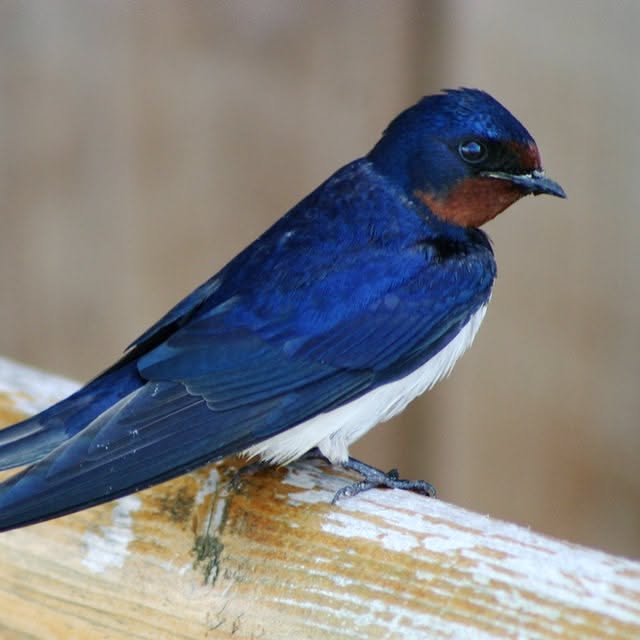
The barn swallow is the most widespread swallow species on Earth and one of the most recognisable small birds in the world. A streamlined aerial hunter with a deeply forked tail, a rich steel-blue back, and a chestnut throat, Hirundo rustica breeds across almost the entire Northern Hemisphere and migrates to the Southern Hemisphere for the winter.
A single individual, weighing less than 20 grams, will cover more than 11,000 kilometres each way between its breeding loft and its wintering grounds - twice a year, every year, for as long as it lives.
This guide covers every major aspect of barn swallow biology: size and physical features, the six recognised subspecies, their tight relationship with human structures, aerial foraging, migration routes, mud-pellet nest construction, social behaviour, tail-streamer aerodynamics, and conservation trends. It is a reference entry, not a summary - so expect specifics: grams, kilometres, clutch sizes, subspecies ranges, and the verified distances a barn swallow can cover in a single day.
Etymology and Classification
The scientific name Hirundo rustica was given by Carl Linnaeus in 1758 in the tenth edition of Systema Naturae. The Latin word hirundo simply means 'swallow' and rustica means 'of the countryside' - a fitting tag for a bird that has long shared fields and farm buildings with humans. The English name 'barn swallow' reflects the same association, though the species was nesting in caves and cliffs long before the first barn was built.
Barn swallows sit within the family Hirundinidae, the swallows and martins, a family of roughly ninety species found on every continent except Antarctica. Within Hirundinidae they belong to the genus Hirundo, a group of open-country swallows characterised by forked tails, glossy blue upperparts, and warm-coloured throats. Molecular data place barn swallows close to the house swallow, the wire-tailed swallow, and several African relatives.
Six subspecies of barn swallow are currently recognised across the global range. They differ in the colour of the underparts - from nearly white in European populations to deep rusty orange in parts of Asia and North America - and in the extent of the dark breast band. Migration routes, wintering grounds, and timing vary by subspecies.
| Subspecies | Breeding range | Wintering range |
|---|---|---|
| H. r. rustica | Europe, North Africa, western Asia | Sub-Saharan Africa |
| H. r. transitiva | Eastern Mediterranean | Largely resident |
| H. r. savignii | Nile Valley, Egypt | Resident |
| H. r. gutturalis | East Asia | South-East Asia, northern Australia |
| H. r. tytleri | Central and eastern Siberia | South and South-East Asia |
| H. r. erythrogaster | North America | Central and South America |
The North American subspecies erythrogaster ('red-bellied') is the most strongly coloured of the group and shows no dark breast band.
Size and Physical Description
Barn swallows are small, streamlined passerines built for continuous flight. Most of the body length comes from the long, deeply forked tail rather than the compact torso.
Adult measurements:
- Total length: 17-19 cm (including tail streamers)
- Body length without streamers: roughly 10-12 cm
- Wingspan: 32-35 cm
- Weight: 17-20 g
- Tail streamers in adult males: up to 8 cm beyond the central tail feathers
Plumage:
- Upperparts: glossy steel-blue, almost iridescent in sunlight
- Forehead and throat: deep chestnut
- Breast band: dark blue-black (absent in North American birds)
- Underparts: pale buff to rusty orange depending on subspecies
- Tail: deeply forked, black with a row of white spots visible in flight
- Legs and feet: small, short, black, used mainly for perching on wires and ledges
The bill is short, broad, and slightly hooked - a classic gape-feeder mouth optimised for catching flying insects. The eyes are large and forward-facing enough to give excellent depth perception during fast manoeuvres.
Males and females look similar at first glance, but close inspection shows consistent differences. Males carry longer and more symmetrical tail streamers, a deeper throat colour, and a broader breast band. Juveniles have shorter streamers, duller throats, and paler underparts. Young birds gain full adult ornamentation during their second year.
Adaptations for Aerial Life
Almost every feature of a barn swallow's anatomy is shaped by the fact that it catches, drinks, and sometimes mates on the wing. The wings are long, pointed, and narrow - a high-aspect-ratio design that favours efficient long-distance flight and rapid direction changes over hovering or slow speed. The pectoral muscles that power the wingbeats are large relative to the bird's body mass, fuelling sustained flight across thousands of kilometres during migration.
The deeply forked tail is both a display feature and a working flight surface. Wind tunnel experiments with real and replica swallow tails have shown that the forked shape functions as an aerodynamic control surface, cutting drag during tight turns and letting the bird pivot around a smaller radius than a square-tailed bird of the same wing area.
Extending the outer tail feathers into long streamers pushes this effect toward a limit. Streamer length beyond roughly six centimetres actually begins to hurt flight performance - but that is precisely the point. Only a genuinely fit male can afford the cost.
Barn swallows feed by flying low over open ground, pasture, and water and intercepting flying insects in mid-air. Their mouths open extremely wide thanks to a flexible jaw joint, effectively giving them a small aerial net when they are pursuing swarms. They drink by skimming the surface of ponds and slow streams, scooping a mouthful without stopping.
They bathe in a similar way, splashing the body on the water in a series of low, quick passes. Mating sometimes occurs in flight as well, though most copulations happen on perches.
Foraging and Diet
Barn swallows are obligate aerial insectivores. Almost all of their food is caught in flight, and almost all of that food is winged insects.
Primary prey groups:
- True flies (houseflies, horseflies, hoverflies, blowflies)
- Flying ants and winged termite swarms
- Small beetles (including dung beetles attracted to pasture)
- Wasps and other hymenopterans
- Mosquitoes, midges, and mayflies
- Small butterflies and moths
Typical foraging altitude is about seven to eight metres above ground or water, though barn swallows will drop lower to flush insects out of grass and rise higher to pick off swarms carried on updrafts. A typical hunting pass mixes gliding with rapid wingbeats and abrupt direction changes as the bird zigzags through a cloud of prey.
During the breeding season, the food demand on adults is enormous. A pair with a nest full of rapidly growing chicks may deliver 400 to 600 insect meals per day, which requires near-continuous foraging from sunrise to sunset. Chicks are fed balls of compressed insects regurgitated into their open mouths. Adults can identify their own chicks' calls from within a dense colony and respond only to their own brood.
This pure aerial insectivore strategy ties the species tightly to insect abundance. Cold, wet summers that suppress insect flight can collapse breeding success even when adult birds return in good condition. Long-term declines in aerial insect abundance - documented in Europe since the 1980s and more recently in North America - are a measurable threat to regional barn swallow populations.
Nesting and Breeding
Before humans built barns, barn swallows nested in caves, rock crevices, and overhanging cliffs. Over the last several thousand years the species has shifted almost entirely to man-made structures across its breeding range. Barns, stables, sheds, porches, bridges, and road culverts now host the great majority of nests in Europe and North America. This shift is so complete that true wild nest sites are genuinely rare.
Nest construction:
- Material: mud pellets (roughly 1,000-1,500 per nest), mixed with grass stems
- Lining: feathers and softer plant fibre
- Shape: open cup, stuck to vertical or overhanging surface
- Location: sheltered from rain, often inside a building
- Build time: 6-14 days, faster with accessible mud
Each mud pellet is carried from a puddle or muddy bank in the bill, one at a time, and pressed onto the growing nest wall while the bird hovers or clings to the substrate. A single pair may make more than a thousand round trips between mud source and nest site during construction. Finished nests weigh 100-200 grams, a meaningful fraction of the builders' combined body weight.
Pairs reuse nests across years where possible. Long-lived adults famously return to the exact same nest on the exact same beam, season after season, adding repairs and fresh lining rather than building from scratch. Site fidelity is so strong that ringed individuals have been recorded raising successive broods in the same nest for up to seven consecutive years.
Clutch size is usually 4-5 eggs, occasionally up to 7 in good conditions. Incubation takes 13-16 days, mostly by the female. Chicks hatch blind and almost featherless, and fledge after 17-24 days. In warmer regions a pair may raise two or even three successive broods in a single season, staggering them from late spring into early autumn.
Barn swallows nest socially in loose colonies of several pairs, sometimes many dozens in a single large barn. Cooperative breeding has been documented in several populations: unrelated or previous-year offspring help feed chicks at another pair's nest. This behaviour increases chick survival in demanding seasons and gives helpers useful breeding experience.
Monogamy is the advertised mating system, but genetic paternity studies have complicated the picture. Across multiple populations roughly 30 per cent of chicks in a nest are not the offspring of the social male. Extra-pair copulations are common, especially near the edges of loose colonies, and male tail-streamer length is a strong predictor of success in both pair formation and extra-pair matings.
Tail Streamers, Fitness, and Sexual Selection
The long outer tail feathers of adult male barn swallows are one of the cleanest textbook examples of sexual selection in birds. A series of field experiments in Europe and North America have shown repeatedly that females prefer males with longer, more symmetrical streamers.
Research groups have used three classic manipulations: shortening streamers by cutting and regluing them at a reduced length, lengthening streamers by grafting extra feather material on, and leaving control birds untouched. The results are consistent. Males with lengthened tails attract mates faster, form pairs with more fertile females, and father a higher fraction of chicks in their nests. Males with shortened tails delay pairing, lose extra-pair paternity, and sometimes fail to breed at all.
Streamer length carries reliable information because maintaining a long tail is costly. Long streamers produce drag, slow acceleration, and reduce insect-catch efficiency. A male that can maintain a long, symmetrical tail is demonstrating that he has the immune system, feather quality, and foraging skill to absorb the cost. Studies have linked streamer length to lower parasite loads, better feather condition, and higher survival through migration.
The forked shape itself is aerodynamically functional. The streamers act as a control surface that cuts drag during tight turns and lets the bird pivot more sharply while chasing insects. But the extreme length seen in adult males pushes past the aerodynamic optimum - a textbook example of a signal that has been inflated by female choice beyond what raw flight performance would favour.
Migration
Barn swallows are champion long-distance migrants. A European breeder that spends the summer in a Scottish farm loft will spend the northern winter foraging over southern African savanna. A North American breeder from Alberta may end the year in Argentina. Tagged individuals routinely complete annual round trips of more than 20,000 kilometres, on bodies that weigh less than 20 grams.
Representative one-way migration distances:
| Breeding region | Wintering region | Approximate one-way distance |
|---|---|---|
| Western Europe | West Africa | 5,000-7,000 km |
| Central Europe | Southern Africa | 9,000-11,000 km |
| Siberia | South Asia | 6,000-9,000 km |
| Canada | Argentina | 10,000-12,000 km |
| Alaska | South America | up to 13,000 km |
Migration takes place mostly in daylight, at low altitude, so that birds can feed on insects as they travel. Average daily distance during active migration is 150-300 kilometres. Birds cross the Sahara, the Mediterranean, the Gulf of Mexico, and the Caribbean on relatively narrow fronts, often concentrating around coastlines, river valleys, and mountain passes that channel them through the landscape.
Strong site fidelity extends to wintering grounds as well as breeding sites. Ringed individuals return to the same African roosts year after year, sometimes even to the same reed bed where they spent the previous winter. Communal roosts during winter can exceed one million birds in parts of Africa, turning the reedbeds at dusk into dense clouds of incoming swallows.
Many European cultures celebrated the return of swallows as a sign of spring. Traditional 'Swallow's Navigation Day' observances marked the moment when incoming swallows confirmed that the worst of winter had passed and farm work could resume.
The modern scientific study of bird migration essentially grew out of attempts to explain where swallows went when they disappeared each autumn - questions that persisted in European natural history until systematic bird ringing began in the early twentieth century.
Relationship with Human Structures
Few wild bird species are as tightly bound to human landscapes as the barn swallow. The switch from cliffs and caves to barns, stables, and bridges gave the species an enormous boost in suitable nesting real estate, and modern populations rely on human structures for the vast majority of nest sites across their range.
This relationship is largely positive. Traditional livestock farms provide nearly ideal conditions: dry, sheltered nest sites, open pasture full of flying insects, and water for mud and drinking. In regions where mixed farming has persisted, barn swallow densities remain high. In regions where livestock buildings have been converted, sealed, or torn down, populations have dropped sharply.
Modern agricultural change is the biggest long-term pressure on the species across its breeding range. Key drivers include:
- Replacement of open barns and stables with sealed industrial sheds
- Loss of mixed-use farmland to row-crop monocultures
- Insect declines driven by pesticide use and habitat loss
- Sealing of bridges and culverts during infrastructure renewal
- Removal of small farm ponds that provided mud for nest construction
Many European countries now grant barn swallows legal protection against disturbance during the breeding season, which means that property owners cannot remove active nests or block access to them. Conservation groups have also worked with farmers to leave small openings in modern sheds so that returning swallows can still access traditional nesting areas.
Conservation and Population Trends
The IUCN Red List places barn swallows in the Least Concern category. The global population is estimated at 290-500 million individuals, making it one of the most abundant passerines on Earth. At a global scale the species is in no immediate danger of extinction.
Regional trends, however, are more uneven. Surveys across Western Europe and the United Kingdom show 30-60 per cent declines in breeding barn swallow numbers since the 1970s. Eastern North America has seen similar declines over the same period. Parts of Eastern Europe, Asia, and Africa still support stable or increasing populations, which keeps the global figure from collapsing.
Key pressures include aerial insect decline, loss of traditional farm buildings, pesticide exposure on wintering grounds, and climate-driven shifts in the timing of insect emergence relative to chick-rearing.
Barn swallows are protected under national wildlife law across most of their range and are covered by several international migratory-species agreements, including the African-Eurasian Migratory Waterbird Agreement (AEWA) affiliates and equivalent frameworks in the Americas.
Specific conservation actions include maintaining access to traditional nest sites on farms, restoring wetlands for feeding and mud supply, reducing pesticide use near breeding colonies, and monitoring long-distance migration through ringing and tracking.
Related Reading
- Bird Migration: The Longest Journeys in the Animal Kingdom
- Arctic Tern: The Longest Migration of Any Animal
- The Longest Animal Migrations on Earth
- Arctic Tern Migration: The Longest Journey of Any Animal on Earth
References
Relevant peer-reviewed and governmental sources consulted for this entry include IUCN Red List assessments for Hirundo rustica, BirdLife International species factsheets, the British Trust for Ornithology's long-term barn swallow ringing programme, the North American Breeding Bird Survey, and published research in Behavioral Ecology, The Auk, Journal of Avian Biology, and Proceedings of the Royal Society B.
Subspecies descriptions and range figures follow the most recent Handbook of the Birds of the World online updates. Tail-streamer sexual-selection data reflect work by Anders Pape Moller and colleagues across European breeding colonies from the 1980s onward.
Frequently Asked Questions
How big is a barn swallow?
A barn swallow (Hirundo rustica) measures 17-19 centimetres from bill tip to the end of the long outer tail streamers and weighs just 17-20 grams - about the mass of three one-euro coins. Wingspan is 32-35 centimetres. Males average slightly heavier than females and carry noticeably longer tail streamers, which can account for 5-8 cm of total length on their own. Juveniles have shorter, less forked tails and duller throat colouring.
Despite the small body size, the species is built for sustained flight and can cover hundreds of kilometres per day during migration.
What do barn swallows eat?
Barn swallows are obligate aerial insectivores - they catch virtually all of their food on the wing. The diet is dominated by flies (especially true flies and hoverflies), flying ants, small beetles, winged wasps, mosquitoes, mayflies, and other flying insects. Foraging usually takes place 7-8 metres above open ground, pasture, or water, with frequent low passes to flush insects from vegetation.
A breeding pair may deliver 400-600 insect meals per day to a nest full of hungry chicks. Unlike many birds, barn swallows rarely take food from the ground and only occasionally pick prey off foliage. They drink and bathe by flying low over water and dipping the bill or body in flight.
Where do barn swallows live?
The barn swallow is the most widespread swallow species on Earth. Six subspecies breed across the Northern Hemisphere - from western Europe and North Africa across central Asia to Japan and across most of North America from Alaska to central Mexico. Preferred habitat is open country: farmland, pasture, meadows, river valleys, and wetland margins, almost always close to water and open ground suitable for low-altitude insect hunting.
Nesting has shifted heavily toward man-made structures: barns, stables, sheds, bridges, culverts, and porches. During the non-breeding season, European and Asian populations migrate to sub-Saharan Africa, South Asia, and northern Australia, while North American populations winter in Central and South America as far south as Argentina.
How far do barn swallows migrate?
Barn swallows are champion long-distance migrants for their body size. Many individuals cover more than 11,000 kilometres each way between breeding grounds and wintering grounds. European breeders cross the Mediterranean and the Sahara to winter across sub-Saharan Africa. North American breeders fly through Central America to South America, with some reaching Argentina and Chile.
Average daily flight distance during active migration is 150-300 kilometres, flown mostly in daylight and at low altitude so the birds can feed as they travel. Migration routes tend to follow coastlines, river valleys, and mountain passes where insect availability is reliable. A barn swallow weighing 18 grams can complete the full annual round trip of more than 20,000 kilometres - one of the longest migrations of any bird relative to body mass.
How long do barn swallows live?
Most barn swallows that survive their first migration live 4-5 years in the wild. The oldest confirmed individual, a ringed bird recovered in Denmark, reached 11 years old. First-year mortality is extremely high - estimates range from 60 to 80 per cent, mostly from predation, starvation during migration, and weather events that wipe out insect supply.
Adults face continual risk from storms over open water, collisions with man-made structures, and pesticide-driven insect declines on their feeding grounds. Breeding begins at one year old. A pair can raise two or sometimes three broods per season in warmer parts of the range.
Why do male barn swallows have such long tail streamers?
The long outer tail feathers of male barn swallows are a classic example of a sexually selected ornament. Females preferentially pair with males that have the longest, most symmetrical streamers. Experimental studies where researchers shortened or lengthened streamers showed clear effects on mating success, parental effort, and the paternity of chicks in the nest.
Longer streamers appear to signal genetic quality, immune function, and parasite resistance because maintaining them is costly - long tails slow the bird’s flight and increase drag during insect chases. The forked shape itself is aerodynamically useful, acting as a control surface during rapid manoeuvres, but the extreme length seen in adult males goes beyond what pure flight performance would require.
Are barn swallows endangered?
The IUCN lists barn swallows as Least Concern with a huge estimated global population of 290-500 million individuals. However, regional declines are significant. Populations in parts of Western Europe, the United Kingdom, and eastern North America have dropped by 30-60 per cent since the 1970s.
The main drivers are loss of traditional farm buildings suitable for nesting, intensification of agriculture that removes insect-rich pasture, pesticide use that collapses aerial insect populations, and climate-driven shifts in the timing of insect emergence relative to chick-rearing. Wintering grounds in Africa and South America face habitat conversion and pesticide pressure.
The species is protected under national wildlife acts across most of its range, and conservation work focuses on maintaining nesting access to buildings, restoring wetland feeding habitat, and monitoring insect abundance.
How do barn swallows build their nests?
Barn swallow nests are open cups built from mud pellets mixed with grass and lined with feathers. A pair collects roughly 1,000 to 1,500 individual mud balls, carrying one pellet at a time in the bill from a puddle or wet riverbank back to the nest site. Construction takes 6-14 days depending on mud availability and weather.
Nests are fixed to vertical or overhanging surfaces - beams inside barns, ledges under bridges, sheltered porch rafters - where they are protected from rain and most predators. Pairs reuse and repair nests from previous years rather than build new ones, and long-lived birds may return to the exact same nest for many consecutive seasons. In some populations cooperative helpers, often previous-year offspring, assist with feeding the brood.