
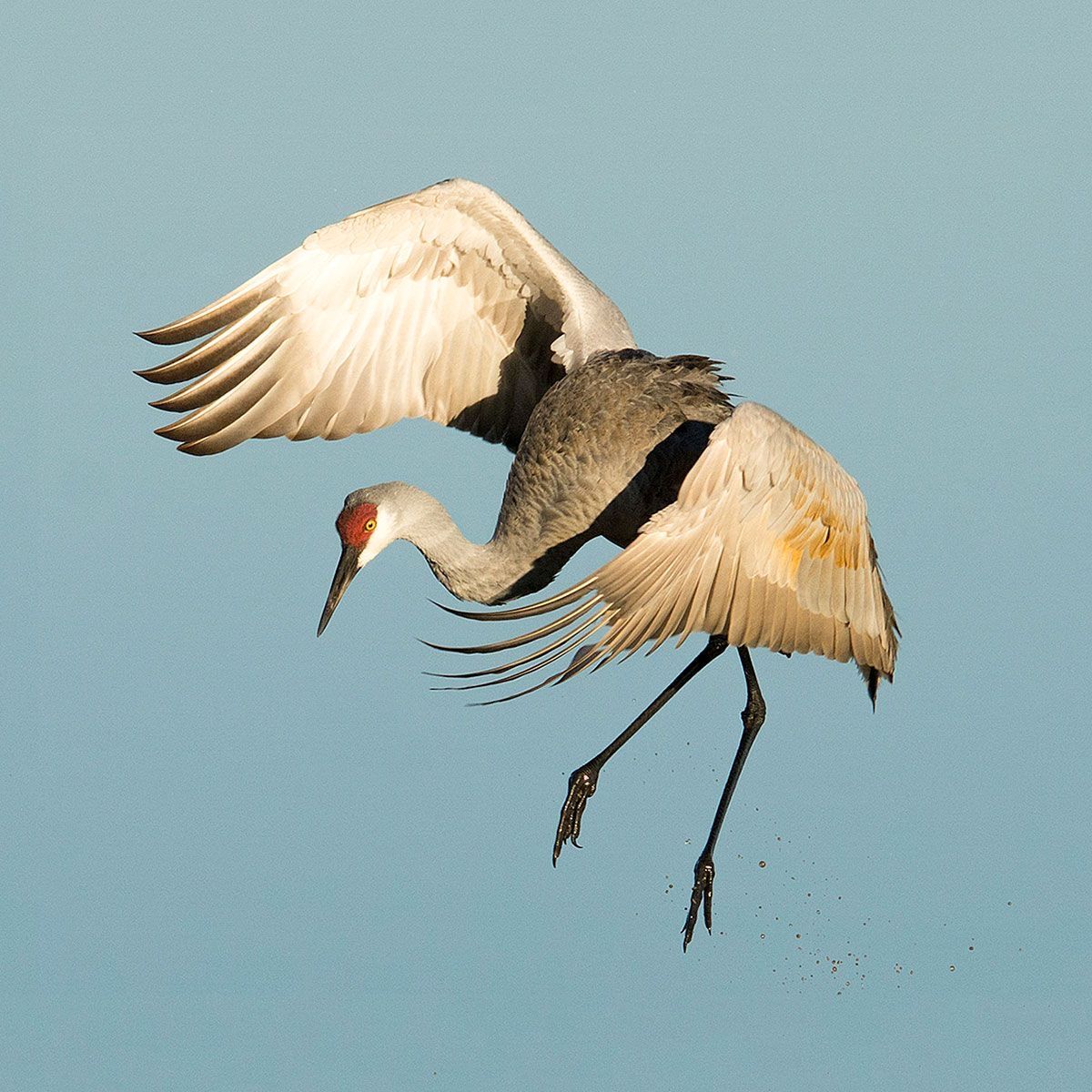
The sandhill crane is the most abundant crane species on Earth and one of the oldest continuous bird lineages alive today. Every spring, roughly 2.5 million sandhill cranes funnel through an 80-kilometre stretch of Nebraska's Platte River, producing the largest crane congregation on the planet and the single greatest avian assembly anywhere in North America.
The species is a tall grey wading bird with a bare red forehead, a bugling call that travels more than three kilometres, and a courtship dance elaborate enough to have inspired a century of ornithological writing.
This guide covers every major aspect of sandhill crane biology and ecology: taxonomy and the recent move from Grus to Antigone, the six recognised subspecies, body size, the famous Platte River staging, mated-for-life pair bonds, dance behaviour, diet, reproduction, conservation status, and the extraordinarily deep fossil history that makes this species one of the longest-surviving birds ever described.
It is a reference entry, not a summary - expect specifics: kilograms, kilometres, years, subspecies counts, and verified records.
Etymology and Classification
The scientific name Antigone canadensis reflects two things at once: a recent taxonomic reshuffle and the bird's long association with Canada. The species was originally described as Grus canadensis by Linnaeus in 1758, based on specimens from Hudson Bay. For more than two and a half centuries it sat inside the large genus Grus alongside most other cranes.
In 2016, comprehensive molecular phylogenies split Grus into three genera. The sandhill crane, the Australasian brolga, the sarus crane, and the white-naped crane moved into the resurrected genus Antigone, named for the mythological Greek princess who was turned into a crane in some tellings of the myth. Many older references still list the bird as Grus canadensis, and both names remain in active use.
The common name has nothing to do with beaches. It comes from the sand hills of Nebraska's prairie, where the central migratory flock has staged for thousands of years - long before European settlers named the landform. Spanish speakers in Mexico call the bird grulla gris (grey crane). Various Indigenous North American languages have their own names rooted in the bird's call, its dance, or its seasonal arrival.
The sandhill crane sits inside the family Gruidae, the true cranes, which contains 15 living species across four genera. Gruidae in turn belongs to the order Gruiformes, an ancient lineage whose living members also include rails, coots, trumpeters, and limpkins.
Fossil cranes resembling the sandhill have been recovered from sediments dated to more than 9 million years, and some analyses push the species itself past 10 million years - a depth of evolutionary history rivalled by very few modern birds.
Subspecies
Six subspecies of sandhill crane are recognised, falling into two clear ecological groups.
Migratory subspecies:
- Lesser sandhill crane (A. c. canadensis) - smallest and most numerous; breeds in Alaska, Arctic Canada, and eastern Siberia; winters in Texas, New Mexico, and Mexico; makes up the bulk of the Platte River congregation.
- Canadian sandhill crane (A. c. rowani) - intermediate in size; breeds across boreal Canada; winters in the southern United States and Mexico.
- Greater sandhill crane (A. c. tabida) - largest subspecies; breeds in the upper Midwest, Great Lakes, and western Canada; winters in the south-eastern United States and along the Gulf Coast.
Resident (non-migratory) subspecies:
- Florida sandhill crane (A. c. pratensis) - restricted to Florida and parts of Georgia; roughly 4,000 to 5,000 wild birds; stable.
- Mississippi sandhill crane (A. c. pulla) - restricted to a single refuge in Jackson County, Mississippi; about 100 wild birds; Endangered; one of the rarest birds in North America.
- Cuban sandhill crane (A. c. nesiotes) - restricted to scattered savanna sites on Cuba and the Isle of Youth; perhaps 350 to 500 birds; Endangered.
The split between migratory and resident groups is relatively recent in evolutionary terms. Genetic work suggests the southern resident subspecies diverged from the migratory northern birds during the Pleistocene, taking shelter in warm refugia while the glaciated interior of North America was uninhabitable. When the glaciers retreated, the northern birds resumed long-distance migration while the southern ones kept the territories they had claimed.
Size and Physical Description
Sandhill cranes are tall, long-legged wading birds with sweeping wings, long necks, and a distinctive bugling voice. Sexual dimorphism is modest - males are slightly heavier than females but the sexes are essentially identical in plumage.
Overall dimensions:
- Height: 80 to 120 centimetres (31 to 47 inches)
- Wingspan: 1.7 to 2.3 metres (5.5 to 7.5 feet)
- Weight: 2.7 to 6.7 kilograms depending on subspecies and season
Lesser sandhill crane (smallest):
- Weight: 2.7 to 3.5 kilograms
- Height: roughly 80 to 95 centimetres
Greater sandhill crane (largest):
- Weight: 4.5 to 6.7 kilograms
- Height: 110 to 120 centimetres
- Wingspan: up to 2.3 metres
The adult plumage is dominated by soft dove-grey, paler on the belly and darker on the wings. Juveniles begin life with warm cinnamon-buff feathering that gradually fades to grey over two years.
A striking bare patch of skin on the forehead is bright red and packed with blood vessels - it is not painted, dyed, or feather-coloured, and it swells and deepens in shade when the bird is excited, courting, or threatened. The cheeks and throat are white. The bill is long, dagger-like, and grey-green. The legs and feet are long and dark.
Breeding adults frequently appear rusty red rather than grey because the birds deliberately smear their plumage with iron-rich mud. During feather-painting, the crane takes mud containing ferric oxide on its bill and works it through the feathers while preening. The stain binds to the feathers and persists until moult.
Ornithologists believe the behaviour functions as crypsis, blending the bird into the red-brown spring vegetation of the breeding grounds, although the exact evolutionary purpose is still debated.
Cranes are often confused with great blue herons at a distance. The quickest field mark is posture in flight: cranes fly with the neck fully extended, while herons tuck the neck back in a tight S against the body. Cranes also give a rattling bugle call that herons cannot produce.
Voice and the Unison Call
The bugling call of the sandhill crane is produced by an extraordinary anatomical specialisation. The windpipe, or trachea, coils inside the sternum in a long loop nearly a metre long. The extra length acts like a French horn or trumpet, producing a lower fundamental frequency and a much louder projected sound than the bird's body size would otherwise allow.
A single sandhill crane call can be heard more than 3 kilometres away across open country, and in winter the combined voices of a staging flock at the Platte River are audible at distances of over 5 kilometres.
Mated pairs produce a coordinated duet known as the unison call. The sequence is precisely structured: the male gives a single lower-pitched call, and the female answers with two higher-pitched notes, with the pattern repeating several times. Each pair's unison call is individually recognisable - researchers can identify specific birds by their call signature.
The duet is produced every morning, before and after migration, and during territorial encounters. It functions both as pair-bond reinforcement and as a boundary signal to neighbouring pairs.
Chicks give soft rolling trill calls to stay in contact with their parents. Alarm calls are short, sharp barks. Flight calls during migration are a rapid, rattling, pulsing bugle that gives cohesion to large flocks in the air.
The Platte River Congregation
Every spring, between late February and early April, roughly 2.5 million sandhill cranes - about 80 per cent of the global population - concentrate along an 80-kilometre stretch of the Platte River in south-central Nebraska. This is the largest crane gathering on Earth and one of the great wildlife spectacles of the northern hemisphere.
The concentration has been happening for thousands of years, long before human settlement of the Great Plains, and fossil evidence suggests cranes have used the Platte corridor essentially unchanged through multiple ice ages.
The Platte works because of three overlapping resources packed into a small area:
- Shallow braided river channels. The Platte is unusually wide and shallow, with sandbars and gravel islands where cranes roost in ankle-deep water at night. Standing in water is the cranes' primary defence against coyotes and other terrestrial predators.
- Surrounding cornfields. Waste grain left in harvested fields supplies the carbohydrate and fat that staging cranes need to fuel the final 3,000 to 5,000 kilometres of migration. Modern cranes can gain 10 to 20 per cent of body weight during a three-to-four-week stopover.
- Wet meadows. The Platte's associated wetlands produce invertebrates - earthworms, snail, insects - that provide calcium, amino acids, and micronutrients. Without these, cranes cannot produce healthy eggs on the breeding grounds.
The spectacle of 2.5 million cranes returning to river roosts at sunset, calling continuously, is one of the densest acoustic environments produced by any wild bird population anywhere. After a three-to-four-week staging period the flock pushes north. Lesser sandhill cranes fly all the way to Arctic Alaska and Siberia; Canadian and greater sandhills fan out across boreal and temperate breeding grounds.
Migration
Migratory sandhill cranes cover some of the longest distances of any large bird in North America.
| Metric | Value |
|---|---|
| Typical one-way distance | 3,000 to 8,000 kilometres |
| Maximum one-day distance | ~650 kilometres |
| Typical cruising altitude | 900 to 1,800 metres |
| Maximum recorded altitude | 3,900+ metres |
| Typical cruising speed | 40 to 60 km/h |
| Flock size during migration | a few dozen to more than 10,000 |
Sandhill cranes migrate by day. They take off in the morning once thermals begin to form, climb in circling flocks, and then glide long distances between thermal columns. This soaring strategy uses almost no flapping flight and dramatically reduces energy consumption compared with continuous-flap migrators. The classic V-formation used by geese is also common in cranes but more variable - long lines, broad arcs, and shifting clusters are all seen.
Migration routes are learned. Juveniles follow their parents on their first southward journey and imprint on staging areas, routes, and wintering grounds. This cultural transmission is strong enough that individual sandhill populations use exactly the same traditional stopovers for generations, which is why the Platte River corridor has persisted as a bottleneck for thousands of years.
Breeding, Nesting, and Chicks
Sandhill cranes form lifelong monogamous pair bonds. Pair formation typically happens between two and seven years of age. Courtship is unhurried, elaborate, and public. The centrepiece is the famous crane dance.
The dance:
- Bows: birds bend forward, spread wings
- Leaps: birds jump up to 2.5 metres into the air
- Stick-tossing: a bird grabs a twig, clump of grass, or feather and throws it overhead
- Head-pumping: rapid up-and-down neck flexion
- Running with spread wings: short dashes with wings held wide
- Unison call: paired duet reinforcing the bond
Dance is not restricted to breeding. Juveniles dance for practice. Unpaired birds dance as part of mate selection. Mated pairs dance throughout the year, sometimes for no obvious reason. Captive birds will dance at their keepers, at shadows, and at objects, suggesting the behaviour is partly reflexive.
Once paired, the birds establish a breeding territory in shallow wetland - a sedge marsh, flooded meadow, bog, or wet prairie. Both adults build the nest, a large flat platform of piled vegetation in shallow water or on a small island. Females lay 1 to 3 eggs, almost always 2. Incubation lasts 29 to 32 days and is shared by both parents.
Chicks, called colts, are precocial. They hatch downy, eyes open, and can run within 24 hours. Within the first day they leave the nest permanently and begin following the adults across the wetland. Both parents feed the colts small insects and worms for the first weeks. Colts fledge at 65 to 75 days but remain with their parents for an unusually long 9 to 10 months, migrating with them and overwintering as a family before dispersing the following spring.
Only about 25 to 50 per cent of colts survive their first year. Causes of mortality include predation by coyotes, foxes, raccoons, raptors, and alligators in southern populations; exposure during cold snaps; and collisions with fences and power lines. Adults that reach independence enjoy extremely high annual survival - more than 90 per cent in most years.
Diet
Sandhill cranes are generalist omnivores. Dietary flexibility is one of the reasons the species has survived essentially unchanged through millions of years of climate change and continental reshaping.
Summer breeding diet (protein-heavy):
- Insects: grasshoppers, dragonflies, beetles, crane flies
- Earthworms and leeches
- Snails and small crustaceans
- Small vertebrates: mice, voles, frogs, snakes, lizards, nestling birds
- Tubers, shoots, berries, and seeds
Winter and migration diet (carbohydrate-heavy):
- Waste corn, wheat, barley, and sorghum from harvested fields
- Peanuts and soybeans in the south-eastern US
- Tubers and roots excavated from wet meadows
- Insects and invertebrates as supplement
The mid-continent population's dependence on agricultural grain is a relatively recent phenomenon, building up over the past century as corn acreage expanded across the Great Plains. Before intensive farming, staging cranes relied more heavily on native tubers and invertebrates. The modern shift to corn has almost certainly contributed to the population's increase but has also tied crane nutrition to farming practices in ways that can change quickly.
Lifespan and Age Records
Sandhill cranes are among the longest-lived birds of their size.
| Record | Value |
|---|---|
| Typical wild lifespan (adult survivor) | 20+ years |
| Oldest banded wild bird | 36 years 7 months (Wyoming recovery) |
| Oldest known captive bird | 37+ years |
| Annual adult survival rate | 90 to 95 per cent |
| First-year mortality | 50 to 75 per cent |
High adult survival combined with low annual reproductive output (a pair produces at most 2 fledglings per year and often fewer) means population growth is slow but steady when conditions are good. It also means the species cannot recover quickly from acute mortality events such as oil spills, mass poisoning, or disease outbreaks.
Evolutionary History
Sandhill cranes belong to one of the oldest continuous bird lineages on Earth. Fossil cranes whose bone structure is indistinguishable from the modern species have been recovered from sediments in Nebraska, Florida, and New Mexico dated to more than 2.5 million years ago, and some material may be as old as 10 million years.
This makes Antigone canadensis a candidate for the longest-surviving bird species ever identified. For comparison, modern humans (Homo sapiens) have existed for roughly 300,000 years.
The sandhill crane has persisted through glacial advances and retreats, sea level changes, the rise and fall of mammoth-dominated Pleistocene ecosystems, and the arrival of humans in the Americas. Its success reflects the combination of generalist diet, strong site fidelity, high adult survival, and the ability to learn migration routes culturally from parents rather than relying purely on genetic instinct.
Conservation
The sandhill crane as a whole is classified as Least Concern by the IUCN, with a global population of more than 800,000 and a stable-to-increasing trend. Several subspecies, however, require urgent protection.
Population and status by subspecies:
| Subspecies | Estimated population | Status |
|---|---|---|
| Lesser sandhill | ~500,000-700,000 | Stable / increasing |
| Canadian sandhill | ~60,000-70,000 | Stable |
| Greater sandhill | ~100,000+ | Increasing |
| Florida sandhill | ~4,000-5,000 | Stable |
| Mississippi sandhill | ~100 wild | Endangered |
| Cuban sandhill | ~350-500 | Endangered |
Primary threats:
- Habitat loss. Draining of wetlands for agriculture and urban development removes both breeding habitat and migratory stopovers. The Platte River in particular has lost roughly 70 per cent of its historic flow to upstream damming and irrigation, narrowing the channels the cranes rely on.
- Power lines and fences. Collisions with transmission lines kill thousands of cranes annually along migration corridors. Line-marking programs reduce mortality significantly but are applied inconsistently.
- Hunting. Regulated crane hunting is permitted in several US states and Canadian provinces for the abundant mid-continent population. Poorly regulated hunting remains a concern for the endangered Cuban subspecies.
- Climate change. Shifting wetland hydrology, changing Arctic snowmelt timing, and altered spring weather patterns affect breeding success and migration timing.
- Poisoning. Lead shot, pesticides, and agricultural chemicals occasionally cause local mass mortality events.
Conservation measures have been notably successful for several subspecies. The Mississippi sandhill crane has been pulled back from the brink through intensive captive breeding, release programs, and strict refuge management. Platte River flow restoration agreements between Colorado, Wyoming, and Nebraska have stabilised critical staging habitat. The greater sandhill crane has expanded significantly across the upper Midwest in recent decades after near-extinction in the early 20th century.
Sandhill Cranes and Humans
Sandhill cranes have held cultural significance across North American Indigenous traditions for thousands of years, featuring in ceremonies, creation stories, and seasonal markers. The bird's dance, voice, and dramatic spring return made it a universal symbol of renewal across cultures whose territories overlapped with crane migration routes.
Modern crane tourism generates substantial economic activity. The Platte River migration draws tens of thousands of visitors to Nebraska every spring, supporting lodging, guiding, and conservation organisations across the corridor. Bosque del Apache National Wildlife Refuge in New Mexico, Jasper-Pulaski in Indiana, and Hiwassee Wildlife Refuge in Tennessee each host major gatherings that anchor regional wildlife tourism.
Regulated hunting of sandhill cranes is legal in 16 US states and several Canadian provinces. Hunters prize the species for its size and the quality of the meat, often referred to as the "ribeye of the sky." Annual harvests in the tens of thousands are considered biologically sustainable for the abundant mid-continent population but are strictly prohibited for the endangered resident subspecies.
Related Reading
- Bird Migration: The Longest Journeys in the Animal Kingdom
- Arctic Tern: The Longest Migration
- Bar-tailed Godwit: Non-stop Flight Champion
- Longest Animal Migrations on Earth
References
Relevant peer-reviewed and governmental sources consulted for this entry include the IUCN Red List assessment for Antigone canadensis (most recent update), the Cornell Lab of Ornithology's Birds of the World species account, US Fish and Wildlife Service recovery plans for the Mississippi sandhill crane, the International Crane Foundation's monitoring reports, and published research in The Auk, Journal of Wildlife Management, Waterbirds, and Condor: Ornithological Applications.
Population figures reflect the most recent consolidated estimates from the Central Flyway Waterfowl Council and the North American Crane Working Group.
Frequently Asked Questions
How big are sandhill cranes?
Adult sandhill cranes (Antigone canadensis) stand 80 to 120 centimetres tall with a wingspan of 1.7 to 2.3 metres. Weight varies dramatically between subspecies: the lesser sandhill averages 2.7 to 3.5 kilograms, while the greater sandhill can reach 4.5 to 6.7 kilograms. Males are slightly larger than females but look nearly identical in the field.
With their long legs, long necks, and sweeping wings they are among the tallest flying birds in North America - only the endangered whooping crane, which sometimes winters alongside them, stands taller.
Where do sandhill cranes live and migrate?
Sandhill cranes occupy North America and the Caribbean across six subspecies. The migratory lesser, Canadian, and greater sandhill cranes breed across Alaska, northern Canada, the upper Midwest, and parts of the Russian Far East, then winter in Texas, New Mexico, Arizona, California, Florida, and central Mexico. The resident Florida, Mississippi, and Cuban subspecies do not migrate at all.
The mid-continent flock funnels through Nebraska’s Platte River every spring, where up to 2.5 million birds stage for several weeks before pushing north to their breeding grounds.
Why do sandhill cranes gather at the Platte River?
Nebraska’s Platte River sits exactly at the narrowest point of the Central Flyway, and the shallow braided channels provide safe night roosting in water where predators cannot easily approach. Surrounding cornfields offer leftover grain for fattening, and wet meadows produce the invertebrates cranes need for protein.
Roughly 2.5 million cranes - about 80 per cent of the global sandhill population - use this narrow corridor between February and April to gain 10 to 20 per cent of their body weight before the final push to Arctic breeding grounds. It is the largest crane gathering anywhere on Earth.
Do sandhill cranes mate for life?
Yes. Sandhill cranes form lifelong monogamous pair bonds, typically established between the ages of two and seven. Pairs renew their bond each spring with a ritualised ‘unison call’ duet and elaborate dancing. If one partner dies, the survivor will eventually seek a new mate, but many birds spend multiple seasons single before re-pairing. Divorce has been documented but is rare.
Pair stability is linked directly to reproductive success - long-established pairs raise more chicks to fledging than recently formed ones because they coordinate territorial defence and chick care more efficiently.
What do sandhill cranes eat?
Sandhill cranes are generalist omnivores, which is a major reason the species has survived for millions of years through repeated climate shifts. Their diet shifts with season and habitat. During migration and winter they feed heavily on waste grain - corn, wheat, barley - in agricultural fields, which now supplies a major fraction of their energy budget.
In summer on breeding territory they switch to insects, earthworms, snails, small mammals, nestling birds, reptiles, amphibians, tubers, berries, and roots. Chicks are fed animal protein almost exclusively for the first several weeks, then gradually shift to the omnivorous adult diet.
Why do sandhill cranes dance?
Dancing is not only a courtship display. Sandhill cranes of all ages dance throughout the year. The dance involves bowing, leaping up to 2.5 metres, running with spread wings, tossing sticks and clumps of grass, and rapid head-pumping. For paired birds, dance strengthens the bond and synchronises hormonal cycles before breeding. For unpaired birds it is a key part of mate selection.
For juveniles it appears to be practice - young cranes dance alone or with siblings long before they are sexually mature. Captive cranes will dance at humans, at shadows, and at objects, suggesting the behaviour is partly reflexive and partly social.
Are sandhill cranes endangered?
The species as a whole is classified as Least Concern by the IUCN, with a global population of more than 800,000 and a stable or slightly increasing trend. The three migratory subspecies (lesser, Canadian, greater) are numerous and expanding in parts of their range.
However, two of the three resident subspecies are in serious trouble: the Mississippi sandhill crane has a wild population of roughly 100 birds restricted to a single Mississippi refuge, and the Cuban sandhill crane is similarly restricted and threatened by habitat loss and hunting. The Florida sandhill population is stable at around 4,000 to 5,000 birds.
How old do sandhill cranes get?
Sandhill cranes are extremely long-lived for their body size. Wild birds commonly reach 20 years if they survive the vulnerable first year, and banding records document individuals past 30. The oldest wild sandhill crane on record was a banded bird recovered at 36 years and 7 months in Wyoming. Captive sandhill cranes have exceeded 37 years.
First-year mortality is high - roughly 50 to 75 per cent of colts die before their first winter due to predation, weather, and accidents - but adult annual survival is 90 per cent or more, which is among the highest survival rates recorded for any bird.