
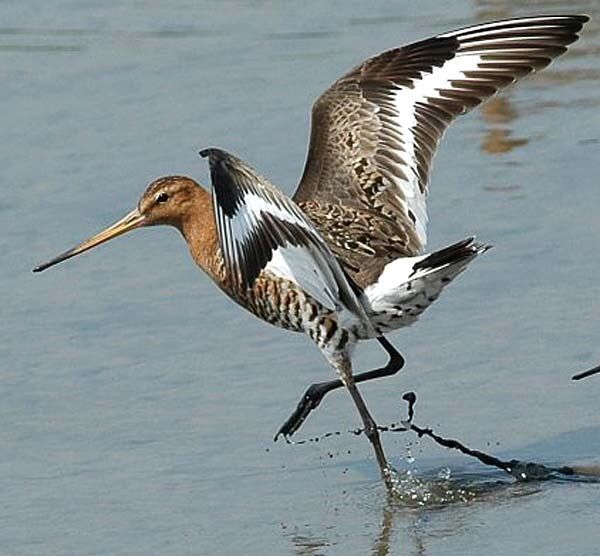
The bar-tailed godwit is the undisputed world record holder for non-stop bird flight. No other species - not the Arctic tern, not any albatross, not the wandering great frigatebird - flies as far in a single continuous effort as Limosa lapponica. A juvenile godwit tagged in Alaska in 2022 flew 13,560 kilometres in 11 days to Tasmania, without landing, without feeding, without drinking a single drop of water.
It slept on the wing. It burned its own internal organs for protein. It navigated an open Pacific crossing it had never attempted before.
This guide covers the biology, ecology, and strange edges of the bar-tailed godwit: its size and anatomy, the physiology of the record-breaking non-stop flight, the pre-migration fat loading and organ shrinkage, the sexual dimorphism in bill length, the discovery of the species' migration by Robert Gill and colleagues, and the conservation pressures now bearing down on the East Asian-Australasian Flyway.
It is a reference entry, not a summary - so expect specific numbers: kilometres, grams, percentages, and the verified records that anchor them.
Etymology and Classification
The scientific name Limosa lapponica was coined by Carl Linnaeus in 1758. The genus name Limosa comes from the Latin limus, meaning mud, a direct nod to the coastal mudflats where godwits feed in vast flocks. The species epithet lapponica means "of Lapland", reflecting the bird's breeding distribution across the far north of Europe.
In Maori the species is called kuaka, a word woven through New Zealand folklore as a signal of the changing of the southern seasons. Dutch and German coastal communities call the bird rosse grutto and Pfuhlschnepfe respectively, names rooted in the rust-red breeding plumage of adult males.
Taxonomically the bar-tailed godwit sits in the family Scolopacidae, the great sandpiper and snipe family, and in the order Charadriiformes, the wader and seabird order that also contains plovers, terns, auks, and gulls. The genus Limosa contains four species: the bar-tailed godwit, the black-tailed godwit (L. limosa), the Hudsonian godwit (L. haemastica), and the marbled godwit (L. fedoa).
Bar-tailed and black-tailed godwits diverged on the order of four to six million years ago, with the bar-tailed lineage specialising toward open-ocean migration and tundra breeding while the black-tailed lineage held to continental wetland habitats.
Five subspecies of bar-tailed godwit are currently recognised, differing in breeding range, wintering range, and migratory strategy. The Alaskan population - subspecies baueri - is the group that performs the record trans-Pacific flights. The Siberian population - menzbieri - uses the East Asian-Australasian Flyway via the Yellow Sea. European populations (lapponica and taymyrensis) winter around the Wadden Sea and West Africa.
Size and Physical Description
Bar-tailed godwits are medium-sized shorebirds with long legs, long upturned bills, and a streamlined body built for sustained flight.
Adult measurements:
- Body length: 37-41 cm from bill tip to tail tip
- Wingspan: 70-80 cm
- Standard weight: 190-400 g depending on sex and season
- Pre-migration peak weight: up to 600 g (roughly double standard mass)
- Bill length: 7.5-10.5 cm, with clear sexual dimorphism
Plumage (breeding male):
- Rich rust-red head, neck, and underparts
- Streaked brown upperparts
- Barred black-and-white tail (the feature that gives the species its common name)
- Dark slightly upturned bill with orange base
- Long blackish legs
Plumage (breeding female):
- Paler buff underparts with limited rust tone
- Similar streaked upperparts
- Longer bill with more prominent pale orange base
- Generally larger overall than the male
Non-breeding adults and juveniles lose most of the rust colouring, becoming overall grey-brown above and white below, with fine dark streaking on the breast. The barred tail remains diagnostic in all plumages.
The sexual dimorphism in bill length is one of the most pronounced among shorebirds. Female bills average 15 to 20 per cent longer than male bills and tend to be paler orange at the base, while male bills are darker and more uniformly coloured.
The most likely adaptive explanation is ecological niche partitioning on shared mudflat feeding grounds - the longer female bill probes deeper into sediment to reach larger, deeper-burrowing marine worms and bivalves, while males specialise on shallower, smaller prey. This division of foraging layers reduces competition between pair members and across mixed flocks at wintering sites.
Godwits have a distinctive silhouette in flight: long pointed wings, long trailing legs, and a straight neck. Flight is rapid, powerful, and low over water, often with dozens to thousands of birds moving as a single coordinated flock.
Built for Non-Stop Flight
Almost every feature of the bar-tailed godwit's biology is an answer to the same engineering problem: how do you fly for 11 days over open ocean without stopping to refuel? The solution is a coordinated physiological and behavioural programme unlike anything in other birds.
Pre-migration fat loading:
- Birds feed intensively at staging sites for four to six weeks
- Body mass increases from ~300 g to nearly 600 g
- Fat deposits form beneath skin and around visceral organs
- Fat can reach 55 per cent of total body weight by departure
- Muscle tissue hypertrophies in the pectoral region to handle the heavier body
Organ remodelling:
- Digestive tract shrinks by 20-25 per cent before departure
- Liver and kidneys reduce in mass
- Leg muscles atrophy because legs will not be used for 11 days
- Flight muscles enlarge to compensate
- Total body re-engineering takes roughly three weeks
In-flight metabolism:
- Fat is the primary energy source, burned at a metered rate to last 11 days
- Protein from shrinking organs provides secondary fuel and amino acids
- Metabolic water from fat oxidation supplies hydration needs
- Heart rate and respiratory rate settle into an efficient cruise state
- Body temperature is maintained within a narrow window across a wide range of external conditions
Unihemispheric sleep:
- One cerebral hemisphere enters slow-wave sleep while the other controls flight
- Sleep episodes last seconds to minutes, alternating between hemispheres
- The eye on the sleeping side often closes; the other remains open
- No full shutdown occurs at any point during the crossing
The consequence of this design is an animal that arrives in New Zealand or Australia exhausted but alive, with visibly shrunken internal organs and dramatically lower body mass. Recovery takes one to two weeks of continuous feeding on productive mudflats. Organs regrow, fat reserves are restored, and the bird prepares for months of normal wintering life before the return journey via the Yellow Sea the following spring.
The Longest Non-Stop Flight on Earth
The bar-tailed godwit's trans-Pacific crossing is the headline fact of the species and the reason it appears in almost every textbook on bird migration. The scale has only become clear in the last two decades, since satellite telemetry and lightweight GPS tags made it possible to track individuals through an entire crossing.
Headline numbers:
| Metric | Value |
|---|---|
| World record non-stop flight | 13,560 km in 11 days (bird 234684, 2022) |
| Typical Alaska-New Zealand leg | 11,000-12,000 km |
| Flight duration | 8-11 days continuous |
| Average ground speed | 50-60 km/h |
| Peak tailwind-assisted ground speed | 90+ km/h |
| Typical cruising altitude | 1,000-4,000 m |
| Peak recorded altitude | ~6,000 m |
| Fat reserves at departure | 45-55 per cent of body mass |
The record crossing belongs to a juvenile godwit tagged in Alaska in September 2022. The bird - officially bird 234684, following the 4BBRW colour-band system used in shorebird research - departed the Kuskokwim Delta on 13 October 2022 and landed in Ansons Bay, Tasmania, 11 days and one hour later, having covered 13,560 kilometres without a single stop.
The earlier record, held by a female known as E7 in the original 2007 Gill study, was 11,680 kilometres from Alaska to Piako River, New Zealand, in nine days.
The flight is not a great-circle line. Birds depart the Kuskokwim and Yukon-Kuskokwim Delta staging grounds in southwest Alaska when a specific weather window opens. That window requires the trailing edge of a large North Pacific low-pressure system, which generates consistent northerly tailwinds over the Bering Sea and North Pacific.
Birds exploit these tailwinds for the first three to five days of the flight, covering enormous distances at low energetic cost. Beyond the tailwind zone they rely on their own flight power for the remaining days, crossing equatorial doldrums, navigating the trade wind belt, and approaching the Australasian coast from the north.
Pacific northbound migration follows a different pattern. Birds leave New Zealand and Australia in March and April, fly northwest to staging grounds around the Yellow Sea in China and South Korea, refuel for several weeks, and then make a final 6,000-kilometre leg to Alaska in May.
The northbound route is split into two legs precisely because the Yellow Sea tidal flats are rich enough to support the entire flyway - or were, until a wave of industrial reclamation gutted them over the past three decades.
The most important single insight from tracking work is that bar-tailed godwits time their departure from Alaska to specific synoptic weather patterns rather than astronomical dates. Birds wait, sometimes for days, at the staging site, reading wind direction and atmospheric pressure. When the right pattern arrives they launch en masse. Birds that mistime their departure pay the price in exhaustion or mortality over the open ocean, where no alternative is available.
Discovery of the Migration
The modern understanding of bar-tailed godwit migration is a story of dogged field research by a small team of biologists.
Pre-satellite era:
Early twentieth-century leg-band recoveries established that Alaskan godwits reached New Zealand, but could not prove the crossing was non-stop. Many biologists assumed the birds stopped somewhere in the Pacific - perhaps on Pacific islands, perhaps on ships - and the full truth was unknowable with contemporary technology.
The E7 revelation (2007):
In 2007, Robert Gill of the US Geological Survey Alaska Science Center, working with colleagues including Lee Tibbitts, Phil Battley, Jesse Conklin, and Theunis Piersma, fitted a small number of female godwits with 26-gram satellite transmitters at Alaskan staging sites.
One bird, designated E7, transmitted continuously for nine days as she flew 11,680 kilometres from the Yukon-Kuskokwim Delta directly to the Piako River estuary in New Zealand, never stopping. The transmission ended an 80-year speculation about whether the crossing was non-stop. It was.
Scaling the research (2010s):
Over the next decade Gill's group and research partners at Massey University in New Zealand, the Global Flyway Network, and the University of Groningen fitted progressively lighter and more capable tags to hundreds of birds. GPS transmitters replaced satellite units. Colour-band identification systems allowed individual birds to be tracked year after year.
The 4BBRW-style banding protocol assigned unique four-letter colour codes to each bird, enabling birders and researchers across the flyway to log sightings and piece together full annual cycles.
The 234684 record (2022):
Bird 234684 was a juvenile male tagged in autumn 2022 as part of an ongoing study by the US Geological Survey and the Global Flyway Network. His track set the current verified world record: 13,560 kilometres in 11 days to Tasmania. The record reflects a combination of exceptional tailwinds on that particular Pacific crossing, favourable low-pressure system positioning, and the individual bird's condition at departure. Subsequent crossings have come close but not yet surpassed the 2022 number.
Diet and Feeding Behaviour
Bar-tailed godwits are tactile probers of soft sediment, using the long sensitive bill to detect invertebrate prey buried in mudflats and estuarine sediments. Their whole feeding strategy is built around probing cycles rather than visual hunting.
Primary prey on wintering grounds:
- Polychaete marine worms (Nereis, Abarenicola, Nephtys and related genera)
- Bivalves (small mussels, cockles, venerids)
- Small crustaceans (amphipods, crabs)
- Marine snails on productive mudflats
Primary prey on breeding grounds:
- Adult and larval insects (craneflies, beetles, midges)
- Spiders and other tundra arthropods
- Occasional seeds and berries during poor insect years
Probing technique:
- The godwit walks slowly across the mudflat surface with a measured, head-down posture.
- The long bill is inserted vertically into the sediment to a depth of several centimetres.
- Sensitive nerve endings at the bill tip (Herbst corpuscles) detect prey vibrations and tissue.
- When a worm or bivalve is located, the bird grips and withdraws it, often with visible tension through the whole body.
- Prey is rinsed in a shallow pool if available, then swallowed whole.
Probing depth depends on bill length, so the sex difference matters directly. Females reach deeper-burrowing worms and larger prey; males focus on shallower layers. During peak staging periods at sites like the Yellow Sea tidal flats, godwits feed almost continuously during low tide, roosting in dense flocks when water covers the mudflats.
A staging bird at peak refuelling ingests several grams of worm and bivalve biomass per hour. Over a typical three-week staging stop the bird converts perhaps 150 grams of prey tissue into 250 grams of fat and flight-muscle hypertrophy - an apparent mass-balance paradox explained by extraordinary assimilation efficiency and by using dietary water to support tissue growth without storing it as dead weight.
Breeding Season and Parental Care
The bar-tailed godwit's breeding life is compressed into about eight to ten weeks in the Arctic summer. Timing has to align with insect emergence, snow melt, and long photoperiods of near-continuous daylight.
Annual breeding cycle:
- Late May to early June: arrival at tundra breeding grounds
- Early to mid-June: pair formation, territorial display, nest site selection
- Mid-June: egg laying (clutch of 3-4 eggs, usually 4)
- Mid-June to early July: incubation (20-22 days), shared by both parents
- Early July: chicks hatch
- Late July: chicks fledge at 28-30 days
- August: adults depart staging grounds; juveniles follow independently weeks later
Nests are simple scrapes in tundra vegetation - shallow depressions lined with lichens, moss, and dry grass. Pairs are typically monogamous within a season, with both adults defending the nest and incubating in alternating shifts. Territorial display flights involve long, high, undulating aerial passes above the tundra accompanied by a loud musical call.
Chicks are precocial - down-covered, mobile, and self-feeding within hours of hatch. Parents lead chicks to insect-rich wet tundra but do not feed them directly. Adult males typically take the lead in chick defence, performing distraction displays and alarm calls when predators approach. Main predators of eggs and chicks are jaegers, gulls, and Arctic foxes.
Adult females typically depart the breeding grounds first, followed by adult males, and finally by juveniles. Juveniles make their first southbound migration - including the record-breaking Pacific crossing for Alaskan birds - without parental guidance. The route and timing framework are therefore innate, not learned, which places godwits among the most striking examples of genetically encoded long-distance navigation in any animal.
Populations and Distribution
Bar-tailed godwits are distributed across every inhabited continent except South America and Antarctica, with different subspecies using different flyways.
Subspecies and flyway distribution:
| Subspecies | Breeding range | Wintering range | Flyway |
|---|---|---|---|
| baueri | Alaska | New Zealand, eastern Australia | Central Pacific (non-stop) |
| menzbieri | Siberia (Yana-Indigirka region) | Northern Australia, SE Asia | East Asian-Australasian (Yellow Sea) |
| anadyrensis | Anadyr region, Chukotka | Australia | East Asian-Australasian |
| lapponica | Scandinavia, NW Russia | Western Europe, West Africa | East Atlantic |
| taymyrensis | Central Siberia (Taymyr) | West Africa (Banc d'Arguin) | East Atlantic |
Global population estimates sit around 1.1 million individuals. The East Asian-Australasian Flyway populations (menzbieri and related forms) have declined most sharply over the past three decades, with peer-reviewed estimates of 60 per cent or more population loss in some subpopulations since the late 1990s.
The Alaskan baueri population is also in measurable decline, though slower than the menzbieri group. European and African wintering populations are more stable but still exposed to cumulative pressures.
Conservation Status and Threats
The IUCN Red List classifies the bar-tailed godwit as Near Threatened with a decreasing global population trend. The threats driving decline are concentrated at the flyway's most critical bottleneck: the staging mudflats of the Yellow Sea.
Primary threats:
- Yellow Sea tidal-flat reclamation. Industrial conversion of intertidal mudflats in China and South Korea for ports, factories, airports, and aquaculture has destroyed roughly 65 per cent of historical tidal-flat area around the Yellow Sea since the 1950s. The Saemangeum reclamation in South Korea, completed in 2006, alone eliminated 400 square kilometres of critical staging habitat. Godwits and other shorebirds using the East Asian-Australasian Flyway cannot replace these staging sites - there is nowhere else to go.
- Climate-driven shifts in wind patterns. Non-stop flights depend on predictable tailwinds from trailing low-pressure systems. Changes in Pacific storm track frequency, intensity, and position can extend or shorten the window available to departing birds. Paradoxically, some recent crossings have benefited from stronger tailwinds, which is part of why the 2022 record was set, but the long-term trend is toward greater unpredictability.
- Arctic breeding ground changes. Thawing permafrost, shifting insect emergence, and changes to tundra hydrology alter the match between chick demand and prey availability. Mismatch leads to reduced fledging success.
- Coastal disturbance at wintering sites. Dogs, off-road vehicles, recreational activities, and urban development at estuaries in New Zealand, Australia, and Europe cause roost abandonment and reduce feeding time.
- Plastic pollution and marine debris. Fine plastic fragments ingested on mudflats contaminate the food web and reach godwit tissues.
- Avian influenza and other disease. Large dense flocks at staging sites create conditions for rapid disease transmission; the 2021-2023 global H5N1 outbreak has affected multiple shorebird species including godwits at some sites.
Conservation measures:
- International protection under the Convention on the Conservation of Migratory Species (CMS), the East Asian-Australasian Flyway Partnership, and bilateral migratory bird agreements.
- UNESCO World Heritage inscription of parts of the Yellow Sea coast in 2019 (China) with commitments to protect remaining tidal flats.
- National reserves protecting key wintering sites in New Zealand (Miranda, Farewell Spit), Australia (Roebuck Bay, Corner Inlet), and Europe (Wadden Sea).
- Long-term banding and GPS tracking programmes that inform flyway-scale management.
The long-term outlook depends on whether the remaining Yellow Sea tidal flats are retained, whether Arctic breeding conditions remain viable, and whether Pacific wind systems continue to support non-stop crossings. Local conservation at wintering sites helps but cannot compensate for staging habitat loss or climatic shifts over the open ocean.
Bar-Tailed Godwits and Humans
The bar-tailed godwit occupies a unique place in Maori and Pacific Rim cultures. In New Zealand the species is called kuaka, and its annual arrival in late September and departure in March are embedded in oral tradition, calendars, and seasonal rituals.
The kuaka features in the whakatauki (proverb) "Kua kite koia koe i te kohanga kuaka?" - "Have you ever seen the nest of the kuaka?" - a rhetorical device used to describe things rare or impossible to witness, because the kuaka's breeding grounds in Alaska were entirely unknown to Maori for centuries.
Since Gill's 2007 revelation, the bar-tailed godwit has become an international symbol of long-distance migration. New Zealand schoolchildren follow individual tagged birds via public tracking websites during the southbound migration each September and October. Australian, European, and East Asian conservation groups use the species as a flagship for flyway-scale protection efforts. The 2022 record-breaking flight of bird 234684 was reported in newspapers worldwide.
For ordinary observers the bar-tailed godwit offers the same reminder as other extreme migrants: small animals can do enormous things. A bird that weighs less than a pound - roughly the mass of a paperback book - flies from the Arctic to Tasmania in a single continuous effort, without stopping, without drinking, without landing. It does it for the first time with no parental guidance. It does it again, twice a year, for 15 to 20 years.
Related Reading
- Arctic Tern: The Pole-to-Pole Migrant
- Bird Migration: The Longest Journeys in the Animal Kingdom
- Longest Animal Migrations on Earth
- Barn Swallow: Continental Migrant
References
Relevant peer-reviewed and governmental sources consulted for this entry include Gill et al. (2009) "Extreme endurance flights by landbirds crossing the Pacific Ocean" in Proceedings of the Royal Society B, Battley et al. (2012) "Contrasting extreme long-distance migration patterns in bar-tailed godwits" in Journal of Avian Biology, Conklin et al.
(2021) reviewing bar-tailed godwit flyway ecology, US Geological Survey Alaska Science Center tracking data releases (2007-2023), the 2022 Global Flyway Network record announcement for bird 234684, IUCN Red List assessments for Limosa lapponica, BirdLife International species factsheets, and the East Asian-Australasian Flyway Partnership status reports on Yellow Sea staging habitat.
Population figures reflect consolidated estimates from the most recent BirdLife International assessment and the 2023 flyway population review.
Frequently Asked Questions
How far can a bar-tailed godwit fly without stopping?
The bar-tailed godwit (Limosa lapponica) holds the verified world record for the longest non-stop flight by any bird. A juvenile tagged in Alaska and identified as bird 234684 flew 13,560 km to Tasmania in 11 days during the autumn of 2022, without landing, feeding, or drinking. Routine annual migration distances for the Alaska-New Zealand subspecies (L. l. baueri) run from 11,000 to 12,000 km per leg.
GPS-satellite tracking since 2007, led by Robert Gill of the US Geological Survey, has confirmed dozens of crossings in the 11-day range. No other bird species reliably performs continuous flights of comparable duration.
How do godwits fly for 11 days without eating or drinking?
Before migration, bar-tailed godwits nearly double their body mass. They feed intensively on mudflats in Alaska, converting marine worms and bivalves into subcutaneous and visceral fat reserves that can reach 55 per cent of total body weight.
During the flight itself the birds burn this fat at a carefully paced rate, and critically they also metabolise their own organs - the liver, kidneys, digestive tract, and leg muscles shrink by up to 25 per cent, yielding both protein and reduced drag. Water balance is maintained because fat metabolism produces metabolic water as a byproduct. On arrival the birds regrow their organs within days of resuming feeding.
Do bar-tailed godwits sleep during their non-stop flight?
Yes, but not in the way land animals sleep. Bar-tailed godwits use unihemispheric slow-wave sleep, the same adaptation documented in frigatebirds, swifts, and several other long-flight seabirds. One cerebral hemisphere enters a sleep state while the other remains awake and in control of flight. The eye corresponding to the sleeping hemisphere often closes. Sleep episodes last seconds to minutes and alternate between hemispheres over the full 11-day flight.
The birds never fully shut down in the air, and there is no evidence of sleep debt accumulating across the crossing.
Why do female bar-tailed godwits have longer bills than males?
Bill length sexual dimorphism in bar-tailed godwits is pronounced - females typically carry bills 15-20 per cent longer than males and with paler, more orange base tones compared with the darker male bills. The adaptive explanation most supported by ecological data is niche partitioning on shared mudflat feeding grounds.
The longer female bill probes deeper into sediment and targets larger, deeper-burrowing marine worms and bivalves, while males work shallower layers and smaller prey. This reduces competition between pair members and across mixed-sex flocks. Bill length is a reliable field mark for sexing adult birds.
Where do bar-tailed godwits breed and where do they winter?
Bar-tailed godwits breed across a circumpolar band of Arctic and sub-Arctic tundra: Alaska, northern Scandinavia, European Russia, and much of Siberia. Wintering grounds depend on subspecies and population. The Alaska-breeding baueri subspecies flies to New Zealand and eastern Australia, performing the record non-stop Pacific crossing.
Siberian and central Asian populations (menzbieri and related forms) use the East Asian-Australasian Flyway and winter in southeast Asia, northern Australia, and around the Yellow Sea. European and African populations winter on mudflats and estuaries from the Wadden Sea down through the coasts of West Africa. The total global range covers every inhabited continent except South America and Antarctica.
How did scientists discover the bar-tailed godwit's record flight?
The modern understanding of bar-tailed godwit migration emerged from a long-term research programme led by Robert Gill of the US Geological Survey in Anchorage, Alaska, working with colleagues including Lee Tibbitts, Jesse Conklin, and the late Phil Battley. Early leg-band recoveries hinted at enormous distances but could not confirm non-stop flight. In 2007 the team fitted satellite transmitters to female godwits at Alaskan staging sites.
One bird, designated E7, transmitted continuously during a 11,680 km flight from Alaska to New Zealand in nine days, ending decades of speculation. Since then, smaller GPS tags have been fitted to hundreds of birds, refining tracks and revealing the 2022 record by bird 234684 that flew 13,560 km in 11 days.
Are bar-tailed godwits endangered?
The IUCN Red List classifies the bar-tailed godwit as Near Threatened with a decreasing population trend. The global population is roughly 1.1 million individuals spread across several subspecies and flyways. The sharpest declines are in the East Asian-Australasian Flyway subspecies, driven by large-scale tidal-flat reclamation around the Yellow Sea in China and South Korea.
These mudflats are the critical northbound staging grounds where birds refuel between wintering grounds in Australasia and Arctic breeding sites. Loss of staging habitat has cut some flyway populations by more than 60 per cent since the late 1990s. Climate change, disturbance at estuaries, and plastic pollution add further pressure.
How do godwits navigate such long ocean flights?
Bar-tailed godwits navigate using a multi-sensor system that integrates a sun compass, a magnetic compass calibrated by the Earth’s geomagnetic field, star patterns at night, and a real-time reading of wind direction and atmospheric pressure.
Departure timing is the most remarkable component: birds wait at Alaskan staging sites for the specific tailwind window generated by the trailing edge of strong Pacific low-pressure systems, which typically provides four to six days of favourable tailwinds before birds must rely on their own flight power for the remainder of the crossing.
Juveniles performing their first migration have no parental guidance for the open-ocean crossing, indicating that the route and timing framework are largely innate rather than learned.