
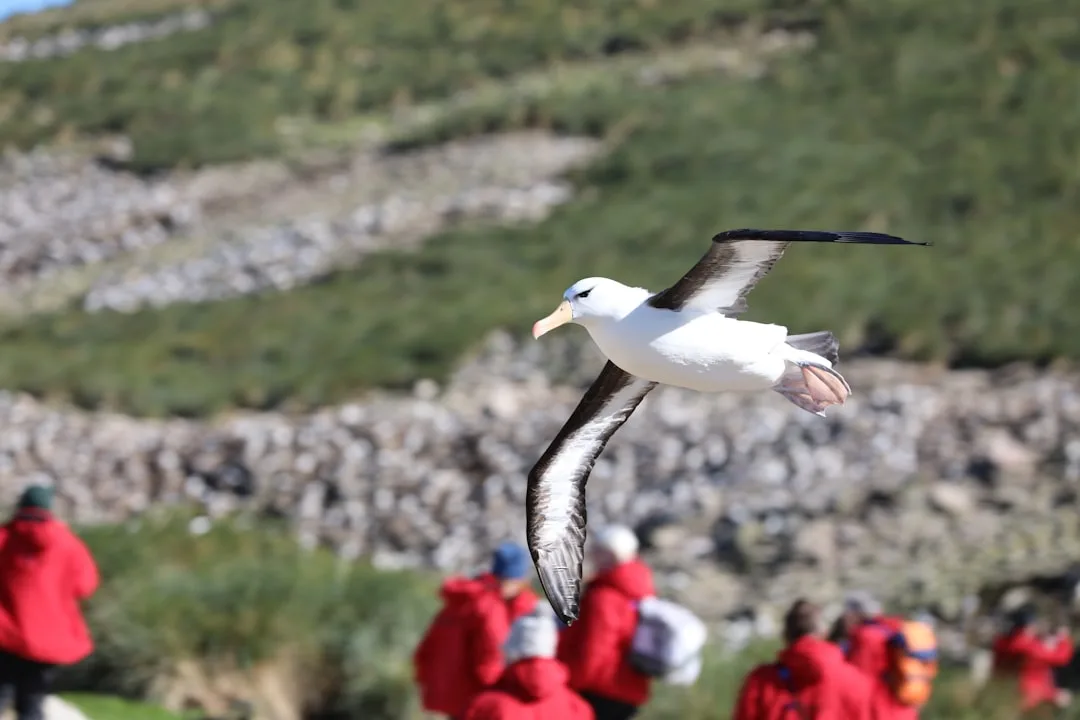
The wandering albatross is the bird with the largest wingspan alive today. Adult birds routinely carry wings 3.1 to 3.5 metres from tip to tip, and the record verified wingspan reaches 3.7 metres - broader than the height of most rooms. That enormous wing exists for one purpose.
Diomedea exulans is a specialist of the Southern Ocean, a circumpolar band of open water wrapped in near-constant westerly winds, and its life history is built around extracting free energy from that wind to cross oceans without flapping.
This guide covers every aspect of wandering albatross biology and ecology: size and physical adaptations, the physics of dynamic soaring, annual migration patterns, breeding cycle, feeding behaviour, conservation threats, and the cultural place of the albatross from Coleridge's "Rime of the Ancient Mariner" to modern bycatch campaigns. It is a reference entry, not a summary - expect specifics: wingspans, distances, weights, breeding success rates, and verified records.
Etymology and Classification
The scientific name Diomedea exulans was assigned by Carl Linnaeus in 1758 in the tenth edition of Systema Naturae. The genus Diomedea refers to Diomedes, a hero of the Trojan War whose companions were transformed into birds in Ovid's Metamorphoses. The species epithet exulans means "wandering" or "exiled" in Latin, a direct reference to the bird's habit of disappearing across the open ocean for years between visits to land.
The English common name "albatross" derives from the Arabic al-qadus, meaning a water-lifting bucket, which passed into Portuguese as alcatraz for various large seabirds. The spelling shifted under the influence of the Latin albus, meaning white, because sailors associated the birds with their pale plumage in mature adulthood.
The wandering albatross sits in order Procellariiformes - the "tubenoses" - alongside petrels, shearwaters, and storm petrels. All members of this order share tubular nostrils on top of the bill, which house a salt gland used to excrete excess salt absorbed from seawater.
The family Diomedeidae contains roughly 22 albatross species depending on taxonomic authority, most of them concentrated in the Southern Hemisphere.
Recent molecular work has split the traditional "wandering albatross" into a species complex, with the Tristan albatross, Antipodean albatross, and Amsterdam albatross now often recognised as distinct species, though Diomedea exulans sensu stricto remains the largest of the group.
Size and Physical Description
The wandering albatross is a bird built for sustained flight over open water. Everything about its proportions is unusual for a seabird.
Wingspan:
- Typical adult: 3.1-3.5 metres
- Record verified: 3.7 metres (Tasman Sea, 1960s)
- Aspect ratio: approximately 15 - close to a sailplane
Body dimensions:
- Body length: 1.07-1.35 metres (bill to tail)
- Standing height: roughly 1.2 metres
- Bill length: 14-17 centimetres, massive and hooked
Weight:
- Males: 8-12.7 kg
- Females: 5.9-10 kg
- Fledglings: up to 16 kg at peak, slimming before first flight
Plumage changes dramatically with age and is one of the most reliable ways to estimate an individual's maturity. Juveniles fledge in dark chocolate-brown feathers with a white face and throat. Across the following ten to twenty years they progressively whiten, starting from the body and spreading outward along the wings.
The oldest males become almost entirely white with narrow black wingtip margins and a pink wash across the breast and nape. Females retain slightly more dark pigmentation in the crown and upper wings. Because the whitening process is gradual and predictable, experienced biologists can estimate a bird's age from plumage alone within a range of a few years.
The bill is large, pale pink, and ends in a sharply hooked tip designed to grip slippery prey at the sea surface. The tubular nostrils on the upper mandible house a specialised salt gland that excretes concentrated brine, allowing the bird to drink seawater without dehydrating.
The feet are fully webbed, pink or pale flesh-coloured, and used primarily for braking on water landings and for paddling at the surface. Wandering albatrosses are awkward on land and cannot take off without a running start into the wind, which restricts breeding sites to windswept subantarctic islands with suitable launch slopes.
The Wing and the Physics of Dynamic Soaring
The wandering albatross is almost unique among birds in that its day-to-day flight is nearly free of metabolic cost. Two features make this possible: a tendon lock at the shoulder, and a technique called dynamic soaring.
The shoulder lock. A sheet of tendon passes across the shoulder joint and clicks into place when the wing is fully extended. With the lock engaged, no muscular effort is required to hold the wing out horizontally. An albatross in flight burns almost the same energy as an albatross sitting on water.
Heart rates of gliding birds have been measured at only a few beats per minute above resting levels, a remarkable figure for an animal weighing up to thirteen kilograms and travelling at highway speeds.
Dynamic soaring. Dynamic soaring exploits the wind-speed gradient just above the ocean surface. Friction with the water slows the wind closest to the waves; a few metres higher the air flows faster. The albatross rides this gradient in a repeating cycle:
- Climb into the wind. The bird banks up and turns its belly toward the incoming wind. Rising into faster-moving air increases relative airspeed and provides lift.
- Turn downwind at altitude. At the top of the climb the bird rolls and turns to face downwind.
- Descend downwind. Falling through the gradient, it continues to extract energy from the differential and accelerates.
- Pull up near the surface. Close to the waves, the bird turns back into the wind and begins the next climb.
Each cycle takes roughly ten seconds and covers 50 to 100 metres. The bird neither flaps nor glides in the conventional sense - it weaves continuously between layers of moving air. Sustained dynamic soaring can continue for hours and carry the bird hundreds of kilometres without a single wing beat.
Because the technique depends on a wind gradient, wandering albatrosses prefer wind speeds above 20 km/h and actively seek out the strong westerlies of the "Roaring Forties" and "Furious Fifties". In calm conditions the species is nearly grounded and may float on the sea waiting for wind to return.
Range, Migration, and Daily Movement
Wandering albatrosses are circumpolar in the Southern Ocean. They occupy a belt of open water between roughly 28 and 60 degrees south, covering tens of millions of square kilometres, and come ashore only to breed.
Travel data:
| Metric | Value |
|---|---|
| Typical foraging trip | 3,000-15,000 km per outing |
| Daily distance in good wind | 500-950 km |
| Maximum recorded daily total | ~950 km in 24 hours |
| Annual travel (tracked adults) | Up to 120,000 km/year |
| Circumnavigation of Antarctica | Every 46-60 days on average |
| Cruising gliding speed | 40-80 km/h |
| Peak gliding speed (strong wind) | ~130 km/h |
Tracking studies from the 1990s onward - among the first large-scale uses of satellite telemetry on seabirds - revealed that breeding adults split parenting duties between one bird on the nest and the other on multi-week oceanic foraging trips. A bird might depart South Georgia, sweep 10,000 kilometres across the South Atlantic to Patagonian shelf waters, and return to relieve its mate on the egg three weeks later having lost only a portion of the body mass gained in transit.
Juveniles and non-breeding adults are even more mobile. A tagged juvenile may not touch land again for five to ten years after fledging, wandering across the entire circumpolar band. One tracked bird completed three circumnavigations of Antarctica in under six months.
Males and females show subtle differences in preferred foraging latitudes. Males, slightly heavier and with broader wings, tend to range further south into windier waters near the Antarctic Convergence. Females more often forage in subtropical waters to the north. This spatial separation reduces competition between partners.
Feeding Ecology
Wandering albatrosses feed on prey taken from the sea surface, typically by seizing it in the bill while sitting on the water or in a low hover. They cannot dive deeply - maximum dive depth recorded is around one metre - and are not pursuit predators like penguins or cormorants.
Primary diet:
- Large oceanic squid (Kondakovia longimana, Moroteuthopsis longimana, and others) - 60-80 per cent of diet by mass
- Fish including lanternfish (Myctophidae) and Patagonian toothfish (Dissostichus eleginoides)
- Crustaceans in smaller quantities
- Carrion including marine mammal carcasses and fish discards
Foraging methods:
- Surface seizing. The bird lands on the water beside prey and grabs it with the hooked bill. This is the most common technique.
- Shallow plunging. A low dive from a metre or two above the surface to seize prey visible near the top of the water column.
- Ship following. Wandering albatrosses routinely follow fishing vessels, cargo ships, and research boats to scavenge discards, galley waste, and disturbed prey. This behaviour is evolutionarily ancient, documented by sailors for centuries, and now tragically misaligned with longline fishing where the same scavenging instinct pulls birds onto baited hooks.
Because large oceanic squid often float to the surface after mating or dying, and because albatrosses cannot pursue prey at depth, the species has effectively specialised on a sub-niche of surface-available cephalopods. Climate-driven shifts in squid distribution and abundance are therefore a direct conservation concern even where longline bycatch is controlled.
Breeding and Life Cycle
Wandering albatross reproduction is one of the slowest and most elaborate in the bird world. The full cycle from courtship to fledged chick takes approximately 280 days, which means a successful pair can raise only one chick every two years.
Breeding timeline:
- November to December: adults arrive at breeding colonies; courtship and pair bonding
- December to January: single egg laid in a pedestal nest of mud and vegetation
- January to March (early autumn): incubation shared between partners
- March onward (autumn through winter): chick hatches, brooded and guarded then left alone on nest
- Following summer: chick fledges at 270-280 days old
Courtship display. Pair bonding is marked by "sky-pointing", one of the most visually spectacular courtship displays in the bird world. Birds stand opposite each other, spread their wings fully to reveal their three-metre span, point the bill straight up, and emit long whining calls that rise into something between a bray and a whistle. Bill clapping and mutual preening follow. Young birds spend years learning and practicing these displays before pairing successfully.
Pair bonds. Wandering albatrosses are famously monogamous. A bonded pair typically stays together for life, which can mean 30 to 50 years of successful partnership. "Divorce" rates in long-term study colonies are low but non-zero, mostly following repeated breeding failure. Pairs that lose a partner may remain unpaired for years before attempting to re-bond.
The egg and chick. One enormous egg - roughly 11 centimetres long and 500 grams - is laid in a pedestal-shaped nest built of mud, peat, and tussock grass. Both parents incubate in shifts lasting 2 to 17 days, with the off-duty bird at sea. Hatching occurs 75 to 85 days after laying. The chick is brooded for about four weeks, then left unattended on the exposed nest while both parents forage, returning at widely spaced intervals to deliver regurgitated squid oil and prey fragments.
Fledging and dispersal. The chick spends the subantarctic winter alone on its nest, losing heat, gaining mass on irregular feeds, and shedding down as adult-style dark juvenile plumage grows in. Fledging occurs at 270 to 280 days. The juvenile flies directly out to sea and typically does not return to land for 5 to 10 years. First breeding attempts occur at ages 11 to 15.
Across a 50-year reproductive lifetime, a successful pair raises approximately 15 to 20 chicks to fledging. Compared with most birds this is extraordinarily low, and it means adult survival is the overwhelming driver of population dynamics. Losing breeding adults at rates above a few per cent per year - as longline fisheries do - rapidly drives populations into decline.
Population and Subspecies
The wandering albatross species complex has been progressively split in recent taxonomic revisions. Current IUCN treatment recognises Diomedea exulans (the nominate wandering albatross), Diomedea antipodensis (Antipodean albatross), Diomedea dabbenena (Tristan albatross), and Diomedea amsterdamensis (Amsterdam albatross) as separate species. Populations and trends below refer to D. exulans sensu stricto.
| Colony | Breeding pairs (approx.) | Trend |
|---|---|---|
| South Georgia | 1,100 | Declining |
| Crozet Islands | 2,000 | Stable to slight decline |
| Kerguelen Islands | 1,100 | Stable |
| Prince Edward / Marion | 3,100 | Stable to slight decline |
| Macquarie Island | 10 | Near-extinction locally |
Total global breeding population is estimated at roughly 20,100 pairs, corresponding to around 75,000 mature individuals when non-breeders are included. The South Georgia population has declined by more than 50 per cent since the 1970s. Macquarie Island was historically a large colony but was reduced to fewer than a dozen pairs by a combination of historic harvesting and fishery bycatch and is now at critical risk of local extinction.
Conservation Status and Threats
The IUCN Red List classifies wandering albatrosses as Vulnerable with a decreasing global population trend. The species is listed on the Convention on the Conservation of Migratory Species (CMS) Annex II and is covered by the Agreement on the Conservation of Albatrosses and Petrels (ACAP), signed in 2001 by most southern-ocean range states.
Primary threats:
- Longline fishing bycatch. Pelagic longline vessels set hundreds of thousands of baited hooks per day across the Southern Ocean. Albatrosses attempting to scavenge bait during line setting swallow hooks, are dragged under, and drown. Published estimates suggest longlines kill around 100,000 albatrosses of all species every year. Some wandering albatross populations lose five to seven per cent of adults annually to bycatch, which combined with the species' two-year breeding cycle produces rapid decline.
- Plastic ingestion. Wandering albatrosses routinely swallow floating plastic fragments mistaken for squid, and regurgitate them to their chicks. Chick stomachs at several colonies contain tens to hundreds of plastic items at fledging.
- Invasive mice. On some colonies, particularly Marion Island and Gough Island, introduced house mice have learned to attack live albatross chicks on the nest, consuming them alive over several nights. Mouse eradication programs are active but technically demanding on remote windswept islands.
- Climate-driven prey shifts. Changes in Southern Ocean productivity, squid distribution, and wind patterns alter foraging success. Warming ocean waters may also shift fishing-fleet distributions into closer overlap with albatross ranges.
- Historic harvest. Several colonies were reduced by 19th- and early-20th-century harvesting for feathers, eggs, and bait. Macquarie Island has not recovered to its pre-harvest population.
Conservation measures. Mitigation techniques pioneered by ACAP and implemented by responsible fisheries have shown dramatic results where adopted. Adding weighted branch-lines, streamer bird-scaring lines, night-setting, and underwater bait-setting chutes can cut seabird bycatch by 80 to 99 per cent.
Where these measures are enforced across entire fisheries - as in the South Georgia toothfish fishery - bycatch has fallen essentially to zero. Compliance varies widely across fisheries and flag states, and illegal, unreported, and unregulated fishing remains a major source of continued mortality.
The Albatross in Human Culture
Few birds carry as heavy a cultural load as the albatross. Sailors across centuries regarded the species as both guide and omen: a following albatross was considered good luck, and killing one was believed to bring disaster on the ship and crew. The superstition reflected real ecological intuition, since albatrosses follow productive water masses and storm systems that sailors also needed to understand.
Samuel Taylor Coleridge transformed this maritime lore into one of the most enduring poems in the English language. "The Rime of the Ancient Mariner", first published in 1798, follows a sailor who shoots an albatross that had guided his ship through Antarctic waters.
The rest of the poem is the protracted punishment of that act - his crew dies, his ship is becalmed, and the dead bird is hung around his neck as a literal and moral weight. The phrase "an albatross around one's neck" passed from the poem into everyday English to describe any burden of guilt or consequence.
Modern albatross biology has given the poem unexpected contemporary force. Images of dead chicks with stomachs full of cigarette lighters, bottle caps, and fishing floats - documented most famously on Midway Atoll with related Laysan albatrosses - have made the species an emblem of marine plastic pollution. Conservation campaigns against longline bycatch and for marine protected areas in the Southern Ocean regularly draw on the cultural resonance Coleridge created.
Related Albatross Longevity
Wandering albatrosses share the Diomedeidae family with several other long-lived species, and one individual in particular has become a case study in seabird longevity. Wisdom, a Laysan albatross (Phoebastria immutabilis) originally banded on Midway Atoll in 1956 at an estimated age of five or six, was still present on her breeding territory and laying eggs in 2024 at approximately 72 years old.
She has raised an estimated 30 to 40 chicks over her documented lifespan and is the oldest confirmed wild bird of any species in banding history.
Wisdom is not a wandering albatross, but her biology rhymes closely with D. exulans: a slow-breeding seabird with strong pair fidelity, long juvenile maturation, and extreme longevity. Verified wandering albatrosses in long-term study populations at South Georgia and Crozet have reached ages over 60, and banding effort has not yet been ongoing long enough to know the true upper limit for the species.
Biological signals - low adult mortality, slow telomere shortening, late senescence - suggest the true maximum lifespan could meaningfully exceed anything yet recorded.
Related Reading
- Arctic Tern: The Longest Migration on Earth
- Bar-Tailed Godwit: Non-Stop Transpacific Migration
- Bird Migration: The Longest Journeys in the Animal Kingdom
- Longest Animal Migrations on Earth
References
Relevant peer-reviewed and governmental sources consulted for this entry include IUCN Red List assessments for Diomedea exulans, BirdLife International species factsheets, Agreement on the Conservation of Albatrosses and Petrels (ACAP) species assessments, long-term demographic studies from the Centre d'Etudes Biologiques de Chize (CEBC) at Crozet and Kerguelen, British Antarctic Survey population monitoring at South Georgia, and published research in Proceedings of the Royal Society B, Journal of Avian Biology, Marine Ornithology, and Biological Conservation.
Dynamic soaring biomechanics draw on work by Pennycuick, Rayleigh, Richardson, and Sachs. Tracking figures reflect satellite telemetry datasets published between 1990 and 2024.
Frequently Asked Questions
How big is a wandering albatross wingspan?
Adult wandering albatrosses (Diomedea exulans) typically carry wingspans between 3.1 and 3.5 metres from tip to tip - the largest wingspan of any living bird. The record verified measurement reached 3.7 metres, taken from a bird caught in the Tasman Sea in the 1960s. Body length is modest by comparison at 1.07 to 1.35 metres, giving the species an exaggerated wing-to-body ratio evolved specifically for oceanic gliding.
Body mass ranges from 5.9 to 12.7 kilograms, with males roughly twenty per cent heavier than females. The long, narrow wings have an aspect ratio around 15, close to that of a high-performance sailplane.
How far does a wandering albatross fly?
GPS and satellite tracking studies show that individual wandering albatrosses cover up to 120,000 kilometres per year. A single foraging trip from a South Georgia nest often spans 3,000 to 15,000 kilometres over one to three weeks, with the bird returning to relieve its partner on the egg. Adults circumnavigate the Southern Ocean repeatedly - one tracked bird lapped Antarctica three times in 46 to 60 days each.
Juveniles leave the colony at fledging and do not return to land for five to ten years, accumulating travel distances in the millions of kilometres before their first breeding attempt.
What is dynamic soaring?
Dynamic soaring is a flight technique in which the albatross extracts kinetic energy from the wind-speed gradient just above the ocean surface, where friction slows the air closest to the waves. The bird climbs upwind into faster-moving air, turns downwind while losing altitude, accelerates across the boundary layer, and then uses that speed to climb again. Each cycle takes roughly ten seconds and covers 50 to 100 metres.
A wandering albatross can maintain this cycle for hours without a single wing flap, converting the wind gradient into essentially free transport. The species is so dependent on this technique that it cannot easily fly in calm air and prefers wind speeds above 20 km/h.
Where do wandering albatrosses live and breed?
Wandering albatrosses live across the Southern Ocean between roughly 28 and 60 degrees south, covering tens of millions of square kilometres of open water. They come ashore only to breed, and only on a handful of subantarctic islands: South Georgia in the South Atlantic, the Crozet and Kerguelen archipelagos in the southern Indian Ocean, Prince Edward and Marion Islands south of Africa, and Macquarie Island south of Tasmania.
Birds from different colonies intermix at sea but return faithfully to their natal island to breed. Outside the breeding season they disperse across the entire circumpolar band of westerly winds.
How long do wandering albatrosses live?
Wandering albatrosses routinely exceed 50 years in the wild, with banded individuals verified past 60 years old. Their related species include Wisdom, a Laysan albatross who has been laying eggs since 1956 and was confirmed still active at age 72 in 2024 - making albatrosses among the longest-lived wild birds on record.
Wandering albatrosses do not attempt their first breeding until age 11 to 15, spend 5 to 10 years maturing at sea beforehand, and then breed every second year if successful. Over a 50-year reproductive lifespan a bonded pair may raise only 15 to 20 chicks to fledging, one of the slowest reproductive totals of any vertebrate.
Why are wandering albatrosses endangered?
The IUCN lists wandering albatrosses as Vulnerable with a decreasing population trend. The primary threat is longline fishing bycatch: baited hooks set by tuna and toothfish vessels attract scavenging albatrosses which swallow the hooks and drown.
Estimates suggest pelagic longlines kill around 100,000 albatrosses of all species every year, with wandering albatross populations losing roughly five to seven per cent of adults annually in the worst-hit regions. Because the species reproduces so slowly - one egg every two years, first breeding after a decade - adult mortality has a direct, compounding effect on population trajectory.
Secondary threats include plastic ingestion, invasive mice that attack chicks at some colonies, and shifting prey distribution under climate change.
What do wandering albatrosses eat?
Wandering albatrosses are pelagic carnivores feeding primarily on squid, fish, and carrion taken from the sea surface. Cephalopods - especially large oceanic squid such as Kondakovia longimana and Moroteuthopsis longimana - make up roughly 60 to 80 per cent of the diet by mass. Fish (lanternfish, toothfish) and crustaceans supplement the core squid diet.
The species is a specialist surface feeder: it cannot dive deeply, typically reaching only one metre, and instead seizes prey floating at or just below the surface. Wandering albatrosses follow ships for galley waste and fishing vessels for discards, behaviour that repeatedly pulls them into lethal contact with longline hooks.
Why does the albatross feature in 'The Rime of the Ancient Mariner'?
Samuel Taylor Coleridge’s 1798 poem ‘The Rime of the Ancient Mariner’ uses the albatross as a symbol of natural innocence and moral consequence. In the poem a sailor shoots an albatross that had guided his ship through Antarctic waters, and his crew hang the dead bird around his neck as punishment - the origin of the phrase ‘an albatross around one’s neck’.
Coleridge drew on real sailor superstition that albatrosses carried the souls of drowned sailors and that killing one brought disaster. The poem crystallised the albatross in Western imagination as a creature whose destruction represents a deeper ecological and spiritual wrong, and its influence now extends to conservation campaigns addressing longline bycatch and plastic pollution in the Southern Ocean.