
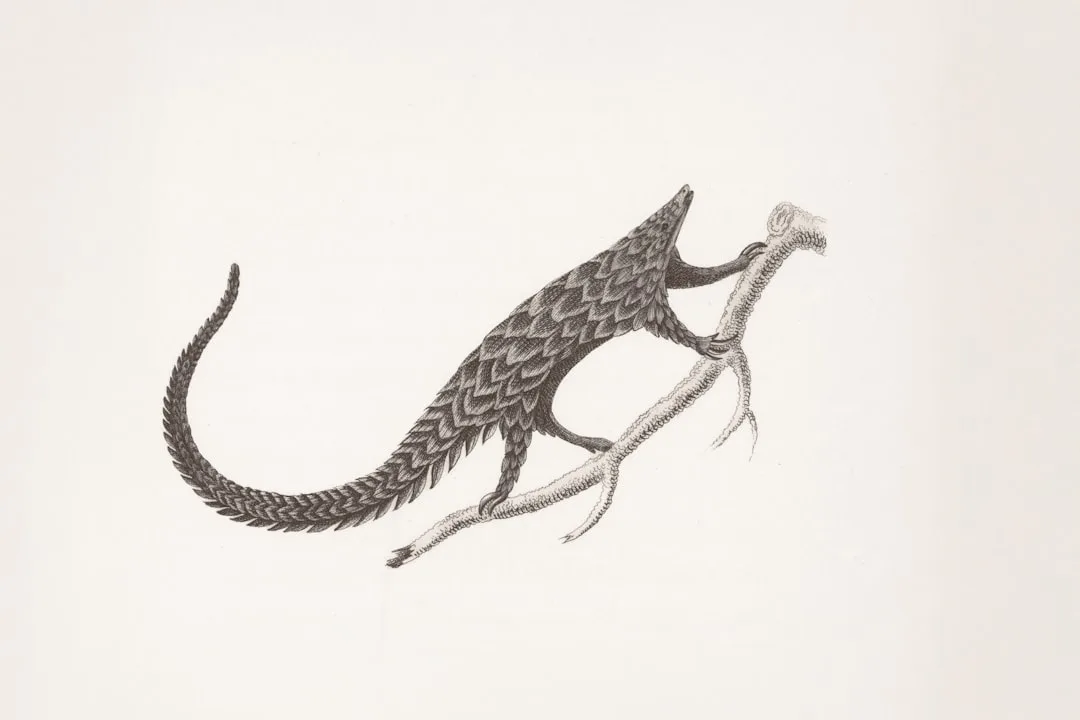
Hallucigenia sparsa is a tiny, worm-shaped Cambrian animal from the Burgess Shale of British Columbia, and it is probably the most famously misinterpreted fossil in the history of palaeontology.
For nearly forty years Hallucigenia was reconstructed upside-down and backwards - spines drawn as stilt-legs, legs drawn as feeding tentacles, head confused for tail - and it appeared in textbooks as a poster child for how bizarre the Cambrian fauna was. The animal turned out to be strange in real life too, just less strange than the reconstructions.
Hallucigenia was about 10 to 35 millimetres long, walked on seven pairs of small clawed legs, carried seven pairs of rigid spines on its back, and roamed the muddy floors of a shallow Cambrian sea some 508 million years ago.
This entry covers what Hallucigenia actually was, how it was collected and eventually understood, what the corrected reconstruction looks like, where it fits on the tree of life, and why it has become one of the defining images of the Cambrian explosion. Expect specifics: millions of years, millimetres, spine counts, tooth rings, and the slow process by which a fossil sitting in a Smithsonian drawer became one of the most recognisable animals of deep time.
Etymology and Discovery
The first specimens of Hallucigenia were collected at the Burgess Shale in the Canadian Rockies by Charles Doolittle Walcott, then Secretary of the Smithsonian Institution. Walcott worked the Burgess Shale quarry, high on the ridge above Field, British Columbia, between 1909 and 1924. He collected tens of thousands of fossils of soft-bodied Cambrian animals - a haul that remains one of the richest lagerstatte collections ever assembled.
Among the fossils were small, worm-shaped impressions only a centimetre or two long. Walcott studied them briefly and filed them under the polychaete worms - a broad group of marine annelids - and moved on to more eye-catching material like Marrella and Opabinia. The specimens went into labelled drawers at the Smithsonian, where they sat, largely untouched, for the next several decades.
Simon Conway Morris, then a graduate student at Cambridge working with Harry Whittington, took a serious second look at Walcott's soft-bodied Burgess Shale material beginning in the early 1970s. Whittington's group rewrote the Cambrian fauna over the course of a long re-description project, recognising that many of Walcott's "worms" and "shrimps" were actually members of extinct groups with no close relatives in modern oceans.
In 1977 Conway Morris published the formal description of Hallucigenia. He chose the genus name from the Latin verb hallucinari, meaning to wander in the mind or hallucinate, because the anatomy of the animal, as he read it, seemed dream-like and surreal. The species name sparsa means "few" or "scattered," referring to the relatively small number of specimens known at the time.
The name stuck, and so did the legend that went with it: Hallucigenia became shorthand for the idea that the Cambrian world was populated by creatures so alien that modern biology simply could not account for them.
Taxonomy and the Panarthropod Stem
Placing Hallucigenia on the tree of life took almost as long as getting its orientation right. Conway Morris originally described it as an enigmatic animal of uncertain relationships. Subsequent decades of work have produced a much firmer position.
Current classification:
- Kingdom: Animalia
- Superphylum: Ecdysozoa (the moulting animals)
- Group: Lobopodia (stem-group panarthropods with soft, worm-like bodies and paired clawed legs)
- Family: Hallucigeniidae
- Genus: Hallucigenia
- Species: H. sparsa
Hallucigenia belongs to the lobopodians, a cluster of extinct Cambrian animals with soft bodies and pairs of stubby limbs ending in claws. Lobopodians sit on the stem of the panarthropod tree - the branch that gave rise to three very successful living phyla:
- Arthropoda - insects, crustaceans, spiders, and their relatives
- Onychophora - velvet worms, about 200 living species in tropical leaf litter
- Tardigrada - microscopic "water bears" found almost everywhere
Among these, Hallucigenia's closest living relatives appear to be the velvet worms. Their stubby, clawed walking legs look uncannily similar to those of Hallucigenia, and a 2015 study of microscopic structures inside the Cambrian claws showed that they are constructed of nested elements almost identical to those in modern onychophoran claws.
Hallucigenia is not the direct ancestor of velvet worms - too many millions of years and too many branches separate them - but it is a close cousin that preserves the kind of body plan they branched from.
Size and Body Plan
Hallucigenia was small, even for a Cambrian lobopodian. Individual specimens span a size range from about ten millimetres to roughly thirty-five millimetres in total body length. The largest known specimens are about the size of a paperclip; most are closer to the size of a grain of rice.
Body outline:
- Length: 10-35 mm
- Shape: soft, worm-like, cylindrical trunk with a slightly bulbous head end
- Limbs: seven pairs of short, clawed legs underneath the trunk
- Spines: seven pairs of rigid, bony spines along the back
- Head: small, blunt, forward-facing, separated from the trunk by a short neck
- Tail: trailing soft section behind the last pair of legs, lacking clear appendages
The corrected reconstruction, published by Martin Smith and Jean-Bernard Caron in 2014 and refined in 2015, shows an animal that is basically a soft worm with two opposing series of appendages. On the ventral side it walks on seven pairs of tiny clawed legs. On the dorsal side it carries seven pairs of long, narrow spines that rise almost vertically from the body.
At the front end a simple head supports a pair of slender tentacles, a small mouth, and, as it turns out, a surprising amount of internal dental machinery.
The overall impression is much less "dream creature" and much more "armoured caterpillar" than earlier reconstructions suggested. The spines read as a defensive palisade rather than as walking stilts, and the legs read as sensible walking equipment rather than as waving tentacles.
The Famous Upside-Down and Backwards Story
The reason Hallucigenia is so widely discussed outside palaeontology is the story of how badly the original reconstruction got the animal's anatomy wrong. The short version: for nearly forty years, Hallucigenia was drawn upside-down and with its head and tail switched. The long version is a useful lesson in how science corrects itself.
The 1977 interpretation:
- The long, rigid spines were drawn as paired stilt-like legs.
- The short, soft, paired structures were drawn as a row of waving tentacles on the animal's back.
- The bulbous dark stain at one end was drawn as the head.
- The trailing soft section at the other end was treated as the tail.
That reconstruction gave Hallucigenia a wildly improbable silhouette: an animal walking on seven pairs of pointy stilts with a row of seven feeding tentacles waving above.
It became the mascot of the idea, promoted in Stephen Jay Gould's 1989 book Wonderful Life, that the Cambrian oceans were stocked with fundamentally alien body plans most of which went extinct without descendants. The reconstruction was so peculiar that it helped define the popular image of the Cambrian fauna for a generation.
The 2014 correction:
- The "stilt legs" are spines on the animal's back.
- The "tentacles" are legs along the animal's underside.
- The body must therefore be flipped top-to-bottom relative to the 1977 reconstruction.
- The dark stain Conway Morris had read as the head is probably a decay stain near the tail.
- The previously overlooked blunt end is the head.
Smith and Caron's 2014 paper in Nature combined fresh specimens from the Burgess Shale with detailed imaging and reinterpreted the orientation. A 2015 follow-up paper added the decisive detail: the head preserves a ring of microscopic teeth around the mouth and an inner pharynx lined with rows of additional denticles. Neither structure had been recognised before. With the teeth fixed in place, the orientation became unambiguous: spines on top, legs underneath, head at the previously ignored end.
Why the error persisted:
| Factor | Effect |
|---|---|
| Rarity of well-preserved specimens | Few clear views of legs and spines on the same fossil |
| Flattened preservation | Dorsal and ventral sides hard to tell apart in 2-D rock |
| Decay stains | Created misleading "head" blobs at the wrong end |
| Authority of 1977 description | Subsequent textbooks reused the original reconstruction |
| Absence of tooth data | Head-tail polarity remained ambiguous until 2015 |
The Hallucigenia correction is now used in classrooms as a case study in how palaeontology improves. The fossil was not bad. The preservation was extraordinary. The error sat in the interpretation, and it persisted partly because the original description was authoritative and partly because no one had examined the material in a way that resolved the head-to-tail question. When better imaging and new specimens arrived, the orientation flipped and stayed flipped.
Anatomy in Detail
With the orientation corrected, the anatomical details become coherent rather than surreal.
The legs: Seven pairs of short, stubby, soft appendages run along the ventral surface of the body. Each leg ends in a pair of nested claws. In shape, arrangement, and microscopic construction they resemble the walking legs of modern velvet worms very closely. The limbs are too small and too soft to have carried the animal quickly or far, but they are clearly built for contact with a solid surface - walking on mud, sand, or sponge bodies.
The spines: Seven pairs of long, rigid spines rise from the dorsal surface. They are mineralised, narrow, and slightly curved. Unlike the legs, the spines do not articulate with any joint; they emerge directly from the body wall. Their arrangement, always in paired rows and always on the back, indicates a defensive role. A predator closing in from above would have to contend with two rows of sharp, needle-like points before reaching the soft trunk.
The head: Small, blunt, and separated from the trunk by a narrow neck region. It carries a pair of slender appendages that may be feeding tentacles, sensory antennae, or both. The mouth opens at the front and is encircled by a ring of microscopic denticles. Beyond the mouth, the pharynx - the first part of the digestive tract - is lined with rows of tiny teeth arranged in regular spiral patterns.
The internal teeth: The 2015 discovery of the dental ring and pharyngeal teeth was decisive in two ways. First, it nailed down the head end once and for all. Second, it established a clear anatomical link with other panarthropods and especially with velvet worms, whose pharynx also contains an arrangement of cuticular teeth used in feeding. The Hallucigenia teeth are microscopic - tens of micrometres across - but they are abundant and well-preserved.
The trunk: Soft, cylindrical, and unarmoured apart from the dorsal spines. The body wall consists of a cuticle similar to that of modern onychophorans, with traces of the annular ridges typical of lobopodians. The gut is sometimes preserved as a dark trace running the length of the body.
Life and Lifestyle
Reconstructing the behaviour of a ten-millimetre Cambrian animal is an exercise in careful inference. For Hallucigenia the inferences are supported by anatomy, by specimens preserved in life-like positions, and by the ecology of the Burgess Shale community as a whole.
Likely lifestyle:
- Walked slowly on the Cambrian seafloor using seven pairs of clawed legs
- Lived among sponges, often in direct contact with sponge bodies
- Fed on sponge tissue, associated organic matter, or detritus
- Used dorsal spines as defence against small predators
- Probably solitary, with no evidence of swarming or schooling
Many Hallucigenia specimens are preserved draped across or alongside sponge fossils. That association is striking and repeats across specimens, suggesting that Hallucigenia was not merely swept into the same mud as the sponges but actually lived on or with them. Whether it grazed on sponge tissue, on microbial films growing on sponges, or simply used sponges as cover is unclear.
The dental apparatus, with a ring of outer teeth and a lined pharynx, is consistent with a sucking or rasping feeding mode compatible with any of those possibilities.
A useful mental image: imagine a soft, short caterpillar crawling slowly across a sponge garden on the floor of a dim Cambrian sea, raising no more than a millimetre off the bottom, its seven pairs of small clawed feet finding purchase on rough surfaces, its seven pairs of needle-like spines angled upwards as a deterrent. That is not a caricature. It is what the anatomy and the co-preservation data say the animal was doing.
The Burgess Shale: Why the Fossils Exist
Hallucigenia is preserved only because it died in one of the most extraordinary fossil sites on Earth. The Burgess Shale is a lagerstatte - a rock unit that preserves soft tissues alongside hard parts with unusual fidelity.
Burgess Shale at a glance:
| Attribute | Value |
|---|---|
| Age | Middle Cambrian, ~508 million years ago |
| Location | Yoho National Park, British Columbia, Canada |
| Discovery | Walcott's quarry, 1909 |
| Environment | Muddy slope below a carbonate reef on a shallow tropical sea |
| Preservation | Rapid burial in anoxic mudslides, tissues preserved as films |
| Biota | Hundreds of species of Cambrian animals, mostly soft-bodied |
The Burgess Shale community lived on a muddy slope next to a carbonate reef in a shallow tropical sea that lay across the equator during the Cambrian. Periodic mudslides swept local communities down the slope and buried them rapidly in oxygen-poor sediment. Without oxygen, decay was slow; without predators, the carcasses were not scavenged. Soft tissues had time to imprint onto the surrounding mud as dark organic films before the mud hardened into shale.
The result is a fossil record that captures things almost no other rocks preserve: gut contents, digestive linings, delicate gills, feeding tentacles, nervous systems, and - in Hallucigenia's case - a ring of teeth ten micrometres across on an animal the size of a paperclip. The Burgess Shale provides much of our direct evidence for what the Cambrian explosion actually produced. Without it, Hallucigenia would almost certainly be unknown to science.
Similar lagerstatte in China, especially the slightly older Chengjiang biota in Yunnan Province, preserve related lobopodians such as Microdictyon and Cardiodictyon. Together, Burgess Shale and Chengjiang give palaeontologists a surprisingly detailed picture of Cambrian animal diversity.
Hallucigenia and the Cambrian Explosion
The Cambrian explosion is the name for the relatively rapid appearance of most major animal body plans in the fossil record between about 540 and 510 million years ago. Before this interval, animal fossils are limited to simple tubes, microbial mats, and the enigmatic Ediacaran biota. After it, the oceans are populated with recognisable arthropods, worms, molluscs, chordates, and echinoderms.
Hallucigenia sits near the middle of the Cambrian explosion in time and near its outer edge in body plan. It is clearly an animal - bilaterally symmetrical, with a differentiated head, limbs, armour, gut, and dental apparatus. It is clearly complex. But it belongs to a group, the lobopodians, that has no direct living descendants as a separate phylum. The lobopodian body plan gave rise to panarthropods and then faded into extinction.
Role of Hallucigenia in the Cambrian story:
- Demonstrates that soft-bodied, segmented animals were experimenting with armour and legs early in animal evolution
- Preserves a body plan intermediate between worm-like ancestors and modern panarthropods
- Shows that velvet worms, arthropods, and tardigrades share deep Cambrian roots
- Provides a concrete example of an "experiment" that disappeared without producing a modern phylum
- Anchors much of the popular understanding of the Cambrian fauna as "bizarre"
The Hallucigenia body plan is a reminder that evolution does not work by running a pre-planned set of designs. Early animals tried combinations of features - armour plus legs, tentacles plus spines, soft trunks plus hard claws - and many of those combinations died out. The survivors are the ones whose descendants we recognise today.
Extinction and Legacy
Hallucigenia itself disappears from the fossil record after the Middle Cambrian. The broader lobopodian lineage persisted in reduced form into the Ordovician but eventually vanished as well. Its closest living descendants are the velvet worms, which retain a soft body with paired clawed legs but lack the dorsal spines and the dramatic body plan of Hallucigenia.
In a narrow sense, Hallucigenia is an evolutionary dead end. In a broader sense, it is part of the stem group that gave rise to three of the most successful animal phyla in history. Every insect, crab, spider, tardigrade, and velvet worm alive today traces part of its ancestry back through a lineage that once looked something like Hallucigenia.
Its legacy in modern palaeontology is large. Hallucigenia appears in virtually every textbook on Cambrian palaeontology and in most popular surveys of deep time. It features prominently in Stephen Jay Gould's Wonderful Life (1989), which used the Burgess Shale fauna as a case for the role of contingency in evolution, and in more recent popular works that have updated the story with the corrected reconstruction.
When palaeontologists need to demonstrate that even well-preserved fossils can be misinterpreted for decades, Hallucigenia is the example of choice.
Common Misconceptions
Hallucigenia is popular, which means it is also frequently misdescribed. A few corrections:
- It did not walk on stilts. The original stilt-like reconstruction is outdated. Hallucigenia walked on seven pairs of short, clawed legs.
- Its spines are not legs. They are defensive armour on the dorsal surface.
- It is not a worm. Despite its shape, Hallucigenia is a stem panarthropod, not a true annelid or polychaete.
- It is not the ancestor of all arthropods. It is part of a stem group close to velvet worms.
- Its name is not descriptive of behaviour. The "hallucinatory" name refers to the early reconstruction's dream-like appearance, not to any property of the animal itself.
- It was not discovered in 1977. Walcott collected the specimens in the 1910s. Conway Morris described them formally in 1977.
Related Reading
- Tiktaalik: The Fish That Almost Walked
- The Cambrian Explosion: Life's Big Bang
- Burgess Shale: A Window into Cambrian Oceans
- Velvet Worms: Living Relatives of Cambrian Lobopodians
References
Key peer-reviewed sources for this entry include Conway Morris (1977) Palaeontology, "A new metazoan from the Cambrian Burgess Shale of British Columbia"; Ramskold and Hou (1991) Nature, "New early Cambrian animal and onychophoran affinities of enigmatic metazoans"; Smith and Caron (2014) Nature, "Hallucigenia's onychophoran-like claws and the case for Tactopoda"; Smith, Caron, and colleagues (2015) Nature, "Hallucigenia's head and the pharyngeal armature of early ecdysozoans"; Stephen Jay Gould's Wonderful Life (1989); and subsequent synthesis work on the Burgess Shale and Chengjiang lagerstatte.
Stratigraphic and palaeogeographic context draw on ongoing research at the Royal Ontario Museum, Parks Canada, and affiliated institutions conducting continued excavation in the Burgess Shale.
For more extreme animal biology, see our guide to tardigrades.
Frequently Asked Questions
What is Hallucigenia and why does it matter?
Hallucigenia sparsa is a tiny, worm-shaped animal from the Middle Cambrian Burgess Shale of British Columbia, about 508 million years old. It was roughly 10 to 35 millimetres long, walked on seven pairs of clawed legs, and carried seven pairs of rigid spines along its back. It matters for two reasons.
First, it is a vivid example of the Cambrian explosion - the burst of animal body plans that appeared in the fossil record between roughly 540 and 510 million years ago. Second, its discovery, misinterpretation, and eventual correct reconstruction is one of the most famous stories in modern palaeontology, showing how careful re-examination can completely overturn accepted science even when a fossil is exquisitely preserved.
Why is Hallucigenia called 'hallucinatory'?
The genus name comes from the Latin verb ‘hallucinari’, which means to wander in the mind or experience hallucinations. Palaeontologist Simon Conway Morris chose the name in 1977 when he formally described the specimens, because the anatomy he reconstructed seemed too strange to be real. In his original interpretation the animal had stilt-like legs along one side and a row of waving tentacles on the other, with no obvious head.
That combination of features felt like something out of a dream. The name stuck even after the orientation was corrected decades later - an accidental but fitting tribute to how bizarre the Cambrian world actually was.
How was Hallucigenia reconstructed upside-down and backwards?
When Charles Walcott collected the first specimens from the Burgess Shale in 1911, he catalogued them as polychaete worms and moved on. In 1977 Simon Conway Morris re-examined the fossils and decided that the long, rigid structures on one side were legs and the soft, paired structures on the other side were feeding tentacles. That put the animal upside-down.
Because the head and tail regions were preserved as dark blobs at opposite ends, he also guessed the wrong one was the head - effectively flipping the body lengthwise as well. A 2014 study by Martin Smith and Jean-Bernard Caron combined new specimens with detailed imaging and showed that the spines belong on the dorsal side, the soft paired structures are the legs, and the previously ignored end is the head.
In short, it took 37 years of reinterpretation to get the animal the right way up.
What are Hallucigenia's closest living relatives?
Hallucigenia belongs to a group of extinct soft-bodied animals called lobopodians, which sit on the stem of the panarthropod tree - the branch that gave rise to arthropods, tardigrades, and velvet worms. Its closest living relatives are the velvet worms, known formally as Onychophora.
Modern velvet worms are slow, nocturnal predators of tropical leaf litter with soft bodies and pairs of stubby clawed legs that look remarkably similar to Hallucigenia’s limbs. A 2015 study of Hallucigenia’s claws and microscopic teeth strengthened this relationship and placed the genus firmly on the onychophoran side of the panarthropod stem.
It is not a direct ancestor of velvet worms, but it is a close cousin that preserves the body plan they branched from.
Where did Hallucigenia live?
Hallucigenia lived on the muddy seafloor of a shallow tropical sea that covered what is now British Columbia, Canada, during the Middle Cambrian Period about 508 million years ago. The animal’s fossils are preserved in the Burgess Shale, a lagerstatte - a rock unit famous for preserving soft tissues as well as hard parts.
The Burgess Shale environment was a muddy slope adjacent to a carbonate reef, and periodic mudslides buried communities of Cambrian animals rapidly and without oxygen, which preserved even delicate features like gut linings and microscopic teeth. Hallucigenia walked among sponges, early arthropods, priapulid worms, and other bizarre lobopodians in what was probably a dim, low-oxygen, and quiet corner of the Cambrian ocean.
What did Hallucigenia eat?
The best current guess is that Hallucigenia fed on sponges and organic detritus on the seafloor. The animal’s body was small and soft, its legs were adapted for walking rather than swimming or burrowing, and sponges were abundant in its environment. Some specimens have been found draped against sponge bodies, which is suggestive of either grazing or shelter.
The 2015 discovery of a ring of tiny teeth around the mouth and a pharynx lined with further microscopic denticles hints at a suction or rasping feeding style suited to scraping organic material from sponge surfaces or straining particles from mud. The heavy dorsal spines probably served as defence against predators rather than for capturing food.
How was Hallucigenia discovered?
The first Hallucigenia fossils were collected by Charles Doolittle Walcott, then Secretary of the Smithsonian Institution, during his early twentieth-century field seasons at the Burgess Shale. Walcott collected tens of thousands of specimens between 1909 and 1924. Among them were small, worm-like fossils that he catalogued as polychaete worms and stored in drawers at the Smithsonian. The specimens sat there, largely unexamined, for more than sixty years.
In 1977 Simon Conway Morris, working through Walcott’s collection during a systematic redescription of Burgess Shale soft-bodied animals, recognised them as something entirely new and named them Hallucigenia sparsa. Further specimens from new excavations and from the closely related Chinese Chengjiang biota have since refined the picture.
Why does Hallucigenia represent the Cambrian explosion so well?
The Cambrian explosion is the term palaeontologists use for the relatively rapid appearance of most major animal body plans between about 540 and 510 million years ago. Before that interval the fossil record is dominated by simple tubes, mats, and enigmatic soft-bodied forms. After it the oceans are filled with recognisable arthropods, worms, molluscs, and chordates.
Hallucigenia sits near the middle of this interval and displays a body plan that is clearly animal, clearly complex, and yet unlike anything alive today. Its spines, stubby clawed legs, and soft trunk show how evolution was experimenting with panarthropod design, producing combinations that did not survive into the modern fauna. It is a small, vivid example of how strange the Cambrian fauna looked compared with the animals that inherited the Earth.