
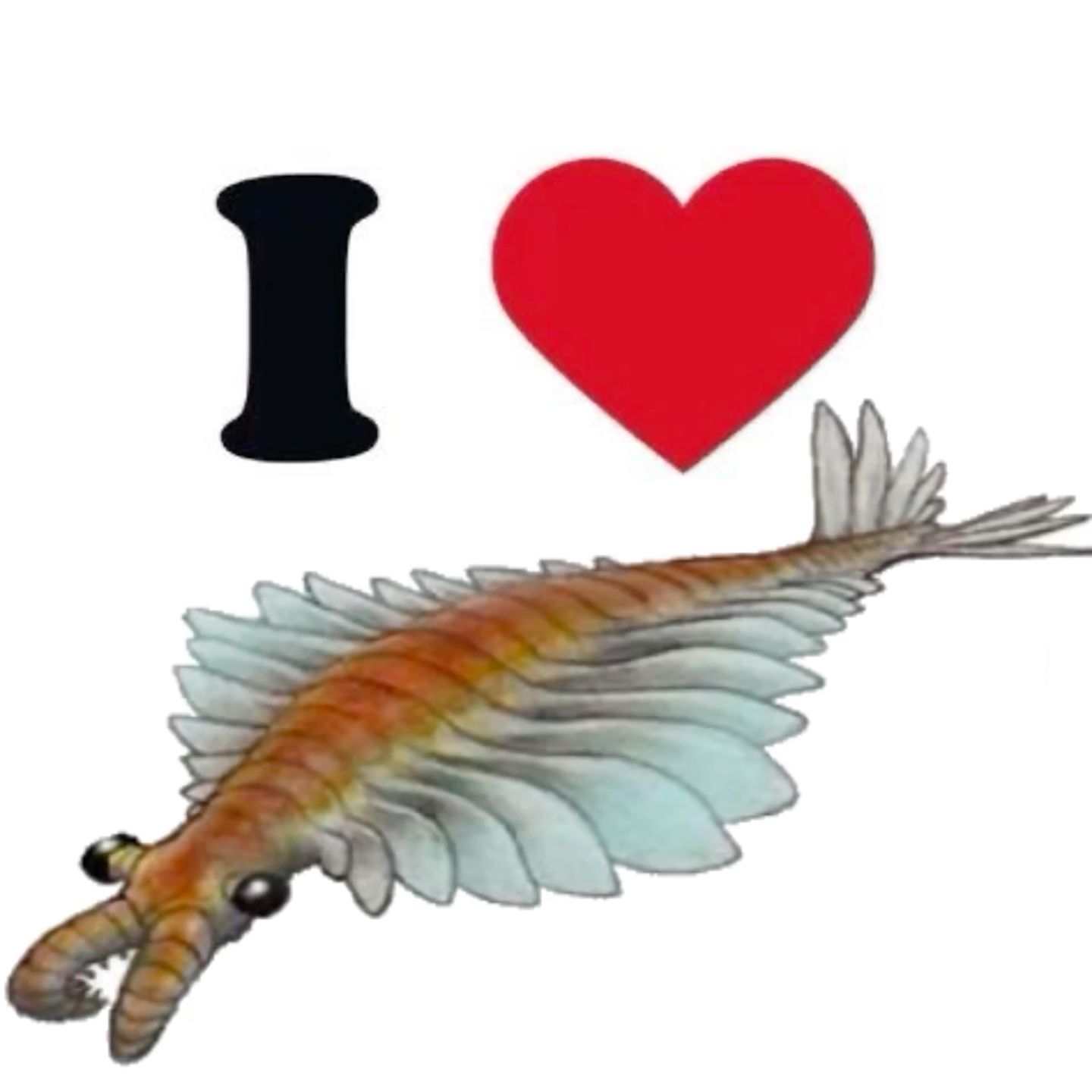
Anomalocaris canadensis is the first true apex predator in the fossil record. It is a metre-long, soft-bodied, visually hunting arthropod relative that cruised the shallow Cambrian seas of what is now western Canada roughly 515 to 505 million years ago, and it sat at the top of a marine food chain that had existed for only a few tens of millions of years. Nothing alive today looks like Anomalocaris.
Its closest living relatives - crustaceans, insects, arachnids, and their kin - descend from a common ancestor that branched off the Anomalocaris lineage deep inside the Cambrian.
And yet Anomalocaris is immediately recognisable once you have seen it: two spiny, segmented grasping appendages hanging beneath a blunt head, two stalked compound eyes, a circular toothed mouth that closed like an iris, and a soft torpedo-shaped body propelled by a row of undulating lateral flaps.
This entry covers what Anomalocaris actually was, how it was discovered and misclassified, how its anatomy finally came together in 1985, where it fits on the tree of life, how it hunted, and why it matters so much to our understanding of the Cambrian explosion. Expect specifics: millions of years, centimetres of body length, numbers of lens facets, and the 99-year wait that turned three separate "species" back into one animal.
Etymology and the First Fossil
The name Anomalocaris - literally "strange shrimp" - was coined in 1886 by Joseph Frederick Whiteaves, a palaeontologist at the Geological Survey of Canada, to describe a single curved, segmented, shrimp-like fossil collected by Richard McConnell from the Ogygopsis Shale near Kicking Horse Pass in British Columbia.
The specimen is about ten centimetres long, tapers to a point at one end, and carries a row of repeating segments each bearing a pair of short spines. It looks, superficially and convincingly, like the abdomen of a large shrimp with the head and thorax broken off.
Whiteaves combined the Greek anomalos, meaning "strange" or "irregular", with the Latin caris, meaning "shrimp" or "crab", to signal that this was an unusual crustacean. He added the species name canadensis to mark the country of origin. The resulting binomial, Anomalocaris canadensis, entered the literature in a short descriptive paper in the Canadian Record of Science.
What Whiteaves did not know, and could not have known, was that he was not holding a small crustacean at all. The object in front of him was a single detached grasping appendage belonging to the head of a much larger animal. The rest of that animal, including its circular mouth and its metre-long flap-propelled body, lay in the same rocks waiting to be collected and, as it turned out, to be misidentified several more times before the pieces came together.
The Burgess Shale and the Three "Species"
Twenty-three years after Whiteaves published, Charles Doolittle Walcott, Secretary of the Smithsonian Institution, stumbled on the Burgess Shale quarry high on the ridge above Field, British Columbia, in 1909. Over the next fifteen summers Walcott and his field crews extracted tens of thousands of exquisitely preserved Cambrian fossils.
The Burgess Shale is a lagerstatte - a rock unit in which soft tissues as well as hard parts are preserved - and it remains one of the most important palaeontological sites on Earth.
Among Walcott's material were three apparently unrelated animals that would much later prove to be parts of Anomalocaris:
- A curved, segmented, shrimp-like appendage identified with Whiteaves's Anomalocaris canadensis
- A circular, radially symmetric ring of plates described as a jellyfish and named Peytoia nathorsti
- A flattened, soft, disc-shaped object catalogued as a sponge and named Laggania cambria
Each piece fit a plausible story. The "shrimp" body was catalogued with other arthropod-like fragments. The "jellyfish" mouth, with its thirty-two radially arranged plates, resembled the oral disc of a modern scyphozoan. The "sponge" body, being soft and formless, was classified with other soft-bodied members of the Burgess Shale sponge assemblage. Because the specimens came from different collecting seasons, different sub-layers, and different preservation orientations, nobody connected them.
The misclassification persisted across 99 years - from Whiteaves's 1886 paper to the 1985 reconstruction. During that century, textbooks, museum displays, and popular science illustrations all treated Anomalocaris, Peytoia, and Laggania as three distinct Cambrian species.
When early Cambrian food-web reconstructions were drawn, the top predator slot was frequently left empty or filled with a speculative "large unknown arthropod" because no single catalogued species seemed large enough to fit the role.
The 1985 Reconstruction
The correction came from Harry Whittington and his graduate student Derek Briggs at Cambridge. Whittington led a long, systematic redescription of the Burgess Shale fauna that ran from the 1970s into the 1980s. The project rewrote Cambrian palaeontology by recognising that many of Walcott's "worms" and "shrimps" were actually members of extinct groups with no close living relatives.
Briggs and Whittington's 1985 paper on Anomalocaris - co-authored with a series of collaborators who had been working on individual body parts - combined several previously unreported Burgess Shale specimens that preserved the appendages, oral disc, and body in anatomical connection on the same slab. In other words, the three "species" had been found side by side, physically attached to each other. Once that was recognised, the whole animal fell into place.
The 1985 synonymy:
| Original "species" | Actual body part |
|---|---|
| Anomalocaris canadensis | Paired frontal grasping appendages |
| Peytoia nathorsti | Circular radial oral disc (mouth) |
| Laggania cambria | Soft trunk with lateral swimming flaps |
The synonymised animal retained the oldest available name - Anomalocaris canadensis - under standard taxonomic rules. Whittington and Briggs's reconstruction produced a metre-long, torpedo-shaped predator with a pair of spiny grasping arms at the front of its head, a circular toothed mouth on the underside of its head, two stalked compound eyes mounted above, and a soft trunk propelled by a row of lateral flaps.
The image appeared in Philosophical Transactions of the Royal Society and rapidly made its way into every subsequent Cambrian palaeontology textbook.
The 1985 reconstruction is routinely taught in modern palaeontology courses as one of the most elegant fossil puzzle solutions of the twentieth century. It is also a case study in how fragmentary preservation can maintain a taxonomic error for generations, and in how careful re-examination of existing museum drawers can overturn long-accepted classifications without requiring new field discoveries.
Size and Body Plan
Anomalocaris was large. Very large for its time.
Body dimensions:
- Length: 50-100 cm, with the largest specimens approaching a full metre
- Width of trunk: 15-20 cm at maximum extent
- Grasping appendage length: 15-25 cm each, extending forward from the head
- Oral disc diameter: 3-5 cm
- Eye diameter: up to 3 cm per stalked eye
For comparison, the typical Burgess Shale arthropod is three to eight centimetres long. The typical Cambrian worm is a centimetre or two. A metre-long streamlined predator cruising through that community would have been visually and ecologically dominant, and the anatomical evidence is consistent with no other animal in the deposit challenging it as prey or as rival.
Major anatomical components:
- Head: Short, blunt, without a fused shield. Carries the eyes, mouth, and grasping appendages.
- Eyes: Two, paired, stalked, positioned on either side of the dorsal surface. Compound, each containing more than 16,000 hexagonal lenses.
- Frontal appendages: Two, curved, segmented, spiny. Hang forward and downward from the front of the head and were used to grasp, manipulate, and deliver prey to the mouth.
- Mouth: Circular, on the ventral surface of the head. Composed of 32 hardened plates arranged radially around a central opening, each plate bearing inward-pointing teeth.
- Trunk: Long, soft, cylindrical, without calcified armour. Divided into segments that each bear a pair of lateral swimming flaps.
- Flaps: Eleven pairs on the main body in the classic Whittington-Briggs reconstruction, soft and membranous, overlapping slightly from front to back.
- Tail: Ends in a small fan of three pairs of larger flaps that served as a rudder and propulsion booster.
The overall silhouette is of a streamlined, flat, torpedo-shaped swimmer with two long grasping arms held forward beneath a pair of raised compound eyes. It is as recognisable in reconstruction as a modern shark, and it occupies a similar ecological position in its community.
The Radial Mouth
The mouth of Anomalocaris is its single most distinctive structure, and it is unlike the mouth of any animal alive today. It is a ring rather than a pair of jaws.
Oral disc anatomy:
- 32 hardened, chitinous plates arranged radially around a central opening
- Each plate bears inward-pointing teeth along its inner edge
- The plates could contract towards the centre, closing the opening like an iris aperture
- The disc did not fully close - it retained a central gap even at maximum contraction
- Interior of the pharynx bears additional rows of smaller teeth
Functionally, the oral disc is a grasping and puncturing device rather than a crushing one. Food was brought to the mouth by the grasping appendages, then the disc contracted around it, the inward teeth punctured or sliced prey tissue, and the food was pulled into the pharynx where additional teeth further processed it.
The central gap in the closed disc is unusual and distinguishes Anomalocaris from some other radiodonts, which have fully sealing mouths. That gap is one of the diagnostic features used to identify Anomalocaris canadensis specifically rather than related radiodont species.
The bite mechanics have been the subject of substantial recent debate. A 2023 biomechanical modelling study led by Russell Bicknell and colleagues concluded that the Anomalocaris oral disc was probably not strong enough to crack a fully calcified adult trilobite exoskeleton.
The study instead suggested that Anomalocaris preferred soft-bodied prey, freshly moulted trilobites with uncalcified cuticles, or smaller and weaker-shelled arthropods. That does not disqualify Anomalocaris from apex-predator status - plenty of modern apex predators feed on soft or vulnerable prey - but it refines the picture of what "top of the Cambrian food web" actually looked like.
The 16,000-Lens Eyes
In 2011 a team led by John Paterson of the University of New England published a study in Nature describing exceptionally well-preserved compound eyes of Anomalocaris from the Emu Bay Shale in South Australia. The preservation was good enough to resolve individual lenses, and the counts were astonishing.
Eye specifications:
- Stalked, positioned above the head on short flexible bases
- Compound, each made up of many hexagonal lens facets packed together
- Lens count: more than 16,000 per eye
- Lens diameter: tens of micrometres, decreasing outward from the centre
- Estimated angular resolution: comparable to modern dragonflies
The number is staggering in context. Most Cambrian arthropods had simple eye spots or low-resolution compound eyes with a few hundred lenses. Trilobite eyes, which are among the best-preserved Cambrian visual systems, typically contain hundreds of lenses. Anomalocaris had more than 16,000 per eye, approaching the upper end of lens counts seen in any living arthropod. Modern dragonflies, which are among the sharpest visual hunters alive, carry roughly 30,000 ommatidia per eye.
The implications of high-resolution vision in a Cambrian predator are large. Visual acuity on that scale implies active detection of distant prey, pursuit predation rather than ambush, a developed optic nervous system, and - critically - selection pressure on prey species to hide, armour themselves, or escape.
The Cambrian explosion is often described as a vision-driven arms race, and Anomalocaris is the empirical foundation for that description. Its eyes show that high-acuity vision was already in place early in the Cambrian, and its ecological dominance shows that this vision gave it a decisive hunting advantage.
Propulsion: The Lateral Flaps
Anomalocaris did not swim with paired legs, a tail fin, or jet propulsion. It swam by undulating a row of soft lateral flaps arranged along each side of its body, producing a travelling wave that pushed it forward.
Propulsion anatomy:
- Eleven pairs of swimming flaps along the trunk
- Overlapping, front to back, like roof shingles
- Soft, membranous, reinforced by internal supports
- Coordinated muscular control along the body length
- Small paired tail fan provides steering and additional thrust
Mechanically, the system resembles the fin undulation of a modern cuttlefish or a stingray more than the paddle-stroke of a crustacean. A travelling wave passes along the flaps from front to back, displacing water backwards and driving the animal forward. Steering is achieved by varying the amplitude or phase of the waves on each side. The result is smooth, controlled, sustained swimming rather than the bursts of acceleration characteristic of tail-flick predators.
This is consistent with an active pursuit predator. Anomalocaris did not need burst speed to catch slow-moving Cambrian prey. It needed sustained cruising, precise steering, and the ability to hold position while the grasping appendages deployed. The flap system delivers exactly that profile.
It is also mechanically distinct from the paddle-based propulsion of crown-group arthropods, which is one of the reasons Anomalocaris is placed on the arthropod stem rather than inside any modern arthropod group.
Taxonomy and the Arthropod Stem
Placing Anomalocaris on the tree of life has been a long project. The current classification is supported by multiple lines of evidence - morphology, phylogenetic analysis, and comparison with related radiodont material from China and Australia.
Current classification:
- Kingdom: Animalia
- Phylum: Arthropoda (stem group)
- Class: Dinocaridida
- Order: Radiodonta
- Family: Anomalocarididae
- Genus: Anomalocaris
- Species: A. canadensis
Anomalocaris belongs to Radiodonta, an extinct Cambrian order characterised by paired frontal grasping appendages, a circular radial mouth, stalked compound eyes, and a row of lateral swimming flaps. Radiodonts are part of the broader class Dinocaridida and sit on the stem of the arthropod tree. "Stem group" means they branched off the arthropod lineage before the common ancestor of all living arthropods.
In practical terms, Anomalocaris is more closely related to modern arthropods than to any other living phylum, but it sits outside the group of animals that descended from the last common ancestor of modern arthropods.
This placement is supported by a cluster of shared features - segmented body, paired jointed appendages, compound eyes, cuticle composition - combined with the absence of several crown-group arthropod features, including a fully sclerotised trunk cuticle, a fused head shield, and the specific limb articulation patterns that define modern arthropod classes.
Radiodonts are part of what palaeontologists sometimes call the great-appendage arthropods, a Cambrian lineage marked by prominent frontal grasping limbs that were later modified or lost in the transition to crown-group forms.
The great-appendage lineage is ancestral in a broad sense to modern arthropods but not in the strict sense of being a direct linear ancestor. The common ancestor of Anomalocaris and modern crustaceans, insects, and chelicerates lived somewhere in the early Cambrian or late Ediacaran, and the two lineages have been diverging ever since.
The Cambrian Explosion and the First Food Chain
The Cambrian explosion is the name for the relatively rapid appearance of most major animal body plans in the fossil record between about 540 and 510 million years ago. Before this interval the fossil record is dominated by simple tubes, microbial mats, and the enigmatic Ediacaran biota - mostly sessile, often unclassifiable, and without unambiguous evidence of predation.
After it, the oceans are populated with arthropods, worms, molluscs, chordates, and echinoderms, complete with predators, prey, armour, burrows, and bite marks.
Anomalocaris sits in the middle of this interval in time and at the top of its food web in space. Its role in the Cambrian story is threefold.
Why Anomalocaris matters to the Cambrian story:
- Demonstrates that active macro-predation existed by 515 million years ago
- Provides direct evidence that the Cambrian food web included an apex predator tier
- Shows that high-acuity compound vision evolved very early in animal history
- Anchors the "vision-driven arms race" model of the Cambrian explosion
- Supplies concrete prey-predator evidence in the form of W-shaped trilobite bite marks
- Preserves a stem-group arthropod body plan intermediate between soft lobopodians and crown-group arthropods
The broader picture is that by the time Anomalocaris appears in the fossil record, Earth's oceans already contained a complete marine food chain - primary producers, grazers, small predators, and a macro-predator tier. That transition, from the effectively predator-free Ediacaran seas to a full Cambrian food web, is one of the major ecological events in the history of life, and Anomalocaris is the animal that marks its upper end.
Geographic and Temporal Range
Anomalocaris canadensis specifically is known from the Middle Cambrian of western North America, including the Burgess Shale of British Columbia and related deposits. Other species of Anomalocaris and closely related radiodonts have been found in:
| Site | Location | Age (mya) |
|---|---|---|
| Burgess Shale | British Columbia, Canada | ~508 |
| Ogygopsis Shale | British Columbia, Canada | ~510 |
| Chengjiang biota | Yunnan Province, China | ~518 |
| Emu Bay Shale | South Australia | ~515 |
| Sirius Passet | North Greenland | ~518 |
This distribution - spanning what were then separate continents on the equatorial margins of the Cambrian world - shows that radiodonts were a globally successful group during the Middle Cambrian. They were not isolated Burgess Shale oddities. They were the dominant large predators of Cambrian oceans worldwide.
Extinction and Legacy
Anomalocaris canadensis itself disappears from the fossil record after the Middle Cambrian. The broader radiodont group persisted longer. Some radiodont lineages survived into the Ordovician, and recent finds from Morocco pushed the group's range into the Early Ordovician, roughly 480 million years ago. After that the group fades from the record, replaced by the proliferating crown-group arthropods that eventually came to dominate marine and terrestrial ecosystems.
Anomalocaris's legacy in modern palaeontology is large. It appears in nearly every textbook on Cambrian life. It is a signature specimen at the Royal Ontario Museum, the Smithsonian, and museums worldwide. It features prominently in Stephen Jay Gould's Wonderful Life (1989), which used the Burgess Shale fauna as a case for the role of contingency in evolution.
When palaeontologists want to illustrate what a Cambrian apex predator looked like, Anomalocaris is the illustration of choice. When they want to demonstrate how fragmentary preservation can mislead taxonomy for generations, Anomalocaris is the case study.
In a narrow sense, Anomalocaris is a dead-end lineage. Nothing alive today descends directly from it as a distinct phylum. In a broader sense, it is part of the stem group that bracketed the origin of modern arthropods - and modern arthropods are the most species-rich group of animals on Earth, comprising insects, crustaceans, arachnids, myriapods, and their relatives.
Every insect, crab, spider, scorpion, and centipede alive today shares a Cambrian ancestor with Anomalocaris, which means the "strange shrimp" story never quite ended. It simply moved down the family tree.
Common Misconceptions
Anomalocaris is popular, which means it is also frequently misdescribed. A few corrections:
- It is not a shrimp. Despite the name, Anomalocaris is not a crustacean. It is a stem-group arthropod, more distantly related to shrimp than shrimp are to insects.
- Its "body" is not a sponge. The flattened disc originally described as Laggania cambria is the soft trunk of Anomalocaris, not a sponge at all.
- Its mouth is not a jellyfish. The circular radial oral disc was for decades catalogued as Peytoia nathorsti, a medusoid cnidarian. It is the mouth of Anomalocaris.
- It did not bite through armoured trilobites easily. Recent biomechanics suggest the oral disc struggled with fully calcified trilobite exoskeletons and probably preferred soft or freshly moulted prey.
- It is not the ancestor of modern arthropods. It is a close relative on the stem of the arthropod tree, not a direct ancestor.
- It was not discovered in 1985. The first specimen was described in 1886; Whittington and Briggs reconstructed the whole animal in 1985.
Related Reading
- Hallucigenia: The Upside-Down Cambrian Animal
- Tiktaalik: The Fish That Almost Walked
- Trilobite: Armoured Arthropod of the Palaeozoic
- Burgess Shale: A Window into Cambrian Oceans
- The Cambrian Explosion: Life's Big Bang
References
Key peer-reviewed sources for this entry include Whiteaves (1886) Canadian Record of Science, "Illustrations of the fossil fauna of the Utica slate and related rocks"; Whittington and Briggs (1985) Philosophical Transactions of the Royal Society B, "The largest Cambrian animal, Anomalocaris, Burgess Shale, British Columbia"; Paterson et al.
(2011) Nature, "Acute vision in the giant Cambrian predator Anomalocaris and the origin of compound eyes"; Daley and Edgecombe (2014) Journal of Paleontology, "Morphology of Anomalocaris canadensis from the Burgess Shale"; Bicknell et al.
(2023) Proceedings of the Royal Society B, "Raptorial appendages of the Cambrian apex predator Anomalocaris canadensis are built for soft prey and speed"; and Stephen Jay Gould's Wonderful Life (1989).
Stratigraphic and palaeogeographic context draws on continuing research at the Royal Ontario Museum, the Geological Survey of Canada, and Parks Canada, which administers the Burgess Shale UNESCO World Heritage site in Yoho National Park.
Frequently Asked Questions
What is Anomalocaris and why does it matter?
Anomalocaris canadensis is a metre-long, soft-bodied predator from the Middle Cambrian Burgess Shale of British Columbia, about 515 to 505 million years old. It belongs to a group called radiodonts - stem-group arthropods with a pair of grasping frontal appendages, a circular radial mouth, two large stalked compound eyes, and a row of swimming flaps along each side of the trunk. It matters for three reasons.
First, it is the earliest undisputed apex predator in the fossil record, which means the Cambrian explosion produced not only a burst of new body plans but also a full food chain with macro-predators at the top. Second, its discovery story - in which three different parts of the same animal were catalogued as three different species across 99 years - is one of the most famous examples in palaeontology of how fragmentary preservation can mislead taxonomy.
Third, its 16,000-lens compound eyes show that high-resolution vision evolved very early in animal history and probably helped drive the Cambrian arms race between predators and their armoured prey.
Why was Anomalocaris misclassified as three separate animals?
Anomalocaris had a soft body with several distinctive hardened structures - the paired frontal grasping appendages, the circular oral disc, and the lateral flaps - and these parts tended to detach from the main body during decay or burial. Early Cambrian fossil sites produced isolated fragments rather than complete animals.
In 1886 Joseph Whiteaves, working on material from the Ogygopsis Shale in British Columbia, described a curved, segmented, shrimp-like object as Anomalocaris canadensis, a small crustacean. The same animal’s circular mouth was later described independently as a jellyfish and given the name Peytoia. Its flattened body was classified as a sponge named Laggania.
Each part looked plausibly like a different animal on its own, and the specimens came from different collecting seasons, so nobody realised they belonged together. In 1985 Harry Whittington and Derek Briggs published the first whole-animal reconstruction, combining specimens from the Burgess Shale that preserved the appendages, mouth, and body in anatomical connection.
Their paper collapsed the three “species” into one and restored the correct image of a metre-long predator. That was 99 years after the original name, and it reset Cambrian palaeontology overnight.
How big was Anomalocaris and how does it compare to other Cambrian animals?
Anomalocaris canadensis reached body lengths of 50 to 100 centimetres from the tip of the grasping appendages to the trailing tail flaps. Most Burgess Shale animals are centimetres or even millimetres long, which makes Anomalocaris roughly ten to twenty times larger than the average Cambrian arthropod.
Fragmentary material from related species in other lagerstatte - particularly the Chinese Chengjiang biota and the Emu Bay Shale in Australia - suggests that some radiodonts grew even larger, potentially approaching two metres. That places Anomalocaris in a size class no other Cambrian animal matched. For context, a typical Cambrian trilobite was three to eight centimetres long and a typical Cambrian worm just a centimetre or two.
A metre-long streamlined predator cruising through that community would have been visually dominant and ecologically unmatched, which is consistent with its designation as the first true apex predator in Earth’s oceans.
What did Anomalocaris eat and how did it hunt?
Anomalocaris was an active carnivore. Its primary prey almost certainly included trilobites, other Cambrian arthropods, and soft-bodied animals such as priapulid worms. The evidence comes from three independent sources. Fossilised gut contents in some Anomalocaris specimens preserve fragments of arthropod cuticle.
Trilobite exoskeletons from the same beds show distinctive W-shaped bite marks consistent with the geometry of an Anomalocaris oral disc closing around them. And the animal’s anatomy is purpose-built for active pursuit predation: large stalked compound eyes for detection, a pair of spiny grasping appendages for capture, a circular radial mouth lined with hardened teeth for piercing or crushing, and a row of lateral swimming flaps for sustained propulsion.
Hunting was probably a combination of visual detection, pursuit, and grasping strike. Debate continues about whether the oral disc was strong enough to crack fully calcified trilobite exoskeletons, and recent biomechanical studies suggest that Anomalocaris preferred softer-bodied or freshly moulted prey, but the conclusion that it was a vision-guided, actively swimming macro-predator is not in dispute.
How good was Anomalocaris's eyesight?
Extraordinarily good for its time. A 2011 study by John Paterson and colleagues, published in Nature, described exceptionally preserved compound eyes of Anomalocaris from the Emu Bay Shale in South Australia. The eyes are stalked, positioned on either side of the head, and each one contains more than 16,000 individual hexagonal lenses.
That is denser and more acute than the compound eyes of any other Cambrian animal known to science, and it is comparable to modern dragonflies - some of the sharpest visual hunters alive today. Vision at that resolution implies a well-developed optic nervous system, target detection at meaningful distances, and active pursuit rather than ambush. The discovery also helped anchor a broader idea: the Cambrian explosion was in part a vision-driven arms race.
Once predators could see well, prey had to hide, run, or armour themselves, and that selection pressure contributed to the rapid proliferation of body plans preserved in the Burgess Shale and Chengjiang fossils.
Where does Anomalocaris sit on the arthropod family tree?
Anomalocaris belongs to Radiodonta, an extinct order of stem-group arthropods within the class Dinocaridida. In plain terms, it is a close relative of modern arthropods - crustaceans, insects, arachnids, myriapods - but it sits outside the crown group. That is, it branched off the arthropod lineage before the common ancestor of all living arthropod classes.
Radiodonts share with modern arthropods several defining features: segmented bodies, paired jointed appendages, and compound eyes. They lack other arthropod features, including a fully sclerotised cuticle over the trunk and the integrated head shield that defines crown-group forms.
The radiodont lineage is part of what palaeontologists call the great-appendage arthropods - a Cambrian grouping characterised by prominent frontal grasping limbs that were later modified or lost in the transition to crown-group arthropods. Modern arthropods did not descend from Anomalocaris directly, but they share a common ancestor with it that lived in the early Cambrian or late Ediacaran.
Where was Anomalocaris discovered and why is the Burgess Shale so important?
The first Anomalocaris fossil - a single detached grasping appendage - was collected in 1886 by Richard McConnell from the Ogygopsis Shale near Kicking Horse Pass in British Columbia and described by Joseph Whiteaves of the Geological Survey of Canada. The much richer Burgess Shale deposit, located a short distance away in what is now Yoho National Park, was discovered in 1909 by Charles Doolittle Walcott.
Walcott excavated the quarry from 1910 to 1924 and produced tens of thousands of specimens, including the mouths, bodies, and appendages that would eventually be recognised as Anomalocaris. The Burgess Shale is a lagerstatte - a rock unit that preserves soft tissues as dark films alongside hard parts - formed when Cambrian mudslides rapidly buried marine communities in oxygen-poor sediment.
This preservation style is the only reason we know Anomalocaris in the detail we do. The Burgess Shale was designated a UNESCO World Heritage site in 1980, and Anomalocaris is one of its signature animals. Related radiodont material has since been recovered from the Chengjiang biota in China and the Emu Bay Shale in Australia, showing that the group had a global distribution during the Cambrian.
Why is Anomalocaris considered the first apex predator?
The title of apex predator requires three conditions. An animal must be large relative to its community, it must actively hunt other animals, and it must sit at the top of its food web with no regular predators of its own. Anomalocaris meets all three. At 50 to 100 centimetres it was by far the largest mobile animal in the Cambrian communities it inhabited.
Its anatomy - grasping appendages, radial toothed mouth, stalked high-resolution compound eyes, and propulsive lateral flaps - is a precise fit for active predation rather than scavenging or filter feeding. And the Cambrian fossil record contains no animal large or fast enough to have routinely preyed on adult Anomalocaris.
Before the Cambrian, the fossil record shows simple tube-builders, microbial mats, and enigmatic Ediacaran forms, with no unambiguous evidence of macro-predation. After Anomalocaris appears, bite marks, defensive armour, rapid-burrowing prey, and pursuit predators all proliferate in the fossil record. The Cambrian explosion, in other words, was not just the appearance of new body plans.
It was the installation of Earth’s first full marine food chain, and Anomalocaris was the animal that sat at the top.