
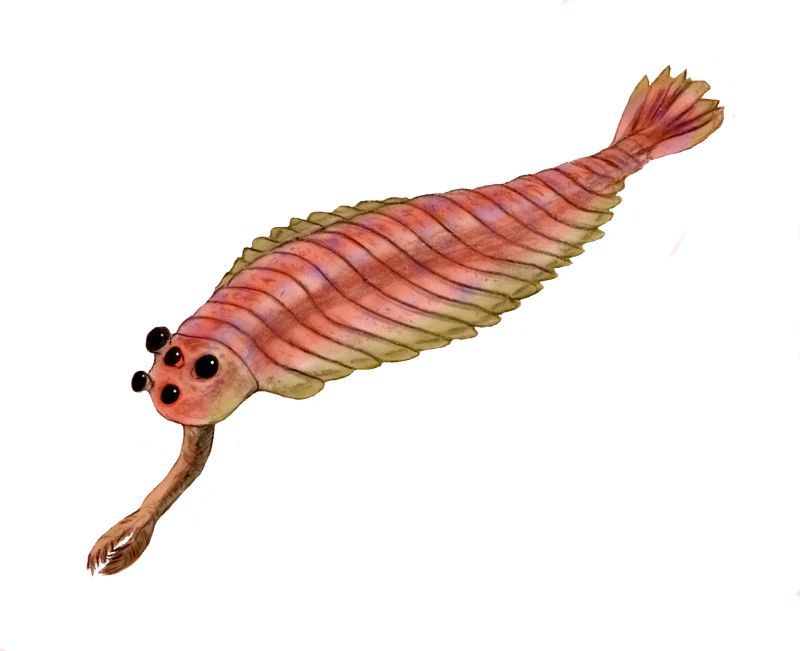
Opabinia regalis is arguably the strangest animal ever to have lived.
It is small - most adult specimens measure only four to seven centimetres from the base of the proboscis to the tail - but its body plan is so unlike anything alive today that when Harry Whittington unveiled the corrected reconstruction at a Paleontological Association meeting in Oxford in 1975, delegates in the audience are said to have laughed out loud.
The animal had five stalked compound eyes, three on top of the head and one on each side. It had a single flexible trunk-like proboscis projecting from the front of the head and ending in a clawed grasping nozzle ringed with inward-pointing spines. Its mouth was not at the end of the proboscis but on the underside of the head, pointing backward.
And its soft, segmented body was propelled through the water by about thirty pairs of lateral flaps undulating in sequence like the wings of a cuttlefish.
This entry covers what Opabinia actually was, how Charles Walcott first misidentified it in 1912, how Harry Whittington corrected the record in 1975, where it sits on the tree of life, what it ate, how it swam, why the 2022 discovery of Utaurora mattered, and why Opabinia has become an icon of the Cambrian explosion and of the idea that early animal evolution produced body plans no modern survey could predict.
Expect specifics: millions of years, centimetres of body length, numbers of eyes and segments, and the 110-year wait for a second opabiniid to appear.
Etymology and Discovery
The genus name Opabinia comes from Opabin Pass, a mountain pass in the Canadian Rockies a short walk from the Burgess Shale quarry high on the ridge above the town of Field, British Columbia. The species name regalis - Latin for "royal" - was chosen by Charles Doolittle Walcott when he named the animal in 1912, after his first field seasons at the Burgess Shale site.
Walcott was Secretary of the Smithsonian Institution at the time and had discovered the quarry three years earlier, in 1909. Over fifteen summers he and his crews extracted tens of thousands of exquisitely preserved Cambrian fossils, including several slabs containing Opabinia.
Walcott interpreted Opabinia in terms of the animal groups he already knew. The lateral flaps running down the body reminded him of the swimming limbs of branchiopod crustaceans - a modern group that includes brine shrimp and fairy shrimp. The segmented trunk and compound eyes fit that reading.
Walcott placed Opabinia regalis among the branchiopod arthropods, described it in a short formal paper, and moved on to the hundreds of other specimens in his collection. The classification stuck. For more than sixty years, textbooks, monographs, and museum displays treated Opabinia as an unusual but recognisable Cambrian crustacean.
What Walcott did not do - and what no one did until Whittington took the job up in the 1970s - was sit down with a prepared specimen, strip the assumption that this must be a crustacean, and describe what the fossil actually showed. That delay is part of why Opabinia became famous. The truth, once it emerged, was stranger than the misidentification.
The 1975 Reconstruction and the Laughter
Harry Whittington, a palaeontologist at the University of Cambridge, led a systematic redescription of the Burgess Shale fauna beginning in the late 1960s and running through the 1980s.
His team - which included the graduate students Derek Briggs and Simon Conway Morris, both of whom would become major figures in Cambrian palaeontology in their own right - treated Walcott's specimens as if they had never been described.
Whittington removed matrix, photographed specimens under controlled lighting, drew new camera-lucida renderings, and in several cases produced whole-animal reconstructions that overturned decades of settled classification.
Opabinia was one of Whittington's most dramatic cases. When he cleaned and examined the specimens properly, the "crustacean" identification collapsed almost immediately. The animal had five eyes, not two. The frontal appendage was not a pair of antennae or mouthparts but a single, flexible, trunk-like proboscis ending in a clawed grasping nozzle.
The mouth opening was not at the front of the head but on the underside, pointing backward. The trunk had about thirty segments, each bearing a pair of soft lateral flaps, rather than the jointed limbs of a crustacean. And the whole body was soft - no sclerotised exoskeleton, no mineralised cuticle, nothing that would fit comfortably inside the crown group of living arthropods.
Whittington presented this reconstruction at a 1975 meeting of the Paleontological Association in Oxford. The formal publication, titled "The enigmatic animal Opabinia regalis, Middle Cambrian, Burgess Shale, British Columbia", appeared the same year in Philosophical Transactions of the Royal Society B.
Accounts of the meeting agree that when the corrected reconstruction was projected on the screen, delegates in the audience - professional palaeontologists, people who had just spent the morning listening to careful talks on other Burgess Shale animals - laughed out loud. The five eyes, the flexible proboscis, the backward-pointing mouth, the thirty pairs of flaps: it was simply too much at once.
The moment has become part of palaeontological folklore, often cited as the clearest single example of just how strange the Cambrian fauna really was.
The laughter was not derision. It was the response of specialists confronted with a body plan no one had predicted, on an animal that had been misclassified for sixty-three years and was now, without warning, being shown for what it actually was.
Anatomy and Body Plan
Opabinia's body plan has no modern analogue. The following sections break it down part by part.
Head and eyes:
- Five stalked compound eyes mounted on the dorsal surface of the head
- Three eyes arranged roughly along the midline on top - front, middle, rear
- One eye extending to each side, giving wide lateral coverage
- Eye stalks short but mobile, consistent with active visual scanning
- Compound eye facets present but individual lens count not resolvable in most specimens
Proboscis:
- Single flexible trunk projecting forward from the front of the head
- Roughly a third of body length at full extension
- Jointed enough to bend in multiple directions
- Terminates in a widened, claw-like grasping nozzle
- Nozzle interior lined with inward-facing spines to hold prey
Mouth:
- Located on the underside of the head, not at the end of the proboscis
- Opens backward, toward the trunk
- Feeding required curling the proboscis under the head to deliver prey
Trunk:
- Approximately thirty body segments
- Each segment bears a pair of soft lateral flaps (swimming structures)
- No jointed limbs, no mineralised exoskeleton
- Gill-like lamellae present on the dorsal surface of the flaps in some reconstructions
- Soft cuticle only, preserved as carbon film in Burgess Shale material
Tail:
- Three to four pairs of flap-like tail lobes at the rear
- Probably acted as a rudder or stabiliser rather than primary propulsion
Total adult body length was typically four to seven centimetres excluding the extended proboscis. Including the proboscis at full stretch, the animal reached perhaps ten centimetres. This makes Opabinia significantly smaller than Anomalocaris, which routinely reached fifty to one hundred centimetres and sat at the top of the same Cambrian food chain.
How Opabinia Moved
Opabinia swam, hovered, and probed rather than cruising long distances at speed. The evidence is entirely anatomical - no trackways or direct behavioural fossils exist for this animal - but the anatomy is specific enough to support several clear conclusions.
The thirty pairs of lateral flaps, arranged in sequence along the trunk, would have undulated in a wave running from front to back or back to front. This is the same mechanical principle used by modern cuttlefish, some rays, and certain polychaete worms for fine-control swimming.
Undulating flap propulsion is slow compared to tail-driven swimming but offers excellent manoeuvrability, hovering capability, and the ability to reverse direction quickly. For an animal that hunted by extending a flexible proboscis toward prey on the sea floor, hovering was more useful than sprinting.
The tail lobes at the rear probably acted as rudders or stabilisers. They are too small to have generated significant thrust on their own. The head, with five eyes providing wide panoramic coverage, could have scanned for prey and threats in almost every direction simultaneously, while the body held position and the proboscis reached out. The overall picture is of a slow, visually alert, near-bottom predator rather than a fast pelagic hunter.
Opabinia was almost certainly a poor long-distance swimmer. Its body was soft and lacked the streamlined profile of Anomalocaris or of modern pelagic predators. It would have lost ground to currents and would not have been able to outrun a larger predator in open water. Its survival strategy was probably a combination of camouflage, visual alertness, and the ability to withdraw the proboscis and hold position until a threat passed.
Diet and Feeding Mechanics
No direct evidence of Opabinia's gut contents has been reported in the published literature, so its diet has to be inferred from anatomy and the ecological context of the Burgess Shale community.
The animal was almost certainly a predator or active scavenger. The clawed grasping nozzle at the end of the proboscis is not a filter structure, nor is it suited to scraping biofilms or ingesting sediment. It is a grasping organ - built to grip something solid and hold on. The inward-facing spines inside the nozzle would catch on the body of a prey animal as the proboscis retracted, pulling the prey toward the mouth rather than allowing it to escape.
Likely prey items:
- Priapulid worms (abundant in Burgess Shale sediment)
- Small arthropods such as trilobite juveniles or Marrella-like forms
- Soft-bodied invertebrates living on or just beneath the sediment surface
- Carcasses of recently dead animals
The feeding sequence would have run something like this. Opabinia, hovering just above the sea floor, extended its proboscis toward a prey item detected by the five eyes. The nozzle closed around the prey. The proboscis then retracted and curled backward under the head. The prey was delivered to the rear-facing mouth opening on the underside of the head, and then ingested.
The whole sequence is reminiscent of an elephant using its trunk to bring food to a mouth located elsewhere on the head - a separation of grasping organ from feeding opening that is extremely rare in the animal kingdom.
This feeding mode is one reason Opabinia looks so bizarre to modern eyes. Almost every predator alive today has a mouth located at or near the end of whatever structure does the grasping - the jaws of a shark, the beak of a bird, the chelicerae of a spider, the mandibles of a beetle.
A grasping organ wholly separate from the mouth, delivering food by curling backward, violates that near-universal pattern. Opabinia demonstrates that early animal evolution produced feeding architectures that later lineages did not preserve.
Where Opabinia Sits on the Tree of Life
Placing Opabinia on the arthropod family tree has been a long-running project. The key facts are these.
Opabinia is a stem-group arthropod. It branched off the arthropod lineage before the common ancestor of all living arthropod classes - crustaceans, insects, arachnids, myriapods. It shares with modern arthropods several defining features: a segmented body, paired appendages at least on the head, compound eyes, and bilateral symmetry. It lacks several others: a fully sclerotised trunk exoskeleton, integrated head shield, and jointed walking limbs on the trunk.
Within the stem group, Opabinia is usually placed in or near the order Radiodonta, the clade containing Anomalocaris. Both groups share stalked compound eyes, lateral swimming flaps, and a grasping frontal apparatus. The differences are structural. Radiodonts have a paired set of segmented frontal appendages hanging from the head. Opabinia has a single midline proboscis. Radiodonts have a circular radial oral disc. Opabinia has a simple ventral mouth.
Current phylogenetic proposals:
- Opabiniidae as the sister group of Radiodonta
- Opabiniidae nested inside a broad Radiodonta
- Opabiniidae plus Radiodonta together forming a clade on the arthropod stem
Each of these arrangements is supported by different character sets and phylogenetic methods. The community has not converged on a single answer, and the question is likely to remain open until more opabiniid specimens are recovered. What all proposals agree on is that Opabinia is a close cousin of Anomalocaris and that both lineages are informative about how the arthropod head evolved before the crown group emerged.
The 2022 Discovery of Utaurora
For 110 years - from Walcott's 1912 description of Opabinia regalis until early 2022 - Opabiniidae was a family of one. Dozens of Burgess Shale animals were recognised as stem arthropods, radiodonts, or related forms, but none of them matched the specific combination of traits that defines an opabiniid: a single flexible frontal proboscis, multiple stalked eyes on the head, a trunk with lateral swimming flaps, and a posteriorly directed mouth.
In February 2022, a team led by Stephen Pates of Harvard University published a formal description of Utaurora comosa, a new genus and species recovered from the Middle Cambrian Wheeler Shale in Utah, USA. The specimen had originally been collected decades earlier and catalogued as a radiodont relative. Pates and colleagues re-examined it and recognised features - particularly the proboscis-like frontal appendage and the head-eye arrangement - that placed it firmly inside Opabiniidae.
Significance of Utaurora:
- First confirmed opabiniid outside the Burgess Shale
- Extends the family's geographic range from British Columbia into what is now Utah
- Provides a second data point for reconstructing opabiniid anatomy
- Helps test competing phylogenetic placements of Opabiniidae relative to Radiodonta
- Shows that opabiniids were a genuine lineage, not a one-off local curiosity
Utaurora did not overturn the classic image of Opabinia. It reinforced it, while expanding the opabiniid family from a single genus to at least two. Additional opabiniid material almost certainly exists in museum drawers worldwide, catalogued under other names. The Pates team's paper has already prompted other workers to re-examine old collections with opabiniid anatomy in mind.
Cultural and Scientific Legacy
Opabinia occupies an outsized place in public science writing relative to the number of specimens known. Stephen Jay Gould featured it prominently in his 1989 book Wonderful Life, where he used it - alongside Anomalocaris, Hallucigenia, Wiwaxia, and other Burgess Shale oddities - to argue that the Cambrian explosion produced far greater morphological disparity than the modern animal kingdom contains.
Gould's broader argument that many Cambrian lineages were failed experiments has been partly revised by later work showing that most of his "failed phyla" actually fit on the stem of known crown groups. But his instinct about disparity was correct, and Opabinia remains the single clearest example of a Cambrian body plan with no modern counterpart.
Among palaeontologists, Opabinia is a teaching example of two things. The first is how fragmentary preservation and default assumptions can hold a misidentification in place for decades.
Walcott's placement of Opabinia among branchiopod crustaceans survived from 1912 to 1975 - sixty-three years of textbook entries, museum labels, and derivative illustrations - before anyone sat down with the actual specimens and questioned the framework. The second is how important the Burgess Shale lagerstatte is for recovering soft-bodied animals.
Opabinia's five eyes, flexible proboscis, and lateral flaps are preserved only because rapid burial in oxygen-poor sediment allowed carbon films to form on shale partings. Without that preservation, the animal would be invisible in the fossil record.
Opabinia has also become a minor cultural icon. Illustrations appear in museum displays, science-magazine features, natural-history documentaries, and popular books on evolution. The animal's combination of recognisable features - eyes on stalks, a flexible trunk, flaps along the body - and genuinely alien proportions makes it visually memorable.
Among Cambrian animals, only Anomalocaris and Hallucigenia rival Opabinia for public recognition, and none of them match its reputation for strangeness.
Why Opabinia Matters
Opabinia matters because it closes the gap between theoretical claims about the Cambrian explosion and what that explosion actually looked like. Textbooks can say the Cambrian produced dozens of experimental body plans. Opabinia shows what one of those experiments was - a five-eyed, rear-mouthed, flexible-proboscis predator with thirty pairs of swimming flaps, preserved well enough to reconstruct in anatomical detail, and with no modern descendants we can point to.
The animal also illustrates several general points about early animal evolution. First, the arthropod head went through structural experiments - with eye number, eye arrangement, frontal appendage form, mouth orientation - long before the familiar crown-group arthropod head locked in. Second, disparity was very high early in animal evolution and narrowed over time as many experimental lineages failed.
Third, the record we have is heavily biased by preservation. Lagerstatte like the Burgess Shale, the Chengjiang biota, the Emu Bay Shale, and the Wheeler Shale preserve soft-bodied animals that never enter the normal fossil record. Without them, we would have almost no idea that animals like Opabinia ever existed.
Opabinia's laughter-inducing 1975 reconstruction is now more than fifty years old. The anatomy has been refined by later preparation and imaging, and the 2022 description of Utaurora has added a sister genus to the family. But the core reconstruction - five eyes, flexible proboscis, rear-pointing mouth, thirty pairs of flaps - has held up essentially unchanged. It remains, more than a century after Walcott first collected the genus, the strangest animal in the fossil record.
Related Reading
- Anomalocaris: Cambrian Apex Predator
- Hallucigenia: The Cambrian Oddity That Was Reconstructed Upside Down
- Tiktaalik: The Fish That Walked
- Evolution and Adaptation: How Species Change Over Time
References
Relevant peer-reviewed sources consulted for this entry include Walcott's 1912 original description in Smithsonian Miscellaneous Collections, Whittington's 1975 paper in Philosophical Transactions of the Royal Society B titled "The enigmatic animal Opabinia regalis, Middle Cambrian, Burgess Shale, British Columbia", Budd's phylogenetic analyses of stem-group arthropods, and Pates et al.
(2022) in Proceedings of the Royal Society B describing Utaurora comosa from the Wheeler Shale of Utah. Stephen Jay Gould's Wonderful Life (1989) remains the most widely cited popular-science treatment of Opabinia and the broader Burgess Shale fauna.
Frequently Asked Questions
What is Opabinia and why is it so famous?
Opabinia regalis is a small, soft-bodied, five-eyed animal from the Middle Cambrian Burgess Shale of British Columbia, about 508 million years old. Adults measured only 4 to 7 centimetres, but the body plan is unlike anything alive today.
It has five stalked compound eyes mounted on the head - three on top and one on each side - a long flexible frontal proboscis ending in a clawed grasping nozzle, a rear-facing mouth tucked beneath the head, and a trunk of about thirty segments each bearing a pair of soft lateral flaps for swimming. Opabinia is famous for three reasons. First, the five-eye configuration is unique in the entire animal fossil record.
Second, the 1975 reconstruction by Harry Whittington, which corrected Walcott’s 1912 misidentification, was so strange that delegates at the Paleontological Association meeting where it was presented reportedly laughed out loud. Third, Opabinia has become an icon of the Cambrian explosion and a teaching example of how early animal evolution produced body plans that no modern survey of living animals would predict.
How was Opabinia discovered and why did the 1975 reconstruction get laughed at?
The first Opabinia specimens were collected by Charles Doolittle Walcott in the Burgess Shale quarry near Field, British Columbia, during his field seasons between 1910 and 1924. Walcott named the genus in 1912 and initially placed it among branchiopod crustaceans, interpreting the five eyes and lateral flaps in terms of existing arthropod groups. That classification persisted for more than sixty years.
In the 1970s Harry Whittington of Cambridge led a systematic redescription of the Burgess Shale fauna and, after careful preparation of previously overlooked specimens, produced a whole-animal reconstruction that no longer fit inside any known phylum.
Opabinia was unlike any crustacean: it had five eyes, a flexible single-trunk proboscis that was not a mouthpart but a grasping appendage, a mouth that pointed backward, and a segmented trunk with thirty pairs of swimming flaps.
When Whittington presented this reconstruction at a Paleontological Association meeting in Oxford in 1975, the audience - specialists who had just seen their first correct image of the animal - reportedly laughed out loud at how improbable it looked. The moment became a minor legend in palaeontology. Whittington published the formal description the same year, and Opabinia has been taught in that form ever since.
Why does Opabinia have five eyes?
Nobody knows for certain, and Opabinia is the only known animal with this configuration. The five eyes are all stalked compound eyes mounted on the dorsal surface of the head - three arranged roughly along the midline on top, and one extending to each side.
The most plausible ecological interpretation is that Opabinia was a slow-moving, hovering or near-bottom predator that needed wide panoramic vision to detect prey and threats in every direction simultaneously. Three top-mounted eyes could provide overlapping forward, dorsal, and rear coverage while the two lateral eyes filled in the sides.
Compound eyes of this size in a small Cambrian animal would not have resolved fine detail, but they could have detected motion, shadows, and silhouettes with high reliability. The five-eye arrangement in Opabinia is evolutionarily interesting because it shows that the arthropod stem experimented with eye numbers and layouts that no living lineage retained.
Crown-group arthropods - crustaceans, insects, chelicerates, myriapods - all converged on a pattern of two primary compound eyes plus a smaller number of median ocelli. Opabinia represents a body plan from before that convergence locked in.
What did Opabinia eat and how did its proboscis work?
Opabinia was almost certainly a predator or scavenger targeting small soft-bodied prey - priapulid worms, small arthropods, and soft invertebrates - living on or just above the Cambrian seafloor. The proboscis is the clearest piece of anatomical evidence. It is a single flexible trunk extending forward from the head, roughly a third of the body length, ending in a widened nozzle ringed with inward-facing spines or short claws.
The proboscis was jointed enough to bend in multiple directions and could be pointed downward to probe sediment or forward to grasp moving prey. Crucially, the mouth is not at the end of the proboscis. The mouth opening is on the underside of the head, pointing backward. Feeding therefore required the proboscis to grasp a prey item, curl back under the head, and deliver the food to the rear-facing oral opening.
The closest functional analogy in a living animal is an elephant’s trunk - a flexible, muscular grasping organ separate from the mouth, used to bring food to a differently located feeding opening. No other Cambrian animal, and no living animal, shows exactly this arrangement.
Is Opabinia related to Anomalocaris?
Yes, though the exact relationship is debated. Both Opabinia and Anomalocaris sit on the arthropod stem - they branched off the arthropod lineage before the common ancestor of all living arthropod classes. Both share several key features: stalked compound eyes, lateral swimming flaps along the trunk, a soft cuticle rather than a fully sclerotised exoskeleton, and a grasping frontal apparatus on the head.
Opabinia is typically placed inside or immediately next to Radiodonta, the order containing Anomalocaris and its kin. Some recent analyses treat opabiniids as the sister group of radiodonts; others place them within a broader radiodont crown including Anomalocaris. The shared features suggest they descend from a common ancestor that already had compound eyes, lateral flap swimming, and a grasping frontal appendage.
Opabinia evolved a single midline proboscis while radiodonts kept a paired set of jointed frontal appendages - the difference is structural rather than fundamental. In either phylogenetic arrangement, Anomalocaris and Opabinia are close cousins within the great-appendage grade of stem arthropods, and both illuminate how the arthropod head evolved before the crown group emerged.
How long was Opabinia alone with no close relatives, and what changed in 2022?
For 110 years - from Walcott’s 1912 description until 2022 - Opabinia was the only confirmed member of its family. Dozens of Burgess Shale animals have been recognised as stem arthropods, radiodonts, or related forms, but none matched the specific combination of features that defines Opabiniidae: a single flexible frontal proboscis, five eyes, a trunk with lateral flaps, and a posteriorly directed mouth.
In February 2022 a team led by Stephen Pates published a description of Utaurora comosa, recovered from the Middle Cambrian Wheeler Shale in Utah. Utaurora is preserved well enough to show a proboscis-like frontal appendage, a similar body proportion, and flap-bearing segments that place it as the sister genus of Opabinia inside Opabiniidae. The discovery was significant for two reasons.
It confirmed that opabiniids were not a single Burgess Shale oddity but a genuine lineage with at least two genera across what is now North America. And it provided a second data point for reconstructing opabiniid anatomy and for testing where opabiniids sit relative to radiodonts like Anomalocaris. Utaurora did not overturn Opabinia’s image - it reinforced it, while expanding the family tree.
Where was Opabinia found and why is the Burgess Shale so important?
All confirmed Opabinia regalis specimens come from a single rock unit: the Burgess Shale in Yoho National Park, British Columbia, Canada. The Burgess Shale quarry was discovered in 1909 by Charles Doolittle Walcott of the Smithsonian Institution and excavated by him and his field crews for the next fifteen years.
It is a lagerstatte - a rock unit that preserves soft tissues as carbon films alongside hard parts - formed when Cambrian mudslides rapidly buried marine communities in oxygen-poor sediment. This preservation style is the only reason we can see Opabinia’s five eyes, flexible proboscis, soft lateral flaps, and internal structures in any detail.
Without lagerstatte preservation, Opabinia would be known only from faint impressions or missing entirely from the fossil record, as almost all of its body was soft. The Burgess Shale was designated a UNESCO World Heritage site in 1980, in large part because of the unique community of soft-bodied Cambrian animals preserved there, including Opabinia, Anomalocaris, Hallucigenia, Wiwaxia, Marrella, and many others.
These animals together produced the modern understanding of the Cambrian explosion as a burst of experimental body plans, of which only a subset survived into later geological periods.
Why does Opabinia matter for understanding the Cambrian explosion?
Opabinia matters because it demonstrates, more vividly than almost any other fossil, that the Cambrian explosion produced body plans with no modern equivalent. A twenty-first-century survey of living animals would never predict a five-eyed, rear-mouthed, flexible-proboscis predator with lateral swimming flaps and thirty body segments. Yet Opabinia existed, swam, hunted, and left fossils. This tells us several things about early animal evolution.
First, the arthropod head went through structural experiments - with eye number, eye placement, frontal appendage form, and mouth orientation - long before the familiar crown-group arthropod head locked in. Second, disparity - the range of body plans present at one time - was very high early in animal evolution. The Cambrian seas contained more distinct body-plan experiments than the modern ocean, even though the modern ocean contains vastly more species.
Third, many of these experiments were evolutionary dead ends. Opabinia itself left no descendants that anyone has yet identified. Its closest relatives within the opabiniid lineage also vanished by the end of the Cambrian.
Opabinia is therefore a reminder that life’s history is not a smooth progression toward modern forms - it is a pruned tree with many branches that simply stopped, and some of the strangest of those branches sat very close to the ancestry of animals we still see today.