
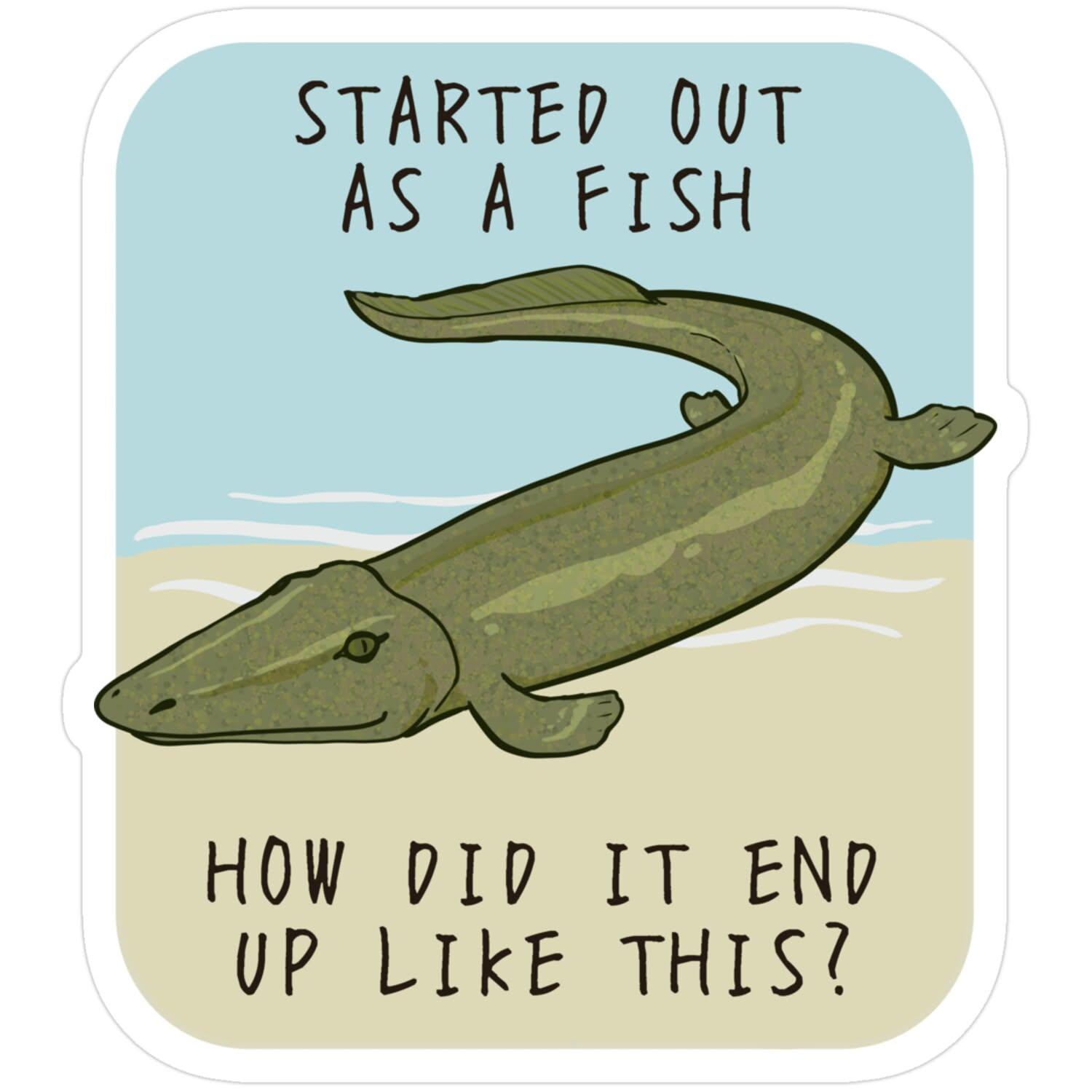
Tiktaalik roseae is a 375-million-year-old lobe-finned fish from the Late Devonian of Arctic Canada, and it is probably the most famous "transitional" fossil recovered in the last fifty years. The reason is simple: Tiktaalik does not look like a fish, and it does not look like a four-legged animal.
It looks like a body caught between those two ways of living, with scales and fin rays and gills on one side of the ledger and a flat head, a true neck, a shoulder, an elbow, and a wrist on the other. Palaeontologists call it a "fishapod" - part fish, part tetrapod - because neither category holds it comfortably.
This entry covers what Tiktaalik was, how it lived, where and when it existed, why its anatomy matters, and why its discovery in 2004 by Neil Shubin, Edward Daeschler, and Farish Jenkins counts as one of the most celebrated predictions-made-real in modern palaeontology. Expect specifics: millions of years, metres, latitudes, bones, and the strange circumstances surrounding a fossil that was found because theory said it should be there.
Etymology and Classification
The genus name Tiktaalik comes from Inuktitut, the language of the Inuit of Nunavut, on whose traditional land the fossils were found. It means "large freshwater fish" and refers generally to big river fishes like the burbot. The name was suggested by Nunavut elders during consultation with the research team, and it is one of the rare major fossil genera named in an Indigenous language by the community that shares the landscape.
The species epithet roseae is a different kind of tribute. It honours an anonymous donor - known only as "Rose" - who helped fund the Arctic expeditions that uncovered the fossil. The combination is unusual and memorable: an ancient Inuktitut word for the most famous Devonian cousin of the tetrapods, paired with a Latinised commemoration of an unnamed patron.
Taxonomically, Tiktaalik sits in the class Sarcopterygii (the lobe-finned fishes) and the order Elpistostegalia, which groups together the flat-headed, tetrapod-like lobe-fins of the Late Devonian. Its closest well-known relatives include Elpistostege watsoni from Quebec and Panderichthys rhombolepis from Latvia.
Elpistostegalia is not itself the tetrapod line, but it sits right next to it: its members share a common ancestor with tetrapods that lived only a few million years before Tiktaalik itself.
Tiktaalik is not your direct ancestor. It is a cousin. Because fossilisation is rare, palaeontologists do not expect to find the exact great-great-grandparent of any living group. What they look for are close relatives that preserve the body plan the ancestor probably had. Tiktaalik is the best such window onto the fish-to-tetrapod transition yet discovered.
Size and Physical Description
Tiktaalik was a large, flat-bodied fish built for life in shallow water. Adult specimens range from about 1.2 metres to at least 2.7 metres in length, with the largest individuals comparable in size to a modern adult human.
Body outline:
- Length: 1.2-2.7 metres in known specimens
- Build: long, flat, broad-bodied with a crocodile-like head
- Body covering: overlapping bony scales typical of lobe-finned fishes
- Tail: symmetrical, paddle-shaped, with fin rays
- Cross-section: depressed (flattened top to bottom) rather than fish-like (side to side)
The flattened body plan is the first major hint that Tiktaalik was not a typical open-water fish. Most fish are compressed side to side, which suits fast swimming in mid-water. Tiktaalik is squashed top to bottom, like a crocodile or a large salamander. That shape is useful for lying on the bottom of shallow pools, pushing through vegetation, and raising the head above the waterline.
The head is the second giveaway. Tiktaalik has a flat, broad skull with eyes placed on top rather than on the sides. In living animals that combination is typical of ambush predators in shallow water - think crocodiles and alligators lurking with only their eyes and nostrils breaking the surface. A spiracle on the top of the skull suggests Tiktaalik could gulp air from the surface without lifting its entire head, an advantage in oxygen-poor water.
The limbs - or rather, the limb-like pectoral fins - are the third giveaway, and by far the most famous.
The "Fishapod" Anatomy
Tiktaalik matters because its skeleton preserves a specific mosaic of features: fish on the outside, tetrapod on the inside, with the two mingling in detail after detail. The nickname "fishapod" is not marketing. It is a reasonable attempt to describe an animal that refuses to fit cleanly on either side of the fish-tetrapod line.
Fish features retained:
- Scales covering the body
- Fin rays (lepidotrichia) at the edges of the paired fins
- Internal gills and a gill-arch skeleton
- A fish-like pelvic girdle not yet fused to the vertebral column
- An aquatic tail built for swimming, not walking
Tetrapod features already present:
- A flat, crocodile-like skull
- Eyes on top of the head rather than on the sides
- A true neck - the skull is free to swivel independently of the shoulder girdle
- Robust, overlapping ribs capable of supporting body weight
- A pectoral fin whose internal skeleton includes a humerus, radius, ulna, and wrist bones
- Functional joints at what we would call the shoulder, elbow, and wrist
The most visually striking feature is the neck. Almost all fish have the skull bolted directly to the shoulder girdle through a series of bones. Move the shoulder and the head moves too. Tiktaalik broke that connection. It is the first known vertebrate in which the skull can swivel freely relative to the body - a feature that every subsequent tetrapod, including every amphibian, reptile, bird, and mammal, inherits.
When you turn your head to look over your shoulder, you are using a bit of kit that shows up first in the fossil record in Tiktaalik.
The pectoral fin is equally load-bearing, in both the anatomical and the argumentative sense. Inside the fleshy base of the fin sit the same four bone regions you have in your arm: a single upper bone (humerus), two parallel bones below it (radius and ulna), a cluster of small wrist bones, and radiating digit-like elements. The fin rays still fringe the end, so Tiktaalik is not walking on fingers. But everything you would call "arm" is already built.
The internal architecture of the fin is arranged to allow flexing at the shoulder, bending at the elbow, and angling at the wrist. Functionally, Tiktaalik could plant its pectoral fins on the bottom and prop its front end up - the famous "Devonian push-up." It could use the same motion to crawl through dense vegetation, shuffle between shallow pools, or brace itself against a current.
A 2014 study described Tiktaalik's pelvic region for the first time. The result changed the standard story. The hind fins were much larger and more powerful than anyone had expected based on earlier reconstructions. The pelvis was expanded, the hip socket was deep, and the attachment points for muscles were robust.
Before that paper, the conventional view held that early tetrapod-like lobe-fins were essentially "front-wheel drive," with the big anatomical investments concentrated in the pectoral limbs. Tiktaalik shows that four-limb locomotion - or at least four-fin locomotion - was already being developed before true tetrapods appeared.
Respiration: Gills, Lungs, and Spiracles
Tiktaalik is not a lungfish that forgot how to breathe water. It is a fish that was running a dual respiratory system, and the details matter because they tell us what kind of water it lived in.
Respiratory features:
- Functional gills for extracting oxygen from water
- Lungs (inferred from related lobe-finned fishes and confirmed by skeletal features)
- Large spiracles on the top of the skull for air gulping
- A reinforced shoulder and rib cage that could support breathing movements out of water
The spiracles are particularly interesting. A spiracle is essentially a respiratory opening on top of the head, left over from an ancestral gill slit. In Tiktaalik the spiracles appear to have been enlarged and positioned so the animal could surface, take a breath, and sink again without lifting more than the top of its skull above the water.
This is characteristic of animals living in warm, shallow, stagnant water where dissolved oxygen falls low enough that pure gill-breathing becomes difficult.
The combination - gills plus lungs plus spiracles - places Tiktaalik firmly in a swampy, sluggish-water world. It was not swimming in the open ocean. It was sitting in oxygen-poor backwaters where the ability to grab air made the difference between life and death.
Habitat and Environment
The rocks that preserve Tiktaalik - the Fram Formation of Ellesmere Island - are now exposed at roughly 77 degrees north latitude, inside the Canadian Arctic. But during the Late Devonian, plate tectonics placed this rock formation near the equator. The ancient landscape was tropical, not Arctic.
Paleoenvironmental reconstruction:
| Attribute | Devonian condition | Modern analogue |
|---|---|---|
| Latitude | Near equatorial | Amazon basin, Congo basin |
| Climate | Warm, seasonally wet | Tropical floodplain |
| Water | Shallow, slow-moving, sometimes stagnant | Backwater swamps, oxbow lakes |
| Vegetation | Early land plants along banks | Sparse ferny floodplain flora |
| Oxygen | Low in bottom water | Tannic, oxygen-poor tropical streams |
Tiktaalik lived in this low-oxygen, shallow, vegetated environment. The surrounding landscape was a floodplain cut by rivers, dotted with ponds, and punctuated by seasonal dry spells. Early land plants - mostly small, leafless, spore-bearing forms - had begun to stabilise banks and create the first true freshwater soils. Invertebrate life was abundant in these waters: arthropods, small fish, and early insect-like creatures provided prey.
The equatorial-to-Arctic journey of the Fram Formation is a useful reminder that geology is never static. Continents have moved, rotated, and rafted entire biomes across the planet. Tiktaalik lived in a warm, humid, mud-choked equatorial swamp. Its fossils are now mined from snow-banked cliffs thousands of kilometres from any swamp that would suit it.
How Tiktaalik Lived
Reconstructing the behaviour of an extinct animal is always an exercise in reasoned inference, not direct observation. For Tiktaalik the inferences are unusually well-supported because the skeleton is so informative.
Likely lifestyle:
- Ambush predator in shallow, vegetated water
- Moved slowly on the bottom using pectoral and pelvic fins for support
- Surfaced periodically to gulp air through spiracles
- Fed on smaller fish, early aquatic arthropods, and other swamp invertebrates
- Used flat head and top-placed eyes for crocodile-style surface lurking
- Could brace against currents and push itself over obstacles between pools
A mental image that gets close to the lifestyle: imagine an alligator gar with slightly longer "arms" lying motionless in a weedy Amazon backwater, occasionally raising its head above the water to watch for movement on the bank and occasionally propping itself up on its front fins to shove between logs. That is not a caricature; that is what the anatomy says the animal was doing.
There is no evidence that Tiktaalik ventured far from water. Its hydrodynamic body, fin rays, scales, and gills all say aquatic animal. But the limb-like pectoral fins, the mobile neck, the overlapping ribs, and the spiracles all say "capable of surviving in the border zone between water and land." That border zone is exactly where early tetrapods were evolving, and Tiktaalik shows the kind of body plan that makes the transition conceivable.
Why Tiktaalik Was Predicted Before It Was Found
The discovery of Tiktaalik is almost as important as the fossil itself because of how it happened. Most major fossils are found by accident. Tiktaalik was found on purpose.
The prediction:
- The fish-to-tetrapod transition must have happened somewhere, and the relevant animals must have lived in shallow freshwater.
- The transition occurred during the Late Devonian, roughly 380-360 million years ago.
- Late Devonian freshwater rocks exposed at the surface are rare, but not unknown.
- One of the best-exposed Late Devonian freshwater units on Earth is the Fram Formation on Ellesmere Island.
- Therefore, if the transition is going to be preserved anywhere, Ellesmere Island is a likely place to look.
Neil Shubin, Edward Daeschler, and Farish Jenkins followed that chain of reasoning through several field seasons on Ellesmere Island beginning in 1999. In 2004, the team recovered the first well-preserved skull and partial skeleton. The formal description was published in Nature in 2006. The fossil matched the predicted anatomy: fish scales, fins with fin rays, and gills, combined with a flat skull, a neck, and limb-like internal bones in the pectoral fins.
The prediction-and-confirmation cycle is one of the clearest examples in modern science of theory guiding a discovery. It is often used in classrooms as a case study in how evolutionary biology and geology work together.
Extinction and Legacy
The Elpistostegalia - the group that contains Tiktaalik and its closest relatives - did not survive the end of the Devonian. They disappeared along with many other lobe-finned fishes during a period of significant extinction and ecological reorganisation.
Two nearby lineages, however, did survive and thrive:
- True tetrapods. By the very end of the Devonian, animals like Acanthostega and Ichthyostega show fingers and toes rather than fin rays and represent the earliest tetrapods proper. Everything from amphibians to mammals descends from this group.
- Other sarcopterygians. Modern lungfish and coelacanths are living lobe-finned fishes. They are not descended from Tiktaalik specifically, but they share a deeper common ancestor with the tetrapod line.
Tiktaalik itself is a terminal branch. Its anatomy represents a working compromise between aquatic and terrestrial demands that persisted for a long time but did not lead directly to any living descendants. What Tiktaalik preserves is not ancestry in a literal sense but the shape of the transition - the specific sequence of anatomical changes that made moving from water to land possible.
Its legacy in modern biology is enormous. Tiktaalik appears in every college-level textbook on vertebrate evolution, in most introductory biology surveys, and in countless documentaries. It is central to Shubin's popular-science book Your Inner Fish, which traces features of the human body back to Devonian ancestors. When educators need to show a single example of a transitional fossil with both fish and tetrapod features in one skeleton, Tiktaalik is usually the example they reach for.
Tiktaalik in Context: The Devonian "Age of Fishes"
The Devonian Period (roughly 419 to 359 million years ago) is often nicknamed the Age of Fishes, and not without reason. During the Devonian, the world's fish lineages diversified explosively. Placoderms (armoured fishes), acanthodians (spiny fishes), early ray-finned fishes, sharks, and lobe-finned fishes all expanded and experimented with new body plans.
Late Devonian vertebrate context:
| Group | Representative | Notable feature |
|---|---|---|
| Placoderms | Dunkleosteus | Armoured predator, up to 6 m long |
| Lobe-finned fishes | Eusthenopteron | Lobed fins, close relative of tetrapod line |
| Elpistostegalia | Panderichthys, Tiktaalik | Flat heads, near-limb pectoral fins |
| Early tetrapods | Acanthostega, Ichthyostega | True digits, still mostly aquatic |
Tiktaalik slots into this sequence right before fingers and toes appear. Panderichthys, a close cousin, shows a slightly less tetrapod-like anatomy. Tiktaalik is more derived in the direction of tetrapods. Acanthostega, which lived a few million years later, crosses the digit threshold. The fish-to-tetrapod transition was not a single jump: it was a staircase of incremental anatomical changes recorded in a handful of closely related species.
Common Misconceptions
Tiktaalik is popular, which means it is also frequently misrepresented. A few corrections:
- It is not the "first" anything walking on land. It almost certainly did not walk on dry land regularly. It crawled and propped itself up in shallow water.
- It did not have fingers. Its pectoral fins contain limb-like internal bones but still end in fin rays. True digits appear in later relatives like Acanthostega.
- It is not our direct ancestor. It is a close cousin of the lineage that led to tetrapods, not that lineage itself.
- It did not breathe only through lungs. It retained functional gills and simply supplemented them with air-breathing structures.
- It is not an "arctic" animal. The rocks are arctic today. The animal lived in an equatorial swamp.
Related Reading
- Acanthostega: The First True Tetrapod
- Coelacanth: The Living Fossil Lobe-Finned Fish
- Dunkleosteus: The Devonian Armoured Predator
- Lungfish: Modern Relatives of the Tetrapod Line
References
Key peer-reviewed sources for this entry include Daeschler, Shubin, and Jenkins (2006) Nature, "A Devonian tetrapod-like fish and the evolution of the tetrapod body plan"; Shubin, Daeschler, and Jenkins (2006) Nature, "The pectoral fin of Tiktaalik roseae and the origin of the tetrapod limb"; Shubin, Daeschler, and Jenkins (2014) Proceedings of the National Academy of Sciences, "Pelvic girdle and fin of Tiktaalik roseae"; and Neil Shubin's book Your Inner Fish (2008).
Stratigraphic and palaeogeographic context draw on ongoing work on the Fram Formation and the Late Devonian palaeoclimate, including reports from the Academy of Natural Sciences of Drexel University and the University of Chicago.
Frequently Asked Questions
What is Tiktaalik and why does it matter?
Tiktaalik roseae is a Late Devonian lobe-finned fish that lived about 375 million years ago and preserves an astonishing mixture of fish and tetrapod features. It had scales, fin rays, and gills like a fish, but also a flat head, a functional neck, and pectoral fins containing a shoulder, elbow, and wrist.
Tiktaalik matters because it is one of the clearest ‘transitional’ fossils ever found: it shows how fins gradually rebuilt themselves into limbs, how a head learned to swivel, and how an aquatic animal prepared itself for life at the water’s edge. It is a central piece of evidence for the fish-to-tetrapod transition.
How was Tiktaalik discovered?
Tiktaalik was uncovered in 2004 by a team led by Neil Shubin, Edward Daeschler, and Farish Jenkins on Ellesmere Island in Nunavut, Arctic Canada. The discovery is famous not only for the fossil itself but for how the team found it. Shubin reasoned that the fish-to-tetrapod transition should be preserved in Late Devonian freshwater rocks, and a geological map pointed his team straight to Ellesmere Island’s exposed Devonian strata.
After several seasons of searching, they located the now-iconic skull peeking out of a cliff face. It is one of the few major fossils in history that was found because theory said it should be there.
Why is Tiktaalik called a 'fishapod'?
The nickname ‘fishapod’ blends ‘fish’ and ‘tetrapod’ (four-limbed vertebrate) because Tiktaalik cannot be cleanly placed in either group. It retains fish characteristics - scales, fin rays, gills, and an aquatic body plan - while simultaneously showing tetrapod characteristics such as a flattened head, a mobile neck, robust ribs, and limb-like internal bones in its pectoral fins.
The fishapod label captures the idea that evolution does not flip a switch from fish to land animal. Instead, a body gradually accumulates features that work better in shallow water and near the shore. Tiktaalik is the clearest example of that mosaic in action.
Could Tiktaalik walk on land?
Not in the way a salamander or lizard walks. Tiktaalik almost certainly spent its life in water, but it was built for shallow, weed-choked environments where propping itself up on its fins was useful. Its pectoral fins had a functional shoulder, elbow, and wrist, letting the animal support part of its body weight and push itself through vegetation or briefly across mudflats.
A 2014 study of its pelvic anatomy showed its hind fins were unusually muscular for a fish, suggesting a kind of early ‘four-limb’ propulsion. The honest answer is that Tiktaalik did push-ups and crawl-swims in shallow water more than it walked on dry land.
Where did Tiktaalik live?
Tiktaalik lived in shallow freshwater streams, ponds, and swamps on a broad floodplain near the Devonian equator. The rocks that preserve it - now exposed on Ellesmere Island at roughly 77 degrees north latitude - were equatorial when they formed. Plate tectonics have since carried the entire rock formation far north into the Arctic.
The environment was warm, seasonally wet, and choked with early land plants whose roots stabilised river banks and created quiet backwaters. Oxygen levels in these shallow waters were probably low, which is why many lobe-finned fish of the era, including Tiktaalik, evolved lungs and air-gulping behaviour alongside their gills.
Is Tiktaalik our ancestor?
Strictly speaking, no. Tiktaalik belongs to the Elpistostegalia, a group of lobe-finned fishes that are very close relatives of the lineage that became tetrapods, but it is not the single direct ancestor of all four-limbed animals. Think of Tiktaalik as a close evolutionary cousin - a great-uncle on the family tree - that preserves the body plan the direct ancestor probably had.
Because fossilisation is rare and lucky, palaeontologists do not expect to find the exact great-great-grandparent. Tiktaalik is the best-preserved member of a body plan that existed in many related forms, and it is therefore the best window we have into what the true ancestor looked like.
What does the name Tiktaalik mean?
Tiktaalik is an Inuktitut word meaning ‘large freshwater fish’, specifically referring to a big burbot-like fish in the rivers of Nunavut. The name was proposed by elders of the Inuit community consulted by the research team after the fossil was recovered from their traditional lands. The species name, roseae, honours an anonymous benefactor - known only as ‘Rose’ - who helped fund the Ellesmere Island expeditions.
The combination is unusual in palaeontology: a genus name in an Indigenous language chosen by community elders, paired with a species epithet commemorating a private donor.
What happened to Tiktaalik and its relatives?
The Elpistostegalia - the group that contains Tiktaalik - vanished by the end of the Devonian, along with many other early lobe-finned fishes. The Late Devonian saw significant extinction events that reshaped aquatic ecosystems. Meanwhile, the lineage that became true tetrapods (animals with fingers and toes like Acanthostega and Ichthyostega) continued to evolve into the first genuinely terrestrial vertebrates.
Tiktaalik itself was a successful shallow-water predator for millions of years, but its body plan was a transitional compromise, not an end state. The future belonged to its cousins that fully committed to life on land - and eventually to every amphibian, reptile, bird, and mammal that followed.