
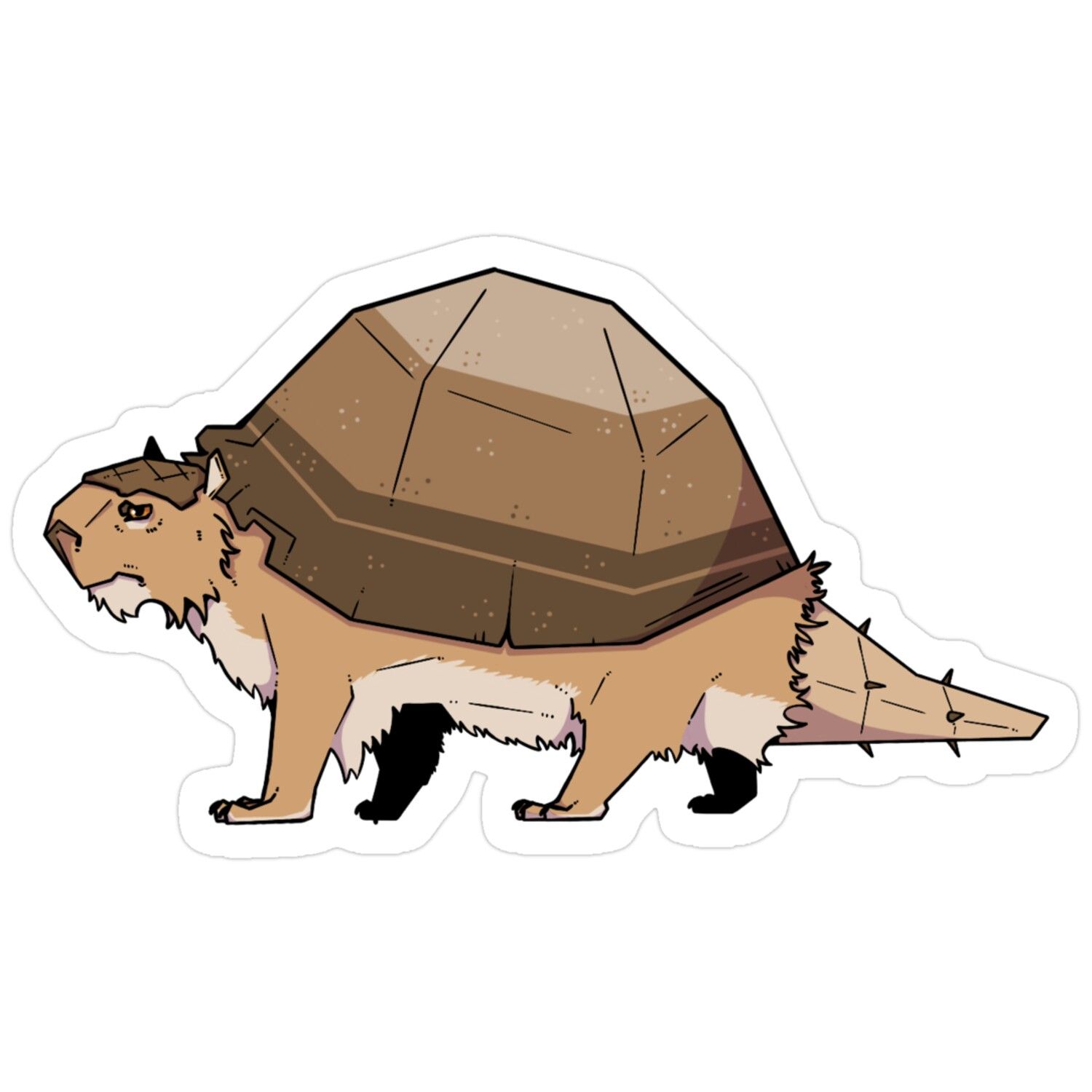
How big were glyptodons?
Glyptodons were massive armored mammals reaching up to 3. 3 meters (11 feet) in length and 1. 5 meters (5 feet) tall, weighing approximately 2,000 kg (4,400 pounds) - roughly the size and weight of a modern Volkswagen Beetle. They were covered in thick bony armor composed of over 1,000 individual bony plates called osteoderms fused into a rigid dome-shaped.
A Volkswagen Beetle With a Tail Club
Imagine an armadillo. Now scale it up 100 times. Give it a rigid dome-shaped shell the size of a car. Add a massive tail ending in a bony club capable of breaking bones. Place it in Ice Age South America alongside giant ground sloths, saber-toothed tigers, and early humans.
This was the glyptodon, a 2-ton armored herbivore that walked the Americas for over 5 million years before going extinct 10,000 years ago. Their shells were so large and strong that early humans used them as shelters.
The Animal
Glyptodons were massive armored mammals.
Physical features:
- Length: up to 3.3 meters
- Height: 1.5 meters
- Weight: up to 2,000 kg
- Shell: dome-shaped, rigid
- Tail: armored with club
- Head: bony cap protection
Shell structure:
- Over 1,000 individual bony plates (osteoderms)
- Fused into rigid dome
- Cannot flex like armadillo bands
- Thick enough to resist predators
- Hexagonal plate pattern
The tail weapon:
Some species (especially Doedicurus):
- Bony rings along tail
- Massive club at tip
- Some had spikes
- Could break bones on impact
Armadillo Relatives
Glyptodons were giant armadillos.
Evolutionary relationship:
- Same superorder (Xenarthra)
- Same family as modern armadillos
- Diverged ~35 million years ago
- Evolved in isolated South America
- Genuine giant armadillos
DNA confirmed:
Genetic analysis shows:
- Within armadillo family tree
- Closer to fairy armadillos than expected
- Clear evolutionary lineage
- Well-documented relationship
Size comparison:
- Glyptodon: 2,000 kg
- Giant armadillo (living): 50 kg
- Nine-banded armadillo: 5 kg
- Pink fairy armadillo: 0.1 kg
- Scale difference: 20,000x smallest to largest
Shared features:
Both glyptodons and armadillos have:
- Bony armor (osteoderms)
- Similar skull structure
- Xenarthran joints
- Herbivorous diet
- American distribution
Key differences:
- Glyptodon shell rigid (armadillo flexible)
- Glyptodon cannot curl up
- Glyptodon much larger
- Different defensive strategies
The Armor
Glyptodon shells were engineering marvels.
Construction:
- 1,000+ individual bony plates
- Each plate hexagonal or pentagonal
- Fused together into dome
- Total thickness: 2-5 cm
- Weight of shell alone: significant portion of body
Strength:
The shell could:
- Resist saber-toothed tiger bites
- Deflect predator attacks
- Protect internal organs
- Withstand significant force
Design:
- Dome shape distributes force
- No weak joints or hinges
- Complete coverage of body
- Rigid protection
Head protection:
- Bony cap covered skull
- Protected brain
- Limited vision somewhat
- Defensive compromise
Tail armor:
- Bony rings encased tail
- Flexible enough to swing
- Club tip for offense
- Complete protection system
The Tail Club
Some glyptodons had formidable weapons.
Doedicurus (most armed):
Massive tail club:
- 40+ cm diameter
- Bony spikes on some
- Swung with massive force
- Defensive and offensive
Combat uses:
Against predators:
- Swing at approaching threats
- Enough force to break bones
- Deterrent from attacking
- Last line of defense
Male-male combat:
Evidence from fossils:
- Impact damage on shells
- Broken bone plates
- Healed injuries
- Fighting over mates
Biomechanics:
Research shows:
- Medieval mace-like force
- Calculated swing power
- Effective range 1-2 meters
- Devastating impact
Convergent evolution:
Similar weapons evolved in:
- Ankylosaurs (dinosaurs)
- Some turtles (moderately)
- Unique among mammals
- Remarkable parallel
Where They Lived
Glyptodons inhabited the Americas.
South America (primary):
- Argentina (famous fossils)
- Brazil
- Uruguay
- Paraguay
- Bolivia
- Colombia
- Venezuela
North America (after Great American Interchange):
- Southern United States
- Mexico
- Central America
- Arrived ~3 million years ago
Habitats:
- Grasslands (primary)
- Open woodlands
- River valleys
- Temperate regions
- Various environments
The Great American Interchange:
When North and South America connected:
- Glyptodons moved north
- Other species moved south
- Major ecological mixing
- ~3 million years ago
Diet
Glyptodons were herbivores.
Food sources:
- Grasses (primary)
- Low vegetation
- Some shrubs
- Roots occasionally
- Ground-level plants
Feeding style:
- Grazers primarily
- Low to ground
- Broad muzzle for grass
- Constant feeding needed
Daily consumption:
- Hundreds of kilograms
- Continuous grazing
- Large gut for processing
- Slow metabolism
Digestive system:
- Large cecum (like horses)
- Microbial fermentation
- Efficient for tough vegetation
- Adapted to grassland diet
Humans and Glyptodons
Early Americans encountered them.
Human arrival:
- ~15,000 years ago in South America
- Found established glyptodon populations
- Hunting evidence clear
- Overlap period ~5,000 years
Hunting evidence:
- Butchered bones
- Human tools near remains
- Kill sites
- Systematic hunting
Shell as shelter:
Archaeological evidence:
- Human artifacts inside shells
- Fire remains inside
- Tool marks on shells
- Oral traditions support
How they hunted them:
Despite armor, humans could:
- Flip them over (expose soft belly)
- Dig under them
- Attack vulnerable areas
- Use coordinated group tactics
- Trap in terrain features
Why vulnerable:
- Slow movement
- Predictable habits
- Cannot escape humans
- Armor useless against flipping
- Low reproduction
Extinction
Gone 10,000 years ago.
Timeline:
- Thrived millions of years
- Declined with megafauna
- Extinct ~10,000 years ago
- Coincided with human expansion
Causes:
Human hunting:
- Major factor
- Systematic hunting
- Vulnerable despite armor
- Easy targets (slow, predictable)
Climate change:
- End of Ice Age
- Grassland changes
- Habitat transformation
- Food source shifts
Combined pressures:
- Hunting + climate
- Slow reproduction
- Cannot recover
- Population collapse
No survivors:
- All glyptodon species extinct
- No close living equivalent
- Only distant armadillo relatives survive
- Unique body plan lost
Famous Fossils
Remarkable preservation.
Argentine discoveries:
- Numerous complete shells
- Articulated skeletons
- River bank exposures
- Museum specimens worldwide
Charles Darwin connection:
- Darwin found glyptodon fossils in 1830s
- During Beagle voyage
- Noted similarity to armadillos
- Influenced evolutionary thinking
- Early paleontological insight
Museum specimens:
Major displays:
- Natural History Museum (London)
- American Museum of Natural History
- Argentine museums
- Various worldwide institutions
Research value:
Complete specimens allow:
- Detailed anatomy study
- Armor analysis
- Diet reconstruction
- Behavioral inference
- Evolutionary research
Species Diversity
Multiple glyptodon species existed.
Notable species:
Glyptodon clavipes:
- Classic species
- Well-studied
- South American
- Medium-large
Doedicurus:
- Largest species
- Most dramatic tail club
- South American
- Heavily armed
Panochthus:
- Distinctive shell pattern
- South American
- Well-preserved
- Research subject
Neosclerocalyptus:
- Smaller species
- South American
- Different adaptations
- Various populations
Glyptotherium:
- North American species
- Arrived via interchange
- Different from South American
- Separate evolution
Evolutionary Context
Glyptodons in broader perspective.
Xenarthra superorder:
Includes:
- Glyptodons (extinct)
- Armadillos (living)
- Sloths (living + extinct giant)
- Anteaters (living)
- All originated in South America
South American isolation:
For 60+ million years:
- South America isolated
- Unique fauna evolved
- Xenarthrans diversified
- Megafauna developed
- No placental competition
Great American Interchange:
3 million years ago:
- Land bridge formed
- Species mixed
- North and South American fauna
- Ecological disruption
- Some species spread, others declined
Glyptodon success:
- Survived interchange
- Spread northward
- Persisted millions of years
- Only climate + humans ended them
Modern Armadillo Connection
Living relatives continue.
Giant armadillo:
- Largest living
- 50 kg (tiny vs glyptodon)
- South American
- Endangered
- Closest living analog
Nine-banded armadillo:
- Most widespread
- North and South America
- Expanding range
- Common species
Pink fairy armadillo:
- Smallest
- Argentine specialist
- Endangered
- Fascinating biology
What armadillos share:
- Bony armor
- Xenarthran biology
- American distribution
- Herbivorous/omnivorous
- Ancient lineage
Why They Matter
Glyptodons represent significant biology.
Evolutionary significance:
- Unique body plan
- Extreme armor evolution
- Tail club convergence
- Size achievement
Ecological role:
- Major herbivores
- Grassland shapers
- Ecosystem participants
- Food web members
Cultural importance:
- Darwin connection
- Museum icons
- Educational tools
- Paleontological heritage
Modern lessons:
- Armor doesn't protect against humans
- Specialization creates vulnerability
- Climate + humans = extinction
- Conservation urgency for surviving relatives
The Living Tanks
Every glyptodon that walked Ice Age Americas represented one of nature's most heavily armored land animals.
Their shells could stop a saber-toothed tiger. Their tail clubs could break bones. Their armor protected them from essentially every predator they evolved alongside. For 5 million years, their defense strategy worked perfectly.
Then humans arrived, and figured out how to flip them over.
Their shells, which protected them against natural predators, were useless against coordinated human hunters who attacked the unprotected underside. Their slow movement couldn't escape pursuit. Their low reproduction couldn't replace losses. Their predictable habits made them easy targets.
Within 5,000 years of human arrival, they were extinct. Their shells remained, some used as human shelters, others gradually fossilized into the museum specimens we study today.
Modern armadillos carry the genetic legacy of the glyptodon lineage in smaller form. Giant armadillos at 50 kg are the closest living analogs, but they're 40 times smaller than their Ice Age relatives.
The glyptodons demonstrate that even the most heavily armored animals can go extinct when they face threats their armor wasn't designed for. Saber-toothed tigers couldn't get through the shell. Humans didn't need to.
Glyptodon Species and Sizes
The Kalenux Team has compiled the major glyptodont species known from complete or near-complete specimens. Glyptodontidae contained at least 65 described species across roughly 15 genera, ranging from small armadillo-sized ancestors to elephant-sized giants.
| Species | Time Range | Body Mass | Shell Length | Notable Feature |
|---|---|---|---|---|
| Glyptodon clavipes | Pleistocene | 1,000-2,000 kg | 3.3 m | Type species; most common South American |
| Doedicurus clavicaudatus | Late Pleistocene | 1,500-2,000 kg | 3.6 m | Massive spiked tail mace |
| Panochthus tuberculatus | Late Pleistocene | 1,200-1,500 kg | 3.0 m | Ornate shell ornamentation |
| Glyptotherium texanum | Late Pleistocene | 800-1,200 kg | 2.5 m | Main North American species |
| Hoplophorus euphractus | Pliocene | 400-600 kg | 2.0 m | Earlier glyptodont stage |
| Neosclerocalyptus pseudornatus | Pleistocene | 400-500 kg | 2.1 m | Cold-adapted species |
"Doedicurus had a tail mace that would fit perfectly on a medieval knight's flail. The mace was covered in bony spikes and swung with enough force - probably exceeding several hundred Newton-meters of torque - to break bone in attacking predators or combating rival males. Glyptodon evolution produced weapons that no other mammal had before or has since." - Sergio Vizcaino, Universidad Nacional de La Plata, Journal of Mammalian Evolution, 2011 [1]
The maces are not hypothetical. Several Doedicurus skulls have been found with exactly the kind of healed fractures that a swung mace would produce, suggesting that males used the weapons in intraspecific combat, likely for mating rights or territorial defense. This makes the mace weapons one of the few confirmed examples of mammalian combat with truly lethal natural weapons.
Biomechanics of the Shell
The glyptodont shell was not a single solid plate like a turtle's carapace. It was a mosaic of bony osteoderms - hundreds or thousands of individual hexagonal, pentagonal, or irregularly shaped plates fused into a rigid dome. Detailed microscopy by Julian Campagna and colleagues has shown that each osteoderm contained an outer dense cortex, a porous middle layer, and an inner cortex. The design combined exceptional strength with surprising light weight.
Finite element simulations indicate that a typical Glyptodon shell could absorb impacts exceeding 10 kilonewtons without structural failure - enough to withstand the bite of any Pleistocene South American predator, including the saber-toothed cats and the terror birds. The shell was thinnest near the hip and shoulder joints, where flexibility was needed, and thickest over the vertebral column, where protection was most important.
| Shell Metric | Glyptodon clavipes | Modern Giant Armadillo |
|---|---|---|
| Osteoderm count | ~1,800 | ~1,000 |
| Shell thickness | 3-5 cm | 0.5-1 cm |
| Shell mass | ~400 kg | ~2 kg |
| Shell as % of body mass | 20-25% | 3% |
| Mobility (articulated shell) | Rigid | Partially flexible bands |
The shell's weight is striking. A quarter of the animal's body mass was armor, committed to defense at a metabolic cost no modern land mammal accepts. Walking, running, digging, and even breathing were shaped around supporting this carrying load. Every square centimeter of the shell represents a thousand generations of selection for increasing thickness, fitting into what was clearly an arms race with predators and rivals.
Ancient DNA Confirms the Armadillo Connection
A 2016 study by Kieren Mitchell and colleagues, published in Current Biology, recovered ancient DNA from a Doedicurus specimen preserved in Argentine sediments. The genetic sequences placed glyptodonts firmly within Chlamyphoridae, the family that includes the living pink fairy armadillo and giant armadillo. This finally settled a long-running taxonomic debate: glyptodonts are not a separate family but a subfamily within the modern armadillo family tree.
"Glyptodonts are essentially giant armadillos. They split from the chlamyphorid lineage around 35 million years ago in the Eocene, and the rest of their evolution is a story of increasing size, increasing armor, and increasing specialization. The modern giant armadillo is what a small glyptodont might still look like today." - Kieren Mitchell, University of Adelaide, Current Biology, 2016 [2]
This insight has changed how museums display glyptodonts. They are no longer shown alongside turtle skeletons or labeled as mysterious extinct creatures but rather grouped with their modern armadillo descendants. The giant armadillo (Priodontes maximus), at up to 50 kilograms, is their closest living relative - still a formidable animal but a mere shadow of Glyptodon.
Human Use of Glyptodon Shells
The archaeological record documents an unusual afterlife for glyptodont shells in human culture. Several Pampean sites in Argentina preserve hollowed-out glyptodont carapaces used by Paleoindian groups as temporary shelters, hearths, and possibly children's cradles. The shells' natural dome shape and structural strength made them practical materials to repurpose, particularly in the treeless grassland environments where wood was scarce.
"We have clear evidence of glyptodont shells used as shelters. Carapaces at Arroyo del Vizcaino in Uruguay show both butcher marks from initial processing and wear marks consistent with subsequent domestic use. These animals provided meat first, then housing second." - Richard Fariña, Universidad de la Republica, Journal of Archaeological Science, 2013 [5]
The evidence implies a multi-stage human interaction with glyptodonts: hunting them for meat (with the shell protecting most of the carcass, forcing attack on the underside), consuming the meat, and then repurposing the shells as durable structural materials. This pattern may have accelerated the species' decline by creating economic incentives beyond simple food acquisition.
References
- Vizcaíno, S. F., and De Iuliis, G. (2011). "Adaptations of glyptodonts (Mammalia, Xenarthra) to their Pleistocene environment." Journal of Mammalian Evolution, 18(4), 243-263.
- Mitchell, K. J., Scanferla, A., Soibelzon, E., Bonini, R., Ochoa, J., and Cooper, A. (2016). "Ancient DNA from the extinct South American giant glyptodont Doedicurus sp. reveals that glyptodonts evolved from Eocene armadillos." Current Biology, 26(2), R127-R129.
- Alexander, R. M., Fariña, R. A., and Vizcaino, S. F. (1999). "Tail blow energy and carapace fractures in a large glyptodont (Mammalia, Xenarthra)." Zoological Journal of the Linnean Society, 126(1), 41-49.
- Delsuc, F., Vizcaino, S. F., and Douzery, E. J. P. (2004). "Influence of Tertiary paleoenvironmental changes on the diversification of South American mammals: a relaxed molecular clock study within xenarthrans." BMC Evolutionary Biology, 4, 11.
- Fariña, R. A., et al. (2014). "Arroyo del Vizcaino, Uruguay: a fossil-rich 30-ka-old megafaunal locality with cut-marked bones." Proceedings of the Royal Society B, 281(1774), 20132211.
Related Articles
- Giant Ground Sloth: The 4-Ton Sloth
- Saber-Toothed Tiger: The Ice Age Predator
- Why Mammoths Went Extinct
Frequently Asked Questions
How big were glyptodons?
Glyptodons were massive armored mammals reaching up to 3.3 meters (11 feet) in length and 1.5 meters (5 feet) tall, weighing approximately 2,000 kg (4,400 pounds) - roughly the size and weight of a modern Volkswagen Beetle. They were covered in thick bony armor composed of over 1,000 individual bony plates called osteoderms fused into a rigid dome-shaped shell.
Their tails were armored with bony rings and some species had club-like tail tips that served as defensive weapons. Their heads also had protective bony caps. They were relatives of modern armadillos but approximately 100 times larger. Different species varied in size - Doedicurus was among the largest with a massive tail club, while Glyptodon itself was somewhat smaller.
Their shells were so thick and strong that early South American humans reportedly used them as shelters. They lived in South America and southern North America from approximately 5.3 million years ago until about 10,000 years ago.
Were glyptodons related to armadillos?
Yes, glyptodons were closely related to modern armadillos, belonging to the same superorder Xenarthra. Genetic analysis has confirmed they are within the armadillo family (Chlamyphoridae), making them essentially giant armadillos rather than a completely separate lineage.
Their evolutionary history: diverged from other armadillos approximately 35 million years ago, evolved in South America during its isolation, grew to enormous sizes through megafaunal gigantism, and developed their characteristic rigid shell. Key differences from armadillos: glyptodon shells were rigid (not banded like armadillos), could not curl into balls, shell was fused into dome shape, and much larger overall.
Similar features: both have bony armor, both belong to Xenarthra, both have similar skull structure, and both eat primarily vegetation. Modern armadillos (9-banded, giant, pink fairy) represent surviving relatives of the same lineage. The giant armadillo (Priodontes maximus) at 50 kg is the largest living relative but still much smaller than any glyptodon species.
What were glyptodon tail clubs for?
Some glyptodon species (particularly Doedicurus) had massive tail clubs that functioned as formidable defensive and possibly offensive weapons. The tail clubs were composed of: bony rings along the tail, a large clubbed tip (sometimes spiked), heavy bone and tough tissue, and muscular base for swinging power.
Research suggests they were used for: defending against predators (saber-toothed cats, bears), combat between males (territorial disputes), competition during mating season, and general self-defense. Biomechanical studies indicate: enough force to break bones, comparable to medieval maces, effective against large predators, and capable of causing severe injury.
Male-male combat is particularly well-supported - many glyptodon shells show evidence of impact damage from tail clubs, suggesting intra-species fighting over mates or territory. Similar weapon evolution has occurred in other species including ankylosaurs (dinosaurs with tail clubs) - convergent evolution of defensive weaponry across different evolutionary lineages.
The combination of impenetrable shell + offensive tail weapon made glyptodons among the most heavily defended herbivores in Earth’s history.
Did humans use glyptodon shells as shelters?
Archaeological evidence suggests early South American humans did use abandoned glyptodon shells as temporary shelters. Evidence includes: human artifacts found inside glyptodon shells, fire remnants inside shells (suggesting campfire use), tool marks on some shells, and oral traditions from indigenous peoples.
The shells were well-suited for shelter: dome-shaped and waterproof, large enough for several people, strong enough to resist weather, and readily available after the animal’s death. Research indicates: humans hunted glyptodons for meat and used shells opportunistically, some shells show deliberate modification by humans, various South American archaeological sites contain shell-associated human activity, and the practice may have lasted centuries.
Whether humans specifically hunted glyptodons for shells is debated - more likely they used shells of naturally dead or hunted-for-meat animals. The shells weighed hundreds of kilograms and couldn’t be easily moved, so shelter use was at the death site. This represents one of the most dramatic human-megafauna interactions in the Americas.
Why did glyptodons go extinct?
Glyptodons went extinct approximately 10,000 years ago as part of the broader Pleistocene megafauna extinction. Causes included: human hunting (major factor - humans arrived in South America ~15,000 years ago), climate change (end of Ice Age), habitat loss (vegetation changes), slow reproduction (limited recovery capacity), and possibly disease.
Despite their formidable armor, they were vulnerable because: humans could flip them over to access soft underside, their slow movement made them easy targets, their predictable habits allowed planned hunts, and their low reproductive rate prevented population recovery. Their armor protected against animal predators but not coordinated human hunters.
Archaeological evidence shows: butchery marks on bones, human tools near glyptodon remains, kill sites across South America, and systematic hunting evidence. Their extinction followed the same pattern as other American megafauna - arrival of skilled human hunters combined with climate stress proved overwhelming for species that had evolved without human predation. No closely related large species survived - only smaller armadillos persisted.