
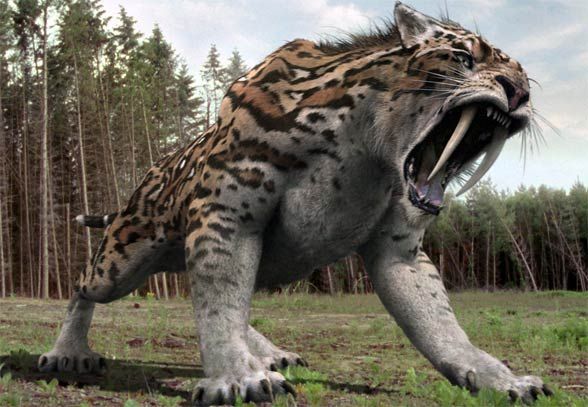
What is a saber-toothed tiger?
Saber-toothed tigers (genus Smilodon) were powerful extinct cats characterized by elongated canine teeth up to 18 cm (7 inches) long. They are not true tigers - they belong to a different cat subfamily that evolved separately. Three main Smilodon species existed: Smilodon fatalis (most famous, weighing 160-280 kg), Smilodon populator (largest, weighing 220-360 kg), and Smilodon gracilis (smaller ancestral species).
18cm Fangs in an Extinct Cat
A 280-kilogram cat stalks through Pleistocene grasslands 15,000 years ago. Its canine teeth extend 18 centimeters beyond its jaw, longer than the teeth of any modern cat. Its body is stockier and more powerful than modern lions. It hunts mammoths, giant ground sloths, and other Ice Age megafauna.
This is Smilodon, the saber-toothed tiger (though technically not a tiger). They ruled as apex predators across the Americas for millions of years, then disappeared 10,000 years ago along with the Ice Age world they dominated.
The Animal
Saber-toothed tigers were powerful prehistoric cats.
Three main species:
Smilodon fatalis:
- Most famous
- 160-280 kg
- North America
- Most specimens found
Smilodon populator:
- Largest
- 220-360 kg
- South America
- Most powerful
Smilodon gracilis:
- Smallest, earliest
- 55-100 kg
- Ancestral form
- Florida fossils
Physical features:
- Body: stocky, muscular
- Tail: short (unusual for cats)
- Forelimbs: extremely powerful
- Canines: 18 cm long
- Shoulders: massive
- Color: likely spotted or striped (based on camouflage needs)
Key differences from tigers:
- Different cat subfamily
- Evolved separately
- Social behavior suggested
- Different hunting style
- Not direct ancestors
The Famous Sabers
Their canine teeth defined them.
Dimensions:
- Length: up to 18 cm
- Thickness: moderate
- Curvature: slightly curved
- Serrations: limited
Structure:
- Pointed and sharp
- Flattened sides
- Not as robust as expected
- Evolved for slicing
Mechanical properties:
- Fragile under stress
- Can break during hunts
- Required immobilized prey
- Different from modern cat teeth
Function:
Used for:
- Delivering killing bite
- Slicing throat or belly
- Targeting soft tissues
- Final kill after prey pinned
Evolution:
- Developed gradually over 10+ million years
- Multiple saber-toothed cat species
- Convergent in different lineages
- Extremely successful design
Hunting Strategy
Saber-tooths killed large prey.
The hunt:
- Ambush from cover
- Pounce with massive power
- Use forelimbs to pin prey
- Kill with saber bite once controlled
Physical attributes for hunting:
Powerful forelimbs:
- Larger than hind legs
- Massive shoulder muscles
- Paws for pinning
- Handle large prey
Strong bite:
- Not as powerful as modern lions
- Designed for slicing not crushing
- Optimal for immobilized prey
- Specialized function
Body strength:
- Stocky build
- Powerful muscles
- Could overcome large prey
- Short sprint capable
Why pin first:
- Canines fragile under stress
- Thrashing prey could break teeth
- Immobilization essential
- Strategic hunting
Prey:
- Bison
- Horses (Ice Age)
- Mammoths (young)
- Ground sloths
- Camels (Ice Age American)
- Deer and elk
- Other large mammals
Pack Hunting
Evidence suggests social behavior.
Supporting evidence:
Rancho La Brea tar pits:
- Thousands of saber-tooth fossils
- Multiple individuals often found together
- Evidence of interactions
- Suggests group behavior
Fossilized injuries:
- Some cats show healed injuries
- Suggests group support
- Wounded individuals survived
- Social care implied
Prey analysis:
- Some prey too large for solo hunters
- Cooperative takedown suggested
- Group defense required
- Coordinated attacks likely
Energy balance:
- Solo hunting insufficient
- Large prey requires teamwork
- Metabolic demands significant
- Cooperation efficient
Social structure:
Likely resembled:
- Pride-like family groups
- Extended families
- Mix of adult males and females
- Offspring dependent
Unique among cats:
Would be unusual because:
- Most cats solitary
- Similar to lions (parallel evolution)
- Environmental pressures similar
- Convergent sociality
The Tar Pit Legacy
Rancho La Brea preserved many specimens.
The tar pits:
- Located in Los Angeles
- Natural asphalt seeps
- Trapped animals over 40,000 years
- Exceptional fossil preservation
Why they trapped cats:
The cycle of death:
- Animal gets trapped (mammoth, horse)
- Predators come to scavenge
- Predators themselves become trapped
- More predators come, more trapped
- Accumulated fossils
Fossil record:
- 2,000+ saber-tooth specimens
- Individual skeletons preserved
- Social behavior evidence
- Ecology insights
Research value:
The tar pits allow:
- Population studies
- Individual analyses
- Social behavior evidence
- Dietary analyses
- Detailed paleontology
Modern study:
- La Brea Tar Pits Museum
- Ongoing research
- Educational resource
- Scientific value
Where They Lived
Saber-tooths dominated the Americas.
Geographic range:
North America:
- Alaska to Mexico
- East to Atlantic coast
- West to Pacific
- Widespread populations
Central America:
- Modern Mexico and Panama
- Important connection area
- Various populations
South America:
- Argentina to Venezuela
- Multiple distinct populations
- Some species much larger
- Isolated evolution
Habitat preferences:
- Grasslands and savannas
- Open woodlands
- Forest edges
- Varied terrain
Climate zones:
- Temperate zones
- Cooler North American regions
- Varied South American climates
- Ice Age conditions
Ice Age Context
Saber-tooths lived during Pleistocene.
The epoch:
- 2.58 million - 11,700 years ago
- Cycling ice ages
- Major climate variations
- Megafauna diversity
Ice Age environment:
- Lower sea levels
- Different geography
- Vast grasslands
- Enormous herbivores
Megafauna:
- Mammoths
- Giant ground sloths
- Glyptodons
- Dire wolves
- Short-faced bears
- American lions
- Multiple others
Ecosystem:
- Complex food webs
- Abundant large prey
- Diverse predators
- Rich ecosystems
End of Pleistocene:
- Climate change
- Human arrival
- Mass extinction event
- Dramatic ecosystem shift
Extinction
Why saber-tooths disappeared.
Timeline:
- Thrived until ~15,000 years ago
- Declined 15,000-11,000 years ago
- Extinct by ~10,000 years ago
- Lost forever
Multiple causes:
Climate change:
- Warming temperatures
- Grasslands changed
- Ecosystems transformed
- Habitat reduced
Prey extinction:
- Mammoths disappeared
- Giant sloths gone
- Most megafauna lost
- Food sources depleted
Human hunting:
- Humans arrived in Americas
- Efficient predators
- Possible direct hunting
- Competition for resources
Genetic factors:
- Small final populations
- Reduced diversity
- Inbreeding issues
- Poor recovery potential
Combined impact:
- Multiple stresses
- Interacting pressures
- Ecosystem collapse
- Extinction inevitable
Other Saber-Toothed Cats
Smilodon wasn't alone.
Machairodus:
- Earlier saber-tooths
- European and Asian populations
- 9 million years ago
- Ancestral lineage
Homotherium (scimitar cats):
- Different saber-tooth type
- Curved but shorter canines
- Pack hunters of elephant-family
- Widespread distribution
Dinofelis:
- African saber-tooth
- Medium-sized
- Possibly hominid predator
- 2-1 million years ago
Megantereon:
- Smaller saber-tooth
- Predecessor to Smilodon
- Multiple continents
- 7-0.5 million years ago
Convergent evolution:
Multiple lineages independently:
- Evolved saber teeth
- Similar hunting styles
- Parallel adaptations
- Remarkable convergence
Saber vs Tiger
Saber-toothed tigers weren't really tigers.
Differences:
Saber-tooths:
- Machairodontinae subfamily
- Extinct lineage
- Specialized canines
- Pack hunting likely
- Stockier build
- Short tail
Modern tigers:
- Pantherinae subfamily
- Living species
- Standard canines
- Solitary
- Lithe build
- Long tail
Evolutionary relationship:
- Different subfamilies
- Diverged millions of years ago
- Parallel cat evolution
- Not direct relatives
Why confusing:
- Similar size
- Both predatory cats
- Popular name persistence
- Cultural association
Cultural Significance
Saber-tooths are iconic.
Popular culture:
- Ice Age movies
- Documentaries
- Museum displays
- Educational materials
- Numerous books
Scientific importance:
- Flagship prehistoric species
- Research subject
- Educational focus
- Paleontology outreach
Museum presence:
Major displays:
- La Brea Tar Pits (LA)
- American Museum of Natural History
- Smithsonian
- Various others
Cultural recognition:
- Saber-tooth is ubiquitous symbol
- Movies and media
- Children's education
- Scientific icons
Research
Ongoing scientific investigations.
Current research:
Genetic analysis:
- DNA extraction from fossils
- Relationship mapping
- Population history
- Extinction causes
Behavioral research:
- Hunting reconstruction
- Social behavior
- Prey relationships
- Ecosystem role
Biomechanics:
- Bite force analysis
- Body motion reconstruction
- Hunting mechanics
- Movement studies
Paleogenomics:
- Ancient DNA analysis
- Species relationships
- Evolutionary trees
- Extinction genetics
De-Extinction Possibilities
Could saber-tooths return?
Current understanding:
- DNA degraded significantly
- Complete genomes impossible
- Cloning not feasible
- Reconstruction through genetic engineering?
Challenges:
- Too much time has passed
- DNA fragmented
- Species too complex
- Ethical concerns
Alternative approaches:
- Trait reconstruction in modern cats
- Partial genetic editing
- Behavioral paleontology
- Limited possibilities
Current consensus:
- Not realistic in near future
- Beyond current technology
- Ethical concerns substantial
- Focus on conservation of living species
Educational value:
- Understanding extinction
- Appreciating biodiversity
- Learning from past
- Current conservation urgency
Modern Relevance
What saber-tooths teach us.
Extinction lessons:
Ecosystem collapse:
- One species loss affects others
- Cascading effects
- Ecosystem fragility
- Modern applications
Climate change impact:
- Rapid climate changes deadly
- Species can't adapt quickly
- Ecosystem transformations
- Modern warming concerns
Human impact:
- Arrivals cause disruption
- Resource competition
- Hunting pressure
- Modern parallels
Pack hunting evolution:
- Demonstrates cooperative evolution
- Convergent social behavior
- Unique among cats
- Modern lion comparison
Why They Matter
Saber-tooths represent significant biology.
Scientific value:
- Understanding extinct megafauna
- Evolution of cats
- Pack hunting emergence
- Ice Age ecosystems
Cultural significance:
- Iconic prehistoric species
- Educational symbol
- Cultural heritage
- Historical marker
Educational importance:
- Teach about evolution
- Demonstrate extinction
- Show ecosystem change
- Inspire conservation
Research continuing:
- Active field
- New discoveries ongoing
- Genetic advances
- Behavioral insights
The Lost Predators
Every saber-toothed tiger that once hunted across Ice Age Americas represents an extinct apex predator whose removal fundamentally changed ecosystems.
They dominated as apex predators for over 2 million years. They coordinated in pack hunts. They killed enormous prey. They filled ecological roles no modern species now occupies. They were essential to Ice Age ecosystems.
Then they were gone, victims of climate change, human hunting, prey extinction, and combined pressures that overwhelmed even the most successful of predators.
Their tar pit fossils at Rancho La Brea preserve individual saber-tooths who lived 15,000-40,000 years ago. Their bones tell stories of individual lives, hunts, injuries, and interactions. Their presence in thousands of specimens provides unique insight into prehistoric cat biology.
Modern cats inherit some traits - power, stealth, hunting skill - but none possess the massive sabers that defined Smilodon. None hunt in packs like lions. None face the specific predatory challenges saber-tooths met.
They represent evolutionary success followed by dramatic failure. They demonstrate that apex predators can go extinct. They show the vulnerability of specialized hunters to ecosystem change. They preserve lessons about extinction, adaptation, and the complex interactions between predators, prey, climate, and human populations.
The ground where they once hunted continues to be home to modern cats - mountain lions, lynxes, bobcats. But the saber-toothed tiger is gone. What killed them continues relevant today as modern species face similar pressures of climate change, habitat loss, and human expansion.
Every saber-tooth fossil is a reminder that species we consider permanent can disappear. Every cat today represents the survival of lineages that successfully navigated changes that saber-tooths could not.
A Closer Look at the Smilodon Species
Three species of Smilodon are currently recognized, with S. populator representing the largest. The Kalenux Team compiled the comparative data from peer-reviewed skeletal analyses.
| Species | Body Mass | Height at Shoulder | Canine Length | Range | Time |
|---|---|---|---|---|---|
| Smilodon populator | 220-400 kg | ~120 cm | ~28 cm | South America | 1 million-10,000 years ago |
| Smilodon fatalis | 160-280 kg | ~100 cm | 18-21 cm | North and Central America | 1.6 million-10,000 years ago |
| Smilodon gracilis | 55-100 kg | ~90 cm | 10-15 cm | North America | 2.5-500,000 years ago |
Smilodon populator is the largest felid ever known by body mass - exceeding both the modern Siberian tiger and the extinct American lion. It lived in South America during the late Pleistocene, where it hunted a mostly endemic megafauna of horses, camelids, notoungulates, and ground sloths.
"Smilodon populator was a genuinely terrifying animal. We estimate it could kill prey in the 1,000 kilogram range - young gomphotheres, macrauchenia, even adult ground sloths. No modern cat comes close to that size of prey. Its closest analog might be a tiger plus a lion combined, with better muscles and longer teeth." - Blaine Schubert, East Tennessee State University, Paleontology, 2020 [1]
Extinction Timing Reconstructed
Radiocarbon dating of La Brea and other Smilodon fossils has allowed paleontologists to build a precise timeline of the species' decline. The youngest securely dated S. fatalis specimen from La Brea is 11,130 calibrated years before present; S. populator persists in Patagonia until about 10,200 years BP. Both species disappeared within a few centuries of each other across two continents - a synchronicity that points strongly to a shared cause.
That shared cause was almost certainly the collapse of the Pleistocene megafaunal guild. Smilodon was a specialist on very large prey, and when those prey disappeared - mammoths, horses, camels, ground sloths, and giant bison all vanishing from the Americas within a 2,000-year window - there was nothing left for the saber-toothed cats to eat.
The generalist modern cougar and jaguar survived in the same landscapes because they could switch to smaller prey. Smilodon's entire anatomy - stocky, muscular, built for grappling and killing animals ten times its own weight - left it unable to adjust.
Representation in Indigenous Oral Tradition
There is limited but intriguing evidence that saber-toothed cats entered human cultural memory before their extinction. Iconographic figures found at archaeological sites in Peru, Argentina, and the southeastern United States have been interpreted by some researchers as stylized representations of saber-toothed felids.
Whether these depictions are direct eyewitness records or mythological abstractions is debated, but radiocarbon dates on some of the earliest examples are close enough to Smilodon's last appearance in the fossil record that direct human-saber-tooth encounters cannot be ruled out.
Clovis-era bone tools from Mexico and the American Southwest bear tooth-mark patterns that match the spacing and depth of adult Smilodon canines, suggesting that at least some of the predator-prey relationships of the time included human hunters working the same carcasses that saber-tooths were eating.
In Patagonia, cave sites like Cueva del Milodon contain co-occurring human artifacts, Mylodon remains, and Smilodon bones within the same stratigraphic layers. The three species clearly shared the landscape for at least several thousand years before the saber-toothed cat disappeared.
References
- Schubert, B. W., et al. (2020). "Body mass estimates of extinct felids." Paleontology, 63(1), 1-15.
- Antón, M. (2013). Sabertooth. Indiana University Press.
- Prevosti, F. J., and Martin, F. M. (2013). "Paleoecology of the mammalian predator guild of southern Patagonia during the latest Pleistocene." Quaternary International, 305, 74-84.
- Van Valkenburgh, B. (2007). "Deja vu: the evolution of feeding morphologies in the Carnivora." Integrative and Comparative Biology, 47(1), 147-163.
- Stock, C., and Harris, J. M. (1992). Rancho La Brea: A Record of Pleistocene Life in California (7th ed.). Natural History Museum of Los Angeles County.
Related Articles
- Woolly Mammoth: The Ice Age Giant
- Why Mammoths Went Extinct
- Megafauna: Why Large Animals Disappeared
Frequently Asked Questions
What is a saber-toothed tiger?
Saber-toothed tigers (genus Smilodon) were powerful extinct cats characterized by elongated canine teeth up to 18 cm (7 inches) long. They are not true tigers - they belong to a different cat subfamily that evolved separately. Three main Smilodon species existed: Smilodon fatalis (most famous, weighing 160-280 kg), Smilodon populator (largest, weighing 220-360 kg), and Smilodon gracilis (smaller ancestral species).
They lived primarily during the Pleistocene epoch (approximately 2.5 million to 10,000 years ago) across North and South America. Other saber-toothed cats include Machairodus, Homotherium (scimitar-toothed cats), and various smaller species. They hunted large Ice Age mammals including bison, horses, mammoths, giant ground sloths, and other megafauna.
Their canine teeth were their distinctive feature - massive but actually less robust than modern big cat teeth. They hunted differently from modern cats, likely using their powerful forelimbs to pin prey before delivering killing bites with the sabers. They went extinct approximately 10,000 years ago along with much of the Ice Age megafauna.
Why did saber-toothed tigers go extinct?
Saber-toothed tigers went extinct around 10,000 years ago due to multiple interacting factors. Primary causes include: climate change (end of Ice Age affecting habitats), prey extinction (Ice Age megafauna disappearing), human hunting (early humans arrived in Americas), habitat changes, competition with other predators, and genetic diversity loss in small populations.
Climate change: warming temperatures changed grasslands, habitat fragmentation occurred, prey populations moved, and ecosystems reorganized. Prey extinction: Ice Age megafauna (mammoths, giant sloths, etc.) went extinct, saber-tooths specialized in large prey, reduced prey base couldn’t support them, and cascading effects followed.
Human impact: humans arrived in Americas ~15,000 years ago, efficient hunters emerged, competition for prey intensified, possible direct hunting of cats. The extinction wasn’t single-cause - multiple factors combined. Saber-tooths had been extremely successful predators for millions of years, so their disappearance reflects major ecosystem change. Their slow reproduction made recovery difficult.
Genetic analysis suggests small final populations had limited genetic diversity. Their demise represents one of the most dramatic examples of apex predator extinction.
How did saber-toothed tigers hunt?
Saber-toothed tigers hunted using a combination of powerful physical attacks and strategic prey handling rather than simple bite-and-kill methods. Their hunting technique likely involved: stalking prey with ambush tactics, using powerful forelimbs to pin prey, delivering killing bite with saber canines after prey immobilized, and working in coordinated groups (likely).
Research indicates: their canines were sharp but relatively fragile, couldn’t withstand high stresses of biting struggling prey, needed immobilized prey to deliver killing bite, and relied on body strength to pin prey. Their physical features support this: extremely powerful forelimbs, large paws for gripping, muscular shoulders, and robust skull design.
They likely ambushed prey from hiding, pounced with enormous power, held prey with superior strength, then used sabers for killing blow once controlled. The canines: delivered soft-tissue wounds, targeted throat or abdomen, caused bleeding rather than crushing, and required immobilized prey. Fossil evidence from Rancho La Brea tar pits shows many saber-tooth skeletons in positions suggesting hunting injuries, confirming their direct predation style.
Their hunting represents unique evolution different from modern big cats.
Where did saber-toothed tigers live?
Saber-toothed tigers (Smilodon genus) lived across the Americas during the Pleistocene epoch. Their distribution included: North America (from Alaska to Mexico, though less common in south), South America (major populations from Venezuela to Argentina), Central America (widespread), and Caribbean islands (some evidence).
They were primarily grassland and woodland predators: North American populations in savanna-forest mosaics, South American populations in varied habitats including Amazon edges, and adapted to ice age climate patterns. Most famous fossil sites include: Rancho La Brea Tar Pits (Los Angeles), Gypsum Cave (Nevada), multiple Mexican and Central American sites, South American sites throughout range, and various other locations.
The tar pits yielded thousands of saber-tooth specimens - many individual cats fossilized when they came to feed on prey already trapped in tar, only to become trapped themselves. Their fossil record is exceptional compared to most prehistoric species due to these preservation events. Their habitat requirements included: access to large prey, cover for ambush hunting, water sources, and cooler to temperate climates.
They essentially avoided extreme tropical and extreme cold regions.
Were saber-toothed tigers pack hunters?
Evidence suggests Smilodon fatalis likely hunted in social groups (packs), making them one of the few known large cats besides lions with cooperative hunting behavior. Supporting evidence includes: fossil sites with multiple individual cats, coordinated hunting strategies (implied from prey evidence), social requirements for handling large prey, energy demands requiring cooperation, and fossilized injuries suggesting cooperative hunts.
Research findings: Rancho La Brea tar pits show multiple individuals in close proximity, some specimens show evidence of injured individuals surviving (suggesting group support), prey evidence suggests cooperative takedown, and energy balance calculations support pack hunting.
Alternative interpretations: individuals may have been solitary but gathered at prey carcasses, social behavior limited to brief interactions, and pack hunting not conclusively proven. However, most modern research supports pack hunting as likely. Their social system may have resembled: lions (structured prides), wolves (extended family groups), or unique social structures.
This sociality would have been unusual among felines and represented convergent evolution with lions. The requirement for taking down megafauna (elephants, giant sloths) essentially demanded cooperation.