
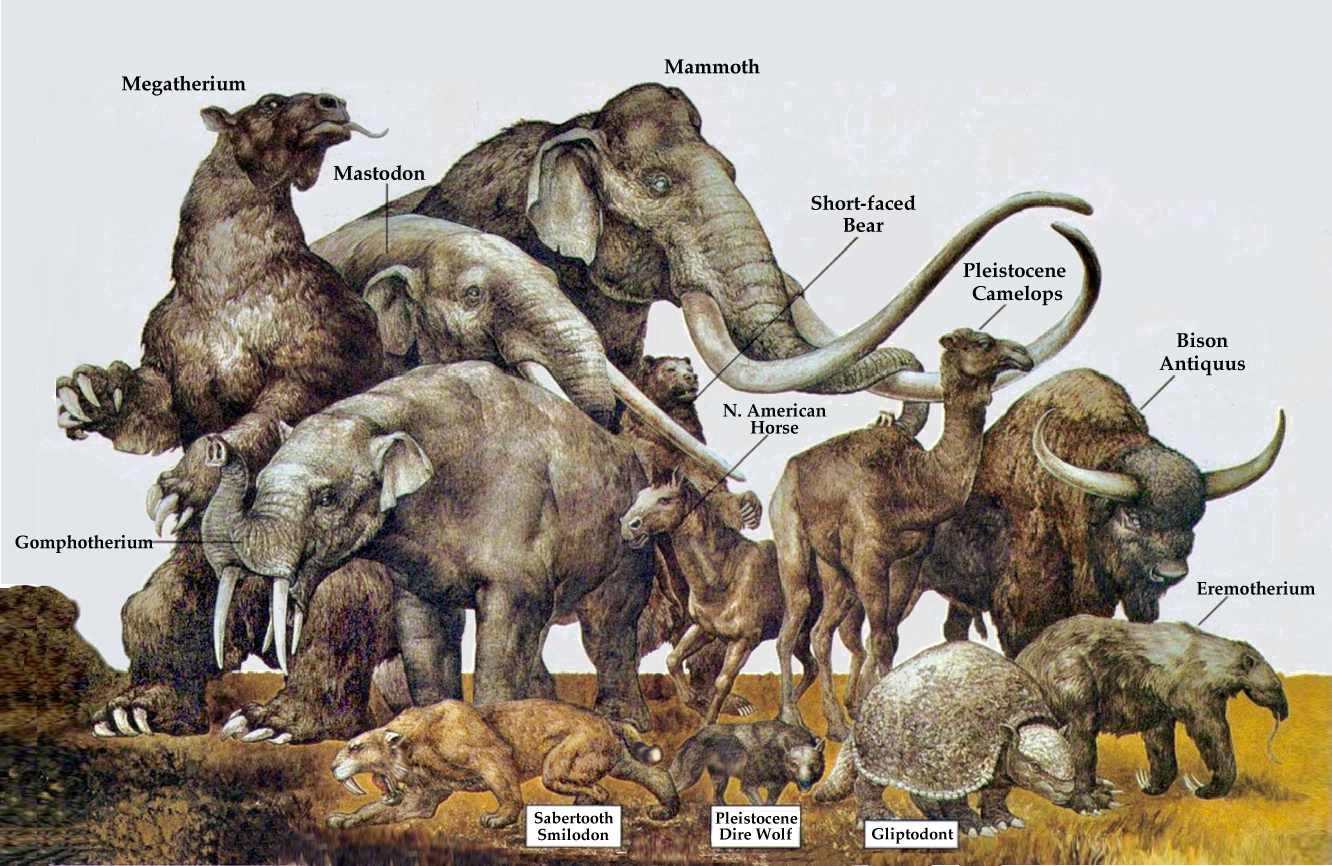
What counts as megafauna?
Megafauna disappearances begin with a definition: megafauna are animals with an adult body mass exceeding 44 kilograms (roughly 100 pounds). This threshold, established by Australian paleontologist Tim Flannery and widely adopted in ecology and paleontology, separates large-bodied species from smaller fauna. By this definition, modern megafauna include elephants, hippos, rhinos, giraffes, bears, large cats, and even humans.
Until remarkably recently in geological terms, every continent on Earth teemed with giant animals. North America had mammoths, mastodons, and bears that dwarfed modern grizzlies. Australia hosted wombat relatives the size of rhinoceroses and monitor lizards longer than saltwater crocodiles. South America was home to ground sloths that weighed as much as elephants and armadillo relatives the size of small cars.
Madagascar had half-ton birds. New Zealand had eagles with three-meter wingspans hunting prey no raptor alive today could bring down.
Then, continent by continent, they vanished. Not in a single catastrophe, but in a rolling wave of extinction that swept across the globe over tens of thousands of years - and in every case, the disappearances began shortly after a single new species arrived.
The pattern is so consistent, so geographically precise, and so chronologically tight that it has become one of the most debated and consequential questions in the history of life on Earth: did humans systematically destroy the planet's largest animals?
The answer, supported by decades of fossil evidence, radiocarbon dating, ancient DNA analysis, and ecological modeling, is almost certainly yes - though the details are far more complex, and far more instructive, than a simple narrative of slaughter.
What Is Megafauna?
The term megafauna refers to animals with an adult body mass exceeding 44 kilograms (approximately 100 pounds). This threshold, widely adopted in ecology and paleontology, was formalized to distinguish large-bodied species whose ecological roles - as grazers, browsers, seed dispersers, predators, and ecosystem engineers - differ fundamentally from those of smaller animals. By this definition, modern megafauna include elephants, hippos, bears, large cats, cattle, horses, and even humans.
During the Pleistocene epoch (2.6 million to 11,700 years ago), megafauna diversity was extraordinary. Every habitable continent supported multiple species of animals weighing over 1,000 kilograms. Many exceeded 3,000 kilograms. These were not obscure ecological footnotes - they were dominant components of their ecosystems, shaping vegetation structure, nutrient cycling, fire regimes, and the distribution of water sources across entire landscapes.
The loss of the Pleistocene megafauna was not merely a reduction in species counts. It was a fundamental restructuring of terrestrial ecosystems worldwide, the consequences of which ecologists are still measuring today.
The Global Pattern: Extinction Follows Arrival
The single most important observation in megafauna extinction science is the correlation between human arrival and megafauna disappearance on every landmass where the timing can be reliably established. This is not a vague association. The chronological sequence is remarkably precise:
| Continent/Region | Approximate Human Arrival | Approximate Megafauna Extinction | Megafauna Lost |
|---|---|---|---|
| Africa | Co-evolved (millions of years) | Gradual, ongoing | ~18% of genera |
| Australia | ~65,000-50,000 years ago | ~46,000 years ago | ~88% of genera |
| Europe | ~45,000 years ago (modern humans) | ~15,000-10,000 years ago | ~36% of genera |
| North America | ~16,000-14,000 years ago | ~11,000 years ago | ~72% of genera |
| South America | ~15,000-14,000 years ago | ~10,000 years ago | ~83% of genera |
| Madagascar | ~2,000-1,500 years ago | ~1,000 years ago | ~100% of endemic megafauna |
| New Zealand | ~1280 CE | ~1400-1500 CE | ~100% of endemic megafauna |
The pattern is striking. Africa, where humans and megafauna co-evolved over millions of years, lost the fewest species. Every other continent lost the majority of its large animals within a few thousand years of human arrival - and in some cases, within a few hundred years.
"Everywhere we look, from Australia to the Americas, from Madagascar to the Pacific Islands, the arrival of people is followed closely by the disappearance of large animals. The coincidence is too precise and too global to be explained by climate alone." - Tim Flannery, The Future Eaters (1994)
Australia: The First Catastrophe
Australia provides the oldest and in many ways the most dramatic example of human-driven megafauna extinction. When the first humans crossed from Southeast Asia into the Australian continent approximately 65,000 to 50,000 years ago (the exact date remains debated, though genetic evidence and archaeological sites like Madjedbebe in the Northern Territory support the earlier end of this range), they encountered an ecosystem of extraordinary strangeness.
The Giants of Sahul
The Australian megafauna had evolved in isolation on the supercontinent of Sahul (Australia, New Guinea, and Tasmania, connected during periods of low sea level) for tens of millions of years. The result was a fauna utterly unlike anything on any other continent - dominated by marsupials, giant reptiles, and enormous flightless birds.
Diprotodon optatum was the largest marsupial that ever lived. Roughly the size of a modern hippopotamus, it stood approximately 1.8 meters at the shoulder, measured up to 3 meters in length, and weighed an estimated 2,500 to 2,800 kilograms. Diprotodon was a herbivore, browsing on shrubs, trees, and possibly grasses across much of the Australian interior.
Its massive skull housed large, forward-facing eyes and a pair of prominent incisors - the feature that gives it its name, meaning "two forward teeth." Fossil trackways discovered at Lake Callabonna in South Australia reveal herds of Diprotodon moving together, suggesting gregarious behavior similar to that of modern large herbivores [1].
Megalania (Varanus priscus), the largest terrestrial lizard known to science, was a monitor lizard estimated at 5.5 to 7 meters in length and weighing up to 575 kilograms - roughly seven times the mass of the largest living Komodo dragon.
Recent biomechanical analyses suggest Megalania was an active predator rather than a pure scavenger, capable of ambushing large prey including juvenile Diprotodon. Like modern monitors, it likely possessed venom-delivery systems, making it an extraordinarily dangerous predator [2].
Thylacoleo carnifex, the marsupial lion, was pound-for-pound one of the most formidable predators in mammalian history. Weighing approximately 100 to 160 kilograms, Thylacoleo had the strongest bite force relative to body size of any known mammal. Its enormous, blade-like premolars functioned as shearing tools, capable of slicing through bone.
Its semi-retractable claws and powerful forelimbs indicate it was likely an ambush predator, possibly hunting from trees. Despite the name, Thylacoleo was not a cat but a marsupial, more closely related to wombats and koalas than to any placental carnivore.
Other notable Australian megafauna included Genyornis newtoni, a flightless bird standing over 2 meters tall and weighing approximately 230 kilograms; Procoptodon goliah, the largest kangaroo that ever lived at roughly 240 kilograms with a single large toe on each hind foot adapted for arid environments; and Quinkana, a land-dwelling crocodilian that hunted on dry ground rather than in water.
The Collapse
By approximately 46,000 years ago, the vast majority of these species had vanished. The rapidity of the collapse - occurring within perhaps 5,000 to 10,000 years of human arrival - and its severity (roughly 88 percent of megafauna genera lost) make it difficult to attribute to climate alone.
Australia had experienced numerous glacial-interglacial transitions throughout the Pleistocene without comparable megafauna losses. The extinctions occurred during a period of relative climatic stability, not during a glacial maximum or a rapid warming event.
Evidence of direct human predation is scarce in Australia - there are no kill sites comparable to those found in North America. However, indirect evidence is compelling. Burned eggshell fragments of Genyornis found at archaeological sites suggest humans consumed the bird's eggs, potentially disrupting reproduction of an already slow-breeding species [3].
Charcoal records indicate a dramatic increase in fire frequency following human arrival, suggesting that Aboriginal fire-stick farming fundamentally altered vegetation patterns, removing the browse and habitat that megafauna depended upon.
North America: Mammoths, Lions, and the Clovis Controversy
Humans arrived in North America approximately 16,000 to 14,000 years ago, crossing from Siberia via the Beringia land bridge (or possibly along the Pacific coast by boat). They entered a continent populated by one of the most impressive megafauna assemblages in the world.
The North American Giants
The short-faced bear (Arctodus simus) was the largest terrestrial carnivorous mammal in North America. Standing up to 1.8 meters at the shoulder on all fours and reaching 3.4 meters when rearing on its hind legs, Arctodus weighed approximately 800 to 1,000 kilograms. Its long legs and relatively slender build suggest it was more cursorial than modern bears - potentially capable of sustained running to scavenge or hunt across open landscapes.
The American lion (Panthera atrox) was approximately 25 percent larger than modern African lions, with adult males weighing up to 350 kilograms. It ranged from Alaska to Central America and is well represented in the La Brea tar pit fossil record.
The American mastodon (Mammut americanum) was a browser of forests and woodlands, distinct from mammoths in both diet and habitat preference. Mastodons weighed approximately 4,500 to 5,500 kilograms and are found in fossil deposits across eastern North America, often in former swamp and forest environments.
The Columbian mammoth (Mammuthus columbi), larger than the more famous woolly mammoth, ranged across the southern half of North America. Adult males reached approximately 4 meters at the shoulder and weighed up to 10,000 kilograms, making them among the largest elephants to have ever lived.
Additional losses included the dire wolf (Aenocyon dirus), the saber-toothed cat (Smilodon fatalis), the American cheetah (Miracinonyx trumani), giant beavers (Castoroides ohioensis) weighing 100 kilograms, multiple species of horses and camels (both of which had originated in North America before going extinct there), and the glyptodont Glyptotherium.
The Clovis Connection
The extinctions in North America cluster tightly around 11,000 years ago, coinciding with both the spread of the Clovis culture - identified by their distinctive fluted stone projectile points - and the rapid warming at the end of the Younger Dryas cold period. This dual coincidence has made North America the central battleground in the overkill versus climate change debate.
Clovis kill sites definitively demonstrate that early Americans hunted mammoths and mastodons. Sites such as Murray Springs in Arizona and Lehner Ranch in the San Pedro Valley preserve Clovis points embedded in or directly associated with mammoth bones. However, confirmed Clovis megafauna kill sites number fewer than 15 across the entire continent - a fact that critics of the overkill hypothesis cite as evidence that hunting pressure alone was insufficient.
South America: The Strangest Giants
South America's megafauna was shaped by tens of millions of years of geographic isolation, producing some of the most unusual large animals in evolutionary history.
Megatherium americanum, the giant ground sloth, was among the largest terrestrial mammals that ever lived. Standing up to 6 meters tall when rearing on its hind legs and weighing approximately 4,000 to 6,000 kilograms, Megatherium was roughly the size of a modern elephant.
Despite its enormous claws - up to 30 centimeters long - isotopic analysis of its bones suggests it was primarily herbivorous, though some researchers have proposed facultative scavenging. Megatherium's massive pelvis and tail formed a tripod that allowed it to stand bipedally to reach high vegetation, stripping branches with a prehensile tongue.
Glyptodon was a car-sized relative of modern armadillos, encased in a rigid, domed carapace up to 1.5 meters in diameter composed of over 1,000 bony plates called osteoderms. Adults weighed approximately 2,000 kilograms. Glyptodon's tail, in some species, ended in a bony club studded with spikes - a weapon almost certainly used in intraspecific combat and possibly in defense against predators.
Archaeological evidence from Argentina suggests that early South Americans used Glyptodon carapaces as shelters, and kill sites confirm direct predation [4].
Toxodon platensis - described by Charles Darwin during the voyage of the Beagle as "perhaps one of the strangest animals ever discovered" - was a massive, rhinoceros-like herbivore weighing approximately 1,500 kilograms. Toxodon belonged to the Notoungulata, an entirely South American order of mammals with no close living relatives.
Its combination of features - hippo-like body, rhinoceros-like head, and rodent-like incisors - defied easy classification, and Darwin struggled for years to determine its affinities.
South America lost roughly 83 percent of its megafauna genera by approximately 10,000 years ago, a rate of loss exceeded only by Australia.
Madagascar: The Most Recent Continental Extinction
Madagascar's megafauna extinction is remarkable for its recency. Humans - arriving from Borneo and East Africa approximately 2,000 to 1,500 years ago - encountered an island ecosystem that had been evolving in isolation for roughly 88 million years.
Elephant birds (family Aepyornithidae), the heaviest birds known to science, included Vorombe titan at approximately 730 kilograms and standing up to 3 meters tall. Their eggs, with a volume of roughly 8.5 liters (equivalent to approximately 160 chicken eggs), are the largest eggs of any known vertebrate. Elephant bird eggshell fragments with cut marks and charring have been found at human occupation sites, providing direct evidence of exploitation [5].
Giant lemurs, including Archaeoindris fontoynontii at approximately 200 kilograms (comparable in size to a male gorilla), filled ecological niches occupied by great apes and ground sloths on other continents. Multiple species occupied ground-dwelling, tree-hanging, and koala-like niches - a radiation of body forms and ecologies unprecedented among primates.
By approximately 1,000 years ago, virtually all of Madagascar's megafauna had been eliminated. The rapidity of the collapse - occurring within roughly 500 to 1,000 years of first human contact - underscores the vulnerability of island megafauna to novel predation pressure.
New Zealand: The Fastest Extinction
New Zealand represents the most recent and most rapid megafauna extinction event on record. Polynesian settlers (the ancestors of the Maori) arrived approximately 1280 CE, according to radiocarbon dating of settlement sites and rat-gnawed seeds.
They found a landscape dominated by birds. In the absence of terrestrial mammals (New Zealand's only native mammals were bats), birds had radiated to fill virtually every ecological niche.
The most spectacular were the moa (order Dinornithiformes), a group of nine species of flightless birds ranging in size from 20 kilograms to the enormous Dinornis robustus (South Island giant moa), which stood up to 3.6 meters tall and weighed approximately 230 kilograms. Moa were browsers and grazers, occupying the ecological roles filled by deer, antelope, and cattle on other continents.
Hunting the moa was Haast's eagle (Hieraaetus moorei), the largest eagle known to science. With a wingspan of up to 3 meters and a body weight of 10 to 15 kilograms - roughly 30 to 40 percent heavier than the largest modern eagles - Haast's eagle was a hyperpredator, striking moa at speeds estimated at up to 80 kilometers per hour. Its talons, comparable in size to those of a modern tiger, could puncture bone.
Haast's eagle is the only known eagle large enough to have routinely killed prey exceeding its own body weight by a factor of 10 or more.
All nine moa species and Haast's eagle were extinct by approximately 1400-1500 CE - within roughly 100 to 200 years of human arrival. Archaeological evidence is unambiguous: moa butchery sites containing thousands of bones, cooking pits, and discarded eggshells have been excavated across both islands. New Zealand's moa extinction is the clearest, most chronologically constrained example of human-driven megafauna destruction anywhere in the world.
The Overkill Hypothesis
The idea that humans, not climate, were the primary driver of megafauna extinction was most forcefully articulated by American geoscientist Paul S. Martin of the University of Arizona, beginning in the 1960s and culminating in his 2005 book Twilight of the Mammoths: Ice Age Extinctions and the Rewilding of America.
Martin's argument was elegant and testable. If climate change drove the extinctions, they should correlate with climatic events. But the extinctions did not occur at the same time - they occurred at different times on different continents, always tracking human arrival. Africa's megafauna, which co-evolved with hominins for millions of years, survived.
Every continent and island colonized by humans lost its megafauna shortly afterward. The pattern held whether the climate was warming, cooling, or stable.
"The near-time extinctions followed man through the Late Quaternary like a shadow. Wherever humans went, the megafauna perished. It is not climate that connects these events - it is us." - Paul S. Martin, Twilight of the Mammoths (2005)
Blitzkrieg vs. Sitzkrieg
Martin originally proposed the blitzkrieg model: a rapid wave of overhunting in which human populations advanced into new territory and eliminated naive megafauna within a few hundred years. In this model, animals that had never encountered human hunters had no evolved fear response and were easily killed.
However, the archaeological record often lacks the mass kill sites that a blitzkrieg scenario would predict. This led to the development of the sitzkrieg model (from the German for "sitting war"), which proposes a slower process. In this framework, humans did not simply hunt megafauna to extinction through direct killing.
Instead, they gradually degraded megafauna populations through a combination of moderate hunting pressure, habitat modification through fire, competition for resources, and disruption of animal behavior and reproduction.
Even a small increase in adult mortality - as little as 2 to 5 percent annually above the natural replacement rate - could drive a slow-breeding megafauna population to extinction within a few centuries, all without leaving dramatic archaeological evidence.
Computer simulations support the sitzkrieg model's plausibility. Modeling by John Alroy of the University of California demonstrated that even low-intensity hunting by small human populations could eliminate megafauna populations within 1,000 to 2,000 years across North America, consistent with the archaeological and paleontological record [6].
The Climate Change Counter-Argument
Proponents of the climate hypothesis point out that the terminal Pleistocene involved genuinely dramatic environmental changes. The end of the last Ice Age brought rapid warming, shifts in precipitation patterns, habitat fragmentation, and the replacement of open grasslands and parklands with closed forests - environments poorly suited to many megafauna species.
In North America, the extinctions coincided with the end of the Younger Dryas cold period (approximately 12,900 to 11,700 years ago), a sudden return to near-glacial conditions that lasted over a millennium before an equally sudden warming. This climatic whiplash could have stressed megafauna populations already in decline.
However, the climate hypothesis faces a fundamental problem: megafauna had survived dozens of equivalent or more severe climatic transitions throughout the Pleistocene without comparable extinction events. The glacial-interglacial cycles of the past 2.6 million years involved repeated warming and cooling episodes of similar magnitude to the terminal Pleistocene event.
What was new about the last transition was not the climate - it was the presence of anatomically modern humans with sophisticated hunting technology.
Why Africa's Megafauna Survived
The survival of African megafauna is arguably the strongest evidence for the human-driven extinction model. Africa retains elephants, rhinoceroses, hippopotamuses, giraffes, Cape buffalo, lions, leopards, and a host of other large species that exceed the body mass threshold of 44 kilograms. No other continent preserved such a diverse megafauna community through the Pleistocene-Holocene transition.
The standard explanation is co-evolution. Hominins have been present in Africa for at least 6 million years. Early human ancestors - Australopithecus, Homo habilis, Homo erectus - were part of African ecosystems long before modern humans evolved.
African megafauna therefore had millions of years to develop behavioral and physiological responses to human predation: heightened wariness, aggression toward bipedal predators, herding behavior, nocturnal activity shifts, and the ability to distinguish dangerous humans from non-threatening ones at a distance.
Animals on other continents had no such preparation. When modern humans arrived in Australia, the Americas, Madagascar, and New Zealand, the resident megafauna had never encountered a terrestrial predator with projectile weapons, coordinated group hunting strategies, and the ability to modify entire landscapes through fire. The result was ecological naivety - a failure to recognize humans as threats - and rapid population collapse.
Africa did lose some megafauna during the Pleistocene, including several species of elephants, giant baboons, and large carnivores. But the losses were gradual, spread over hundreds of thousands of years, and never approached the catastrophic percentages seen on other continents. The long co-evolutionary history acted as a buffer, allowing African megafauna to adapt incrementally to increasing human hunting sophistication.
The Rewilding Vision: Pleistocene Park
The recognition that megafauna loss fundamentally altered ecosystems has inspired one of the most ambitious ecological experiments in history: Pleistocene Park, a 20-square-kilometer nature reserve in northeastern Siberia, near the town of Chersky in the Republic of Sakha (Yakutia).
Founded in 1996 by Russian ecologist Sergey Zimov and now managed jointly with his son Nikita, Pleistocene Park is attempting to recreate the mammoth steppe ecosystem - the vast, highly productive grassland that dominated the Northern Hemisphere during the Pleistocene and disappeared after the megafauna that maintained it went extinct.
The hypothesis is straightforward: the mammoth steppe was not merely the habitat of megafauna - it was created and maintained by megafauna. Large herbivores grazed grasses, trampled shrubs and saplings, broke up moss cover, compacted snow in winter (increasing heat transfer from the ground to the cold air above, thereby cooling the underlying permafrost), and recycled nutrients through dung.
When the megafauna vanished, the grasslands they maintained were invaded by mosses, shrubs, and eventually the larch forests that dominate Siberia today. These replacement ecosystems are far less productive, store less carbon in soil, and - critically - insulate the permafrost less effectively, potentially accelerating thaw and the release of vast stores of ancient carbon.
Zimov's team has introduced herds of Yakutian horses, bison (imported from Denmark), musk oxen, yaks, Kalmyk cattle, and reindeer to the park. The results after more than two decades are measurable. In areas with high herbivore density, grass cover has increased, shrub cover has decreased, snow compaction has increased, and winter soil temperatures are consistently lower than in ungrazed control areas.
A 2020 study published in Scientific Reports confirmed that herbivore-mediated snow compaction at Pleistocene Park reduced winter soil temperatures by an average of approximately 2 degrees Celsius - a significant effect in permafrost regions [7].
The park remains small and the herbivore densities are still well below Pleistocene levels. Zimov has described his vision as requiring animal densities comparable to the modern Serengeti - roughly five large herbivores per hectare - across millions of square kilometers of northern Siberia. Whether this is achievable, and whether the ecological benefits would scale as predicted, remains the subject of active research and considerable debate.
A World Reshaped by Absence
The Pleistocene megafauna extinctions were not merely a loss of charismatic species. They fundamentally reshaped the biological and physical structure of terrestrial ecosystems in ways we are only now beginning to understand. Seed dispersal networks were severed - many large-fruited trees in the Americas and Madagascar lost their primary dispersers and now persist only through secondary, less efficient mechanisms.
Fire regimes shifted as ungulate grazing no longer checked the buildup of flammable vegetation. Nutrient transport from lowlands to highlands via animal movement was interrupted. Waterways changed as beaver populations and wallowing megaherbivores no longer maintained wetland habitats.
The extinctions also carry an uncomfortable lesson for the present. The Pleistocene megafauna losses demonstrate that technologically simple human populations - armed with stone tools, fire, and cooperative hunting strategies - were capable of driving entire assemblages of the world's largest animals to extinction across every continent.
Modern humans, with vastly greater destructive capacity, have already reduced wild mammal biomass by an estimated 83 percent since the Pleistocene. The remaining megafauna of Africa and Asia face poaching, habitat fragmentation, and climate change on a scale that dwarfs anything Pleistocene hunters could have inflicted.
Understanding why the world's largest animals disappeared is not merely an exercise in paleontological reconstruction. It is essential context for the conservation battles being fought today - and for the rewilding experiments that may, if they succeed, begin to restore some fraction of what was lost.
What Venomous Animals Are in New Zealand?
New Zealand has almost no native venomous animals - a rarity among habitable landmasses. The only native venomous species is the rare katipo spider (Latrodectus katipo), a relative of the Australian redback now classified as endangered. No venomous snakes, scorpions, or medically dangerous centipedes exist natively.
This near-absence reflects New Zealand's long isolation since it split from Gondwana about 85 million years ago, which also explains why its Holocene megafauna consisted of flightless birds like the moa (up to 3.6 meters tall) and the Haast's eagle (Hieraaetus moorei) - with three-meter wingspans - rather than mammals.
When humans arrived around 1280 CE, roughly 100 percent of New Zealand's endemic megafauna was driven extinct within 200 years, including all nine moa species, but the lack of venomous animals made the archipelago uniquely safe for early Polynesian settlers.
What Venomous Animals Does New Zealand Have?
Very few - New Zealand is famously one of the least venomous-animal-populated countries on Earth. The native katipo spider (Latrodectus katipo) is the only venomous native, and it is now endangered with populations scattered along coastal dunes. Introduced species include the Australian redback spider (Latrodectus hasselti) in some urban areas and the white-tailed spider (Lampona species).
No native snakes, scorpions, or dangerous ticks exist. This near-absence of venomous fauna contrasts sharply with neighboring Australia, where over 100 venomous snake species and the Sydney funnel-web spider occur.
New Zealand's isolation since splitting from Gondwana 85 million years ago produced an ecosystem dominated by birds including the Haast's eagle, with a 3-meter wingspan - but when humans arrived around 1280 CE, approximately 100 percent of endemic megafauna was extinct within 200 years.
What Venomous Animals Live in New Zealand?
Only the native katipo spider (Latrodectus katipo) and the introduced redback spider (Latrodectus hasselti) are medically significant venomous species living in New Zealand today. The katipo, a relative of the Australian redback, inhabits coastal sand dunes and is now endangered due to habitat loss.
Introduced white-tailed spiders (Lampona species) occasionally cause localized skin reactions but rarely anything serious. New Zealand has zero native snakes, zero native scorpions, and no medically significant centipedes - a direct consequence of geographic isolation since the landmass separated from Gondwana 85 million years ago.
That isolation also fostered remarkable endemic megafauna like the moa (which reached 3.6 meters tall in the giant moa Dinornis) and the Haast's eagle. All endemic megafauna went extinct within 200 years of human arrival around 1280 CE.
References
[1] Price, G. J., et al. "Seasonal migration of marsupial megafauna in Pleistocene Sahul." Proceedings of the Royal Society B, vol. 284, no. 1863, 2017.
[2] Fry, B. G., et al. "A central role for venom in predation by Varanus komodoensis (Komodo Dragon) and the extinct giant Varanus (Megalania) priscus." Proceedings of the National Academy of Sciences, vol. 106, no. 22, 2009, pp. 8969-8974.
[3] Miller, G. H., et al. "Ecosystem collapse in Pleistocene Australia and a human role in megafauna extinction." Science, vol. 309, no. 5732, 2005, pp. 287-290.
[4] Politis, G. G., et al. "Earliest evidence of human interaction with megafauna in South America." Quaternary International, vol. 431, 2016, pp. 10-18.
[5] Hansford, J. P., and Turvey, S. T. "Unexpected diversity within the extinct elephant birds (Aves: Aepyornithidae) and a new identity for the world's largest bird." Royal Society Open Science, vol. 5, no. 9, 2018.
[6] Alroy, J. "A multispecies overkill simulation of the end-Pleistocene megafaunal mass extinction." Science, vol. 292, no. 5523, 2001, pp. 1893-1896.
[7] Beer, C., et al. "Protection of permafrost soils from thawing by increasing herbivore density." Scientific Reports, vol. 10, 2020, article 4170.
Frequently Asked Questions
What counts as megafauna?
Megafauna are animals with an adult body mass exceeding 44 kilograms (roughly 100 pounds). This threshold, established by Australian paleontologist Tim Flannery and widely adopted in ecology and paleontology, separates large-bodied species from smaller fauna. By this definition, modern megafauna include elephants, hippos, rhinos, giraffes, bears, large cats, and even humans.
During the Pleistocene, megafauna were far more diverse and widespread, with giant species occupying every continent except Antarctica.
Did humans cause the extinction of megafauna?
The evidence strongly implicates humans as a primary driver, though the mechanism remains debated. On every landmass where the timing of human arrival and megafauna extinction can be reliably dated - Australia, the Americas, Madagascar, New Zealand - the extinctions closely follow first human contact, often within a few thousand years or less.
Climate change contributed in some cases, particularly in the Americas where warming coincided with human arrival, but climate alone cannot explain why Africa’s megafauna survived while nearly identical animals on other continents did not. The leading explanation is that African megafauna co-evolved with human predators over millions of years, developing behavioral defenses that animals on other continents never had the time to acquire.
What is the largest animal that ever lived?
The blue whale (Balaenoptera musculus) is the largest animal known to have ever existed, reaching lengths of 30 meters and weights of up to 190 metric tons. Among land animals, the largest ever was likely the titanosaur Argentinosaurus, estimated at 70-80 metric tons during the Late Cretaceous.
The largest land mammal was Paraceratherium, a hornless rhinoceros relative that stood 5 meters at the shoulder and weighed approximately 15-20 metric tons during the Oligocene epoch, roughly 30 million years ago.