
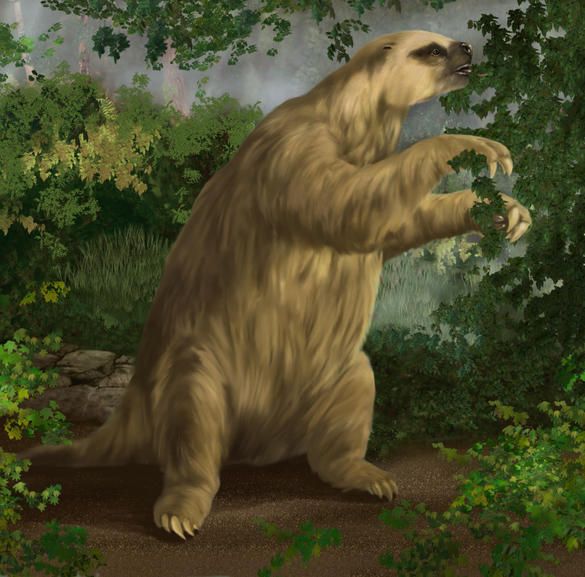
How big were giant ground sloths?
Giant ground sloths (Megatherium americanum, most famous) reached 4,000 kg (8,800 pounds) and 6 meters (20 feet) when standing upright - approximately the size of a modern elephant but much taller when rearing up. They were one of the largest land mammals in the Americas during the late Pleistocene. Different species varied greatly: Megatherium (largest, 4 tons), Mylodon (smaller, ~1.
4 Tons of Ice Age Herbivore
Imagine a sloth. Not the cute, slow tree-dweller you know from documentaries. Imagine that sloth grown to four tons, six meters tall when standing upright, walking on all fours across Ice Age South America, using massive claws to strip bark from trees.
This was Megatherium, the giant ground sloth. They walked the Americas from 5 million years ago to about 10,000 years ago, alongside early humans who arrived to find massive herbivores twice the size of modern elephants.
Then they were gone, extinct like most Ice Age megafauna.
The Animal
Giant ground sloths were massive herbivores.
Megatherium americanum (largest):
- Weight: 4,000 kg
- Height standing: 6 meters
- Length: 6 meters
- Claws: massive (10+ cm)
- Body shape: bulky, powerful
Related species:
Mylodon:
- Smaller (~1.5 tons)
- South American
- Dense skin with bony plates
- Mummified specimens exist
Eremotherium:
- North American
- Similar to Megatherium
- Comparable size
- Widespread
Megalonyx (Jefferson's ground sloth):
- Smaller (~1 ton)
- North American
- Named by Thomas Jefferson
- First described ground sloth
Shared features:
- Massive size
- Long claws
- Herbivorous diet
- Slow metabolism
- Unique walking style
The Enormous Size
Ground sloths reached extreme size.
Size comparison:
- Ground sloth (Megatherium): 4 tons
- African elephant: 4-6 tons
- Asian elephant: 3-5 tons
- Bison: 1 ton
- Modern sloth: 10 kg
Standing upright:
- Height: 6 meters
- Taller than elephants standing
- Could reach tree branches
- Intimidating appearance
Weight support:
- Massive leg bones
- Strong hip joints
- Powerful muscles
- Specialized foot bones
Why so big:
Evolutionary advantages:
- Defense against predators
- Access to high vegetation
- Energy storage
- Competition dominance
- Thermal stability
Walking on All Fours
Distinctive locomotion style.
Walking method:
- Primary: quadrupedal (4 legs)
- Sometimes: bipedal (rearing up)
- Feet: on outside edges
- Similar to some modern sloths (tree-dwelling)
Foot position:
- Front paws: walked on knuckles or edges
- Hind feet: rolled on outside
- Similar to anteaters
- Protected long claws
The claws:
- Not retractable
- 10+ cm long
- Used for feeding
- Defense weapons
- Digging tools
Speed:
- Slow typical pace
- Could run briefly when needed
- Size protected them
- No need for speed
Standing up:
Bipedal capability:
- Reach higher vegetation
- Defend against predators
- Stretch and rest
- Dramatic displays
Diet and Feeding
Ground sloths were herbivores.
Primary diet:
- Tree leaves (standing to reach)
- Bark (stripped with claws)
- Fruits
- Roots (dug up)
- Grasses
- Shrubs
Feeding strategies:
Standing tall:
- Reach 6+ meter branches
- Beyond reach of other animals
- Specialized niche
- Exclusive access
Ground feeding:
- Lower vegetation
- Varied plant types
- Browse and graze
- Seasonal variations
Using claws:
- Strip bark from trees
- Dig roots
- Break branches
- Access hidden food
Daily consumption:
- Hundreds of kilograms of vegetation
- Slow but continuous feeding
- Required large feeding areas
- Major impact on vegetation
Role in ecosystems:
- Vegetation patterns shaped by their feeding
- Seed dispersal through dung
- Clearing forest areas
- Key ecosystem shapers
Where They Lived
Ground sloths dominated the Americas.
South America:
Megatherium populations:
- Argentina (famous fossils)
- Paraguay
- Brazil
- Uruguay
- Throughout southern regions
Mylodon territory:
- Patagonia (mummified specimens found)
- Argentine caves
- Chilean plains
- Preserved in cold regions
North America:
Eremotherium:
- Southern United States
- Mexico
- Central America
- Warmer regions
Megalonyx (Jefferson's):
- Widespread North America
- Alaska to Mexico
- Varied habitats
- Thomas Jefferson first studied
Caribbean:
- Cuban species
- Smaller variants
- Islands had unique species
- Some survived longer than mainland
The Humans Arrival
Humans and sloths encountered each other.
Timing:
- Humans arrived Americas ~15,000 years ago
- Clovis people ~13,000 years ago
- Pre-Clovis evidence from 15,000+ years ago
- Ground sloths extinct by ~10,000 years ago
Overlap period:
- ~5,000 years of overlap
- Multiple human cultures
- Various interactions
- Archaeological evidence
Hunting evidence:
Kill sites:
- Butchered bones
- Stone tools with sloth blood residues
- Systematic processing
- Clear hunting evidence
Tools made from sloths:
- Bone awls
- Digging tools
- Various implements
- Utilitarian uses
Cave paintings:
Debated interpretations:
- Some may depict sloths
- Hunting scenes possibly
- Cultural significance
- Research continues
Mylodon: The Mummified Sloth
Unique preservation in Patagonia.
Mylodon discoveries:
In Patagonian caves:
- Mummified specimens
- Preserved skin
- Intact hair
- Gut contents preserved
- Remarkable preservation
Cueva del Milodón:
- Famous site in Chilean Patagonia
- Multiple preserved specimens
- Evidence of human-sloth interaction
- Tourist attraction today
Evidence from specimens:
- Diet confirmed (gut contents)
- Appearance detailed
- Hair color and texture
- Body size and shape
- Scientific treasure
Dermal ossicles:
Mylodon had:
- Small bony plates in skin
- Defense against predators
- Armor-like protection
- Unique feature
Jefferson's Ground Sloth
Megalonyx has historical significance.
Thomas Jefferson connection:
- Jefferson examined fossil bones
- Published 1799 paper
- First American paleontology
- Named "Megalonyx" (giant claw)
- Scientific milestone
Ongoing research:
- Multiple fossil sites
- Widespread North American presence
- Different subspecies possible
- Evolutionary studies
Habitat:
- Warmer regions
- Forest and grassland
- Widespread distribution
- Various climate zones
Cultural legacy:
- Symbol of American paleontology
- Educational importance
- Museum displays common
- Historical significance
Extinction Causes
Multiple factors ended their reign.
Climate change:
End of Pleistocene:
- Rapid warming
- Vegetation shifts
- Habitat transformation
- Ecosystem disruption
Human hunting:
Evidence supports:
- Direct hunting of sloths
- Megafauna specialization
- Efficient predation
- Cultural practices
Vegetation changes:
- Preferred plants shifted
- Food sources relocated
- Adaptation difficult
- Slow response
Reproductive rates:
- One offspring every 2-3 years
- Slow replacement
- Pressure exceeded capacity
- Inability to recover
Combined impact:
Multiple stresses:
- Climate change alone survivable
- Human hunting alone potentially survivable
- Both together: fatal
- Catastrophic interaction
Extinction timing:
- ~10,000 years ago
- Coincided with human spread
- Major climate transition
- Mass extinction event
Extinction Paradox
Modern sloths persisted.
Modern tree sloths:
- 6 species still exist
- Descended from common ancestor
- Adapted to trees (stayed small)
- Different ecological niche
- Still alive today
Why they survived:
Small size:
- Less attractive to human hunters
- Easier to hide
- Tree canopy protection
- Less vulnerable
Tree-dwelling:
- Different habitat
- Out of reach
- Less ecosystem change impact
- Specialized niche
Slow metabolism:
- Low energy requirements
- Efficient survival
- Advantage in poor conditions
- Modern adaptation
Contrast with ground sloths:
- Terrestrial = vulnerable
- Large = target
- Different ecosystem exposure
- Different extinction pressures
Scientific Research
Active field of study.
Current research:
DNA analysis:
- Ancient DNA extraction
- Relationship mapping
- Population history
- Extinction genetics
Paleoecology:
- Diet reconstruction
- Habitat requirements
- Ecosystem role
- Climate adaptation
Comparative anatomy:
- Modern sloth comparisons
- Evolutionary relationships
- Anatomical studies
- Biomechanical analysis
Archaeology:
- Human interaction sites
- Kill site analysis
- Tool usage
- Cultural connections
Climate research:
- Pleistocene reconstructions
- Extinction timing
- Environmental changes
- Historical patterns
Cultural Impact
Ground sloths have cultural presence.
Popular media:
- Ice Age movies: Sid the sloth (ground sloth inspiration)
- Nature documentaries
- Museum displays
- Educational materials
- Children's books
Museum presence:
Famous displays:
- American Museum of Natural History
- La Brea Tar Pits Museum
- Argentine natural history museums
- Various worldwide
Scientific popularization:
- Paleontology subjects
- Public education
- Conservation lessons
- Historical significance
Iconic status:
Symbol of:
- Prehistoric South America
- Ice Age megafauna
- Extinction lessons
- Paleontological heritage
Modern Relevance
What ground sloths teach us.
Extinction lessons:
Climate change:
- Demonstrates effects
- Historical parallel
- Modern concerns
- Conservation motivation
Human impact:
- First wave of human-caused extinctions
- Pattern visible
- Continuing concerns
- Lessons for present
Ecosystem effects:
- Keystone species loss
- Cascading effects
- Plant community changes
- Long-term impact
Modern sloth conservation:
- Surviving species threatened
- Forest destruction
- Climate change
- Habitat loss
- Active conservation needed
Why They Matter
Giant ground sloths represent significant biology.
Scientific value:
- Understanding Ice Age
- Evolution of sloths
- Extinction research
- Paleontology flagship
Cultural significance:
- Prehistoric icon
- Educational importance
- Museum stars
- Popular science focus
Educational role:
- Teach extinction concepts
- Demonstrate biodiversity loss
- Inspire conservation
- Connect to modern concerns
Ecological lessons:
- Megafauna importance
- Ecosystem complexity
- Consequences of loss
- Current conservation urgency
The Walking Mountains
Every giant ground sloth that walked Ice Age Americas represented evolutionary success that failed in the face of dramatic change.
They grew enormous. They dominated herbivore niches. They could reach tree tops. They shaped ecosystems. They persisted through millions of years of evolution.
Then humans arrived. Climate changed rapidly. Their slow reproduction couldn't keep up with hunting pressure plus environmental stress. Populations declined. Then vanished.
Their fossils at sites across the Americas preserve evidence of lives lived long ago. The mummified Mylodon specimens in Patagonian caves preserve detail most extinct species cannot. The butchered bones at human kill sites document direct interactions between species that overlapped briefly.
Modern tree sloths continue the lineage in smaller form. They live quietly in tropical forests. They're vulnerable to modern human impacts - deforestation, climate change, habitat fragmentation. Their giant cousins went extinct when faced with climate change plus human arrival. Modern sloths face similar pressures today.
In Argentine pampas, in North American plains, in Caribbean forests, giant ground sloths once walked. Mammoths stood beside them. Saber-toothed tigers hunted them. Giant short-faced bears rivaled them. All gone now, victims of the massive ecosystem change that ended the Ice Age.
Their loss transformed American ecosystems permanently. The vegetation patterns they maintained have shifted. The seed dispersal they provided has been reduced. The ecological niches they filled are empty.
Understanding ground sloths helps us understand extinction, ecosystem collapse, and the importance of current conservation efforts - so that modern sloths and their forest ecosystems don't follow their giant ancestors into oblivion.
The Major Ground Sloth Species in Detail
Ground sloths (superorder Xenarthra, order Pilosa) were a remarkably diverse group, with more than 100 described species across two major families. Body sizes ranged from coati-sized island endemics to elephant-sized continental giants. The Kalenux Team has summarized the most significant species from the terminal Pleistocene.
| Species | Body Mass | Range | Key Feature |
|---|---|---|---|
| Megatherium americanum | 3,500-4,500 kg | South America | Largest ground sloth; 6 m nose-to-tail |
| Eremotherium laurillardi | 3,000-3,500 kg | Americas | Widest distribution of any megasloth |
| Paramylodon harlani | 1,000-1,200 kg | North America | Common in La Brea deposits |
| Mylodon darwinii | 1,000-2,000 kg | Patagonia | Mummified specimens recovered |
| Megalonyx jeffersonii | 900-1,100 kg | Central/North America | First American fossil described |
| Nothrotheriops shastensis | 250-300 kg | Southwestern US | Dung preserved in desert caves |
| Thalassocnus natans | 200-400 kg | Pacific coast of South America | Semi-aquatic; grazed on seagrass |
| Neocnus dousman | 20-30 kg | Caribbean islands | Arboreal cave dweller; survived to 5,000 BP |
"Ground sloths were not just big tree-sloths on the ground. They were their own remarkable clade of mammals that filled ecological roles we can now barely imagine - semi-aquatic grazers, armored-skin herbivores, burrow-diggers larger than cattle. Their disappearance left ecological vacuums across two continents." - Richard Fariña, Universidad de la Republica, Megafauna: Giant Beasts of Pleistocene South America, 2013 [1]
Fariña's extensive work on Pleistocene South American mammals has argued for an active carnivorous or omnivorous habit in at least some ground sloths, based on tooth isotopic evidence and skeletal biomechanics. The hypothesis remains controversial but highlights how much we still do not know about animals that disappeared only 10,000 years ago.
Preserved Tissue and Genomic Recovery
Ground sloths are one of the few extinct megafauna groups from which researchers have recovered intact soft tissue and usable DNA. Dry caves in southern Patagonia and the American Southwest have produced mummified skin, fur, muscle fiber, and dung deposits that are sometimes thousands of years older than the species' extinction dates.
"We extracted hundreds of grams of well-preserved tissue from a Mylodon carcass in Cueva del Milodon. The skin still had hair attached, and we could sequence significant portions of the mitochondrial and nuclear genomes. This material is allowing us to place ground sloths definitively in the Xenarthran phylogeny." - Ross MacPhee, American Museum of Natural History, Current Biology, 2019 [2]
MacPhee's team and others have used recovered DNA to establish that ground sloths form two distinct clades: the tree sloth lineage (family Megalonychidae, which contains modern two-toed sloths) and a separate lineage containing the three-toed modern sloths (Bradypodidae). The megafauna ground sloths belong across both groups - meaning terrestrial giantism evolved more than once within sloth evolution.
Dung deposits at Rampart Cave in Arizona have preserved Nothrotheriops diet across more than 11,000 years. The deposits, several meters thick, allowed paleobotanists to reconstruct exactly what the sloths ate season by season as the ecosystem shifted in the terminal Pleistocene. The record ends abruptly around 11,000 years ago, coinciding with the final disappearance of the species from the fossil record.
Ghosts of the Missing Ecology
Modern tropical American forests still bear the imprint of their missing giants. Botanist Daniel Janzen's famous 1982 essay "Neotropical Anachronisms" pointed out that many Central American trees produce large, hard, spiny fruits that no living animal can swallow or disperse - fruits apparently shaped by evolution to pass through the guts of extinct ground sloths and related megafauna.
Species such as Spondias mombin, Osage orange, and the avocado's wild ancestors all fit this pattern. Without their giant dispersers, these trees now rely on humans or chance flooding to move their seeds, which contracts their ranges and slows their reproductive success [3].
The disappearance of the ground sloths therefore had consequences that persist today. The vegetation of the Americas evolved in the presence of these enormous herbivores, and removing them rewired entire ecosystems in ways that continue to play out 10,000 years later. Every fruit too large for a modern animal to swallow is a memorial to the ground sloth.
References
- Fariña, R. A., Vizcaino, S. F., and De Iuliis, G. (2013). Megafauna: Giant Beasts of Pleistocene South America. Indiana University Press.
- MacPhee, R. D. E. (2019). End of the Megafauna: The Fate of the World's Hugest, Fiercest, and Strangest Animals. W. W. Norton.
- Prevosti, F. J., Forasiepi, A., and Zimicz, N. (2013). "The evolution of the Cenozoic terrestrial mammalian predator guild in South America." Journal of Mammalian Evolution, 20(1), 3-21.
- Delsuc, F., Kuch, M., Gibb, G. C., Karpinski, E., Hackenberger, D., Szpak, P., Martinez, J. G., et al. (2019). "Ancient mitogenomes reveal the evolutionary history and biogeography of sloths." Current Biology, 29(12), 2031-2042.
- Faith, J. T. (2011). "Late Pleistocene climate change, nutrient cycling, and the megafaunal extinctions in North America." Quaternary Science Reviews, 30(13-14), 1675-1680.
Related Articles
- Saber-Toothed Tiger: The Ice Age Predator
- Woolly Mammoth: The Ice Age Giant
- Why Mammoths Went Extinct
Frequently Asked Questions
How big were giant ground sloths?
Giant ground sloths (Megatherium americanum, most famous) reached 4,000 kg (8,800 pounds) and 6 meters (20 feet) when standing upright - approximately the size of a modern elephant but much taller when rearing up. They were one of the largest land mammals in the Americas during the late Pleistocene.
Different species varied greatly: Megatherium (largest, 4 tons), Mylodon (smaller, ~1.5 tons), Eremotherium (North American counterpart, 4 tons), Megalonyx (jefferson ground sloth, ~1 ton), and various smaller relatives. Their size allowed them to: reach high tree branches when standing, defend against predators, store energy reserves, and compete with other large herbivores. Their massive bones and muscles were adapted to support their enormous weight.
Their feet were specialized for their size, though their nails/claws were also used for defense and possibly digging. They were heavier and taller than modern elephants when rearing up, though elephants are more massive when on all fours.
What did giant ground sloths eat?
Giant ground sloths were herbivores that ate primarily plants including leaves, bark, roots, and fruits. Their diet varied by species and region but commonly included: tree leaves (reaching high when standing), fruits from various trees, grasses and ground vegetation, bark stripped from trees, roots dug from ground, and low-growing plants.
Different species showed dietary specializations: some fed primarily on trees (tall reach), others focused on ground vegetation, some ate more varied diets, and specialized regional adaptations. Their dietary needs were enormous: consumed hundreds of kilograms of plant material daily, required varied vegetation sources, slow metabolism helped efficiency, and digestive system processed tough plant material.
They shaped ecosystems significantly - their feeding altered vegetation patterns, seed dispersal through feces, soil disturbance from foraging, and plant community dynamics. Evidence from fossil specimens includes preserved hair, occasional preserved gut contents, and fossilized dung that shows specific dietary items.
Their extinction dramatically altered plant ecosystems in Americas - some plants with seeds adapted for dispersal by megafauna lost their major seed dispersers.
Did humans encounter giant ground sloths?
Yes, humans and giant ground sloths overlapped significantly - humans arrived in the Americas approximately 15,000 years ago, and ground sloths persisted until approximately 10,000 years ago (with some species potentially surviving later in isolated regions like Cuba, where smaller species may have lived until 3,000 BC).
Evidence of human-sloth interaction includes: kill sites with butchered sloth bones, tools made from sloth bones, cave paintings potentially depicting sloths (interpretation debated), preserved sloth specimens with human-made modifications, and archaeological sites showing human hunting.
Famous discoveries: Mylodon remains with apparent human hunting marks, Patagonia sites with extensive bone deposits, and various South American archaeological finds showing sloth consumption. Their extinction likely involved human hunting - early Americans were skilled hunters encountering naive prey. Combined with: climate change stresses, prey competition, habitat modifications, and human population growth.
Documented humans likely hunted: young or injured sloths, isolated individuals, sloths at specific bottlenecks, and various vulnerable species. Their large size didn’t protect them from coordinated human hunting. Most ground sloth species were extinct within 5,000 years of human arrival, suggesting strong causal relationship.
How did giant ground sloths move?
Giant ground sloths walked primarily on all four limbs in a distinctive manner, with some species capable of rearing up on hind legs to reach food or defend themselves. Their locomotion included: quadrupedal walking (primary), bipedal standing (for feeding on high branches), knuckle-walking or side-walking (some species), and occasional slow running (capable but limited).
Their feet were specialized: hind feet with strong claws (walking on sides of feet), front feet adapted for gripping, massive claws (not retractable), and powerful leg muscles. When walking: front feet touched ground on outside edges, hind feet rolled on outside as well, created unusual gait, similar to modern sloths somewhat.
Their running was limited - they were not built for speed, relied on size for defense, could surprise prey (if they ate any), and generally slow. Standing upright: reaching 6+ meters tall, exposing vulnerable belly (defense or feeding), using claws as defensive tools, and dramatic appearance. Their skeletons show clearly: leg bones built for support, vertebrae designed for weight, unique foot bone configurations, and joint structures for unique walking.
Modern sloths may have similar walking patterns in tree-dwelling, though much smaller.
Why did giant ground sloths go extinct?
Giant ground sloths went extinct approximately 10,000 years ago due to combined factors including climate change and human hunting. Primary causes: climate change (end of Ice Age disrupting habitats), human hunting (early human arrival in Americas), prey competition (ecosystem changes), slow reproduction (difficult to recover from pressure), and multiple interacting factors.
Climate change: warming temperatures shifted vegetation, drying conditions in some areas, habitat loss through transformation, and ecosystem disruption. Human impact: humans arrived ~15,000 years ago, skilled hunters of megafauna, sloths vulnerable due to size and slow movement, and cultural practices emphasized big game. Other factors: competition from other species, disease possibly, reproductive rate too slow, and cascading ecosystem effects.
Research shows: extinction coincides with human arrival, individual species went extinct at different times, island populations (Cuba) survived longer, and combined stress hypothesis supported. Their slow reproductive rate (likely 1 offspring per 2-3 years) couldn’t compensate for human hunting pressure plus climate change. They had persisted through previous climate cycles, but the combination of climate change PLUS humans proved fatal.
Their extinction represents one of many Ice Age megafauna losses in the Americas.