
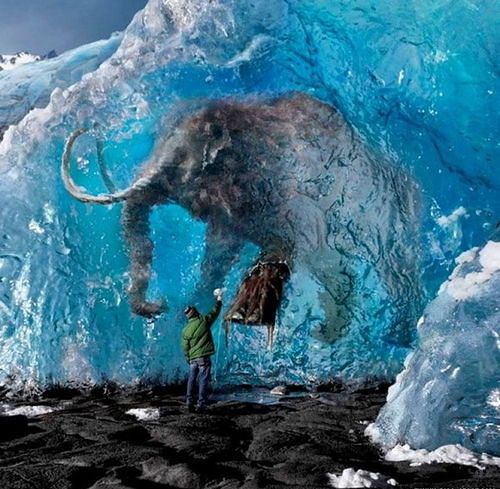
When did woolly mammoths go extinct?
Most woolly mammoths (Mammuthus primigenius) went extinct approximately 10,000-11,000 years ago at the end of the last ice age. However, isolated populations survived much longer on remote islands. The final population of woolly mammoths lived on Wrangel Island in the Arctic Ocean north of Siberia and went extinct only about 4,000 years ago - when Egyptian pharaohs were already building.
Still Alive When Pharaohs Built Pyramids
The popular image of woolly mammoths places them firmly in the deep past - part of a lost ice age world that ended thousands of years before human civilization began. This image is wrong.
The last mammoths were alive when the Egyptian pyramids were being built. They survived on a remote Arctic island called Wrangel until approximately 4,000 years ago. A pharaoh mummifying his father in Egypt could have, in principle, received news that shaggy elephants still roamed an island in the Arctic Ocean.
The extinction of mammoths is not a distant geological event. It is a recent tragedy, and understanding why it happened matters for the same reasons it matters today: climate change, human hunting pressure, and small populations collapsing under combined stresses.
What Mammoths Were
The woolly mammoth (Mammuthus primigenius) was one of the most successful large mammals ever to exist.
Size and appearance:
- Shoulder height: 2.7-3.4 meters (9-11 feet)
- Weight: 5-7 tons
- Tusk length: up to 4.2 meters in large males
- Fur: thick double-layered coat, brown to dark reddish-brown
- Ears: small (reduced heat loss)
- Tail: short (reduced frostbite risk)
Mammoths were not simply elephants with extra fur. Their anatomy was thoroughly adapted to cold. Small ears and tails minimized exposed surface area. Thick subcutaneous fat provided insulation. A fatty "hump" over the shoulders stored energy reserves.
Range:
At their peak, woolly mammoths lived across nearly all of Europe, Asia, and North America north of about 40 degrees latitude. Their habitat - the mammoth steppe - was one of Earth's largest biomes, a grassland ecosystem that supported enormous herds of large mammals during the ice ages.
Other mammoth species:
The woolly mammoth was one of several mammoth species. Others include:
- Columbian mammoth (M. columbi): larger than woolly mammoth, lived in North America in warmer climates
- Steppe mammoth (M. trogontherii): ancestor of the woolly mammoth, even larger
- Pygmy mammoths: dwarf species that evolved on islands (California Channel Islands, Mediterranean islands)
The last of all these species was a dwarf form that survived on Wrangel Island until roughly 2000 BCE.
The Mammoth Steppe
Mammoths depended on a specific ecosystem that no longer exists.
What it was:
The mammoth steppe was a cold, dry grassland that stretched from what is now Spain across all of northern Europe and Asia, across the Bering land bridge to North America, and down the continent's interior. At its maximum extent, it was the largest biome on Earth.
What lived there:
The steppe supported an extraordinary community of large mammals:
- Woolly mammoths
- Woolly rhinoceros
- Steppe bison
- Wild horses
- Saiga antelope
- Musk ox
- Cave lions (apex predators)
- Cave hyenas
- Wolves
- Early humans
Why it worked:
The steppe combined cold climate (reducing tree growth) with enough precipitation to sustain grasses. Strong winds kept snow thin, so grazers could access vegetation through winter. The combination produced vast grasslands with biomass comparable to modern African savannas.
Why it ended:
As the ice age ended, the climate warmed and became wetter. Permafrost melted. Trees returned to former steppe areas. Thicker snow cover made winter grazing harder. The distinctive mammoth steppe ecosystem fragmented and largely disappeared, replaced by modern tundra (too cold and infertile for large grazers) and boreal forest (too wooded for steppe species).
The Extinction Timeline
Mammoths did not all die at once. Different populations went extinct at different times as their habitat collapsed.
Mainland Eurasia (Europe and most of Asia):
Woolly mammoths disappeared from most of Europe and western Asia by approximately 14,000 years ago. Some populations in northeastern Siberia persisted until about 10,000 years ago.
North America:
Mammoths in most of North America disappeared by 11,000-12,000 years ago, coincident with the arrival and expansion of Clovis-culture humans.
St. Paul Island (Alaska):
A population of woolly mammoths on this small island survived until approximately 5,600 years ago. They likely died out due to freshwater loss as sea level changes altered the island's water table.
Wrangel Island (Arctic Ocean):
The final population survived on Wrangel Island until approximately 4,000 years ago. This island is north of Siberia in the Arctic Ocean. The Wrangel mammoths were notably smaller than mainland mammoths (about 2 meters at shoulder) and DNA analysis shows severe genetic problems from generations of inbreeding in a small population.
Why They Died Out
The extinction of mammoths involved multiple overlapping causes.
Climate Change
The end of the last ice age (roughly 12,000-10,000 years ago) caused rapid global warming. The mammoth steppe ecosystem collapsed as climate and vegetation patterns shifted.
What specifically killed mammoths:
- Habitat loss: Grasslands converted to forests or bogs
- Snow depth increase: Wetter winters created deeper snow, making grazing harder
- Permafrost thaw: Changed hydrology and vegetation
- Range fragmentation: Populations split into smaller groups that could not mix
Mammoths had survived previous interglacial periods, but the combination of this warming with other pressures proved fatal.
Human Hunting
Archaeological evidence shows mammoths were major prey for ice age humans.
The evidence:
- Thousands of mammoth bone sites with spear wounds
- Mammoth bone structures used as dwellings (particularly in Ukraine and Russia)
- Tools made from mammoth ivory
- Cave paintings depicting mammoth hunts
- Mammoth meat and marrow as primary food sources
Clovis culture in North America:
The Clovis people (roughly 13,000-12,700 years ago) expanded rapidly across North America, hunting mammoths with distinctive stone spear points. Dozens of Clovis sites contain mammoth bones with embedded spear points.
The timing of mammoth extinction across North America correlates closely with Clovis expansion, suggesting humans accelerated if not caused the extinction.
Sustainable versus unsustainable hunting:
Hunting pressure that would have been sustainable on a stable mammoth population became unsustainable when combined with climate stress. A weakened, shrinking population could not absorb both environmental collapse and sustained human predation.
Disease
Some researchers propose that diseases carried by other species (possibly by humans or by domesticated dogs accompanying humans) contributed to mammoth decline. Direct evidence is limited, but it is one plausible additional stressor.
Genetic Collapse in Small Populations
The Wrangel Island mammoths show what happens to a species reduced to a tiny isolated population.
DNA analysis findings:
- Severe genetic bottlenecks visible in the genome
- Accumulation of harmful mutations that could not be purged
- Loss of olfactory genes (reducing sense of smell)
- Defects in sperm quality genes
- Overall signs of "genomic meltdown"
The Wrangel mammoths likely went extinct not just from external pressures but from internal genetic degradation - a small population accumulated deleterious mutations faster than natural selection could remove them.
The Last Mammoths
The final population of woolly mammoths on Wrangel Island provides a haunting window into species extinction.
The island:
Wrangel Island sits in the Arctic Ocean approximately 140 km off the northeastern coast of Siberia. It is about 7,600 square kilometers - large enough to support a mammoth population but small enough to isolate one.
When Russia reached the continent:
Russian explorers first reached the general region in the 17th-18th centuries. Wrangel itself was visited in 1849 and systematically explored in the early 20th century. By that point, the mammoths had been gone for roughly 3,900 years.
What scientists have learned:
Frozen mammoth remains on Wrangel and surrounding areas have yielded:
- Full DNA sequences
- Stomach contents (revealing last meals)
- Soft tissue preservation including muscle, skin, and hair
- Evidence of dwarfism from resource limits
- Signatures of inbreeding in the final population
Radiocarbon dating of the youngest bones places the final mammoths at roughly 4,000 years ago. After that date, no mammoth remains have been found anywhere on Earth.
De-Extinction
Modern science is actively working to bring mammoths back.
Colossal Biosciences:
Founded by George Church (Harvard geneticist) and Ben Lamm (entrepreneur), Colossal Biosciences is the primary organization pursuing mammoth de-extinction. The company has raised over $225 million and employs large teams of geneticists.
The approach:
Rather than cloning mammoth DNA directly (impossible because no intact mammoth cells survive), Colossal plans to:
- Sequence full mammoth genomes from frozen remains (done)
- Identify genes that make mammoths distinct from Asian elephants
- Edit Asian elephant cells using CRISPR to add mammoth genes
- Develop modified embryos from edited cells
- Implant embryos in Asian elephant surrogates or artificial wombs
- Produce mammoth-like calves
Target date:
Colossal has publicly targeted 2028 for the first mammoth-like calf.
The critique:
Critics raise several concerns:
- The result would be a modified Asian elephant, not a true mammoth
- Reintroducing "mammoths" into modern ecosystems may cause unintended consequences
- Resources might better serve conservation of species still alive
- Ethical questions about using endangered Asian elephants as surrogates
- Unclear what habitat the new mammoths would occupy
Counter-arguments:
Supporters argue that mammoth-like animals could help restore the mammoth steppe ecosystem, potentially slowing Arctic permafrost thaw (a significant climate feedback). They also argue that de-extinction technology developed for mammoths could help protect endangered species still alive.
What Mammoth Extinction Teaches
Mammoth extinction is more than a historical curiosity. It previews what happens when large animals face combined pressures.
Rapid climate change + habitat loss + human hunting = extinction.
This equation describes not just mammoth extinction but the current extinction crisis. Modern elephants face habitat loss from human expansion, poaching for ivory, and climate-driven changes to their savanna environments. African forest elephants have declined by over 80 percent since 2000. Asian elephants face severe habitat fragmentation.
The lesson is not abstract. The same processes that killed mammoths are currently threatening their closest living relatives. Mammoths demonstrate that even species which dominated vast continental ecosystems for hundreds of thousands of years can disappear when pressures combine.
Small populations collapse.
The Wrangel Island population shows what happens to species reduced below a viable threshold. Genetic problems accumulate. Births decline. The species cannot sustain itself even if external pressures ease. Several currently endangered species - including northern white rhinos (2 individuals remaining), vaquita porpoises (~10 remaining), and several island bird species - face similar genetic bottleneck risks.
Extinction is permanent (for now).
The mammoth has been extinct for 4,000 years. Modern technology may soon change this - but even with full genetic data, frozen remains, and hundreds of millions of dollars, producing a mammoth is extraordinarily difficult. For species that go extinct without equivalent preservation of genetic material, de-extinction is impossible regardless of technology.
Each species that dies out represents a unique evolutionary experiment that took millions of years to produce. The mammoth's long reign ended in a few thousand years of combined pressure. The current extinction crisis is accelerating at a pace that makes the ice age extinctions look slow.
The Mammoth Species: A Taxonomic Summary
The genus Mammuthus includes at least ten recognized species spread across three continents and more than five million years. The Kalenux Team has compiled the essential data on the major species from peer-reviewed paleontological literature.
| Species | Time Range | Body Mass | Shoulder Height | Tusk Length | Range |
|---|---|---|---|---|---|
| M. subplanifrons | 5-4 Ma | ~6 tonnes | 3.0 m | 2.5 m | Africa |
| M. africanavus | 4-3 Ma | ~5 tonnes | 2.8 m | 2.5 m | Africa |
| M. meridionalis | 2.5-0.8 Ma | ~10 tonnes | 4.0 m | 3.5 m | Europe, Africa |
| M. trogontherii (steppe) | 600-200 ka | ~10-12 tonnes | 4.2 m | 4.0 m | Eurasia |
| M. columbi (Columbian) | 1.5 Ma-11,500 years ago | 8-10 tonnes | 4.0 m | 4.0 m | North America |
| M. primigenius (woolly) | 400,000-4,000 years ago | 6 tonnes | 3.0 m | 2.5 m | Northern Hemisphere |
| M. exilis (pygmy) | 50-12 ka | 700-1,000 kg | 1.7 m | 1.5 m | Channel Islands, California |
| M. creticus | Pleistocene | 300 kg | 1.1 m | 0.5 m | Crete |
| M. lamarmorae | Pleistocene | 500 kg | 1.4 m | 1.0 m | Sardinia |
"Mammoths ranged from the largest proboscideans ever to walk the Earth - steppe mammoths standing 4.3 meters at the shoulder - to dwarfed island endemics the size of a large pig. The genus spans perhaps the widest size range of any mammalian clade in evolutionary history." - Adrian Lister, Natural History Museum London, Mammoths: Giants of the Ice Age, 2015 [1]
The Columbian mammoth of North America and the woolly mammoth of the Arctic are the two species best known to the public, but the steppe mammoth (M. trogontherii) was actually the largest.
The genetic story has recently become even more interesting: ancient DNA from a 1.2-million-year-old molar recovered from Siberian permafrost was sequenced in 2021 and revealed that the Columbian mammoth is a hybrid, its ancestors produced by interbreeding between woolly mammoths and an earlier, unknown mammoth lineage [2].
The Frozen Specimens That Changed Paleontology
Permafrost preservation has given paleontology some of its most complete specimens ever recovered. Several frozen mammoth carcasses have been recovered from Siberia and Alaska with skin, hair, muscle, stomach contents, and in some cases intact eyes still in place.
The most famous is Lyuba, a month-old woolly mammoth calf recovered on the Yamal Peninsula in 2007. Her body is nearly complete, with hair, skin, and internal organs all preserved. She is 42,000 years old and represents the most complete mammoth specimen ever found. Other notable frozen mammoths include:
- Zhenya - a 39,000-year-old juvenile found on the Taimyr Peninsula in 2012
- Kolyma baby - a 50,000-year-old infant found in 2010
- Yukagir - a 28,000-year-old adult male discovered in 2002
- Malolyakhovsky - a 29,000-year-old female found in 2013, which yielded fresh-looking blood from frozen tissue
"Every frozen mammoth we recover gives us a complete biological snapshot of an Ice Age animal. We can examine diet directly through stomach contents. We can sequence the genome from fresh-looking tissue. We can study parasites and pathogens. Mammoths are the best-documented extinct species in the fossil record because so many frozen examples have survived." - Alexei Tikhonov, Zoological Institute of the Russian Academy of Sciences, Quaternary International, 2012 [3]
The ongoing thaw of Siberian permafrost is both a tragedy for climate and a boon for paleontology. As the ground warms, more mammoths are emerging each year. Local communities - particularly Yakut reindeer herders - have become important collaborators, bringing specimens to the attention of research institutions rather than trading them on the informal ivory market.
References
- Lister, A. M., and Bahn, P. (2015). Mammoths: Giants of the Ice Age (3rd ed.). Frances Lincoln.
- van der Valk, T., Pecnerova, P., Diez-del-Molino, D., Bergstrom, A., Oppenheimer, J., Hartmann, S., Xenikoudakis, G., et al. (2021). "Million-year-old DNA sheds light on the genomic history of mammoths." Nature, 591(7849), 265-269.
- Tikhonov, A. N. (2012). "Specimen selection for DNA analysis from frozen mammoth carcasses." Quaternary International, 255, 165-168.
- Palkopoulou, E., Mallick, S., Skoglund, P., Enk, J., Rohland, N., Li, H., Omrak, A., et al. (2015). "Complete genomes reveal signatures of demographic and genetic declines in the woolly mammoth." Current Biology, 25(10), 1395-1400.
- Haynes, G. (2009). "Estimates of Clovis-age megafaunal populations and their extinction risks." In American Megafaunal Extinctions at the End of the Pleistocene, Springer, 39-54.
Related Articles
- Saber-Toothed Cats: The Ice Age's Apex Predators
- Dire Wolves: The Real Animals Behind the Myth
- Ground Sloths: The Giant Ground-Dwelling Relatives of Modern Sloths
Frequently Asked Questions
When did woolly mammoths go extinct?
Most woolly mammoths (Mammuthus primigenius) went extinct approximately 10,000-11,000 years ago at the end of the last ice age. However, isolated populations survived much longer on remote islands. The final population of woolly mammoths lived on Wrangel Island in the Arctic Ocean north of Siberia and went extinct only about 4,000 years ago - when Egyptian pharaohs were already building pyramids.
This means mammoths were alive during the early Bronze Age, overlapping with early human civilizations. The Wrangel Island mammoths were small compared to mainland populations (only about 2 meters tall at the shoulder) and suffered from genetic disorders caused by generations of inbreeding within their small isolated population. Other late-surviving populations existed on St.
Paul Island (Alaska, extinct around 5,600 years ago) and possibly other Arctic islands now submerged.
Did humans kill the mammoths?
Humans played a significant but not solitary role in mammoth extinction. Archaeological evidence shows humans hunted mammoths extensively across Europe, Asia, and North America during the last 30,000-40,000 years. Mammoth bones with spear wounds and butchery marks have been found at hundreds of sites. Mammoth ivory, meat, fat, and bones were crucial resources for ice age human populations.
However, mammoths had survived previous climate changes and human pressure alone probably did not cause extinction. The combination of rapid climate warming at the end of the ice age (which destroyed their grassland habitat), increased human hunting pressure, and possibly disease pressure proved too much.
Populations that could retreat to cold refuges (like Wrangel Island) survived thousands of years longer than mainland populations, suggesting habitat loss was the primary driver with human hunting as an accelerant.
How big were woolly mammoths?
Adult woolly mammoths stood 2.7-3.4 meters (9-11 feet) at the shoulder and weighed 5-7 tons. Males were larger than females. This made them similar in size to modern African elephants but smaller than Columbian mammoths (Mammuthus columbi) of North America, which reached 4 meters tall and up to 10 tons. Woolly mammoths had shorter tails, smaller ears, and thick fur coats adapted to cold climates - features that reduced heat loss and frostbite risk.
Their tusks could reach 4.2 meters long in males (the largest of any elephant relative), curving dramatically and crossing over each other at the tips. Mammoths had a high domed skull, sloped backs, and a distinctive fatty hump over the shoulders that stored energy reserves. They ate grasses, sedges, herbs, and woody plants in the mammoth steppe ecosystem.
Can scientists bring back mammoths?
Scientists are actively working on mammoth de-extinction, though no mammoth has yet been resurrected. The primary project is led by Colossal Biosciences, founded by geneticist George Church and entrepreneur Ben Lamm. Their approach uses CRISPR gene editing to modify Asian elephant cells (mammoths’ closest living relatives, sharing 99.6 percent of DNA) to express mammoth traits: cold tolerance, thick fur, fat layer, small ears, and curved tusks.
The modified embryos would be implanted in elephant surrogates or grown in artificial wombs. Colossal has stated a goal of producing the first mammoth-like calf by 2028. Full mammoth genomes have been recovered from frozen remains found in Siberian permafrost, providing the genetic blueprint.
Critics question whether the result will be a true mammoth or simply a modified Asian elephant, and raise ethical concerns about reintroducing species into ecosystems that have evolved without them for thousands of years.
What did mammoths eat?
Woolly mammoths were herbivores that ate grasses, sedges, herbaceous plants, and woody vegetation including tree bark and shrubs. An adult mammoth consumed approximately 180-230 kg of vegetation per day and spent 16-18 hours daily feeding. They lived in an ecosystem called the mammoth steppe - a vast grassland that stretched across Eurasia and North America during the ice age.
This ecosystem supported enormous herds of mammoths, horses, bison, and other megafauna. Stomach contents recovered from frozen mammoth remains have revealed exact details of their diet, including the Berezovka mammoth (discovered in 1900 in Siberia) whose stomach contained 30 kg of undigested plant material - primarily grasses and buttercups.
Mammoths used their tusks to scrape snow off vegetation in winter and their long, flexible trunks to grasp and pull up plants. Their flat ridged molars efficiently ground down tough grasses.