
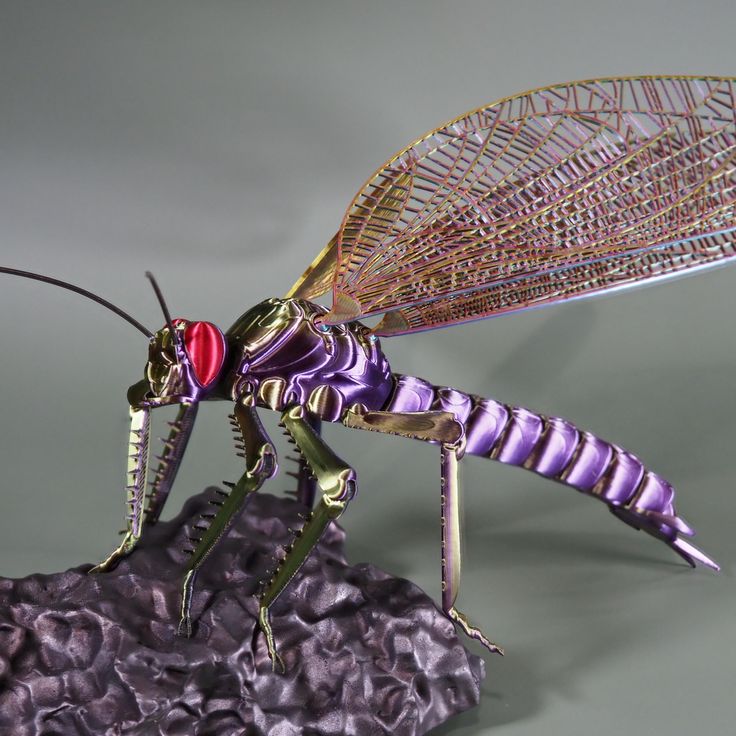
Meganeura is the most famous giant insect in the fossil record - a four-winged aerial predator from the coal swamps of Late Carboniferous Europe, roughly 305 to 299 million years ago, with a wingspan of up to 71 centimetres. It is often described in popular writing as a "giant dragonfly", and it does look strikingly like one, but that shorthand is biologically inaccurate. Meganeura is not a dragonfly.
It belongs to an extinct insect order called Meganisoptera, commonly known as griffinflies, and neither dragonflies nor any other living insect descends from it.
This entry is a full reference page on the genus Meganeura, its type species Meganeura monyi, its palaeoecology, the physics of its gigantic body plan, and its long disappearance from the fossil record. Expect specifics: centimetres, millions of years, oxygen percentages, discovery localities. Where modern ecological comparisons help, they appear; where they mislead, they are flagged.
Name, Etymology, and Classification
The genus name Meganeura was coined by the French palaeontologist Charles Brongniart in 1885. It is assembled from the Greek roots mega- meaning "large" and neuron meaning "sinew" or "nerve", and refers to the dense network of wing veins that is the most visible feature of the preserved fossils.
To a nineteenth-century palaeontologist splitting open a lump of Commentry shale and finding a wing the size of a dinner plate, the crisscrossing veins were what jumped out first. The type species, Meganeura monyi, was named in honour of the French mining engineer Henri Mony, who helped recover the original specimens from the coal basin.
The placement of Meganeura within the insect tree has been revised several times as more fossils have been recovered. The current consensus places the genus in the family Meganeuridae, within the order Meganisoptera, within the superorder Odonatoptera. Odonatoptera is a large clade that also contains the surviving order Odonata - living dragonflies and damselflies. The two groups share a common ancestor deep in the Palaeozoic but diverged early, and Meganisoptera is entirely extinct.
| Rank | Taxon |
|---|---|
| Kingdom | Animalia |
| Phylum | Arthropoda |
| Class | Insecta |
| Superorder | Odonatoptera |
| Order | Meganisoptera (griffinflies) |
| Family | Meganeuridae |
| Genus | Meganeura |
| Type species | Meganeura monyi Brongniart, 1885 |
About five Meganeura species have been formally described, with varying degrees of completeness. Several other Carboniferous giant-insect taxa have been moved into or out of the genus over the last century as fossil preparation and morphological analysis have improved. Closely related Permian genera - especially Meganeuropsis from North America - extend the Meganisoptera record about 50 million years beyond Meganeura itself.
Size and Physical Description
Meganeura is one of the largest flying insects ever to have lived. Only its Permian cousin Meganeuropsis permiana rivals it in wingspan, and the two are usually cited together as the record-holders for flying insect size.
Measurements, M. monyi:
- Wingspan: roughly 65-71 centimetres
- Body length: approximately 40 centimetres
- Individual wing length: 30-35 centimetres
- Wing chord (front-to-back width of a wing): approximately 5-6 centimetres near the base
To put those numbers in perspective, a herring gull has a wingspan of roughly 130 centimetres, and a pigeon about 65 centimetres. Meganeura had the wingspan of a pigeon, delivered on a long, stick-thin insect body. The largest living dragonfly, the helicopter damselfly Megaloprepus caerulatus of Central American rainforests, has a wingspan of about 19 centimetres - a quarter of Meganeura's maximum.
The overall body plan is immediately recognisable as dragonfly-like: two long, narrow pairs of wings held out to the sides, a slender abdomen, a boxy thorax with three pairs of legs clustered toward the front, and a comparatively small head dominated by two enormous compound eyes. The mouthparts are strong, bladed mandibles of a predatory insect type.
The legs carry grasping spines, suitable for seizing prey in flight. The wings are membranous, supported by a fine but dense lattice of longitudinal and cross veins. It is that vein network that most frequently survives as fossil material, flattened into fine coal-field shales.
One feature modern readers find counter-intuitive: Meganeura's wings probably did not fold. Like modern dragonflies, the species almost certainly rested with its wings held out or angled downward, not flat along the body. Folding wings against the abdomen is a later insect innovation, absent in Odonatoptera.
Habitat and Palaeoecology
Meganeura inhabited the vast equatorial coal swamps of the Late Carboniferous. These were warm, humid, low-lying forests dominated by giant lycopsid trees - plants unrelated to any modern tree but superficially resembling overgrown club mosses, reaching heights of 30 to 40 metres. The understory was a tangle of tree ferns, seed ferns, and horsetails. Standing and slow-moving water was everywhere.
The landscape was functionally an enormous swamp, and the buried remains of its plant life compressed over hundreds of millions of years into the coal seams that were later mined across Europe and North America.
The fauna shared this habitat with Meganeura included:
- Giant millipedes (Arthropleura) reaching two metres in length, the largest land arthropods ever
- Early amphibians - temnospondyls and lepospondyls - filling the niches of modern salamanders and crocodilians
- Early reptiles and reptile-ancestors, small and mostly terrestrial
- Other large insects: cockroach ancestors, giant mayfly relatives, and enormous crickets
- A forest floor and water surface teeming with smaller arthropods
For an aerial predator the size of Meganeura, this ecosystem provided three critical ingredients: open flight lanes above the water and between the tall trees, dense populations of smaller flying insect prey, and a steady supply of small vertebrates along the swamp margins that could be picked off opportunistically. Crucially, no other flying vertebrates existed. Birds, bats, and pterosaurs all evolve more than 50 million years later. The Carboniferous air belonged to insects.
How a 71-Centimetre Insect Breathed: The Oxygen Hypothesis
The single most important question about Meganeura is why it could be this large. Modern insects rarely exceed 15 centimetres in any dimension, and only a handful of exotic species push past that limit. Meganeura was bigger by a full order of magnitude on wingspan. Understanding the answer requires understanding how insects breathe.
Insects do not have lungs. They have tracheae - a branching network of air-filled tubes that opens to the outside at small pores called spiracles along the sides of the body. Oxygen diffuses passively through the tracheal network to reach the tissues. Carbon dioxide diffuses out the same way. Larger insects can assist the process with abdominal pumping, but the underlying mechanism remains diffusion-limited.
This system scales poorly. Diffusion over longer distances takes disproportionately longer, so making an insect twice as big requires more than twice the tracheal capacity. At some point, the tracheae occupy so much internal volume that there is no room left for muscle and organs. Modern atmospheric oxygen at 21 per cent sets that ceiling somewhere around the largest beetles and dragonflies alive today.
Carboniferous atmospheric oxygen was substantially higher. Reconstructions from geochemical and palaeobotanical data place Late Carboniferous O2 at roughly 30 to 35 per cent, the highest in Earth's history. With richer air, each unit volume of tracheal tube delivered more oxygen, and the diffusion-length problem relaxed. The same body plan that tops out at 19 centimetres in today's atmosphere could reach 71 centimetres in Carboniferous air.
Evidence supporting the oxygen-gigantism link:
| Line of evidence | What it shows |
|---|---|
| Geochemical O2 reconstructions | Atmospheric oxygen peaks in the Late Carboniferous, drops sharply in the Permian |
| Fossil insect size trends | Maximum insect size tracks atmospheric O2 through the Permian and into later periods |
| Modern hyperoxic rearing experiments | Dragonflies reared in 31% O2 grow measurably larger than controls in normal air |
| Tracheal scaling studies | Larger modern beetles devote a larger fraction of body volume to tracheae, confirming the constraint |
A competing, complementary hypothesis points to the absence of flying vertebrate predators. In the Carboniferous there were no birds, no bats, no pterosaurs. Aerial competition came only from other insects. With nothing faster or smarter overhead, a giant insect was not at the disadvantage it would face in, say, a modern forest.
Some researchers argue that the aerial-vertebrate hypothesis is more important than oxygen, noting that insect size drops not when oxygen drops but when pterosaurs and later birds appear. The likely answer combines both: Carboniferous oxygen opened the door to gigantism, and the absence of aerial vertebrates kept it open.
Flight and Hunting
The mechanics of Meganeura flight remain partly speculative. Aerodynamic models suggest its wings operated on the same principles as those of modern dragonflies - four independently controlled surfaces beating in patterns that can shift between synchrony and counter-phase depending on the manoeuvre required.
Dragonflies are among the most aerially capable animals alive today, able to hover, fly backward, and intercept prey at impressive accuracy. If Meganeura's nervous system and musculature were scaled-up versions of the dragonfly design, it was probably a proficient flyer rather than a clumsy giant.
At this size, however, take-off and acceleration would have been energetically costly. Researchers comparing Meganeura to modern dragonflies estimate that sustained powered flight would have demanded very high muscular output per wingbeat, plausibly supportable only in the oxygen-rich air of the Carboniferous.
Several reconstructions propose that Meganeura relied heavily on gliding between short bursts of active flight, conserving muscular effort while using forest-edge thermals and the open space above swamp water.
Hunting almost certainly looked like modern dragonfly predation scaled up:
- Visual detection. The huge compound eyes covered most of the head surface and provided wide-angle, high-refresh visual input optimised for detecting moving prey against a cluttered background.
- Interception flight. The insect homed in not on where the prey was but on where it was predicted to be, steering to a calculated intercept point - the same "motion camouflage" strategy used by modern odonates.
- Mid-air capture. The spiny forelegs formed a basket that closed around prey in flight.
- Perching to feed. Larger prey was probably carried to a perch and dismantled with the mandibles.
Prey included other large Carboniferous insects and, plausibly, small tetrapods - early amphibians and lizard-sized stem reptiles. A griffinfly with a 71-centimetre wingspan and powerful mandibles could physically take animals the size of a modern gecko.
Development and Life Cycle
Like modern Odonata, Meganeura almost certainly had an aquatic larval stage. Modern dragonfly nymphs are predatory underwater insects with extensible, spring-loaded labia that shoot out to capture prey. They spend months to years underwater before crawling up a plant stem, splitting their exoskeleton, and emerging as winged adults.
Meganeura nymphs are rarely preserved; the adult wings dominate the fossil record because they are large, flat, and rigid. Some Carboniferous aquatic insect larvae from the same deposits may be juvenile griffinflies, but firm identification is difficult. What is certain is that griffinfly development was holometabolous in the "incomplete" sense used by odonates - nymph, emergence, adult - not the full-metamorphosis holometaboly of beetles and flies.
A nymph of appropriate scale would have been a formidable freshwater predator in its own right, taking fish-equivalent prey (there were no true fish of modern type in the upper freshwater column yet, but small jawed vertebrates were abundant) and smaller invertebrates.
Discovery and Fossil Record
The discovery and naming of Meganeura is a nineteenth-century French story. In the 1880s, workers at the coal mines of Commentry in central France were extracting fossil-rich shales alongside the coal itself. A particularly well-preserved insect wing, enormous in size, came to the attention of Charles Brongniart, a palaeontologist at the Paris Museum of Natural History.
Brongniart described the specimen in 1885 under the name Meganeura monyi. Additional material accumulated from Commentry and from the nearby Montceau-les-Mines basin over the following decades, eventually providing a near-complete picture of the adult body plan.
Additional Meganisoptera material has since been recovered from the British Midlands, the Czech Republic, and other European coalfields. Related genera are known from Carboniferous North America. The Permian genus Meganeuropsis, from the Elmo Limestone of Kansas, represents the largest griffinfly specimen on record at up to 71 centimetres in wingspan, matching or exceeding Meganeura depending on the specimen consulted.
The quality of preservation varies enormously. Most specimens are compression fossils - wings flattened into sedimentary rock and preserved as a thin carbon film. Three-dimensional body preservation is extremely rare. Much of what is known about Meganeura anatomy therefore comes from inference: from wing venation patterns, from scattered body parts, and from better-preserved relatives.
Extinction and Legacy
Meganeura itself disappears from the fossil record at the end of the Carboniferous, roughly 299 million years ago. The broader Meganisoptera clade persisted into the Permian in the form of genera such as Meganeuropsis and Tupus, then vanished entirely at the Permian-Triassic mass extinction about 252 million years ago.
The decline was not sudden. Atmospheric oxygen began dropping from its Carboniferous peak through the Permian, and the vast equatorial coal swamps dried out as climatic belts shifted. The combination of lower O2 and lost habitat squeezed giant insects from both directions: their respiratory ceiling lowered and their habitat shrank. By the end of the Permian, the Permian-Triassic extinction - the largest known in Earth's history - finished the job alongside most marine and terrestrial life.
One timing point is worth emphasising because it is routinely confused in popular writing. Meganeura went extinct before the dinosaurs evolved. The earliest dinosaurs appear in the Middle Triassic, about 230 million years ago - roughly 70 million years after the last Meganisoptera. No dinosaur ever saw a griffinfly. The image of a giant dragonfly sharing the air with a pterosaur is scientifically impossible.
Insect size never returned to Carboniferous extremes. Post-Permian atmospheric oxygen stabilised at lower levels. By the time flying vertebrates evolved - pterosaurs in the Late Triassic, birds in the Jurassic, bats in the Eocene - any remaining potential for flying insect gigantism was also constrained by predation pressure. The modern insect ceiling is the product of both atmospheric physics and ecological competition.
Meganeura in Public Culture
Meganeura occupies an outsized place in public imagination given how incomplete its fossil record is. It appears routinely in illustrated children's books about prehistoric animals, in natural history documentaries covering the Carboniferous, and in museum halls showing the history of life. The appeal is obvious: a flying insect the size of a pigeon is easy to picture and difficult to forget.
Some of the most common public-facing claims about Meganeura are incorrect or oversimplified:
- "Giant dragonfly" - not a dragonfly, a griffinfly (Meganisoptera), not Odonata.
- "Ancestor of modern dragonflies" - not an ancestor, a cousin whose line ended.
- "Lived with dinosaurs" - extinct roughly 70 million years before the first dinosaur.
- "Needed the oxygen-rich air" - correct, although the absence of aerial vertebrates also mattered.
Accurate public communication matters because Meganeura is one of the clearest examples of how atmospheric chemistry controls body plans. The fact that a single insect group could reach 71 centimetres when oxygen was at 35 per cent, and no insect group has reached anything close since, is a striking piece of evidence that body size is not free to evolve in any direction - it is constrained by the physics of the atmosphere an animal breathes.
Related Reading
- Prehistoric Insects: Giants of the Carboniferous
- Arthropleura: The Two-Metre Millipede
- How Oxygen Shaped the Evolution of Life
- The Permian-Triassic Extinction
References
Primary and synthetic sources consulted for this entry include Brongniart's original 1885 description of Meganeura monyi, subsequent revisions of Meganisoptera by Carpenter and by Nel and colleagues, published research on Carboniferous atmospheric oxygen by Berner and Dudley, experimental studies of hyperoxic insect rearing in the Journal of Experimental Biology, and reviews of Palaeozoic insect gigantism in Annual Review of Entomology and in the Smithsonian Contributions to Paleobiology.
Size estimates for M. monyi follow the consolidated figures reported in Nel and colleagues' Meganisoptera phylogenetic revisions; Meganeuropsis permiana figures follow Carpenter's Kansas specimens.
Frequently Asked Questions
How big was Meganeura?
Adult Meganeura monyi reached a wingspan of roughly 65 to 71 centimetres - the width of a large pizza or a small coffee table - with a slender body around 40 centimetres long. That places it among the largest flying insects ever discovered, rivalled only by its Permian cousin Meganeuropsis permiana.
For comparison, the largest living dragonfly, Megaloprepus caerulatus, has a wingspan of about 19 centimetres, so Meganeura was roughly three to four times wider across the wings than anything flying today. The body mass is harder to estimate from compressed fossils but probably exceeded that of a modern sparrow.
Was Meganeura a dragonfly?
Not technically. Meganeura belongs to the extinct order Meganisoptera, commonly called griffinflies. Modern dragonflies and damselflies belong to the order Odonata. Both orders sit inside the superorder Odonatoptera and share a common ancestor, but griffinflies split off early and left no descendants.
The superficial resemblance - four long wings, big eyes, long body, predatory habits - reflects shared ancestry plus convergent adaptations to aerial hunting. Calling Meganeura a ‘giant dragonfly’ is a useful shorthand but it is biologically inaccurate. Think of it as a dragonfly-shaped cousin that died out before the real dragonflies reached their modern form.
When did Meganeura live?
Meganeura lived during the Late Carboniferous period, roughly 305 to 299 million years ago. This was the age of vast equatorial coal swamps, towering lycopsid trees the size of modern redwoods, and the first true reptiles. No dinosaurs existed yet; the first dinosaurs would not appear for another 70 million years.
The Carboniferous coal-swamp ecosystem that Meganeura inhabited was buried, compressed, and preserved as the coal seams that later powered the Industrial Revolution - which is how the fossils came to be found inside nineteenth-century French coal mines.
Why was Meganeura so large?
The leading explanation is atmospheric oxygen. Carboniferous air contained roughly 30 to 35 per cent oxygen, compared with today’s 21 per cent. Insects breathe by passive diffusion through a branching network of internal tubes called tracheae - they do not have lungs and do not actively pump air. This respiratory system scales poorly with body size, because larger insects need disproportionately more tracheal volume to supply oxygen to their tissues.
High atmospheric oxygen relaxed that constraint, allowing insects to grow far bigger than modern air permits. A secondary hypothesis points to the total absence of flying vertebrate predators: no birds, no bats, no pterosaurs. With no aerial competitors, big-bodied insects faced no disadvantage, and may even have benefited from size in aerial combat with each other.
What did Meganeura eat?
Meganeura was a predator. Its body plan - spiny grasping legs, powerful jaws, huge compound eyes, and agile four-winged flight - is almost identical in function to that of modern dragonflies, which are among the most effective aerial hunters alive. Prey almost certainly included other Carboniferous insects (some of which were themselves very large), and probably small tetrapods such as early amphibians and the lizard-sized ancestors of reptiles.
Palaeontologists have suggested that Meganeura hawked prey from the air the way modern dragonflies do, intercepting flying insects on the wing and snatching small animals from leaves or from the surface of swamp water.
Why did Meganeura go extinct?
No single event ended Meganeura itself; the species disappears from the fossil record around the end of the Carboniferous. The broader clade, Meganisoptera, survived into the Permian via genera such as Meganeuropsis, then vanished entirely at the Permian-Triassic mass extinction around 252 million years ago - the worst extinction event in Earth history.
The slow decline appears linked to falling atmospheric oxygen through the Permian, drying of the coal-swamp habitats that had supported giant insects, and eventually the catastrophic collapse of terrestrial ecosystems at the Permian-Triassic boundary. Critically, Meganeura went extinct long before the first dinosaurs evolved. The two never met.
Where are Meganeura fossils found?
The best Meganeura fossils come from the coal basins of central France, particularly Commentry and Montceau-les-Mines. Charles Brongniart described the first specimens in the 1880s from material extracted during coal mining. Additional Meganisoptera fossils have been found in the British Midlands, the Czech Republic, and scattered sites across Europe, with related taxa known from North America and Asia.
The Permian cousin Meganeuropsis permiana comes from the Elmo Limestone in Kansas. Because insect bodies rarely fossilise, the surviving record consists almost entirely of wings pressed flat into fine-grained sedimentary rock, preserving the distinctive vein pattern that gave the genus its ‘large-nerved’ name.
Could Meganeura exist today?
Almost certainly not. Modern atmospheric oxygen is too low to support passive tracheal breathing at Meganeura’s body size. Experiments rearing modern dragonflies in enriched-oxygen atmospheres do produce measurably larger adults, supporting the oxygen-gigantism link, but today’s 21 per cent oxygen imposes a hard upper limit on insect size somewhere around the largest living beetles, stick insects, and dragonflies.
Even if oxygen were artificially raised, a Meganeura-scale insect would also have to contend with birds and bats - highly manoeuvrable aerial vertebrates that did not exist in the Carboniferous and that routinely prey on the largest modern insects. The combination of low oxygen and vertebrate aerial predation makes Meganeura-scale giants structurally impossible in today’s world.