
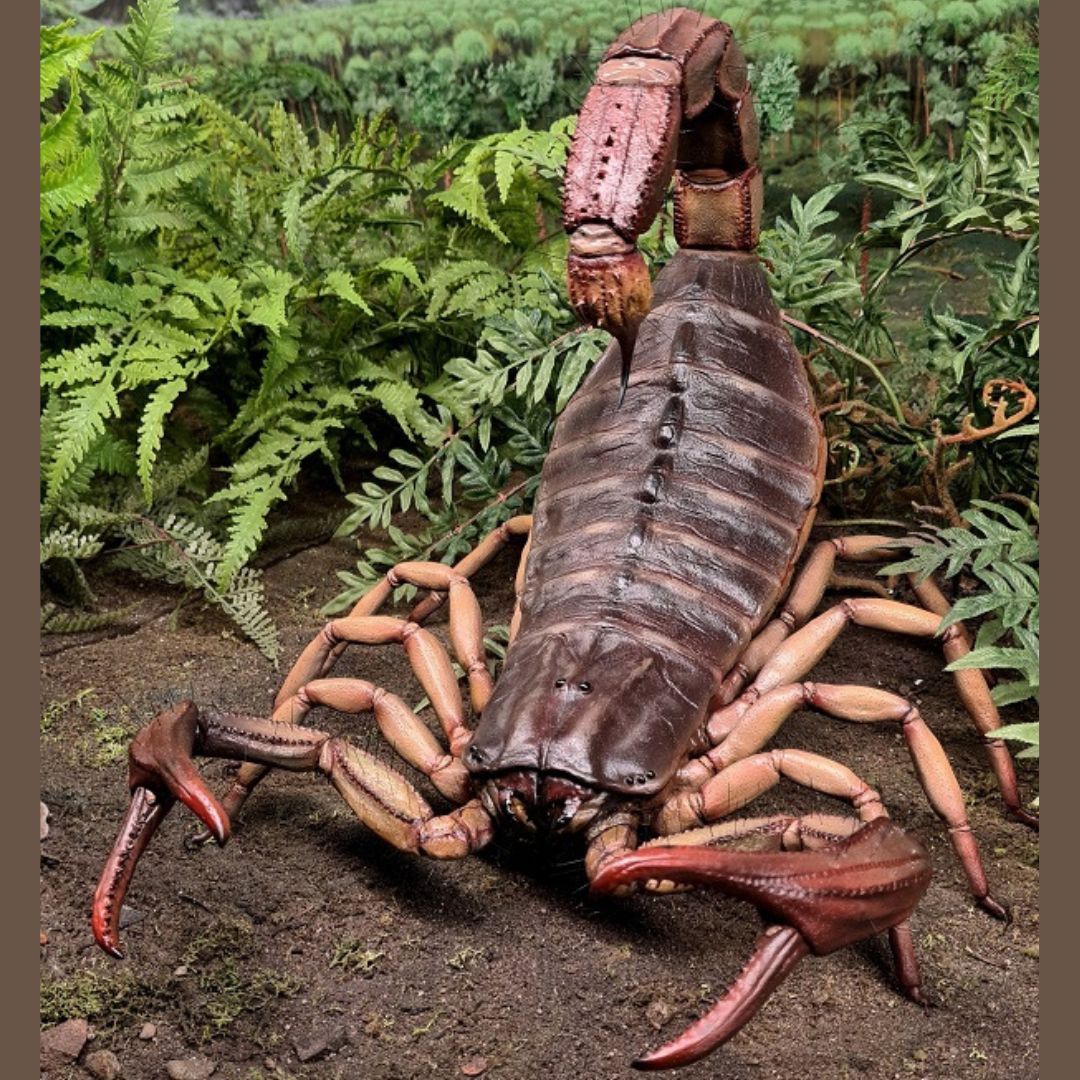
Pulmonoscorpius kirktonensis is one of the largest scorpions that ever lived and the oldest definitively fully terrestrial scorpion known to science. At roughly 70 centimetres from the tips of its chelicerae to the point of its sting, it was longer than most domestic cats and several times the size of any scorpion alive today.
Its name - pulmo plus scorpius - literally means "lung scorpion", a reference to the fossilised book lungs preserved in the type specimens. Those preserved lungs are the direct evidence that by the Early Carboniferous, roughly 330 million years ago, the scorpion lineage had completed its move from water onto land.
Pulmonoscorpius is not a household name in the way that Meganeura or Arthropleura are, but in the story of Palaeozoic gigantism and the colonisation of land by air-breathing arthropods it sits in a central position. It is the point at which a book-lung-breathing, fully terrestrial scorpion can first be demonstrated in the fossil record, and the point at which scorpions appear to have exploited the oxygen-rich Carboniferous atmosphere to grow to near-metre scale.
This entry is a full reference page on the genus Pulmonoscorpius, its type species P. kirktonensis, its anatomy and lifestyle, the East Kirkton Lagerstatte that preserved it, the oxygen-gigantism hypothesis that best explains its size, and its disappearance as the Carboniferous world gave way to the Permian.
Name, Etymology, and Classification
The genus Pulmonoscorpius was established by the British arachnologist Andrew Jeram in the early 1990s, based on material from East Kirkton Quarry in West Lothian, Scotland. Jeram's formal description, published in two papers in 1993 and 1994, named the animal after the most striking feature of the preserved fossils - their book lungs.
The generic name combines Latin pulmo, meaning "lung", with scorpius, meaning "scorpion". The species epithet kirktonensis refers to the East Kirkton locality where the type material was collected.
Preservation of soft respiratory anatomy in a 330-million-year-old arthropod is extremely rare. In most fossil arthropods, cuticle hardens and preserves, while internal organs decay long before burial.
The East Kirkton specimens are exceptions: thin, layered impressions of book-lung lamellae are visible on the underside of several articulated specimens, and it was those impressions that motivated the choice of name. A scorpion preserved clearly enough for its lungs to be measured is a rare object.
The placement of Pulmonoscorpius inside the scorpion tree is as follows.
| Rank | Taxon |
|---|---|
| Kingdom | Animalia |
| Phylum | Arthropoda |
| Subphylum | Chelicerata |
| Class | Arachnida |
| Order | Scorpiones |
| Family | Pulmonoscorpiidae |
| Genus | Pulmonoscorpius |
| Type species | Pulmonoscorpius kirktonensis Jeram, 1993 |
Pulmonoscorpiidae is an extinct family of Palaeozoic scorpions with no living members. The order Scorpiones as a whole extends from the Silurian to the present day, but the deep splits within the order separate extinct giant forms like Pulmonoscorpius from the smaller-bodied lineages that eventually gave rise to modern scorpions. Pulmonoscorpius is therefore a cousin of living scorpions rather than a direct ancestor.
The body plan is the same in broad outline - chelicerae, pedipalps bearing pincers, a segmented mesosoma, a long metasoma ending in a sting - but the details of the pedipalp structure, segmentation, and especially respiratory anatomy fall outside the range occupied by any living scorpion.
Size and Physical Description
Pulmonoscorpius was a giant by any standard that applies to living scorpions. Published length estimates for the largest East Kirkton specimens fall at around 70 centimetres total body length from the front of the chelicerae to the tip of the sting. Several of the East Kirkton specimens are partly disarticulated or juvenile, and the 70-centimetre figure represents the high end of reconstructed adult size rather than the average individual recovered.
Measurements, P. kirktonensis:
- Total body length: up to approximately 70 cm (tip of chelicerae to tip of sting)
- Carapace length: on the order of 6-8 cm in the largest specimens
- Pedipalp (pincer) length: proportionally very large, giving a total reach of roughly a metre when the animal was positioned in strike posture
- Metasoma (tail) length: comparable to or slightly longer than the rest of the body, ending in a telson and sting
- Estimated mass: on the order of a few kilograms for the largest adults - heavier than most domestic cats, though precise mass is hard to recover from flattened fossils
- Number of book-lung pairs: four pairs preserved on the underside of the mesosoma, consistent with the standard scorpion pattern
The body plan is instantly recognisable as a scorpion. The chelicerae at the front are small, the pedipalps that follow are large and bear terminal pincers, and the prosoma (head-and-thorax region) is covered by a single carapace.
Behind the prosoma the mesosoma is built from a series of broad tergal segments, and behind that the much narrower metasoma - the "tail" - extends as five elongated segments ending in a bulbous telson carrying a curved sting. The underside of the mesosoma bears the book lungs, visible in the best-preserved specimens as stacks of thin layered plates inside paired chambers.
Scaling that body plan up from modern 20-centimetre scorpions to a 70-centimetre animal is not a trivial geometric exercise. Several features of Pulmonoscorpius anatomy show that it was not a simple blown-up emperor scorpion.
The pedipalps are proportionally larger, the mesosoma is more robust, and the book lungs are themselves relatively larger than modern scorpion book lungs - all consistent with the physiological demands of maintaining a predatory lifestyle at a body size no living arachnid approaches.
One widely circulated popular figure puts Pulmonoscorpius at "a metre long". That number appears in documentaries and in some online summaries, but the published size estimates from the actual specimens cluster around 70 centimetres rather than a full metre. Seventy centimetres is already an extraordinary scorpion.
Habitat: East Kirkton and the Carboniferous of Scotland
Pulmonoscorpius is known from a single locality: East Kirkton Quarry in West Lothian, Scotland, a few kilometres west of Edinburgh. East Kirkton is one of the most important Early Carboniferous Lagerstatten in the world, and its biota differs in important ways from the better-known late Carboniferous coal-swamp faunas.
Key facts about East Kirkton:
- Age: Early Carboniferous, Visean stage, roughly 336-326 million years ago
- Depositional setting: a small, shallow lake on the margin of active hot springs and volcanic vents
- Lithology: thin limestones and shales interbedded with volcanic ash fall deposits
- Preservation: exceptional; both terrestrial and freshwater organisms are represented as articulated body fossils
The East Kirkton biota includes the earliest reptile-like tetrapod known from well-preserved body fossils - Westlothiana lizziae, a lizard-sized animal that briefly attracted enormous attention as a candidate early amniote. Alongside Westlothiana the deposit preserves temnospondyl amphibians, other early tetrapods, harvestmen, eurypterid remains, smaller scorpions, plant material, and Pulmonoscorpius itself.
Several of these animals are known only from East Kirkton, making the quarry irreplaceable as a window into Early Carboniferous terrestrial life.
The habitat reconstructed around the East Kirkton lake is not a typical Carboniferous coal swamp. Instead it was a warm, geothermally active basin fringed by low vegetation, periodically showered with volcanic ash, with small freshwater bodies and active hydrothermal springs. For a large terrestrial predator, that environment offered three key advantages.
First, the lake margins concentrated small prey - amphibians, small tetrapods, arthropods - into a predictable, water-dependent strip. Second, volcanic ash falls repeatedly smothered ground-level organisms and provided the rapid burial needed to preserve articulated soft-bodied animals.
Third, the ecosystem was productive enough to support multiple predator niches, from small scorpions and harvestmen to giant Pulmonoscorpius.
Pulmonoscorpius was almost certainly not restricted to East Kirkton in life. A single-locality fossil record more likely reflects the rarity of preservation windows adequate to capture a 70-centimetre terrestrial arthropod than the genuine range of the living animal.
Comparable giant scorpion lineages are known from other Carboniferous sites in Europe and North America, but without the quality of preservation East Kirkton offers. Pulmonoscorpius is a snapshot through a narrow Lagerstatten window, not a complete map of its world.
Book Lungs and Terrestrial Life
The single most important feature of Pulmonoscorpius, and the reason for its name, is the preservation of book lungs.
Book lungs are the respiratory organs of modern scorpions and many other arachnids. They are paired, invaginated chambers on the underside of the abdomen, each containing a stack of thin, parallel lamellae separated by narrow air spaces. Air enters through a slit-shaped opening called a stigma, diffuses through the lamellar stack, and oxygen is absorbed into the haemolymph flowing between the plates.
The stacked structure - hence the name "book" - maximises the surface area available for gas exchange within a compact organ.
Book lungs function only in air. They are an evolutionary modification of the book gills that ancestral chelicerates used in water: the lamellar structure is homologous, but the underlying organ is enclosed inside the body and open to air through a narrow slit rather than exposed to flowing water. Book gills work only in water; book lungs work only in air. A scorpion that can be shown to have book lungs rather than book gills is, by anatomical definition, fully adapted to air-breathing.
Fossil preservation of book lungs is extremely rare. For the East Kirkton Pulmonoscorpius specimens, the combination of rapid ash burial, fine-grained sediment, and minimal post-burial disturbance produced the conditions needed for the delicate lamellae to leave impressions on the cuticle and matrix. When Jeram described the specimens, he could see and measure the book-lung structure directly.
That observation settles one of the long-running questions in the history of scorpions. Fossil scorpions from the Silurian and Devonian are known from cuticular remains but not from preserved internal respiratory anatomy, and there has been extensive debate about whether those earlier forms were aquatic (using book gills), amphibious, or already terrestrial.
Pulmonoscorpius pins down the latest possible point for the scorpion lineage to have achieved full book-lung-based terrestriality: the Early Carboniferous, roughly 330 million years ago, and possibly earlier. Scorpions were already air-breathing land animals when the great coal swamps began to form, and Pulmonoscorpius is the physical proof.
The fact that the book-lung-breathing apparatus of a 70-centimetre scorpion is essentially the same layered plate system used by a 10-centimetre modern scorpion is also important. It tells us that book lungs, as a respiratory solution, scale up to body sizes that no living scorpion approaches - provided the atmospheric oxygen supply is rich enough to make diffusion through those lamellae efficient at that scale. Modern 21-per-cent air does not provide that supply.
Why So Large: The Oxygen Hypothesis
The obvious question about Pulmonoscorpius is why it could be this large. A 70-centimetre scorpion is outside the range of modern arachnids by a factor of three or more, and the reason is not exotic biochemistry but atmospheric physics.
Arthropods breathe by diffusion. Whether the organ in question is a tracheal tube (insects, myriapods) or a book lung (arachnids), oxygen reaches the tissues by passive diffusion across a thin gas-exchange surface. Diffusion scales poorly with body size: doubling body mass more than doubles the respiratory capacity required. Beyond a certain size, diffusion-limited breathing cannot keep up with metabolic demand, and the ceiling on terrestrial arthropod body size is reached.
In today's atmosphere, with oxygen at 21 per cent by volume, that ceiling sits around 20-25 centimetres for the largest living scorpions and comparable arachnids. Push past that, and respiratory capacity becomes limiting.
Carboniferous atmospheric oxygen was substantially higher. Reconstructions from geochemical proxies - carbon burial rates, pyrite burial, stomatal densities on fossil plants - place Late Carboniferous O2 at roughly 30 to 35 per cent, the highest level in Earth's history. East Kirkton sits at the start of that oxygen rise, and by the late Carboniferous the atmosphere was around 50 per cent more oxygen-rich than today's.
Evidence supporting oxygen-driven gigantism in Palaeozoic arthropods:
| Line of evidence | What it shows |
|---|---|
| Geochemical O2 reconstructions | Atmospheric oxygen peaks in the late Carboniferous, drops sharply in the Permian |
| Fossil arthropod size through time | Maximum body sizes in insects, myriapods, and arachnids track atmospheric O2 |
| Hyperoxic rearing experiments (modern) | Dragonflies and cockroaches reared in 31% O2 grow measurably larger than controls |
| Comparative book-lung physiology | Larger scorpions devote proportionally more body volume to lungs and tracheae |
With air that carried roughly 50 per cent more oxygen per unit volume, each unit of book-lung surface area delivered more oxygen per breath, and the diffusion-distance problem relaxed. A scorpion body plan that tops out around 25 centimetres in modern air could reach 70 centimetres in Carboniferous air.
Two additional factors probably mattered. First, large terrestrial vertebrate predators capable of routinely killing an adult Pulmonoscorpius did not yet exist. The largest land carnivores of the Early Carboniferous were amphibians such as temnospondyls and small reptile-like tetrapods; none of them were reliably capable of overpowering a 70-centimetre pincered, stinging arachnid.
Second, the East Kirkton ecosystem, and similar hot-spring and swamp-margin environments around the Carboniferous world, provided a steady supply of small prey - amphibians, juvenile tetrapods, other arthropods - for a large predatory scorpion to exploit.
When all three conditions reversed in the Permian - oxygen fell, the wetlands dried, and larger vertebrate predators diversified - the entire niche for near-metre terrestrial arachnids collapsed. Pulmonoscorpius and its giant relatives disappeared. The smaller-bodied scorpion lineages that continued into the Mesozoic remained well within the tens-of-centimetres range that modern scorpions still occupy.
Diet and Predatory Behaviour
Pulmonoscorpius was a predator. Its anatomy is the standard predatory scorpion toolkit, scaled up.
The hunting toolkit:
- Pincers (pedipalps) large enough to seize prey the size of a small amphibian
- Long metasoma ending in a telson and sting - the venom-delivery system
- Forward-facing chelicerae for cutting and ingesting prey
- Well-developed median and lateral eyes on the carapace
No direct gut contents have been recovered from Pulmonoscorpius specimens, so its diet is reconstructed from the fauna of East Kirkton and from comparison with the known hunting ecology of living scorpions at the upper end of the modern body-size range.
Likely prey at East Kirkton:
- Westlothiana and other small early tetrapods (around 20 cm long)
- Temnospondyl amphibian juveniles and larvae
- Harvestmen, smaller scorpions, and other arthropods of the lake margin
- Soft-bodied invertebrates in the leaf litter around the hot-spring lake
This is a significant point in the broader story of Palaeozoic terrestrial ecology. The East Kirkton ecosystem preserves some of the earliest definite evidence of giant arthropods hunting early backboned land animals. In modern terrestrial ecosystems, vertebrates dominate the large-predator niche and arthropods are almost exclusively prey or specialised insectivores.
At East Kirkton, that relationship was at least partly reversed: a 70-centimetre scorpion was the apex predator of a small-bodied ecosystem in which early reptile-like tetrapods were potential prey.
Venom almost certainly played a role. Living scorpions use venom both for defence and to subdue struggling prey; the sting is not a stabbing weapon but a neurotoxin-delivery organ. Pulmonoscorpius preserved the full stinger apparatus, including a well-developed telson shaped essentially like that of a large modern scorpion. The chemistry of its venom is obviously unknowable, but its function is not in doubt.
A 70-centimetre scorpion with a stinger proportional to its body would have been able to deliver a killing dose to prey up to and including small tetrapods.
As ambush-capable predators, modern large scorpions typically hunt by a combination of sit-and-wait from burrows and low cover, and slow stalking when prey is detected by vibration and chemosensory cues. Pulmonoscorpius likely used the same basic toolkit: sitting motionless in low vegetation or on the litter layer at the lake margin, detecting vibrations and chemical cues from approaching prey, and striking with the pedipalps before using the sting to finish a kill.
Fossil Record and Discovery
East Kirkton Quarry had been worked for centuries as a source of building stone before its palaeontological importance was recognised. The modern phase of scientific collection began in the 1980s, when the Scottish fossil collector Stan Wood and colleagues started systematic recovery of fossils from the exposed shales and limestones.
The resulting material, worked through by palaeontologists at the National Museums of Scotland and visiting specialists, established East Kirkton as one of the key Early Carboniferous Lagerstatten worldwide.
Pulmonoscorpius kirktonensis was among the most striking finds from that work. Andrew Jeram's formal description, published in 1993 and 1994, established the genus, species, and family, and documented the book-lung preservation that gave the animal its name. The type material is held in the collections of the National Museums of Scotland in Edinburgh.
Summary of the fossil record:
- Locality: East Kirkton Quarry, West Lothian, Scotland (essentially the only well-known site)
- Preservation: articulated specimens with preserved book lungs in several individuals
- Specimen count: a small number of individuals - on the order of a dozen - representing a range of size classes
- Associated biota: Westlothiana, temnospondyl amphibians, harvestmen, other arthropods, plant material
- Depositional setting: hot-spring lake margin with volcanic ash falls
A handful of fragmentary Carboniferous scorpion remains from other localities in Europe and North America have been compared to Pulmonoscorpius, but none match the East Kirkton material in preservation or completeness. For practical purposes the genus is an East Kirkton animal, and almost everything that can be said about its anatomy and lifestyle is tied to that single Lagerstatte.
The rarity of the fossil record for Pulmonoscorpius does not reflect rarity of the living animal. Large terrestrial arthropods have low preservation potential: their exoskeletons are not strongly mineralised, and their body cavities decay rapidly. A 70-centimetre scorpion on a normal Carboniferous swamp margin would leave almost no trace.
East Kirkton captures Pulmonoscorpius because volcanic ash falls and hot-spring chemistry combined to create an exceptional preservation environment. Without those conditions, we would likely know the animal only from isolated cuticular fragments, if at all.
Life Cycle and Development
Very little is known directly about the life cycle of Pulmonoscorpius. Modern scorpions are distinctive among arachnids in giving birth to live young; females carry developing embryos internally and then bear offspring that climb onto the mother's back for several weeks before dispersing. Juveniles moult repeatedly through a series of instars before reaching adult size, with total developmental time depending on species and environment.
Pulmonoscorpius almost certainly followed the same general pattern. The East Kirkton assemblage includes individuals of several size classes, consistent with a population of a single species at different developmental stages rather than with multiple species at the same locality. Reaching 70 centimetres from a juvenile of a few centimetres would have required many moults and a substantial span of years, though no direct estimate of longevity is possible from the fossils.
Each moult would have been a dangerous event. Freshly moulted scorpions are soft-bodied, unable to move effectively, and vulnerable to desiccation and predation until the new cuticle hardens. A 70-centimetre Pulmonoscorpius undergoing a moult would have been exposed for hours to days.
Likely strategies include sheltering in burrows, under logs, or in litter accumulations during the moulting window, as modern large scorpions do, but no direct evidence of moulting sites exists in the fossil record.
Reproduction, courtship, and parental care are effectively undocumented for the genus. By analogy with living scorpions, courtship would have involved the characteristic promenade a deux in which male and female grasp pedipalps and manoeuvre together while the male deposits a spermatophore; females would then have borne live young that climbed onto the mother's back for their first instars.
None of this is preserved in the fossil record of Pulmonoscorpius, but the overall consistency of scorpion reproductive biology across the order makes the broad pattern a reasonable inference.
Extinction and Legacy
Pulmonoscorpius is not known from younger deposits, and the wider family Pulmonoscorpiidae, together with the other giant Palaeozoic scorpion lineages, declined through the later Carboniferous and disappeared during the early Permian. No single catastrophe ended them. Several environmental changes unfolded in parallel:
- Atmospheric oxygen dropped from its Carboniferous peak through the Permian, tightening the diffusion-limited constraint on book-lung breathing at large sizes. The very atmospheric conditions that had made 70-centimetre scorpions possible reversed, and a body plan that had been viable for tens of millions of years became marginal.
- The equatorial wetlands dried out as Pangaea assembled and climatic belts shifted. Hot-spring lake margins like East Kirkton, and the vast coal swamps of the late Carboniferous, contracted and fragmented. The habitat that had supported giant terrestrial predators shrank.
- Terrestrial vertebrate predators diversified. Early synapsids and reptiles appeared in a range of sizes and ecologies, and many of them became better-armed and faster than the Carboniferous amphibians they replaced. For a slow, ground-dwelling 70-centimetre scorpion, newly agile tetrapod predators represented a threat that had not previously existed.
- White-rot fungi spread, accelerating the decomposition of woody plant material and draining the litter-layer food base that had supported giant detritivores and, by extension, the predators that preyed on them.
Any one of these changes would have stressed Pulmonoscorpius. The combination squeezed its ecological niche from several directions at once. By the early Permian, the giant Palaeozoic scorpions are gone.
Modern scorpions survived. They descend from smaller-bodied Carboniferous and Permian lineages - not from Pulmonoscorpiidae - and their body plan is the same in broad outline as Pulmonoscorpius but at one-third or less the body length. The book-lung respiratory system persists; what has been lost is the ability to use it at near-metre body sizes, because the post-Carboniferous atmosphere no longer allows it.
One often-repeated misconception is worth clearing up. Pulmonoscorpius went extinct before the first dinosaurs evolved. The earliest dinosaurs appear in the Middle Triassic, around 230 million years ago - roughly 90 million years after Pulmonoscorpius disappears from the fossil record. No dinosaur ever encountered one.
The image of a giant Carboniferous scorpion stalking through a forest of sauropods is scientifically impossible; the scorpion giants belong to a world that predated dinosaurs by a margin larger than the entire age of mammals.
Pulmonoscorpius in Public Culture
Pulmonoscorpius is less famous than Meganeura or Arthropleura, but it has a niche cultural footprint. It appears in natural history documentaries about the Carboniferous, in museum displays at the National Museum of Scotland in Edinburgh (which holds the type specimens), and in popular-science summaries of Palaeozoic gigantism. It also features occasionally in video games and speculative fiction about prehistoric ecosystems, usually as a stand-in for "giant terrifying arthropod predator".
Several of the most common public claims about Pulmonoscorpius are either overstated or simply wrong:
- "A metre-long scorpion" - overstated. The published length estimates for the largest specimens are around 70 centimetres, not a full metre. That is still an extraordinary animal by any modern standard.
- "The largest scorpion ever" - approximately correct among terrestrial scorpions, though the earlier aquatic form Brontoscorpio anglicus (from the Silurian-Devonian) is sometimes reconstructed at similar or larger sizes, and the distinction between terrestrial and aquatic giants matters biologically.
- "Lived with dinosaurs" - wrong. Pulmonoscorpius went extinct roughly 90 million years before the first dinosaur.
- "Proof of oxygen gigantism" - correct in outline, with the caveat that habitat, prey availability, and the absence of large vertebrate predators also mattered. Oxygen is the necessary condition but not the only one.
- "An ancestor of modern scorpions" - wrong. Pulmonoscorpius sits in an extinct family. Modern scorpions descend from a separate lineage.
Accurate communication about Pulmonoscorpius matters because the animal is one of the clearest examples in the fossil record of how atmospheric chemistry, ecological opportunity, and body-plan physics combine to set limits on terrestrial life. A 70-centimetre air-breathing scorpion is not a fantasy.
It existed, it walked the margins of a hot-spring lake in what is now West Lothian, and its fossilised lungs sit in the collections of the National Museum of Scotland to prove it. The reason nothing like it exists today is not a historical accident but a direct consequence of modern atmospheric oxygen, modern climate, modern ecosystems, and modern vertebrate predators.
Related Reading
- Arthropleura: The 2.6-Metre Carboniferous Millipede
- Meganeura: The 71-Centimetre Carboniferous Griffinfly
- Meganeuropsis: The Largest Flying Insect Ever
- Prehistoric Insects: When Bugs Ruled the World
References
Primary and synthetic sources consulted for this entry include Andrew Jeram's 1993 and 1994 descriptions of Pulmonoscorpius kirktonensis in Transactions of the Royal Society of Edinburgh: Earth Sciences, the monograph volume on the East Kirkton Lagerstatte edited by Rolfe, Clarkson, and Panchen (Transactions of the Royal Society of Edinburgh: Earth Sciences, 1994), reconstructions of Carboniferous atmospheric oxygen by Berner and Beerling, reviews of arthropod gigantism and tracheal and book-lung scaling in the Journal of Experimental Biology and Annual Review of Entomology, synthetic treatments of scorpion phylogeny and the water-to-land transition by Dunlop, Jeram, and colleagues, and catalogue material on the type specimens held by the National Museums of Scotland in Edinburgh.
Size estimates follow the figures reported in Jeram's original descriptions and subsequent reviews of Palaeozoic scorpion gigantism.
Frequently Asked Questions
How big was Pulmonoscorpius?
Adult Pulmonoscorpius kirktonensis reached a body length of roughly 70 centimetres from the chelicerae at the front to the tip of the sting at the rear. For comparison, the largest living scorpion - the African emperor scorpion Pandinus imperator - grows to around 20 centimetres, and the giant forest scorpion Heterometrus swammerdami to about 23 centimetres.
Pulmonoscorpius was therefore roughly three times the body length of any modern scorpion and, by linear proportion, at least an order of magnitude heavier. It ranks among the largest scorpions ever described, rivalled only by a few other Palaeozoic giants such as Brontoscorpio. A 70-centimetre scorpion would be longer than a domestic cat from nose to tail-tip and substantially heavier than a housecat kitten.
When and where did Pulmonoscorpius live?
Pulmonoscorpius lived in the Early Carboniferous, specifically the Visean stage, roughly 336 to 326 million years ago. The type locality and only well-known site is East Kirkton Quarry in West Lothian, Scotland. East Kirkton is a small but globally important Early Carboniferous Lagerstatte that preserves a rich terrestrial and freshwater biota around the margins of a volcanic hot-spring lake.
The quarry has produced early amphibians, the earliest reptile-like tetrapod Westlothiana, harvestmen, scorpions, and plant material. Pulmonoscorpius was one of the top predators of that ecosystem, living on the drying margins of the lake among low vegetation and volcanic ash beds.
Why is it called the 'lung scorpion'?
The genus name Pulmonoscorpius combines the Latin pulmo, meaning lung, with scorpius, meaning scorpion. It literally means lung scorpion. The name was chosen because the original East Kirkton specimens preserve fossilised book lungs - the paired, layered respiratory organs on the underside of the abdomen that modern scorpions also use to breathe air.
Preservation of book lungs in a 330-million-year-old fossil is extraordinarily rare, and the East Kirkton material is one of the earliest cases where terrestrial arthropod respiratory anatomy can be directly observed in the fossil record. That preservation is why we can say with confidence that Pulmonoscorpius was fully air-breathing and fully terrestrial, not a semi-aquatic form like many earlier scorpions.
Was Pulmonoscorpius fully terrestrial?
Yes. Pulmonoscorpius is the oldest definitively fully terrestrial scorpion in the fossil record. Earlier Silurian and Devonian scorpions were either aquatic, using gill-like book gills that functioned only in water, or amphibious and dependent on wet conditions to breathe. Pulmonoscorpius breathed with book lungs - invaginated, air-filled chambers on the underside of the abdomen - which function only in air.
Combined with the taphonomic context at East Kirkton, where the animal is found in terrestrial lake-margin deposits rather than in marine or estuarine sediment, this makes the case for a fully land-adapted scorpion unambiguous. Pulmonoscorpius therefore marks the point at which the scorpion lineage had completed the evolutionary shift from water to land respiration.
What did Pulmonoscorpius eat?
Pulmonoscorpius was a carnivore. Its anatomy - large pincers (pedipalps), a muscular tail ending in a sting, and forward-facing chelicerae - is the standard toolkit of predatory scorpions, simply scaled up. At 70 centimetres it was large enough to kill and eat prey that no modern scorpion can realistically tackle, including small amphibians, juvenile early tetrapods, and other large arthropods of the East Kirkton lake margin.
The fauna preserved at East Kirkton includes Westlothiana, an early reptile-like tetrapod only about 20 centimetres long, together with temnospondyl amphibian larvae and various arthropods, all of which would have been available prey. No direct gut contents of Pulmonoscorpius are preserved, but the combination of size, body plan, and available fauna strongly points to a diet of small vertebrates and invertebrates that shared its habitat.
Why did Pulmonoscorpius grow so large?
The dominant hypothesis is atmospheric oxygen combined with a terrestrial predator niche that was not yet dominated by vertebrates. Carboniferous atmospheric oxygen is reconstructed at roughly 30 to 35 per cent of the atmosphere, substantially higher than today’s 21 per cent. Arthropods breathe through diffusion-limited systems - book lungs in scorpions, tracheal tubes in insects and myriapods - and diffusion-limited breathing scales poorly with body size.
In today’s air, 20 centimetres is about the practical ceiling for a terrestrial scorpion. In Carboniferous air with roughly 50 per cent more oxygen per unit volume, that ceiling relaxes, and a book-lung-breathing scorpion can push much further. Two additional factors probably mattered.
First, large terrestrial vertebrate predators capable of routinely killing an adult Pulmonoscorpius did not yet exist; the largest terrestrial carnivores of the Early Carboniferous were amphibians and reptile-ancestors that were themselves potential prey rather than threats. Second, East Kirkton’s productive lake-margin ecosystem provided abundant small prey.
When oxygen fell, the swamps dried, and vertebrate predators diversified in the Permian, all three advantages disappeared together.
How was Pulmonoscorpius discovered?
Pulmonoscorpius was described by the British arachnologist Andrew Jeram in the early 1990s from material collected at East Kirkton Quarry in West Lothian, Scotland. East Kirkton had been worked as a building-stone quarry for centuries, but its palaeontological importance was only recognised in the 1980s when Stan Wood and colleagues began systematic collection there.
The resulting Lagerstatte proved to be one of the most important Early Carboniferous terrestrial biotas in the world, and the Pulmonoscorpius specimens were among its key finds. Jeram’s formal description, published in two papers in 1993 and 1994, established the genus and species, documented the preserved book lungs that gave the animal its name, and placed Pulmonoscorpius in its own family, Pulmonoscorpiidae.
The specimens are held in the collections of the National Museums of Scotland in Edinburgh.
What happened to Pulmonoscorpius?
Pulmonoscorpius is known only from the Early Carboniferous of East Kirkton, and the genus does not appear in younger deposits. The wider family Pulmonoscorpiidae and the other giant Palaeozoic scorpion lineages declined through the later Carboniferous and disappeared during the early Permian.
The most likely driver is the combined environmental change at the end of the Carboniferous: atmospheric oxygen dropped from its Carboniferous peak, tightening the diffusion limit on book-lung breathing at large sizes; the warm humid equatorial swamps dried out as Pangaea assembled and climatic belts shifted; and larger terrestrial vertebrate predators - better-armed synapsids and early reptiles - diversified and began to exploit giant slow-moving arthropods as prey.
No single catastrophe is needed to explain the extinction. Modern scorpions are descended from a separate, smaller-bodied lineage that survived the Permian transition and persisted into the Mesozoic and beyond, while the giant forms like Pulmonoscorpius did not.