
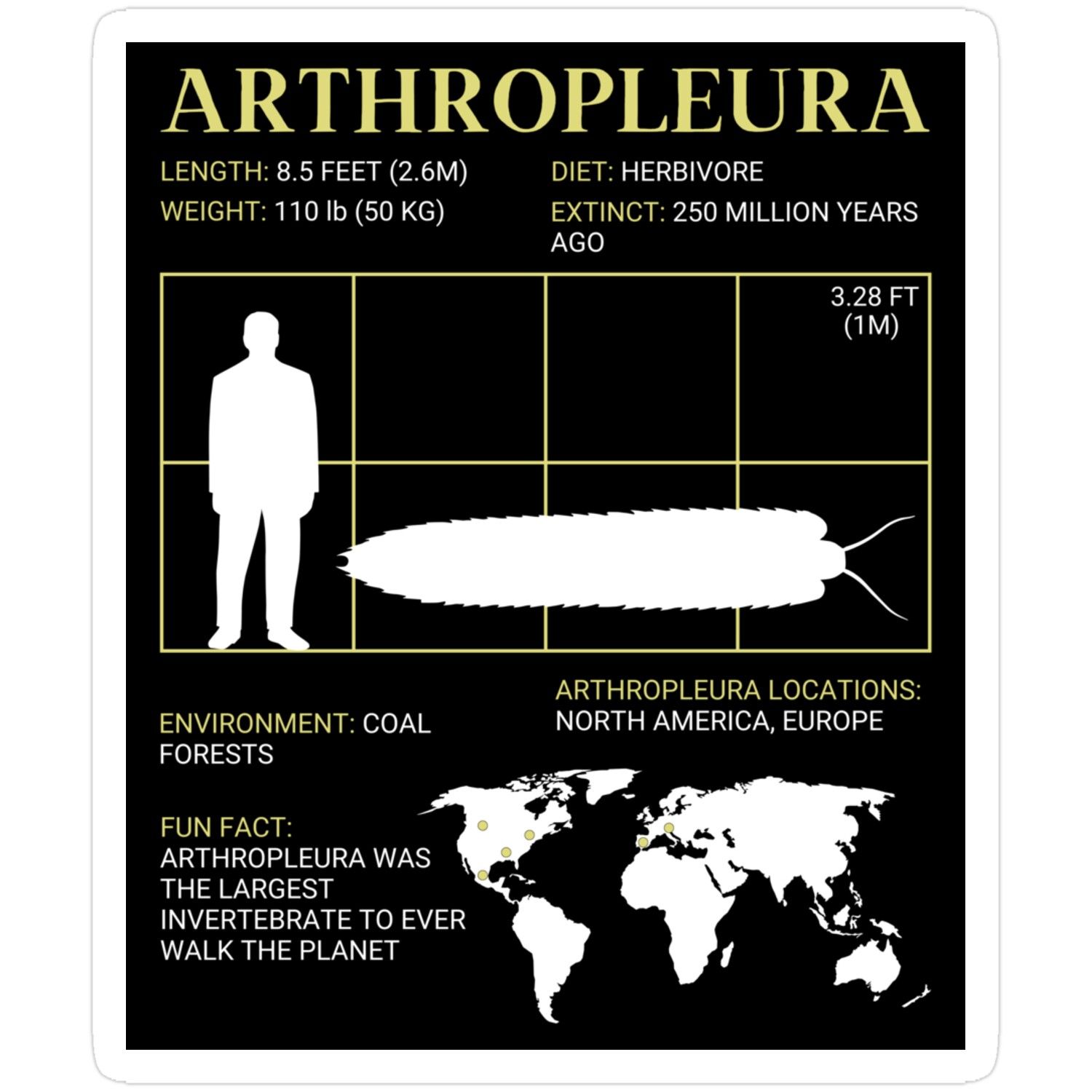
Arthropleura is the largest land invertebrate that has ever existed. It was a millipede-like arthropod of the Late Carboniferous and early Permian coal swamps, growing to body lengths between two and almost three metres and widths of roughly half a metre. An adult Arthropleura walking across the forest floor would have been longer than a small car, wider than a bicycle, and carried on roughly 60 pairs of legs. No terrestrial invertebrate before or since has matched it.
Despite its appearance, Arthropleura was almost certainly not the monster predator that popular images sometimes suggest. The surviving evidence, including gut contents and coprolites, points to a herbivore or detritivore feeding on the abundant plant litter of the Carboniferous coal forests.
Its story is tightly bound to the unusual atmospheric chemistry of that world - oxygen levels of around 30 to 35 per cent, far above today's 21 per cent - and to the vast equatorial wetlands whose buried remains became the coal seams that powered the Industrial Revolution.
This entry is a full reference page on the genus Arthropleura, its type species Arthropleura armata, its anatomy and lifestyle, the oxygen-gigantism hypothesis that best explains its size, the discoveries that document it - including the headline 2.63-metre specimen described from Howick in 2021 - and its slow extinction in the early Permian.
Name, Etymology, and Classification
The genus Arthropleura was established in 1854 by the German palaeontologists Hermann Jordan and Hermann von Meyer, working on fossil material from the Carboniferous coal basins of the Saarland region. The name is assembled from the Greek roots arthron, meaning "joint", and pleuron, meaning "side" or "rib", and refers to the conspicuous lateral plates that flank each body segment.
To a nineteenth-century palaeontologist picking through German coal shale, those jointed side-plates were the most obvious feature of the preserved fossils, and the name stuck.
The type species Arthropleura armata was described on the same material. Several other species have been proposed over the subsequent 170 years - A. mammata, A. armata, A. fayoli, A. pustulata, among others - with ongoing debate about how many are genuinely distinct and how many reflect differences in preservation or ontogenetic stage. For the purposes of a species-level discussion the type species A. armata is the best-understood.
The placement of Arthropleura inside the myriapod tree has been revised several times. The current consensus is as follows.
| Rank | Taxon |
|---|---|
| Kingdom | Animalia |
| Phylum | Arthropoda |
| Subphylum | Myriapoda |
| Class | Arthropleuridea |
| Order | Arthropleurida |
| Family | Arthropleuridae |
| Genus | Arthropleura |
| Type species | Arthropleura armata Jordan and Meyer, 1854 |
The class Arthropleuridea is extinct. It sits inside the subphylum Myriapoda, which also contains the living classes Diplopoda (millipedes), Chilopoda (centipedes), Symphyla, and Pauropoda. Within that tree Arthropleura's closest living relatives are millipedes (Diplopoda).
Two key features point the same way: the body is built from dorsal plates each of which carries two pairs of legs, and the mouthparts are not the venom-loaded fangs of a centipede but the humbler chewing mouthparts of a detritivore. Calling Arthropleura a "giant millipede" is therefore a reasonable shorthand, even though it is not a member of Diplopoda proper.
Size and Physical Description
Arthropleura is the largest known land invertebrate in the fossil record. No other terrestrial arthropod, mollusc, worm, or other invertebrate ever reached comparable dimensions. The only group that approaches it is found in the sea, where eurypterids (sea scorpions) and some early Palaeozoic nautiloids reached comparable or greater sizes with the buoyancy support of water.
Measurements, A. armata:
- Body length: roughly 2.0-2.7 metres
- Body width: up to approximately 50 centimetres
- Estimated body mass: on the order of 50 kilograms for the largest adults
- Number of dorsal plates (tergites): approximately 30
- Legs per segment: two pairs (diplopodous condition, inherited from the millipede lineage)
- Total leg pairs: approximately 60 in a fully grown adult
- Walking height: comparable to a modern dachshund at the shoulder
The body plan is a long, flattened, multi-segmented tube. Each segment is built from a central tergite (dorsal plate) flanked by paired paranotal lobes - those "jointed sides" that gave the genus its name. The ventral surface carries the legs, arranged as two pairs per segment. The head is relatively small compared with the body and bears a pair of antennae and simple chewing mouthparts. There is no evidence of the elongated, venom-injecting fangs that characterise predatory centipedes.
Arthropleura's exoskeleton was lighter than the sheer size suggests. Because diffusion-limited tracheal breathing sets strict volume constraints, large arthropods cannot afford dense, heavy cuticle. The known body-fossil evidence - especially the Howick specimen - suggests an exoskeleton that was structurally robust but partly unmineralised, more like a modern cockroach scaled up than like an armoured crab.
The paranotal lobes and tergite margins were reinforced; the inter-segmental regions remained flexible to allow the body to bend while walking.
One consistently misunderstood feature: Arthropleura was built for walking, not for striking. Its legs were short in proportion to body length, and its gait would have been the slow undulating wave characteristic of modern millipedes. A 2.7-metre Arthropleura did not chase prey. It trundled.
Habitat and Palaeoecology
Arthropleura inhabited the vast equatorial coal swamps of the Late Carboniferous, extending into the drier lowlands of the early Permian. These were warm, humid, low-lying forests dominated by giant lycopsid trees - plants unrelated to any modern tree but reaching heights of 30 to 40 metres - together with tree ferns, seed ferns, sphenophytes (horsetails), and early conifers at the drier margins.
Standing and slow-moving water covered much of the landscape. The forest floor was a continuous mat of decomposing plant litter tens of centimetres thick in places, underlain by saturated peat.
This was an unusually productive ecosystem by modern standards. Net primary productivity in the Carboniferous coal swamps was high, and because the microbial decomposition of lignin was still inefficient - white-rot fungi capable of breaking lignin down rapidly had not yet evolved - plant debris accumulated on the forest floor rather than being recycled into CO2.
The result was two things simultaneously: a gigantic pulse of long-term carbon burial (the coal seams) and a continuous food supply for any animal capable of shredding and digesting plant detritus. Arthropleura slotted neatly into that second role.
The fauna sharing this habitat with Arthropleura included:
- Meganeura and other giant griffinflies patrolling the air, with wingspans up to 71 centimetres
- Early amphibians - temnospondyls and lepospondyls - filling niches of modern salamanders and crocodilians
- Early reptiles and reptile-ancestors, still mostly small and terrestrial
- Other large insects: cockroach ancestors, giant mayfly relatives, crickets, and silverfish relatives
- Freshwater sharks, lobe-finned fish, and smaller arthropods throughout the water column
For a two-metre-plus detritivore, this ecosystem offered three key things: almost unlimited plant-litter food on the forest floor, humid air that reduced the water-loss problems most large arthropods face in drier climates, and a scarcity of predators large enough to kill an adult Arthropleura reliably.
The largest terrestrial carnivores of the late Carboniferous were at most dog-sized amphibians and early reptiles, and tackling a 50-kilogram millipede protected by reinforced tergites would have been an expensive undertaking for any of them.
Diet: The Predator Question and the Evidence
Popular reconstructions of Arthropleura have historically cast it as a terrifying hunter, often pictured snapping at small tetrapods in the Carboniferous undergrowth. The current evidence does not support that image.
The case against predation rests on several independent lines of evidence:
- Gut contents. Several arthropleurid specimens preserve stomach contents, and where identifiable material has been recovered it consists of plant tissue - lycopsid fragments, fern pinnules, and palaeobotanical debris - rather than animal remains.
- Coprolites. Fossilised droppings from the same Carboniferous deposits, some attributed to arthropleurids on the basis of size and associated body fossils, contain spores and plant cell walls. No vertebrate bone or insect cuticle has been reported from these coprolites.
- Mouthparts. The head of Arthropleura is small, and its mouthparts lack the elongated, venom-injecting forcipules of predatory centipedes. The jaws resemble enlarged versions of the chewing mouthparts used by modern detritivorous millipedes.
- Modern analogue. The closest living relatives - Diplopoda - are almost entirely detritivorous. The exceptions (a handful of carnivorous polyxenid millipedes) are small and specialised. Extrapolating the group's default lifestyle to Arthropleura gives a herbivore-detritivore by default.
- Locomotion. A two-metre millipede walking with the slow undulating gait of its modern relatives is poorly suited to prey pursuit. Its ecological niche is far more consistent with a bulk detritus shredder than with an active hunter.
That does not mean Arthropleura never ate meat. Modern detritivores are frequently facultative: a millipede that encounters a dead insect or amphibian on the forest floor will usually consume it. Arthropleura was almost certainly capable of opportunistic scavenging of small carcasses, and perhaps of eating soft-bodied invertebrates it encountered while shredding litter.
The distinction that matters is between "occasional opportunistic scavenger" and "active predator". The evidence supports the first and not the second.
How a 2.6-Metre Arthropod Breathed: The Oxygen Hypothesis
The single most important question about Arthropleura is why it could be this large. Modern terrestrial arthropods rarely exceed 30 centimetres in any dimension, and the few that approach it - coconut crabs, giant stick insects, the largest millipedes and scorpions - are nowhere near the Arthropleura scale. Understanding why requires understanding how arthropods breathe.
Terrestrial arthropods do not have lungs. They have tracheae - a branching network of air-filled tubes that opens to the outside at small pores called spiracles along the sides of the body. Oxygen diffuses passively through the tracheal network to reach the tissues. Carbon dioxide diffuses out the same way. Larger arthropods can assist the process with body-wall pumping, but the underlying mechanism is diffusion-limited.
This system scales poorly. Diffusion over longer distances takes disproportionately longer, so making an arthropod twice as big requires more than twice the tracheal capacity. Beyond a certain size the tracheae occupy so much internal volume that little room is left for muscle and organs. Modern atmospheric oxygen at 21 per cent sets that ceiling around the largest living beetles, millipedes, and dragonflies.
Carboniferous atmospheric oxygen was substantially higher. Reconstructions from geochemical and palaeobotanical data place Late Carboniferous O2 at roughly 30 to 35 per cent, the highest in Earth's history. With richer air, each unit volume of tracheal tube delivered more oxygen, and the diffusion-length problem relaxed. The same body plan that tops out around 40 centimetres in today's air could reach more than two metres in Carboniferous air.
Evidence supporting oxygen-driven gigantism in arthropods:
| Line of evidence | What it shows |
|---|---|
| Geochemical O2 reconstructions | Atmospheric oxygen peaks in the Late Carboniferous, drops sharply in the Permian |
| Fossil arthropod size trends | Maximum arthropod size tracks atmospheric O2 through the Permian and into later eras |
| Modern hyperoxic rearing experiments | Dragonflies and cockroaches reared in 31% O2 grow measurably larger than controls |
| Tracheal scaling studies | Larger modern arthropods devote a greater fraction of body volume to tracheae |
Complementary factors probably mattered too. The Carboniferous coal swamps offered effectively unlimited plant-detritus food, which lowered the metabolic cost of size. The humid climate reduced evaporative water loss, which is a serious constraint for large-surface-area arthropods on land.
And the scarcity of large vertebrate predators allowed slow, ground-dwelling giants to persist without being preyed on into smaller body plans. When all three conditions reversed in the Permian - falling O2, drying swamps, rising vertebrate predators - the entire niche for giant land arthropods collapsed, and Arthropleura went with it.
Movement, Trackways, and Behaviour
Surprisingly, the richest evidence for how Arthropleura moved comes not from its body fossils - which are rare - but from the trackways it left behind.
These trackways are classified under the ichnogenus Diplichnites cuithensis. They are series of parallel rows of small footprints, tens of centimetres wide in total, preserved in Carboniferous sandstones across Europe and North America.
The width of the trackway matches the body width expected for a walking Arthropleura; the spacing and number of prints per segment matches a diplopodous body plan; the total length of some trackways preserves evidence of several metres of continuous locomotion at a stretch. Diplichnites trackways are, in effect, fossil footprints of Arthropleura going about its life.
What the trackways show:
- Gait: a slow, rhythmic wave of leg movements along each side of the body, characteristic of modern millipedes.
- Substrate: wet to damp sandy sediment, consistent with crawling across the margins of swamp water bodies and temporarily exposed sandbars.
- Speed: slow. Reconstructed stride frequencies suggest a walking speed comparable to that of a modern very large millipede, on the order of metres per minute rather than metres per second.
- Orientation: individual trackways are usually straight or gently curved, with few sharp turns. Arthropleura was not zigzagging after prey.
A particularly revealing category of trackway comes from Joggins in Nova Scotia, where Diplichnites trails run up to and in some cases into the hollow interiors of upright, fossilised lycopsid tree trunks. Those trunks served as natural pitfall traps for Carboniferous animals when the trees were preserved upright during rapid burial events.
Arthropleura body fossils have been recovered from inside some of these trunks, showing directly that the animals inhabited the same forests that became the Joggins coal.
Discovery and Fossil Record
Arthropleura body fossils are among the rarest Palaeozoic arthropod fossils known. Trackways attributed to the genus are far more common than actual body remains, and even modest fragments of exoskeleton attract substantial palaeontological attention.
The type material was described from Carboniferous deposits in Germany in 1854. Additional nineteenth- and twentieth-century material from the French Massif Central, the British coal measures, Scotland, and the Czech Republic established Arthropleura as a widespread but elusive element of the European Carboniferous.
In North America, the Joggins Fossil Cliffs in Nova Scotia have yielded both trackways and body fossils, and material has been recovered from the Appalachian coal basin of the eastern United States.
The headline discovery of the modern era was the Howick specimen.
The 2021 Howick, Northumberland specimen:
- In 2018, a large sandstone block fell from the sea cliff at Howick on the north-east coast of England.
- When the fallen block split open on the beach, it exposed a section of fossilised Arthropleura exoskeleton roughly 76 centimetres long and 36 centimetres wide on the fracture surface.
- The specimen was collected by researchers from the University of Cambridge and colleagues, and formally described by Davies and colleagues in 2021 in the Journal of the Geological Society.
- Extrapolation from the preserved fragment to a whole animal yields an estimated total body length of approximately 2.63 metres, with an estimated mass on the order of 50 kilograms.
The Howick specimen is the largest Arthropleura body fossil ever found, and one of only three articulated body fossils currently known. Its description in 2021 effectively rewrote the upper limit on Arthropleura size and confirmed, with direct physical evidence, that the multi-metre reconstructions long implied by Diplichnites trackways were real animals. The specimen also preserved enough morphological detail to constrain reconstructions of the tergite pattern and body proportions.
Because body fossils are so rare, most Arthropleura research still relies on indirect evidence - trackways, coprolites, isolated tergite plates, and comparative anatomy of living millipedes. Each new articulated specimen is a significant event.
Life Cycle and Development
Very little is known with confidence about the life cycle of Arthropleura. Modern millipedes develop through a series of moult stages, adding body segments and legs with each moult, a process called anamorphosis. Individuals begin life as small, few-segmented juveniles and gradually reach adult segment counts over months to years. Arthropleura almost certainly followed the same pattern in broad terms, growing segment by segment through repeated moults.
Reaching 2.6 metres at adult size would have required many years of growth and many moults. Each moult would have been a dangerous event: the freshly shed exoskeleton leaves the animal soft, vulnerable to desiccation, and unable to move effectively until the new cuticle hardens.
Giant arthropods in any environment moult slowly, and large Arthropleura individuals would have been exposed for hours to days during each event. How they survived that window without predation is an open question; likely answers include sheltering in hollow logs or burrows, or selecting moulting sites deep in forest-floor litter where detection was unlikely.
Reproduction is effectively undocumented in Arthropleura itself. By analogy with modern millipedes, eggs were probably laid in damp substrate, with juveniles hatching as small, few-segmented larvae and progressing through anamorphic moults toward adulthood. No fossil eggs or juveniles have been securely attributed to the genus.
Extinction and Legacy
Arthropleura disappears from the fossil record in the early Permian, roughly 290 million years ago. The decline was gradual rather than catastrophic. Several environmental changes unfolded in parallel:
- Atmospheric oxygen dropped from its Carboniferous peak through the Permian, tightening the tracheal-diffusion constraint on arthropod body size.
- The coal swamps dried out as climatic belts shifted with the assembly of Pangaea and the drying of Laurussia's equatorial wetlands. The primary habitat of giant detritivores shrank and fragmented.
- White-rot fungi evolved and spread, breaking down lignin efficiently for the first time. The forest-floor litter layer that had fed giant detritivores was now recycled rapidly by microbes rather than piling up.
- Terrestrial vertebrate predators diversified. Larger early reptiles and synapsids appeared, capable of attacking slow, ground-dwelling giants more effectively than Carboniferous amphibians had been.
Any one of these changes would have stressed Arthropleura. The combination squeezed its ecological niche from several directions at once. By the early Permian, the last arthropleurids vanish from the record.
One timing point is worth emphasising because it is routinely confused in popular writing. Arthropleura went extinct before the dinosaurs evolved. The earliest dinosaurs appear in the Middle Triassic, about 230 million years ago - roughly 60 million years after the last Arthropleura. No dinosaur ever met one. The image of a giant millipede crawling through a forest of sauropods is scientifically impossible.
Arthropod body size never returned to Carboniferous extremes. Post-Permian atmospheric oxygen stabilised at lower levels. Modern land-arthropod giants - coconut crabs, goliath beetles, African giant millipedes - are a tenth or less of Arthropleura's length. The ceiling is the product of both atmospheric physics and ecological competition, and it appears to be hard.
Arthropleura in Public Culture
Arthropleura has become a popular-culture shorthand for "Carboniferous giant arthropod", alongside Meganeura. It appears in illustrated children's books, natural history documentaries, and museum reconstructions, usually shown crawling across a forest floor under towering lycopsid trees.
Several of the most common public-facing claims about Arthropleura are incorrect or oversimplified:
- "Giant centipede" - no. Centipedes are Chilopoda. Arthropleura is closer to millipedes (Diplopoda) and is placed in its own class, Arthropleuridea.
- "Apex predator of the Carboniferous" - no. The gut and coprolite evidence points to a herbivore-detritivore. Carboniferous apex predators were large amphibians and early reptiles.
- "Ancestor of modern millipedes" - no. It is a relative in an extinct class, not a direct ancestor of living Diplopoda.
- "Lived with dinosaurs" - no. Extinct roughly 60 million years before the first dinosaur.
- "Needed oxygen-rich air" - correct, with the caveat that coal-swamp habitat and scarce large predators also mattered.
Accurate public communication matters because Arthropleura is one of the clearest examples of how atmospheric chemistry, ecological opportunity, and body-plan physics combine to set limits on size. A 2.6-metre land invertebrate is not a fantasy animal. It existed, it walked across forest floors in what is now northern England and Nova Scotia, and we have the trackways and fossils to prove it.
The reason nothing comparable exists today is not an accident of history but a direct consequence of modern atmospheric oxygen, modern climate, modern forest ecosystems, and modern vertebrate predators.
Related Reading
- Meganeura: The 71-Centimetre Carboniferous Griffinfly
- Meganeuropsis: The Largest Flying Insect Ever
- Prehistoric Insects: When Bugs Ruled the World
- Oxygen and Gigantism in the Palaeozoic
References
Primary and synthetic sources consulted for this entry include Jordan and Meyer's original 1854 description of Arthropleura armata, subsequent revisions of the genus in the twentieth-century German and French palaeontological literature, Davies and colleagues' 2021 description of the 2.63-metre Howick specimen in the Journal of the Geological Society, the monographs on the Joggins Fossil Cliffs in Nova Scotia by Calder and colleagues, reconstructions of Carboniferous atmospheric oxygen by Berner and Beerling, reviews of tracheal scaling and insect gigantism by Dudley and by Harrison and colleagues in the Journal of Experimental Biology and Annual Review of Entomology, and analyses of Diplichnites cuithensis trackways by Briggs, Plint, and others.
Size and mass estimates for the largest specimens follow the figures reported in Davies and colleagues (2021).
Frequently Asked Questions
How big was Arthropleura?
Adult Arthropleura armata reached a body length of roughly 2.0 to 2.7 metres and a width of up to 50 centimetres, making it the largest land invertebrate in the entire fossil record. For comparison, the largest living millipede, Archispirostreptus gigas of East Africa, grows to about 38 centimetres - roughly one-seventh the length of a large Arthropleura.
The animal’s mass is harder to pin down from flattened fossils, but reconstructions based on the 2.63-metre Howick specimen place an adult at somewhere in the range of 50 kilograms. It was wider than a bicycle, longer than a small car, and carried on roughly 60 pairs of legs. Nothing on land today comes close.
When did Arthropleura live?
Arthropleura lived from the late Carboniferous into the early Permian, roughly 323 to 290 million years ago. That span covers the final 25 million years of the great coal-forming swamp forests of Laurussia and the first 10 million years of the drier, cooler Permian world that replaced them.
The genus pre-dates the first dinosaurs by about 70 million years - dinosaurs do not appear until the Middle Triassic, roughly 230 million years ago - so Arthropleura and dinosaurs never coexisted. It overlapped instead with giant griffinflies like Meganeura, early amphibians, and the first true reptiles.
Was Arthropleura a predator?
No. Despite the intimidating appearance, the best available evidence points to a herbivorous or detritivorous diet. Gut contents preserved in some arthropleurid fossils, together with coprolites (fossilised droppings) from the same deposits, contain fragments of lycopsid plant tissue, fern pinnules, and spores. There is no evidence of animal remains in Arthropleura gut traces.
The mouthparts are also less specialised for slicing prey than the powerful, venom-delivering jaws of predatory centipedes. Modern millipedes, Arthropleura’s closest living relatives, are almost exclusively detritivores that shred decaying plant matter, and Arthropleura likely filled the same ecological role at vastly larger scale - as a giant composter of the coal-swamp forest floor.
Why was Arthropleura so large?
The dominant hypothesis is atmospheric oxygen. During the late Carboniferous, oxygen is reconstructed at 30 to 35 per cent of the atmosphere, far above today’s 21 per cent. Arthropods breathe through tracheal tubes rather than lungs, and tracheal diffusion scales poorly with body size. A modern 21-per-cent atmosphere imposes a hard upper limit on terrestrial arthropod dimensions; a 30-plus-per-cent atmosphere relaxes it.
Three secondary factors probably mattered too: the vast coal swamps provided effectively unlimited plant detritus as food, there were no large terrestrial vertebrate predators capable of routinely killing an adult Arthropleura, and the humid climate reduced the surface-area-to-volume water-loss problems that constrain most arthropods. When oxygen fell and the swamps dried through the Permian, all three advantages disappeared together.
What did the 2021 Howick discovery add?
In 2018 a large sandstone block fell from a sea cliff at Howick on the Northumberland coast of northern England. When it split open, it revealed a 76-centimetre-long section of Arthropleura exoskeleton, which extrapolates to a whole animal approximately 2.63 metres in length.
Neil Davies and colleagues at the University of Cambridge formally described the specimen in 2021 in the Journal of the Geological Society, making it one of only three body fossils of Arthropleura ever found, and the largest on record. The discovery confirmed that Arthropleura reached genuinely multi-metre sizes, refined the reconstruction of body segment proportions, and extended the known palaeogeographic range of the genus.
It also underscored how rare body fossils of this animal really are: most Arthropleura evidence comes from trackways and isolated plates, not articulated remains.
Where have Arthropleura fossils been found?
Arthropleura fossils are concentrated in the coal-bearing rocks of the Carboniferous equatorial supercontinent Laurussia, which today corresponds to the British Isles, Germany, France, Atlantic Canada, and the Appalachian basin of the eastern United States. The type species Arthropleura armata was described by Jordan and Meyer in 1854 from German material. The Joggins Fossil Cliffs in Nova Scotia preserve both body fossils and extensive trackways.
The Northumberland coast, Scottish coalfields, French Massif Central, and sites in the Czech Republic have all produced important material. Trackways (ichnogenus Diplichnites cuithensis) extend the known range further than body fossils alone would suggest, and give an independent line of evidence for how widely distributed these giants were across the Carboniferous coal forests.
What killed off Arthropleura?
Arthropleura declined through the early Permian and disappeared from the fossil record around 290 million years ago. No single catastrophe ended the genus.
The most likely driver is the combined environmental change at the end of the Carboniferous and into the early Permian: atmospheric oxygen dropped from its Carboniferous peak, the great equatorial coal swamps dried out as climatic belts shifted, and the warm humid lowlands that had supported giant detritivores were replaced by drier, more seasonal landscapes.
Lower oxygen directly constrained body size via tracheal breathing; habitat loss removed the unlimited plant-litter food base; and the rise of larger terrestrial vertebrate predators - early reptiles and synapsids - added predation pressure that a slow, ground-dwelling giant could not easily escape. The extinction was quiet and incremental rather than sudden.
Are modern millipedes descendants of Arthropleura?
No. Arthropleura is a relative of modern millipedes, not an ancestor. It belongs to its own class, Arthropleuridea, which sits inside the subphylum Myriapoda alongside true millipedes (Diplopoda), centipedes (Chilopoda), and two smaller classes. Arthropleuridea has no living members; the lineage ended in the early Permian.
Living millipedes descend from a separate branch of the myriapod tree that also existed during the Carboniferous and survived the environmental changes Arthropleura did not. The similarity in body plan - many segments, two leg pairs per segment, plant-based diet - reflects shared ancestry within Myriapoda rather than direct descent. Think of Arthropleura as a long-dead cousin of today’s pill millipedes, not their great-grandparent.