
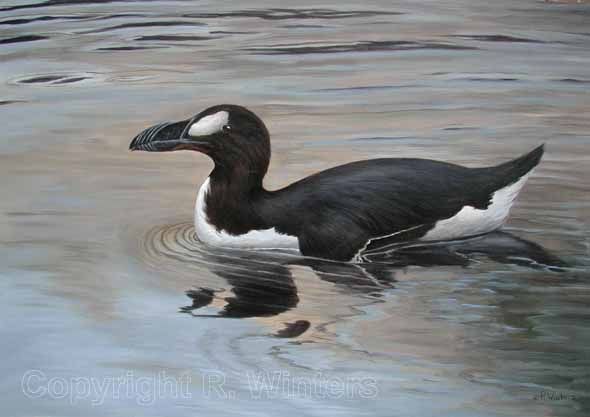
The great auk was the original penguin. Long before European sailors reached the Southern Hemisphere and encountered the unrelated black-and-white birds that today monopolise the name, the word pinguinus belonged to this large flightless seabird of the North Atlantic. It bred in the millions on rocky islands from Newfoundland to Iceland to the west coasts of Scotland and Ireland.
It swam upright, dived to 75 metres, and fed almost entirely on fish. It looked so much like a modern penguin that when Europeans met the southern birds centuries later, they simply reused the familiar word. Then, between the 16th and 19th centuries, commercial hunters ground the species out of existence. On 3 July 1844 three Icelandic fishermen strangled the last confirmed breeding pair on Eldey Island. One of them stepped on the egg.
This guide covers every aspect of great auk biology, ecology, and extinction as current research reconstructs it: size and anatomy, habitat, diet, breeding behaviour, the long commercial exploitation, the precise extinction timeline, the 80 skins and 75 eggs that remain, the relationship between the species and modern penguins, and the conservation lessons drawn from its disappearance.
It is a reference entry, not a summary, so expect specifics: dates, masses, specimen counts, and named individuals.
Etymology and the Original Penguin
The name "great auk" is the modern English rendering of a much older family of terms. Welsh pen gwyn - "white head" - is one commonly cited root, referring to the large white patches of bare skin between the eye and the bill that the species carries during the breeding season. Breton, Cornish, and early English seafaring records use related forms. The name crossed into scientific Latin as Pinguinus in the 18th century and survives today as the genus name.
When Portuguese, Spanish, Dutch, and English sailors rounded the southern tips of Africa and South America in the 15th and 16th centuries, they met tall, upright, flightless, black-and-white birds that stood in colonies on rocky shores and dived for fish. The sailors simply reused the familiar word. "Penguin" migrated to the Southern Hemisphere and stuck. When the northern bird went extinct in 1844, the name stayed with the southern birds that had borrowed it.
The species name impennis means "without flight feathers" or "without wings capable of flight" in Latin. Taken together, Pinguinus impennis translates roughly as "flightless white-head". The binomial was fixed by Linnaeus in 1758 and has never been seriously challenged.
In Norse and Icelandic sources the bird is called geirfugl - "spear-bird" - a reference either to the sharp bill or to the slender shape of the body. The name survives in Icelandic geography: Geirfuglasker, the "spear-bird skerry", was one of the two last major breeding islands before it was destroyed by a volcanic eruption in 1830.
Taxonomic Position and Evolution
Great auks belong to the auk family Alcidae, within the order Charadriiformes - the same taxonomic group that contains gulls, terns, plovers, and sandpipers. They are not closely related to modern penguins, which belong to the entirely separate order Sphenisciformes in the Southern Hemisphere.
The resemblance between the two groups is a textbook case of convergent evolution: two unrelated lineages independently evolved upright posture, flipper-like wings, dense waterproof plumage, and underwater pursuit-diving as adaptations to cold-water marine foraging.
Within Alcidae, DNA analysis recovered from preserved museum specimens places the great auk in its own genus, Pinguinus, sister to the genus Alca. The closest living relative is the razorbill (Alca torda), a flying seabird still common across the North Atlantic.
Razorbills share the great auk's plumage pattern, the grooved hooked bill, the colonial breeding ecology, and the underwater pursuit feeding - everything but the size and the flight. Common murres (Uria aalge) and thick-billed murres (Uria lomvia) are the next closest living relatives.
Estimates based on molecular clock analysis place the divergence between Pinguinus and Alca roughly two to four million years ago. During that window, the great auk lineage lost flight, scaled up in body mass, and specialised in deep-water fish pursuit. The fossil record is thin but extends into the Pleistocene, with bones recovered from kitchen middens, cliffs, and cave sites across the North Atlantic rim.
Size and Physical Description
The great auk was the largest member of the auk family and the only flightless one. Its body plan was a scaled-up razorbill optimised for underwater swimming rather than flight.
Adult measurements:
- Height: 75-85 centimetres standing upright
- Body length: around 80 centimetres nose to tail tip
- Weight: approximately 5 kilograms in breeding condition
- Wingspan: around 40 centimetres - wings reduced to flippers
- Bill: large, heavy, hooked, with deep vertical grooves
Plumage and colouration:
- Upperparts: glossy blue-black in breeding adults
- Underparts: pure white from throat to vent
- Face: large white oval patch in front of the eye during breeding season
- Winter: white extends up the throat and neck
- Legs and feet: black, webbed, positioned far back on the body
The wings were proportionally smaller than those of any other auk. The forearm and hand bones were shortened, the flight muscles were reduced, and the keeled breastbone was much less developed than in flying auks. These features made flight impossible but created a highly efficient underwater flipper, comparable in function to the wings of a modern penguin. The legs were set far back on the body, forcing the characteristic upright stance on land.
The bill was one of the bird's most distinctive features. Large, laterally compressed, and deeply grooved with up to eight visible ridges, it was a fish-catching tool. The grooves probably helped grip slippery prey, much as they do in living razorbills and murres.
Habitat and Geographic Range
Great auks lived in a ring around the North Atlantic, breeding on low rocky islands and spending the non-breeding season at sea. At peak historical population the species occupied a vast range spanning both coasts of the ocean.
Confirmed breeding sites:
- Funk Island, off Newfoundland
- Bird Rocks and Grand Banks islets
- Geirfuglasker and Eldey, off Iceland
- Fuglasker off the Faroe Islands
- St Kilda and other Scottish islands
- Outer islets off Ireland
Wintering range:
- Open North Atlantic
- Banks of Newfoundland
- Coasts of New England
- Bay of Biscay
- Mediterranean in occasional winters
Subfossil bones have been recovered as far south as Florida, Italy, and southern Spain, indicating that winter dispersal reached well below the core breeding range. Kitchen midden finds along the coasts of Scandinavia, the British Isles, Iceland, and eastern North America show that great auks were hunted by coastal peoples for thousands of years before the commercial exploitation that finally caused extinction.
Breeding colonies required specific conditions: low, accessible rocky islands or skerries that were free of ice in summer, rich feeding waters nearby, and - critically - no land predators. The combination was rare, which is why only a handful of sites supported most of the global population. Isolation from foxes, bears, and humans was non-negotiable for a flightless ground-nesting seabird.
Diet and Diving Behaviour
Great auks were pursuit-diving piscivores. They fed primarily on fish, caught by swimming down onto schools and seizing individual prey with the grooved bill.
Primary prey:
- Atlantic herring (Clupea harengus)
- Capelin (Mallotus villosus)
- Sand eel (Ammodytes species)
- Atlantic menhaden in the western range
- Other schooling pelagic fish
Secondary prey:
- Crustaceans (amphipods, small shrimp)
- Small squid
- Marine invertebrates taken opportunistically
Dive performance was impressive. Analysis of skeletal proportions and comparison with living alcids suggests great auks could dive to at least 75 metres and remain underwater for more than a minute per dive. They swam using the wings as flippers, with the feet serving as rudders. On land they were slow and awkward; in water they were fast, agile, and highly efficient.
The species probably fed in social groups and may have cooperated to herd fish schools, behaviour seen in several living auk species. Isotope analysis of preserved tissue suggests a high-trophic-level marine diet dominated by pelagic fish, consistent with sailors' descriptions of the birds following fishing vessels and swimming beneath ship hulls.
Breeding Biology and Colonies
Great auk reproductive biology combined extreme colony density with an extremely slow per-pair reproductive rate. Both features mattered for extinction dynamics.
Reproductive traits:
- Clutch size: one egg per pair per breeding attempt
- Nest: no nest - egg laid directly on bare rock
- Incubation: shared by both parents, roughly 6 weeks
- Fledging: chick at sea within 2-3 weeks after hatching
- Sexual maturity: probably 4-7 years
- Breeding frequency: one attempt per year
The egg itself was a remarkable object. Pyriform in shape (tapered like a pear), around 12-13 centimetres long, and heavily marked with black and brown streaks on a creamy or greenish background. Every egg carried a distinct individual pattern, which may have helped adults recognise their own egg in dense colonies. The tapered shape caused the egg to roll in a tight circle rather than straight off a cliff ledge - a feature shared with cliff-nesting murres.
Colonies were vast and tightly packed. Funk Island, the largest known colony, may have held hundreds of thousands of breeding pairs at peak. Breeding adults stood shoulder to shoulder across flat rocky platforms. The single-egg clutch, combined with the long time to sexual maturity and the ground-nesting habit, meant that any sustained adult mortality wiped out breeding output faster than the population could replace itself.
Historical Populations and the Long Exploitation
At first European contact the great auk was one of the most abundant seabirds of the North Atlantic. Historical accounts from the 16th century describe breeding colonies so dense that ship crews could drive birds up gangplanks in their hundreds.
Estimated historical populations:
| Era | Population estimate |
|---|---|
| Pleistocene peak | Many millions (inferred) |
| Medieval period | Several million |
| ~1500 | 1-3 million adults |
| ~1700 | Several hundred thousand |
| ~1800 | Few thousand |
| 1830 | Low hundreds |
| 1844 | 0 (last confirmed pair killed) |
The earliest exploitation was local and subsistence-based. Coastal peoples from Scandinavia, Iceland, the British Isles, and eastern North America harvested great auks alongside other seabirds for meat, eggs, and oil over thousands of years. Subfossil deposits at ancient kitchen middens show sustained low-level take without driving extinction.
The commercial phase began in earnest in the 16th century. European and Basque cod fishermen working the Grand Banks used Funk Island as a provisioning stop and killed birds by the tens of thousands for fresh and salted meat on long voyages. Jacques Cartier's 1534 voyage records crews loading their ship holds with great auks in less than half an hour of hunting.
Over the following two centuries the trade expanded to feathers (for mattresses, pillows, and hats), down, oil (rendered from body fat), and bait for commercial cod fishing.
The Funk Island colony was particularly brutal. Crews built stone corrals into which birds were herded, then boiled them alive in giant cauldrons heated with the rendered fat of earlier birds as fuel. By the late 1700s Funk Island - once home to several hundred thousand great auks - held none. A similar pattern played out on every accessible colony. By 1800 only a handful of breeding sites remained, and each was being targeted by boats that knew where the last birds were.
Extinction Timeline
The great auk's extinction is the best-documented vertebrate extinction in European history. Ship logs, natural history journals, letters, and even court records fix the chronology in unusual detail.
Key dates:
| Year | Event |
|---|---|
| pre-1500 | Population intact across the North Atlantic |
| 1534 | Jacques Cartier's crews provision from Funk Island |
| 1550-1750 | Commercial harvesting at industrial scale; Funk Island devastated |
| ~1785 | Last breeding confirmed on Funk Island |
| 1800 | British and Irish colonies gone; Icelandic colonies reduced to remnants |
| 1813 | Last confirmed breeding on St Kilda, Scotland |
| 1830 | Volcanic eruption destroys Geirfuglasker off Iceland |
| 1830s-1844 | Eldey Island becomes the final active breeding site |
| 3 Jul 1844 | Last confirmed pair killed on Eldey Island by Icelandic fishermen |
| 1852 | Last unverified sighting (Grand Banks of Newfoundland) |
| 1971 | Great auk DNA first extracted from museum skins |
| 2019 | Partial genome published using archival material |
The 3 July 1844 date is the accepted extinction year. Three Icelandic fishermen - Jon Brandsson, Sigurdur Isleifsson, and Ketill Ketilsson - had been hired by the local natural history collector Carl Siemsen, who had a standing order from Reykjavik merchants supplying European museums. The three men rowed to Eldey Island, spotted the pair incubating a single egg on a ledge, and strangled both birds.
The egg appeared to have a crack, so Ketilsson stepped on it. The skins were sold, the internal organs preserved in alcohol, and the egg discarded as worthless.
Several later reports of great auk sightings exist - including one from 1852 off Newfoundland - but none are independently confirmed and all lack physical evidence. The 1844 date is universally used in modern extinction literature.
Why the Great Auk Went Extinct
The extinction had one primary cause and several amplifiers. The primary cause was commercial human exploitation on a scale the species could not withstand. Great auks were slow breeders. One egg per pair per year, a multi-year time to sexual maturity, colonial breeding on accessible flat islands, and an inability to fly meant the species had no defence against industrialised harvesting.
Compounding factors mattered at the end. The 1830 volcanic eruption that destroyed Geirfuglasker concentrated the last birds onto the more accessible Eldey. As the population fell, the commercial value of each remaining bird rose, because European and American natural history museums were competing to obtain skins and eggs of a species everyone could see was vanishing.
Collectors hired fishermen specifically to hunt the last survivors. The extinction was not passive: it was actively accelerated by the rising market value of rarity.
The great auk's disappearance is the single clearest case study of what conservation biologists now call the "anthropogenic Allee effect" - the phenomenon where commercial demand for a species rises as the species becomes rare, creating a positive feedback loop that finishes off populations too small to sustain themselves.
Surviving Specimens
Approximately 80 stuffed skins and about 75 eggs survive today in museum collections and private hands. Around 24 complete or near-complete skeletons are held worldwide, plus a larger number of individual bones in comparative anatomy collections.
Major specimen holdings:
- Natural History Museum, London - multiple skins, eggs, skeletons
- American Museum of Natural History, New York
- Smithsonian National Museum of Natural History, Washington
- Icelandic Institute of Natural History, Reykjavik
- Zoological Museum, University of Copenhagen
- Royal Belgian Institute of Natural Sciences, Brussels
- Several European universities and private collections
Every single specimen is individually catalogued and tracked. A 1999 census by Errol Fuller and other researchers mapped the location and provenance of every known skin and egg, including those lost to fires, wars, and undocumented private transfers over the past century and a half.
Great auk eggs remain among the most valuable natural history objects on Earth - single eggs have sold at auction for tens of thousands of pounds or dollars since the late 19th century, with modern prices reaching 70,000-100,000 US dollars or more depending on provenance and condition.
The internal organs of the pair killed on Eldey in 1844 are preserved in alcohol at the Zoological Museum in Copenhagen. Those two specimens are the only known great auk soft tissue in existence. They have been used repeatedly as DNA sources, most recently for genome-scale sequencing efforts.
Cultural Legacy and Conservation Significance
The great auk's cultural footprint far exceeds its early popular recognition. The species gave modern penguins their name, made flightless seabirds a scientific category of interest, and became a reference symbol for human-caused extinction in ornithological literature. The American Ornithologists' Union journal The Auk takes its title directly from the extinct species. The logo of the Society for the Preservation of Birds of Prey, among others, uses a great auk silhouette.
In Iceland the bird is a national historical figure. Eldey Island is now a nature reserve, and the precise ledge where the last pair was killed is marked. The Icelandic Institute of Natural History keeps one of the original 1844 skins on permanent display. In 1971 the Icelandic state purchased a great auk specimen at auction in London for what was at the time a record price, partly as a symbolic repatriation gesture.
For conservation biology the great auk became one of the clearest reference cases. Early protective legislation for seabirds and their eggs - including the 1869 Sea Birds Preservation Act in Britain, among the world's first dedicated wildlife protection laws - was shaped directly by the recent memory of the species' disappearance.
Every subsequent programme aimed at protecting colonial seabirds operates in the great auk's shadow, treating its extinction as the standard warning of what unregulated commercial take can do.
Modern Research and De-extinction Prospects
Scientific research on the great auk continues despite the species having been extinct for almost two centuries. Modern work falls into several categories.
Genetic work. DNA has been extracted from preserved skin, bones, and the Copenhagen soft-tissue specimens. Partial genomes have been assembled and used to refine the species' evolutionary position within Alcidae. Full genome sequencing remains incomplete but is technically achievable.
Morphometric and ecological reconstruction. Detailed study of skeletons and bill morphology has refined estimates of diving depth, prey size, and foraging ecology. Isotope analysis of preserved tissue has supported dietary reconstructions.
De-extinction feasibility. The great auk is sometimes discussed as a de-extinction candidate, with the razorbill proposed as a genetic template and surrogate parent.
The same core obstacles that apply to every bird de-extinction project apply here: avian eggs cannot be cloned by classical nuclear transfer because of egg cell structure, primordial germ cell editing is still experimental, and any resulting animal would be an edited razorbill expressing great auk traits rather than a true resurrected great auk. No well-funded programme currently targets the species.
Palaeoecology. Sub-fossil bones continue to inform broader questions about North Atlantic marine ecosystem structure before industrial exploitation and about the ecological role that the great auk once played as a major mid-size pelagic fish predator.
The overall scientific picture continues to fill in. The cartoon view of the great auk as a quaint historical curiosity has been steadily replaced by a precise reconstruction of a large, highly specialised, once-abundant North Atlantic seabird that was destroyed by three centuries of industrial harvesting and finished off by museum collectors racing each other to buy the last individuals.
Related Reading
- Extinct Animals: The Species We Lost
- Recently Extinct Species: The Animals We Lost in Our Lifetime
- Dodo: The Flightless Pigeon of Mauritius
- Passenger Pigeon: From Billions to None
- Island Gigantism and Flightlessness
References
Relevant sources consulted for this entry include Fuller (1999, 2003) census of surviving specimens and eggs; Bengtson (1984) on historical exploitation in The Auk; Gaskell (2000) Who Killed the Great Auk?; Montevecchi and Kirk (1996) species account in Birds of North America; Thomas et al.
(2019) partial genome analysis in Genes; collection records from the Natural History Museum London, the American Museum of Natural History, the Zoological Museum Copenhagen, and the Icelandic Institute of Natural History; and IUCN Red List assessment confirming extinction status. Historical dates follow Grieve (1885) The Great Auk, or Garefowl and subsequent corrections in Fuller (1999).
Frequently Asked Questions
What was the great auk?
The great auk (Pinguinus impennis) was a large flightless seabird of the North Atlantic, the only flightless member of the auk family Alcidae. It stood 75-85 centimetres tall, weighed around 5 kilograms, had glossy black upperparts, white underparts, and a large hooked bill with deep grooves.
Great auks swam upright on land and dived underwater using their reduced wings as flippers, behaviours that gave them an uncanny resemblance to Southern Hemisphere penguins despite no close evolutionary relationship. They bred in dense colonies on low rocky islands across the North Atlantic and spent the rest of the year at sea. The species went extinct on 3 July 1844.
Why is the great auk called the original penguin?
The word ‘penguin’ was used for the great auk long before the modern penguins of the Southern Hemisphere were known to Europeans. Welsh, Breton, and early English seafaring records refer to the North Atlantic bird as pen gwyn, penguin, or pinguinus - variously attributed to the Welsh for ‘white head’, a Breton term, or a descriptive sailors’ name.
When European explorers reached the Southern Ocean in the late 15th and 16th centuries, they encountered unrelated flightless seabirds that looked remarkably similar and borrowed the familiar word. The great auk’s scientific genus name Pinguinus preserves this original usage. Modern penguins retained the name; the bird it was coined for went extinct.
When and how did the great auk go extinct?
The great auk went extinct on 3 July 1844 when three Icelandic fishermen - Jon Brandsson, Sigurdur Isleifsson, and Ketill Ketilsson - landed on Eldey Island off the southwest coast of Iceland and killed the last confirmed breeding pair. The birds were strangled, and the single egg they had been incubating was crushed under Ketilsson’s boot because he thought it already looked damaged.
The fishermen had been hired by a collector who was paying for great auk specimens, which had become extremely valuable as the species approached extinction. A handful of unconfirmed sightings continued into the late 1840s and even the 1850s, but 3 July 1844 is accepted as the extinction date. It is one of the very few vertebrate extinctions with a precise day, location, and named individuals responsible.
What caused the great auk's extinction?
Commercial exploitation by humans drove the extinction, compounded at the end by collectors. For more than three centuries, great auks were killed in huge numbers for their down and feathers (used in bedding and hats), their meat (preserved for ship provisions), their oil (rendered from body fat), and their use as fishing bait.
The Funk Island colony off Newfoundland, which may once have held hundreds of thousands of birds, was systematically harvested into the late 1700s using stone corrals where birds were herded and boiled for oil. Volcanic destruction of the Geirfuglasker breeding island off Iceland in 1830 pushed the last birds onto Eldey, which was more accessible to humans.
As the species became rare, natural history museums and private collectors paid rising prices for skins and eggs, directly paying fishermen to kill the final survivors.
What is the closest living relative of the great auk?
DNA evidence identifies the razorbill (Alca torda) as the great auk’s closest living relative. Razorbills are flying seabirds of the North Atlantic that share many features with great auks at smaller scale - similar plumage, similar bill shape with grooves, similar colony-breeding ecology, and similar underwater pursuit diving.
The two species diverged roughly two to four million years ago from a common flighted ancestor, after which the great auk lineage lost flight and scaled up in body mass. Other close relatives include the common murre (Uria aalge) and thick-billed murre (Uria lomvia). All of these birds belong to the auk family Alcidae within the order Charadriiformes.
Despite strong physical resemblance to Southern Hemisphere penguins, great auks are not closely related to any penguin species.
How many great auk specimens survive today?
Roughly 80 stuffed skins and about 75 eggs are known to survive in museum collections and private hands worldwide, along with around 24 complete or near-complete skeletons and a larger number of individual bones. Every skin and egg is individually catalogued, tracked across ownership changes, and treated as a uniquely valuable natural history object.
Major holdings include the Natural History Museum in London, the American Museum of Natural History in New York, the Smithsonian, the Icelandic Institute of Natural History, and several European universities. Great auk eggs have been auctioned for prices ranging from tens of thousands to over 100,000 US dollars.
Several specimens have changed hands multiple times over more than a century, and a few historical specimens are considered lost to fires, wars, or unrecorded disposal.
Could the great auk be brought back?
Full de-extinction of the great auk remains extremely difficult. Partial genome sequencing has been achieved using DNA extracted from museum skins and bones, and the razorbill provides a relatively close living relative that could in principle serve as a template for genetic editing.
A theoretical programme would sequence the complete great auk genome, identify the genetic differences from the razorbill, edit razorbill germ cells to carry great-auk-like changes, and raise modified offspring through surrogate parents.
The same core obstacles that apply to every avian de-extinction project apply here: birds cannot be cloned by nuclear transfer because of egg cell structure, primordial germ cell editing is still experimental, and any resulting bird would be an edited razorbill expressing great auk traits rather than a true resurrected great auk. No well-funded programme is currently dedicated to the species.
Why is the great auk important as a conservation symbol?
The great auk is the clearest single case study of commercial exploitation driving an abundant species to extinction within recorded history. Historical populations ran into the millions across the entire North Atlantic.
The species was slow to reproduce - one egg per pair per year, no ability to fly away from humans, colonial nesting on flat accessible islands - and could not withstand centuries of industrial-scale harvesting for down, feathers, meat, and oil. Its extinction occurred under full documentary record, in a recognisably modern Europe, at named dates and places, with surviving specimens visible today.
For conservation biology the great auk became a reference example of how human economic demand can destroy even enormous animal populations, and its story informed early protective legislation on seabirds, eggs, and colonial breeding sites. The species is now a widely used symbol of human-caused extinction.