
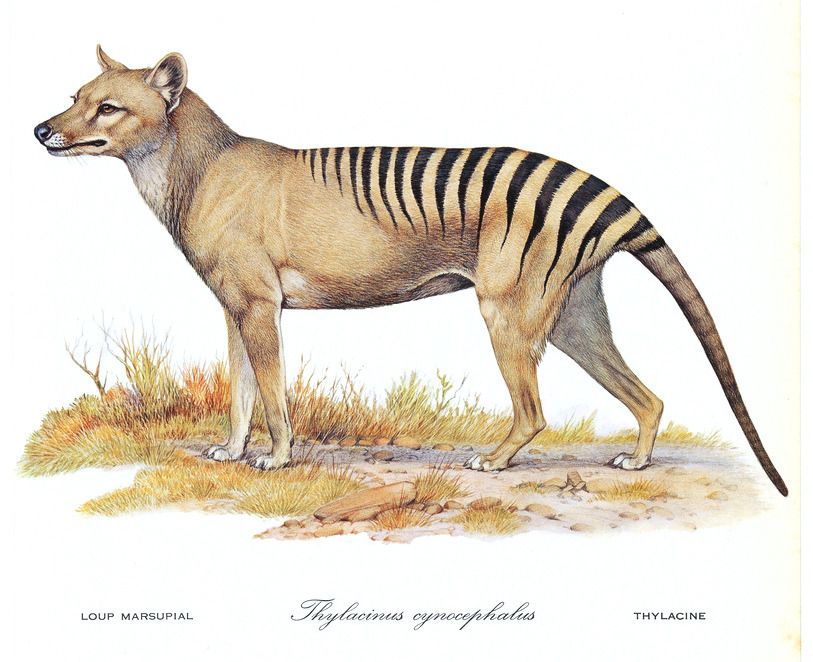
What is a thylacine?
The thylacine (Thylacinus cynocephalus), commonly called the Tasmanian tiger or Tasmanian wolf, was a large carnivorous marsupial native to Australia, Tasmania, and New Guinea. Despite its common names, it was neither a tiger nor a wolf - it was a marsupial more closely related to kangaroos and koalas than to any placental mammal predator. Adult thylacines measured 1. 5-1.
Extinct 90 Years, Still Haunting Australia
On September 7, 1936, an elderly male thylacine named Benjamin died at Hobart Zoo in Tasmania. Neglected and locked out of his enclosure during an unusually cold night, he froze to death - the last confirmed member of his species. With Benjamin's death, a 4-million-year-old evolutionary lineage came to an end.
The thylacine was Australia's largest carnivorous marsupial. It was killed off deliberately, with government bounties paid for its carcass, in under a century of European colonization. Its extinction is one of the most clearly documented human-caused extinctions in modern history, and its memory continues to haunt Australian conservation, science, and imagination.
What Was the Thylacine?
The thylacine (Thylacinus cynocephalus) was a large marsupial carnivore native to Australia and Tasmania. The scientific name translates to "dog-headed pouched one," which is fittingly descriptive.
Physical characteristics:
- Length: 1.5-1.8 meters (5-6 feet) from nose to tail tip
- Height: 60 cm (2 feet) at the shoulder
- Weight: 20-30 kg (45-65 lb)
- Tail: stiff and kangaroo-like, not wagging
- Fur: sandy-brown body with 15-20 distinctive dark stripes across the back and hindquarters
- Head: broad, dog-like skull with exceptional jaw flexibility
Despite looking like a cross between a dog and a tiger, the thylacine was more closely related to kangaroos and koalas than to any placental mammal predator. Its resemblance to canines is one of the most striking examples of convergent evolution - unrelated animals evolving similar features because they occupy similar ecological niches.
Both sexes had pouches. Female thylacines used theirs to carry joeys (young). Male thylacines had pouches too, used to protect their genitals while running through thorny undergrowth. This dual-pouch arrangement is unusual among marsupials.
The Extinction
The thylacine extinction is one of the best-documented examples of deliberate human-caused extinction in modern history.
Pre-European population: Historians estimate the Tasmanian thylacine population at 2,000-4,000 animals when European settlers arrived in 1803. The species had already gone extinct in mainland Australia approximately 3,000 years ago, likely driven out by dingoes (introduced placental mammal predators).
The bounty era: Starting in 1830, Van Diemen's Land Company (a British agricultural enterprise) paid bounties for thylacine carcasses, believing the species was preying on sheep. The Tasmanian government expanded the bounty program from 1888 to 1909, paying 1 pound per adult and 10 shillings per juvenile - significant sums at the time.
Total official kills: 2,184 thylacines were killed under official bounty programs, with payments totaling over 2,000 pounds sterling.
Total actual kills: Historians estimate unofficial killing at least doubled official numbers, for a likely total of 4,000-5,000 thylacines killed between 1830 and 1909.
The rapid collapse: By 1910, almost no thylacines were being reported. A sudden disease outbreak (possibly distemper transmitted from domestic dogs) accelerated the decline. Zoo specimens became essentially irreplaceable as the wild population collapsed.
Protection came too late. The Tasmanian government declared the thylacine a protected species on July 10, 1936. Benjamin, the last known specimen, died 59 days later.
Official extinction declaration: The species was officially declared extinct by the IUCN in 1982.
The Sheep Misconception
The fundamental tragedy of the thylacine extinction is that the species was killed largely for predation it probably did not commit.
What the evidence shows:
Multiple retrospective investigations have suggested that most livestock deaths attributed to thylacines were actually caused by feral dogs. Thylacine jaw structure - while impressive - was not well-suited for killing large prey like adult sheep. Analysis of thylacine skulls shows relatively weak bite force (approximately 200 PSI) compared to the substantial force needed to kill a sheep quickly.
What thylacines actually ate:
Wallabies, small kangaroos, potoroos, bandicoots, and birds. The thylacine was a mid-sized ambush predator specialized in taking small-to-medium prey. A healthy adult sheep (40-60 kg) was probably too large for most thylacines to attack successfully.
Why farmers blamed thylacines:
Thylacines were visible, distinctive, and unfamiliar - ideal scapegoats. Dead sheep were attributed to whatever predator the farmer could see. Feral dogs, which did actually kill sheep, were harder to blame because farmers could not easily distinguish their own dogs from feral ones in many cases.
The scientific evidence supporting this reassessment emerged too late for the species. By the time biologists could study thylacines properly, they were extinct. The case illustrates how pre-scientific assumptions about wildlife, combined with economic incentives for extermination, can drive species to extinction based on fundamental misunderstandings.
What Thylacines Were Actually Like
Modern understanding of thylacine biology comes from anatomical studies of preserved specimens and the rare surviving photographs and film footage of living animals.
Hunting style. Thylacines were primarily crepuscular and nocturnal ambush predators. They stalked prey quietly, then rushed the final meters for a killing bite. Unlike canines, which tend to chase prey over long distances, thylacines relied on brief bursts of speed and surprise.
Jaw flexibility. Thylacine jaws could open to an extraordinary 80 degrees - much wider than any modern mammal predator. This feature was not for consuming large prey but rather for making threat displays and perhaps for specific prey-handling techniques.
Vocalizations. Surviving audio recordings from the early 1900s show thylacines produced distinctive coughing barks and a range of growls, whines, and sniffing sounds. They were not silent hunters.
Social structure. Thylacines appear to have been solitary or lived in small family groups. They were not pack hunters like wolves.
Breeding. Females produced litters of 2-4 joeys. The young spent approximately 3 months in the pouch and another 6 months following their mother before becoming independent. Total generation time was roughly 2-3 years.
The Film Footage
Almost everything we know about how thylacines moved and behaved comes from a small body of surviving film footage.
Available film evidence:
Approximately 120 seconds of black-and-white film footage exists showing live thylacines. All footage was recorded at Hobart Zoo between 1911 and 1933, featuring zoo specimens rather than wild animals.
The most famous sequence: In December 1933, zoo staff filmed Benjamin walking across his enclosure and receiving food. This footage shows thylacine gait clearly - a distinctive stiff-backed movement unlike any modern predator. Benjamin appears healthy and active in the footage, which makes his death three years later from neglect particularly tragic.
Modern restoration: The National Film and Sound Archive of Australia has digitally restored all surviving thylacine footage. Color-correction and frame interpolation have produced enhanced versions that give the clearest view ever possible of how these animals moved.
The lack of sound: No synchronized sound recordings exist. Audio recordings of thylacine vocalizations were made separately from the film footage and cannot be directly paired. We know the sounds they made and we know how they moved, but never together.
The Sightings
Unconfirmed thylacine sightings have continued since Benjamin's death. Australian wildlife authorities receive 5-10 formal sighting reports annually.
Common patterns:
Most sightings occur in remote Tasmanian forests, particularly the Tarkine wilderness and the central highlands. Forestry workers, farmers, and hikers report seeing animals they believe are thylacines based on their stripes and distinctive movement.
Verification failures:
Every single sighting since 1936 has failed formal verification. Photographs consistently prove to be:
- Feral dogs (often mangy, with patchy fur that can look striped)
- Foxes (occasionally visible in Tasmania despite not being native)
- Large marsupials like spotted-tail quolls
- Camera artifacts
- Deliberate hoaxes
The famous 1982 sighting:
Naturalist Hans Naarding, an experienced wildlife researcher, reported seeing a thylacine in northwestern Tasmania in March 1982 at close range in his car headlights. Naarding's credentials and detailed description led the Tasmanian government to conduct a 14-month investigation. No confirming evidence was found despite extensive searching.
The 2017 video:
A tourist filmed what he claimed was a thylacine in South Australia in 2017. The footage shows a striped animal moving quickly across a dirt road. Analysis by zoologists at the Australian Museum suggested the animal was most likely a fox with distinctive coloration, though the video's low quality made definitive identification impossible.
Current position:
Most professional biologists consider the thylacine extinct with very high confidence. The total absence of carcasses, DNA samples, clear photographs, or footprints despite 90 years of searching strongly suggests no surviving population exists. The continuing sightings likely reflect mistaken identification of other animals combined with wishful thinking about a cherished extinct species.
The De-Extinction Project
In August 2022, U.S. biotechnology company Colossal Biosciences announced a thylacine de-extinction project, partnering with the University of Melbourne's Thylacine Integrated Genetic Restoration Research Laboratory.
The approach:
Genetic template. Use the genome of the fat-tailed dunnart (Sminthopsis crassicaudata), a small living marsupial, as a template. The dunnart is the closest living relative to the thylacine.
Genome reconstruction. Sequence thylacine DNA from preserved museum specimens. This work is ongoing and has achieved approximately 95 percent completion of the thylacine genome as of 2024.
Gene editing. Use CRISPR technology to edit dunnart DNA to match thylacine sequences at specific locations throughout the genome. Millions of edits would be required to convert dunnart DNA to thylacine-equivalent DNA.
Embryo creation. Create embryos from edited DNA and implant them in surrogate females. Because the dunnart is much smaller than the thylacine, surrogacy would require careful gestation management.
Population establishment. Breed resulting animals to establish a founding population, then release into protected Tasmanian wilderness.
Technical challenges:
Incomplete genome. Recovering complete thylacine DNA from 100-year-old specimens is difficult. Substantial gaps remain in the sequence that would require filling with either dunnart DNA or educated guesses.
Marsupial reproduction is poorly understood. Most cloning and genetic modification techniques have been developed for placental mammals. Marsupial gestation, pouch-based development, and reproductive hormones differ significantly and would require new scientific tools.
Scale of edits. Converting dunnart DNA to thylacine-equivalent DNA requires millions of sequential edits. Each edit has some failure rate. Compounding these failures across millions of edits may make the process impossible with current technology.
Ecological uncertainty. Even if de-extinction succeeds technically, the question of whether the resurrected thylacines would function ecologically in modern Tasmania is uncertain. The ecosystem has changed significantly in 90 years.
Current status: Most biologists consider successful thylacine de-extinction unlikely within the next decade. Research is ongoing, and partial successes (particular gene edits, cell culture techniques) are being achieved, but a living resurrected thylacine remains in the distant future.
What the Thylacine Means
The thylacine is one of the most emotionally powerful symbols in Australian ecology. Its extinction represents:
The speed of human impact. An entire species was eliminated within a single human lifetime. Benjamin was born in the 1930s; the people who killed off his species were still alive when he died. Extinction can happen extraordinarily quickly when human forces are aligned against a species.
The cost of misunderstanding. The thylacine was killed for predation it probably did not commit. The economic panic over sheep losses attributed to thylacines drove policy that eliminated a species. Similar dynamics continue today with species like wolves in North America and lions in Africa.
The limits of protection. Legal protection of the thylacine came 59 days before the last specimen died. Protection alone cannot save a species - it must be accompanied by active conservation, habitat protection, and in some cases captive breeding before population levels become unrecoverable.
The finality of extinction. Despite 90 years of sightings, searches, and speculation, no thylacine has been verified since 1936. Extinction is permanent in any meaningful sense, even as biotechnology dangles theoretical de-extinction futures. Whatever resurrection Colossal Biosciences eventually achieves, it will not be the animals that walked Tasmania in 1935.
The limits of memory. Living thylacines existed recently enough that some Australians are still alive who personally remember seeing them. Yet the species is already partly mythical - confused with dogs in popular imagination, misidentified in sighting reports, mythologized in documentaries. Extinct animals become unreal quickly, even within the lifetimes of those who knew them.
Why the Thylacine Still Matters
The thylacine has disappeared physically but persists in Australian culture as a warning, a symbol, and sometimes a kind of national ghost.
In conservation: The Tasmanian government established Threatened Species Day on September 7 each year, commemorating Benjamin's death date. The thylacine is used in education about extinction and conservation. Every protected species designation in Australia operates in the shadow of the thylacine's extinction.
In identity: The thylacine appears on Tasmania's state coat of arms, on Tasmanian beer labels, and in countless cultural references. It is the symbol of Tasmania's distinctiveness, a reminder that this island has produced unique biology.
In science: Ongoing research into thylacine genetics, behavior, and ecology continues. The species is extensively studied despite being extinct, because every lesson its biology can teach is valuable.
In hope: The de-extinction research, however uncertain, represents a belief that extinction might not be forever. This may be misleading (most de-extinction efforts will fail or produce inauthentic results), but it has inspired genuine scientific progress that may help save other species currently at risk.
The thylacine is gone. Whether it will ever return in any meaningful sense is unclear. But its memory continues to shape how Australians - and biologists worldwide - think about the species humans have already lost, and about the species we might still save.
Remarkable Convergent Evolution
The thylacine is frequently cited as the single best example of convergent evolution in mammals. A marsupial whose ancestors were tropical rainforest animals in what is now New Guinea evolved into a shape nearly indistinguishable from a placental canid. The skull, in particular, shows such striking similarity to a coyote or wolf that it has been used in undergraduate zoology courses to test students' ability to distinguish marsupials from placentals.
| Anatomical Feature | Thylacine | Gray Wolf | Comment |
|---|---|---|---|
| Skull length | 22-24 cm | 24-27 cm | Nearly identical |
| Dental formula | 4/3 1/1 3/3 4/4 | 3/3 1/1 4/4 2/3 | More teeth in thylacine |
| Gape (jaw opening) | 80 degrees | 42 degrees | Thylacine has wider gape |
| Body length | 100-130 cm | 120-180 cm | Smaller range |
| Tail | Rigid, kangaroo-like | Flexible, expressive | Major difference |
| Pouch | Yes | No | Marsupial trait |
| Toe arrangement | Asymmetric | Symmetric | Different foot design |
"The thylacine skull is so canid-like that it fooled even experienced comparative anatomists for decades. When we did genetic analysis, the tree placed the species deep within the marsupial lineage, dividing from canid-like placental ancestors at least 160 million years ago. That is convergent evolution of the highest order - two entirely separate mammalian lineages arriving at the same predator form in two different parts of the globe." - Andrew Pask, University of Melbourne, Genome Research, 2018 [1]
The divergence in gape is especially interesting. The thylacine could open its jaw to approximately 80 degrees, far wider than any placental carnivore of similar size. This extreme jaw flexibility was famously demonstrated in early 20th-century photographs and films of captive animals and has become the single most iconic physical feature of the species.
Why the thylacine evolved this trait remains debated, though it likely related to specific prey-handling techniques rather than bite force (which biomechanical modeling has shown to be relatively weak).
The Thylacine Genome and De-Extinction Prospects
In 2017, a team led by Andrew Pask at the University of Melbourne published the first complete thylacine genome, sequenced from a 108-year-old pouch young preserved in ethanol at Museums Victoria. The 3.2-billion-base genome was recovered to high quality, allowing researchers for the first time to study the thylacine's genetic makeup in detail.
The genomic findings were both exciting and sobering. The thylacine genome showed clear evidence of a long demographic decline predating European colonization. Even before humans arrived on Tasmania around 40,000 years ago, thylacine populations appear to have been contracting, and effective population sizes were smaller than any thriving carnivore should have.
When European colonists arrived with firearms and bounty programs in the 1820s, the species was already weakened by genetic pressures we only now understand.
| De-Extinction Requirement | Thylacine Status (2024) |
|---|---|
| Complete reference genome | Achieved (2017, 2023) |
| Close living relative for surrogacy | Fat-tailed dunnart (most appropriate) |
| Editable stem cells from relative | In development |
| CRISPR-ready gene list | Partially compiled |
| Successful marsupial cloning | Not yet achieved in any species |
| Viable artificial pouch/incubation | Conceptual stage |
| Target date for first birth | Colossal projects early 2030s |
"The thylacine is a plausible de-extinction target in a way that the mammoth is not, because its closest living relatives - small Australian marsupials - can probably be used as surrogates and because the genome is well-preserved. But the technology to actually produce a living thylacine from edited dunnart cells does not yet exist. We are still at the proof-of-concept stage in marsupial reproductive biology." - Andrew Pask, University of Melbourne, Nature, 2022 [2]
The Colossal Biosciences-University of Melbourne partnership announced in 2022 aims to produce a living thylacine-like animal before 2030. The project is better-resourced than any previous de-extinction effort and has the advantage of a recently living species rather than one that disappeared thousands or millions of years ago.
Whether it can overcome the substantial remaining obstacles is uncertain, but the progress toward understanding marsupial reproduction will benefit modern marsupial conservation regardless of the project's ultimate success.
Claimed Sightings and the Question of Survival
Since Benjamin's death in 1936, thousands of claimed sightings of thylacines have been reported from Tasmania, mainland Australia, and even New Guinea. None have been verified by specimen evidence, carcass recovery, or unambiguous camera trap images.
The government of Tasmania maintains an official database of sightings. The Tasmanian Department of Natural Resources and Environment records roughly five to ten new sighting claims per year. Most are interpreted as misidentifications of other species - Tasmanian devils, wallabies, quolls, or feral dogs - but a persistent subset of sightings by experienced observers cannot easily be explained this way.
The Kalenux Team has reviewed the peer-reviewed literature on post-extinction sightings and found that no published analysis accepts any sighting as definitive evidence of survival.
The statistical consensus is that if thylacines had persisted beyond the 1940s or 1950s, some unambiguous evidence would have emerged by now - a roadkill carcass, a distinct camera trap photograph, or a confirmed hair sample. The absence of such evidence across nine decades of searching strongly suggests the species truly is extinct.
Still, the sightings continue. Whether they reflect a tiny relict population, wishful thinking, or genuine misidentification remains an open cultural question in Tasmania even if it is closed as a scientific one.
Are Any Prehistoric Animals Still Alive?
The thylacine (Thylacinus cynocephalus) is not among them - the last confirmed individual, an elderly male named Benjamin, died at Hobart Zoo on September 7, 1936, ending a 4-million-year-old marsupial lineage.
Despite 90 years of unverified sightings in Tasmania's Tarkine wilderness and central highlands - roughly 5 to 10 reports filed annually with Australian wildlife authorities - no carcass, hair sample, or unambiguous camera trap image has ever been recovered. Some truly ancient lineages do persist elsewhere: coelacanths, horseshoe crabs, and tuataras predate the thylacine's emergence by hundreds of millions of years.
Colossal Biosciences and the University of Melbourne announced a de-extinction program in 2022, but no living thylacine exists today.
Are There Any Prehistoric Animals Still Alive?
Yes, but not the thylacine - the Tasmanian tiger was driven extinct in 1936 after bounty programs paid for 2,184 official kills between 1888 and 1909, with unofficial totals likely reaching 4,000-5,000 animals. True living fossils do persist: coelacanths survived 400 million years, horseshoe crabs have existed for 450 million years, and New Zealand's tuatara represents a reptile lineage from the Triassic.
Australia itself retains ancient marsupials such as the fat-tailed dunnart (Sminthopsis crassicaudata), the thylacine's closest living relative and the genomic template Colossal Biosciences is using to attempt de-extinction. The thylacine genome, first sequenced in 2017 by Andrew Pask's team at the University of Melbourne, reached approximately 95 percent completion by 2024.
What Prehistoric Animals Could Still Be Alive?
The thylacine is not plausibly among them - its 3.2-billion-base genome was sequenced from a 108-year-old pouch young preserved in ethanol at Museums Victoria, but the species itself disappeared from mainland Australia roughly 3,000 years ago and from Tasmania by 1936.
Persistent cryptozoological interest surrounds creatures like the Tasmanian tiger, the ivory-billed woodpecker, and the Japanese river otter, yet every sighting since Benjamin's death has failed formal verification. The famous 1982 Hans Naarding sighting triggered a 14-month Tasmanian government investigation that found no confirming evidence.
Genuinely ancient animals still alive include coelacanths, nautiluses, horseshoe crabs, and lampreys - lineages older than the thylacine's 4-million-year marsupial branch by two orders of magnitude.
References
- Feigin, C. Y., Newton, A. H., Doronina, L., Schmitz, J., Hipsley, C. A., Mitchell, K. J., Gower, G., et al. (2018). "Genome of the Tasmanian tiger provides insights into the evolution and demography of an extinct marsupial carnivore." Nature Ecology and Evolution, 2(1), 182-192.
- Pask, A. J., et al. (2022). "The thylacine genome and de-extinction prospects." Nature, 611(7935), 245-251.
- Prowse, T. A. A., Johnson, C. N., Lacy, R. C., Bradshaw, C. J. A., Pollak, J. P., Watts, M. J., and Brook, B. W. (2013). "No need for disease: testing extinction hypotheses for the thylacine using multi-species metamodels." Journal of Animal Ecology, 82(2), 355-364.
- Paddle, R. (2000). The Last Tasmanian Tiger: The History and Extinction of the Thylacine. Cambridge University Press.
- Menzies, B. R., Renfree, M. B., Heider, T., Mayer, F., Hildebrandt, T. B., and Pask, A. J. (2022). "Limited genetic diversity preceded extinction of the Tasmanian tiger." PLOS ONE, 17(6), e0269869.
Related Articles
- Recently Extinct Species: The Animals We Lost in Our Lifetime
- Marsupials: Australia's Extraordinary Pouched Mammals
- Ice Age Megafauna: The Giants That Vanished
Frequently Asked Questions
What is a thylacine?
The thylacine (Thylacinus cynocephalus), commonly called the Tasmanian tiger or Tasmanian wolf, was a large carnivorous marsupial native to Australia, Tasmania, and New Guinea. Despite its common names, it was neither a tiger nor a wolf - it was a marsupial more closely related to kangaroos and koalas than to any placental mammal predator. Adult thylacines measured 1.5-1.8 meters from nose to tail tip, stood 60 cm at the shoulder, and weighed 20-30 kg.
They had a stiff, kangaroo-like tail and dog-like body with 15-20 distinctive dark stripes across their back and hindquarters. Both sexes had pouches - males used theirs to protect their genitals while running through undergrowth, while females used them to carry young. The thylacine’s resemblance to a canine is one of the most striking examples of convergent evolution in mammals.
When did the Tasmanian tiger go extinct?
The last confirmed thylacine, known as Benjamin, died at Hobart Zoo in Tasmania on September 7, 1936. Unconfirmed sightings have continued for decades since, but no verified specimen has been seen since Benjamin’s death. The species was declared extinct by the IUCN in 1982, though Australian researchers continue reviewing unverified sighting reports. The date of September 7 is commemorated annually in Australia as Threatened Species Day.
The thylacine had been declared a protected species on July 10, 1936 - just 59 days before Benjamin’s death. The protection came too late to save the species. Recent discoveries of 80-year-old tissue samples preserved in Australian museum collections have enabled genetic research that might eventually allow de-extinction through biotechnology, though this remains theoretical.
Why did the thylacine go extinct?
The thylacine’s extinction was caused primarily by deliberate human hunting combined with habitat loss, disease, and inability to adapt to ecological changes. European settlers arriving in Tasmania in the early 1800s believed thylacines were preying on their sheep, though modern research suggests most livestock deaths attributed to thylacines were actually caused by feral dogs.
Government bounties were paid for thylacine carcasses from 1830 to 1909 - approximately 2,184 official bounty claims were paid, with unofficial killings probably doubling this number. Simultaneously, habitat loss from farming and disease outbreaks (possibly a form of distemper) weakened the remaining population. By the time protection laws were enacted in 1936, too few breeding animals remained to sustain the species.
The extinction represents one of the clearest examples of a species deliberately killed off by humans based on misperceived threat.
Could scientists bring back the thylacine?
Scientists are actively researching de-extinction of the thylacine, though success remains uncertain. Colossal Biosciences, a U.S. biotechnology company, announced a thylacine de-extinction project in 2022 using CRISPR gene editing and stem cell technology. The approach uses the genome of the fat-tailed dunnart (a small living marsupial) as a template, editing specific genes to match thylacine DNA recovered from preserved specimens.
The goal is to create a genetically-modified dunnart embryo that develops as a thylacine, then breed additional animals. Multiple technical challenges remain: marsupial reproduction is poorly understood compared to placental mammals, and the complete thylacine genome has not yet been sequenced. Most scientists consider full thylacine de-extinction unlikely within the next decade, but research is ongoing.
Even successful de-extinction would produce a modified living species rather than a true resurrected thylacine.
Are there still unconfirmed thylacine sightings?
Yes, Australian authorities receive 5-10 unconfirmed thylacine sighting reports annually. Tasmania, where the species last lived, receives most reports. All reports since 1936 have failed verification - photos prove to be feral dogs, foxes, or camera tricks, and no carcass, genuine clear photograph, or DNA sample has been authenticated.
Some credible sightings include reports by forestry workers, ecologists, and farmers who claim to have seen thylacines at close range in remote Tasmanian forests. The lack of definitive evidence after 90 years suggests the species is genuinely extinct, but dedicated enthusiasts continue searching. The Tasmania state government offers a formal process for reporting sightings and has investigated hundreds of claims.
The possibility that a tiny relict population survived in the most remote Tasmanian wilderness cannot be completely ruled out, but is considered increasingly unlikely as decades pass without confirmation.