
What is the most recent animal to go extinct?
Determining the single most recent extinction is difficult because many species disappear before scientists can document them. Among well-known cases, the Bramble Cay melomys (Melomys rubicola), a small rodent from a tiny island in Australia's Torres Strait, was declared extinct in 2019 - the first mammal species officially recognized as a casualty of human-driven climate change.
Extinction is not an abstract concept from the age of dinosaurs. It is happening now, in real time, at a pace that dwarfs anything in the geological record outside of the five great mass extinctions. Species that existed when your grandparents were alive - animals that were photographed, filmed, studied, and named - are gone forever.
Their disappearance is not the result of asteroid impacts or supervolcanic eruptions. It is the result of human decisions: habitat destruction, overhunting, pollution, invasive species introduction, and the accelerating destabilization of the global climate.
The numbers are staggering. According to the Intergovernmental Science-Policy Platform on Biodiversity and Ecosystem Services (IPBES), approximately 1 million animal and plant species are currently threatened with extinction, many within decades [1].
The current extinction rate is conservatively estimated at 1,000 times the natural background rate - the rate at which species would disappear without human interference. Some researchers, including the late biologist E.O. Wilson, have argued the true figure may be closer to 10,000 times the background rate.
Between 24 and 150 species are estimated to vanish every single day, most of them invertebrates and plants that disappear without ever receiving a scientific name.
"The one process now going on that will take millions of years to correct is the loss of genetic and species diversity by the destruction of natural habitats. This is the folly our descendants are least likely to forgive us." - E.O. Wilson, The Diversity of Life (1992)
This is not a crisis that is coming. It is a crisis that has arrived. And the stories of the species we have already lost are both a warning and an indictment.
The Dodo: Where the Story of Modern Extinction Begins
The dodo (Raphus cucullatus) has become so synonymous with extinction that its name is a byword for obsolescence. But the real story of this flightless bird is more nuanced - and more damning - than the popular caricature suggests.
The dodo was a large pigeon, roughly one meter tall and weighing between 10 and 18 kilograms, endemic to the island of Mauritius in the Indian Ocean. It evolved in complete isolation from terrestrial predators over millions of years, which explains its most famous characteristic: an utter lack of fear toward humans. When Dutch sailors first landed on Mauritius in 1598, they found a bird that would walk directly up to them, showing no defensive behavior whatsoever.
Sailor accounts from the period describe the dodo with a mixture of fascination and contempt. The Dutch called it walghvogel ("disgusting bird") because its meat was reportedly tough and unpalatable, though later accounts suggest that properly prepared dodo was edible enough.
More destructive than direct hunting were the animals the sailors brought with them: rats, pigs, cats, and macaques that devoured dodo eggs and chicks from their ground-level nests. The dodo, having never evolved defenses against mammalian predators, had no response to this onslaught.
By 1681 - less than a century after first European contact - the dodo was extinct. It is one of the first well-documented cases of human-caused extinction, and it set a pattern that would repeat itself across the globe for the next three and a half centuries.
The Passenger Pigeon: From 5 Billion to Zero
If the dodo's extinction was the prologue, the passenger pigeon (Ectopistes migratorius) was the first act of the modern extinction crisis - and perhaps its most shocking chapter. No species in recorded history has gone from such staggering abundance to absolute zero in so short a time.
In the early 19th century, the passenger pigeon was the most abundant bird in North America, and possibly the most abundant bird on Earth. Ornithologist Alexander Wilson estimated a single flock he observed in 1813 near Frankfort, Kentucky, at over 2 billion birds. John James Audubon described a flock that took three days to pass overhead.
Total population estimates range from 3 to 5 billion individuals - a number so large that passenger pigeons may have constituted 25 to 40 percent of all birds in the United States.
Their flocks were so dense they darkened the sky. Nesting colonies stretched for miles, with trees bending and breaking under the weight of hundreds of nests. The sound of a passing flock was described as resembling a tornado or a freight train.
The Market Hunting Catastrophe
The passenger pigeon's abundance was its undoing. Commercial hunters - known as pigeon professionals - slaughtered them on an industrial scale. Birds were shot, netted, trapped with alcohol-soaked grain, and suffocated by setting fires beneath their roosts. A single hunter could kill thousands in a day. The pigeons were shipped by rail to urban markets in barrels, sold for as little as a few cents each.
They were eaten in pies, stews, and as cheap protein for the growing industrial workforce. They were also used as live targets in shooting galleries - the sport of "trap shooting" originally used live passenger pigeons.
The combination of relentless hunting and massive deforestation - the pigeons depended on vast tracts of deciduous forest for mast (acorns and beechnuts) - collapsed the population with terrifying speed. The species likely required enormous flock sizes to trigger breeding behavior, and once populations fragmented below a critical threshold, reproduction failed catastrophically.
Martha: The Last of Her Kind
The final chapter played out at the Cincinnati Zoo. A female passenger pigeon named Martha - named after Martha Washington - was the last known individual of her species. She had been hatched in captivity and had never known the sky-darkening flocks of her ancestors. Zookeepers reported that she was lethargic and unsteady on her perch in her final years. At approximately 1:00 PM on September 1, 1914, Martha was found dead on the floor of her cage. She was 29 years old.
Her body was frozen in a 300-pound block of ice and shipped to the Smithsonian Institution, where she was mounted and remains on display to this day. A reward of $1,000 had been offered for a living mate for Martha. None was ever found.
"Men still live who, in their youth, remember pigeons; trees still live who, in their youth, were shaken by a living wind. But a few decades hence only the oldest oaks will remember, and at long last only the hills will know." - Aldo Leopold, A Sand County Almanac (1949)
The Thylacine: Benjamin and the Extinction of the Tasmanian Tiger
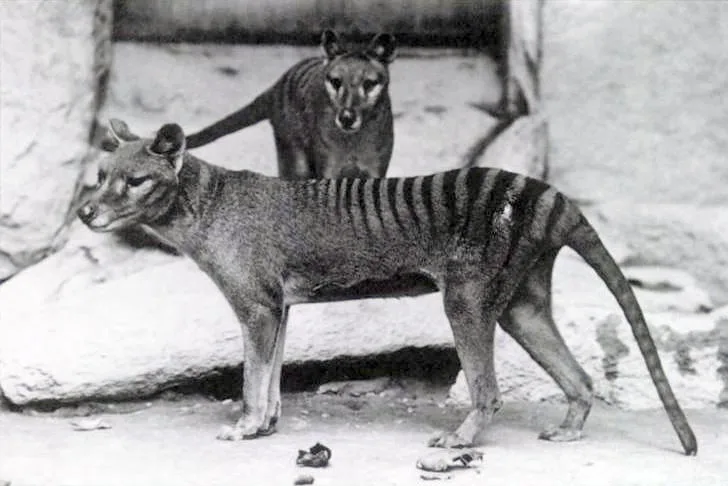
The thylacine (Thylacinus cynocephalus), commonly known as the Tasmanian tiger or Tasmanian wolf, was the largest carnivorous marsupial of modern times. Superficially dog-like in appearance, with a stiff tail and distinctive dark stripes across its lower back, the thylacine was a striking example of convergent evolution - a marsupial that independently evolved to fill the ecological niche occupied by canids on other continents.
Once widespread across mainland Australia, New Guinea, and Tasmania, the thylacine was driven to extinction on the mainland approximately 3,000 years ago, likely due to competition with dingoes. By the time of European settlement, it survived only in Tasmania.
Bounty, Blame, and Extermination
Tasmanian settlers viewed the thylacine as a threat to their sheep flocks, and the Tasmanian government introduced a bounty system in 1888, paying one pound per dead adult thylacine and ten shillings per pup. Between 1888 and 1909, the government paid bounties on 2,184 thylacines. Combined with habitat destruction, disease (likely a distemper-like illness), and competition with introduced wild dogs, the bounty system decimated the population.
The last confirmed wild thylacine was shot by farmer Wilf Batty in 1930. The last captive individual, a male known informally as "Benjamin" (though this name was applied retroactively and its historical accuracy is debated), lived at the Beaumaris Zoo in Hobart, Tasmania. Film footage from 1933 shows Benjamin pacing in his enclosure, opening his jaws in the species' characteristic wide gape.
Benjamin died on September 7, 1936, reportedly from exposure after being locked out of his sheltered sleeping quarters on a cold night. The species had received official protected status just 59 days earlier - a protection that came far too late to matter.
Sightings and De-extinction
Despite its official extinction, the thylacine has generated more reported sightings than virtually any other extinct species. Hundreds of unverified sighting reports have come from Tasmania's wilderness areas, and periodic expeditions have attempted to find surviving individuals. None has produced confirmed evidence.
More scientifically promising is the de-extinction effort led by the University of Melbourne's Thylacine Integrated Genetic Restoration Research (TIGRR) Lab, in partnership with Colossal Biosciences. The project aims to use CRISPR gene-editing technology to modify the genome of the fat-tailed dunnart - the thylacine's closest living relative - to gradually approximate the thylacine genome.
As of 2024, the team has sequenced the thylacine genome to high resolution and is working on the monumental challenge of turning that sequence into a living organism. Success, if it comes, is likely decades away.
The Baiji: A Goddess Silenced by Industry
The baiji (Lipotes vexillifer), also known as the Yangtze river dolphin or the Chinese river dolphin, was one of only a handful of freshwater dolphin species on Earth. Known in Chinese folklore as the "Goddess of the Yangtze," the baiji had inhabited the river for approximately 20 million years.
The species was driven to functional extinction by the rapid industrialization of the Yangtze River basin in the second half of the 20th century. The Yangtze became one of the busiest waterways on Earth, carrying more cargo tonnage than any other river.
The baiji faced an unrelenting combination of threats: collision with cargo vessels, entanglement in fishing gear (particularly rolling hooks and electroshock fishing), habitat degradation from dam construction (including the Three Gorges Dam), and severe water pollution from industrial runoff.
A comprehensive survey of the entire Yangtze in 2006 - covering 3,400 kilometers over six weeks using visual and acoustic monitoring - failed to detect a single baiji. The species was declared functionally extinct that same year [2]. It is widely regarded as the first cetacean driven to extinction by human activity in modern times. Occasional unconfirmed sightings have been reported since 2006, but no scientific evidence of surviving individuals has emerged.
The Western Black Rhino: Poached into Oblivion
The western black rhinoceros (Diceros bicornis longipes), a subspecies of the black rhino, once roamed across the savannas and shrublands of central and western Africa. By the mid-20th century, intensive poaching for rhinoceros horn - driven by demand in traditional medicine markets and for ornamental dagger handles in Yemen - had reduced the population to critical levels.
Despite conservation efforts in the 1990s, inadequate anti-poaching enforcement and continued demand allowed the decline to continue unchecked. The last confirmed sighting was in Cameroon in 2006. After extensive surveys failed to locate any surviving individuals, the International Union for Conservation of Nature (IUCN) formally declared the western black rhino extinct in 2011 [3].
The western black rhino's extinction is particularly galling because the broader species - the black rhinoceros - still survives in other subspecies, demonstrating that the loss was not inevitable but rather the result of specific policy failures, corruption, and insufficient international cooperation.
Spix's Macaw: The Bird That Inspired "Rio"
Spix's macaw (Cyanopsitta spixii), a small blue parrot native to the dry caatinga scrubland of northeastern Brazil, is one of the most famous extinct-in-the-wild species on Earth, largely due to the 2011 animated film Rio, which told a fictionalized version of its story.
The species was already critically rare by the time it received scientific attention. Habitat destruction - the clearing of Tabebuia caraiba gallery woodland, the macaw's preferred nesting habitat - and capture for the illegal pet trade reduced the wild population to a handful of individuals by the 1980s. The last known wild Spix's macaw, a solitary male, was observed near the town of Curaca in Bahia, Brazil, until he disappeared in October 2000.
However, a captive population survived, scattered across private collections and breeding programs in Qatar, Germany, Brazil, and elsewhere. A coordinated international breeding effort gradually increased the captive population to over 200 individuals. In June 2022, the first Spix's macaws were reintroduced into the wild in the caatinga of Bahia, within a newly established protected area.
As of 2024, approximately 35 birds have been released, and early reports indicate some are adapting to wild conditions, though the reintroduction remains in its early and precarious stages [4].
The Golden Toad: Climate's First Casualty
The golden toad (Incilius periglenes) was a small, brilliantly orange amphibian found exclusively in a roughly 4-square-kilometer area of high-elevation cloud forest near Monteverde, Costa Rica. It was discovered by herpetologist Jay Savage in 1966 and quickly became a symbol of Costa Rica's extraordinary biodiversity.
The species had an unusual reproductive biology. Males would gather in large numbers at temporary pools during the brief rainy season, their vivid coloration making them visible from considerable distance. Females were cryptically colored in dark olive with red spots. The entire breeding season lasted just a few weeks.
In 1987, researcher Martha Crump documented 1,500 golden toads gathering at breeding pools in what appeared to be a normal season. In 1988, only 10 individuals were found. In 1989, a single male was observed on May 15 - the last confirmed sighting of the species.
The golden toad's extinction is attributed to a lethal combination of the chytrid fungus (Batrachochytrium dendrobatidis) and climate change. Shifting weather patterns altered the cloud forest's moisture regime, creating conditions that favored the spread of chytrid while simultaneously stressing amphibian populations already adapted to a narrow range of environmental conditions.
The golden toad became one of the first species whose extinction was directly linked to climate change, and its loss foreshadowed the global amphibian crisis that has since claimed or threatened hundreds of additional species [5].
Lonesome George: The Last Pinta Island Tortoise
The Pinta Island tortoise (Chelonoidis abingdonii), a subspecies of Galapagos giant tortoise endemic to Pinta Island in the Galapagos archipelago, was reduced to a single known individual: a male discovered in 1971 by snail biologist Joseph Vagvolgyi. Named Lonesome George, this tortoise became arguably the most famous individual animal in the world and a global symbol of the extinction crisis.
George was estimated to be roughly 100 years old at the time of his discovery. He was brought to the Charles Darwin Research Station on Santa Cruz Island, where decades of effort were devoted to finding him a mate. Females from closely related subspecies were introduced to his enclosure, and while George eventually mated with females of the C. becki subspecies from Isabela Island, none of the resulting eggs proved viable.
Lonesome George was found dead in his corral on June 24, 2012, by his long-time caretaker, Fausto Llerena. Necropsy revealed no obvious cause of death; he was estimated to be over 100 years old. His preserved body was sent to the American Museum of Natural History in New York, where it was prepared by expert taxidermists and later returned to the Galapagos for permanent display.
In a remarkable twist, genetic studies conducted after George's death identified tortoises on the volcanic slopes of Isabela Island carrying partial Pinta Island tortoise DNA - likely the descendants of Pinta tortoises transported by whalers or pirates centuries ago. Conservationists are now attempting to selectively breed these hybrid individuals to recover as much of the Pinta genome as possible.
Comparison of Recently Extinct Species
| Species | Last Individual / Sighting | Year Extinct | Primary Cause | Range |
|---|---|---|---|---|
| Dodo | No named individual recorded | 1681 | Invasive species, hunting | Mauritius |
| Passenger pigeon | Martha (Cincinnati Zoo) | 1914 | Market hunting, habitat loss | North America |
| Thylacine | "Benjamin" (Hobart Zoo) | 1936 | Bounty hunting, disease, habitat loss | Tasmania |
| Golden toad | Single male, Monteverde | 1989 | Chytrid fungus, climate change | Costa Rica |
| Spix's macaw | Lone male, Curaca, Bahia | 2000 (wild) | Habitat loss, pet trade | Brazil |
| Baiji | None found in 2006 survey | 2006 | Ship strikes, fishing, pollution, dams | Yangtze River, China |
| Western black rhino | Last seen in Cameroon | 2011 | Poaching for horn | Central/West Africa |
| Pinta Island tortoise | Lonesome George | 2012 | Invasive goats, small population | Galapagos, Ecuador |
Lessons Written in Loss
Each of these extinctions follows a disturbingly similar script. A species evolves over thousands or millions of years, perfectly adapted to its ecological niche. Human activity - whether hunting, habitat destruction, pollution, or introduced predators - disrupts that niche faster than the species can adapt. Warning signs are ignored.
Conservation action, when it finally comes, arrives too late or is inadequately funded. And then the species is gone, leaving behind only museum specimens, faded photographs, and the knowledge of what was lost.
Several patterns emerge from these case studies:
Island and range-restricted species are disproportionately vulnerable. The dodo, golden toad, Pinta Island tortoise, and Spix's macaw all occupied extremely limited ranges. Small populations have less genetic diversity, fewer individuals to absorb losses, and nowhere to retreat when threats arrive.
Exploitation can collapse even superabundant species. The passenger pigeon's extinction proves that no population size is safe from sufficiently destructive harvesting. Abundance creates complacency.
Cascading threats are deadlier than any single factor. The thylacine faced bounties, habitat loss, and disease simultaneously. The baiji was struck by boats, tangled in nets, and poisoned by pollution. Rarely does a single cause drive extinction alone.
The window for effective action is brief. By the time a species is down to its last few individuals, the practical and genetic barriers to recovery are often insurmountable. Conservation must begin when populations are still large enough to be viable.
Species on the Brink Right Now
The lessons of these extinctions are not merely historical. They are urgently relevant to species teetering on the edge today.
The vaquita (Phocoena sinus), a small porpoise endemic to the northern Gulf of California, Mexico, is the world's most endangered marine mammal. Fewer than 10 individuals are believed to remain, driven to the brink by entanglement in gillnets set for the totoaba fish, whose swim bladder commands extraordinary prices in Chinese traditional medicine markets. Despite international pressure and a gillnet ban, illegal fishing continues.
The Sumatran rhinoceros (Dicerorhinus sumatrensis) is the smallest and most ancient of the living rhino species, with fewer than 80 individuals scattered across fragmented habitats in Sumatra and Borneo. Their extremely low population density means individuals struggle to find mates, and the species faces a reproductive crisis compounded by habitat loss from palm oil plantations and logging.
The Javan rhinoceros (Rhinoceros sondaicus) survives only in Ujung Kulon National Park on the western tip of Java, Indonesia. The entire species consists of approximately 72 individuals confined to a single population - making it vulnerable to a single catastrophic event such as a tsunami, volcanic eruption, or disease outbreak.
Each of these species could follow the baiji, the western black rhino, and the golden toad into oblivion within our lifetimes. Whether they do depends entirely on choices that governments, communities, and individuals make in the coming years.
The Weight of What We Have Lost
Extinction is permanent. It is not a decline that can be reversed, a population that can be rebuilt, or a habitat that can be restored. When a species vanishes, it takes with it millions of years of evolutionary history, a unique genetic library, an irreplaceable set of ecological relationships, and - in the case of animals like the thylacine or the baiji - a form of intelligence and awareness that will never exist again.
The species described in this article are not relics from a distant past. They are casualties of the modern world, lost within living memory. Martha the passenger pigeon died the same year World War I began. Benjamin the thylacine died the same year Jesse Owens ran at the Berlin Olympics. Lonesome George died the same year the Curiosity rover landed on Mars.
We have the scientific knowledge, the conservation tools, and the economic resources to prevent future extinctions on this scale. What has been lacking, consistently and fatally, is the political will and public urgency to deploy them. The stories of these lost species are not just obituaries. They are warnings - and the question of whether we heed them will define the biological legacy of the 21st century.
How Many Venomous Animals Does Australia Have?
Australia hosts roughly 170 species of land snakes, about 100 of which are venomous, plus 32 venomous sea snake species - giving Australia the highest concentration of venomous serpents on Earth. Add the 2,000+ spider species (including Sydney funnel-webs, redbacks, and mouse spiders), the cone snails, blue-ringed octopuses, and box jellyfish, and the venomous fauna totals thousands of species.
This context matters in the story of recent extinctions: the Bramble Cay melomys (Melomys rubicola), declared extinct in 2019 as the first mammal officially lost to human-driven climate change, lived on a single Torres Strait island where sea-level rise destroyed its habitat. Australia's unique biogeographic isolation produced both the world's most venomous animals and its most vulnerable endemics.
References
IPBES (2019). Global Assessment Report on Biodiversity and Ecosystem Services. Intergovernmental Science-Policy Platform on Biodiversity and Ecosystem Services. Bonn, Germany.
Turvey, S.T., Pitman, R.L., Taylor, B.L., et al. (2007). First human-caused extinction of a cetacean species? Biology Letters, 3(5), 537-540.
Emslie, R. (2012). Diceros bicornis ssp. longipes. The IUCN Red List of Threatened Species. International Union for Conservation of Nature.
Instituto Chico Mendes de Conservacao da Biodiversidade (ICMBio) (2022). Reintroduction of Spix's Macaw (Cyanopsitta spixii) in the Caatinga of Bahia, Brazil. Brazilian Ministry of the Environment.
Pounds, J.A., Bustamante, M.R., Coloma, L.A., et al. (2006). Widespread amphibian extinctions from epidemic disease driven by global warming. Nature, 439(7073), 161-167.
Ceballos, G., Ehrlich, P.R., & Raven, P.H. (2020). Vertebrates on the brink as indicators of biological annihilation and the sixth mass extinction. Proceedings of the National Academy of Sciences, 117(24), 13596-13602.
Pask, A., Newton, A.H., & Peel, E. (2023). De-extinction of the thylacine: progress, challenges, and ethical considerations. Genes, 14(7), 1434.
Frequently Asked Questions
What is the most recent animal to go extinct?
Determining the single most recent extinction is difficult because many species disappear before scientists can document them. Among well-known cases, the Bramble Cay melomys (Melomys rubicola), a small rodent from a tiny island in Australia’s Torres Strait, was declared extinct in 2019 - the first mammal species officially recognized as a casualty of human-driven climate change.
Rising sea levels and storm surges repeatedly inundated its habitat, destroying the vegetation it depended on for food and shelter.
Can we bring back extinct species through de-extinction?
De-extinction research has made significant advances but remains far from routine. The most prominent effort involves the thylacine (Tasmanian tiger), where researchers at the University of Melbourne’s TIGRR Lab are using CRISPR gene-editing technology to reconstruct thylacine DNA and potentially implant modified embryos into fat-tailed dunnart surrogates. Colossal Biosciences is pursuing similar work with the woolly mammoth.
However, major obstacles remain: reconstructing a complete functional genome, developing viable embryos, ensuring the health of surrogate mothers, and - perhaps most critically - restoring the ecosystems these animals would need to survive. Most conservation biologists caution that de-extinction should not distract from protecting species that still exist.
How many species go extinct every day?
Estimates vary, but leading conservation scientists calculate that between 24 and 150 species go extinct every day, depending on the methodology and assumptions used. The Intergovernmental Science-Policy Platform on Biodiversity and Ecosystem Services (IPBES) reported in 2019 that approximately 1 million animal and plant species are threatened with extinction, many within decades.
The current extinction rate is estimated at 1,000 times the natural background rate, and some researchers argue it may be as high as 10,000 times. The vast majority of these losses involve invertebrates, plants, and fungi that vanish without ever being formally described by science.