
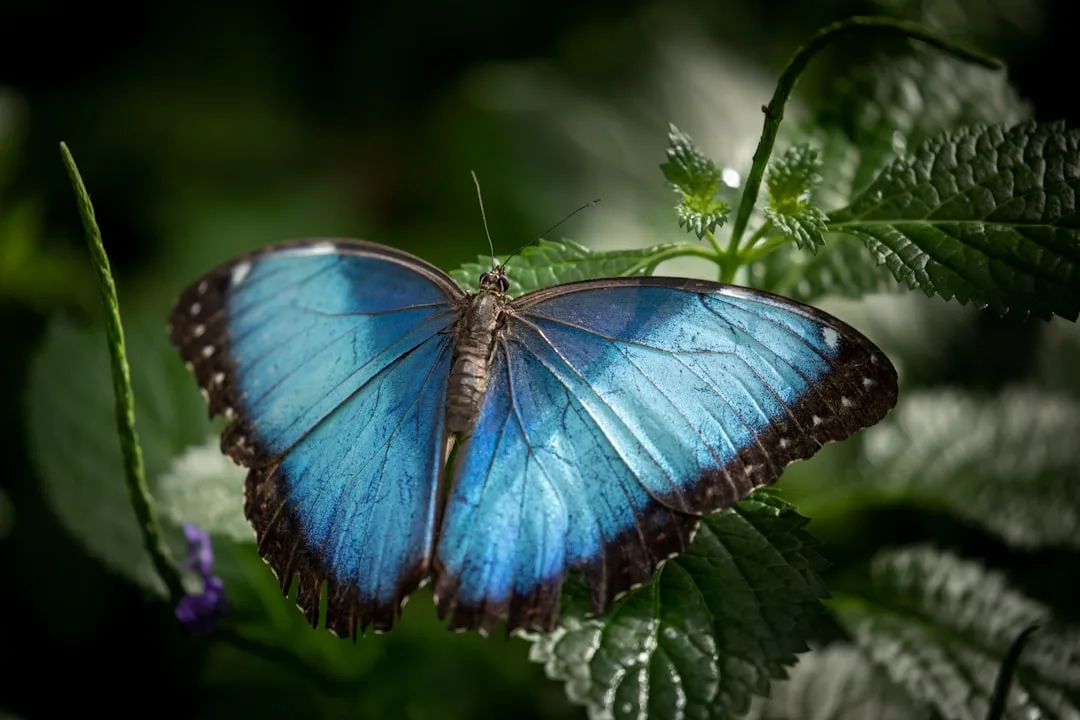
The blue morpho butterfly is one of the most instantly recognisable insects on Earth. A single flash of its iridescent wings through a rainforest clearing in Costa Rica, Panama, or the Brazilian Amazon is enough to stop most visitors in their tracks. The colour is so saturated, so bright, so impossibly electric that it appears artificial - as though someone had painted a cobalt shard and hung it in the air. It is not paint.
It is not pigment. It is a trick of physics performed by billions of microscopic ridges on a handful of wing scales, and it has made the blue morpho a scientific curiosity for over two centuries.
This guide covers every aspect of blue morpho biology and ecology: size, habitat, the structural iridescence that gives the species its name, diet, the surprisingly aggressive caterpillar stage, reproduction, flight behaviour, predator evasion, human use, and conservation. It is a reference entry - expect specifics: centimetres, wavelengths, days in each life stage, and verified observations.
Morpho peleides is the representative species. It is the blue morpho most commonly seen in butterfly houses, framed displays, and rainforest tours, and most of the research summarised here concerns this species. The genus Morpho contains roughly thirty recognised species, all confined to the Neotropics.
Etymology and Classification
The genus name Morpho is Greek for 'shape' or 'beautiful form', and it was used in antiquity as a title for Aphrodite. The Swedish naturalist Carl Linnaeus adopted the word for this group of large, flamboyant tropical butterflies in the eighteenth century. The species epithet peleides refers to Peleus, father of Achilles in Greek myth - a typical nineteenth-century naturalist flourish.
Common English names include blue morpho, common morpho, and peleides morpho. In Spanish-speaking Central America the butterfly is often called morfo azul or celeste comun.
Taxonomically, Morpho peleides belongs to the family Nymphalidae, the brush-footed butterflies, which also includes monarchs, admirals, fritillaries, and emperors. Nymphalidae are distinguished by having a reduced and hairy first pair of legs, which the butterfly holds against the body rather than uses for walking.
Within Nymphalidae the morphos sit in the subfamily Satyrinae or, depending on the classification system, their own subfamily Morphinae. Genetic work since 2000 has consolidated roughly thirty species into the genus, including recognisable forms like Morpho menelaus, Morpho didius, Morpho helenor, and Morpho rhetenor.
Size and Physical Description
Blue morphos are large by butterfly standards. Typical wingspan for Morpho peleides is 12-15 centimetres, with the largest females reaching 20 cm. Body length is modest - only 2-4 cm - which makes the wings look disproportionately huge in flight and contributes to the slow, bouncing, almost parachute-like flight pattern.
Key measurements:
- Wingspan (typical): 12-15 cm
- Wingspan (maximum, large females): up to 20 cm
- Body length: 2-4 cm
- Wing thickness: less than 0.2 mm
- Adult mass: 2-3 g
The dorsal (upper) surface of the wings carries the famous iridescent blue. Colour intensity varies between subspecies, sexes, and individuals. Males are typically more saturated and reflective than females, which often show duller blue or blue with heavier black borders. The wing margins are edged in matte black, and several species in the genus carry white or dark speckling along the edges.
The ventral (under) surface could not be more different. It is a muted palette of browns, greys, creams, and rust tones arranged in a pattern that resembles a dead leaf or a strip of bark. Several large eyespots are scattered across the underside, imitating the eyes of small vertebrates. When the butterfly settles on a branch and folds its wings closed, only the ventral surface is visible, and the insect effectively disappears into the forest floor debris.
Structural Colour: Why the Blue Isn't Really Blue
The iridescence of the blue morpho is one of the most studied examples of structural colouration in biology. No blue pigment exists in the wings. If you were to grind a morpho wing to dust under a microscope, the dust would be brown. The blue is a product of physics, not chemistry.
Each wing scale is covered in rows of microscopic ridges made of chitin and air. The ridges are arranged in a layered 'Christmas tree' cross-section when viewed under electron microscopy, with regular spacing tuned to the wavelength of blue light (roughly 450 nanometres). When white light hits the scale, most wavelengths pass through or are absorbed by a layer of dark melanin beneath.
Blue wavelengths, however, are reflected and scattered by constructive interference off the ridges. The result is a colour that is far brighter than any chemical blue pigment can produce, does not fade over time, and shifts slightly with viewing angle - the hallmark of iridescence.
Key structural facts:
| Feature | Value |
|---|---|
| Ridge spacing on wing scales | ~200 nanometres |
| Peak reflected wavelength | ~450 nm (blue) |
| Reflectivity of dorsal surface | up to ~70% at peak wavelength |
| Visible distance in canopy | ~1 kilometre to the human eye |
| Pigment contribution to blue | zero - colour is entirely structural |
This is why a blue morpho flashing through a forest clearing can be seen from roughly a kilometre away - a remarkable distance for an insect. The brightness also explains why the species has been a target for engineering research. Laboratories have replicated morpho-style ridges to produce anti-counterfeiting inks, displays that remain bright without backlighting, and fade-free cosmetic pigments.
Habitat and Range
Blue morphos are tropical lowland insects. Morpho peleides is distributed across a vast sweep of the Neotropics, from southern Mexico through the Yucatan, Belize, Guatemala, Honduras, Nicaragua, Costa Rica, and Panama, then southward through Colombia, Venezuela, the Guianas, Ecuador, Peru, Bolivia, and into northern Brazil including parts of the Amazon basin.
The species prefers primary and mature secondary rainforest with closed canopy, though it is not strictly tied to pristine habitat. Individuals occur along forest edges, river corridors, plantations bordered by forest, and even along paths cut through disturbed land. Ideal conditions include:
- Average annual rainfall of 1,500-4,000 mm
- Mean temperature of 22-28 degrees Celsius
- Low-elevation forest, typically below 1,500 m
- Canopy with gaps that allow patches of direct sunlight
Males patrol regular flight paths through forest clearings and along streams, often returning to the same territory daily. Females spend more time in the canopy but descend to find oviposition sites and to feed on fruit falls. Guides in protected areas like Costa Rica's La Selva, Panama's Soberania National Park, and Ecuador's Yasuni National Park can usually show visitors morphos in the same patrol corridors on consecutive mornings.
Flight and Predator Evasion
Blue morphos are slow fliers. Their wing-loading - mass per unit wing area - is very low, and the flight pattern is a distinctive bouncing, gliding, parachute-like motion rather than a rapid beat. Speed rarely exceeds 12 km/h. This slowness should, in theory, make morphos easy prey for birds, lizards, and monkeys. It does not, because the species has evolved an elegant multilayer defence.
Predator evasion mechanisms:
- Flashing dorsal blue. Every wingbeat alternates between the brilliant blue dorsal surface and the cryptic brown ventral surface. To a pursuing predator the target appears, disappears, appears again, each time slightly displaced because the butterfly is moving. This flickering confuses tracking and disrupts strike timing.
- Crypsis at rest. When the butterfly lands and folds its wings closed, only the brown underside is visible. The pattern mimics dead leaves, bark, or leaf litter. Motionless morphos are extremely difficult to spot even at close range.
- Eyespots. Large ocelli on the ventral wing surface resemble the eyes of a small vertebrate such as an owl or a lizard. Predators presented with what appears to be a staring face often break off attacks.
- Startle response. When approached while feeding, a morpho snaps its wings open, exposing the sudden flash of blue and the eyespots. Small predators are often startled into retreating.
- Flight in open clearings. Morphos prefer to fly where there is space to maneuver, which reduces the advantage of ambush predators like jumping spiders.
The combination works. Predation rates on adult morphos are measurable but low compared with similarly slow-flying butterflies of equivalent size, and the genus has radiated into roughly thirty species across the Neotropics partly because this defensive package is so effective.
Diet and Feeding Behaviour
Blue morphos break one of the popular stereotypes of butterflies. They do not drink nectar. Adults never visit flowers. Instead, their diet consists of:
- Fermenting and rotting tropical fruit - mangoes, bananas, plantains, figs, papayas
- Tree sap seeping from wounds in the bark
- Decomposing fungi on fallen logs
- Wet mud puddles rich in dissolved minerals (puddling behaviour, mainly in males)
- Decaying animal matter, including carcasses and faeces
This is essentially a fruit fly diet attached to a much larger animal. The proboscis is long and flexible, adapted for probing into soft fermenting fruit flesh rather than for reaching into flower corollas. Ethanol produced by fermenting fruit intoxicates morphos mildly, which is why guides and photographers in rainforest reserves can often approach and even handle morphos that are feeding on set-out bananas - the butterflies become slower, less responsive, and more tolerant of disturbance.
Caterpillars are an entirely different ecological creature. They are strictly herbivorous, feeding on the leaves of legumes in genera including Machaerium, Pterocarpus, Mucuna, Erythrina, and Arachis. The caterpillars chew through leaf tissue and grow rapidly through five instars before pupation.
Life Cycle
Blue morpho development follows the standard butterfly sequence - egg, larva, pupa, adult - but with some distinctive features.
Egg:
- Females lay ~100 eggs in a lifetime, singly or in small clusters on host plant leaves
- Eggs are pale green, roughly spherical, ~1.5 mm in diameter
- Hatching occurs in ~9 days
Caterpillar (larva):
- Five instars across 5-7 weeks
- Final instar length: 5-8 cm
- Colouration: reddish-brown body with bright lime-green patches
- Defences: long irritating bristles, foul-smelling defensive fluid, gregarious to semi-gregarious habits
- Notable behaviour: cannibalistic under crowding or food shortage
Pupa (chrysalis):
- Duration: ~14 days
- Jade-green with gold speckles, suspended head-down from a leaf stem
- Rattles and produces ultrasonic clicks when disturbed - a warning signal
Adult:
- Duration: 3-4 weeks
- Activity: diurnal, most active in mid-morning and mid-afternoon
- Resting: wings closed on bark, trunks, or leaf litter
Total life cycle from egg to death spans roughly 115 to 137 days. Multiple generations occur each year in the lowland tropics, with no clear diapause or overwintering stage. Adult numbers rise seasonally in response to fruiting cycles and rainfall patterns, and local peaks can be pronounced in reserves like Monteverde, Costa Rica, or Tambopata, Peru.
Reproduction and Territory
Males patrol specific flight corridors in the forest understory, returning day after day. Rival males encountering each other in a shared corridor engage in spiralling, circling flights that appear almost choreographed. The brilliant dorsal blue functions as a sexual and territorial signal - both a warning to rival males and an advertisement to females.
Some research indicates that the ultraviolet component of the reflectance, invisible to humans but visible to butterflies, carries most of the signalling load.
Females, duller blue or almost brown depending on the population, enter a male's territory to mate. Copulation can last from thirty minutes to several hours. After mating, females search for appropriate host plants - certain leguminous trees and vines - and lay eggs singly or in small clusters on the underside of leaves. A single female may lay around a hundred eggs across her short three to four week adult life.
Egg placement is precise. Females test leaf chemistry with their feet before ovipositing, rejecting leaves that do not carry the correct chemical signature for the host plant. This is a general nymphalid trait but is particularly well documented in Morpho species.
Cannibal Caterpillars
Blue morpho caterpillars are gregarious when newly hatched, often clustering in loose groups on their host plant. Under normal conditions of ample foliage the group remains peaceful. Under crowding, or when leaves are limited, the caterpillars turn on each other. Smaller or weaker larvae are eaten by larger siblings.
This cannibalistic behaviour is documented in both wild and captive populations, and it is one reason why commercial butterfly farms must raise morphos at low density with abundant foliage.
Several hypotheses explain the behaviour:
- Cannibalism reduces direct competition for a limited leaf supply
- Eating another caterpillar provides a concentrated protein source
- Consuming smaller siblings reduces the overall density of the aggregation and therefore its attractiveness to parasitoid wasps and flies
Cannibalism is not unique to Morpho among Lepidoptera - it has been recorded in roughly 8% of butterfly and moth species studied - but its occurrence in a genus so large, so showy, and so widely observed gives morpho cannibalism an outsized place in popular rainforest biology.
Human Use and Cultural History
Blue morphos have been an object of human fascination for centuries. Indigenous peoples across Central and South America incorporated the butterfly into folklore, jewellery, and ornament. European contact from the sixteenth century onward sent a steady stream of mounted specimens to museums and private collectors.
The Victorian era and early twentieth century saw an intense commercial trade. Morpho wings were mounted into framed pictures, pressed into glass-topped trays, cut into jewellery inlays, and even incorporated into decorative boxes and trinkets. Entire rural communities in parts of Brazil, Colombia, and Peru became economically dependent on butterfly collection.
Estimates place the peak annual export at many millions of wings. The structural blue does not fade when mounted, which gave morpho-wing objects a commercial advantage over pigment-based decoration.
Modern uses are more subtle. Blue morphos are staples of commercial butterfly houses from Florida to Frankfurt. Butterfly-release companies ship chrysalises to zoos and private events. The structural colour itself has become a model for engineers working on reflective displays, anti-counterfeit security features, sensors, and industrial coatings. A morpho-inspired pigment in a banknote's security strip can be brighter and more durable than any chemical dye.
Cultural depictions are extensive. The morpho appears in logos, nature documentaries, fashion, tattoo designs, and marketing across Central and South America. In Costa Rica in particular the species functions as an unofficial biodiversity emblem, alongside the quetzal and the red-eyed tree frog.
Conservation Status and Threats
The IUCN Red List classifies Morpho peleides as Least Concern. The species is geographically widespread, tolerates moderate habitat disturbance, and remains locally common in protected rainforest reserves. However, several threats reduce populations and require sustained attention.
Primary threats:
- Habitat loss. Deforestation for cattle ranching, soy, oil palm, and logging continues across the Neotropics. Blue morphos depend on mature forest for breeding and on native legume host plants for caterpillar development. Clear-cut land supports neither.
- Agrochemicals. Herbicides and insecticides used in agriculture reduce host plant availability and directly kill caterpillars and adults on forest margins and in plantations.
- Commercial collection. Modern commercial wing collection is a fraction of historical levels but continues. Some exports remain legal under national regulations, while others are informal or illicit.
- Climate change. Shifts in rainfall patterns and rising temperatures alter host plant distribution and fruiting phenology, which affects both caterpillar and adult food supplies.
- Forest fragmentation. Morphos patrol linear flight corridors, and fragmentation that disrupts these corridors isolates subpopulations and reduces gene flow.
Several other species in the genus face greater pressure. Morpho godarti is restricted to high-elevation Andean forest that is shrinking rapidly. Morpho rhetenor populations are declining across the southern Amazon basin. Conservation work focused on lowland and mid-elevation Neotropical rainforest protects morphos alongside the much larger biodiversity of their ecosystem.
Sustainable butterfly farms in countries including Costa Rica, Belize, and Ecuador breed morphos in captivity for the pupae trade, reducing pressure on wild populations while generating rural income. Well-run farms also educate visitors about rainforest conservation, creating economic incentives to protect rather than clear forest.
Blue Morphos in Butterfly Houses
Blue morphos are the single most popular species in commercial butterfly houses worldwide. Reasons include:
- Spectacular visual impact - few insects generate more visitor reaction
- Robust pupae that survive long-distance shipping in refrigerated packages
- Tractable adult behaviour - morphos land readily on fruit trays and sometimes on people
- Short life cycle allowing continuous replacement stock
- Good emergence rate from chrysalises under standard butterfly-house climate
A typical butterfly house maintains a free-flight conservatory at ~26 degrees Celsius and 70-80% humidity, provisioned with fruit trays and host plants. Morpho pupae are suspended from display racks where visitors can watch emergence. The species' cooperation with this environment has turned it into a global ambassador for tropical entomology.
Related Reading
- Monarch Butterfly
- Monarch Butterfly Migration Mystery
- Butterflies and Moths: Metamorphosis and the Art of Transformation
References
Relevant peer-reviewed and governmental sources consulted for this entry include IUCN Red List assessments for Morpho peleides and related species, published research on structural colouration in Nymphalidae from journals including Nature, Proceedings of the Royal Society B, and Journal of Experimental Biology, host plant and life-cycle data from the Costa Rican Instituto Nacional de Biodiversidad (INBio) and the Smithsonian Tropical Research Institute in Panama, and ecological observations from long-term Neotropical butterfly monitoring projects.
Engineering applications of morpho-inspired structural colour are drawn from materials science literature in Advanced Materials and Applied Physics Letters.
Frequently Asked Questions
How big is a blue morpho butterfly?
Adult Morpho peleides wingspan measures 12-15 cm in typical individuals, with larger females reaching 20 cm across. Body length is only 2-4 cm. The wings are disproportionately large relative to the body, which contributes to the butterfly’s slow, bouncing flight. Among the roughly thirty species in the genus Morpho, the largest (Morpho hecuba and Morpho amathonte) reach 20 cm, which places blue morphos among the largest butterflies in the Americas.
Females are typically slightly larger than males but less brilliantly blue, reflecting the fact that iridescence evolved primarily as a male sexual signal.
Why do blue morpho wings look so blue?
The wings look blue, but no blue pigment is involved. Each wing scale carries rows of microscopic ridges spaced at distances tuned to the wavelength of blue light. When white light hits the scales, the ridges scatter and reflect blue wavelengths outward while absorbing other colours in underlying melanin. This is called structural colouration. The effect is much brighter than any pigment-based blue and does not fade over time.
Crushing the wing destroys the ridges and the colour vanishes, revealing dull brown melanin beneath. Engineers studying morpho scales have built reflective inks, anti-counterfeit labels, and cosmetic pigments based on the same principle.
Where do blue morpho butterflies live?
Blue morphos are Neotropical insects, meaning they live in the tropical forests of Central and South America. Morpho peleides ranges from southern Mexico through Central America and into Colombia, Venezuela, Ecuador, Peru, Bolivia, and northern Brazil. They prefer primary and mature secondary rainforest with intact canopy, though individuals are seen along forest edges, river corridors, and plantations bordered by forest.
They patrol clearings and flyways through the understory at low and mid heights, typically one to ten metres above the ground. Males are much more visible than females, which spend more time in the canopy.
What do blue morphos eat?
Adult blue morphos do not drink nectar. They have long proboscises adapted for probing fermenting tropical fruit - mangoes, bananas, plantains, figs - and feed also on tree sap wounds, rotting fungi, decaying animal matter, and wet mineral-rich mud. This diet puts them closer ecologically to fruit flies than to a typical butterfly.
In the caterpillar stage the species is strictly herbivorous, chewing leaves of legumes such as Machaerium, Pterocarpus, Mucuna, and Arachis. Captive breeding facilities feed adults rotting fruit on trays, and guides in wild reserves can often attract morphos by setting out overripe bananas or pineapple.
How long does a blue morpho butterfly live?
The full life cycle from egg to death takes roughly 115 to 137 days. Eggs hatch in about nine days. The caterpillar stage lasts five to seven weeks across five instars. The pupa (chrysalis) lasts two weeks. The adult butterfly lives only about three to four weeks.
During that short adult life the butterfly must find mates, defend territory, lay up to about a hundred eggs, and avoid a long list of predators including birds, lizards, frogs, monkeys, spiders, and mantises. The adult’s short lifespan is typical of large tropical butterflies and drives the intense, fast-paced behaviour visible in rainforest clearings.
Are blue morpho caterpillars really cannibals?
Yes. Blue morpho caterpillars are documented cannibals, especially when larval density is high or food is limited. They also secrete a foul-smelling defensive fluid when disturbed. The caterpillars are reddish-brown with bright lime-green patches and bear rows of long irritating bristles, which deter most predators and warn other caterpillars to keep their distance.
In captive breeding facilities the caterpillars must be raised at low density on ample foliage, or losses to cannibalism become significant. Cannibalism in tropical butterfly larvae is unusual but well studied in the Morpho genus and a few other Nymphalidae.
Why do blue morphos flash blue then brown in flight?
Every wingbeat alternates between the brilliantly iridescent dorsal (upper) surface and the cryptic brown ventral (under) surface of the wings. From a bird or lizard’s perspective, the target appears then disappears then appears again, each time in a slightly different position because the butterfly is moving. This flickering breaks the visual lock predators need to strike.
When the butterfly lands and folds its wings closed only the brown underside is visible, complete with large eyespots that mimic an owl or lizard face. The combination of flashing flight and motionless leaf-like resting is one of the most sophisticated predator-avoidance systems documented in butterflies.
Are blue morphos endangered?
The IUCN classifies Morpho peleides as Least Concern. The species is widespread across Central and South America, tolerates partial habitat disturbance, and remains locally common in protected rainforest. However, habitat loss from logging, agriculture, and cattle ranching reduces breeding populations wherever primary forest is cleared.
Historical pressure from commercial wing collectors in the nineteenth and early twentieth centuries devastated some local populations, and small amounts of decorative trade continue. Several rarer species in the genus Morpho, including Morpho godarti and Morpho rhetenor, are under greater pressure. Conservation today focuses on protecting lowland rainforest reserves across the Neotropics rather than on the species specifically.