
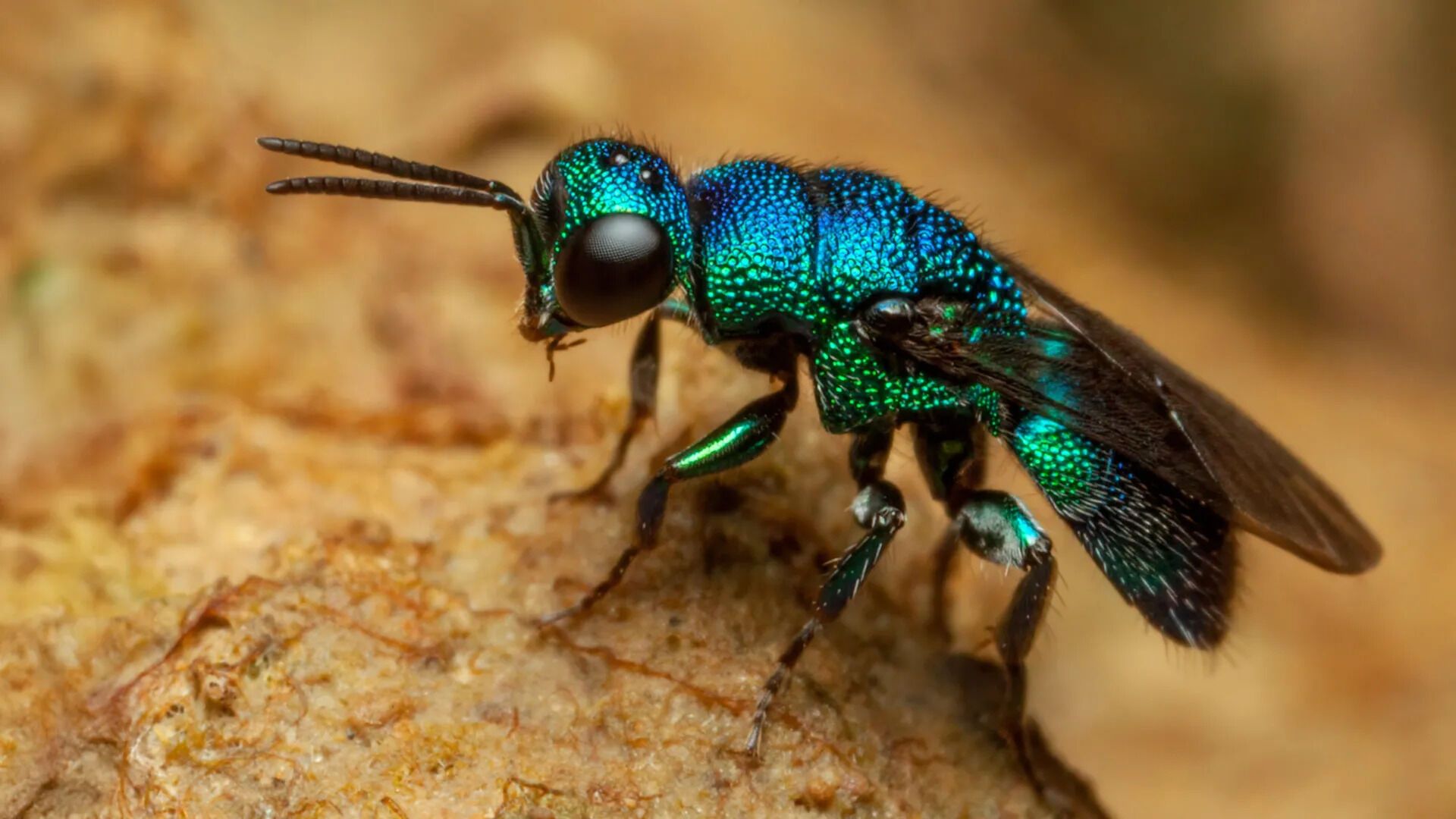
Quick Answer: The jewel wasp (Ampulex compressa), also known as the emerald cockroach wasp, is a parasitoid insect famous for its ability to manipulate cockroach behavior. By injecting venom directly into a cockroach’s brain, the wasp disables the insect’s escape reflexes, effectively turning it into a compliant “zombie.” This allows the wasp to lead the cockroach to a burrow, where it lays an egg on the immobilized host, ensuring food for its developing larva.
The jewel wasp’s vivid metallic coloration and extraordinary parasitic strategy have fascinated entomologists for decades. Unlike most predators, this wasp does not simply kill its prey. Instead, it performs a precise neurological attack that transforms a living cockroach into a passive vessel for its offspring.
The wasp’s evolutionary adaptations are so specialized that they have become a textbook example of behavioral manipulation in the animal kingdom. Many people encounter references to the jewel wasp in discussions of mind control, neurobiology, and the extremes of parasitism.
Its life cycle demonstrates the intricate relationships that can evolve between parasite and host, and it challenges common assumptions about insect intelligence and free will.
The Jewel Wasp’s Life Cycle: A Masterclass in Parasitic Manipulation
The jewel wasp (Ampulex compressa) is a solitary parasitoid wasp native to tropical regions of Africa, South Asia, and the Pacific islands. Its entire reproductive strategy revolves around a single, astonishing behavior: transforming a cockroach into a living, immobilized food source for its young. This process begins when a female wasp locates a suitable cockroach, typically of the genus Periplaneta.
The wasp’s attack is methodical and precise. First, it delivers a quick sting to the cockroach’s thorax, temporarily paralyzing its front legs and preventing escape. This initial strike is not fatal but serves to immobilize the host long enough for the wasp to deliver a second, more targeted sting.
The second injection is the true marvel. The wasp uses its stinger, which doubles as a highly sensitive probe, to locate specific regions in the cockroach’s brain that control escape and movement. Once in position, the wasp injects a complex cocktail of neurotoxins that selectively disables the cockroach’s motivation to flee, without affecting its basic motor functions.
The cockroach remains alive and capable of movement, but it no longer initiates escape behavior, even in the face of obvious threats.
After stinging, the wasp chews off part of the cockroach’s antennae and drinks some hemolymph (insect blood), possibly to replenish energy or to further weaken the host. The wasp then leads the subdued cockroach by its remaining antenna, much like a leash, to a pre-dug burrow. There, the wasp lays a single egg on the cockroach’s abdomen and seals the entrance with debris.
The cockroach, now a passive host, remains in the burrow as the wasp larva hatches, burrows into its body, and consumes it from within over several days.
Key Insight: The jewel wasp’s reproductive success depends entirely on its ability to manipulate cockroach behavior with surgical precision, ensuring a fresh, uncontested food source for its offspring.
This life cycle is a striking example of evolutionary specialization. The wasp’s venom does not kill the cockroach outright but instead preserves it in a living, yet helpless, state. This ensures that the developing larva has access to fresh tissue, maximizing its chances of survival.
Such extreme adaptations illustrate the complex interplay between predator and prey, and they provide a window into the evolutionary arms race that shapes the behavior and physiology of both parties. For more on parasitism and behavioral manipulation, see the Britannica entry on animal behavior.
Neurobiological Mechanisms: How the Wasp Controls Its Host
The jewel wasp’s manipulation of cockroach behavior is one of the most sophisticated examples of neuroparasitism known to science. The wasp’s stinger is not just a weapon; it is a precision tool capable of delivering venom directly into specific neural circuits. Research has shown that the wasp targets two key areas in the cockroach’s brain: the subesophageal ganglion, which controls movement, and the central complex, which governs escape responses and motivation.
Neuroparasitism is a phenomenon in which a parasite manipulates the nervous system of its host to alter behavior in ways that benefit the parasite. In the case of the jewel wasp, the injected venom contains a blend of neurotoxins that block the cockroach’s ability to initiate escape, while leaving other functions, such as walking, intact. This selective paralysis is so effective that the cockroach will not attempt to flee even when prodded or threatened by predators.
The wasp’s venom acts on neurotransmitter pathways, particularly those involving octopamine, which is analogous to norepinephrine in vertebrates. By disrupting these pathways, the venom effectively “hijacks” the cockroach’s motivation circuitry. The result is a state of learned helplessness, where the insect remains alive but is unable to resist the wasp’s control.
Key Takeaway: The jewel wasp’s ability to inject venom into precise brain regions demonstrates an extraordinary evolutionary adaptation, allowing it to override the host’s natural instincts without causing death.
This process has attracted significant attention from neuroscientists, as it offers insights into the modular nature of insect brains and the possibility of manipulating specific behaviors through targeted chemical intervention. The jewel wasp’s strategy has even inspired research into potential medical applications, such as targeted drug delivery and the treatment of neurological disorders.
For further reading on neuroparasitism, see the Wikipedia article on neuroparasitology and the APA’s overview of behavioral neuroscience.
Evolutionary Arms Race: Adaptations and Counter-Adaptations
The relationship between the jewel wasp and its cockroach host is a classic example of an evolutionary arms race. Over millions of years, both predator and prey have developed increasingly sophisticated adaptations to outmaneuver each other. The wasp’s highly specialized stinger, its ability to detect precise neural targets, and its complex venom composition are all products of this ongoing struggle.
Cockroaches, for their part, have not remained passive victims. Some species exhibit heightened sensitivity to the wasp’s approach, employing erratic escape behaviors or seeking refuge in tight crevices where the wasp cannot follow. However, the wasp’s attack is so rapid and precise that these defenses are often insufficient.
The evolutionary pressure exerted by the wasp has likely influenced the development of cockroach nervous systems, favoring individuals with faster reflexes or greater resistance to venom.
Evolutionary Principle: Predator-prey relationships often drive rapid and dramatic changes in both parties, resulting in a dynamic balance of adaptation and counter-adaptation.
This arms race extends beyond the individual level. The jewel wasp’s reproductive strategy, which involves producing relatively few offspring but investing heavily in each one, contrasts sharply with the cockroach’s strategy of high fecundity and rapid reproduction. Such divergent life histories reflect the different selective pressures faced by parasites and their hosts. For a broader discussion of evolutionary arms races, see the Wikipedia entry on coevolution.
The Jewel Wasp in Human Culture and Scientific Research
Few insects have captured the human imagination as vividly as the jewel wasp. Its metallic green-blue body and macabre reproductive strategy have made it a staple of documentaries, popular science books, and even horror fiction. The wasp’s ability to “zombify” its prey is often cited in discussions of free will, mind control, and the limits of animal consciousness.
In scientific circles, the jewel wasp is a model organism for studying neurobiology, behavioral ecology, and the evolution of parasitism. Its unique life cycle provides a natural experiment in the manipulation of neural circuits and the interplay between brain chemistry and behavior. Researchers have used the wasp-cockroach system to explore questions about the modularity of insect brains, the role of neurotransmitters in motivation, and the evolutionary origins of complex behaviors.
The jewel wasp has also inspired bioengineers and roboticists. The precision with which the wasp locates and disables specific neural targets has informed the design of micro-robots and targeted drug delivery systems. Its venom, which can selectively paralyze without killing, is of interest to pharmacologists seeking new painkillers or treatments for neurological disorders.
Cultural Note: The jewel wasp’s story is often used as an entry point for discussions about the nature of consciousness and the ethical boundaries of behavioral manipulation.
For more on the cultural significance of insects and their role in science, see the Britannica article on entomology and explore our .
Parasitoid Wasps: Diversity and Ecological Role
The jewel wasp belongs to a broader group known as parasitoid wasps. These insects lay their eggs on or inside other arthropods, with the developing larvae eventually consuming the host. Parasitoidism is distinct from true parasitism in that it invariably results in the host’s death. This strategy is widespread among wasps, and it plays a crucial role in regulating insect populations.
Parasitoid wasp diversity is staggering. There are tens of thousands of described species, ranging from tiny micro-wasps to large, vividly colored forms. Many target agricultural pests, making them valuable allies in biological control. The jewel wasp’s specialization on cockroaches is just one example of the intricate host-parasite relationships that have evolved within this group.
The ecological impact of parasitoid wasps extends far beyond their immediate hosts. By controlling pest populations, they help maintain the balance of ecosystems and reduce the need for chemical pesticides. Their complex behaviors and life cycles provide rich material for research in evolutionary biology, ecology, and even applied fields like integrated pest management.
For more on parasitoid wasps and their ecological significance, see the Wikipedia entry on parasitoid wasps and our .
Zombie Cockroaches: What Happens After the Sting?
Once stung by the jewel wasp, a cockroach enters a state that is neither fully alive nor dead. The insect retains motor function but loses the ability to initiate movement independently. This “zombie” state can persist for days, during which the cockroach remains passive and unresponsive to most stimuli.
The wasp’s larva, upon hatching, feeds externally for a short period before burrowing into the cockroach’s body cavity. Over the course of several days, the larva consumes the host’s internal organs in a specific order, avoiding vital tissues until the final stages. This ensures that the cockroach remains alive and fresh for as long as possible, maximizing the nutritional value for the developing wasp.
Key Insight: The jewel wasp’s larva displays a remarkable degree of selectivity in its feeding, a trait that has evolved to optimize survival and minimize waste.
Eventually, the larva pupates within the hollowed-out shell of the cockroach, emerging as an adult wasp ready to repeat the cycle. The fate of the cockroach is sealed from the moment of envenomation, but the process is drawn out to serve the needs of the parasite. This grim efficiency is a hallmark of parasitoid strategies across the insect world.
Implications for Understanding Insect Intelligence and Free Will
The jewel wasp’s manipulation of cockroach behavior raises profound questions about the nature of intelligence, consciousness, and free will in animals. Cockroaches are often dismissed as simple automatons, but their nervous systems are capable of complex behaviors, including learning, memory, and decision-making. The wasp’s ability to override these systems suggests that even “simple” brains can be precisely targeted and controlled.
This phenomenon has implications for the study of cognitive autonomy, the capacity of an organism to make independent decisions based on internal and external cues. The jewel wasp’s venom effectively strips the cockroach of this autonomy, transforming it into an extension of the wasp’s reproductive apparatus. Such examples challenge our intuitions about agency and the boundaries between self and other in the animal kingdom.
Philosophical Reflection: The jewel wasp’s strategy blurs the line between predator and puppet master, forcing us to reconsider what it means to act freely in a world shaped by evolutionary pressures.
For further exploration of animal cognition and autonomy, see the Wikipedia article on animal cognition and our .
Comparing Parasitoid Strategies: Jewel Wasp vs. Other Parasitoids
While the jewel wasp’s method of zombifying its host is particularly dramatic, it is not unique among parasitoids. Many wasps, flies, and even some nematodes employ similar tactics to manipulate host behavior. For example, certain ichneumonid wasps inject their eggs into caterpillars, which then continue to feed and grow until the larvae consume them from within.
Some fungal parasites, like Ophiocordyceps, induce “summit disease” in ants, compelling them to climb to elevated positions before dying and releasing spores.
| Parasitoid | Host | Manipulation Type | Outcome for Host |
|---|---|---|---|
| Jewel wasp | Cockroach | Neural venom injection | Zombie, eaten alive |
| Ichneumon wasp | Caterpillar | Hormonal/immune suppression | Eaten alive |
| Ophiocordyceps fungus | Ant | Behavioral manipulation | Climbs, dies, spore release |
Comparison: The jewel wasp’s method is notable for its surgical precision and the dramatic behavioral changes it induces, but it is part of a broader pattern of host manipulation in nature.
Such comparisons highlight the diversity of evolutionary solutions to the challenges of parasitism and underscore the jewel wasp’s place within a larger ecological and evolutionary context. For more on comparative parasitology, see our .
The Broader Significance: Lessons from the Jewel Wasp
The jewel wasp’s story is more than a curiosity of natural history. It serves as a powerful reminder of the complexity and ingenuity of evolutionary processes. The wasp’s ability to manipulate another organism’s behavior with such precision challenges our assumptions about the limits of biology and the potential for natural systems to inspire technological innovation.
From a practical perspective, the jewel wasp and its relatives offer potential solutions to real-world problems. Their role in controlling pest populations, their utility as models for neurobiological research, and their inspiration for bioengineered systems all point to the value of studying even the most unlikely creatures. The jewel wasp’s life cycle exemplifies the interconnectedness of life and the endless variety of strategies that evolution can produce.
Final Thought: The jewel wasp stands as a testament to the power of adaptation, the intricacy of ecological relationships, and the enduring fascination of the natural world.
For those interested in exploring related topics, consider taking our to learn about cognitive abilities, or try our to deepen your understanding of animal intelligence and behavioral adaptation.
Frequently Asked Questions
Can a jewel wasp sting harm humans?
Jewel wasp stings are not dangerous to humans; the venom is specialized for cockroaches and causes only mild irritation if stung.
Why does the jewel wasp drink cockroach hemolymph?
The wasp drinks hemolymph to replenish energy and possibly further weaken the cockroach before leading it to the burrow.
How long does a cockroach survive after being stung by a jewel wasp?
A stung cockroach can survive for several days, remaining alive until the wasp larva finishes consuming its internal organs.
Are jewel wasps used in pest control?
Jewel wasps are not widely used in pest control due to their specific host requirements and solitary nature.
Do other animals exhibit similar mind-control behavior?
Yes, other parasites such as certain fungi and wasps manipulate host behavior, but the jewel wasp’s method is among the most precise.
Is the jewel wasp found worldwide?
The jewel wasp is native to tropical regions but has been introduced to other areas where cockroaches are present.