
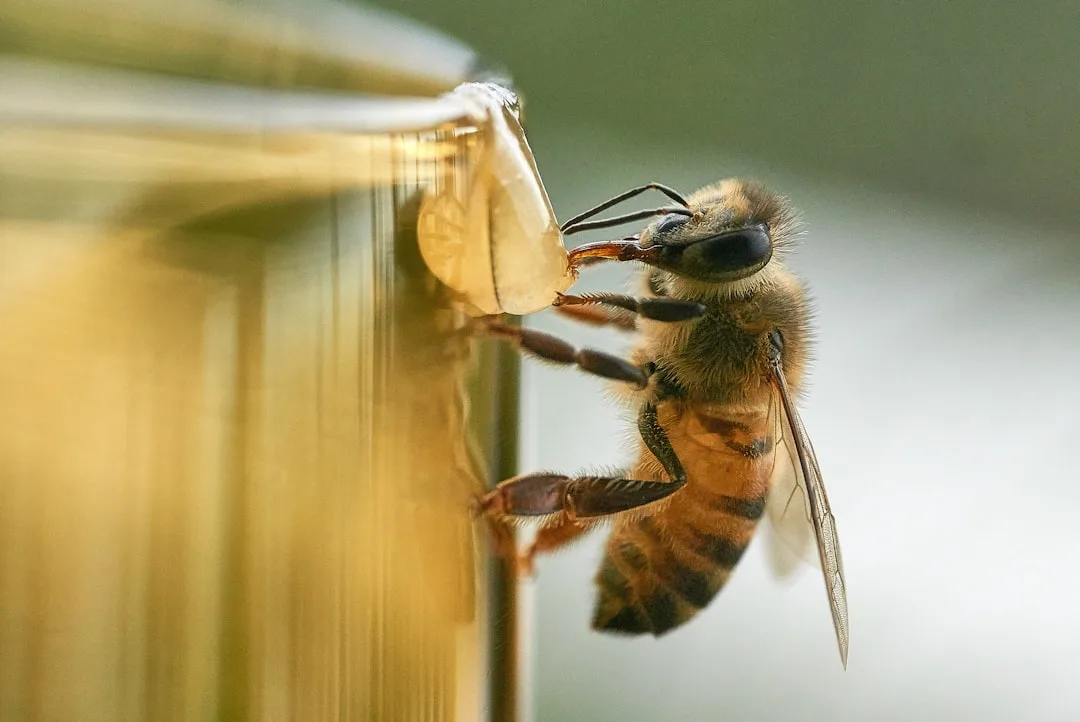
The honey bee is perhaps the most economically important insect on Earth and certainly the most biologically studied.
One species, Apis mellifera - the western or European honey bee - pollinates roughly a third of global food crops, produces every drop of commercial honey sold worldwide, and maintains colonies of up to eighty thousand individuals coordinating through a form of symbolic communication unique in the insect world.
This guide covers honey bee biology from the level of individual physiology up to the colony as a super-organism: caste system, waggle dance, foraging, reproduction, honey production, disease, and the tangled relationship between the species and the humans who depend on it.
Honey bees are not just insects. They are the closest biology comes to a society of their size running without a central authority. A hive is a collective that makes decisions through distributed consensus, regulates its own temperature within a degree, stores food against winter shortages, disposes of its dead, and replaces its own queen when one fails. No other insect does all of this at this scale.
Etymology and Classification
The scientific name Apis mellifera combines the Latin apis (bee) and mellifera (honey-bearing). Carl Linnaeus named the species in 1758. A few years later Linnaeus regretted the name because the bee makes honey rather than bearing it, and coined Apis mellifica as a replacement. The original name took priority under later taxonomic rules, and Apis mellifera remains the accepted binomial today.
The genus Apis contains seven to ten recognised species depending on the taxonomic authority, all of which produce honey. They include the Asian or eastern honey bee (A. cerana), the giant honey bee (A. dorsata), the dwarf honey bee (A. florea), and several less common species.
Commercial beekeeping outside Asia centres almost exclusively on A. mellifera, which has dozens of regional subspecies: the Italian (A. m. ligustica), the Carniolan (A. m. carnica), the Africanised hybrid widespread in the Americas, and many others adapted to specific climates.
Honey bees belong to the order Hymenoptera, which also includes wasps, ants, and sawflies. Within that order they fall in the family Apidae alongside bumblebees, carpenter bees, and orchid bees. The twenty thousand or so known bee species include most of these relatives; honey bees themselves are a tiny fraction of total bee diversity.
Anatomy and Physiology
A honey bee is roughly one centimetre and a half long with a furry, banded body divided into head, thorax, and abdomen. Every feature reflects the species' twin specialisations: flying long distances and collecting nectar.
Head:
- Two large compound eyes with about 6,900 ommatidia each
- Three simple eyes (ocelli) on the top of the head for light direction
- Antennae with 170 olfactory receptors detecting pheromones and floral scents
- A proboscis that extends up to 7 mm to reach into flowers
Thorax:
- Two pairs of wings that couple during flight via tiny hooks (hamuli)
- Six legs; the hind pair carries specialised pollen baskets (corbiculae)
- Powerful flight muscles occupying most of the thoracic cavity
Abdomen:
- In workers and queens, a sting derived from a modified ovipositor
- Wax glands on the underside of segments 4-7 (workers only)
- Honey stomach (crop) separate from the digestive stomach
Honey bees see a colour range that stretches from yellow through blue and into ultraviolet, missing red entirely. Many flowers display ultraviolet patterns functioning as landing strips visible only to bees. This co-evolution is roughly 100 million years old.
Flight mechanics are among the most studied in any insect. A honey bee beats her wings about 230 times per second, well above the natural resonant frequency of such a small animal. This is achieved through indirect flight muscles that deform the thorax and cause the wings to snap into position, rather than each wing being moved directly.
The resulting flight is efficient over long distances - up to 8 km round-trip for a single forage - but energetically expensive, which is why foraging bees require constant nectar intake.
Colony Structure and Caste System
A honey bee colony is a eusocial super-organism built from three castes. The caste system is the species' most profound adaptation and drives almost every other aspect of its biology.
The queen. A single reproductive female. Her only jobs are mating and laying eggs. At the peak of the season she lays up to 2,000 eggs per day, producing her own body weight in eggs every 24 hours.
She mates exactly once in her life - a single mating flight during which she couples with 12 to 20 drones in rapid succession, stores millions of sperm, and returns to the hive to lay for the rest of her lifespan. She can live 2-5 years, but modern beekeepers typically replace her every one or two years to maintain productivity.
Workers. Sterile females, genetically similar to the queen but fed differently as larvae. Tens of thousands of them run every aspect of the colony: nursing larvae, building wax comb, processing nectar into honey, guarding the entrance, foraging, cleaning the hive, cooling it in summer, and generating heat in winter. A worker progresses through these jobs by age, starting with nursing (first 2 weeks) and ending as a forager (last 3 weeks of her six-week summer life).
Drones. Males. Their only purpose is mating. They have no sting, no foraging apparatus, no wax glands. They are fed and cared for by workers until late summer, at which point workers evict them from the hive. Most die of cold or starvation within days.
The ratio between castes shifts dramatically with the seasons. A summer colony might contain a queen, 60,000 workers, and several hundred drones. A winter cluster contains the queen and perhaps 15,000 workers and no drones at all.
The Waggle Dance
The waggle dance is the most famous act of animal communication outside human language. Karl von Frisch decoded it in the 1940s, and the discovery earned him the 1973 Nobel Prize in Physiology or Medicine.
A returning forager performs a figure-eight pattern on the vertical surface of a honeycomb inside the dark hive. The pattern contains two straight 'waggle runs' separated by return loops. The information encoded in each waggle run is:
- Direction. The angle of the waggle run relative to vertical equals the angle of the food source relative to the position of the sun. Vertical up means 'toward the sun'. A waggle 30 degrees to the right of vertical means 'food lies 30 degrees to the right of the sun's current position'.
- Distance. The duration of the waggle portion encodes distance. Roughly one second of waggling corresponds to one kilometre. Shorter waggles mean closer food.
- Quality. More enthusiastic dances, repeated more times, signal richer food sources.
The dance is symbolic in the deepest sense: the bee is not pointing at the food or leading followers to it. She is encoding an abstract spatial relationship in a patterned body movement, and other bees decode it and fly out on their own. The dance remains one of only a handful of documented non-human signalling systems that convey displaced information - communication about things not present - placing honey bees alongside humans and great apes in that narrow cognitive category.
Foraging and Pollination
A colony deploys roughly one-third of its workers as foragers at any time. Foragers specialise - a bee that starts on apple blossoms tends to stick to apple blossoms for the day. This fidelity to a single flower species is what makes honey bees such valuable pollinators: they move pollen between flowers of the same species rather than wasting it on unrelated plants.
Foraging data:
| Metric | Value |
|---|---|
| Flowers visited per trip | 50-100 |
| Trips per day per bee | 10-15 |
| Typical foraging distance | 2-5 km |
| Maximum recorded foraging distance | ~13 km |
| Nectar load per trip | ~40 mg (half body mass) |
| Pollen load per trip | ~15-20 mg |
| Lifetime honey production per summer worker | ~1/12 teaspoon |
Pollination service performed by honey bees is worth an estimated 235-577 billion US dollars per year globally. Roughly 35 per cent of global food production depends on animal pollination, and honey bees perform a large share of that, especially on industrial farms where native pollinators have been displaced by monocultures.
Honey Production
Honey begins as flower nectar - roughly 80 per cent water when collected. A forager sucks nectar into her crop (honey stomach), mixes it with enzymes (including invertase, which begins breaking sucrose into glucose and fructose), and returns to the hive. There she passes the nectar to hive bees through mouth-to-mouth transfer.
They continue processing it, evaporating water by repeatedly sucking the nectar into and out of their mouthparts until water content drops below 20 per cent. The thickened honey is then deposited into wax cells and capped with a thin lid of beeswax.
A healthy colony stores 25-45 kilograms of honey for winter in cold climates. Beekeepers harvest what the colony produces above this reserve, typically 10-30 kg per hive per year.
Beeswax itself is secreted from glands on the worker's abdomen. Producing one kilogram of wax requires the colony to consume roughly six to eight kilograms of honey, which is why bees are so economical with wax and will reuse comb for years. The hexagonal cell shape is mathematically the most efficient way to tile a plane with equal-area cells and minimum wall material.
Reproduction and Swarming
Honey bee colonies reproduce at the colony level, not the individual level. When a colony grows too large or conditions favour expansion, workers begin raising a new queen and the old queen leaves with roughly half the colony - a swarm - to find a new nest site.
The swarm process is one of the most remarkable feats of distributed decision-making known in biology. The swarm settles temporarily on a branch or surface while scout bees search the surrounding landscape for candidate nest sites. Each scout returns and performs a waggle dance for her preferred site. Other scouts visit the advertised sites and then either dance for that site or for their own.
Gradually consensus builds. When a quorum of roughly 15 scouts dances for the same site, the entire swarm - sometimes 20,000 bees - lifts off as one and flies there. The decision-making algorithm is the subject of a sizable scientific literature and has been used as inspiration for robotic swarm coordination.
Diseases, Pests, and Colony Collapse
Honey bees face an unusual combination of pressures unique in agriculture. Commercial bees are moved across continents, kept in dense apiaries, and exposed to pesticides intended for target pests but not for bees. Native pollinators compete with them for forage. A complex of parasites and diseases has emerged to exploit these conditions.
Major threats:
- Varroa destructor. A mite that attaches to bees, feeds on fat body tissue, and vectors a suite of viruses. Varroa is probably the single greatest cause of colony loss worldwide. It co-evolved with the Asian honey bee, which tolerates it through grooming behaviour, but A. mellifera has no comparable defence.
- Deformed wing virus (DWV). Spread largely by Varroa. Infected bees have shrivelled wings, reduced cognitive function, and shortened lifespans.
- Nosema. A fungal parasite of the bee gut that reduces lifespan and foraging capacity.
- Pesticides. Neonicotinoid insecticides impair navigation, memory, and immune function at sub-lethal doses. Regulatory action in the EU has restricted some neonicotinoids; US rules remain weaker.
- Habitat loss. Monoculture farming provides brief, intense blooms surrounded by floral deserts. Urban expansion replaces meadows with lawns and pavement.
- Climate change. Shifting bloom timing can put colonies out of sync with their food supply.
Colony Collapse Disorder - the mass abandonment of hives by adult workers - received intense media attention in the late 2000s. Researchers now view CCD as one symptom of the broader stressor complex rather than a distinct disease. Annual colony losses in the United States have averaged 30-45 per cent since 2006, which beekeepers offset by splitting surviving colonies and raising new queens.
Human Relationship
Humans have kept honey bees for at least 9,000 years. Rock paintings from Spain dated to roughly 8000 BCE depict honey collection from wild hives. Ancient Egyptians kept bees in ceramic cylinders and moved hives up and down the Nile to follow blooms. Ancient Greeks and Romans wrote detailed beekeeping manuals; Virgil's Georgics devotes an entire book to bees.
Modern beekeeping dates to the mid-1800s when Lorenzo Langstroth invented the movable-frame hive that remains industry standard today. The Langstroth hive allowed beekeepers to inspect and manipulate colonies without destroying the comb, enabling the industrial-scale operations that pollinate almond groves, apple orchards, and cranberry bogs.
Honey bees are not native to the Americas, Australia, or most of Asia outside their natural range. In many places their introduction has displaced native bees, reduced pollinator diversity, and created conservation dilemmas. Some researchers argue that 'save the bees' campaigns focused on A. mellifera can actually harm native pollinators by concentrating resources on an already abundant, managed species at the expense of thousands of wild ones that perform similar ecological work.
Cognition and Intelligence
For a long time, honey bees were dismissed as pure instinct machines: beautifully complex, but mindless. Work since the early 2000s has overturned that assumption.
Abstract number sense. Research published by Scarlett Howard and colleagues at RMIT University in 2018 and 2019 showed that trained bees can perform simple addition and subtraction and grasp the concept of zero - that is, they recognise zero as 'less than one' rather than simply 'nothing'. This places honey bees alongside primates, crows, and parrots as animals with abstract numerical reasoning, achieved with a brain containing roughly one million neurons.
Face recognition. Bees trained with sugar rewards can learn to distinguish individual human faces from photographs and remember them for days. They process the stimuli as holistic patterns much like we do, despite having no evolutionary reason to care about human faces.
Social learning. Bees can learn new foraging techniques by watching other bees perform them, a form of social transmission usually reserved for vertebrates.
Tool-adjacent behaviour. Bumblebees (close relatives of honey bees) have been filmed rolling small wooden balls to earn rewards, then solving variations of the task, in what some researchers interpret as play behaviour in an insect.
The cognitive architecture behind all this remains poorly understood. The honey bee brain is roughly the size of a sesame seed. Whatever algorithms it runs, they are dramatically more efficient per neuron than anything in vertebrate neuroscience. This makes the species interesting not just to ecologists but to neuroscientists and AI researchers studying minimal intelligence.
Related Reading
- Bees and Wasps: Pollinators, Architects, and Warriors
- The Honey Bee Waggle Dance: Communication in the Hive
- Why Are Bees Dying? Inside Colony Collapse
References
This entry draws on peer-reviewed sources including work by Thomas Seeley (Honeybee Democracy, 2010), Karl von Frisch (The Dance Language and Orientation of Bees, 1967), USDA Agricultural Research Service honey bee surveys, IPBES pollinator assessments, and ongoing research published in Apidologie, Journal of Apicultural Research, and PNAS. Population loss statistics reflect the most recent Bee Informed Partnership annual surveys as of 2024.
Frequently Asked Questions
How long does a honey bee live?
Lifespan depends entirely on role and season. Summer workers live just six weeks - they literally wear their wings to shreds foraging. Winter workers, who do not forage, live four to six months. Drones (males) live roughly ninety days or until they mate, whichever comes first. A queen lives two to five years under normal conditions, occasionally longer.
Modern commercial beekeeping tends to shorten queen lifespan because beekeepers replace queens on a strict schedule to maintain colony productivity.
What is the waggle dance?
The waggle dance is a form of symbolic communication unique to honey bees. A returning forager performs a figure-eight pattern inside the hive. The straight ‘waggle’ portion encodes two pieces of information: the angle of the dance relative to vertical equals the angle of the food source relative to the sun, and the duration of the waggle encodes distance. Karl von Frisch decoded the dance in the 1940s and won the 1973 Nobel Prize for the discovery.
It remains one of only a handful of documented non-human languages that convey abstract spatial information.
How much honey does a single bee make?
A single worker bee produces about one-twelfth of a teaspoon of honey in her entire six-week summer life. Producing 500 grams (one pound) of honey requires roughly 556 workers, visits to approximately two million flowers, and a cumulative flight distance of about 88,500 kilometres - more than twice the circumference of Earth.
Honey is made by workers regurgitating nectar, partially digesting it, and repeatedly passing it mouth-to-mouth to evaporate water before capping the cells with wax.
Why are honey bees dying?
Honey bee colony losses have averaged 30-40 per cent annually in many regions since 2006. Causes are multiple and interacting: Varroa destructor mites that feed on bees and spread viruses, neonicotinoid and other pesticides that impair navigation and immunity, habitat loss eliminating wildflower forage, industrial monoculture farming that provides only brief flowering windows, climate change shifting bloom timing out of sync with bee life cycles, and diseases like Nosema. No single cause explains colony collapse; the consensus is that multiple stressors together overwhelm the colony’s ability to maintain population.
Can honey bees really do math?
Research published in 2018 and 2019 demonstrated that trained honey bees can perform simple arithmetic involving addition and subtraction with small numbers, and can grasp the concept of zero as a lower bound below one. Bees achieve this with a brain containing roughly one million neurons - about 100,000 times fewer than a human brain. The research places honey bees alongside primates, crows, and parrots as animals capable of abstract numerical reasoning.
The cognitive implications are still being debated.
Do all bees make honey?
No. Of the roughly 20,000 known bee species, only seven species in the genus Apis - the true honey bees - produce the kind of storable honey humans harvest. Other honey-producing bees include stingless bees of the Meliponini tribe, which produce smaller quantities of a different, more liquid honey. The vast majority of bee species are solitary, do not form colonies, and do not make honey at all.
Many pollinate more effectively than honey bees despite their lower profile.
Are honey bees native to North America?
No. Apis mellifera is native to Europe, western Asia, and Africa. European settlers brought honey bees to North America in 1622 when the Virginia Company shipped hives to Jamestown. They have since spread across the continent and are now essential to North American agriculture, though they compete for resources with native bees - bumblebees, mason bees, leafcutter bees, and thousands of others.
Some conservation biologists argue that prioritising managed honey bees can harm native pollinators.