
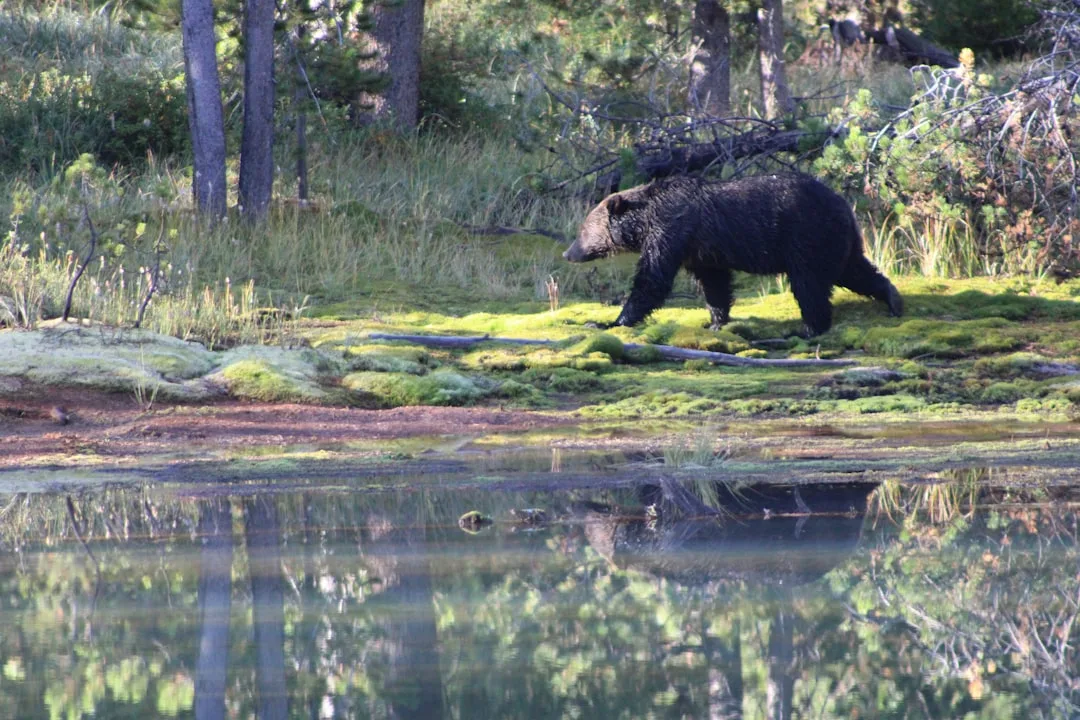
A hiker on a ridge in Glacier National Park watches a brown-coated bear digging at a slope half a mile away. Is it a cinnamon-phase black bear, harmless to almost everyone who keeps a sensible distance, or a grizzly, capable of killing a person with a single forepaw swipe?
The answer determines whether the appropriate response, should the animal turn toward the trail, is to climb a tree, stand ground, deploy bear spray, play dead, or fight back. Black bear vs grizzly bear identification is not a trivia question. In the overlap zone across western North America it is one of the most consequential pieces of natural history a backcountry traveller can know.
The bad news is that color, the feature most people instinctively reach for, is the worst possible diagnostic. Both Ursus americanus and Ursus arctos horribilis range across the same color spectrum from jet black through chocolate, cinnamon, and blond.
A blond black bear in Wyoming meadow grass looks remarkably like a small grizzly at a distance, and a dark interior grizzly in Yukon spruce forest can be mistaken for a large black bear. The good news is that several other features are nearly diagnostic, and once you train your eye to look for them in this priority order, the identification becomes reliable in almost every viewing condition.
This article covers the body shape differences that work at distance, the head and claw features that work close up, the track and sign differences that work after the animal has moved on, and the very different attack response protocols that biologists have refined over decades of incident review. For the underlying species profiles, see the American black bear reference and the grizzly bear reference, which this comparison expands on throughout.
The One-Line Answer
If you only remember one sentence, remember this one.
Look for the shoulder hump. Grizzly bears have a prominent muscular hump above the shoulders. American black bears do not. The hump is visible from hundreds of metres, works in any color phase, and resolves the identification correctly in roughly nine cases out of ten before any other feature becomes relevant.
Everything below is the explanation, the supporting features, and the response protocol that follows once you know which species you are looking at.
The Hierarchy of Field Marks
Bear identification works best when you proceed from the most reliable features to the least. Color, despite being the most visually obvious, sits at the bottom of this hierarchy because it varies enormously within both species. The features at the top stay consistent across age, sex, season, and color phase.
| Priority | Feature | Grizzly | Black bear | Notes |
|---|---|---|---|---|
| 1 | Shoulder hump | Prominent, muscular | Absent | Visible at long range, near-diagnostic |
| 2 | Face profile | Concave, dished | Straight from forehead to nose | Diagnostic when bear is sideways to you |
| 3 | Claws | 4 inches, slightly curved, often pale | 1.5 to 2 inches, sharply curved, dark | Grizzly claws often visible at 100 m |
| 4 | Highest point in profile | Shoulders | Rump | Direct corollary of the hump |
| 5 | Ear shape | Short, rounded, set wide | Tall, pointed, set high on a tall head | Black bear ears look "doggy" |
| 6 | Body proportions | Heavy front end, lower hindquarters | Even or slightly heavier rear | Grizzly looks "front-loaded" |
| 7 | Track shape | Toes nearly in a straight line | Toes form a clear arc | Front track diagnostic |
| 8 | Color | Black, brown, cinnamon, blond | Black, brown, cinnamon, blond, white (Kermode) | Useless on its own |
The hierarchy works because each feature tells you something the next one corroborates. A bear with a hump and a dished face and visible long claws is unambiguously a grizzly. A bear with no hump, a straight face profile, and short curved claws is unambiguously a black bear. A bear that looks intermediate on one feature is almost always conclusive on the others.
"If you cannot see a hump, look for a hump. If you still cannot see a hump, look at the face. The shoulder hump in Ursus arctos is the muscle attachment for the digging arm, and it is the single most diagnostic external feature in the genus. Black bears do not have one because they do not dig the way grizzlies dig."
- Stephen Herrero, Bear Attacks: Their Causes and Avoidance
The Shoulder Hump: What It Actually Is
The grizzly's hump is not fat, not a fashion statement, and not a sex character. It is the visible swelling of the trapezius and rhomboid muscles anchoring the forelimb to the spine, supplemented by the dorsal portions of the latissimus dorsi. These are the muscles a grizzly uses to dig, and grizzlies dig prodigiously.
They excavate ground squirrel colonies, root through alpine meadows for biscuit-root and yampa, dismantle rotten logs for ant brood, and tear into hibernation dens to evict marmots. A grizzly uses its forelimbs the way a backhoe uses its boom, and the trapezius hypertrophies accordingly.
American black bears do not dig at this scale. They forage by climbing, browsing, raking through soft vegetation, and tearing apart standing trees and downed logs, but they do not excavate hard ground for hours at a stretch. Their forelimb musculature is correspondingly lighter, their shoulder profile is smooth or even slightly recessed below the spine, and the highest point on a standing black bear is the rump rather than the shoulders.
This is the easiest test of all. Imagine a horizontal line from the bear's nose to its tail. On a grizzly, the line dips between the shoulders and the rump. On a black bear, the line slopes upward continuously from shoulders to rump. From any angle except straight head-on, the difference is unmistakable once you know to look for it.
A useful corollary is that the shoulder hump tells you the bear's species even when it is dead, sleeping, lying down, or photographed in poor light. Color may fail, claws may be hidden, the face may be turned away, but the hump or its absence almost always shows.
The Face: Dished vs Straight
The second feature in the hierarchy is the face profile, and it works in any sideways view. Take a grizzly's head and trace a line from the forehead down the snout to the nose tip. The line curves inward at the bridge, creating a clear concave or "dished" profile that is one of the most distinctive features of the genus. The dishing reflects the underlying skull architecture: grizzlies have a heavier braincase relative to their muzzle and the forehead bulges accordingly.
Black bear faces are different. The same line from forehead to nose runs almost straight, with at most a very slight dip at the eyes. The black bear skull is longer, narrower, and more dog-like in profile. Combined with the taller, more pointed ears, this gives black bears a characteristically "doggy" head silhouette that experienced observers can identify at a glance.
| Head feature | Grizzly | Black bear |
|---|---|---|
| Profile | Concave, dished | Straight, slightly convex |
| Forehead | Prominent, bulging | Flat to slightly rounded |
| Muzzle length | Short relative to skull | Long, dog-like |
| Ears | Short, rounded, wide-set | Tall, pointed, high-set |
| Skull length (adult male) | 35 to 42 cm | 28 to 32 cm |
| Bite force (estimated) | ~1,160 psi | ~600 to 800 psi |
The bite force figures come from estimates published in Journal of Anatomy and Journal of Zoology and reflect the grizzly's heavier jaw musculature and broader cranium. They are not the most useful field mark on a living bear, but they are part of why a grizzly's head simply looks more massive in proportion to its body. A black bear's head looks carried, sitting prominently on the neck. A grizzly's head looks embedded, blending into the heavy shoulders behind it.
Claws: 4 Inches vs 2 Inches
Claw length is the third feature, and the one most often quoted in popular accounts. The numbers are real. Grizzly front claws average 4 inches long, sometimes reaching 5 to 6 inches in old males, and are only slightly curved, designed for digging and gripping. American black bear front claws average 1.5 to 2 inches, are sharply curved, and are designed for tree climbing.
Beyond length, the claws differ in colour and visibility. Grizzly claws are often pale, ivory, or yellowish, contrasting visibly against the fur, and can be seen at 100 metres or more in good light. Black bear claws are dark, often black, and blend with the foot fur, making them hard to see except very close.
The functional difference is critical to understanding the two species' lives. Long, blunt-tipped grizzly claws are bad for tree-climbing because they cannot dig in to thin bark, and adult grizzlies are essentially terrestrial. Cubs climb but lose the ability as they mature.
Short, sharply curved black bear claws are excellent for tree-climbing, and black bears of all ages climb routinely, often retreating up trees to avoid grizzlies, predators, or human pursuit. The piece on how to survive a black bear attack covers why "climb a tree" is no longer recommended advice for either species.
"Foot anatomy follows behaviour. The grizzly is a digger and the black bear is a climber, and you can read the entire ecological history of each species in their claws. When I tell hunters and hikers that color does not matter for identification, claws are the example I reach for: a four-inch ivory claw on a brown bear means grizzly, every time."
- Tom Smith, USGS Alaska Science Center, on three decades of bear-human interaction studies
Color: Why It Almost Never Works
Both species span the full color spectrum from black to blond. In the eastern half of North America, where only black bears live, virtually all individuals are jet black with a pale muzzle. In the western half, both species become highly polymorphic.
Cinnamon and brown black bears are the dominant phase across much of the interior west, including Colorado, Idaho, Montana, and Wyoming, where roughly 50 to 80 percent of black bears are not black. Blond black bears occur.
White Kermode or "spirit" bears, a recessive white phase of Ursus americanus kermodei, occur on islands of coastal British Columbia and look nothing like any other bear. Our piece on black bear color phases including cinnamon, blond, and Kermode walks through the full palette.
Grizzlies are equally variable. Interior grizzlies are typically dark brown, but silver-tipped guard hairs give many adults a frosted appearance, especially across the back and shoulders, hence the name "grizzled." Cinnamon and blond grizzlies occur, particularly in Yellowstone and along the eastern slopes of the Canadian Rockies. Coastal brown bears trend darker on average. The variation overlaps with black bear coloration almost perfectly.
The practical rule is simple: never identify a bear by color alone. A blond bear in a Yellowstone meadow can be either species. A black bear in a Banff trailhead parking lot can be either species. Color narrows nothing. Use the hump, the face, and the claws.
Body Size and Shape
Size differs on average but overlaps so substantially that it cannot be used reliably for identification of any single individual. The numbers below are population means, and a large adult male black bear can outweigh a small adult female grizzly with no difficulty.
| Measurement | American black bear | Grizzly bear |
|---|---|---|
| Adult male weight | 60 to 300 kg, average ~120 kg | 180 to 360 kg, average ~250 kg interior |
| Adult female weight | 40 to 180 kg, average ~80 kg | 130 to 200 kg, average ~160 kg |
| Shoulder height (4-legged) | 70 to 105 cm | 90 to 150 cm |
| Standing height | 1.5 to 2.0 m | 2.0 to 2.5 m |
| Body length | 1.4 to 2.0 m | 1.7 to 2.5 m |
| Population (North America) | ~600,000 | ~55,000 |
The population numbers are worth pausing on.
Black bears outnumber grizzlies roughly eleven to one across North America. A bear sighting in any habitat where both occur is statistically more likely to be a black bear, and identification protocols built on prior probability alone would default to "black bear unless proven otherwise." The reverse default in panic situations leads to many false grizzly reports each year, particularly in Yellowstone backcountry where overheated tourists report grizzlies for any cinnamon black bear they see.
Body shape supplements weight. A grizzly carries weight forward, and the front end looks heavier than the back end in standing or walking posture. The forelimbs are noticeably thicker than the hindlimbs. A black bear carries weight more evenly, and the back end may even look heavier, especially in autumn fattened bears. The grizzly's heavy-front, light-rear posture is the reason it looks "low-slung" or "front-loaded" in field guides.
For more on the species' physical range, see the American black bear reference profile and the grizzly bear North American predator profile.
Tracks and Sign
When the bear has already moved on, tracks and sign continue the identification.
Front tracks are the diagnostic ones. Hind tracks of both species look superficially similar to a flat-footed human print, with five toes and a long heel pad. Front tracks differ in two important ways. First, the toes. Black bear front tracks show toes arranged in a pronounced arc, with the inner toe noticeably lower than the outer toe.
Grizzly front tracks show toes arranged in a nearly straight line across the top of the pad. Second, claw marks. Grizzly claws leave clear puncture or drag marks 5 to 8 cm in front of the toe pads. Black bear claws, being shorter, leave marks much closer to the toe pads or none at all in firm substrate.
Track size also differs but overlaps.
| Track measurement | Black bear | Grizzly |
|---|---|---|
| Hind track length | 17 to 18 cm | 25 to 30 cm |
| Front track width | 9 to 13 cm | 14 to 19 cm |
| Claw mark distance from toe | 0 to 3 cm | 5 to 8 cm |
| Toe arrangement | Strong arc | Nearly straight line |
A track wider than 13 cm at the toes is almost certainly a grizzly. A track narrower than 10 cm is almost certainly a black bear. Tracks between 10 and 13 cm need the toe-line and claw-distance test.
Other sign includes excavations, day beds, scat, and tree marks. Grizzlies leave large excavations, sometimes square metres of overturned earth at ground squirrel colonies or on alpine slopes. Black bears do not. Both species mark trees, but black bears bite-mark and claw-mark trees as climbing aids, while grizzlies tend to use rub trees without climbing them.
Grizzlies also tear apart logs and rocks for insects with much more violent force than black bears, leaving log fragments scattered metres from the original deadfall.
"A grizzly leaves a battlefield. A black bear leaves a quiet investigation. The amount of earth moved, logs torn open, and ground disturbed at a foraging site is itself a useful identification feature when the bear is no longer present."
- Ursus, vol. 12, on bear sign interpretation
Range Overlap and Where the Question Actually Matters
Across most of the contiguous United States and southern Canada, only one of the two species lives, and identification is by default. Black bears occupy almost all forested habitat from Florida to northern Quebec to Mexico's Sierra Madre. Grizzlies are absent from this range entirely. East of Montana and Wyoming, every bear is a black bear.
In the western overlap zone, both species share habitat, and the identification question is live every time someone sees a bear. The overlap covers western Montana, the Idaho panhandle, northwestern Wyoming, the Greater Yellowstone Ecosystem, western Alberta, most of British Columbia, the Yukon, the Northwest Territories, and almost all of Alaska except the southeast islands.
The piece on where black bears live maps the species range continent-wide, and within the overlap zone the grizzly distribution is a subset of the black bear distribution rather than the other way round.
Population-wise, the overlap zone is black-bear-dominated by numbers. Yellowstone holds roughly 600 grizzlies and several thousand black bears, for instance. Glacier holds about 300 grizzlies and an estimated 600 to 800 black bears. The default species in the overlap zone is therefore black bear, and the burden of evidence falls on identifying the grizzly correctly when it appears.
"In our long-term Yellowstone work, more than 80 percent of bear reports filed by visitors at trailhead boxes were misidentified at least once. Cinnamon black bears were called grizzlies, dark grizzlies were called black bears, and the only consistently correct visitor identification was a sow with cubs of the year, where the cub fur length and proportion gave away the species."
- Lynn Rogers, North American Bear Center, on visitor-reported bear sightings
Behaviour Differences That Matter
Identification is a means to an end, and the end is deciding what to do. The two species have different ecological niches, different temperaments, and dramatically different attack profiles, and the appropriate response in an encounter differs accordingly.
Black bears are timid by default. The vast majority of encounters end with the bear retreating or fleeing as soon as it detects a human. Black bear-caused fatalities in North America average roughly one per year, and the fatality rate per encounter is so low that most lifetime hikers in black-bear country never see a defensive black bear.
When black bears do attack, the attacks are unusually likely to be predatory, meaning the bear has decided you are food rather than reacting to a perceived threat. Predatory black bear attacks are rare in absolute terms but represent a higher proportion of total black bear attacks than is the case for grizzlies. The article on are black bears dangerous to humans covers the statistical picture in detail.
Grizzlies are more aggressive by default. They are larger, more confident, and more likely to defend a food cache, a kill, or cubs through a violent charge than to flee. Grizzly attacks are mostly defensive, meaning the bear is reacting to a surprise encounter, a perceived threat to cubs, or the proximity of a person to a carcass.
Defensive grizzly attacks are typically short and stop once the bear concludes the threat is neutralised, which is the basis for the play-dead protocol. Predatory grizzly attacks occur but are rare.
The species' different climbing abilities also shape the encounter. Black bears, especially sows with cubs, often send cubs up trees when alarmed and may climb themselves. Grizzlies do not climb at scale and respond to perceived threats by charging or by displacing the threat with sheer presence.
Climbing a tree is no longer recommended as an escape technique for either species, because adult black bears can easily out-climb a person and grizzlies will simply pull a person out of any tree below 30 feet.
Attack Response: The Most Important Table in This Article
The single most consequential difference between the two species, for backcountry travellers, is what to do during an attack. The protocols are opposite. Confusing them can be fatal.
| Scenario | Grizzly bear | Black bear |
|---|---|---|
| Defensive charge, surprise encounter | Stand ground, deploy bear spray at 30 feet, do NOT run | Stand ground, deploy bear spray at 30 feet, do NOT run |
| Bear makes physical contact, defensive | Play dead. Lie face down, hands behind neck, legs spread | Fight back. Strike eyes and snout, never play dead |
| Bear stalks or follows you | Fight back. This is predatory | Fight back. This is predatory |
| Bear enters tent at night | Fight back. All tent attacks are predatory | Fight back. All tent attacks are predatory |
| Sow with cubs, defensive | Play dead if contact is made | Fight back if contact is made |
| Bear on a carcass or food cache | Back away slowly, deploy bear spray if charged | Back away slowly, deploy bear spray if charged |
| Bear charges and stops, then resumes | Hold ground, spray at 30 feet | Hold ground, spray at 30 feet |
| After attack ends | Stay still 20+ minutes before moving | Move out, secure injuries |
The logic of these protocols, refined by Stephen Herrero, Tom Smith, and others over forty years of incident analysis, comes down to one question: is the bear defensive or predatory?
A defensive grizzly attacks because it perceives a threat, and once the threat is gone, so is the motivation. Playing dead removes the threat. Fighting back, by contrast, signals continued resistance and prolongs the attack.
A predatory bear, of either species, has decided you are prey. Playing dead removes resistance to predation, which is the worst possible outcome. Fighting back signals that you are a difficult, costly prey item and frequently causes the bear to break off the attack. Black bears that initiate contact almost always do so for predatory reasons, which is why fighting back is the universal recommendation regardless of context.
"The play-dead protocol applies to defensive grizzly attacks and only to defensive grizzly attacks. For everything else, including any black bear contact and any night-time tent invasion by either species, the protocol is to fight back hard, immediately, and as long as it takes for the bear to disengage. Bear spray, used correctly at the right distance, prevents most of these decisions from ever becoming necessary."
- National Park Service, Bear Safety Guidelines for backcountry visitors
The bear spray point is worth underlining. Smith and colleagues' 2008 review of bear-human encounters in Alaska found that bear spray stopped aggressive bear behaviour in 92 percent of incidents, with no human fatalities and minor injuries in only three percent of cases. Firearms used in the same context stopped bears in only 67 to 84 percent of incidents and were associated with substantially higher rates of human injury. Carry bear spray. Know how to use it. Deploy at 30 feet, not 10.
Cubs and Family Differences
Sows with cubs are the most defensive bears in either species and the most common source of attacks. The species differ in their family structure in ways that aid identification.
Black bear cubs are born tiny, weighing 200 to 450 grams at birth, in winter dens, and emerge in late April or May weighing 2 to 4 kg. Litter sizes are typically two to three cubs. Cubs stay with the sow for about 17 months, separating in their second summer. Black bear cubs are strong climbers from very young ages, and a sow with cubs of the year almost always has the cubs in a tree during a perceived threat.
Grizzly cubs are similarly tiny at birth but grow faster on a higher-fat diet. Litter sizes are typically two cubs, with three less common and four rare. Cubs stay with the sow for two to three years rather than seventeen months, leading to the smaller average litter sizes and larger cub size at separation. Grizzly cubs do not climb to the same extent as black bear cubs and stay close to the sow on the ground during a threat. The piece on grizzly bear cubs and family life covers the cub biology.
A sow with cubs clinging to her flanks on the ground is almost always a grizzly. A sow with cubs fifty feet up a tree is almost always a black bear. Late-summer mother bears with multi-year cubs that look almost as big as the mother are typically grizzlies, because black bear cubs separate before they reach that size.
Diet Differences
Both species are omnivorous, but the dietary breakdown differs in ways that affect where you encounter them. Black bears eat 70 to 90 percent plant material in most seasons, with insects, fish, and occasional small mammals making up the balance. They are skilled at exploiting concentrated soft foods like berries, acorns, and human garbage. The dedicated piece on what black bears eat walks through the seasonal calendar.
Grizzlies are more omnivorous in absolute calorie terms, with 60 to 80 percent plant intake balanced by significant animal protein from elk calves, deer fawns, ground squirrels, army cutworm moths, salmon where available, and winter-killed ungulates.
Their digging behaviour reflects the higher-protein extraction strategy, and their ability to handle a 200 kg elk carcass alone is unmatched in North America except by polar bears on seal kills. Our polar bear profile sits at the carnivorous extreme of the family.
Where the two species coexist, the dietary niche differences reduce direct competition. Black bears use forest and edge habitat more heavily, exploit tree-borne foods grizzlies cannot reach, and feed at different times of day to avoid encounters. Grizzlies use open country and high-elevation habitat that black bears typically avoid, and dominate at any concentrated food source where the two meet, including carcasses and salmon streams.
Practical Identification in the Field
Putting all of this together, the field protocol when you spot a bear at distance is roughly:
- Look for the hump. If the bear has a clear shoulder hump above the spine, it is a grizzly.
- Look at the rump vs shoulders. If the rump is the highest point, it is a black bear.
- Look at the face. Dished and concave means grizzly. Straight and dog-like means black bear.
- Look at the claws. Long, pale, and visible at distance means grizzly. Short, dark, and invisible means black bear.
- Look at the body shape. Front-heavy and barrel-chested means grizzly. Even or rear-heavy means black bear.
- Ignore color unless every other feature is also pointing the same way and the color confirms.
- Ignore size unless the bear is exceptionally large or exceptionally small. Size overlap defeats this feature.
When you cannot resolve the identification, default to grizzly protocol if you are in known grizzly habitat, because the consequences of a wrong answer are asymmetric. Treating a black bear as a grizzly is conservative and rarely costs anything except some wasted bear spray. Treating a grizzly as a black bear can be fatal.
For deeper situational training, the grizzly bear vs black bear companion piece works through additional photo-based identification scenarios and the American black bear reference covers the species in full.
What Identification Cannot Do
Identification gives you the species, but it does not tell you the bear's intentions, recent feeding state, hormonal status, or familiarity with humans. A perfectly identified grizzly can still surprise you with non-aggressive curiosity. A perfectly identified black bear can still surprise you with predatory persistence. The ID is a starting point, not a complete situation assessment.
The other thing identification cannot do is replace bear spray. Carry it. Practice deploying it. Replace it when expired. Bear spray works on both species, on either sex, in any color phase, and against either defensive or predatory motivations. No identification mistake is recoverable if you do not have bear spray, and most identification mistakes are irrelevant if you do.
Frequently Asked Questions
Are grizzly bears bigger than black bears? On average yes, but the ranges overlap. A large black bear male can outweigh a small grizzly female with no difficulty.
Can black bears kill grizzlies? Effectively no. Grizzlies dominate every interspecific interaction and have been documented displacing, injuring, and occasionally killing black bears. The reverse is undocumented.
Do grizzlies and black bears interbreed? No, despite occasional internet claims. They are different species with incompatible mating timing and behaviour.
Are spirit bears (Kermode) really white grizzlies? No. Kermode bears are a recessive white phase of the American black bear, Ursus americanus kermodei, found on islands of coastal British Columbia.
Is a brown bear in the Lower 48 always a grizzly? In a wild context, almost certainly yes, because the Lower 48 grizzly population is the only Ursus arctos west of the Mississippi. A brown-coated bear in eastern North America is a cinnamon-phase black bear.
Do black bears live in Alaska? Yes, throughout interior and southern Alaska, but not in some specific zones where grizzlies dominate, and not on the Aleutian Islands or Kodiak Archipelago.
Closing Synthesis
The black bear vs grizzly bear identification reduces to four ranked tests applied in order. First, look for the shoulder hump. Second, check the face profile. Third, look at the claws. Fourth, evaluate body shape and size. Color comes last and almost never resolves the question on its own.
Once the species is established, the response protocol differs dramatically: play dead for a defensive grizzly that makes contact, fight back for any black bear that makes contact, and carry bear spray for everything else.
The two species share habitat across western North America, and the identification question is live every time someone in that overlap zone sees a bear. The features above resolve the ID correctly in nearly every viewing condition once trained on, and the response protocols, refined over forty years of incident analysis by Herrero, Smith, and others, save lives when applied correctly.
For the species reference profiles, see the American black bear and the grizzly bear North American predator. For attack-specific guidance, see are black bears dangerous to humans and how to survive a black bear attack. For the related species comparison, grizzly bear vs black bear sits as a companion piece. For broader bear-family context, the polar bear and the American black bear references frame the genus.
For broader natural-history reading, the platforms at Evolang, What's Your IQ, and Pass4Sure publish companion content on biology, identification logic, and field skills that pairs directly with the comparative material in this article.
References
- Herrero, S. (2011). Bear Attacks: Their Causes and Avoidance, revised edition. Lyons Press. doi:10.2192/URSUS-D-10-00005.1
- Smith, T. S., Herrero, S., Debruyn, T. D., and Wilder, J. M. (2008). "Efficacy of bear deterrent spray in Alaska." Journal of Wildlife Management, 72(3), 640-645. doi:10.2193/2006-452
- Smith, T. S., Herrero, S., Layton, C. S., Larsen, R. T., and Johnson, K. R. (2012). "Efficacy of firearms for bear deterrence in Alaska." Journal of Wildlife Management, 76(5), 1021-1027. doi:10.1002/jwmg.342
- Herrero, S., Higgins, A., Cardoza, J. E., Hajduk, L. I., and Smith, T. S. (2011). "Fatal attacks by American black bear on people: 1900-2009." Journal of Wildlife Management, 75(3), 596-603. doi:10.1002/jwmg.72
- Mattson, D. J., Herrero, S., and Merrill, T. (2005). "Are black bears a factor in the restoration of North American grizzly bear populations?" Ursus, 16(1), 11-30. doi:10.2192/1537-6176(2005)016[0011:ABBAFI]2.0.CO;2
- Christiansen, P. and Wroe, S. (2007). "Bite forces and evolutionary adaptations to feeding ecology in carnivores." Ecology, 88(2), 347-358. doi:10.1890/0012-9658(2007)88[347:BFAEAT]2.0.CO;2
- Schwartz, C. C., Miller, S. D., and Haroldson, M. A. (2003). "Grizzly bear." In Wild Mammals of North America: Biology, Management, and Conservation, 556-586. Johns Hopkins University Press. doi:10.5860/choice.41-2843
- Pelton, M. R. (2003). "Black bear." In Wild Mammals of North America: Biology, Management, and Conservation, 547-555. Johns Hopkins University Press. doi:10.5860/choice.41-2843
For productivity tools used by field biologists compiling identification records and managing publication workflows, the utilities at When Notes Fly and File Converter Free cover note capture and document conversion respectively.
Frequently Asked Questions
How do you tell a black bear from a grizzly bear?
The single most reliable field mark is the shoulder hump. Grizzly bears have a prominent muscular hump above the shoulders, the visible attachment point for the massive forelimb muscles they use for digging. American black bears do not have a hump, and their highest point in profile is the rump rather than the shoulders. The second most reliable marker is the face profile.
A grizzly’s face is dished, meaning the forehead and snout meet at a clear concave curve. A black bear’s face profile is straight from forehead to nose tip. Claws come third. Grizzly front claws are 4 inches or longer, often visible from a distance and frequently lighter coloured than the fur. Black bear claws are roughly 1.5 to 2 inches and rarely conspicuous in the field.
Color is the worst diagnostic because both species span black to cinnamon to blond, and a blond black bear photographed against tundra looks deceptively like a grizzly. Use hump first, face second, claws third, and ignore color almost entirely.
What should you do if a black bear or grizzly attacks you?
The protocols differ and the difference can save your life. For a defensive grizzly attack, where the bear has been surprised, is defending cubs, or is protecting a food cache, the recommended response is to play dead. Lie face down with your hands clasped behind your neck and your legs spread to make rolling harder. Stay still until the bear leaves the area. Resistance against a defensive grizzly typically prolongs and intensifies the attack.
For a black bear attack, the response is the opposite. Black bear attacks are far rarer but disproportionately predatory in nature, meaning the bear sees you as food. Fight back with anything available, focusing strikes on the eyes and snout. Never play dead with a black bear.
The same fight-back rule applies to any bear that attacks you in your tent at night or that follows and stalks you, regardless of species, because that behaviour pattern is predatory. Bear spray, deployed when the bear closes to within 30 feet, is more effective than firearms in published incident reviews and works on both species.
Can black bears and grizzlies live in the same area?
Yes, and the overlap zone is where most identification mistakes happen. Black bears and grizzlies share habitat across western Montana, Wyoming, Idaho, western Alberta, British Columbia, the Yukon, and most of Alaska. In Yellowstone, Glacier, and Banff National Parks, both species live within walking distance of every trailhead, and visitors frequently misidentify one as the other.
Black bears occupy the broader range continent-wide, with roughly 600,000 individuals from Florida to Alaska, while grizzlies are restricted to about 55,000 animals concentrated in northwestern North America. Where the two coexist, grizzlies dominate ecologically. Black bears avoid grizzly home ranges, climb trees more readily, and adjust their feeding times to reduce encounters.
The two do not interbreed in the wild, contrary to occasional internet claims, because they are different species with incompatible reproductive timing and behaviour.