
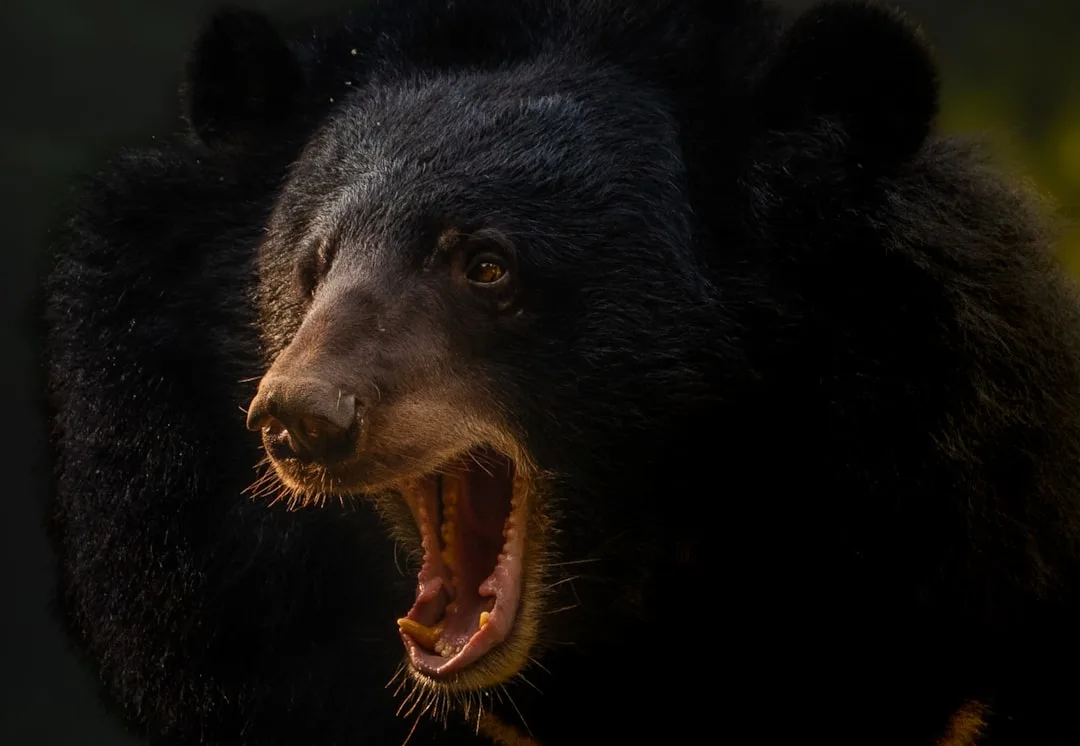
What is the correct response if a black bear attacks?
Black bear attacks demand the opposite response from grizzly attacks. Do not play dead. Fight back immediately and aggressively, targeting the eyes, nose, and face. Herrero and Higgins (2011) found that 88% of fatal black bear attacks were predatory in nature, carried out almost exclusively by lone adult males. A still, silent body looks like prey.
Carry bear spray, deploy it in a 1 to 2 second burst at 8 to 10 metres, and yell loudly to assert dominance. Smith et al. (2008) measured bear spray effectiveness against aggressive black bears at 92 to 98%. Never run, never climb a tree, and never curl up.
The One Decision That Reverses the Grizzly Protocol
If you have spent any time reading bear-country safety material, you already know the grizzly script. Defensive attack, play dead, hands behind the neck, elbows protecting the face, legs spread to prevent rolling. That protocol has saved many lives, and it is the right protocol for the right bear.
It is also the wrong protocol for the bear most North Americans will ever encounter.
The American black bear (Ursus americanus) is the most common large carnivore on the continent, with a population estimated at over 800,000 across the United States, Canada, and northern Mexico. It is also the bear species most likely to walk through a campsite, raid a garbage shed, climb a porch, or step out of a hedge in suburban New Jersey. Encounters are routine. Attacks are not.
But when an attack does occur, the data show a pattern that requires a fundamentally different response from the one we use with brown bears.
This article is built on the foundational work of Stephen Herrero at the University of Calgary, particularly the 2011 Journal of Wildlife Management analysis co-authored with Andrew Higgins, alongside Tom Smith's bear spray studies for the United States Geological Survey, the long observational record of Lynn Rogers at the North American Bear Center, and the official guidance of the National Park Service and Parks Canada.
For the natural history of the animal, see our profile of the American black bear. For risk context, the companion piece are black bears dangerous to humans lays out the underlying numbers.
Why You Fight Back: The Predatory Pattern
The single most important paper on black bear attack response is Herrero and Higgins (2011), Fatal attacks by American black bear on people: 1900-2009, published in the Journal of Wildlife Management. The authors compiled every confirmed fatal black bear attack on a human in North America across 110 years and classified each by motivation.
Their findings overturned the older folk wisdom that all bears, brown or black, should be met with the play-dead response.
- 63 fatal attacks were documented across the study window
- 88% of those fatal attacks were predatory in motivation
- 92% of the predatory bears were male, mostly lone adults
- Only a small minority of fatal attacks involved a sow defending cubs
- Habituated and food-conditioned bears were over-represented in the predatory cases
The reason the pattern matters is mechanistic. A defensive grizzly is trying to neutralise a perceived threat to herself, her cubs, or her food cache. She wants the threat to stop being a threat. Stillness works because it shortens the encounter. A predatory black bear, by contrast, is evaluating a body the way it evaluates a deer carcass or a beaver kit. Stillness signals that the prey is not going to fight back, which is precisely the cost-benefit threshold the bear is testing.
"Of the 63 fatal incidents we examined, 88 percent involved a predatory motivation by the bear. Bears that perceive humans as prey have made a hunting decision, and the standard play-dead response that works for a defensive brown bear actively encourages the predatory black bear to continue."
- Stephen Herrero and Andrew Higgins, Journal of Wildlife Management, 2011
The protocol that follows from this finding is unambiguous. Treat any black bear that closes the distance without defensive vocalisation as a predator until proven otherwise, and respond with the resistance pattern that raises injury cost above food reward.
Reading the Signs: Defensive vs Predatory Behaviour
The single most useful skill in black bear country is the ability to read body language at 30 metres and translate it into the correct response. Defensive bears advertise themselves loudly. Predatory bears do not.
Behaviour Comparison: Warning vs Hunting
| Cue | Defensive (Warning) | Predatory (Hunting) |
|---|---|---|
| Vocalisation | Huffing, blowing, jaw popping, woofing | Silent |
| Ears | Forward, alert, sometimes flicking | Flat back against skull |
| Head Position | Raised or level, eyes on you | Lowered, neck extended forward |
| Body Language | Side-on display, paw swatting ground, false charges | Direct line, steady gait, focused |
| Distance Closure | Erratic, stops short, retreats and re-approaches | Persistent, deliberate, no retreat |
| Triggers | Surprise, cubs, carcass, den proximity | None obvious; bear is hunting |
| Outcome if Ignored | Charge usually breaks off | Contact with intent to consume |
A vocal black bear is almost always a defensive black bear. The huffing, the jaw popping, and the swatted ground are the species' way of saying back off, you are too close. Comply with the request. Do not run, but back away diagonally while keeping the bear in your peripheral vision and speaking in a calm, low voice. Most defensive encounters end inside thirty seconds because the bear gets the space it asked for.
A silent black bear closing distance, especially one that follows when you back off, is the encounter that kills people. The 88% statistic from Herrero and Higgins is built almost entirely on this profile. Trust the silence. Treat it as a hunting decision.
"Black bears that are committed to predation are quiet, focused, and persistent. The behaviour does not look like aggression in the way most people imagine it. It looks like a bear walking calmly toward you and refusing to stop."
- Lynn Rogers, North American Bear Center
The Survival Protocol, Step by Step
The protocol below is consolidated from National Park Service guidance, Parks Canada bear safety manuals, the Interagency Grizzly Bear Committee field training materials, and the published response algorithms in the Wildlife Society Bulletin.
Step 1: Identify the Species
This is non-negotiable. The response to a black bear is the opposite of the response to a grizzly. Colour does not identify the species. Black bears come in cinnamon, brown, blonde, and even white phases. Identify by shoulder profile, face shape, claws, and ear height:
- Black bear: no shoulder hump, straight facial profile, tall pointed ears, short dark claws under 5 cm
- Grizzly: prominent shoulder hump, dished facial profile, short rounded ears, long pale claws over 7 cm
If you cannot tell, default to the grizzly protocol only if you are within current grizzly range (parts of Montana, Wyoming, Idaho, Washington, Alaska, western Canada). In every other state, the bear is a black bear. For the full identification breakdown, see American black bear vs grizzly bear.
Step 2: Assess Defensive vs Predatory
Apply the table above. If the bear is vocalising, posturing, or bluff charging, it is defensive. If the bear is silent, low-headed, ears back, and approaching steadily, it is predatory.
Step 3: Stand Tall and Make Yourself Large
Whatever the motivation, never crouch and never run. Raise your arms, open your jacket, and stand on a rock or stump if one is at hand. A larger silhouette deters both contexts. Speak loudly and firmly. Do not scream in panic; speak in a deep, assertive voice.
Step 4: Deploy Bear Spray at 8 to 10 Metres
If the bear continues to close, spray. Aim slightly below the bear's face so the cloud rises into the eyes and nostrils. Use a 1 to 2 second burst. Do not wait for contact. Bear spray creates a wall of capsaicin at the exact distance where panic destroys aim with any other weapon.
Step 5: Fight Back if Contact Occurs
Target the eyes, nose, and face. Use anything heavy, sharp, or hard: rocks, knives, trekking poles, sticks, camera tripods, fists, knees, boots. Yell continuously. Black bears retreat from determined resistance more often than any other large North American carnivore. The same Herrero record contains repeated cases of unarmed adults driving off attacking black bears with sustained punches and kicks to the muzzle.
Step 6: Do Not Stop Until the Bear Leaves
A black bear that disengages once may circle and re-approach. Stay loud, stay large, and back to a defensible position with the bear still in view. Do not turn your back. Do not assume the encounter is over until the bear is out of sight for several minutes.
What NOT to Do
Equally important is the catalogue of well-meaning mistakes that have killed black bear attack victims. Each item below appears repeatedly in the post-incident reviews compiled by Herrero, Smith, and the National Park Service.
Do Not Play Dead
Playing dead in a predatory black bear attack is the most lethal mistake a person can make. It signals exactly the outcome the bear is hunting for. The Herrero and Higgins record is unambiguous on this.
Do Not Run
Running triggers chase response in every large predator. Black bears can sprint at 40 kilometres per hour and accelerate faster than a human across the first few metres. You will not outrun a black bear on any surface. Running also converts a defensive encounter into a predatory one because flight is a prey signal.
Do Not Climb a Tree
This is the single biggest cultural misconception about black bears. Black bears are exceptional climbers. Their short curved claws, light frame, and powerful forelimbs make them faster up a trunk than any human, and they will follow you up. Lynn Rogers and other observational researchers have documented black bears scaling vertical 20-metre trees in under thirty seconds.
The old advice to "climb a tree to escape a black bear" is the inverse of correct. The species evolved tree access to escape predators larger than itself, including grizzlies. Treat any tree as a death trap, not a refuge.
Do Not Approach Cubs
A black bear sow is statistically less aggressive than a grizzly sow, but she will still attack to defend cubs. More importantly, a cub at close range often means a sow at closer range that you have not seen yet. Back away the moment you identify a cub. For more on family dynamics, see black bear cubs and mothers.
Do Not Rely on Firearms Alone
Smith et al. (2012) reviewed 269 firearm-bear incidents and found shooters were injured in 56% of close encounters. Bear spray was effective in 92 to 98% of black bear cases. Carry both if you choose, but the spray comes out first.
Do Not Camp With Food in the Tent
Predatory black bear attacks at night are nearly always associated with food smell, garbage, or attractants on or near the sleeper. The Sage Patton case (Saskatchewan, 2019) and the Catherine Sweatt-Mueller case (Ontario, 2019) both occurred in landscapes with established bear-human conflict around residential and recreational food storage.
Bear Spray vs Other Deterrents: The Numbers
The empirical literature on bear deterrents has matured significantly since 2000. The single most cited paper is Smith et al. (2008), Efficacy of Bear Deterrent Spray in Alaska, published in the Journal of Wildlife Management. A companion firearm study by the same group followed in 2012. The synthesis below combines those two papers with the more recent reviews from the Wildlife Society Bulletin.
| Deterrent | Effectiveness vs Black Bears | User Injury Rate | Effective Range | Notes |
|---|---|---|---|---|
| Bear spray | 92-98% (Smith 2008) | Near zero in close encounters | 8-10 m | Capsaicin 1-2% concentration; expanding cloud |
| Firearm (any) | 76% (Smith 2012) | 56% in close encounters | 0-30 m | Marksmanship under panic is the failure mode |
| Air horn | ~50% at distance | Low | 0-5 m | Effective at deterring approach, not contact |
| Loud voice / yelling | 30-60% | Variable | 0-2 m | Best paired with spray or determined resistance |
| Group size 4+ | 90%+ encounter avoidance | Near zero | n/a | Single most protective factor outside of spray |
| Playing dead | Increases predatory attack lethality | High | n/a | Wrong response for black bears |
| Climbing a tree | Effectively zero | Very high | n/a | Bears climb faster than humans |
Two findings stand out. First, bear spray works at the exact range and timing where firearms most often fail. Second, group size of four or more is the single most protective behavioural factor. Herrero's database contains almost no fatal black bear attacks on groups of four or more humans. Predatory bears appear to evaluate group risk before committing.
"Of 83 incidents involving bear spray in Alaska between 1985 and 2006, the spray altered the bear's aggressive behaviour 92 percent of the time. In close encounters with brown and black bears, only three of 72 spray users sustained injuries. No spray user was killed."
- Tom S. Smith, USGS, Journal of Wildlife Management, 2008
Case Study: Sage Patton, Saskatchewan, 2019
In May 2019, Sage Patton, a 22-year-old triathlete and wildlife photographer, was killed by a black bear near Hudson Bay, Saskatchewan. Patton was an experienced outdoorsperson and was working on a remote site in northern boreal forest. The post-incident wildlife necropsy classified the attack as predatory.
The bear was a lone adult male in good physical condition, with no evidence of injury, illness, or food conditioning that would have explained defensive aggression. Investigators concluded the attack fit the textbook predatory profile documented by Herrero and Higgins: silent approach, focused pursuit, lone male bear, healthy adult human victim.
The Patton case is cited in updated Saskatchewan provincial bear safety protocols because it demonstrated three things at once. Fitness does not protect against a predatory black bear, which can match human sprint speed over short distances. Experience does not protect either, because predatory encounters rarely give warning signs to read. And carrying bear spray is the single behaviour change that consistently shifts outcomes, even for solo travellers in deep backcountry.
Case Study: Catherine Sweatt-Mueller, Ontario, 2019
Four months after Patton, Catherine Sweatt-Mueller was killed by a black bear at her family's cabin on Red Pine Island, Lake of the Woods, Ontario. She had stepped outside in the evening to investigate disturbance to her dogs.
The attacking bear was a lone adult female with two cubs, but the post-incident review by the Ontario Ministry of Natural Resources and Forestry noted that the encounter dynamics were predatory rather than purely defensive: persistent pursuit, return after initial disengagement, and partial consumption of the victim. A second bear, also a female with cubs, was destroyed at the scene.
The Sweatt-Mueller case complicates the simple male-predator framing because it demonstrates that female black bears can also engage in predatory behaviour, particularly in landscapes with chronic food conditioning around cabin and cottage country. The Lake of the Woods region had documented bear-human conflict around residential food storage in the years leading up to the incident.
Both 2019 cases together pushed Canadian provincial agencies to revise public education materials, with stronger emphasis on the fight-back-immediately rule and on food storage discipline in cottage country.
Camp Food Storage in Bear Country
The single largest behavioural lever for preventing predatory black bear attacks is removing the food incentive that creates habituated bears in the first place. Black bears that learn to associate humans with food calories progress through a documented escalation: campsite raids, daytime approaches, structure damage, and in a small minority of cases, predation on the humans themselves.
The bear that killed Catherine Sweatt-Mueller did not become a predator overnight. It became one across years of access to anthropogenic food.
The Interagency Grizzly Bear Committee and Parks Canada both publish detailed food storage standards. The core rules are universal across black and grizzly country.
- Store all food, garbage, toiletries, and cookware in an IGBC-certified bear canister, in a hard-sided vehicle, or hung at least 4 metres up and 1.5 metres out from any tree trunk
- Cook and eat at least 100 metres from your tent, downwind where possible
- Never sleep in clothes worn while cooking; food vapour bonds to fabric
- Burn nothing: black bears can detect food residue in fire pits at 100 metres or more
- Do not bury scraps; bears excavate them within hours
- Wash dishes immediately and disperse grey water at least 50 metres from camp
- Carry bear spray on your hip at all times in camp, including overnight
For deeper context on what attracts black bears to human food sources, see what do black bears eat and our overview of where black bears live.
Black Bear vs Grizzly Response: The Comparison
Many North Americans live in landscapes where both species range or where the species identification is ambiguous. The protocols are not interchangeable. The table below condenses the contrast.
| Scenario | Black Bear Protocol | Grizzly Protocol |
|---|---|---|
| Surprise encounter, defensive bear | Stand tall, back away, do not run | Stand still, do not run, prepare spray |
| Bluff charge | Stand ground, deploy spray if persistent | Stand ground, deploy spray if at 8-10 m |
| Contact (defensive) | Fight back | Play dead (face down, hands behind neck) |
| Contact (predatory) | Fight back | Fight back |
| Night attack in tent | Fight back immediately | Fight back immediately |
| Climb a tree? | Never (black bears climb fast) | Never (slower but still climb) |
| Run? | Never | Never |
| Group size benefit | High (4+ rarely attacked) | High (4+ rarely attacked) |
For the full grizzly response framework, see how to survive a grizzly bear attack. For polar bears, where attacks are nearly always predatory and protocol shifts again, see are polar bears dangerous to humans and the species profile polar bear.
"Black bears very rarely attack people, and when they do, the attacks are usually predatory. The defensive play-dead response that works for grizzlies is not appropriate. People should fight back vigorously."
- National Park Service, Bear Safety Guidance
The Statistical Picture: How Rare Is a Black Bear Attack?
Despite living alongside more than 800,000 black bears across the continent, North Americans experience an average of one to two fatal black bear attacks per year. Across the entire 110-year window analysed by Herrero and Higgins, 63 deaths were recorded. That is fewer than the number of people killed annually in the United States by bee stings, lightning strikes, or domestic dogs.
Put another way, the per-bear annual fatality rate is on the order of one in 400,000. The per-encounter fatality rate is far lower still, because most encounters end with the bear running away before the human even fully registers it. The pattern remains overwhelmingly favourable: a black bear is statistically among the safer large carnivores to share landscape with on an interaction-by-interaction basis.
The rarity is also why preparation matters. The base rate is so low that complacency is the default failure mode. A backcountry traveller who never carries spray, who hangs food carelessly, who hikes alone without making noise, can spend decades in black bear country without consequence. The same traveller, on a single bad day, meets the lone adult male in the silent predatory profile and has none of the tools that change the outcome.
What This Means for Your Next Hike
The takeaway is simple but uncomfortable for anyone trained on the older grizzly-style protocol. Black bear country is fight-back country. Carry bear spray. Hike in groups of four when possible. Make noise on blind trail sections. Store food rigorously. Identify the species correctly before choosing a response.
And if a black bear closes the distance silently, with ears flat and head low, treat that as the predatory profile that the Herrero data spent a century documenting and respond with everything you have.
For more context on the biology that drives black bear behaviour, our profile of the American black bear covers diet, denning, range, and behaviour in depth. For a direct safety comparison piece, are black bears dangerous to humans is the companion to this article.
Outdoor cognition under stress is itself a skill worth training. The same neural systems that help with logical pattern recognition in the field are the ones tested at whats-your-iq.com. Field communication and team protocols benefit from clear writing skills covered at evolang.info, and trip planning documents are easier to manage with the format conversion tools at fileformer.com.
References
- Herrero, S., and Higgins, A. (2011). Fatal attacks by American black bear on people: 1900-2009. Journal of Wildlife Management, 75(3), 596-603. https://doi.org/10.1002/jwmg.72
- Smith, T. S., Herrero, S., DeBruyn, T. D., and Wilder, J. M. (2008). Efficacy of Bear Deterrent Spray in Alaska. Journal of Wildlife Management, 72(3), 640-645. https://doi.org/10.2193/2006-452
- Smith, T. S., Herrero, S., Layton, C. S., Larsen, R. T., and Johnson, K. R. (2012). Efficacy of Firearms for Bear Deterrence in Alaska. Journal of Wildlife Management, 76(5), 1021-1027. https://doi.org/10.1002/jwmg.342
- Herrero, S. (2018). Bear Attacks: Their Causes and Avoidance (3rd edition). Lyons Press. https://doi.org/10.5860/choice.39-2843
- Rogers, L. L. (1987). Effects of food supply and kinship on social behavior, movements, and population growth of black bears in northeastern Minnesota. Wildlife Monographs, 97, 3-72. https://doi.org/10.2307/3830545
- Garshelis, D. L., Crider, D., and van Manen, F. (2016). Ursus americanus: The IUCN Red List of Threatened Species. https://doi.org/10.2305/IUCN.UK.2016-3.RLTS.T41687A114251609.en
- Mattson, D. J., Herrero, S., Wright, R. G., and Pease, C. M. (1996). Designing and managing protected areas for grizzly bears: how much is enough? Conservation Biology, 10(4), 1013-1025. https://doi.org/10.1046/j.1523-1739.1996.10041013.x
- Gore, M. L., Knuth, B. A., Curtis, P. D., and Shanahan, J. E. (2007). Education programs for reducing American black bear-human conflict. Wildlife Society Bulletin, 34(1), 75-82. https://doi.org/10.2193/0091-7648(2006)34[75:EPFRAB]2.0.CO;2
Frequently Asked Questions
Should I play dead if a black bear attacks me?
No. Playing dead is the correct response for a defensive grizzly attack but the wrong response for almost every black bear attack. Herrero and Higgins (2011) reviewed 63 fatal black bear attacks across North America between 1900 and 2009 and found that 88% were predatory in nature and carried out by male bears. A predatory bear interprets a still, quiet body as available prey.
The protocol endorsed by the National Park Service, Parks Canada, and the North American Bear Center is to fight back immediately and aggressively. Target the eyes, nose, and face with rocks, sticks, fists, knives, trekking poles, or anything heavy. Yell loudly. Never curl up, never lie face-down, and never go quiet.
The same data show that determined resistance from a single human, even an unarmed one, frequently ends a black bear attack within seconds because the species reads injury risk before food reward.
Does bear spray work on black bears?
Yes, and the evidence is overwhelming. Smith et al. (2008), reviewing bear spray incidents in Alaska between 1985 and 2006, found that bear spray stopped aggressive black bear behaviour in approximately 92 to 98% of cases, with no injuries reported among users in the close-range encounters reviewed.
Effective range is 8 to 10 metres, and a single 1 to 2 second burst aimed slightly below the bear’s face creates a capsaicin cloud that disorients the animal at the exact distance where firearms most often miss. The Interagency Grizzly Bear Committee, the National Park Service, and every provincial wildlife agency in Canada recommend bear spray as the primary deterrent in black bear country, including for hikers, campers, hunters, and rural homeowners.
Carry it in a hip holster, never inside a backpack, and replace it before the expiration date stamped on the canister.
How can I tell if a black bear is bluff charging or actually attacking?
A bluff charging black bear is loud, performative, and physically expressive. Look for huffing and blowing, jaw popping, swatting the ground with a front paw, ears rotated forward, and a body that pulls up short of contact. The bear is communicating that you are too close and that it wants you to leave. Stand your ground, speak in a calm low voice, and back away diagonally while keeping the bear in view. A genuine predatory attack looks nothing like this.
The bear is silent, the ears are flattened back, the head is held low and level, and the approach is steady, focused, and persistent. There is no posturing because predation is not a negotiation. If the encounter has any predatory marker, deploy bear spray at 8 to 10 metres and prepare to fight back if contact occurs. The single most reliable indicator is silence: a vocal black bear is almost always a defensive black bear.