
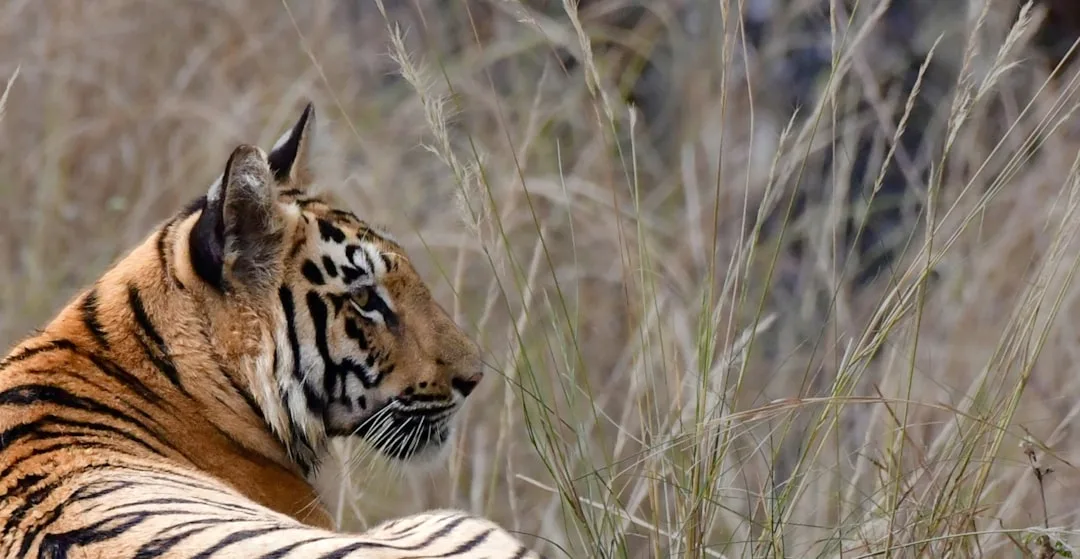
The Bengal tiger is the most numerous and most iconic of the surviving tiger subspecies. It is the national animal of both India and Bangladesh, the flagship species of Project Tiger - the most successful single-species conservation effort in tropical Asia - and one of only two populations of wild cat (the other being the Siberian tiger) in the running for the title of largest living felid.
Panthera tigris tigris is the tiger of Rudyard Kipling, of Mughal miniatures, of the Indian two-rupee coin, and of every serious conversation about Asian mammal conservation.
This guide is a reference entry on Bengal tiger biology and ecology: size, stripes, hunting behaviour, diet, reproduction, population dynamics, Project Tiger, the unusual Sundarbans population, white tigers, and conflict with humans. It is not a summary. Expect specifics - kilograms, kilometres, populations, census years, and verified records.
Etymology and Classification
The tiger genus Panthera includes the five "big cats" capable of true roaring: lion, tiger, jaguar, leopard, and snow leopard. Panthera tigris - the tiger species - was formally described by Linnaeus in 1758. The Bengal subspecies designation Panthera tigris tigris makes it the nominate form: the first-described, reference tiger of the species.
Modern genetic work has simplified the traditional tiger taxonomy.
Where 20th-century authors recognised eight or nine subspecies (three now extinct), the IUCN Cat Specialist Group's 2017 revision condensed surviving tigers into two subspecies: continental (P. t. tigris, which absorbs the former Indochinese, Malayan, South China, and Siberian forms) and Sundaic (P. t. sondaica, Sumatran and the extinct Javan and Balinese forms).
Most field research, census work, and government policy still treats "Bengal tiger" as a distinct population, and that is the sense used in this entry - the tigers of the Indian subcontinent. In Hindi the tiger is bagh; in Bengali, baagh; in Sanskrit, vyaghra.
Tigers diverged from their closest living relatives, the snow leopards, roughly 2.8 million years ago. Within the tiger species, Bengal tigers are thought to have separated from other continental tigers 70,000-110,000 years ago, after a major population bottleneck that left the species with unusually low genetic diversity for such a widespread predator.
Size and Physical Description
Bengal tigers are tied with Siberian tigers as the largest cats alive today. Size is strongly sex-linked: males are substantially heavier, longer, and more muscular than females.
Males:
- Length: 2.7-3.1 metres from nose to tail
- Shoulder height: 90-110 centimetres
- Weight: typically 220-270 kg, exceptional individuals over 300 kg
Females:
- Length: 2.4-2.65 metres
- Weight: typically 140-180 kg
- Generally 60-70 per cent the mass of a comparable male
Cubs at birth:
- Length: roughly 30-35 cm
- Weight: 785-1,610 grams
The heaviest verified wild Bengal tiger was shot in northern India in 1967 and weighed 388.7 kilograms, which remains the record for any wild cat anywhere. That figure is quoted repeatedly in the literature and is backed by multiple independent sources, including field notes and photographs. Exceptional individuals aside, healthy adult Bengal males settle in the 220-270 kg range.
Bengal tigers are built for ambush power rather than distance. Forelimbs are heavily muscled and can swipe with enough force to break the neck of a 400 kg sambar deer. Canines exceed 9 centimetres in adult males - the longest, relative to skull size, of any living cat - and are used to deliver killing bites to the throat or back of the neck.
The tongue is rough enough to rasp meat off bone and carries the same papillae structure as domestic cats, scaled up. Rear molars are reduced; tigers do not chew sideways, they scissor through flesh with their carnassials.
The fur is the tiger's best-known feature. A Bengal tiger's ground colour ranges from pale yellow through orange to deep rust, with white on the belly, chest, inner limbs, and facial markings. Black stripes overlay the coat in a pattern unique to each individual, rather like human fingerprints.
Camera-trap researchers across India identify tigers from flank and shoulder stripe patterns alone, with error rates low enough to support population-level census work. Crucially, stripes continue onto the skin - pigment is in the skin as well as the hair, and a shaved tiger would still show the pattern.
Stripes as Fingerprints and White Tigers
Each tiger has an asymmetric stripe pattern. The left and right flanks are different, and no two tigers share an identical pattern on either flank. This is the basis of photographic mark-recapture surveys that now underpin the tiger census in every range state. A typical India-wide census cycle processes tens of millions of camera-trap photos through semi-automated identification software, matching stripe patterns to generate individual ID histories.
White tigers deserve a careful note because the public myth is almost entirely wrong. White tigers are not albinos, not a separate species, not a separate subspecies, and not a natural variant in any stable population. They are Bengal tigers carrying a recessive mutation in the SLC45A2 gene, which suppresses the production of red and yellow pigments while leaving black stripes intact.
True albinos lack all melanin and have pink eyes; white tigers retain black stripes and blue eyes. The last verified wild white Bengal tiger was captured as a cub in 1951 in Rewa, central India, by the Maharaja. Virtually every white tiger alive today descends from that single animal.
The captive population is sustained by close inbreeding, which concentrates unrelated genetic defects such as cleft palate, crossed eyes, scoliosis, and immune deficiency. Serious conservation biologists oppose commercial white tiger breeding on welfare and genetic grounds.
Hunting and Diet
Bengal tigers are obligate, hypercarnivorous ambush predators. Core prey consists of medium-to-large ungulates - chital (spotted deer), sambar, wild boar, nilgai, gaur, and water buffalo. An adult tiger requires roughly 5-6 kg of meat per day averaged over time, which in practice means one large kill every 7-8 days and a single prolonged feeding session that can consume 20-40 kg at a sitting.
Tigers return to a carcass repeatedly over two to four days, defending it from vultures, jackals, leopards, and other tigers.
Primary prey:
- Chital (Axis axis) - the most common kill across India
- Sambar (Rusa unicolor) - largest common prey, preferred by big males
- Wild boar (Sus scrofa) - year-round staple
- Gaur (Bos gaurus) - occasional, adults only by large males
- Water buffalo - riverine and Terai populations
Secondary and opportunistic prey:
- Nilgai (Indian antelope) and chinkara
- Barking deer and hog deer
- Langur and macaque monkeys
- Livestock near reserve boundaries
- In the Sundarbans: fish, crabs, monitor lizards
- Rarely, young rhinos or elephant calves
Hunting technique. A Bengal tiger stalks downwind through cover, using rocks, grass, and undergrowth for concealment. It closes to within 10-20 metres before launching a short explosive sprint that ends in a single leap onto the prey. Large prey are killed by a suffocating throat bite; smaller prey by a nape bite that severs the spinal cord.
Ambush success is low: long-term studies put the wild kill rate at roughly 10 per cent of attempts, meaning nine failed hunts for every successful one. This is why a tiger invests such effort in defending each carcass.
Bengal tigers can leap horizontally up to 6 metres and vertically 3-4 metres. They can sprint at up to 60 km/h in short bursts but fatigue quickly. Most hunts conclude within 50 metres of the initial pounce; prey that breaks clear of that first rush almost always escapes.
The Sundarbans Population
The Sundarbans is a 10,000 square kilometre mangrove delta shared by India and Bangladesh at the mouth of the Ganges-Brahmaputra river system. It is the only major mangrove habitat on Earth occupied by any big cat, and its Bengal tigers differ from their inland relatives in several measurable ways.
Sundarbans tigers swim constantly between tidal islands, sometimes crossing channels several hundred metres wide. They are the only tiger population that routinely incorporates fish, crabs, and monitor lizards into the diet.
Twice-daily tides reshape the landscape and eliminate freshwater pooling; drinking water is largely brackish, which some researchers link to physiological stress and possibly to the population's unusual behaviour. Average body size is slightly smaller than inland Bengals, and radio-telemetry home ranges are larger per unit prey biomass than in terrestrial reserves.
The Sundarbans is also the only tiger population on Earth in which humans appear consistently in the kill record. Between 50 and 100 people are killed by tigers in the Sundarbans in a typical year, depending on source and jurisdiction.
Explanations overlap rather than compete: dense mangrove cover puts fishermen, honey collectors, and wood cutters well inside a tiger's ambush distance before either species notices; prey densities are lower than inland, raising the marginal attractiveness of unusual prey; low-status human workers are forced into core tiger habitat to make a living; and some researchers argue that brackish drinking water and a high parasite load contribute to elevated aggression.
Mitigation measures include face masks worn on the back of the head - which disrupt ambush approaches from behind - electrified human-shaped decoys, nylon fencing along villages, and strictly controlled access permits.
Life Cycle and Reproduction
Bengal tigers are polyoestrous and can breed year-round, though births cluster in late winter and early spring across most of the range. Females reach sexual maturity at 3-4 years, males at 4-5 and only after establishing a territory, which usually means displacing or killing an incumbent.
Oestrus lasts 3-7 days. Mating pairs copulate repeatedly during this window - sometimes more than 100 times over a few days - before separating. Gestation is 104-106 days. Litters of 2-4 cubs are born in a dense thicket or rock crevice. Cubs are blind, deaf, and helpless at birth, weighing around 1 kg each.
Cub development:
- Eyes open: 6-14 days
- First solid food: ~8 weeks
- Weaning: ~6 months
- First hunting practice: ~6-8 months
- Independence: 18-24 months (sometimes to 30 months)
Cub mortality is severe. Long-term studies estimate that roughly half of Bengal cubs die before their second birthday. Starvation, disease, and infanticide by incoming males are the leading causes. When a new male takes over a territory he typically kills any existing cubs, which brings the resident females back into oestrus and allows him to father his own litter.
This sexual conflict is one of the strongest selective pressures on adult female tigers, who will defend cubs violently and sometimes relocate them to new den sites mid-litter.
Females produce a litter every 2-3 years during their reproductive prime, which runs roughly from age 4 to age 12. Reproductive lifespan in males is shorter because territories rarely last more than five or six years before being contested. A single dominant male may sire 15-25 cubs across his lifetime, of which perhaps 6-10 reach adulthood.
Territory, Movement, and Social Life
Bengal tigers are solitary. Adults maintain exclusive territories, with female ranges overlapping a male's larger range. Typical male territory size is 30-100 square kilometres in prime Indian habitat, rising to 200+ in lower-prey landscapes. Female territories are usually 20-60 square kilometres. Territories are marked with scrape markings, scat, and spray-urine that carry individual-specific chemical signatures.
| Metric | Value |
|---|---|
| Typical male territory size | 30-100 km^2 (prime habitat) |
| Typical female territory size | 20-60 km^2 |
| Daily movement | 10-20 km |
| Sprint speed | 60 km/h (short bursts) |
| Horizontal leap | up to 6 m |
| Vertical leap | 3-4 m |
| Roar audibility | up to 3 km on still nights |
| Swim distance (Sundarbans) | routinely 1-8 km between islands |
A Bengal tiger's roar can be heard up to 3 kilometres away on still nights, and adult tigers produce an estimated 3,000 or more roars per year. Roaring advertises territory, warns rivals, and - in females - signals oestrus. Sub-roar vocalisations include chuffing (prusten), a friendly greeting call; moaning; growling; and an alarm cough.
Social encounters between adults are rare, brief, and usually hostile. Cubs share a mother's range until independence, after which daughters sometimes settle in adjacent territories while sons disperse much further - 30 kilometres or more through forest corridors, often through human-dominated landscape.
Populations, Project Tiger, and Census Data
India holds more than 75 per cent of the global wild tiger population. Nepal, Bangladesh, and Bhutan contribute the remainder. The modern story of the Bengal tiger is one of collapse followed by the most celebrated large-cat recovery in the world.
Project Tiger. Launched on 1 April 1973 by Prime Minister Indira Gandhi, Project Tiger began with nine reserves covering 14,000 square kilometres. It established a network of inviolate core zones surrounded by multi-use buffer zones, trained dedicated forest guards, relocated human settlements out of core areas with compensation, banned tiger hunting nationwide, and funded long-term monitoring.
It is widely considered the most successful single-species conservation programme in tropical Asia. The reserve network has since expanded to 55 tiger reserves covering more than 75,000 square kilometres.
Census trajectory. India has run nationwide tiger censuses at regular intervals since the 1970s. Methods have evolved from pugmark tracking (walkover counts of paw prints) to rigorous camera-trap photographic mark-recapture, which is the current gold standard.
| Census year | India tiger count | Source |
|---|---|---|
| 1973 | ~1,800 (estimate) | Project Tiger baseline |
| 2006 | 1,411 | National Tiger Conservation Authority |
| 2010 | 1,706 | NTCA / Wildlife Institute of India |
| 2014 | 2,226 | NTCA / WII |
| 2018 | 2,967 | NTCA / WII |
| 2023 | 3,682 | NTCA / WII |
The 2006 count of 1,411 tigers was the modern low point and triggered a political and financial re-commitment to the programme. Subsequent censuses have shown near-linear growth, with each four- or five-year cycle adding 500-750 tigers. Nepal has roughly tripled its tiger population since 2009. Bhutan's high-altitude tigers, discovered via camera traps at elevations above 4,000 metres, represent a new and growing population.
Conservation Status and Threats
The IUCN Red List classifies the tiger (Panthera tigris) as Endangered at the species level. The Bengal population is the single largest and most demographically robust of the surviving tiger groups, and it is the only tiger subspecies whose range-state censuses show consistent, sustained growth.
Primary ongoing threats:
- Habitat loss and fragmentation. India's reserve network is effective inside protected boundaries, but forest corridors connecting reserves are steadily lost to roads, railways, agriculture, and urban expansion. Fragmentation isolates small populations, which raises inbreeding risk and cuts off dispersing males from new territories.
- Prey depletion. Tigers cannot be saved without their prey. Declines in chital, sambar, and wild boar populations - driven by poaching, livestock competition, and habitat degradation - directly limit tiger density in otherwise suitable habitat.
- Poaching. Demand for tiger skins, bones, and parts used in traditional East Asian medicine remains the dominant economically-motivated threat. Enforcement across the India-Nepal-Bangladesh border has tightened substantially, but seizures continue at significant rates.
- Human-tiger conflict. Tigers dispersing out of core reserves occasionally kill livestock, injure farmers, and are themselves killed in retaliation. Compensation schemes, rapid-response teams, and community education have reduced retaliatory killings in India but not eliminated them.
- Climate change in the Sundarbans. Sea level rise threatens to inundate much of the Sundarbans mangrove system within this century, potentially eliminating the only big-cat mangrove population on Earth.
Protective measures. The species is listed on CITES Appendix I, banning international commercial trade. India's Wildlife (Protection) Act, 1972 provides the highest level of domestic legal protection. The Global Tiger Recovery Program - a 13-country commitment signed in 2010 in St Petersburg - pledged to double wild tiger numbers by 2022. Range states met or exceeded this goal in aggregate, largely on the strength of Indian and Nepali recovery.
Bengal Tigers and Humans
The Bengal tiger occupies a cultural niche matched by few other animals. It is the national animal of India and Bangladesh, the vehicle (vahana) of the goddess Durga in Hindu mythology, a central figure in Mughal miniature painting, and the subject of some of the most widely-read fiction about the Indian subcontinent - from Rudyard Kipling's The Jungle Book to Yann Martel's Life of Pi. Tiger iconography appears on currency, government logos, and the emblems of the Indian cricket team.
Modern coexistence is a carefully managed balance. Most Indians live within a few hundred kilometres of a tiger reserve. Tiger-based tourism generates significant income for local communities around reserves such as Ranthambore, Bandhavgarh, Corbett, and Kanha, providing economic incentives for conservation that would not otherwise exist. Done badly, tourism overcrowds reserves and stresses individual animals; done well, it builds a constituency that local and national politicians cannot ignore.
Traditional ecological knowledge contributes meaningfully to tiger protection. Indigenous forest communities across central India have accumulated detailed understanding of tiger behaviour, prey ecology, and forest-corridor geography over generations. Several of the most successful recent reserve expansions have explicitly incorporated community co-management arrangements rather than the older exclusion model.
Related Reading
- Tiger: Largest Cat, Stripes, and Survival
- Lion vs Tiger: Who Would Win?
- Snow Leopard: Ghost of the Mountains
- Jaguar: Strongest Bite Force
- The Secret Lives of Big Cats
References
Relevant peer-reviewed and governmental sources consulted for this entry include the National Tiger Conservation Authority of India's Status of Tigers in India reports (2006, 2010, 2014, 2018, 2022/2023), the Wildlife Institute of India's All-India Tiger Estimation protocols, IUCN Red List assessments for Panthera tigris (2022), the IUCN Cat Specialist Group Cat News Special Issue 11 (2017) taxonomic revision, published research in Science, Biological Conservation, Journal of Zoology, and Oryx, and the Global Tiger Recovery Program country status reports from India, Bangladesh, Nepal, and Bhutan.
Population figures reflect the most recent consolidated estimates as of the 2023 All-India Tiger Estimation.
See also: Snow Leopard vs Tiger
Frequently Asked Questions
How big are Bengal tigers?
Adult male Bengal tigers (Panthera tigris tigris) weigh 220-270 kg on average and measure 2.7-3.1 m from nose to tail. Females are smaller at 140-180 kg and 2.4-2.65 m long. The heaviest verified wild Bengal tiger, shot in northern India in 1967, weighed 388.7 kg - the record for any wild cat. Shoulder height in males ranges from 90 to 110 cm. Cubs weigh just 785-1,610 grams at birth and gain roughly 100 grams a day during the first months.
Bengal tigers are tied with Siberian tigers (Panthera tigris altaica) as the largest living felids, though Bengals are on average slightly leaner and more muscular.
What do Bengal tigers eat?
Bengal tigers are obligate carnivores and ambush predators. Their core prey consists of large ungulates - chital (spotted deer), sambar, wild boar, nilgai, gaur, and water buffalo. An adult tiger requires roughly 5-6 kg of meat per day on average and kills a large prey animal every 7-8 days.
Favoured hunting technique is stalk-and-ambush: the tiger closes within 10-20 metres through cover, then explodes into a short sprint and delivers a throat or nape bite. Ambush success is low - around 10 per cent of attempts result in a kill - which is why tigers guard carcasses and return repeatedly. In the Sundarbans, tigers supplement deer and wild boar with fish, crabs, monitor lizards, and occasional livestock.
Where do Bengal tigers live?
Bengal tigers inhabit the Indian subcontinent across four nations: India (which holds more than 75 per cent of the global wild population), Bangladesh, Nepal, and Bhutan. Habitat types are unusually diverse for a single big cat - tropical evergreen forest in the Western Ghats, dry deciduous forest in central India, tall grassland and riverine forest in the Terai Arc, montane forest in Bhutan, and the flooded mangrove forest of the Sundarbans delta.
Tigers in the Sundarbans occupy the only major mangrove habitat where any big cat lives, regularly swim between tidal islands, and face twice-daily tides that reshape their hunting grounds. Density varies enormously: the highest densities exceed 10 tigers per 100 square kilometres in reserves like Corbett and Kaziranga.
Are Bengal tigers endangered?
The IUCN Red List classifies the tiger (Panthera tigris) as Endangered at the species level. The Bengal subspecies is the most numerous of the surviving tiger subspecies and is the only one showing sustained population growth. India’s nationwide census counted about 1,411 tigers in 2006 - the low point - rising to 2,226 in 2014, 2,967 in 2018, and 3,682 in the 2023 census. Nepal has roughly tripled its tiger population since 2009.
Bangladesh and Bhutan remain smaller but stable. Primary ongoing threats include habitat loss, prey depletion, poaching for skins and traditional medicine, human-tiger conflict at reserve boundaries, and fragmentation of forest corridors between protected areas.
How long do Bengal tigers live?
Wild Bengal tigers typically live 10-15 years. Few exceed 15. Captive tigers regularly reach 20 years and occasionally beyond, thanks to consistent food supply and veterinary care. Cub mortality is high - roughly 50 per cent of cubs die before their second birthday, mostly from starvation, predation by other tigers (including infanticide by incoming males), and disease.
Females reach sexual maturity at 3-4 years and typically produce one litter every 2-3 years until around age 12. Males mature later at 4-5 years and must secure a territory before they can breed, which often means displacing or killing an established rival.
What is Project Tiger and why does it matter?
Project Tiger is a government conservation programme launched by India in 1973 under Prime Minister Indira Gandhi, beginning with nine tiger reserves covering 14,000 square kilometres. It is widely considered the most successful single-species conservation effort in tropical Asia.
The programme established a network of core and buffer zones, trained dedicated forest guards, relocated human settlements out of core areas with compensation, banned tiger hunting, and funded long-term monitoring. From an estimated low of about 1,200 tigers in the early 1970s, India’s population roughly doubled within decades.
The reserve network has expanded to 55 tiger reserves covering more than 75,000 square kilometres, and the 2023 census figure of 3,682 tigers represents the highest count since modern surveys began.
Why do Sundarbans tigers attack humans?
The Sundarbans - a 10,000 square kilometre mangrove delta shared by India and Bangladesh - hosts the only Bengal tiger population that consistently includes humans in its killed-prey record. Between 50 and 100 people are killed by tigers in the Sundarbans in a typical year, though figures vary. Several factors overlap.
Dense mangrove vegetation puts fishermen, honey collectors, and wood cutters within a tiger’s ambush distance before either species notices. Drinking water is often brackish, which some researchers link to physiological stress in tigers. Crab and fish prey provides smaller energy returns than deer elsewhere. Human activities bring many low-status workers deep into core tiger habitat.
Mitigation measures include face masks worn on the back of the head (which disrupt ambush approaches from behind), electrified dummies, and restricted access permits.
Are white tigers a different species or albinos?
White tigers are neither a separate species nor albinos. They are Bengal tigers (Panthera tigris tigris) carrying a recessive mutation in the SLC45A2 gene, which suppresses the production of red and yellow pigments while leaving black stripes intact. True albinos lack melanin entirely and have pink eyes; white tigers retain black stripes and blue eyes.
The mutation is extremely rare in the wild - the last verified wild white Bengal tiger was captured in 1951 in Rewa, central India, and most white tigers alive today descend from that single animal. The captive white tiger population is maintained almost entirely through inbreeding, which concentrates unrelated genetic defects such as cleft palate, crossed eyes, and immune deficiency.
Conservation biologists generally oppose white tiger breeding programmes on welfare and genetic grounds.