
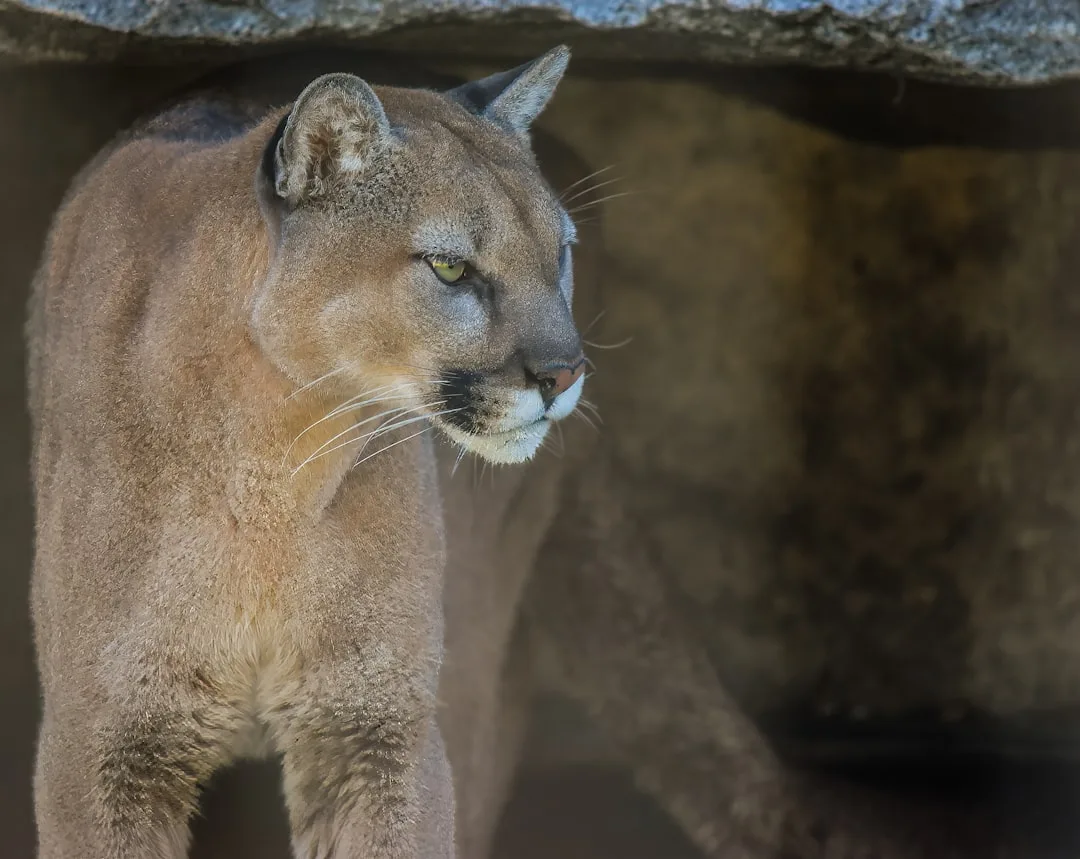
The mountain lion is the most widely distributed wild cat in the Americas and the mammal with the most common names in the English language. A single species, Puma concolor, ranges from the Yukon in northwestern Canada to the southern tip of Patagonia, occupying more habitats and more latitudes than any other native land mammal in the western hemisphere.
Across that range it is called cougar, puma, panther, catamount, ghost cat, painter, mountain screamer, and at least thirty other regional names - all for the same tawny, long-tailed, solitary predator.
This guide covers every major aspect of mountain lion biology and ecology: taxonomy, size, habitat, hunting and diet, reproduction, territory and movement, conservation, subspecies, the famous cats of Los Angeles and Florida, and the uncomfortable fact that this is not actually a "big cat" at all. It is a reference entry, not a summary - so expect specifics: kilograms, kilometres, success rates, record leaps, and subspecies counts.
Etymology and Classification
The scientific name Puma concolor was established by Carl Linnaeus in 1771. Concolor is Latin for "of one colour", a direct reference to the cat's uniformly tawny coat - one of the few large cats without spots, stripes, or rosettes as an adult. Cubs are spotted, but the markings fade before their second year.
The mountain lion holds a Guinness World Record for the most names of any animal.
More than 40 regional English names exist, including cougar (from the Tupi Indigenous word susuarana via Portuguese and French), puma (from Quechua), panther (a catch-all formerly applied to any solid-coloured large cat), catamount (a contraction of "cat of the mountain"), painter (an Appalachian dialect corruption of "panther"), mountain screamer (referring to the female's oestrous call), and ghost cat (a nod to how rarely one is ever seen).
In Spanish, Portuguese, and Indigenous American languages dozens more names exist: leon de montana, leon americano, onca vermelha, mitzli in Nahuatl, yaguarete-pyta in Guarani. All refer to the same species.
Taxonomically the mountain lion belongs to:
- Kingdom: Animalia
- Phylum: Chordata
- Class: Mammalia
- Order: Carnivora
- Family: Felidae
- Subfamily: Felinae
- Genus: Puma
- Species: P. concolor
That subfamily assignment is critical. Despite being the fourth-largest cat in the world, the mountain lion is not a "big cat" in the technical sense. True big cats belong to the subfamily Pantherinae and the genus Panthera - lions, tigers, leopards, jaguars, and snow leopards. The mountain lion sits in Felinae alongside domestic cats, lynx, bobcats, ocelots, and the cheetah.
Molecular clock studies place Puma concolor closer to the house cat than to the lion, with a common ancestor roughly 6-8 million years ago.
The consequences are physical and audible. A mountain lion cannot roar - it lacks the specialised flexible hyoid bone and elongated vocal folds that give Panthera cats their thunderous roar. A mountain lion can purr continuously on both inhalation and exhalation, exactly like a house cat. It also screams, hisses, growls, chirps, and whistles.
The scream of a female mountain lion in oestrus is one of the most unsettling sounds in the North American wilderness and has been mistaken for a woman in distress for centuries.
Size and Physical Description
Mountain lions are large, powerful, elongated cats built for ambush, short bursts of explosive speed, and extraordinary leaping. Size varies across the range, with the largest individuals found in temperate latitudes (western North America and Patagonia) and smaller cats near the equator.
Males:
- Length: 2.0-2.4 metres (nose to tail tip)
- Tail length: 60-90 cm (roughly one-third of total length)
- Shoulder height: 60-90 cm
- Weight: typically 30-90 kg; record 125 kg (Arizona, 1917)
Females:
- Length: 1.5-2.1 metres
- Weight: typically 25-65 kg
- About 60-70% of male body mass
Cubs at birth:
- Length: roughly 30 cm
- Weight: 400-500 grams
- Born blind, deaf, and spotted
The mountain lion's body is proportioned for leaping rather than endurance running. The hind legs are the longest, proportionally, of any cat in the family Felidae. The shoulders and hips are powerful and muscular; the chest is deep; the head is comparatively small with a short, rounded muzzle. The tail is long, thick, and black-tipped, acting as a counterweight during high-speed turns and long leaps.
Adult coat colour is uniform, ranging from grey-brown in northern and high-elevation populations to rich reddish-tawny in the tropics and swamp habitats of Florida. The undersides, throat, and insides of the legs are pale cream or white. The muzzle carries distinctive black markings at the lip line and nose, and the backs of the ears are dark.
Despite persistent folklore, no verified black mountain lion has ever been documented - true melanism has never been confirmed in Puma concolor, and "black panther" sightings in the Americas almost always refer to melanistic jaguars or leopards.
Range and Habitat
The mountain lion's geographic distribution is the broadest of any wild cat in the western hemisphere. From north to south it spans from roughly 60 degrees north in the Yukon to 54 degrees south in Patagonia - more than 110 degrees of latitude. No other native land mammal in the Americas matches this range.
Habitats occupied:
- Boreal and temperate coniferous forest
- Temperate deciduous forest
- Rocky mountain terrain up to 5,800 m
- Desert and semi-desert (Sonoran, Chihuahuan, Patagonian steppe)
- Subtropical and tropical rainforest (Central and South America)
- Swamps and cypress forest (Florida Everglades)
- Grasslands and savanna edges
- High-elevation paramo above 4,000 m
Mountain lions thrive wherever cover is adequate, ungulate prey is present, and persecution pressure is low. They avoid continuous open terrain with no cover and dense human development, but they will cross both when necessary.
The species was once found across the entire Americas, including the eastern United States. Intensive predator control campaigns during the 19th and early 20th centuries eliminated mountain lions from the eastern two-thirds of North America. Today the only recognised breeding population east of the Mississippi is the Florida panther.
Confirmed individual males have been documented in the midwest, the Great Lakes region, and occasionally New England, but no confirmed breeding population outside Florida has been established east of the Dakotas.
Hunting and Diet
Mountain lions are obligate carnivores and ambush specialists. Their hunting style defines their entire body plan, and their success rate is among the highest of any large predator.
Primary prey:
- White-tailed deer and mule deer - dominant in North America
- Elk (usually calves, sometimes adult cows)
- Bighorn sheep and mountain goats
- Guanaco, vicuna, and huemul in South America
- Wild boar
Secondary prey:
- Porcupine, raccoon, beaver, opossum
- Coyote (killed but rarely eaten)
- Rabbits and hares
- Ground squirrels and marmots
- Armadillos (Florida, Central America)
- Domestic livestock - sheep, goats, calves, horses
Across most of the range deer make up 60-70% of the total diet. A single adult mountain lion kills roughly one deer-sized animal per week, or 40-50 per year. Females with cubs kill more frequently because growing cubs require rapidly increasing quantities of meat.
Hunting technique:
- Stalk. The cat approaches through cover, moving only when the prey's head is down. Mountain lions use terrain, vegetation, and darkness. They are patient; a single stalk can last an hour or more.
- Pounce. From within about 10-15 metres the cat explodes from cover in a short burst, closing the distance in two or three bounds.
- Neck bite. Mountain lions kill large prey by biting the back of the neck, severing the spinal cord between the vertebrae with their elongated canines. Smaller prey is killed with a throat bite that crushes the trachea.
- Drag and cache. After the kill the cat drags the carcass - sometimes heavier than itself - up to 400 metres into cover, then buries it under leaves, snow, or dirt. The cat returns over several days to feed.
Hunting success rates are extraordinarily high. Published studies in Montana, Colorado, and Chile report stalk-and-pounce success rates of roughly 80-90% for cats that commit to an attack. The ambush is so effective that once the mountain lion has closed to within a few metres, the deer is nearly certain to die.
| Prey item | Approximate share of diet | Region |
|---|---|---|
| White-tailed deer | 40-60% | Eastern / Midwestern NA |
| Mule deer | 40-60% | Western NA |
| Elk (calves) | 5-15% | Rocky Mountain states |
| Bighorn sheep | 1-5% | Western NA |
| Guanaco | 30-50% | Patagonia |
| Feral hog, armadillo | 15-30% | Florida |
| Small mammals | 10-20% | Across range |
Life Cycle and Reproduction
Mountain lion reproduction is not seasonal at most latitudes; females come into oestrus throughout the year, though a mild peak occurs in spring. In northern populations births concentrate in late spring and summer to give cubs the best chance of surviving their first winter.
Mating:
- Females advertise receptivity with the famous "mountain screamer" call.
- Males track females across large territories via scent and vocalisation.
- Mating pair stays together for about a week, copulating frequently.
- Females generally mate with only one male per cycle.
Gestation and birth:
- Gestation: 90-96 days
- Litter size: 1-6 cubs, typically 2-3
- Den: a rock crevice, cave, dense thicket, or hollow log chosen by the female
Cubs weigh roughly 400-500 grams at birth. They are blind, deaf, toothless, and covered in dark spots and ringed tails that provide camouflage in dappled forest light. Eyes open at about 10 days, teeth erupt at 3 weeks, and the cubs begin following the mother at 6-8 weeks. Spots fade gradually and disappear by 18-24 months.
Cubs depend entirely on the mother. Male mountain lions play no role in rearing offspring and will kill unrelated cubs they encounter - a reproductive strategy that forces the mother back into oestrus. Females will defend cubs aggressively and are responsible for the vast majority of recorded mountain lion attacks on humans.
Independence and dispersal:
- Cubs stay with the mother for 18-24 months
- Females often settle near their natal range
- Males disperse long distances - sometimes hundreds of kilometres - to establish territory
This male dispersal is how the species recolonises former range. A young male walking a thousand kilometres to find unclaimed territory is not unusual, which is how mountain lions have begun to appear again in places like Nebraska, Iowa, and even further east.
Territory and Movement
Mountain lions are fiercely territorial and solitary. Adults outside the mother-cub relationship interact only to mate or to fight. Territories are maintained by scent marking (scraping, urine, faeces), occasional vocalisation, and direct confrontation.
Territory sizes:
- Male: 150-1,000 km^2, averaging roughly 300 km^2
- Female: 50-400 km^2, averaging roughly 150 km^2
- Males' territories overlap with multiple female territories but not with other adult males.
Territory size varies with prey density. In the rich deer country of western Montana, a male may hold 150 km^2. In the sparse Patagonian steppe, the same male might need 1,000 km^2 to find enough guanaco.
| Metric | Value |
|---|---|
| Average male territory | 300 km^2 |
| Average female territory | 150 km^2 |
| Nightly travel distance | 5-20 km |
| Maximum documented dispersal | 2,900+ km (SD to Connecticut, 2011) |
| Vertical leap record | 4.5 m |
| Horizontal leap record | 12 m |
| Top sprint speed | 80 km/h (short bursts) |
The 2,900-kilometre dispersal case is among the most remarkable mammal movement records on record. A young male mountain lion from the Black Hills of South Dakota was tracked via genetic analysis through Minnesota, Wisconsin, New York, and into Connecticut, where he was struck and killed by a vehicle in 2011.
The animal crossed multiple major rivers, interstate highways, and heavily developed suburban landscapes. His confirmed journey is the longest documented movement of any land mammal in the contiguous United States.
Subspecies
The subspecies taxonomy of Puma concolor has been completely rewritten within the last two decades. Historically, museum specimens were described as belonging to as many as 32 subspecies based on regional differences in fur colour, skull dimensions, and geographic origin. Modern molecular genetics has overturned most of those distinctions.
In 2017 the IUCN Cat Specialist Group's Cat Classification Task Force reduced the recognised subspecies to just six:
- Puma concolor couguar - North America (Canada, US, most of Mexico, and the Florida panther)
- Puma concolor costaricensis - Central America
- Puma concolor capricornensis - eastern South America
- Puma concolor concolor - northern South America (Colombia, Venezuela, Ecuador, Guyana)
- Puma concolor cabrerae - central-southern South America
- Puma concolor puma - Patagonia and the Southern Cone
Under this revision, nearly every mountain lion in North America - from Alaska to Florida to central Mexico - belongs to a single subspecies. This is significant for conservation. The Florida panther, once considered its own distinct subspecies (P. c. coryi), is now classified as part of the same North American lineage as the cats in Colorado and British Columbia. The reclassification strengthened the legal and biological case for the 1995 Texas puma introduction to Florida, discussed below.
The Florida Panther
The Florida panther is the only mountain lion population still surviving east of the Mississippi River. By the early 1990s the population had collapsed to roughly 20-30 individuals confined to southern Florida. Inbreeding had produced severe physical defects: kinked tails, heart defects, undescended testes, and sperm abnormalities. The population was on a clear trajectory to extinction within a generation.
In 1995, biologists with the Florida Fish and Wildlife Conservation Commission and the US Fish and Wildlife Service captured eight female mountain lions in Texas and released them into Florida panther habitat. The Texas cats belonged to what was then considered a neighbouring subspecies and is now understood to belong to the same North American lineage.
The introduction worked. The Texas females bred with resident Florida males, and the resulting hybrid cubs showed dramatically improved health. Kinked tails and heart defects dropped in frequency. Cub survival climbed. The population grew from approximately 30 cats in the mid-1990s to about 200 cats today.
The Florida panther is still federally Endangered and still faces severe threats - vehicle collisions kill roughly 20-30 cats per year, and habitat loss continues - but the genetic rescue is one of the most successful large-carnivore conservation interventions on record.
P-22 and the Urban Mountain Lion
Mountain lions are rarely seen, but one individual became internationally famous. P-22 was a male mountain lion born around 2010 in the Santa Monica Mountains of California.
As a young dispersing male, he crossed the eight-lane US Highway 101 and then the Interstate 405 - two of the busiest freeways in North America - and took up residence in Griffith Park, a 17-square-kilometre urban park inside the city of Los Angeles. He lived there for roughly ten years, an unprecedented urban mountain lion existence.
P-22 was repeatedly photographed by a remote camera trap, most famously with the Hollywood sign in the background. He survived rat poison exposure, mange, traffic, and the constant presence of millions of humans. His story drove a successful campaign for the construction of the Wallis Annenberg Wildlife Crossing over Highway 101 - when completed it will be the largest urban wildlife crossing in the world.
P-22 was euthanised in December 2022 after being hit by a vehicle and suffering severe injuries. He is credited with reshaping public understanding of urban wildlife and the need for habitat connectivity across the American west.
Conservation Status
The IUCN Red List classifies Puma concolor as Least Concern at the species level, with an estimated 50,000 mature individuals globally and a population trend described as stable but slowly declining in parts of the range. This designation reflects the species' enormous geographic distribution rather than universal health.
Regional concerns:
- Florida panther - Endangered, approximately 200 individuals
- Eastern cougar - Declared extinct in 2018 (historical North American eastern population)
- Central America - Declining due to habitat fragmentation
- Patagonia - Regionally threatened by livestock retaliation
Primary threats:
- Habitat loss and fragmentation. Road networks, suburban sprawl, and agricultural conversion reduce usable habitat and sever dispersal corridors.
- Vehicle collisions. The largest single source of mortality for Florida panthers and a significant cause of death in urban-adjacent populations.
- Retaliatory killing. Livestock producers across both Americas kill mountain lions believed to have attacked cattle, sheep, or goats.
- Legal sport hunting. Several US states and Canadian provinces permit mountain lion hunting. Quota-based management has been generally stable, though not without controversy.
- Genetic isolation. Small populations cut off from the main range (Florida, isolated mountain ranges in the southwest) suffer inbreeding depression.
- Rodenticides. Mountain lions in peri-urban landscapes accumulate anticoagulant rat poisons through prey, causing immune suppression and death.
Conservation measures in place include protected area networks, wildlife crossings, science-based hunting quotas, genetic rescue programmes, public education, and livestock compensation schemes. The long-term survival of Puma concolor appears secure at the species level, but several subpopulations require active intervention.
Mountain Lions and Humans
Mountain lion attacks on humans are statistically rare. Fewer than 30 fatal attacks have been recorded across North America in the last century. Domestic dogs kill roughly twenty times more people per year in the United States alone. Most mountain lion attacks involve lone children, joggers, or cyclists - small, fast-moving figures in dense cover that match the cat's prey profile.
Standard safety guidance in mountain lion country includes:
- Travel in groups where possible
- Keep children close and within sight
- Make yourself appear as large as possible during an encounter
- Maintain eye contact; do not turn your back
- Back away slowly; do not run
- Fight back aggressively if attacked - mountain lions routinely abandon an attack when the target resists
The "ghost cat" nickname captures the realistic picture of mountain lion and human coexistence. In areas with healthy cougar populations, the cats see humans constantly while humans almost never see cats. Camera trap studies routinely document mountain lions walking through hiking trails within hours or minutes of human use.
A hiker with decades of experience in cougar country can live an entire life without a single visual confirmation, while the resident cats have observed that hiker a thousand times.
Indigenous cultures across the Americas - including the Inca, Hopi, Cherokee, Apache, and Mapuche - have assigned the mountain lion major symbolic roles as a warrior, hunter, spiritual guide, or territorial sovereign. Many of these cultural traditions predate European contact by centuries. Modern coexistence efforts increasingly draw on traditional ecological knowledge alongside GPS collar data and genetic monitoring.
Related Reading
- Jaguar: Strongest Bite Force
- Snow Leopard: Ghost of the Mountains
- Leopard: The Most Adaptable Cat
- Cheetah: Fastest Land Animal
- The Secret Lives of Big Cats
References
Peer-reviewed and governmental sources consulted for this entry include the IUCN Red List assessment for Puma concolor (2015, updated), the Cat Classification Task Force subspecies revision (2017), the US Fish and Wildlife Service Florida Panther Recovery Plan, the Mountain Lion Foundation status reports, National Park Service P-22 monitoring data, and published research in Journal of Wildlife Management, Conservation Biology, Molecular Ecology, and PLOS ONE.
Specific population figures reflect the most recent consolidated estimates as of the 2024 monitoring cycle.
Frequently Asked Questions
How big are mountain lions?
Adult male mountain lions (Puma concolor) typically weigh 30-90 kg and stretch 2.0-2.4 m from nose to tail tip. The tail alone accounts for roughly one-third of total length. Females are smaller, usually 25-65 kg. Shoulder height is 60-90 cm. Size varies geographically - mountain lions in Patagonia and the western United States tend to be largest, while those near the equator in Central America and northern South America are smaller.
The heaviest verified wild mountain lion weighed 125 kg, shot in Arizona in 1917. Despite their size, they are the fourth-largest cat in the world and the second-largest in the Americas after the jaguar.
Are mountain lions big cats?
Genetically, no. Mountain lions belong to the subfamily Felinae, which contains the smaller cats including domestic cats, lynx, bobcats, and ocelots. True ‘big cats’ - lions, tigers, leopards, jaguars, and snow leopards - belong to the genus Panthera. Mountain lions are therefore more closely related to your house cat than to an African lion.
The most obvious consequence is vocalisation: Panthera species can roar because of a specialised flexible hyoid bone and elongated vocal folds. Mountain lions cannot roar, but they can purr continuously during both inhalation and exhalation, just like domestic cats. They also produce hisses, growls, whistles, and the famous blood-curdling scream used by females in oestrus.
What do mountain lions eat?
Mountain lions are obligate carnivores specialised for ungulate prey. Deer make up 60-70% of the diet across most of the range - white-tailed deer and mule deer in North America, guanaco and huemul in South America. A single adult mountain lion kills approximately one deer-sized animal per week, or 40-50 per year. Secondary prey includes elk, moose calves, bighorn sheep, wild boar, raccoons, porcupines, coyotes, beavers, rabbits, and ground squirrels.
In the Andes they hunt vicunas and mountain viscachas. Florida panthers include feral hogs and armadillos in their diet. Mountain lions rarely scavenge and almost always eat from their own kills, which they cache and return to for several days.
Where do mountain lions live?
Mountain lions have the widest distribution of any native terrestrial mammal in the Americas. Their range stretches from the Yukon in northwestern Canada to the southern tip of Patagonia in Chile and Argentina - more than 110 degrees of latitude. No other wild cat in the western hemisphere approaches this geographic coverage.
They occupy almost every habitat available: boreal forest, temperate forest, rocky mountains, deserts, swamps, grasslands, and high-elevation paramo above 4,000 m. Their eastern North American population was eliminated by the early 1900s except for the Florida panther, but confirmed sightings and genetic evidence indicate that individual males are now recolonising parts of the midwest and occasionally reaching the northeast.
Are mountain lions endangered?
The IUCN classifies Puma concolor as Least Concern at the species level, with an estimated 50,000 mature individuals globally and a stable or slowly declining trend. This reflects the species’ enormous range rather than local abundance. Several populations are in serious trouble. The Florida panther subspecies is federally Endangered in the United States, with approximately 200 individuals in a single breeding population in southern Florida.
Eastern mountain lion populations outside Florida are considered functionally extinct. Primary threats include habitat fragmentation, vehicle collisions, conflict with livestock producers, legal sport hunting in several US states and Canadian provinces, and genetic isolation of small populations. Wildlife crossings, corridor protection, and updated hunting quotas have stabilised some populations.
How long do mountain lions live?
Wild mountain lions typically live 8-13 years. Few exceed 12. The primary causes of death are vehicle collisions, legal hunting, starvation after injury, conflict with other mountain lions, and retaliatory killing by livestock producers. Cub mortality is high: up to 50% die in their first year from starvation, predation by adult males, and exposure. In captivity mountain lions regularly live 20 years or more thanks to consistent food and veterinary care.
Females reach sexual maturity at about 2.5-3 years and produce a litter every 2-3 years thereafter. A productive female may raise 20-30 cubs to independence across her lifetime, though usually fewer.
Why does a mountain lion have so many names?
The mountain lion holds the record for the most regional names of any mammal - more than 40 in English, plus dozens in Spanish, Portuguese, and Indigenous languages. The diversity reflects the cat’s enormous geographic range and the fact that European settlers in each region named it independently.
Common English names include cougar (from Tupi Indigenous ‘susuarana’ via French), puma (Quechua), mountain lion, panther (despite having no spots), catamount (a shortening of ‘cat of the mountain’), painter (a dialect corruption of ‘panther’), ghost cat, mountain screamer, and red tiger. In Florida the same species is called the panther. In Texas it is typically called the mountain lion. In the Andes it is the puma. All refer to Puma concolor.
Are mountain lions dangerous to humans?
Mountain lion attacks on humans are extremely rare. Fewer than 30 people have been killed by mountain lions in North America in the last 100 years, compared to roughly 20 fatalities per year from domestic dogs in the United States alone. Most attacks involve solitary children or adults moving quickly - running or cycling - through dense cover where the cat perceives them as prey.
Standard safety advice is to stay visible, keep children close in cougar country, make yourself appear larger if you encounter one, maintain eye contact, back away slowly, and fight back if attacked. The true risk profile of living in mountain lion country is vastly lower than driving to a trailhead. The ‘ghost cat’ nickname reflects the reality that the vast majority of hikers will never see the many mountain lions that have seen them.