
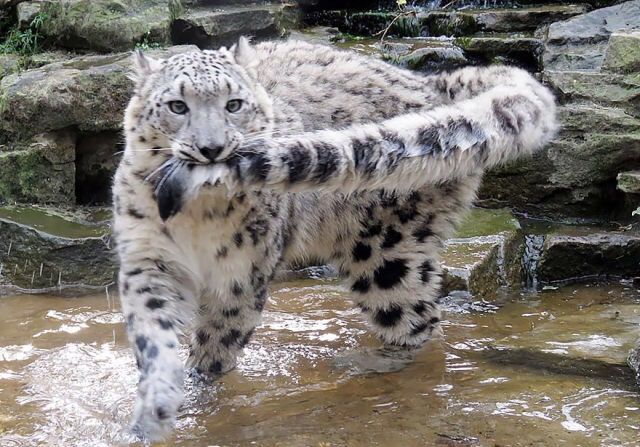
The snow leopard is the most vertically adapted of the world's big cats, a mid-sized predator tuned for one narrow environment - the bare, thin-aired, almost vertical stone of Central Asia's highest mountains.
Unlike the lion of the savanna or the tiger of the subtropical forest, Panthera uncia lives where oxygen is scarce, winter temperatures collapse below minus forty degrees Celsius, and the ground itself is usually sliding or crumbling. It is the only big cat that cannot roar, the only Panthera species that routinely hunts above four thousand metres, and one of the rarest large carnivores on Earth.
This guide covers every aspect of snow leopard biology and ecology: size and proportions, cold-weather adaptations, hunting behaviour, diet, reproduction, range, conservation status, and the changing relationship between snow leopards and the mountain communities who share their territory. It is a reference entry, not a summary - so expect specifics: kilograms, kilometres, elevations, populations, and verified records.
Etymology and Classification
The scientific name Panthera uncia carries its own small history. Panthera is the cat genus that holds lions, tigers, jaguars, leopards, and - since modern genetic work - the snow leopard. Uncia is an old European word for a lynx-like cat; it survives in the archaic English word 'ounce' and in a handful of heraldic traditions.
For most of the twentieth century the snow leopard was placed in its own genus Uncia, partly because it cannot roar and partly because of perceived anatomical quirks. Molecular phylogenies published in the 2000s and refined in 2016 placed it unambiguously inside Panthera, as an early branch that split roughly four to five million years ago, before the lineage that produced the roaring cats.
Across its range it carries dozens of regional names. In Kyrgyz it is ilbirs; in Mongolian irves; in Tibetan sa; in Ladakhi shan; in Urdu and Hindi him tendua, the snow leopard. The English name 'ghost of the mountains' has no single origin but began circulating widely in conservation literature in the 1980s to capture how seldom the cat is actually seen, even by professional biologists working in its core range.
The snow leopard is the sister lineage to the tiger within Panthera. It is not a subspecies of the common leopard (Panthera pardus), despite the English name, and the two species do not overlap ecologically in most of their range.
Size and Physical Description
Snow leopards are mid-sized big cats. They look heavier than they are because of an unusually dense coat and a long tail that doubles the apparent length of the body.
Adults:
- Head-and-body length: 1.0-1.3 metres
- Tail length: 0.9-1.1 metres (nearly equal to the body)
- Shoulder height: 55-65 centimetres
- Weight: 35-55 kg (males slightly heavier than females)
Cubs at birth:
- Length: roughly 25-30 cm including tail
- Weight: 320-567 grams - about the size of a small kitten
The skull is short and broad, with an enlarged nasal cavity that warms thin cold air before it reaches the lungs. The nasal turbinates are larger and more convoluted than in other big cats, which is a consistent sign of cold- and altitude-adapted carnivores.
The fur is pale smoky grey to cream across the back and flanks, patterned with dark rosettes and spots that break up the cat's outline against lichen-streaked rock and patchy snow. The belly is nearly pure white. Underfur reaches up to 12 centimetres deep on the ventral surface - the thickest coat of any cat species.
The tail is the single most striking anatomical feature. In most big cats the tail is used mainly for balance during fast turns. In the snow leopard the tail performs at least four distinct jobs: in-air counterweight during long jumps, balance during cliff traverses, a fat reserve for lean winters, and - most famously - a cold-weather face wrap.
A resting snow leopard curls into a tight ball with the tail drawn across the nose, so each inhalation passes through insulating fur and is preheated before it reaches the lungs.
Paws are broad, heavy, and fur-covered underneath. Each paw weighs roughly three pounds and functions as a natural snowshoe, spreading the cat's weight across powder that a human foot would sink through. Claws are semi-retractable and heavily used for gripping rock.
Built for High, Cold, Thin Air
Every element of snow leopard physiology serves one of three goals: retain heat, extract oxygen from thin air, or move efficiently over unstable, near-vertical terrain.
Thermal adaptations:
- Double-layer coat with long guard hairs and dense woolly underfur
- Fur-padded paws for insulation against cold rock and snow
- Small rounded ears that minimise exposed surface area
- Subcutaneous fat stored preferentially in the tail and hindquarters
- Compact body plan with shorter legs than most other Panthera species
Altitude adaptations:
- Proportionally larger lungs for oxygen uptake
- Enlarged nasal chambers with elaborate turbinates to warm and humidify air
- Higher red-blood-cell density than lowland cats (though still studied less than human high-altitude populations)
Terrain adaptations:
- Long hind legs with heavy thigh musculature
- Flexible lumbar spine allowing extreme arching during leaps
- Long counterbalancing tail
- Broad paws with gripping pads and strong curved claws
At rest, snow leopards can tolerate ambient temperatures well below freezing without any behavioural effort. During exertion, however, even they can overheat - which is one reason most hunting is done in short ambushes rather than long chases. The famous tail-around-the-face sleeping posture is not a curiosity but a thermoregulatory mechanism: breathing through dense fur traps exhaled warmth and returns it into the respiratory system, reducing heat loss during long rest periods in exposed beds.
Hunting and Diet
Snow leopards are solitary ambush predators. Unlike lions, they do not form social hunting groups, and unlike cheetahs, they do not rely on speed over open ground. Instead they use vertical terrain the way a lion uses tall grass: cover, concealment, and a predictable geometry that channels prey into ambush zones.
Primary prey:
- Blue sheep, or bharal (Pseudois nayaur)
- Asiatic ibex (Capra sibirica)
- Himalayan tahr (Hemitragus jemlahicus)
- Argali sheep (Ovis ammon)
- Markhor (Capra falconeri)
Secondary prey:
- Marmots, pikas, and hares
- Game birds including snowcocks and chukar
- Young yaks, goats, or sheep from domestic herds
A single snow leopard kills roughly 20 to 30 large prey animals per year. Each kill supports three to four days of feeding. The cat drags or pulls its kill to a protected ledge, crevice, or overhang, caches the carcass under loose rocks or snow, and returns to feed until almost nothing remains. In parts of the Himalaya, blue sheep alone account for more than half of all kills by weight.
This dependency is one reason modern snow leopard conservation strategies pay as much attention to blue sheep populations as to the cats themselves.
Hunting technique:
- Stalking and ambush. The cat uses terrain - ridges, gullies, and boulder fields - to close the distance unseen, then launches a short, explosive sprint.
- Cliff-driving. In steep country the cat often attacks from above, using the slope itself as a weapon by forcing prey off a cliff or into a fatal slide.
- Long leaps. Horizontal bounds of up to 15 metres and vertical leaps to around 6 metres let the cat cross gaps and cover the final distance to prey in a single movement.
- Cache and return. After killing, the cat spends several days feeding in short visits, usually from a concealed resting spot above the kill.
Success rates have been difficult to study directly because snow leopards so rarely hunt in view of observers, but camera-trap and GPS-collar data suggest a hit rate somewhere around one successful kill per ten to twenty stalks.
Life Cycle and Reproduction
Snow leopard reproduction is tightly keyed to the short mountain growing season. Mating occurs from late winter into early spring - typically January through March - when the long mournful yowls of females in oestrus carry for kilometres along valleys. Males follow scent trails and scrape markings to locate receptive females. Pairs stay together only for a few days of mating, then separate.
Gestation lasts 90 to 100 days. Females give birth in early summer in a protected den - a rock cleft, crevice, or sheltered cave lined with fur shed from the mother's own belly. Litter size is typically two cubs, with one or three occurring less often. Cubs are born blind and dependent, weighing 320 to 567 grams.
Cub development:
- 7-9 days: eyes open
- 2 months: begin eating solid food brought by the mother
- 3-4 months: leave the den and follow the mother on short trips
- 10-12 months: begin attempting small kills themselves
- 18-22 months: disperse to establish their own territory
Cub mortality in the first winter is high, driven by starvation, falls, exposure, and occasional predation by wolves. Females reach reproductive maturity at roughly two to three years and usually produce one litter every second year thereafter. A long-lived wild female may raise five or six successful litters across her lifetime.
Movement, Range, and Density
Snow leopards live at extraordinarily low densities compared with other Panthera species. Even in good habitat the typical density is between 0.1 and 5 adults per 100 square kilometres. A single male may hold a home range of 100 to more than 1,000 square kilometres, depending on prey abundance and terrain; female ranges are somewhat smaller. Ranges overlap substantially, but direct encounters are rare simply because the landscape is so large.
Movement data:
| Metric | Value |
|---|---|
| Typical elevation, summer | 3,000-4,500 m |
| Maximum recorded elevation | Above 5,400 m |
| Home range, male | 100-1,000+ km^2 |
| Daily movement | 1-7 km, occasionally much more |
| Longest recorded horizontal leap | Up to 15 m |
| Vertical leap | Up to 6 m |
Individuals marked with GPS collars regularly cross international borders - between Pakistan and Afghanistan, Mongolia and Russia, China and Kyrgyzstan - which means any serious conservation strategy has to operate at a cross-border scale.
Range, Populations, and Genetic Structure
Snow leopards are present across 12 range countries in Central and South Asia. The species has an immense geographic footprint - roughly 1.8 million square kilometres of potential habitat - but at very low density, so the global adult population is small.
Approximate distribution:
| Country | Estimated share of global population |
|---|---|
| China | 2,000-2,500 individuals |
| Mongolia | 800-1,700 individuals |
| India | 500-700 individuals |
| Nepal | 300-400 individuals |
| Pakistan | 200-420 individuals |
| Kyrgyzstan | 300-400 individuals |
| Tajikistan | 250-300 individuals |
| Others | Remainder spread across Afghanistan, Bhutan, Kazakhstan, Russia, Uzbekistan |
A 2020 genetic study of Mongolian snow leopards flagged reduced heterozygosity in some fragmented subpopulations, suggesting that habitat corridors and natural dispersal are as important as raw habitat area. Isolated populations - particularly in small mountain ranges cut off by roads, settlements, or reservoirs - show early genetic warning signs even while headline numbers look stable.
Before the 2000s, most population estimates were essentially educated guesses. Camera-trap surveys and, later, non-invasive genetic sampling from scat revolutionised the field and are the reason modern numbers are more trustworthy. The 2017 downlisting from Endangered to Vulnerable on the IUCN Red List was driven more by this improved visibility than by any confirmed increase in animals.
Conservation Status and Threats
The IUCN Red List classifies the snow leopard as Vulnerable with a decreasing population trend. It is listed on CITES Appendix I, which bans international commercial trade, and protected under national law in all 12 range countries. The Global Snow Leopard and Ecosystem Protection Program, signed in Bishkek in 2013, commits range states to coordinated conservation across borders.
Primary threats:
- Poaching. Snow leopards are killed for pelts and bones, the latter increasingly substituted into traditional medicine markets as tiger populations collapse. An estimated 221 to 450 cats are killed illegally each year.
- Retaliatory killing. Livestock losses to snow leopards can destroy a herding family's annual income. Retaliation by shooting, snaring, or poisoning remains a leading cause of mortality in parts of the range.
- Prey depletion. Overhunting of blue sheep, ibex, and argali reduces the food base. Conservation programmes increasingly treat prey recovery as inseparable from cat recovery.
- Habitat fragmentation. New roads, mining operations, hydropower reservoirs, and pastoral expansion cut once-continuous mountain habitat into smaller pieces, with knock-on genetic effects.
- Climate change. Warming is pushing treelines upward and shrinking high alpine zones. Over decades this compresses available snow leopard habitat against the physical ceiling of ridgelines.
Long-term outlook depends less on any single intervention and more on the combination of community-level incentives, anti-poaching enforcement, prey management, and cross-border cooperation.
Snow Leopards and Humans
The snow leopard's cultural status across its range is unusually strong. In Kyrgyzstan it is a national emblem, appearing on coins, stamps, sports kits, and government seals. The Soviet-era mountaineering award known as the Snow Leopard was granted to climbers who summited all five 7,000-metre peaks of the former USSR. In Tibetan and Mongolian Buddhist traditions the cat appears as a guardian spirit.
Modern conservation increasingly relies on this cultural weight. Community-based programmes across the range - Nepal's conservancies, Pakistan's village insurance schemes, Mongolia's herder monitoring groups, India's Snow Leopard Trust partnerships - build on local pride and compensate herders for confirmed livestock losses, reducing the incentive to retaliate. Where these programmes have been sustained for a decade or more, retaliatory killings have measurably declined.
Tourism is still a small force compared with polar bear or African lion tourism, but slow-growing operations in Ladakh, Spiti, and parts of Mongolia now offer organised winter expeditions for paying observers. Done well, snow leopard tourism injects cash directly into the remote communities who bear most of the cost of living alongside the cat. Done badly, it habituates animals to human presence at exactly the spots where poachers also operate.
The Camera-Trap Revolution
For most of the twentieth century, what biologists knew about snow leopards was cobbled together from pugmarks in fresh snow, scrapes on ridgelines, bones in middens, and the occasional pelt confiscated at a border post. Direct observation by researchers was so rare that whole doctoral theses on the species had been written without the author ever seeing a wild cat in person.
This changed between roughly 2002 and 2012, as low-cost digital camera traps with reliable cold-weather performance became widely deployable. Surveys in Mongolia, Nepal, India, and Bhutan began returning the first large bodies of consistent snow leopard imagery in history.
The effects were immediate. Individual cats could be identified by rosette patterns, which are unique like fingerprints. Capture-recapture statistics produced real density estimates. Presence at previously uncertain sites was confirmed or ruled out.
The 2017 downlisting from Endangered to Vulnerable on the IUCN Red List was a direct product of this work: the species was not demonstrably more numerous than it had been in 1996, but it was demonstrably better counted, and previous population figures had almost certainly been low. The revolution is ongoing.
Non-invasive genetic sampling from scat, combined with camera-trap imagery, now produces the most reliable snow leopard population estimates available.
Evolution and Close Relatives
The snow leopard's place in the Panthera family tree was debated for most of the twentieth century. Early morphologists, impressed by its inability to roar and by its short rounded skull, placed it in its own genus Uncia.
Later molecular work, including complete mitochondrial and nuclear genome analyses published in 2016 and refined since, settled the question: the snow leopard is a full member of Panthera, sister to the tiger, and the split between them is estimated at roughly two to three million years ago.
The snow leopard is therefore more closely related to the tiger than the common leopard is. This is one reason the name 'snow leopard' is taxonomically misleading. It is not a high-altitude race of Panthera pardus; it is a separate species whose closest living cousin stalks the tropical and temperate lowland forests of South and East Asia.
This evolutionary proximity also explains why, in captivity, snow leopards and common leopards can on rare occasions produce hybrid offspring, though the pairing is extremely unusual and not documented in the wild.
Related Reading
- Snow Leopard: The Ghost of the Mountains and Why They're Vanishing
- Leopard: The Most Adaptable Cat
- Tiger: Largest Cat and Its Stripes
- The Secret Lives of Big Cats
References
Relevant peer-reviewed and governmental sources consulted for this entry include IUCN Red List assessments (2017, 2023), the Global Snow Leopard and Ecosystem Protection Program (GSLEP) documents, and published research in Biological Conservation, Journal of Mammalogy, Oryx, and PLOS ONE. Population figures reflect the most recent consolidated estimates across the 12 range states, with uncertainty bounds acknowledged where survey coverage remains uneven.
See also: Snow Leopard vs Tiger
Frequently Asked Questions
How big is a snow leopard?
Adult snow leopards (Panthera uncia) are mid-sized big cats. Body length from nose to rump is 1.0 to 1.3 metres, with an additional 0.9 to 1.1 metre tail - so the tail is nearly as long as the body itself. Healthy adults weigh 35 to 55 kilograms, with males averaging slightly larger than females. Shoulder height is roughly 60 centimetres. Snow leopards look bulkier than they are because of a thick double coat of pale grey fur patterned with dark rosettes.
Cubs weigh 320 to 567 grams at birth, about the size of a small kitten, and are fully dependent on the mother for the first two months.
Where do snow leopards live?
Snow leopards inhabit the high mountains of Central and South Asia across 12 range countries: Afghanistan, Bhutan, China, India, Kazakhstan, Kyrgyzstan, Mongolia, Nepal, Pakistan, Russia, Tajikistan, and Uzbekistan. Their range covers the Himalaya, Karakoram, Hindu Kush, Pamir, Tien Shan, Altai, and associated ranges.
Typical elevations are 3,000 to 4,500 metres in summer, with some individuals recorded above 5,400 metres, though in the northern Mongolian and Russian portions of the range they can descend to around 1,000 metres in winter. They favour steep, broken terrain - cliffs, ridges, gullies, and rocky outcrops - rather than open grassland or forest.
What do snow leopards eat?
Snow leopards are obligate carnivores that specialise on mountain ungulates. Primary prey includes blue sheep (bharal), Asiatic ibex, Himalayan tahr, argali sheep, and markhor. Secondary prey includes marmots, pikas, hares, game birds, and occasionally young yaks, sheep, or goats taken from herders.
A single adult kills roughly 20 to 30 large prey animals per year and will feed on a carcass for three to four days, caching the remains under rocks or snow between meals. In parts of the Himalaya, blue sheep alone account for more than half the diet, which is why blue sheep recovery is now a central plank of snow leopard conservation policy.
Why can't snow leopards roar?
Snow leopards are the only members of the Panthera genus that cannot roar. Roaring in lions, tigers, leopards, and jaguars depends on a partially cartilaginous, fully elongated hyoid apparatus in the throat, which lets the larynx act as a large resonating chamber. Snow leopard hyoids never ossify in the same way - the structure is closer to that of smaller cats.
Instead of roaring they produce a soft, puffing greeting call called a chuff, a hiss or growl in conflict, and a long mournful yowl used to advertise presence during the winter mating season. The yowl can travel several kilometres up and down narrow mountain valleys.
How far can a snow leopard jump?
Snow leopards have the longest bound of any cat. Horizontal leaps of up to 15 metres have been documented, with vertical leaps of around 6 metres. The jump is powered by extremely long hind legs, a flexible spine, and unusually heavy thigh muscles for the cat’s modest 35 to 55 kilogram mass. The long tail acts as an in-air counterweight, swinging to stabilise the body mid-leap.
These jumps serve two purposes: launching ambush attacks onto blue sheep or ibex on steep slopes, and escaping or crossing impassable cliff gaps during normal travel. The species’ body plan is essentially a mid-sized cat tuned for one specific environment - vertical stone.
How do snow leopards survive the cold?
Snow leopards live routinely at altitudes where winter temperatures drop below minus 40 degrees Celsius. Their fur is the densest of any cat - up to 12 centimetres long on the belly - with a woolly underlayer trapping still air. Their nasal passages are enlarged to warm cold thin air before it reaches the lungs, and the lungs themselves are proportionally larger than in lowland cats, aiding oxygen uptake at elevation.
Their paws are broad and fur-padded, working as snowshoes. Most distinctively, a resting snow leopard wraps its nearly body-length tail across its face and nose, breathing through the fur so that exhaled heat preloads the next breath. The tail also stores fat and acts as a balance counterweight.
How many snow leopards are left in the wild?
Current best estimates put the global wild population at 4,000 to 6,500 adult snow leopards, though uncertainty remains very high because the species is so difficult to observe. China holds the largest share, with an estimated 2,000 to 2,500 individuals, followed by Mongolia, India, Nepal, Pakistan, Kyrgyzstan, and Tajikistan.
In 2017 the IUCN Red List reclassified the snow leopard from Endangered to Vulnerable, a change driven mostly by improved survey coverage rather than evidence of a rising population. Densities are naturally low - typically 0.1 to 5 cats per 100 square kilometres - spread across roughly 1.8 million square kilometres of fragmented habitat.
How long do snow leopards live?
Wild snow leopards typically live 15 to 18 years, with a few radio-collared individuals reaching their early twenties. Captive snow leopards regularly exceed 20 years and occasionally reach 25, benefiting from consistent food, veterinary care, and no predation or starvation risk. Cub mortality is high in the wild - starvation during their first winter, falls from cliffs, and predation by wolves or other snow leopards all take a toll.
Females reach reproductive maturity at two to three years, males slightly later, and females typically produce one litter every second year from age three until the late teens.