
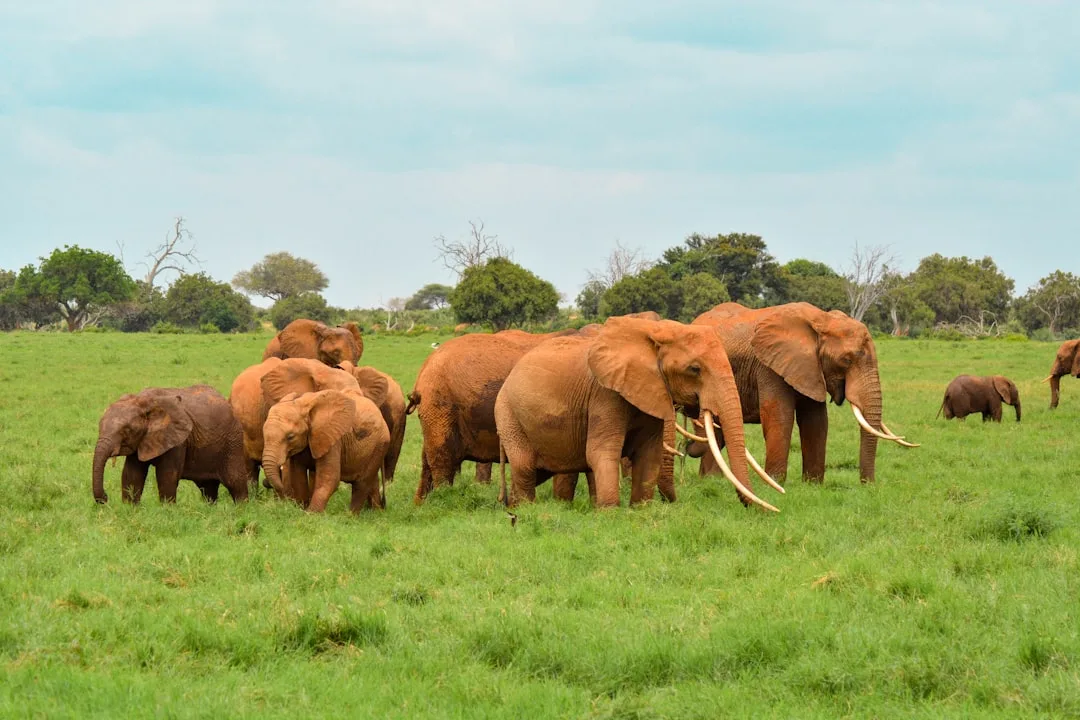
The African bush elephant is the largest land animal alive on Earth today. Nothing that walks on dry ground comes close - not the largest bull giraffe, not the heaviest rhino, not a record saltwater crocodile hauled out on a riverbank. A mature African bush elephant bull can weigh six tonnes, stand four metres at the shoulder, and carry a pair of ivory tusks longer than a grown man is tall.
The species is also among the most cognitively sophisticated animals ever studied, with documented tool use, mirror self-recognition, decades-long memory, complex grief rituals, and an infrasonic communication system that rides seismic waves through the ground.
This guide covers the full biology and ecology of Loxodonta africana: anatomy and size, the extraordinary trunk, matriarchal society, communication, reproduction, diet, range, the ivory crisis, and the modern conservation picture. It is a reference page, not a summary - expect specifics: tonnes, decibels, hertz, hectares, and verified figures.
Etymology and Classification
The genus name Loxodonta was coined in the 19th century from the Greek loxos ('slanting') and odous ('tooth'), referring to the distinctive lozenge-shaped ridges on the molar teeth of African elephants - a feature that separates them from their Asian cousin Elephas. The species epithet africana reflects the continent of origin. Early European naturalists recognised only one African elephant species, but that view collapsed under modern genetic evidence.
In 2021, after a multi-year reassessment, the IUCN formally split the African elephant into two species:
- African bush elephant (Loxodonta africana) - larger, inhabits savanna, woodland, and open country.
- African forest elephant (Loxodonta cyclotis) - smaller, darker, rounder ears, straighter downward-pointing tusks, and confined to Central African rainforest.
Genetic analysis suggests the two species diverged between 2 and 7 million years ago - a separation comparable in depth to that between humans and chimpanzees. Hybrids exist in limited transition zones but are rare because the two species prefer completely different habitats.
The Asian elephant (Elephas maximus) is a third living species, distinct from both African lineages and separated by roughly 5-7 million years of independent evolution. The wider order Proboscidea once included dozens of species - mammoths, mastodons, stegodons, gomphotheres - most of which went extinct during the last ice age. The three living elephants are the last survivors of a once-global radiation.
Size and Physical Description
African bush elephants are the largest living land animals. Sexual dimorphism is extreme, especially in adults.
Males (bulls):
- Shoulder height: 3.0-4.0 metres
- Weight: typically 4,000-6,000 kg, record 10,400 kg
- Body length: 6-7.5 metres (head to tail base)
- Tusks: up to 3 metres, 50 kg each in historic specimens
Females (cows):
- Shoulder height: 2.2-2.6 metres
- Weight: typically 2,500-3,500 kg
- Tusks present but shorter and thinner than in bulls
Calves at birth:
- Shoulder height: ~0.9 metres
- Weight: 100-120 kg
- Can stand and walk within hours, nurses within a day
The largest African bush elephant ever verified was a bull shot in Angola in 1974. It weighed 10,400 kg, stood 3.96 metres at the shoulder, and now stands mounted in the Smithsonian's National Museum of Natural History rotunda. That figure remains the record for any land animal of any species, extinct or living - larger than any verified weighed mammoth and far beyond any modern rhino or hippo.
The skeleton is built for column-loading: legs like vertical pillars, joints that lock for efficient standing, and compact feet that spread across a wide pad of fatty connective tissue. The foot itself is a biological shock absorber: when an elephant steps down, the pad expands; when the foot lifts, it contracts, pulling free from soft mud. This design lets a six-tonne animal walk quietly - a charging elephant is much less noisy than observers expect.
Ears are the other defining feature. A bull's ears can each reach 1.8 metres in length and 1.2 metres wide. Their shape is often compared to the map of Africa itself. The ears are thin, heavily vascularised skin panels that radiate heat; elephants flap them continuously in hot weather to cool blood before it recirculates to the core. This thermoregulation is critical in a species that lacks sweat glands.
The Trunk
The trunk is the single most specialised structure in the entire mammalian body plan. It is a fusion of the upper lip and nose, supported by no bone, and controlled by roughly 40,000 individual muscle fascicles organised into longitudinal, radial, and oblique layers. Those muscles work independently enough that the trunk behaves less like an arm than like a hydrostat - the same mechanical class as an octopus tentacle.
Functions of the trunk include:
- Breathing (it contains the nostrils)
- Smelling - probably the most acute olfactory sense of any mammal
- Drinking (sucking up to 10 litres per intake and squirting into the mouth)
- Feeding (grasping, stripping, tearing)
- Lifting (up to 300 kg in mature bulls)
- Social contact (trunk greetings, reassurance, sparring)
- Vocalisation (trumpets are shaped by trunk position)
- Weapon use (blows, grips, seizures of branches as tools)
The two African species have two 'finger-like' projections at the trunk tip (the Asian elephant has only one). These let an elephant pick up a single blade of grass with the same appendage that can uproot an acacia tree. The precision is uncanny: captive elephants can pluck a peanut, unscrew a bolt, or manipulate a paintbrush with trunk tip alone.
Genomic work suggests the trunk's olfactory capability exceeds that of bloodhounds. African elephants possess nearly 2,000 functional olfactory receptor genes, more than any other mammal studied - roughly twice as many as dogs and five times as many as humans. This translates into measurable behaviour: elephants reliably distinguish amounts of food by scent alone, identify individual humans across years, and detect water sources at distances of 20 km or more.
Tusks and the Ivory Problem
Elephant tusks are elongated upper second incisors that never stop growing. In African bush elephants both sexes carry tusks - unlike Asian elephants, where most females and some males have no external tusks at all. Tusk growth proceeds at roughly 17 cm per year until late adulthood. The largest verified tusks, from a bull shot in Kenya in 1898, measured 3.26 metres and 3.11 metres long and weighed 102 kg and 97 kg.
That individual is unlikely to be matched again. A century of selective poaching has removed the largest-tusked bulls from the gene pool.
Tusks are used for digging water, stripping bark, moving obstacles, sparring with rivals, and occasional self-defence. They also mark individual handedness: most elephants favour one tusk ('master tusk'), which shows greater wear.
The demographic consequences of the ivory trade are severe. Between 1979 and 1989, an estimated 10 million African elephants were killed for ivory - roughly half the total population at the start of the decade. In 1989 CITES adopted Appendix I listing for African elephants, effectively banning international commercial ivory trade.
Populations stabilised or recovered through the 1990s, but demand resurged in the 2000s driven by markets in East Asia. A second wave of poaching from 2008-2014 killed roughly 30% of savanna elephants continent-wide. Enforcement, domestic ivory market closures (notably China's 2017 ban), and concentrated anti-poaching investment have reduced but not eliminated the threat.
A particularly striking evolutionary consequence of heavy selective pressure is the rise of tuskless females in some heavily poached populations. In Gorongosa National Park, Mozambique, where poaching during the civil war was intense, the proportion of tuskless females jumped from around 18% before the war to more than 50% in the postwar generation.
Genetic studies published in Science in 2021 linked the trait to a specific X-linked gene. Selection, in this case, is directly caused by ivory hunters removing tusked animals from the breeding population.
Social Structure and the Matriarch
African bush elephant society is strongly matriarchal. The core unit is a family group of 8-20 related females and their dependent offspring, led by the oldest experienced female. Her role is not ceremonial. She decides when the herd moves, where to drink, which predators warrant defence, and which young bulls are being tolerated too long.
Herd hierarchy:
| Level | Composition | Typical size |
|---|---|---|
| Family group | Matriarch, sisters, daughters, dependent calves | 8-20 |
| Bond group | Several families that meet and separate | 30-50 |
| Clan | Multiple bond groups sharing core range | 100-200 |
| Bull group | Unrelated males, loose and shifting | 2-15 |
Male calves leave the family group between ages 12 and 15, often pushed out by the matriarch once their behaviour becomes disruptive. They join loose bachelor herds or roam alone, associating with families only during mating.
Mature bulls cycle through a state called musth, a period of elevated testosterone (up to 60 times baseline) marked by aggressive behaviour, temporin gland secretion, urine dribbling, and dominance over non-musth bulls regardless of size. Musth lasts weeks to several months per year in a mature bull.
Research led by Cynthia Moss, Joyce Poole, and others over five decades in Amboseli, Kenya has shown that matriarch experience directly predicts herd survival. During severe droughts, families led by older matriarchs - those who remember distant water sources from previous droughts - suffer lower calf mortality than families led by younger, less-experienced females.
Killing an old matriarch for her tusks therefore removes not just one animal but the survival knowledge she would have transmitted to an entire clan.
Cognition and Emotion
African bush elephants are among the most cognitively advanced non-human animals. Documented capabilities include:
- Mirror self-recognition. In 2006, a bull Asian elephant named Happy passed the mirror mark test at the Bronx Zoo. Subsequent experiments confirmed the trait in African elephants. Only humans, great apes, certain cetaceans, magpies, and a handful of other species have passed this benchmark of self-awareness.
- Tool use. Elephants use branches as fly swatters, strip bark to form rudimentary brushes, and modify objects for specific tasks.
- Cooperation. Experimental studies show that pairs of elephants can learn to pull two ends of a rope simultaneously to deliver food, waiting for each other when necessary.
- Teaching. Matriarchs demonstrably teach younger herd members about water sources, migration routes, and responses to predators.
- Counting. Elephants can distinguish between small quantities (1-6) and track individual items.
- Human recognition. Field studies in Kenya show elephants respond differently to recordings of Maasai voices (traditional elephant hunters) versus Kamba voices (farmers who do not hunt elephants), reliably distinguishing human ethnic groups by tone even when the same phrase is spoken.
Documented grief behaviour is among the most striking aspects of elephant cognition. Herds visit the remains of deceased relatives, touch bones with trunk tips, lift skulls, cover carcasses with branches, and remain silent or emit low vocalisations near the dead. Similar behaviour has been recorded at sites where relatives died years or decades earlier.
Researchers distinguish this from incidental investigation because elephants respond specifically to elephant remains - not to bones of other large mammals placed as experimental controls.
Communication and Infrasound
Elephants operate one of the most elaborate communication systems in the animal kingdom. Their vocal range spans five octaves, from deep infrasonic rumbles below 20 Hz to loud audible trumpets above 1,000 Hz.
Vocal categories:
- Rumbles. The core vocabulary, produced in the larynx and modulated through the trunk. Many are infrasonic (below human hearing) and carry up to 10 km through air.
- Trumpets. Sharp high-volume calls signalling alarm, excitement, or greeting. Audible at 2-3 km.
- Snorts, roars, cries, barks. Short-range calls with specific social contexts.
Infrasonic communication is the centrepiece. Frequencies below 20 Hz travel farther and attenuate less than higher frequencies, especially through the ground. Elephants both emit and receive these signals, detecting them through inner-ear bones tuned to low frequencies and through mechanoreceptors (Pacinian corpuscles) concentrated in the feet and trunk tip.
Under favourable conditions, a bull's rumble can reach another elephant 10 km away through air and significantly further through the ground.
Research at Stanford and elsewhere has confirmed that elephants can detect distant thunderstorms, other herd movements, and even seismic warning events through ground vibration alone. The practical implication: a herd in Kenya's Amboseli basin can 'hear' a storm in the Rift escarpment before a single audible sound crosses the gap.
Reproduction and Life Cycle
African bush elephant reproduction runs on a long timeline. Cows reach sexual maturity at 10-12 years but typically produce their first calf at 14-16. Bulls reach physiological maturity at 14 but rarely sire offspring until their 30s, when they are large enough to dominate mating competition with other bulls.
Reproductive timeline:
- Oestrus cycle: 14-16 weeks, with a 2-6 day fertile window
- Gestation: 20-22 months - the longest of any living land mammal
- Inter-birth interval: 3-5 years, sometimes longer
- Weaning: around 2 years, though older calves may nurse opportunistically
- Maternal dependence: 8-10 years for emotional and survival learning
A calf is born 100-120 kg, nearly a metre tall, and able to stand and nurse within an hour. Protection is communal - aunts, sisters, and older cows actively defend newborns from predators (lions, hyenas, crocodiles at water crossings) and from aggressive bulls. Calf survival to age 1 is roughly 70-80% in healthy populations but drops sharply during droughts or in poached areas where family structures have been shattered.
Elephants continue learning throughout their lives. A cow at age 40 is still accumulating social and spatial knowledge. Reproductive lifespan extends into the late 50s or even early 60s in some individuals, and elephants can live to 60-70 years in the wild. Captive specimens have reached 80+ years, but captive lifespans are inflated by veterinary care and are poor guides to wild ecology.
Range and Movement
African bush elephants historically occupied nearly all of sub-Saharan Africa except deep rainforest and the driest deserts. Modern range is a patchwork of protected areas, wildlife corridors, and shrinking buffer zones.
| Country | Approximate population (2016 Great Elephant Census and later surveys) |
|---|---|
| Botswana | ~130,000 |
| Zimbabwe | ~82,000 |
| Tanzania | ~51,000 |
| Kenya | ~36,000 |
| South Africa | ~28,000 |
| Namibia | ~22,000 |
| Other range states | ~65,000 combined |
Total continental estimates range from 350,000 to 450,000, with 415,000 a commonly cited figure. The 2016 Great Elephant Census, the most comprehensive aerial survey ever conducted, counted 352,271 savanna elephants across 18 African nations - a 30% decline from 2007 levels.
Daily movement depends on water and food. A family in a dry savanna may cover 10-20 km per day between feeding and drinking sites, and seasonal movements can exceed several hundred kilometres. Long-distance migrations persist where corridors allow them: parts of the KAZA transfrontier area (Botswana, Zambia, Zimbabwe, Angola, Namibia) still support large-scale elephant movement across five countries.
Ecological Role
African bush elephants are keystone ecosystem engineers. Their influence on African landscapes is immense:
- Seed dispersal. Elephants eat fruit and pass seeds over long distances. Some tree species have seeds that germinate poorly or not at all unless passed through an elephant gut. The decline of elephants in Central and West Africa has already caused measurable declines in several tree species.
- Habitat modification. By pushing over trees, stripping bark, and digging for water, elephants maintain the mosaic of grassland and woodland that supports African megafauna diversity.
- Water access. Elephants dig wells into dry riverbeds that other species - baboons, antelope, lions - depend on during droughts.
- Nutrient cycling. Daily dung output of 100-150 kg per adult supports beetle communities, insect life, and small mammals, and carries seeds across wide areas.
The loss of elephants from a landscape produces cascading effects. Research in Kenya and Tanzania shows that elephant-free regions convert from open savanna to dense thicket within decades, reducing habitat suitability for species from impala to cheetahs.
Conservation Status and Threats
The IUCN lists the African bush elephant as Endangered (2021 assessment). The listing replaced the previous single-species Vulnerable classification after the formal split from forest elephants. Populations fell by roughly 60% over three generations (about 50 years).
Primary threats:
- Poaching. Ivory demand remains the single largest driver of illegal elephant killings. Peaks in 2011-2013 killed tens of thousands per year.
- Habitat loss and fragmentation. Expanding agriculture, infrastructure, and settlements fragment ranges and sever migration corridors.
- Human-elephant conflict. As rural populations grow into traditional elephant habitat, crop raiding leads to retaliatory killings. Thousands of elephants die each year in conflict with farmers.
- Climate change. Droughts intensify, water sources dry, vegetation composition shifts. Prolonged drought killed more than 200 elephants in Kenya in 2022 alone.
- Trophy hunting. Legal but controversial; conservation scientists debate whether managed hunting supports or undermines elephant persistence.
Key conservation measures:
- 1989 CITES Appendix I listing banned international commercial ivory trade.
- Major domestic ivory market closures (United States 2016, China 2017, United Kingdom 2018).
- Transfrontier conservation areas such as KAZA (520,000 km^2 across five countries).
- Community-based conservancies in Kenya, Namibia, and elsewhere that share tourism revenue with local populations, creating economic incentives to tolerate elephants.
- Specialised anti-poaching units and intelligence-led enforcement.
The outlook is mixed. Southern African populations (Botswana, Zimbabwe, Namibia) are stable or growing, to the point where some governments argue for controlled culling or resumed ivory sales. Central and East African populations continue to decline. The species will persist over the 21st century - but almost certainly at much lower numbers than today, and in a much more fragmented range.
African Bush Elephants and Humans
Human relationships with African elephants span tens of thousands of years. Rock art across the Sahara and southern Africa depicts elephants in hunting, ritual, and landscape contexts. Traditional knowledge systems - Maasai, Samburu, San, Himba, and many others - encode detailed ecological information about elephant behaviour, water sources, and temperament.
The modern relationship is complicated. Elephants are central to Africa's tourism economy; a single live elephant is worth hundreds of thousands of dollars in lifetime tourism revenue, far more than any ivory sale. Communities that share revenue from elephant tourism tend to tolerate elephants; communities that bear costs (crop loss, human deaths) without receiving benefits tend to turn against them.
Roughly 500 people are killed by elephants across Africa each year, and several hundred elephants die annually in retaliatory conflict.
Anti-poaching work is a dangerous profession. Hundreds of rangers have been killed in the line of duty defending elephant populations, particularly in Central Africa and parts of East Africa. Their work combines paramilitary patrol, intelligence gathering, community engagement, and wildlife veterinary response.
Related Reading
- Elephants of Africa: The Matriarchs of the Savanna
- How Elephants Communicate
- The Ivory Crisis: A Century of Poaching
- African Forest Elephant: The Rainforest's Hidden Giant
References
Key peer-reviewed and governmental sources consulted include the IUCN Red List 2021 assessment of Loxodonta africana, the 2016 Great Elephant Census (Chase et al., PeerJ), long-term research from the Amboseli Elephant Research Project (Moss, Poole, Lee), Campbell-Staton et al.
(Science, 2021) on tuskless evolution in Gorongosa, CITES trade data, the African Elephant Specialist Group status reports, and studies published in Animal Behaviour, Proceedings of the Royal Society B, PNAS, and Conservation Biology. Population figures reflect the most recent consolidated estimates available as of 2024.
Frequently Asked Questions
How big is the African bush elephant?
The African bush elephant (Loxodonta africana) is the largest living land animal on Earth. Adult bulls stand 3.0-4.0 metres at the shoulder and weigh 4,000-6,000 kg on average. Cows are smaller at 2.2-2.6 m shoulder height and 2,500-3,500 kg. The heaviest individual ever recorded was a bull shot in Angola in 1974 that weighed 10,400 kg and stood 3.96 m at the shoulder - heavier than most delivery trucks.
Newborn calves weigh roughly 100-120 kg and stand about 90 cm tall at birth, already large enough to walk alongside the herd within hours.
How is the African bush elephant different from the forest and Asian elephants?
Three living elephant species exist. The African bush elephant (Loxodonta africana) is the largest and inhabits savanna and woodland. The African forest elephant (Loxodonta cyclotis), split off as a separate species by the IUCN in 2021, is smaller, darker, has straighter downward-pointing tusks, and lives in the Congo Basin rainforest.
The Asian elephant (Elephas maximus) is smaller still, has smaller ears shaped roughly like the Indian subcontinent, a twin-domed forehead, and only males carry external tusks. Bush elephants have the characteristic large ears shaped roughly like the African continent, a single-domed forehead, and both sexes grow tusks. Genetic analysis shows bush and forest elephants diverged 2-7 million years ago - roughly the same timescale as humans and chimpanzees.
What do African bush elephants eat?
African bush elephants are bulk-feeding herbivores. An adult consumes 150-300 kg of vegetation and 100-200 litres of water every day. The diet shifts by season: in wet months grasses dominate, while dry seasons push the herd toward tree bark, roots, twigs, and fruit. Favoured trees include acacia, baobab, marula, and mopane.
Elephants will tear bark off trees with their tusks, strip leaves by running branches through their mouths, and dig for roots and minerals. They spend 16-18 hours per day feeding. Their digestive efficiency is poor - only about 40% of what they eat is absorbed - which is why they eat such extraordinary volumes and why their dung supports entire ecosystems of beetles, plants, and smaller mammals.
Where do African bush elephants live?
African bush elephants inhabit 37 countries across sub-Saharan Africa. Their range covers savanna, open woodland, grassland, semi-desert, and forest edges. Major strongholds include Botswana (roughly 130,000 elephants, the largest population), Zimbabwe, Tanzania, Kenya, South Africa, and Namibia. Historically they occupied almost all of Africa south of the Sahara, but modern populations are fragmented into isolated protected areas.
Range has contracted by more than 50% since the 19th century. Elephants need vast areas: a single herd may cover 1,000 km^2 or more in a season, and they follow traditional migration routes between water sources and feeding grounds that can span hundreds of kilometres.
Are African bush elephants endangered?
Yes. In March 2021, the IUCN Red List upgraded the African bush elephant from Vulnerable to Endangered after the first formal species-level assessment separating bush and forest elephants. The 2016 Great Elephant Census counted approximately 352,000 savanna elephants, and subsequent estimates place the total at around 415,000 individuals continent-wide, down from several million a century ago. Populations fell by roughly 30% between 2007 and 2014 alone.
The main drivers are ivory poaching, habitat loss to agriculture and infrastructure, and increasing conflict with rural communities. Some populations in southern Africa are stable or growing; most in central and East Africa are in decline.
How intelligent are African elephants?
African bush elephants rank among the most cognitively advanced non-human animals. They pass the mirror self-recognition test, cooperate to solve novel problems, use tools (branches as fly swatters, bark as sponges), and teach younger herd members. They display documented grief behaviours, visiting the bones of deceased relatives and investigating them with trunks.
Their spatial memory is remarkable: matriarchs remember water sources, salt licks, and safe routes across decades-long droughts, knowledge that keeps entire herds alive in crisis. They distinguish individual humans by voice, face, and even clothing colour. Elephants can count small quantities, understand pointing gestures, and transmit cultural information - learned behaviours that differ between populations with no genetic basis.
How do elephants communicate?
African bush elephants use an extraordinarily layered communication system. Much of it is infrasonic - rumbles between 1 and 20 Hz, below the threshold of human hearing, that travel up to 10 km through air and even further through the ground. Other elephants detect these vibrations both through their inner ears and through specialised mechanoreceptors in their feet and trunk tip.
Audible calls include trumpets (alarm, excitement), snorts, roars, and rumbles of many specific types. They also use chemical signals through temporin glands, urine, and dung, plus visual cues (ear posture, trunk position, body orientation) and tactile contact. Individual elephants have recognisable voice signatures, and herds develop shared vocal dialects.
What is the social structure of an elephant herd?
African bush elephant society is matriarchal. The core unit is a family group of 8-20 related females and their offspring, led by the oldest experienced female (the matriarch) whose accumulated knowledge guides decisions about water, migration, and danger. Male calves leave the family group at 12-15 years old and join loose bachelor herds or roam alone. Adult bulls associate with families only during mating.
Several family groups form larger ‘bond groups’ that meet and separate across a shared range, and these in turn belong to even larger clans that share core territory. Research shows that killing an older matriarch for her tusks can degrade the social knowledge of an entire population for decades.