
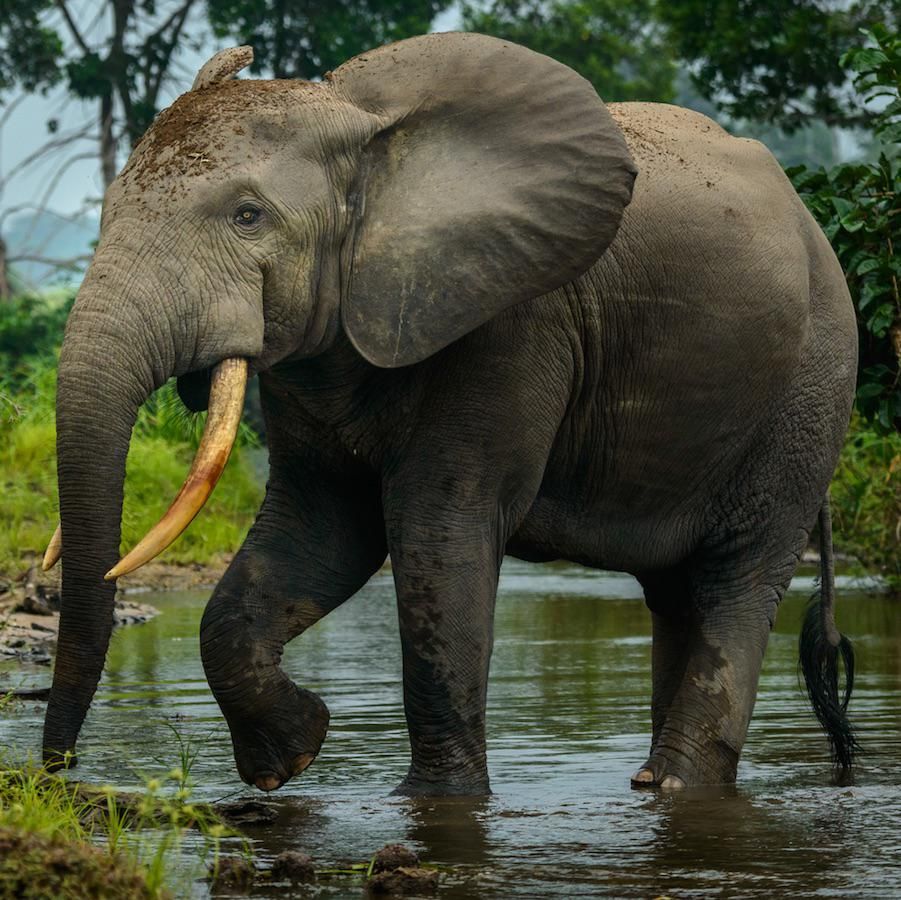
The African forest elephant is the smaller, rarer, and more elusive of the two African elephant species. Loxodonta cyclotis lives in the deep equatorial rainforests of central and west Africa, where it has shaped the botanical makeup of the Congo Basin for hundreds of thousands of years.
Although it looks superficially like a smaller version of its famous savanna cousin, the forest elephant is genetically distinct, ecologically separate, and now in far worse trouble: the IUCN classifies it as Critically Endangered, with a population that has collapsed by roughly 86 per cent since the 1980s.
This guide covers every major aspect of forest elephant biology and conservation: taxonomy and the 2010 species split, size and anatomy, straight tusks and rounded ears, rainforest ecology, diet and geophagy at forest clearings, the 22-month gestation and slow reproduction, infrasonic communication, keystone seed dispersal, the ivory crisis, and the scientists who have dedicated their careers to counting an animal that cannot be seen from the air.
It is a reference entry, not a summary - so expect specifics: kilograms, percentages, clearings, dates, and documented studies.
Etymology and Classification
The genus name Loxodonta was coined in 1827 by Georges Cuvier and means 'sloping tooth' in Greek, a reference to the characteristic lozenge-shaped enamel ridges on African elephant molars. The species name cyclotis comes from the Greek kyklos ('circle') and otis ('ear'), meaning 'round-eared' - an immediate field mark that distinguishes the forest elephant from its savanna cousin.
For most of the twentieth century, zoologists lumped all African elephants into a single species, Loxodonta africana, and treated cyclotis as a subspecies - Loxodonta africana cyclotis. Early naturalists had long noted that elephants in the Congo rainforest looked and behaved differently from those in the savanna, but the scientific consensus was that the differences were environmental, not genetic.
That changed with genetics. Starting in the late 1990s, researchers led by Alfred Roca and Nicholas Georgiadis began sequencing nuclear and mitochondrial DNA from elephants across Africa. Their 2010 paper in PLOS Biology showed that forest and savanna elephants had been genetically separate lineages for between two and seven million years - longer than the split between humans and chimpanzees.
On that basis, the study formally proposed recognising two distinct species: Loxodonta africana (bush) and Loxodonta cyclotis (forest).
For more than a decade the IUCN Red List held off on the reclassification pending further evidence. In March 2021 the IUCN Red List assessment was finally updated to recognise two separate species and assigned each its own conservation status - Endangered for the bush elephant, Critically Endangered for the forest elephant. The reclassification made the forest elephant one of the most threatened large mammals on Earth in a single stroke.
Ancient DNA studies have since added further texture. Forest elephants share some genes with the extinct straight-tusked elephant (Palaeoloxodon antiquus) of Pleistocene Europe, hinting at historic gene flow and a more complex proboscidean family tree than classical taxonomy allowed.
Size and Physical Description
Forest elephants are the smallest living elephant species on average. Their compact body plan is a direct adaptation to dense forest, where navigating between tree trunks and moving under low canopy favours a smaller frame.
Adult females:
- Shoulder height: 2.0-2.4 metres
- Weight: 1,800-2,500 kg
- Noticeably more gracile than bush elephant females
Adult males:
- Shoulder height: 2.2-2.5 metres, rarely above 2.6 m
- Weight: 2,500-3,200 kg, occasionally larger
- Sexual dimorphism less extreme than in bush elephants
Calves at birth:
- Shoulder height: roughly 80 cm
- Weight: 90-110 kg
For comparison, adult bush elephant males commonly stand 3.2-4.0 metres at the shoulder and weigh 4,000-6,000 kg, making them nearly double the mass of their forest relatives.
Field identification features:
- Ears. Small, rounded, close to the head. Bush elephant ears are enormous triangles shaped to radiate heat; forest elephant ears are modest semicircles because rainforest is warm but shaded, not hot and exposed.
- Tusks. Straight and pointing almost directly downward, rather than curving up and out. Tusks appear in both sexes, are often pink-stained from iron-rich soils, and are made of unusually hard, dense ivory. In males they can reach 1.5 metres; in females they are shorter but still prominent.
- Trunk. Slightly shorter and more muscular than the bush elephant's, with fine sensory hairs that help detect fruit in dim forest understorey.
- Toenails. Five on each front foot, four on each hind foot. Bush elephants have four and three respectively.
- Body shape. More rounded back with a high, rounded forehead; bush elephants have a sloping back and more angular head.
- Skin. Darker grey-brown overall, with less dust-colouring because rainforest elephants wallow in dark muddy water rather than red dust.
These differences are consistent enough that experienced field biologists can distinguish the two species instantly in photographs - but the smaller size and straight tusks are the diagnostic combination.
Habitat and Range
Forest elephants are animals of the closed-canopy equatorial rainforest. Their historical range extended across the Guinean forests of west Africa and the entire Congo Basin, from Sierra Leone in the west to the Albertine Rift in the east. Today that range has contracted to a fraction of its former size.
Current strongholds:
| Country | Approximate share of global population |
|---|---|
| Gabon | 60-70% |
| Republic of Congo | 10-15% |
| Cameroon | 5-10% |
| Central African Republic | 3-5% |
| Democratic Republic of Congo | 3-5% |
| West Africa (combined pockets) | Less than 2% |
Within these countries forest elephants use a mosaic of habitats:
- Primary lowland rainforest. The core habitat. Closed canopy, dense understorey, slow-growing hardwoods.
- Swamp forest. Seasonally flooded forest on river edges, especially important in the Likouala and Sangha basins.
- Riverine forest. Narrow forest corridors along rivers, critical for movement between larger habitat blocks.
- Forest clearings (bais). Natural mineral-rich openings in the forest. These may be only a few hectares across but are disproportionately important: bais such as Dzanga Bai (Central African Republic), Mbeli Bai (Republic of Congo), and Langoue Bai (Gabon) attract dozens to hundreds of elephants to drink mineral water and socialise.
- Secondary forest and agricultural edges. Increasingly used as primary forest is logged, often bringing elephants into conflict with farmers.
West African populations have fared worst. Forest elephants in Sierra Leone, Ghana, Ivory Coast, and Liberia now survive in small, isolated pockets, most numbering only dozens to low hundreds of individuals. Several west African subpopulations are functionally extinct.
Tusks, Ivory, and Why They Are Still Hunted
At first glance, the forest elephant's smaller tusks should make it a less attractive target for ivory poachers than its larger savanna cousin. The reality is the opposite. Between 2002 and 2013, researchers led by Fiona Maisels estimated that the forest elephant population fell by 62-65 per cent in just eleven years - an annual decline of roughly 9 per cent, almost entirely driven by ivory poaching.
Three features make forest elephant ivory particularly desirable to the black market:
- Density. Forest elephant ivory is harder and denser than savanna elephant ivory, partly because of the slower growth rate of the species. This makes it better for fine carving, especially for the east Asian hanko (personal seal) market.
- Colour. The characteristic pink or rose staining, caused by iron-rich rainforest soils, is considered aesthetically distinctive and commands a premium among some collectors.
- Scarcity. As the population has declined, the rarity of the ivory itself has pushed prices higher - a classic extinction-market dynamic.
Major seizures of ivory in ports from Singapore to Hong Kong to Mombasa have repeatedly included forest elephant tusks traceable through DNA forensics to poaching hotspots in Gabon, Cameroon, and the Republic of Congo. The ivory-trade spike from roughly 2007 through 2014 was the decisive factor that pushed the species over the IUCN Critically Endangered threshold.
International ivory trade has been banned under CITES since 1989, and domestic markets in China and the United States have since been closed or sharply restricted. Poaching rates have fallen from their 2011-2013 peak, but remain high enough that the population is still declining in most range states.
Reproduction and Life Cycle
Forest elephant reproduction is extraordinarily slow - slower than any other elephant species, and among the slowest of any large mammal. This is the single most important fact for understanding why the population cannot rebound quickly.
Reproductive parameters:
| Metric | Value |
|---|---|
| Age at first reproduction (F) | 17-23 years |
| Age at first reproduction (M) | 25-30 years (effective) |
| Gestation length | 22 months |
| Calving interval | 5-6 years (typical, can exceed 7) |
| Weaning age | 4-5 years |
| Lifespan (wild) | 60-70 years |
By contrast, bush elephants typically have a calving interval of 3-4 years and reach reproductive maturity 3-5 years earlier. A single forest elephant female produces on average only 5-7 calves in her lifetime, of which perhaps 3-5 survive to adulthood. A single poached female is therefore not only irreplaceable within a human lifetime - she represents the loss of an entire reproductive lineage.
Recovery modelling published in Animal Conservation (2020) suggests that even under ideal protection, forest elephant populations require 75-90 years to recover to pre-1980s numbers.
Calves are born into tight matriarchal family groups of 3-8 individuals, smaller on average than bush elephant families because dense forest favours smaller social units. Female offspring typically stay with the natal group for life; males disperse around puberty and live largely solitary lives, associating with bulls in loose, shifting bachelor groups.
At forest clearings these otherwise dispersed individuals can come together in aggregations of 50-150 elephants, which researchers use for individual identification and social-network analysis.
Diet, Fruit, and Forest Gardening
Forest elephants are frugivores to a degree that sets them apart from every other living elephant. During seasons of peak fruit availability, fruit can account for more than 70 per cent of their diet by volume - a proportion no bush elephant ever reaches. They also eat leaves, bark, twigs, aquatic plants, and mineral-rich soil, but the fruit relationship is what defines their ecological role.
Typical plant groups consumed:
- Fruiting trees: Sacoglottis gabonensis, Panda oleosa, Balanites wilsoniana, Irvingia species, Tieghemella africana
- Lianas and climbers
- Aquatic macrophytes in swamp clearings
- Raffia and other palms
More than 70 central African rainforest tree species rely primarily on forest elephants to disperse their seeds. Many of these trees produce fruits that are too large, too hard, or too toxic for smaller animals to handle. Only an elephant can swallow the seeds whole, carry them several kilometres during gut transit, and deposit them in a dung pile that serves as a pre-fertilised nursery.
Studies in Gabon's Lope National Park have shown that germination rates for several tree species are ten to hundreds of times higher in elephant dung than from fallen fruit alone.
A 2019 study in Nature Geoscience, led by Fabio Berzaghi, used ecosystem modelling to estimate that the functional loss of forest elephants would cause a 7-14 per cent decline in above-ground carbon biomass in central African rainforests within decades. The mechanism is that the slow-growing, high-wood-density hardwood trees the elephants disperse are also the species that store the most carbon.
Losing the disperser means losing the disperser's tree species, which means a forest with fewer, smaller, faster-growing trees - and therefore less carbon. The Congo Basin is the second-largest tropical carbon sink on Earth; forest elephants are integral to its function.
Geophagy and the Forest Clearings
Forest clearings - called bais in central African languages - are one of the most remarkable features of the Congo Basin. These are natural openings in the otherwise continuous forest canopy, a few hectares in size, fed by mineral-rich groundwater or sitting on natural salt licks. Forest elephants travel for tens of kilometres to reach them.
Dzanga Bai, in the Dzanga-Sangha Special Reserve of the Central African Republic, is the most famous. Researchers led by Andrea Turkalo have monitored the bai continuously since 1990, identifying more than 4,000 individual elephants over three decades - the longest-running study of individually identified forest elephants anywhere.
On a good day over 100 elephants can be observed simultaneously, digging pits up to a metre deep into the mineral-rich mud with their tusks and trunks, drinking the enriched water, and socialising.
Mineral supplementation at bais provides sodium, calcium, magnesium, and other nutrients that are scarce in leaves and fruit but essential for milk production, bone growth, and muscle function. The pink or rose staining of forest elephant tusks is a direct result of iron oxides in bai mud.
Bais are also where forest elephant social networks become visible to researchers, because most of the forest itself is too dense for observation. Dung-DNA sampling, camera traps, and direct observation at bais have produced most of what we know about individual identification, kinship, and social structure in the species.
Communication and Cognition
Communication in rainforest is a hard engineering problem. Dense foliage absorbs and scatters sound, visibility rarely exceeds 20-30 metres, and family groups can become separated by kilometres. Forest elephants solve this with low-frequency calls that travel through vegetation the way light does not.
Acoustic communication:
- Infrasonic rumbles. Calls below 20 Hz, beneath human hearing, can travel several kilometres through forest with relatively low attenuation. These carry information about identity, family, reproductive state, and alarm.
- Audible rumbles. Higher-frequency rumbles between 20 and 200 Hz for shorter-range coordination.
- Trumpets, roars, and snorts. Short-range vocalisations used in aggressive, defensive, or excited contexts.
- Seismic signals. Foot-stomping produces ground-borne vibrations that can be detected by other elephants through their feet and trunks.
The Cornell Lab of Ornithology's Elephant Listening Project, founded by Katy Payne and led by Peter Wrege, has deployed long-term acoustic monitoring arrays at Dzanga Bai and in Nouabale-Ndoki National Park. The project has catalogued more than a dozen distinct call types and demonstrated that acoustic monitoring can be used to estimate population density and even detect poaching gunshots in real time.
Cognitively, forest elephants show the same hallmarks of intelligence documented in their savanna and Asian relatives: tool use, self-recognition, long-term memory of individuals and places, and cooperative problem-solving. Dense forest makes controlled experiments difficult, so much of this evidence is inferential or comes from the few captive individuals - but the neuroanatomy of the forest elephant brain is essentially identical to that of bush elephants.
Counting an Invisible Elephant
Counting bush elephants is hard but tractable: aerial surveys across open savanna, pioneered by researchers such as Mike Chase and institutionalised in the 2016 Great Elephant Census, can cover enormous areas quickly. Forest elephants are another matter. Under a closed canopy they are effectively invisible from the air. Even trained observers standing on the ground can pass within a few metres of an elephant without seeing it.
Methods used to monitor forest elephants:
- Dung counts. Transects are walked through the forest, dung piles are counted, age is estimated, and densities are calculated using known decay rates and defecation rates.
- Dung-DNA surveys. Samples are genotyped to identify individuals and estimate population size through capture-recapture modelling.
- Forest clearing observation. At bais, researchers identify individuals by ear shape, tusk configuration, tail hair, and scarring. Cumulative observation over years produces a catalogue.
- Camera trap networks. Thousands of cameras across study sites record presence, absence, and relative abundance.
- Acoustic monitoring. Fixed microphone arrays record calls across landscapes and estimate density from call rates.
- Satellite tracking. GPS collars on a small number of individuals map long-distance movement patterns.
The resulting population estimates come with wide confidence intervals, but multiple independent methods converge on roughly 100,000 surviving forest elephants - down from an estimated 700,000 or more in the early 1980s. Researchers including Fiona Maisels, Samantha Strindberg, Stephen Blake, Andrea Turkalo, and John Poulsen have carried the quantitative work that makes these numbers defensible.
Conservation Status and Threats
The IUCN Red List classifies Loxodonta cyclotis as Critically Endangered as of the 2021 reassessment. The species is listed on CITES Appendix I, which bans international commercial trade in the animal or its parts. It is also protected under national laws in every range state, though enforcement varies dramatically.
Primary threats:
- Ivory poaching. The proximate cause of the 86 per cent decline. Organised trafficking networks link poachers in the Congo Basin to buyers in east Asia, with transit points in east African ports.
- Habitat loss and fragmentation. Commercial logging (selective and industrial), road building for logging and oil extraction, industrial oil palm and rubber plantations, and subsistence agriculture all reduce and fragment forest habitat. Road construction is particularly damaging because new roads provide poachers access to previously remote forest.
- Human-elephant conflict. As forest is cleared and elephants are compressed into smaller areas, crop raiding on cassava, plantain, cocoa, and other subsistence crops increases. Retaliatory killings by farmers are a growing source of mortality.
- Slow reproduction. The 5-6 year calving interval and 22-month gestation mean that even small sustained mortality above natural rates leads to population decline.
- Climate change. Shifting rainfall patterns in the Congo Basin may alter fruiting phenology, with unclear but potentially serious consequences for a frugivore-dependent species.
Conservation responses:
- Protected area networks such as Nouabale-Ndoki National Park, Dzanga-Sangha Special Reserve, Lope National Park, Loango National Park, and the Minkebe-Odzala-Dja transboundary complex.
- Anti-poaching units with aerial, foot, and canine patrol components, often trained and supported by NGOs such as WCS, WWF, and African Parks.
- Community-based conservation and benefit-sharing programmes, particularly around high-profile parks in Gabon and Republic of Congo.
- Ivory-market demand reduction, most notably the 2017 Chinese domestic ivory ban.
- Human-elephant conflict mitigation: chili fences, beehive fences, early-warning systems, and compensation schemes.
- Long-term research programmes at Dzanga Bai, Mbeli Bai, and Langoue Bai.
Even with these measures, no range-state government currently reports a stable or increasing national forest elephant population over the past decade. Gabon, which holds the majority of the world's remaining forest elephants, has seen localised declines of 25-80 per cent in monitored sites since 2004.
Forest Elephants and Humans
Forest elephants have shared central Africa with humans for as long as humans have lived there. BaAka and Baka communities in the Congo Basin hold deep traditional knowledge of forest elephant behaviour, seasonal movements, and feeding grounds. In many cases this knowledge predates and complements modern scientific research. Conservation programmes in Dzanga-Sangha and elsewhere now routinely employ BaAka trackers whose forest skills exceed those of any outsider.
At the same time, the relationship is under strain. Crop-raiding by elephants can destroy a subsistence farmer's annual harvest in a single night. Retaliatory killings, both by aggrieved farmers and by poachers using the cover of conflict, are an increasing source of mortality in some regions.
Effective forest elephant conservation requires that rural communities see tangible benefits from keeping elephants alive - through ecotourism revenue, research employment, crop protection, and compensation schemes.
Ecotourism around forest elephants is limited by the very inaccessibility that protects them. Dzanga Bai, Mbeli Bai, and Langoue Bai offer rare, world-class viewing opportunities but receive only modest visitor numbers compared with savanna safari destinations. This is both a strength (low disturbance) and a weakness (less financial leverage for conservation).
Globally, the forest elephant is the great unknown of elephant conservation - less famous than its savanna cousin, less studied than the Asian elephant, yet arguably the most ecologically important of the three. The fate of the Congo Basin rainforest, and through it a significant fraction of the planet's tropical carbon sink, is tied directly to whether enough forest elephants survive to keep planting new trees.
Related Reading
- African Bush Elephant: The Giant of the Savanna
- Asian Elephant: The Forest Giant of the East
- Elephant Memory and Intelligence: Real Science
- Elephants: Memory, Intelligence, and the Fight for Survival
References
Relevant peer-reviewed and governmental sources consulted for this entry include the 2021 IUCN Red List assessment for Loxodonta cyclotis, the Roca et al. (2010) PLOS Biology paper on African elephant species delimitation, Maisels et al. (2013) in PLOS ONE on forest elephant decline, Turkalo et al. ongoing work at Dzanga Bai published in Journal of Mammalogy, Berzaghi et al.
(2019) in Nature Geoscience on forest elephants and carbon storage, and long-term datasets from the Cornell Elephant Listening Project and the Wildlife Conservation Society's central Africa programmes. Population figures reflect consolidated estimates from the 2021 IUCN assessment and subsequent national monitoring reports.
Frequently Asked Questions
How is the African forest elephant different from the African bush elephant?
Forest elephants (Loxodonta cyclotis) and bush elephants (Loxodonta africana) were classified as subspecies for most of the 20th century, but genetic analysis in 2010 and a formal IUCN reassessment in 2021 confirmed they are distinct species. Forest elephants are noticeably smaller - 2.0-2.5 m at the shoulder versus up to 4 m for bush elephants - and weigh 1,800-3,200 kg compared with 4,000-6,000 kg.
Their tusks point straight down rather than curving outward, their ears are small and rounded rather than large and triangular, and they have five toenails on the front feet and four on the back (bush elephants have four and three). Ecologically they are almost entirely separate: forest elephants live in dense equatorial rainforest in central and west Africa, while bush elephants range across open savanna and woodland from southern Africa to the Sahel.
Where do forest elephants live?
African forest elephants inhabit the Congo Basin and surrounding lowland rainforests of central and west Africa. The largest populations remain in Gabon and the Republic of Congo, with smaller numbers in Cameroon, the Central African Republic, the Democratic Republic of Congo, Equatorial Guinea, Liberia, Ivory Coast, and Ghana.
They prefer closed-canopy primary forest but also use swamp forest, riverine forest, and the open mineral-rich clearings called bais - places like Dzanga Bai and Mbeli Bai - where dozens to hundreds of individuals gather to drink mineral-enriched water and socialise.
Their range has contracted dramatically in the past four decades: forest elephants now occupy less than 25% of their historical range, with west African populations reduced to tiny, fragmented pockets.
Why are forest elephants Critically Endangered?
The IUCN uplifted forest elephants to Critically Endangered in 2021 because their population has declined by more than 86% over three generations. Two intertwined threats drive this collapse. First, ivory poaching - between 2002 and 2013 an estimated 65% of all forest elephants were killed for their ivory, which is harder and denser than bush elephant ivory and fetches premium prices.
Second, habitat loss and fragmentation from commercial logging, industrial agriculture (especially oil palm), mining, and road construction, which carve the forest into isolated patches and open previously inaccessible areas to poachers. Because forest elephants reproduce only every 5-6 years with a 22-month gestation, a poached female is effectively irreplaceable within a human lifetime.
Population modelling suggests that even if all poaching stopped today, the species would need close to a century to recover to 1980s numbers.
How many forest elephants are left?
The best current estimate is that roughly 100,000 African forest elephants remain, down from an estimated 700,000+ in the early 1980s. The exact figure is difficult to pin down because forest elephants cannot be counted from the air under dense canopy. Researchers instead use dung-DNA surveys, camera traps, and direct observations at forest clearings to estimate density, then extrapolate.
Gabon alone is thought to hold 60-70% of the remaining global population, with the Republic of Congo and Cameroon holding most of the rest. Several central and west African range states have lost over 95% of their forest elephants since 1980.
Why are forest elephants called 'forest gardeners'?
Forest elephants are the primary long-distance seed dispersers for more than 70 large-seeded rainforest tree species in central Africa - many of these trees produce fruit too big for any other animal to swallow whole. The elephants eat the fruit, carry seeds several kilometres in their guts, and deposit them in dung piles that function as nutrient-rich nurseries.
Research published in Nature Geoscience (2019) and other journals estimates that the Congo Basin’s above-ground carbon biomass would decline by 7-14% within a few decades if forest elephants were lost, because the slow-growing hardwood trees they disperse are disproportionately important for carbon storage. Losing forest elephants therefore means not just losing a species but degrading one of Earth’s most important carbon sinks.
What do forest elephants eat?
Forest elephants are mixed-feeders with a diet dominated by fruit, which can make up more than 70% of their intake in seasons of high fruit availability - a far higher proportion than for any other elephant species. They also eat bark, leaves, twigs, roots, aquatic plants, and mineral-rich soil. An adult consumes roughly 4-7% of its body weight in vegetation per day - around 150-200 kg of plant matter.
At forest clearings they dig pits up to a metre deep with their tusks and trunks to reach mineral-rich water and clay, which supplies sodium, calcium, and other nutrients absent from rainforest vegetation. This geophagy is how the characteristic pink staining ends up on their tusks.
How do forest elephants communicate in dense rainforest?
Rainforest is one of the hardest environments on Earth for long-distance animal communication: thick foliage absorbs high frequencies and visibility is measured in metres rather than kilometres. Forest elephants solve the problem with infrasound - rumbling calls below 20 Hz, beneath the threshold of human hearing. Low frequencies travel farther through dense vegetation and around obstacles.
Cornell University’s Elephant Listening Project has recorded more than a dozen distinct call types used for long-distance contact, mate attraction, alarm, and coordination between family groups separated by several kilometres of forest. They also use scent marking, tactile communication through trunks, and short-range vocalisations within groups.
Are forest elephants dangerous to humans?
Forest elephants are generally shy and avoid humans, but encounters are increasingly dangerous for both sides. The species is behaviourally more reactive than bush elephants - individuals that have been hunted or harassed will charge quickly, and the dense forest means encounters often happen at very close range with little warning. Researchers and rangers use strict protocols: noise, cover, and never approaching family groups.
Crop-raiding around forest edges has become a serious human-elephant conflict issue in parts of Gabon, Cameroon, and Republic of Congo, where elephants drawn to cassava, plantain, and cocoa plantations can be killed in retaliation. Conservation NGOs work with communities on chili fences, beehive fences, and rapid-response programmes to reduce losses and prevent retaliatory killings.