
Why is kangaroo hopping so energy-efficient?
Kangaroo hopping exploits elastic energy storage in the tendons of their hind legs, functioning like biological pogo sticks. At speeds above 15 km/h, a kangaroo's energy expenditure per unit distance actually decreases as speed increases - the opposite of what occurs in running mammals.
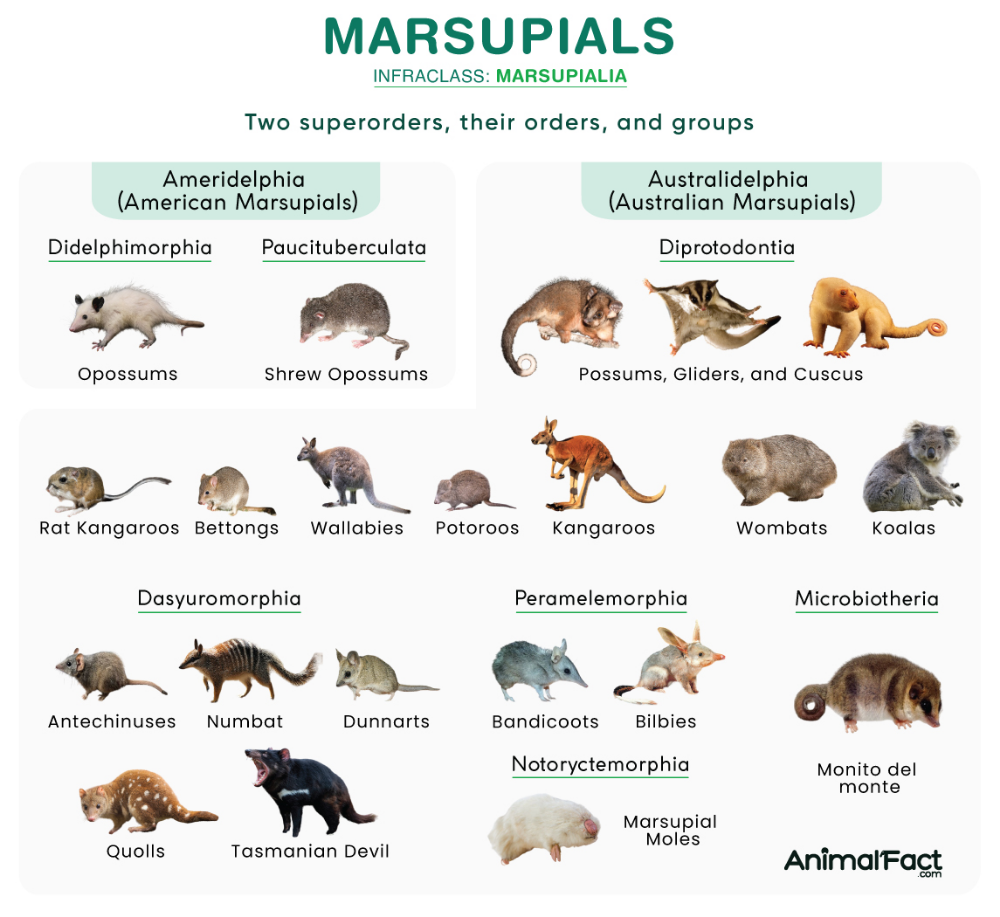
There is no group of mammals on Earth quite like the marsupials. They nurse their young in pouches, give birth to offspring the size of jellybean, and have radiated into ecological roles filled by placental mammals on every other continent - yet they did it all independently, following an evolutionary blueprint that diverged from ours over 160 million years ago.
Australia is their stronghold, home to more than 250 species ranging from the two-meter-tall red kangaroo to the honey possum, which weighs less than a AAA battery. But marsupials are not merely curiosities of biogeography. They are linchpins of their ecosystems, architects of soil structure, seed dispersers, and population regulators whose decline sends shockwaves through entire landscapes.
Understanding marsupials requires abandoning assumptions shaped by familiarity with placental mammals. Their reproduction, metabolism, locomotion, and even their immune systems operate on fundamentally different principles - principles that make them simultaneously more vulnerable to modern threats and, in some cases, astonishingly resilient.
What Makes a Marsupial: The Pouch and Beyond
The defining feature of marsupials (infraclass Marsupialia) is their mode of reproduction. Unlike placental mammals, which nourish embryos through a complex, long-lasting placenta, marsupials give birth after an extremely short gestation period - as little as 12 days in some bandicoot species and a maximum of roughly 36 days in the largest kangaroos.
The newborn emerges at what is essentially an embryonic stage of development: blind, hairless, with fused eyelids and barely formed hind limbs. A newborn red kangaroo weighs approximately 0.75 grams - less than a paper clip - yet it must crawl unaided from the birth canal to the mother's pouch, a journey of about 15 centimeters that takes roughly three minutes.
Once inside the pouch (marsupium), the neonate attaches to a teat that swells inside its mouth, effectively locking it in place.
The mother's mammary glands then perform something remarkable: they produce different compositions of milk from different teats simultaneously, allowing a mother kangaroo to feed a newborn joey on high-fat, low-sugar milk while an older joey at foot receives milk with entirely different nutritional content [1]. This capacity for concurrent, customized lactation has no equivalent in placental mammals.
The marsupial reproductive strategy is not inferior to the placental approach - it is an alternative solution to the same evolutionary problem. By investing less energy in gestation and more in lactation, marsupials can rapidly replace lost offspring in harsh environments. A female kangaroo can maintain an embryo in diapause (suspended development) in her uterus, have a newborn attached in the pouch, and an older joey at foot - three offspring at different developmental stages simultaneously.
"Marsupials are not failed placentals. They are a separate experiment in mammalian design, one that has been running successfully for over 60 million years on the Australian continent." - Tim Flannery, The Future Eaters: An Ecological History of the Australasian Lands and People (1994)
Kangaroos: Engineering Marvels on Two Legs
Kangaroos (family Macropodidae, meaning "big foot") are the most recognizable marsupials and among the most biomechanically extraordinary mammals alive. The red kangaroo (Macropus rufus) is the largest living marsupial, with males standing up to 1.8 meters tall and weighing as much as 90 kg. But it is not their size that makes kangaroos remarkable - it is how they move.
The Biomechanics of Hopping
Bipedal hopping appears, at first glance, to be an energetically wasteful mode of locomotion. In reality, it is one of the most efficient forms of high-speed travel in the animal kingdom. The key lies in elastic energy storage. A kangaroo's massive hind-leg tendons - particularly the gastrocnemius tendon, analogous to the human Achilles tendon - function as biological springs.
During each hop, these tendons absorb kinetic energy on landing, store it as elastic potential energy, and release it on takeoff. Approximately 70 percent of the energy from each bound is recycled through this mechanism [2].
The result is counterintuitive: at speeds above 15 km/h, a kangaroo's metabolic cost of transport (energy per unit distance) decreases as speed increases, up to cruising speeds of roughly 35 km/h. No running mammal achieves this. A red kangaroo cruising at 25 km/h uses less energy per kilometer than a similarly sized quadruped running at the same speed.
At top speed, red kangaroos can reach 70 km/h in short bursts, with individual hops covering 8 to 9 meters in length and clearing heights of 3 meters.
An additional biomechanical trick involves breathing. As a kangaroo hops, its internal organs shift forward and backward within the body cavity, acting as a piston against the diaphragm. This passively inflates and deflates the lungs in synchrony with the hopping gait, meaning the animal breathes without expending additional muscular energy - a phenomenon called visceral piston ventilation.
Mob Structure and Social Behavior
Kangaroos are social animals that live in groups called mobs, typically comprising 10 to 50 individuals, though aggregations of several hundred occur around water sources during drought. Mob structure is loosely organized around a dominance hierarchy among males, established and maintained through ritualized boxing matches.
Males lock forearms, grapple, and deliver powerful kicks with their hind legs - kicks capable of disemboweling a rival, though serious injuries in ritualized combat are rare.
Females exhibit mate choice, preferring larger, more dominant males. Genetic studies have revealed that the largest male in a mob sires a disproportionate share of offspring - up to 50 percent in some studied populations - creating strong sexual selection pressure for male body size [3].
Koalas: The Price of Extreme Specialization
The koala (Phascolarctos cinereus) is arguably the most specialized mammal on the Australian continent. It feeds almost exclusively on the leaves of eucalyptus trees - a food source so toxic, fibrous, and nutritionally poor that virtually no other mammal can subsist on it.
The Eucalyptus Specialist
Eucalyptus leaves contain a cocktail of defensive chemicals including terpenes, phenolic compounds, and cyanogenic glycosides (precursors to hydrogen cyanide). They are also extremely high in indigestible fiber and low in protein. A koala's digestive system has evolved extraordinary adaptations to cope with this diet.
The cecum - the pouch at the junction of the small and large intestines - is proportionally the longest of any mammal, reaching up to 2 meters in length. It houses a dense community of specialized bacteria capable of breaking down eucalyptus toxins and fermenting the fiber to extract what little energy it contains.
Even with these adaptations, koalas extract minimal energy from their food. They compensate with the lowest metabolic rate of almost any mammal their size, sleeping an average of 20 to 22 hours per day. When awake, they move with deliberate slowness, conserving every calorie.
Their brain, relative to body size, is one of the smallest among mammals - the cranial cavity is only about 61 percent filled with brain tissue, the remainder being cerebrospinal fluid. This is likely another metabolic economy, as brain tissue is energetically expensive to maintain.
Koalas are highly selective in their food choices. Of the approximately 900 species of eucalyptus in Australia, individual koalas regularly feed on only 30 to 50 species, and within those, they select specific trees and even specific leaves based on protein-to-fiber ratios and toxin concentrations. They assess leaf quality through smell before eating, rejecting leaves that exceed their toxin tolerance [4].
The Chlamydia Crisis
The koala faces a health crisis that has become as defining to its conservation as habitat loss. Chlamydia - caused primarily by Chlamydia pecorum - is now endemic in koala populations across much of eastern Australia. Infection rates in some Queensland populations exceed 90 percent. The disease causes blindness, urinary tract infections, infertility, and a condition called "dirty tail" (chronic diarrhea leading to stained fur and wasting).
The origins of chlamydia in koalas remain debated. Some researchers believe it was introduced through contact with livestock, while others argue it may have been present at low levels for millennia and has become epidemic due to immune suppression caused by habitat stress and the koala retrovirus (KoRV).
Before the 2019-2020 bushfires, the Australian Koala Foundation estimated there were fewer than 80,000 koalas remaining in the wild. In February 2022, the Australian government officially upgraded the koala's conservation status to endangered in Queensland, New South Wales, and the Australian Capital Territory.
Wombats: Underground Engineers with Cubic Feces
Wombats (family Vombatidae) are stocky, burrowing marsupials that occupy a unique ecological niche as Australia's primary large-bodied fossorial mammals. Three living species exist: the common wombat (Vombatus ursinus), the southern hairy-nosed wombat (Lasiorhinus latifrons), and the critically endangered northern hairy-nosed wombat (Lasiorhinus krefftii), of which fewer than 315 individuals survive.
The Backwards Pouch
Unlike kangaroos, the wombat's pouch opens rearward - toward the animal's hind legs rather than its head. This adaptation prevents soil from entering the pouch during digging. A wombat can excavate a burrow system up to 200 meters long and 3.5 meters deep, creating underground networks that also shelter other species including echidnas, rabbits, and small reptiles. During the 2019-2020 bushfires, wombat burrows served as critical refugia for small animals fleeing the flames.
Cube-Shaped Droppings
Wombats produce cube-shaped feces - the only known mammal to do so. This peculiarity puzzled scientists for decades until a 2018 study by Patricia Yang and colleagues at the Georgia Institute of Technology determined the mechanism. The cubes form in the final 8 percent of the intestine, where sections of the intestinal wall exhibit varying elasticity.
Stiffer regions create flat faces while more elastic regions form the edges, molding the feces into roughly cubic shapes as moisture is extracted. Wombats deposit these droppings on top of rocks and logs as territorial markers; the cubic shape prevents them from rolling away, making them more effective scent signals [5].
Tasmanian Devils: Cancer, Carnage, and Conservation
The Tasmanian devil (Sarcophilus harrisii) is the world's largest surviving carnivorous marsupial, following the extinction of the thylacine in 1936. Males weigh up to 12 kg and possess the strongest bite force relative to body size of any living mammal - a bite force quotient that exceeds that of a hyena.
Devils are primarily scavengers, capable of consuming an entire carcass including bones, fur, and internal organs. They can eat up to 40 percent of their body weight in a single feeding session. Their feeding behavior is noisy, aggressive, and communal, with multiple devils congregating around a carcass and engaging in screaming, growling, and biting disputes that gave early European settlers the impression of demonic creatures - hence the name.
Devil Facial Tumor Disease
In 1996, a wildlife photographer in northeastern Tasmania captured images of devils with grotesque facial tumors. The discovery of devil facial tumor disease (DFTD) revealed one of the most extraordinary and devastating diseases in the natural world. DFTD is a transmissible cancer - the tumor cells themselves are the infectious agent, transferred between individuals through biting.
It is only the second transmissible cancer ever discovered in nature (after canine transmissible venereal tumor, which is largely non-lethal).
The cancer exploits a genetic vulnerability: Tasmania's devil population has extremely low genetic diversity, the result of population bottlenecks over thousands of years. This means the devils' immune systems fail to recognize the foreign tumor cells as non-self. Once transmitted, the tumors grow rapidly on the face and mouth, eventually preventing the animal from eating and leading to death within 6 to 12 months.
Since 1996, DFTD has spread across approximately 80 percent of the devil's range and has killed an estimated 80 percent of the total population. In 2014, a second, independently evolved transmissible cancer (DFT2) was discovered, compounding the crisis.
Conservation efforts include:
- Insurance populations of disease-free devils in mainland Australian zoos and wildlife parks
- A wild population established on Maria Island, off Tasmania's east coast
- Selective breeding programs focused on maintaining genetic diversity
- Research into immune-based therapies and potential vaccines
- Monitoring of natural resistance, as some wild devil populations show signs of evolving immune-mediated tolerance to DFTD
Quokkas: The Smiling Marsupial
The quokka (Setonix brachyurus) is a small wallaby weighing between 2.5 and 5 kg, native to southwestern Australia. It gained global fame through tourist selfies on Rottnest Island (Wadjemup), where its upturned mouth gives the appearance of a permanent smile - earning it the title of "the world's happiest animal."
The quokka's "smile" is an artifact of its jaw and facial muscle structure rather than an emotional expression, but the viral fame has had tangible conservation benefits. Tourism revenue from Rottnest Island funds habitat management and research programs.
The island's population of approximately 10,000 to 12,000 quokkas is relatively stable, though mainland populations have declined severely due to predation by foxes and cats and loss of dense swamp habitat. The species is classified as vulnerable by the IUCN.
Quokkas exhibit an unusual reproductive behavior: like kangaroos, females can maintain embryos in diapause. If a joey is lost, the replacement embryo resumes development immediately, minimizing reproductive downtime in an unpredictable environment.
Possums, Opossums, and Convergent Evolution
The distinction between possums (order Diprotodontia, found in Australasia) and opossums (order Didelphimorphia, found in the Americas) is one of the clearest examples of convergent evolution in mammals. Despite occupying similar ecological niches - nocturnal, arboreal, omnivorous - the two groups are only distantly related, having diverged more than 70 million years ago when the supercontinent Gondwana fragmented.
Australian possums include the common brushtail possum (Trichosurus vulpecula), which has adapted so successfully to urban environments that it is one of the few marsupials with a growing population; the sugar glider (Petaurus breviceps), which has evolved a patagium (gliding membrane) remarkably similar to that of flying squirrels; and the Leadbeater's possum (Gymnobelideus leadbeateri), a critically endangered species confined to small patches of mountain ash forest in Victoria.
The Virginia opossum (Didelphis virginiana) of North America shares striking behavioral parallels with Australian possums - nocturnal foraging, opportunistic diet, high reproductive rate - despite 70 million years of independent evolution. Both groups have also evolved prehensile tails for gripping branches, though the underlying anatomy differs in detail.
| Feature | Australian Possums | American Opossums |
|---|---|---|
| Number of species | ~70 | ~100+ |
| Geographic range | Australia, New Guinea, Sulawesi | North, Central, South America |
| Divergence date | Part of Australidelphia (Gondwanan origin) | Part of Ameridelphia (Gondwanan origin) |
| Diet | Herbivorous to omnivorous | Primarily omnivorous to insectivorous |
| Pouch development | Well-developed in most species | Reduced or absent in many species |
| Unique adaptation | Gliding (sugar glider, greater glider) | Thanatosis ("playing dead") in Virginia opossum |
| Conservation status | Mixed; several species critically endangered | Generally stable; most species least concern |
The Thylacine: A Cautionary Extinction
No discussion of marsupials is complete without the thylacine (Thylacinus cynocephalus), also known as the Tasmanian tiger or Tasmanian wolf. The thylacine was the largest carnivorous marsupial of modern times - a wolf-sized predator with distinctive dark stripes across its back and rump and a jaw that could gape to an extraordinary 75 to 80 degrees.
The thylacine was once widespread across mainland Australia, New Guinea, and Tasmania. It disappeared from the mainland roughly 3,000 years ago, likely due to competition with dingoes (which never reached Tasmania). In Tasmania, it persisted until European colonization, when bounty hunting - driven by unsubstantiated claims that thylacines killed sheep - pushed the species toward extinction. Between 1888 and 1909, the Tasmanian government paid bounties on 2,184 thylacine carcasses.
The last known thylacine, a male sometimes called "Benjamin" (though this name was applied posthumously and is historically unverified), died at the Hobart Zoo on September 7, 1936. Footage shot in 1933 at the same zoo - showing the animal pacing its enclosure and displaying its remarkable jaw gape - remains some of the most haunting wildlife film ever recorded.
"I have seen few things that have moved me as much as watching the last thylacine on that old black-and-white footage. It is like watching the last speaker of a language that no one will ever speak again." - Steve Irwin, quoted in The Last Tasmanian Tiger by David Owen (2003)
In 2022, the biotechnology company Colossal Biosciences announced a partnership with the University of Melbourne to pursue de-extinction of the thylacine using gene-editing technology and the closely related fat-tailed dunnart as a surrogate species. The project remains highly controversial and faces formidable technical barriers, but it has reignited global discussion about humanity's obligation to species it has driven to extinction.
The 2019-2020 Australian Bushfires: Marsupials in the Flames
The Black Summer bushfires of 2019-2020 were the most catastrophic fire event in Australia's recorded history. Between September 2019 and March 2020, fires burned approximately 18.6 million hectares - an area larger than the entire country of Greece. The ecological toll was staggering.
A study led by Chris Dickman of the University of Sydney estimated that approximately 3 billion terrestrial vertebrates were killed or displaced by the fires, including an estimated 143 million mammals [6]. Marsupials were disproportionately affected due to their generally slow movement, habitat specialization, and - in arboreal species like koalas and greater gliders - inability to flee rapidly through burning forest.
Species of particular concern included:
- Koalas: An estimated 60,000 koalas were directly affected (killed, injured, or displaced) across New South Wales and Victoria
- Kangaroo Island dunnart (Sminthopsis aitkeni): Lost approximately 98 percent of its known habitat
- Greater glider (Petauroides volans): Lost an estimated 30 percent of its total range
- Brush-tailed rock-wallaby (Petrogale penicillata): Multiple colonies in New South Wales were entirely wiped out
The fires also disrupted food webs on which marsupials depend. Eucalyptus forests require 15 to 20 years to regrow to a stage that can support koala populations, meaning the full ecological recovery from Black Summer will not occur within a human generation.
The Future of Marsupials
Marsupials face a convergence of threats: habitat destruction through land clearing and urbanization, predation by introduced species (particularly foxes and feral cats, which kill an estimated 1.5 billion native mammals annually in Australia), climate change increasing fire frequency and drought severity, and disease epidemics including chlamydia in koalas and DFTD in Tasmanian devils.
Yet there are reasons for measured optimism. Australia's Threatened Species Strategy and programs like the National Environmental Science Program have delivered targeted conservation outcomes. Feral predator exclusion fencing has enabled the reintroduction of locally extinct marsupials to former habitat. Advances in reproductive technology, including artificial insemination and embryo transfer, offer new tools for managing genetically impoverished populations.
The story of marsupials is ultimately a story about the consequences of isolation and adaptation - about what happens when a lineage has an entire continent to itself for 45 million years and what happens when that isolation is suddenly, catastrophically breached. Their future depends on whether human societies can value these animals not as evolutionary oddities or tourist attractions, but as irreplaceable components of ecosystems that sustain us all.
References
[1] Trott, J. F., et al. "Maternal regulation of milk composition, milk production, and pouch young development during lactation in the tammar wallaby." Biology of Reproduction, vol. 68, no. 3, 2003, pp. 929-936.
[2] Dawson, T. J., and C. R. Taylor. "Energetic cost of locomotion in kangaroos." Nature, vol. 246, 1973, pp. 313-314.
[3] Miller, E. J., et al. "Reproductive skew and genetic relatedness in a natural population of eastern grey kangaroos." Behavioral Ecology, vol. 21, no. 2, 2010, pp. 357-364.
[4] Moore, B. D., et al. "Palatability mapping: a koala's eye view of spatial variation in habitat quality." Ecology, vol. 91, no. 11, 2010, pp. 3165-3176.
[5] Yang, P. J., et al. "How do wombats make cubed poo?" Soft Matter, vol. 17, no. 2, 2021, pp. 361-368.
[6] Dickman, C. R., et al. "Impacts of the unprecedented 2019-2020 bushfires on Australian animals." World Wildlife Fund Australia Report, 2020.
[7] Flannery, T. The Future Eaters: An Ecological History of the Australasian Lands and People. Reed Books, 1994.
[8] Owen, D. The Last Tasmanian Tiger: The History and Extinction of the Thylacine. Cambridge University Press, 2003.
Frequently Asked Questions
Why is kangaroo hopping so energy-efficient?
Kangaroo hopping exploits elastic energy storage in the tendons of their hind legs, functioning like biological pogo sticks. At speeds above 15 km/h, a kangaroo’s energy expenditure per unit distance actually decreases as speed increases - the opposite of what occurs in running mammals.
The large Achilles-like tendons store and release approximately 70 percent of the energy from each bound, while the animal’s internal organs bounce against the diaphragm to assist breathing without additional muscular effort.
Why can koalas only eat eucalyptus leaves?
Koalas possess an extraordinarily long cecum - up to 2 meters in length - containing specialized gut bacteria capable of detoxifying eucalyptus compounds that are lethal to most mammals, including cyanide precursors and terpenes. This extreme dietary specialization took millions of years to evolve and means koalas cannot easily switch food sources.
They select from only 30 to 50 of the roughly 900 eucalyptus species, choosing leaves based on specific protein-to-fiber ratios and toxin concentrations.
What is devil facial tumor disease and can it be stopped?
Devil facial tumor disease (DFTD) is one of only a handful of known transmissible cancers in the animal kingdom. It spreads between Tasmanian devils through biting during feeding and mating, with the cancer cells themselves acting as the infectious agent. Since its discovery in 1996, DFTD has killed approximately 80 percent of the wild devil population.
Conservation programs including captive insurance populations, isolated wild populations on Maria Island, and emerging research into immune-based treatments and a second transmissible cancer strain (DFT2) offer cautious hope for the species.