
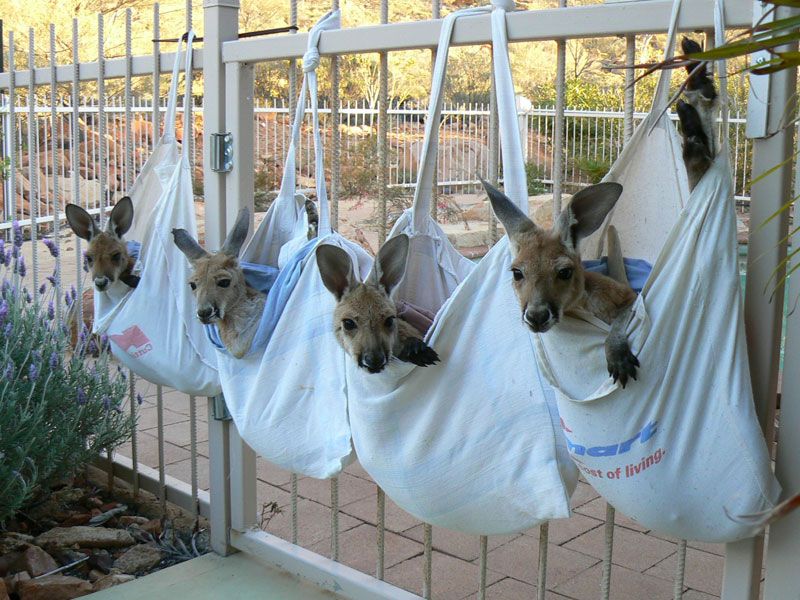
How does a kangaroo pouch work?
A kangaroo pouch is a fur-lined fold of skin on the female's abdomen containing four mammary glands. When a tiny jellybean-sized joey is born after only 33 days of gestation, it crawls unaided from the birth canal to the pouch - a journey of several minutes along its mother's fur.
The Jellybean That Becomes a Kangaroo
A newborn red kangaroo weighs less than a gram and measures about 2 centimeters long. It is hairless, blind, and barely recognizable as a mammal. Its hind legs are mere nubs. Yet within minutes of birth, this tiny being must crawl unassisted up its mother's fur, find the opening of the pouch, enter it, locate a nipple, and attach firmly enough to survive.
Two years later, it may be a 60-kilogram adult capable of jumping 9 meters in a single bound at 60 km/h. The transformation from jellybean to champion jumper occurs largely inside the pouch - a remarkable biological structure that allows marsupials like kangaroos to raise enormous offspring relative to their birth size.
The Pouch
What it is:
The pouch is a fur-lined fold of abdominal skin. It forms a cavity in which joeys develop after their brief time in the womb.
Anatomy:
- Opening: faces forward in most kangaroos (some other marsupials have rear-facing pouches)
- Interior: four mammary glands (teats)
- Muscle control: sphincter muscles regulate the opening
- Cleaning: mother licks pouch regularly
Antibacterial properties:
Kangaroo pouch skin produces antibacterial peptides that keep the interior environment relatively clean. This is essential because joeys cannot maintain their own hygiene for months.
Reproduction
Kangaroo reproduction combines elements of reptile-like egg laying and mammal-like nursing.
Gestation:
Actual internal development is extraordinarily brief:
- Red kangaroo gestation: 33 days
- Contrast: humans 270 days, placental mammals generally 30+ weeks
Birth:
A newborn joey:
- Weighs less than 1 gram
- Measures 2 cm long
- Is hairless and nearly featureless
- Has functional forelimbs for climbing
- Has underdeveloped hind limbs
The mother does not actively assist birth. The joey must climb from the birth canal, up through the mother's fur, and into the pouch on its own. This journey takes several minutes and represents a remarkable ability for such a tiny newborn.
Nursing in the pouch:
Once in the pouch, the joey:
- Attaches to a nipple
- Nipple swells to lock the joey in place
- Cannot detach for approximately 2 months
- Nurses continuously
Multiple young:
Female kangaroos can simultaneously raise:
- A fetus in embryonic diapause (paused development)
- A developing joey inside the pouch
- A "young-at-foot" joey outside the pouch still nursing
This means a single female can produce a new joey almost every year throughout her reproductive life.
Different milk formulas:
Mother kangaroos produce different milk formulas from different teats simultaneously. A teat feeding a newborn produces high-fat, antibody-rich milk. A teat feeding an older joey produces a different composition optimized for rapid growth. The same female manages both formulas from different teats at the same time.
The Physics of Hopping
Kangaroo hopping is one of the most efficient locomotion methods on Earth.
Energy efficiency:
Unlike most animals that use increasingly more energy at higher speeds, kangaroos become more efficient as they speed up (within their optimal range). This is because:
- Tendon elasticity stores and returns energy
- Higher speeds mean less energy wasted per unit distance
- The "bouncing" motion reuses energy efficiently
Speed and distance:
- Typical hopping speed: 25-40 km/h
- Maximum speed: 70 km/h
- Maximum single bound: 8-9 meters horizontal, 3 meters vertical
- Sustained travel: many kilometers without rest
Tendon recoil:
Approximately 70 percent of the energy used in each hop comes from elastic recoil of leg tendons. Only 30 percent comes from active muscle contraction. This is why kangaroos are so efficient - they borrow energy from their previous jump rather than generating it fresh each time.
Breathing efficiency:
At high speeds, each hop corresponds to one breath. The compression of internal organs during landing helps push air out; the extension during takeoff pulls air in. Breathing is automatic and tied to hopping rhythm.
Cannot Walk
Kangaroos cannot walk in the normal mammalian sense.
Why not:
Their hip joints, leg proportions, and tail design are optimized for hopping. Normal quadrupedal walking is mechanically impossible.
Pentapedal locomotion:
At slow speeds, kangaroos use "pentapedal" movement - balancing on their tail and forelimbs while swinging their hind legs forward together.
The sequence:
- Front paws and tail support weight
- Hind legs swing forward
- Hind legs plant and take weight
- Front paws and tail move forward
- Repeat
This is awkward looking and slow but allows movement at grazing speeds without hopping.
Tail as third limb:
The kangaroo tail is approximately as thick and strong as a human thigh. During pentapedal movement, the tail functions as a genuine third support limb.
No reverse:
Kangaroos cannot move backward. The Australian coat of arms features a kangaroo and an emu together (the emu also cannot move backward) symbolizing a nation always moving forward.
Dangerous When Provoked
Kangaroos, particularly adult males, can be dangerous.
Male size:
Adult male red kangaroos:
- Height: 2+ meters when rearing up
- Weight: 60-90 kg
- Muscle development: extraordinary in shoulders and hind legs
Fighting technique:
When kangaroos fight (usually between males), they:
- Balance on their tails
- Kick forward with both hind legs simultaneously
- Use large central claws on hind feet
- Claws can inflict disemboweling wounds
- Boxing motions with forelimbs for grappling
Human attacks:
Wild kangaroos rarely attack humans unprovoked, but:
- Cornered kangaroos attack
- Mothers with joeys can be aggressive
- Hand-fed kangaroos may become demanding and aggressive
- Territorial males sometimes attack intruders
Documented human fatalities from kangaroo attacks number approximately 1-2 per century. Injuries requiring hospitalization occur multiple times per year in Australia.
Not domesticable:
Despite occasional efforts, kangaroos are not domesticated. Hand-raised individuals retain dangerous adult reactions. They cannot be safely kept as pets at adult size.
Why Marsupials Dominate Australia
Australia hosts the most diverse marsupial fauna on Earth.
Ancient origins:
Marsupials evolved approximately 100 million years ago, probably in North America. They spread to South America, Antarctica, and Australia when these continents were connected as part of Gondwana.
Continental drift:
Around 50 million years ago, Australia separated from Antarctica. Marsupials in Australia were isolated from placental mammals for tens of millions of years.
Diversification:
Without placental competition, marsupials diversified to fill every ecological niche:
- Grazers: kangaroos, wallabies
- Browsers: koalas
- Predators: Tasmanian tigers (extinct), quolls, Tasmanian devils
- Climbers: possums, gliders
- Burrowers: wombats, bandicoots
- Insectivores: numerous small species
- Scavengers: Tasmanian devils
Over 250 marsupial species evolved in Australia and surrounding islands.
European disruption:
European colonization (starting 1788) introduced numerous placental mammals:
- Domestic cats (feral populations threaten native species)
- Red foxes (major predator of small marsupials)
- European rabbits (compete for food and habitat)
- Livestock (habitat destruction)
These placentals have caused dozens of marsupial extinctions and continue threatening many species.
Conservation:
Australian conservation efforts focus heavily on controlling feral placentals while protecting remaining marsupial habitat. The Tasmanian tiger was the most famous extinction (1936). More recent losses include the Bramble Cay melomys (2019) - the first mammal extinction attributed specifically to climate change.
Species Diversity
Kangaroos and their close relatives include dozens of species.
Large kangaroos:
- Red kangaroo (largest, up to 90 kg)
- Eastern grey kangaroo
- Western grey kangaroo
- Antilopine kangaroo
Wallaroos:
Medium-sized (20-40 kg):
- Common wallaroo
- Black wallaroo
- Antilopine wallaroo
Wallabies:
Smaller relatives (2-20 kg):
- Red-necked wallaby
- Swamp wallaby
- Rock wallabies (several species)
- Pademelons (smallest, 2-5 kg)
Tree kangaroos:
Highly specialized arboreal species living in tropical forests of Queensland and New Guinea. They retain hopping ability on ground but have adapted for tree climbing.
Cultural Significance
Kangaroos are central to Australian identity.
National symbol:
- Featured on Australian coat of arms
- Appears on currency
- National airline (Qantas) uses kangaroo logo
- Sports teams use kangaroo imagery
Indigenous significance:
Kangaroos have been essential to Australian Aboriginal culture for 65,000+ years:
- Primary source of meat and materials
- Central figures in dreamtime stories
- Featured in rock art across the continent
Modern Australia:
- Kangaroo meat is commercially farmed
- Hide and fur used in various products
- Tourism centered around kangaroo viewing
- Cultural symbol exported worldwide
Survival Strategy
The kangaroo lifestyle represents one of the most successful adaptations for Australia's specific environmental challenges.
Australia is characterized by:
- Irregular rainfall
- Vast semi-arid landscapes
- Sparse vegetation
- Boom-bust resource cycles
- Fire as a regular environmental factor
Kangaroos handle these challenges through:
- Efficient hopping locomotion (low energy per distance)
- Reproductive flexibility (can pause pregnancy during droughts)
- Small physical footprint (dispersed, not concentrated)
- Multiple joey stages (continuous reproduction when conditions allow)
- Adaptation to dry vegetation (digest tough grass effectively)
These features make kangaroos essentially optimized for the Australian interior - a habitat that has challenged and eliminated many other large mammal species.
Modern Australia, with its extensive grasslands partly created by European agricultural development, has supported kangaroo populations larger than what existed before European settlement. Some kangaroo species are more abundant now than historically. The species has adapted to modern landscapes while remaining essentially unchanged biologically - still the same jumping, pouched marsupial that evolved on an isolated continent tens of millions of years ago.
The Marsupial Reproductive Strategy in Detail
Our research team finds that the marsupial reproductive mode is one of the most misunderstood features of this lineage. It is often described as "primitive" compared to placental mammals, but recent evolutionary biology suggests the opposite - marsupial reproduction is a sophisticated solution to specific ecological problems, particularly resource unpredictability.
In placental mammals, the mother carries the embryo internally until it is relatively well-developed. This requires the mother to commit enormous metabolic resources over months of gestation regardless of external conditions. If a drought hits midway through a pregnancy, the mother's options are limited. In marsupials, the metabolic cost of gestation is minimal because internal development is so brief.
The true investment begins only after birth, inside the pouch, where the mother can terminate investment far more easily if conditions deteriorate.
"The marsupial mode of reproduction is not a primitive relic. It is a beautifully adaptive strategy for environments where resources fluctuate unpredictably. Marsupials can ramp reproduction up or down with a flexibility that placental mammals simply do not have." - Marilyn Renfree, University of Melbourne, one of the world's leading marsupial reproductive biologists [1]
Kangaroo Reproductive Stages (Red Kangaroo)
| Stage | Duration | Location | Joey size/state |
|---|---|---|---|
| Copulation to implantation | 24-48 hours | Uterus | Single cell to blastocyst |
| Embryonic diapause (optional) | 0 to 235 days | Uterus | Paused blastocyst |
| Active gestation | 30-33 days | Uterus | Embryonic |
| Birth journey | 3-5 minutes | External fur | 2 cm, 0.75 g |
| Pouch phase 1 (attached) | 70 days | Pouch, attached teat | Tiny, blind, hairless |
| Pouch phase 2 (developing) | 70-190 days | Pouch, mobile | Fur, open eyes |
| Young-at-foot | 190-235 days | Out, returns to nurse | Small but mobile |
| Weaning | 235-365 days | Outside pouch | Nearly adult proportions |
| Full independence | ~12 months | Mob | Sub-adult |
At any given moment, a red kangaroo female can be supporting a diapause blastocyst, an attached pouch joey, and a young-at-foot simultaneously - three offspring at three different developmental stages. The Kalenux Team notes that no placental mammal can manage reproductive parallelism like this.
Embryonic Diapause and Drought Response
Embryonic diapause is the ability to pause an embryo's development for extended periods. In kangaroos, it is a central feature of reproductive biology. When a female mates shortly after giving birth (as is typical), the new embryo develops to the blastocyst stage and then halts. It waits, sometimes for most of a year, until the previous joey exits the pouch or dies. Only then does development resume.
This system solves two problems at once. It lets kangaroos replace lost joeys quickly - if a drought or predator kills the joey in the pouch, the diapause embryo activates within days and a new joey is born in about a month. It also staggers reproduction so that a female can produce a joey approximately every 12 to 18 months while maintaining the 2-year development period each joey requires.
During the 2019-2020 Australian drought, researchers at the University of New South Wales documented populations where embryonic diapause was detected in over 90% of reproductive females - effectively a species-wide reproductive pause until conditions improved [2].
"Embryonic diapause gives kangaroos a time machine for reproduction. They can hold a potential joey in stasis for most of a year and then produce it when conditions are right. No placental mammal has this precision of reproductive timing." - Dr. Graeme Coulson, University of Melbourne
Notable Research Findings
- Kangaroos produce four different milk formulas simultaneously from different teats. A 2019 study in Scientific Reports by Pyne and colleagues demonstrated that the composition varies in fat, protein, immunoglobulin, and specific bioactive peptides optimized for each joey's developmental stage [3].
- Kangaroo tails contain more than 20 vertebrae and generate propulsive force during pentapedal movement equivalent to a human leg. A 2014 Biology Letters study by O'Connor and colleagues measured the propulsive force and concluded the tail functions as a fifth limb, not merely a balance aid [4].
- Kangaroos sweat through their forearms. During high temperatures, they lick their inner forearms to spread saliva that then evaporates, providing evaporative cooling. This is a rare thermoregulation strategy and a reason kangaroos can tolerate Australian summer heat better than many introduced placental mammals.
- Kangaroos produce significantly less methane per kilogram of forage digested than ruminant livestock. Research at the University of Queensland has identified the kangaroo foregut microbiome (dominated by Succinivibrionaceae bacteria) as a potential model for reducing cattle methane emissions.
- A 2020 University of Sydney study found that kangaroos can deliberately communicate with humans, particularly gesturing to request help opening food containers. Kangaroos in the experiment gazed at humans, alternated gaze between human and target, and showed persistent communicative attempts - behaviors previously thought to be limited to domesticated species.
Conservation Status of Marsupials
The IUCN Red List currently classifies over 100 Australian marsupial species as threatened. The primary threats are habitat destruction, feral predators (especially cats and red foxes), altered fire regimes, and - increasingly - climate change. Australia has lost more mammals to extinction since European contact than any other continent.
Kangaroo Conservation Status
| Species | IUCN status | Estimated population | Main threats |
|---|---|---|---|
| Red kangaroo (Osphranter rufus) | Least Concern | 10-14 million | Drought, commercial harvest |
| Eastern grey (Macropus giganteus) | Least Concern | 20-30 million | Road mortality, habitat loss |
| Western grey (Macropus fuliginosus) | Least Concern | 2-4 million | Habitat loss |
| Antilopine (Osphranter antilopinus) | Least Concern | Unknown | Fire regime changes |
| Common wallaroo (Osphranter robustus) | Least Concern | Several million | Pastoral conflict |
| Bridled nail-tail wallaby | Endangered | ~500 | Feral cats, habitat loss |
| Proserpine rock-wallaby | Endangered | <1,000 | Habitat fragmentation |
| Lumholtz's tree kangaroo | Near Threatened | ~20,000 | Rainforest clearance |
| Bennett's tree kangaroo | Near Threatened | <10,000 | Habitat loss, hunting |
| Mountain pygmy possum | Critically Endangered | ~2,000 | Climate change |
Our research team emphasizes that the large kangaroo species are thriving - some more abundantly than before European settlement - while many smaller marsupials face serious threats. The situation is not uniform; it is a mosaic of winners and losers shaped by how each species interacts with modern Australia.
Related Articles
- Marsupials: Australia's Pouch-Bearing Mammals
- Koalas: Australia's Unique Arboreal Marsupial
- Platypus: The Strangest Mammal in the World
References
[1] Renfree, M. B., Pask, A. J., & Shaw, G. (2011). Sex down under: The differentiation of sexual dimorphisms during marsupial development. Reproduction, Fertility and Development, 23(1), 95-105. DOI: 10.1071/RD10259
[2] Bilton, A. D., & Croft, D. B. (2004). Lifetime reproductive success in a population of female red kangaroos Macropus rufus in the sheep rangelands of western New South Wales: Environmental effects and population dynamics. Australian Mammalogy, 26(1), 45-60.
[3] Pyne, M. J., Brown, A. S., & Old, J. M. (2019). Milk composition changes in the tammar wallaby (Notamacropus eugenii) and variation between individuals. Scientific Reports, 9, 3894.
[4] O'Connor, S. M., Dawson, T. J., Kram, R., & Donelan, J. M. (2014). The kangaroo's tail propels and powers pentapedal locomotion. Biology Letters, 10(7), 20140381. DOI: 10.1098/rsbl.2014.0381
[5] Tyndale-Biscoe, C. H., & Renfree, M. B. (1987). Reproductive Physiology of Marsupials. Cambridge University Press.
[6] IUCN Red List. (2023). Macropodidae species assessments. International Union for Conservation of Nature.
[7] Dawson, T. J. (2012). Kangaroos (2nd ed.). CSIRO Publishing.
Frequently Asked Questions
How does a kangaroo pouch work?
A kangaroo pouch is a fur-lined fold of skin on the female’s abdomen containing four mammary glands. When a tiny jellybean-sized joey is born after only 33 days of gestation, it crawls unaided from the birth canal to the pouch - a journey of several minutes along its mother’s fur. Inside the pouch, it attaches to one of the four nipples, which swells to lock the joey in place. It remains attached for 2-3 months, nursing continuously.
Mother kangaroos can nurse two joeys of different ages simultaneously, producing different milk formulas from different teats - one with high-fat milk for the older joey and another with different composition for the newborn. The pouch has specialized sphincter muscles that the mother controls, keeping it closed during hopping and opening when needed.
Pouches are kept clean through frequent licking by the mother and have antibacterial properties in their skin secretions.
How high can kangaroos jump?
Red kangaroos (the largest species) can jump up to 3 meters (10 feet) vertically and cover 8-9 meters (26-30 feet) horizontally in a single bound. During extended travel, they cover these distances repeatedly, reaching sustained travel speeds of 40-60 km/h. Their maximum sprint speed approaches 70 km/h (44 mph).
Jumping requires specialized anatomy including extraordinarily strong tendons in their hind legs that function as springs - storing elastic energy during landing and releasing it for the next jump. Approximately 70 percent of the energy used in each jump comes from tendon recoil rather than muscle work. This makes hopping one of the most energy-efficient forms of animal locomotion.
Kangaroos actually expend less energy traveling at 20 km/h than they would walking at 5 km/h - they cannot walk efficiently because their body plan is specialized for hopping. Their distinctive two-legged hopping gait is unique among large mammals.
Can kangaroos move backward?
No, kangaroos cannot move backward. Their massive hind legs and thick tails are optimized for forward hopping but cannot articulate in reverse. When they need to change direction, they must pivot by using their tail as a third leg, leaning backward and rotating their bodies. This is why the Australian coat of arms features a kangaroo and an emu - both animals can only move forward, symbolizing a nation that always progresses.
Kangaroos can move slowly by walking on all fives (using their tail as a fifth limb), which is called pentapedal locomotion. During slow movement, they balance on their tail and forelimbs while swinging their hind legs forward. This is surprisingly efficient at low speeds but unusable for fast movement.
The tail is heavily muscled - approximately the same thickness and strength as a human thigh - and functions as a critical limb for standing, pivoting, and balance.
Are kangaroos dangerous?
Yes, kangaroos can be dangerous, particularly adult male red kangaroos that stand over 2 meters tall and weigh 90 kg. They attack by balancing on their tail and kicking forward with both hind legs simultaneously, using their large central claws to disembowel opponents. Wild kangaroos rarely attack humans unprovoked, but humans who corner them, approach young joeys, or threaten territorial males can face serious injury.
Documented human fatalities from kangaroo attacks are rare - approximately 1-2 per century in Australia - but hospitalizations from kangaroo kicks and bites occur multiple times per year. Kangaroo boxing competitions between males involve powerful kicks and grappling. Most rural Australians understand to keep distance from wild kangaroos and not to feed them, which can encourage aggressive begging behavior.
Kangaroos are not domesticated and even hand-raised individuals retain dangerous wild reactions as they mature. Farm workers and road vehicles injure kangaroos far more often than the reverse - vehicle collisions with kangaroos kill tens of thousands annually in Australia.
How did marsupials come to dominate Australia?
Marsupials dominate Australia because they arrived before the continent became isolated and faced no competition from placental mammals. Approximately 50 million years ago, Australia was connected to Antarctica and South America as part of the ancient Gondwana supercontinent. Marsupials migrated from the Americas through Antarctica to Australia before continental drift separated the continents.
Once Australia drifted north and isolated, marsupials diversified to fill every ecological niche that placental mammals occupy elsewhere - predators (Tasmanian tigers, quolls), herbivores (kangaroos, wombats), climbers (koalas, possums), burrowers (bandicoots, wombats), and many others. For 30+ million years, marsupials evolved without placental competition.
When humans eventually arrived (roughly 65,000 years ago), they brought dingoes, and European colonization added cats, rabbits, foxes, and livestock. These placental invaders have caused numerous marsupial extinctions and continue to threaten native species. The original marsupial diversity of 250+ species has been reduced by roughly 10 percent through recent extinctions, with dozens more species currently threatened.