
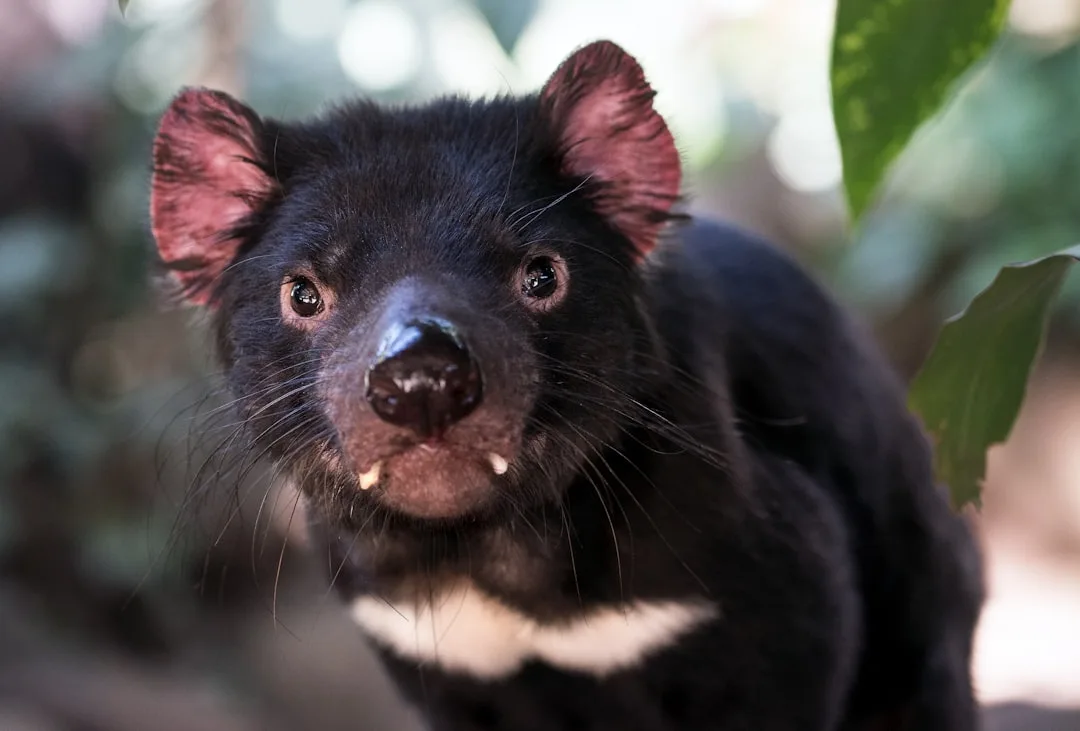
The Tasmanian devil is the largest living carnivorous marsupial on Earth. Since the thylacine - the so-called Tasmanian tiger - was driven to extinction in 1936, Sarcophilus harrisii has held the title of apex marsupial predator without a challenger. Compact, muscular, and strictly nocturnal, the devil is found wild only on the island of Tasmania, off the south coast of mainland Australia, where it fills roles that on every other continent belong to hyenas, wolverines, or small wild dogs.
This guide covers every major aspect of Tasmanian devil biology and ecology: size and bite mechanics, habitat and range, hunting and scavenging behaviour, reproduction, communication, conservation, and the strange transmissible cancer that has reshaped the species over the last three decades. It is a reference entry, not a summary - expect specifics: kilograms, newtons, population counts, and documented records.
Etymology and Classification
The scientific name Sarcophilus harrisii was proposed by naturalist George Harris in 1807, describing specimens sent back from the then-young colony of Van Diemen's Land. Sarcophilus derives from the Greek for "flesh-lover", an accurate if blunt reference to the animal's carnivorous habits, while harrisii honours Harris himself.
The common name "devil" came earlier, applied by English-speaking settlers who were unnerved by the nocturnal screams, shrieks, and open-jawed threat displays they heard echoing through the Tasmanian bush.
The Tasmanian devil sits in the order Dasyuromorphia, which contains almost all of Australia's carnivorous marsupials. Its family Dasyuridae groups it with quolls, antechinuses, and the extinct thylacine - although the thylacine was actually placed in a separate family, Thylacinidae. Within Dasyuridae the devil is the only living species in its genus. Every other Sarcophilus lineage, including the larger Sarcophilus laniarius of the Pleistocene, has gone extinct.
The devil is phylogenetically isolated. Its closest surviving relatives - the quolls of the genus Dasyurus - diverged from the devil lineage roughly 14 million years ago. There is no ecological equivalent anywhere in the world that combines the devil's mix of scavenging specialisation, bone-crushing dentition, and pouch-based reproduction in a single package.
Size and Physical Description
Tasmanian devils are stocky, barrel-chested animals built more like a small badger than any other marsupial. Size differences between the sexes are noticeable but not extreme.
Males:
- Body length: 57-65 cm
- Tail: 25-30 cm (thick, fat-storing)
- Shoulder height: around 30 cm
- Weight: 8-14 kg, rarely heavier
Females:
- Body length: 52-58 cm
- Weight: 4-9 kg
- Pouch opens to the rear, containing four teats
Newborn young:
- Length: roughly 5 mm
- Weight: approximately 0.2 g (size of a grain of rice)
The devil's body is disproportionately front-heavy. The forequarters, neck, and head are massively developed relative to the hindquarters, giving the species its characteristic prowling stance with the head carried low. The legs are short and strong. The fur is mostly jet black, often with a distinctive white chest blaze and sometimes additional white flashes on the rump. Coat patterns vary individually, and researchers routinely use them to identify wild animals.
The head is large and blunt, with muscular jaws, a broad cranium, and ears that flush red with blood when the animal is aroused, alarmed, or feeding in competition. The eyes are forward-set for depth perception. The whiskers are extensive, used for navigation in dense scrub at night and for assessing the interior of hollow logs before entry.
The tail, thick at the base and tapering toward the tip, serves as a fat reservoir - a healthy devil has a visibly plump tail, while a starving or diseased animal shows a noticeably thin, rope-like one.
The Strongest Bite Per Body Size of Any Living Mammal
The single most studied feature of the Tasmanian devil is its bite. Measured against body size, the devil produces roughly 14,000 newtons per kilogram of body weight at the canines - the highest bite force quotient ever measured in a living mammal. Absolute bite forces are smaller than those of a lion or a spotted hyena because the animal is smaller, but pound for pound, nothing alive bites harder.
Several anatomical features produce this performance:
- Enlarged temporalis and masseter muscles that occupy most of the skull volume
- Robust mandibular bone with a deep coronoid process for muscle attachment
- Short, strong jaw lever favouring crushing force over reach
- Premolars and molars specialised for shearing and bone breakage
- Canines thickened and reinforced at the root against torque
Devils use this bite to crush skulls, jawbones, femurs, and turtle shells. A feeding devil processes a carcass rapidly, consuming bone fragments along with meat. Their scat is often pale and chalky because calcified material passes through the digestive tract in significant quantities. In ecological terms, this makes the devil one of Tasmania's most important nutrient recyclers - bone calcium that would otherwise sit locked in carcasses is broken down and returned to the soil.
The same bite strength has a darker consequence. Devils bite each other routinely in social competition, particularly at carcasses and during mating. These bites are the primary route by which Devil Facial Tumour Disease spreads through the population.
Habitat and Range
Tasmanian devils are found only on the island of Tasmania. The state covers roughly 68,000 square kilometres, and devils are distributed across almost all of it: from cool-temperate rainforest in the west through dry sclerophyll eucalyptus forest in the centre to coastal heath and woodland in the east. Pastureland, farm edges, logged forest regrowth, and scrub adjacent to townships are all used. Only treeless alpine zones and heavily developed urban areas are largely avoided.
Preferred habitat features:
- Cover for daytime denning (hollow logs, wombat burrows, dense scrub, caves)
- Access to a reliable carrion supply (wildlife, roadkill, stock mortality)
- Water within reach (streams, farm dams, coastal springs)
- Limited competition from feral cats and wild dogs
Devils maintain overlapping home ranges rather than strict territories. Individual ranges vary from 4 to 27 square kilometres depending on food density, with males generally covering larger areas than females. They walk or trot along established routes night after night, often leaving clearly visible pads through grass and scrub.
On mainland Australia, devils once lived across the southern and eastern regions. Archaeological evidence places their disappearance from the mainland at roughly 3,000 years ago. The likely drivers were the introduction of the dingo (Canis lupus dingo) and pressure from human hunting, both of which would have hit a slow-breeding island-sized carnivore hard. Tasmania's separation from the mainland by Bass Strait protected the species by keeping dingoes out.
Diet and Hunting Behaviour
The Tasmanian devil is primarily a scavenger, secondarily a predator. In most parts of the range more than half of the annual diet is carrion: mammals that have died of disease, exposure, old age, or vehicle collisions. Live prey becomes more important in lean seasons and among larger males, but no devil population is sustained by predation alone.
Primary food sources:
- Bennetts wallaby and pademelon (carrion and occasional kill)
- Common wombat (usually carrion)
- Brushtail possum and ringtail possum
- Sheep (carrion, afterbirth, and weak lambs)
- Native hens and other ground birds
- Reptiles, frogs, and large insects
Feeding behaviour:
- Scent-guided search. Devils locate carrion primarily by smell, using their exceptional nose to detect decomposition gases from kilometres downwind.
- Communal feeding. Multiple devils converge on a carcass and feed together, resolving disputes through screaming, threat displays, and ritualised biting rather than outright combat.
- Complete consumption. A devil will eat muscle, viscera, fur, hide, cartilage, and bone. Carcasses are often left as clean patches of ground with only a scent mark remaining.
- Gorging and storage. A hungry devil can eat up to 40% of its body weight in a single sitting, storing the surplus as fat in the tail.
Hunting of live prey tends to be opportunistic. Sick or injured animals, nesting birds, and unattended newborn livestock are vulnerable. The devil's stamina is limited and its top running speed of roughly 13 km/h cannot catch most healthy adult prey, which is why scavenging dominates.
Reproduction and the Pouch Race
Tasmanian devil reproduction is marsupial reproduction pushed to an extreme. Mating takes place in February and March, with most births in April. Pair bonds do not exist - females are guarded aggressively by dominant males during a short oestrus window, with rival males fighting for access.
Gestation is short: around 21 days. Then comes one of the most biologically astonishing events in the mammal world. The female gives birth to 20 to 30 embryonic young, each the size of a grain of rice and weighing about 0.2 grams. These neonates must crawl from the birth canal across the mother's abdomen and into her rear-opening pouch.
The pouch contains only four teats.
Only the first four neonates to reach a teat can attach. The rest die within minutes. This process is often described as a "death race" because the outcome is deterministic: a litter that begins with 30 living embryonic young ends, within an hour, with exactly four survivors and the remainder lost.
Biologists still debate why evolution favours such overproduction - the leading theory is that oversupply of young ensures all four teats are always claimed even when some neonates are defective or fail the crawl.
Young devil development:
- Weeks 1-12: permanently attached to the teat inside the pouch
- Weeks 12-16: detach from teat, still riding in the pouch
- Weeks 16-24: left in a den while the mother forages at night
- Months 6-9: increasingly independent, beginning to forage on their own
- Months 12-24: sexually mature, dispersing from the natal range
Weaning is complete by around nine months. Sexual maturity arrives at roughly two years, and a wild female will typically breed two or three times before natural mortality or DFTD ends her life.
Vocalisations, Ear-Blushing, and Communication
The devil's common name comes from its voice. A feeding group produces an overlapping soundscape of growls, snorts, whines, coughs, barks, and full open-throated screams audible for hundreds of metres through forest. To the ear of an early colonist, the combination of darkness, red-lit eyeshine, and screaming was genuinely supernatural. The biological function is much more ordinary - almost all the vocal repertoire is used to negotiate access to food without actually coming to blows.
The ear-blush is one of the most distinctive non-vocal signals. When a devil is aroused, startled, or feeding in competition, the fine blood vessels in its ear skin dilate, flushing the cartilage visibly red. Since devils are active at night and heavily reliant on scent and hearing, the visual signal primarily functions at close range during direct interactions at carcasses and in disputes.
Other key communication channels include:
- Scent marking from anal and skin glands
- Wide-jawed yawn displays showing the full set of teeth
- Tail posture, from held high (confident) to tucked (submissive)
- Whisker orientation and crest hair raising
The overall effect is to keep real biting to a minimum. In a species where a single bite can transmit a lethal contagious cancer, the selection pressure on low-contact conflict resolution is considerable.
Dentition and a Single Tooth Replacement
Tasmanian devils follow an unusual dental schedule. Like other marsupials they are diphyodont only for a single tooth position - premolar three - and most of the adult dentition erupts directly as permanent teeth. Functionally, a devil gets one set of teeth for life. There is no true second replacement. Once the adult teeth are in place, any chip, crack, or wear is permanent.
The dental formula produces 42 teeth in total: robust canines for puncturing and carrying, strong incisors for tearing, and heavy premolars and molars for crushing bone. The molars, in particular, are adapted to generate the enormous occlusal pressures needed for bone fracture. Tooth wear is a leading indicator of age in wild devils - researchers can estimate lifespan and diet history by examining tooth crown height and breakage patterns.
Devil Facial Tumour Disease
Devil Facial Tumour Disease (DFTD) is the most significant threat to the species and one of the most scientifically important discoveries in modern wildlife biology. It is a transmissible cancer.
In almost every known cancer, tumour cells arise inside an individual's own body, grow there, and die with the host. DFTD breaks that rule. The tumour cells themselves move between hosts, carried in the saliva and tissue exchange of bites exchanged during feeding and mating. Every DFTD tumour ever sequenced traces back to a single female devil in northeast Tasmania in the mid-1990s.
Her cells escaped the normal limits of individual identity and became a clonal, contagious parasite - biologically more like a single-celled organism than a typical cancer.
Known transmissible cancers in the living world:
| Cancer | Host species | Transmission route | First documented |
|---|---|---|---|
| Devil Facial Tumour Disease (DFTD) | Tasmanian devil | Biting | 1996 |
| DFT2 | Tasmanian devil | Biting | 2014 |
| Canine Transmissible Venereal Tumour | Domestic dog | Mating | Described 1876 |
| Bivalve Transmissible Neoplasia | Clams, mussels | Seawater | 2015 |
DFTD produces visible tumours on the face, jaw, and neck that grow large enough to interfere with feeding within a few months. Almost every infected animal dies within six months of visible tumour onset. Since 1996, local populations have declined by 80% or more in affected regions, and the overall wild population has fallen from approximately 150,000 to roughly 10,000-25,000.
Encouraging signs exist. Genetic monitoring shows that some devil populations are evolving modest resistance, with alleles linked to tumour rejection rising in frequency in infected areas. Captive breeding colonies on mainland Australia provide an insurance population. Experimental vaccines are in trials.
A second transmissible tumour (DFT2) has been identified, which complicates the picture, but it also confirms that devils are in some way unusually vulnerable to cancer transmission and that the biology deserves intensive study.
Population, Conservation, and Recovery
Current status:
| Metric | Value |
|---|---|
| Pre-DFTD population estimate | ~150,000 |
| Current wild population | ~10,000-25,000 |
| IUCN status | Endangered |
| Primary threat | Devil Facial Tumour Disease |
| Secondary threats | Vehicle strikes, habitat loss, snaring |
| Insurance population locations | Maria Island, mainland captive colonies |
The Tasmanian devil is listed as Endangered by the IUCN and the Australian federal government. Recovery efforts operate on several parallel tracks. The Save the Tasmanian Devil Program coordinates wild population monitoring, the managed captive insurance population, and reintroductions to disease-free enclaves. Non-government partners including zoos and wildlife sanctuaries maintain additional breeding stock.
Research programmes at the University of Tasmania, the Menzies Institute, and several international collaborators focus on DFTD genetics, immunology, and candidate vaccines.
Beyond DFTD, the main non-disease threats include road mortality - devils are strongly drawn to roadkill, which puts them in front of vehicles - and incidental losses from snaring and illegal poisoning. Climate change exerts a slower pressure by shifting rainfall patterns and altering the carrion base on which devils depend.
Ecological Role
Tasmanian devils are ecosystem cleaners. By consuming carrion rapidly and completely, they break the life cycle of blowflies and other carcass-associated parasites that cause damaging flystrike outbreaks in sheep. By competing with feral cats at carcasses and in dens, they measurably suppress cat activity in areas where devil densities are high.
Following devil declines to DFTD, researchers have documented increases in feral cat activity, higher rates of small native mammal predation by cats, and measurable changes in scavenger guild composition, with forest ravens and spotted-tailed quolls taking partial advantage of the opening.
The removal of devils from an ecosystem is not a neutral event. Every modelling study that has looked at devil decline concludes that the cascading effects on feral cat abundance, scavenger nutrient cycling, and small mammal populations are significant and unfavourable for native biodiversity.
Devils and Humans
Human attitudes toward the Tasmanian devil have changed dramatically. In colonial Tasmania, devils were persecuted as livestock pests, shot, poisoned, and snared in large numbers. A formal bounty ran for over a century. Protection did not arrive until 1941, five years after the last thylacine died in a Hobart zoo - an extinction that shifted public and political attitudes toward native carnivores across Australia.
Modern Tasmania has embraced the devil as a cultural symbol. It appears on the state's coat of arms, on tourism literature, and on the logos of Tasmanian sporting organisations. Wildlife sanctuaries across Tasmania and parts of mainland Australia offer public viewing and contribute directly to the insurance population. Devil tourism supports conservation funding, and researchers work closely with Tasmanian primary producers to reduce lingering conflict.
Attacks on humans are effectively unknown. Devils will defend themselves vigorously if cornered or mishandled, and their bite is genuinely dangerous, but no reliable records exist of an unprovoked attack by a wild devil on a person. The species poses no meaningful risk to agricultural livestock beyond occasional scavenging on afterbirth and dead stock, which in practice is a benefit to landholders.
Related Reading
- Kangaroo Pouch: How It Works
- Marsupials: Australia's Extraordinary Pouched Mammals
- Red Kangaroo
- Quokka: The Happiest Animal Smile
References
Relevant peer-reviewed and governmental sources consulted for this entry include the IUCN Red List assessment for Sarcophilus harrisii, the Australian Department of Climate Change, Energy, the Environment and Water species listing, reports from the Save the Tasmanian Devil Program, and research published in Nature, Science, Proceedings of the National Academy of Sciences, Journal of Mammalogy, and Ecology Letters.
Bite force values follow Wroe et al.'s comparative mammal bite-force analysis. DFTD biology references the ongoing work of the Menzies Institute and the University of Cambridge Transmissible Cancer Group. Population figures reflect the most recent Save the Tasmanian Devil Program monitoring reports.
Frequently Asked Questions
How big are Tasmanian devils?
Adult male Tasmanian devils (Sarcophilus harrisii) weigh between 8 and 14 kg and measure 57-65 cm along the body plus a thick 25-30 cm tail, reaching roughly one metre from nose to tail tip. Females are noticeably smaller at 4-9 kg. Shoulder height is 30 cm, putting devils at roughly the size of a stocky small dog. Despite being the largest living carnivorous marsupial, the species is much smaller than its extinct relative the thylacine.
Newborn devils are the size of a grain of rice - around 0.2 g - and develop inside the mother’s rear-opening pouch for about four months.
What do Tasmanian devils eat?
Tasmanian devils are opportunistic carnivores and scavengers, and carrion makes up the majority of their diet. Favoured food includes wallaby, possum, wombat, sheep, and road-killed mammals. Live prey - small mammals, ground-nesting birds, reptiles, frogs, and insects - is taken when available but less important than scavenged meat. Devils consume the entire carcass: muscle, organs, fur, hide, and bone.
Their bite force and crushing premolars allow them to pulp skull fragments, ribs, and limb bones that other scavengers leave behind. An adult eats roughly 15% of its body weight per day on average, but can gorge up to 40% in a single meal when opportunity allows.
Where do Tasmanian devils live?
Tasmanian devils live only on the island of Tasmania, the large island state off the south coast of the Australian mainland. They inhabit virtually every habitat on the island: eucalyptus forests, coastal woodlands, dry sclerophyll scrub, heath, pastureland, and the edges of agricultural land. Devils shelter by day in dens - typically hollow logs, burrows abandoned by wombats, caves, or thick scrub - and forage at night.
Mainland Australian populations existed until around 3,000 years ago but vanished, leaving the species restricted to Tasmania. A small insurance population has been established on Maria Island and in captive breeding facilities across mainland Australia as protection against extinction.
What is Devil Facial Tumour Disease?
Devil Facial Tumour Disease (DFTD) is a transmissible cancer that has devastated Tasmanian devil populations since it was first documented in 1996. Unlike almost every other cancer, DFTD is not triggered inside the victim’s own body - the tumour cells themselves move between hosts, passed through bites to the face during feeding and mating.
Every known DFTD tumour shares a single genetic origin in a female devil whose cells escaped the normal limits of the individual body and became an infectious clonal parasite. The disease forms visible facial tumours, interferes with feeding, and kills almost all infected animals within six months. DFTD is one of only a handful of known transmissible cancers alongside canine transmissible venereal tumour and several clam leukaemias.
How many Tasmanian devils are left?
Current estimates place the wild Tasmanian devil population at roughly 10,000-25,000 individuals, down from a pre-disease population of around 150,000. The IUCN lists the species as Endangered with a decreasing trend in most regions, although recent genetic research indicates that some infected populations are evolving partial tolerance to DFTD and that a second transmissible tumour (DFT2) has now been detected.
Recovery programmes include captive insurance colonies on the mainland, reintroduction onto disease-free islands, ongoing vaccine research, and habitat protection. The total recovery of the species depends primarily on whether devil genetics can adapt to the tumour faster than the tumour evolves.
Why do Tasmanian devils scream at night?
The devil’s reputation was earned almost entirely through its vocal repertoire. At a carcass, several devils often feed together, and competition produces a mix of snarls, growls, whines, screeches, coughs, and full open-throated screams that early European colonists found genuinely frightening.
The sounds are territorial and postural rather than truly aggressive - screaming reduces the chance that a confrontation escalates into a bite, since bites in this species risk transmitting DFTD. The red ear flush, wide yawns showing the teeth, and strong musky scent-marking all reinforce position in the feeding hierarchy without physical contact. Devils are strictly nocturnal, so the calls are almost always heard at night.
How do Tasmanian devils reproduce?
Tasmanian devils breed once a year, with mating in March and most births in April. After a gestation of just 21 days, the female produces a huge litter of 20-30 embryonic young, each the size of a grain of rice. Because the pouch contains only four teats, the newborn young must make a short but brutal climb from the birth canal into the pouch, and only the first four to attach survive - the rest die within minutes.
Young devils remain permanently attached to the teat for the first three months, detach and ride in the pouch until about four months, then live in a den while the mother hunts. Weaning occurs at around nine months. Females usually live to breed two or three times before DFTD or natural mortality ends their lives.
Are Tasmanian devils dangerous to humans?
Tasmanian devils are not considered a meaningful danger to humans. They are small - the largest wild-weighed males rarely exceed 14 kg - and naturally shy, preferring to avoid contact with people. Devils bite readily when cornered or handled without training, and their jaws are powerful enough to inflict serious wounds, but unprovoked attacks are effectively unknown.
They do not prey on humans, children, or typical pets, although they may scavenge from rubbish or take very small animals such as poultry. The real concern for humans is accidental harm to devils themselves: vehicle strikes on Tasmanian roads are one of the leading causes of devil mortality outside DFTD, and slowing down at night in rural Tasmania is the single most effective individual conservation action.