
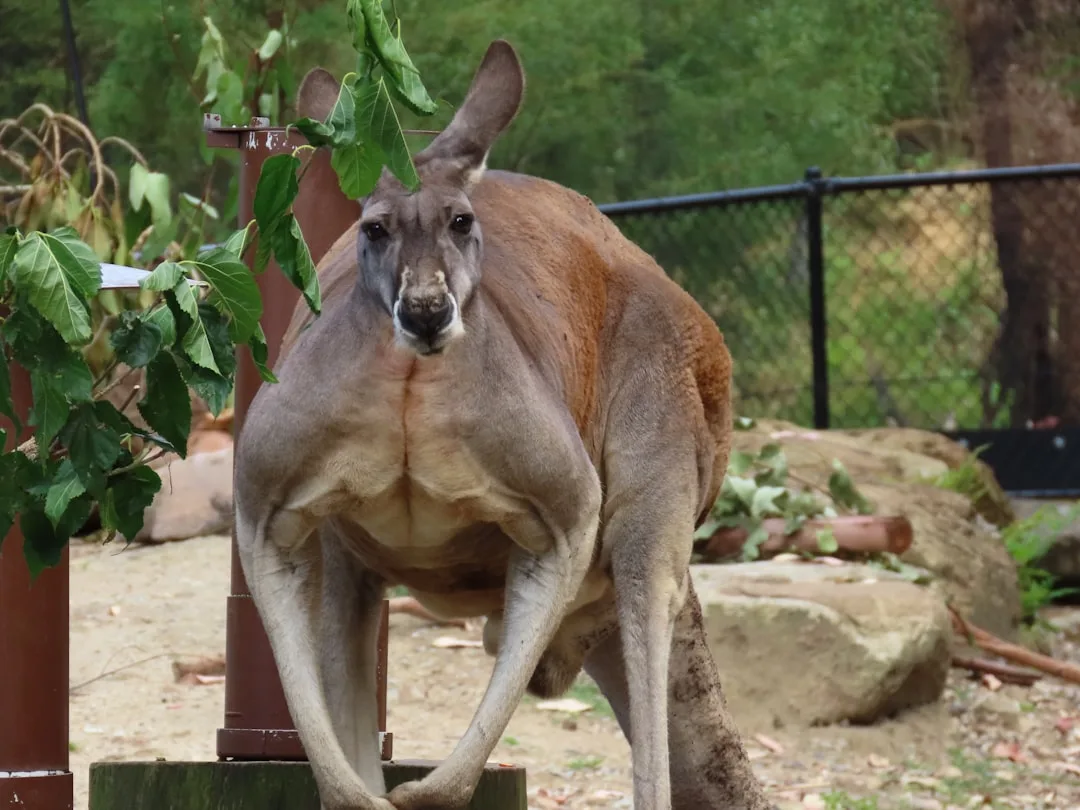
The red kangaroo is the largest marsupial alive today, the largest native land mammal in Australia, and the only large mammal on Earth whose primary gait is hopping. Osphranter rufus - formerly classified as Macropus rufus - dominates the dry interior of the Australian continent, from Mitchell grass downs to mulga scrub to the fringes of the true desert.
Where other large herbivores depend on regular water and lush forage, the red kangaroo thrives on patchy rain, dry grass, and ground that can go a year between proper downpours.
This guide covers every aspect of red kangaroo biology and ecology: size and physique, hopping mechanics, diet, thermoregulation, reproduction including the extraordinary phenomena of embryonic diapause and concurrent multi-formula lactation, social structure, conservation, and the long relationship between red kangaroos and the humans who share the outback. It is a reference entry, not a summary - so expect specifics: kilograms, kilometres, joules, temperatures, and verified records.
Etymology and Classification
The scientific name Osphranter rufus means, loosely, "smelling red one" - osphranter from a Greek root related to scent, rufus from Latin for red. The common name reflects the distinctive red-brown coat of adult males; females are typically bluish-grey and are known in some regions by the separate folk name blue flyer.
Red kangaroos were long placed in the genus Macropus alongside eastern and western grey kangaroos, and many older references still use Macropus rufus. Revised molecular phylogenies published in the 2010s split the large red and wallaroo-like kangaroos into the resurrected genus Osphranter. Most Australian wildlife authorities now use Osphranter rufus, with Macropus rufus listed as a synonym. Whichever name is used, the species is the same animal.
Full taxonomy:
- Kingdom: Animalia
- Phylum: Chordata
- Class: Mammalia
- Infraclass: Marsupialia
- Order: Diprotodontia (meaning "two front teeth", a reference to the distinctive forward-pointing lower incisors)
- Family: Macropodidae (the macropods, or "big feet")
- Genus: Osphranter
- Species: O. rufus
In many Aboriginal Australian languages the red kangaroo has distinct names - including marloo, kurrban, and yawa - reflecting the animal's importance as food, skin, bone tool, and cultural symbol over tens of thousands of years. European colonists adopted the word "kangaroo" from Guugu Yimithirr, a language of the Cooktown region in far north Queensland, where it referred to a specific grey kangaroo species rather than to all macropods.
Size and Physical Description
Red kangaroos show some of the most extreme sexual size dimorphism among mammals. A dominant male, known as a boomer or old man, can weigh more than twice as much as an adult female, called a doe or flyer. Unlike many mammals, red kangaroos continue to grow throughout life - large males keep adding muscle mass into their second decade.
Males (boomers):
- Head-body length: 1.3-1.6 metres
- Tail length: 1.0-1.2 metres
- Standing height on hind legs: 1.6-2.0 metres
- Weight: 55-90 kg, with exceptional specimens over 90 kg
Females (flyers):
- Head-body length: 0.85-1.05 metres
- Tail length: 0.65-0.85 metres
- Standing height: 0.9-1.1 metres
- Weight: 20-40 kg
Newborn joeys:
- Length: roughly 25 mm
- Weight: about 1 gram - roughly the size of a jellybean
Body shape follows the macropod blueprint: short muscular forelimbs with dexterous five-fingered hands, enormous hind legs folded into a long Z-shape at rest, a thick muscular tail that acts as a brace and a counterweight, and a pouch (on females) opening forward on the belly. The hind foot is elongated into a single long paddle with two functional toes, one bearing a formidable claw.
The jaw carries specialised grinding molars and the forward-pointing lower incisors characteristic of the order Diprotodontia.
Coat colour is one of the clearer ways to tell the species apart from grey kangaroos. Mature males are rust-red to brick-red across the back and flanks, fading to cream on the belly. Females are soft blue-grey with a lighter underside, which is how they earned the name blue flyer. Both sexes have pale muzzles with a characteristic dark-and-light striping at the mouth.
Hopping, Tendons, and the Physics of the Gait
The red kangaroo's defining feature is not its pouch or its size but its mode of travel. It is the only large mammal on Earth that uses bipedal saltation - hopping - as its main gait. Above walking pace, a red kangaroo never puts its forelimbs on the ground.
Performance envelope:
| Metric | Value |
|---|---|
| Cruising speed | 20-25 km/h |
| Sustained fast speed | 40-50 km/h |
| Top burst speed | ~70 km/h |
| Longest single bound (horizontal) | ~9 m |
| Highest single bound (vertical) | ~3 m |
| Daily home range | 2-5 km^2 (varies with food) |
The biomechanics are more interesting than the raw numbers. A hopping kangaroo is essentially a pogo stick that has evolved muscle and skin around itself. The Achilles tendon and associated hind-limb tendons are long, thick, and extraordinarily elastic. On each landing, body weight stretches these tendons and stores kinetic energy as elastic potential energy in the collagen fibres.
On the next push-off, that energy is released back into the jump. Muscles fire only briefly to top up what the tendons failed to recover, rather than powering the whole motion from scratch.
The consequence is a metabolic curve unlike anything in running mammals. When a horse or a dog speeds up, oxygen consumption rises roughly in proportion to speed. In a hopping red kangaroo, oxygen use climbs with speed up to about 10 km/h - and then flattens.
Above that threshold, hopping faster uses essentially the same metabolic rate per unit time, which means the energy cost per kilometre actually drops the faster the animal goes. For an animal whose food grows sparsely across enormous arid landscapes, this is a profound advantage: covering a lot of country is almost free.
At very slow speeds hopping is inefficient, so red kangaroos switch to a separate gait called pentapedal locomotion. They plant both forelimbs and the tail on the ground, support their body weight on that tripod, then swing both hind legs forward together. The tail does real load-bearing work here - it is strong enough on its own to support the animal's weight during the swing phase.
Kangaroos have effectively been shown in force-plate studies to do single-legged "push-ups" using only their tail muscles.
Thermoregulation and Surviving the Outback
Arid Australia routinely runs summer daytime temperatures above 40 degrees Celsius, and ground temperatures can climb past 60 degrees. Red kangaroos cannot sweat over most of their body the way humans do. Their primary cooling mechanism is a combination of panting, behavioural avoidance, and a surprising trick: forearm licking.
Red kangaroos lick their wrists and inner forearms repeatedly during heat stress. The skin over the forearms is densely vascularised, and evaporation of saliva from that surface pulls heat out of the blood, which then circulates back into the body as a cooling loop. A hot kangaroo can lose significant body heat this way without losing body water across a large surface, which would be wasteful in a dry environment.
Other heat-management strategies include:
- Resting in shade through the hottest hours
- Digging shallow scrapes into cooler subsoil
- Orienting the body to minimise sunlit area
- Grazing primarily in dawn and dusk twilight
- Panting via a highly vascularised tongue and nasal passages
Red kangaroos also have very concentrated urine, efficient kidneys, and can extract most of their water needs from fresh vegetation. They can survive extended dry periods without drinking at all when green plants are available. During real drought, they compete with livestock and native herbivores for dwindling water points and often congregate around remnant bores and soaks.
Diet and Digestion
Red kangaroos are specialised grazers of arid and semi-arid grasslands. Their preferred food is fresh green grass, especially after rain, but they can also process older dry grass, herbaceous forbs, and leaves of small shrubs. In contrast to the grey kangaroo species, which lean more heavily on browse and wooded margins, red kangaroos are animals of open ground and open pasture.
Typical diet:
- Native grasses (Mitchell grass, spear grass, native millet)
- Introduced pasture grasses
- Forbs and small herbaceous plants
- Leaves of low shrubs during drought
- Buds and seed heads in certain seasons
Their digestive system is a marsupial parallel to the rumen of cattle and sheep - a large sacciform foregut in which microbial fermentation breaks down cellulose. This arrangement evolved independently from the cow rumen, and the microbial community is quite different. Unlike ruminants, red kangaroos do not routinely regurgitate cud; fermentation happens in a single forward chamber.
The process produces far less methane per unit of forage than a cow, which has drawn interest from agricultural researchers exploring how kangaroo gut microbes might be transferred or mimicked in livestock.
Red kangaroos have a low basal metabolic rate for their size - roughly 70 per cent of what a placental mammal of the same weight would burn at rest. Combined with efficient hopping and water-conserving kidneys, this gives the species a survival edge in dry, poor-quality country.
Reproduction: Diapause, Pouch Life, and Tri-Lactation
The reproductive system of the red kangaroo is one of the most flexible in the mammal class. It is built around three innovations that work together: a very short pregnancy, a very long pouch phase, and embryonic diapause.
Mating and Short Pregnancy
Red kangaroos are polygynous. Dominant males in a mob mate with multiple females, while smaller males wait for dominance vacancies or opportunistic chances. Oestrus lasts only a day or two and is advertised through scent. After mating, gestation is extraordinarily short - just 33-34 days.
The animal born at the end of this gestation is, by any reasonable definition, an embryo: about 25 mm long, 1 gram in weight, blind, earless, with no visible hind limbs and only rudimentary forelimbs capable of grasping.
The Climb
Within minutes of birth the newborn joey crawls - unaided - from the cloaca up through the mother's belly fur to the pouch opening. It covers roughly 15-20 centimetres, pulling itself hand-over-hand with tiny claws on its forepaws. Gravity and, possibly, airborne scent cues guide it upward and forward. The journey takes about three minutes. Missed climbs are fatal; the joey cannot survive outside the pouch.
Once inside, the joey latches onto one of four teats. The teat swells inside its mouth, physically wedging it in place so the attachment cannot be accidentally broken by jostling or motion. For the first 70 days or so, the joey is effectively fused to the teat. Disturbing this connection - for example during rough human handling - can tear tissue and kill the joey.
The Pouch Phase
Over the next six to eight months, the joey grows from a gram to several kilograms, opens its eyes, grows fur, and eventually begins to peer out of the pouch. Around month seven it starts to venture briefly outside. By about month eight it leaves the pouch for good, though it continues to nurse from outside the pouch by sticking its head back in. This "young at foot" phase lasts several more months.
Embryonic Diapause
Here the red kangaroo's reproductive cycle becomes remarkable. Shortly after giving birth, a female typically mates again. The resulting fertilised egg develops only to the blastocyst stage - a hollow ball of about 70-100 cells - and then stops. Hormonal signals from the suckling joey in the pouch pause the new embryo indefinitely. This state of embryonic diapause can last for months.
If the pouch joey is lost to predation, disease, or drought stress, the suckling signal drops, the diapause lifts, and the paused embryo resumes development within days. About 33 days later a new joey is born and climbs into the now-empty pouch. The mother therefore carries an instant-ready backup at all times, enormously accelerating reproductive recovery from loss.
Tri-Lactation: Two Kinds of Milk at Once
Because of the staggered schedule, a single mother frequently supports three young at once: a paused embryo in the uterus, a tiny joey attached to one teat inside the pouch, and an older joey-at-foot that returns to nurse from a different teat. The two active teats produce different kinds of milk at the same time.
The teat supplying the in-pouch infant produces thin, dilute, carbohydrate-rich milk tuned to the needs of a rapidly growing early-stage joey. The teat supplying the older at-foot joey produces milk that is dramatically higher in fat and protein, suited to a mobile, fur-covered juvenile. The composition of each teat's milk is independently regulated, apparently by signals from the suckling young themselves.
This phenomenon - concurrent production of two distinct milk formulas in one mother - is rare in mammals and is perhaps the most famous example of marsupial reproductive plasticity.
Social Behaviour, Mobs, and Male Combat
Red kangaroos live in loose social groups called mobs. A mob can range from a few animals to more than a hundred, with composition shifting constantly as animals come and go. Mobs tend to be larger in open country and in response to predation risk - more eyes and ears spread across more ground.
Mob hierarchy is driven largely by male body size. A few large boomers dominate, displacing smaller males from feeding sites and, critically, from oestrus females. Challenges between males are settled through formal boxing matches. Two rivals stand upright, interlock forelimbs, and try to push or pull each other off balance.
Serious fights escalate to rocking back onto the tail as a third support and kicking forward with both hind legs simultaneously. The kick connects with the forward-facing chest and abdomen of the opponent.
The claws on the hind feet are long, thick, and sharp. A full force double kick is physically capable of breaking ribs, tearing open the abdomen, and killing. In the wild, serious injuries from such fights are rare because subordinate males usually break off well before damage becomes catastrophic, but fatalities do occur, especially when a dingo or domestic dog triggers the same defensive kick response on a smaller attacker.
Females interact with each other in quieter, more cooperative ways, moving and feeding in loose associations and occasionally sharing sentinel duties. Mothers show strong bonds to their own pouch and at-foot joeys but limited interaction with unrelated juveniles.
Range, Population, and Density
Red kangaroos occupy most of the Australian mainland interior - from the dry inland ranges of Western Australia east across the Northern Territory, South Australia, western Queensland, and inland New South Wales and Victoria. They avoid the heavily forested humid east coast, the tropical north, and Tasmania. Their preferred country is open grassland, mulga, Mitchell grass downs, and similar semi-arid ecosystems.
Population figures (most recent Australian government surveys):
| Region | Approximate red kangaroo share |
|---|---|
| Queensland interior | Very large populations, millions |
| New South Wales inland | Several million |
| South Australia pastoral | Large, variable with rainfall |
| Northern Territory south | Large, climate-sensitive |
| Western Australia interior | Significant, less densely surveyed |
Total Australian population is estimated at around 50 million red kangaroos, a figure that bounces dramatically with rainfall. A string of wet years can double populations in a few seasons; a severe multi-year drought can halve them. This demographic volatility is the core dynamic of the species.
Density is closely linked to pasture quality and water availability. Artificial watering points installed for livestock since European settlement have allowed red kangaroos to occupy country that would historically have been too dry during prolonged drought, which is one reason the species has almost certainly increased its range and numbers over the last two centuries. Suppression of the dingo across much of the southern rangelands has further reduced predation pressure.
Conservation Status and Threats
The IUCN Red List classifies the red kangaroo as Least Concern with a stable population trend. Within Australia the species is one of the most numerous large mammals on the continent. No subpopulation is listed as threatened.
Threats that do exist include:
- Drought. Extended dry periods drop female body condition below the threshold for milk production. Joeys fail, pouches empty, and embryos are reabsorbed. Adult mortality from starvation follows in the worst droughts.
- Vehicle collisions. Red kangaroos are a leading cause of rural vehicle strikes across inland Australia. Collisions kill large numbers of kangaroos every year and injure or kill many drivers.
- Habitat conversion. Cropping, intensive grazing, fencing, and urbanisation remove or fragment preferred habitat, particularly at the edges of the species' range.
- Commercial harvesting. Red kangaroos are harvested under regulated quotas for meat and leather. Quotas are set annually by state governments based on aerial and ground surveys, and are generally considered sustainable by wildlife authorities - but the harvest is controversial on animal welfare grounds.
- Climate change. Shifts in rainfall patterns, more intense droughts, and more frequent heatwaves may reduce forage productivity over large areas and increase heat-stress mortality. Range shifts are predicted southward and westward.
Because red kangaroos are abundant and widely distributed, conservation concern focuses less on preventing extinction and more on managing populations in tension with agriculture, protecting individual animal welfare, and maintaining ecological function in arid rangelands.
Red Kangaroos and Humans
Red kangaroos have shared landscapes with Aboriginal peoples for at least 50,000 years. Across much of arid Australia they were a key food source, skin source, and sinew source, and they feature centrally in Dreaming stories, song cycles, and art. Traditional hunting methods relied on ambush, persistence pursuit in heat, and cooperative drives.
Since European settlement, the relationship has grown more complicated. Red kangaroos compete with sheep and cattle for pasture, damage crops at the edges of farming country, and occasionally break through fencing.
On the other hand, they are the single most iconic non-human image of Australia, appear on the national coat of arms alongside the emu, and are the subject of an enormous wildlife tourism industry. Purpose-built parks and protected areas allow visitors to observe large mobs at close range.
Commercial harvest for meat and leather runs as a regulated industry, producing several million animals per year across the country. Defenders argue that regulated harvest is ecologically lighter than sheep or cattle farming and that kangaroo meat is a low-fat, low-methane protein source. Critics raise animal welfare concerns around the shooting of mothers with pouch young. The debate is ongoing and politically live within Australia.
Related Reading
- Kangaroos of Australia: The Macropod Family Explained
- Marsupials vs Placental Mammals: Two Paths of Evolution
- Embryonic Diapause: The Animals That Pause Their Pregnancies
- Life in the Australian Outback
References
Relevant peer-reviewed and governmental sources consulted for this entry include the IUCN Red List assessment for Osphranter rufus, Australian Department of Climate Change, Energy, the Environment and Water population reports, annual state harvest quota reviews from New South Wales, Queensland, South Australia, and Western Australia, research published in Journal of Experimental Biology and Journal of Mammalogy on kangaroo hopping biomechanics and tendon elasticity, and foundational work on marsupial reproduction from Tyndale-Biscoe and Renfree's standard reference on marsupial biology.
Population estimates reflect the most recent consolidated figures from Australian government aerial surveys.
Frequently Asked Questions
How big is a red kangaroo?
Red kangaroos (Osphranter rufus) are the largest marsupials on Earth and the largest native land mammals in Australia. Adult males weigh 55-90 kg, with exceptional individuals recorded above 90 kg, and stand up to 2 metres tall on their hind legs. From nose to tail tip, a large male stretches 2.4-2.8 metres.
Females are dramatically smaller - typically 20-40 kg and 0.9-1.1 metres tall standing - one of the most extreme size differences between sexes among mammals. Newborn joeys weigh just 1 gram at birth, roughly one ninety-thousandth of the mother’s mass.
How fast can a red kangaroo hop?
Red kangaroos can hop at sustained speeds of 40-50 km/h and reach short bursts of 70 km/h when pressed. A single bound covers up to 9 metres horizontally and can lift the animal over 3 metres vertically. The gait is uniquely efficient: elastic tendons in the Achilles and associated hind-leg structures store energy on landing and return it on the next push-off.
Above roughly 10 km/h, oxygen consumption stops increasing with speed, which means faster hopping costs almost no extra energy per distance travelled. No other large mammal has this capability.
What do red kangaroos eat?
Red kangaroos are strict herbivores built for dry-country grazing. Their diet consists mostly of green grasses and forbs, supplemented by herbaceous shrubs and foliage during drought. They prefer fresh growth after rain but can survive on dry, poor-quality vegetation for long stretches. A specialised foregut fermentation system - analogous to that of cows but evolved independently - breaks down cellulose using microbes.
Unlike cattle, they produce very little methane per kilogram of forage consumed, one of several reasons they are considered a low-impact grazer for arid Australian ecosystems. Red kangaroos can also go extended periods without drinking by extracting water from plants and concentrating urine.
How does embryonic diapause work in kangaroos?
Embryonic diapause is a reproductive pause shared by many marsupials and perfected in red kangaroos. After mating, the fertilised egg develops only to the blastocyst stage - roughly 70-100 cells - and then stops, floating inside the uterus in suspended animation. It can remain paused for months. Development only resumes when the joey currently in the pouch leaves permanently or dies.
This arrangement lets the mother respond instantly to joey loss by restarting a pre-fertilised backup embryo, and allows her to stagger three young simultaneously: a dormant embryo, a pouch-bound joey, and an older joey still nursing at foot. It is one of the most flexible reproductive strategies in mammals.
Can a mother kangaroo really produce two kinds of milk at once?
Yes. Red kangaroo mothers commonly nurse two joeys of very different ages at the same time - a younger one permanently attached to one teat inside the pouch, and an older one that has left the pouch but returns to nurse from another teat.
Each teat produces milk tuned to that specific joey’s developmental stage: the in-pouch teat delivers a thin, carbohydrate-rich formula suited to early infants, while the teat used by the older at-foot joey produces a much fattier, more concentrated milk appropriate for a larger, mobile animal. The mammary glands are independently regulated, so the composition of each side differs at the same moment in the same mother.
Biologists sometimes call this tri-lactation when combined with a paused embryo waiting its turn.
Why do kangaroos box?
Male red kangaroos fight for access to females in oestrus, and the signature combat style of the species is an upright boxing match. Two rivals rear up, grapple with their forelimbs, and try to push each other off balance. The decisive move is a double-legged kick delivered while the kangaroo rocks back onto its tail for support, freeing both hind legs to strike at once.
The large claws on the hind feet are sharp enough to disembowel a dingo or dog, and serious male-male fights can break ribs and open long wounds. Dominant males - called boomers - win mating access to multiple females in a loose group known as a mob.
Are red kangaroos endangered?
No. The IUCN lists the red kangaroo as Least Concern with a stable population trend. The Australian population is estimated at around 50 million animals, and numbers fluctuate dramatically with rainfall - populations boom after wet years and crash during prolonged droughts. Modern threats include habitat conversion for agriculture, vehicle collisions, and commercial harvesting for meat and leather, which is regulated under federal and state quotas.
Because of their abundance and broad distribution across mainland Australia, red kangaroos are one of the few large mammals worldwide whose population has likely increased since European settlement, thanks to artificial watering points installed for livestock and the suppression of apex predators such as the dingo.
How do newborn joeys get into the pouch?
A newborn red kangaroo is about 25 mm long, weighs roughly 1 gram, and is essentially an embryo in the eyes of developmental biology - blind, earless, with only the forelimbs developed. After birth the joey crawls unaided from the birth canal up through the mother’s fur, climbing hand-over-hand using tiny claws on its front limbs. It covers about 15-20 cm in three minutes, guided by gravity and possibly scent.
Once inside the pouch, it latches onto one of four teats. The teat then swells inside the joey’s mouth, locking it in place so it cannot be accidentally dislodged. The joey stays firmly attached for roughly the first 70 days, growing protected inside the pouch for another 6-8 months before venturing out.