
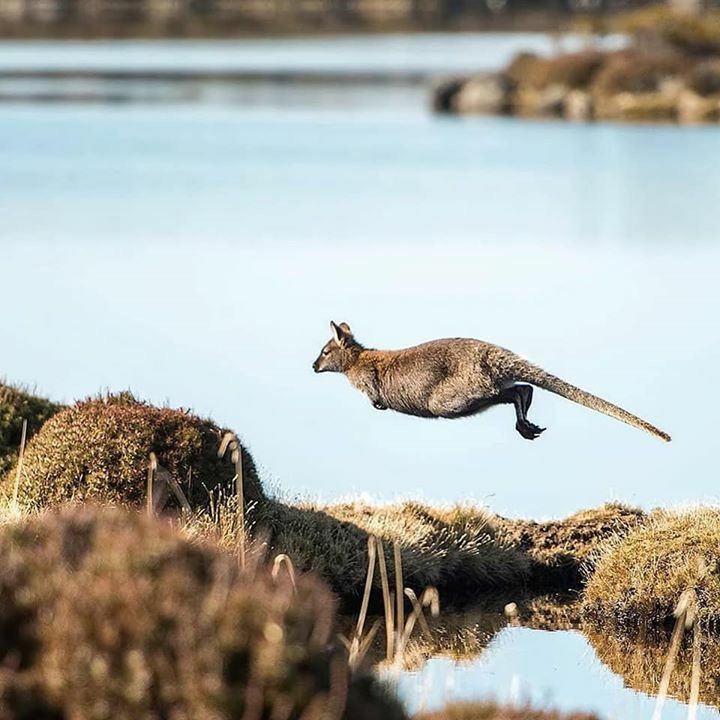
How high can kangaroos jump?
Red kangaroos (the largest species) can jump 3 meters (10 feet) vertically and up to 9 meters (30 feet) horizontally in a single hop. Their top speed is approximately 70 km/h (44 mph) in sustained hopping, with short bursts reaching 80 km/h (50 mph). A typical adult male red kangaroo weighs 80 kg and stands 1.
The Most Efficient Locomotion in the Animal Kingdom
A red kangaroo moves across the Australian outback at 40 km/h. It has been hopping continuously for an hour. Its heart rate, oxygen consumption, and muscle exertion are all lower than they were when it was moving at 20 km/h. This is physically impossible by the rules that govern most mammal locomotion - and yet kangaroos do it, every day, across thousands of kilometers of their range.
Kangaroo hopping is the most energy-efficient high-speed locomotion any vertebrate has ever evolved. Understanding how it works reveals one of the most elegant engineering solutions in biology - a system that turns tendons into springs, stores energy from impacts, and allows fast travel with almost no muscular effort.
The Performance Numbers
Red kangaroo (largest species):
- Maximum vertical jump: 3 meters (10 feet)
- Maximum horizontal hop: 9 meters (30 feet)
- Top sustained speed: 70 km/h (44 mph)
- Top burst speed: 80 km/h (50 mph)
- Body weight: up to 85 kg (190 lb)
- Standing height: up to 1.8 meters (6 feet)
- Daily travel distance: up to 30 km routine, 60+ km during drought
For comparison, a 1.8-meter human male typically jumps 0.5-1 meter vertically and about 2 meters horizontally. A red kangaroo jumps 3-6 times higher and 4-5 times farther than a human of comparable size.
The top speed is equally remarkable. Only a handful of mammals exceed 70 km/h (cheetahs, pronghorns, wildebeests), and they pay enormous metabolic costs for it. Kangaroos sustain 40-50 km/h indefinitely with minimal effort.
The Tendon Spring System
The secret to kangaroo efficiency is their Achilles tendons - specifically, the specialized elastic collagen that connects their calf muscles to their feet.
How tendons store energy:
When a kangaroo lands from a hop, the impact stretches the Achilles tendons. This stretch does not damage the tendons - the collagen fibers are arranged to absorb the impact energy and store it as elastic potential energy, similar to a stretched rubber band.
Approximately 70-90 percent of the impact energy is captured by the tendons during landing. This stored energy is then released during the next takeoff, providing most of the power for the upcoming hop.
The efficiency result:
Because so much energy is recycled through tendon elasticity, the muscles do not need to produce much power. They mainly need to maintain posture and add supplemental energy. Above a certain speed, the kangaroo's muscles actually work less as speed increases - because the tendon springs return more energy per cycle at higher hopping frequencies.
This produces the counterintuitive result that a fast-hopping kangaroo burns less energy per meter traveled than a slow-hopping one. Above about 15 km/h, faster hopping is more efficient than slower hopping.
No other large mammal has this property. Horses get tired faster when running faster. Dogs use more energy at higher speeds. Humans use dramatically more energy when running than walking. Only kangaroos reverse this relationship through tendon-based energy storage.
The Body Design
Kangaroo biomechanics reflect 25 million years of evolution optimized for hopping.
Enormous hind legs. The kangaroo's hind legs are the largest rear limbs proportionally of any mammal. They contain massive calf muscles that generate the power for hopping, though the tendons do most of the actual work.
Fused foot bones. Kangaroo feet have specialized structures that concentrate ground contact on a small area, transferring force efficiently through the ankle joint.
Reduced forelimbs. Kangaroo front limbs are comparatively small because they serve little locomotor purpose. They are used for holding food, occasional support during slow movement, and fighting, but not for weight-bearing during locomotion.
Heavy muscular tail. The tail comprises approximately 20 percent of the kangaroo's total body mass. It serves as a counterbalance during hopping, a fifth limb during walking, and a stabilizer during fighting.
Independent leg restriction. Kangaroo hind legs cannot move independently of each other during hopping. The bones and ligaments are structured in ways that prevent alternating gait. Both legs must move in synchrony.
This last feature is critical. Because kangaroos cannot run in the traditional sense, they can only hop. Evolution optimized hopping as the only option available given their skeletal structure.
Why Hopping Instead of Running
Most mammals run. Why did kangaroos evolve hopping instead?
The answer is evolutionary history. Modern kangaroos descend from small arboreal marsupials that lived in trees approximately 20-30 million years ago. These ancestral marsupials hopped between branches, using coordinated leaps rather than alternating steps.
As these marsupials moved from forest to open grassland, natural selection had to work with the body plan they already had. Redesigning the ankle joints and leg architecture for running would have required enormous evolutionary restructuring. Optimizing the existing hopping mechanism was more efficient.
The result is a body beautifully adapted for fast, efficient hopping but structurally incapable of running.
This is a common evolutionary pattern. When an animal moves into a new environment, evolution typically modifies existing features rather than creating entirely new ones. Kangaroos inherited hopping from their tree-dwelling ancestors and refined it for open terrain.
The outcome is a biomechanical solution that works better, in its specific context, than most conventional running does. Kangaroos move efficiently across vast Australian landscapes using a locomotion system that would seem inferior to running but actually outperforms it for their ecological niche.
The Slow-Speed Problem
Hopping is extraordinarily efficient at high speeds. At low speeds, it is awkward.
A kangaroo moving slowly cannot just hop slowly - the tendon springs only work well at certain frequency ranges. Low-frequency hops do not return much energy to the legs, making slow hopping tiring and awkward.
The solution is a completely different gait called pentapedal locomotion. When moving slowly (below about 10 km/h), kangaroos use all five "limbs" - two front arms, two hind legs, and the tail.
How it works:
- The kangaroo places its front arms on the ground
- It braces its tail against the ground behind it
- With arms and tail supporting weight, it swings both hind legs forward
- Once hind legs land, the arms and tail lift and swing forward
This produces an unusual gait that looks awkward but serves its purpose. The tail functions as a propulsive limb, bearing weight and pushing the kangaroo forward. Biomechanical research has confirmed the tail provides as much forward propulsion as either hind leg during slow walking.
This means kangaroos are the only known mammals that use their tail as a true fifth limb during locomotion. Other animals may use tails for balance, but only kangaroos actively push themselves forward with their tails.
The Tail
The kangaroo tail deserves its own detailed discussion. It is one of the most remarkable specialized appendages in the mammal world.
Physical characteristics:
- Length: 1-1.2 meters in adult red kangaroos
- Weight: 10-15 kg, approximately 20 percent of body mass
- Structure: 20-25 vertebrae, extensive musculature
- Strength: can support the animal's entire body weight when braced
Functions:
Counterbalance during hopping. As the kangaroo hops, the tail swings in opposition to the hind legs. When the body arcs forward during a hop, the tail swings upward and backward, maintaining balance. Without the tail, hopping at high speed would be impossible - the kangaroo would tumble forward.
Fifth limb during slow walking. As described above, the tail bears weight and provides propulsion during pentapedal locomotion.
Support during feeding. When browsing at eye level, kangaroos often brace their tail against the ground to stabilize their upper body. This allows them to reach higher vegetation than would otherwise be accessible.
Weapon during fights. Male kangaroos fight for mating rights using their hind legs for powerful kicks. The tail acts as a stabilizing tripod during fights - allowing the kangaroo to rear up on two legs while kicking with both hind legs simultaneously. The tail-tripod position is impossible without the muscular tail as the third point of support.
Thermal regulation. The tail's surface area helps dissipate heat. Kangaroos sometimes extend their tails fully during hot weather to increase heat loss.
The Fighting Display
Male kangaroos fight for mating access through spectacular displays that look almost like boxing matches.
The confrontation:
Two males stand upright, facing each other. They may balance on their tails for several seconds, reaching full standing height. In this position, they appear to be "boxing" - throwing punches with their front limbs.
The front-arm punches are mostly for display. They rarely cause significant injury. But they test the opponent's balance and commitment. A male who cannot hold his ground during the arm-wrestling phase retreats.
The decisive kicks:
The actual damage in kangaroo fights comes from hind leg kicks. When fighting gets serious, males balance on their tail (as a tripod) and kick forward with both hind legs simultaneously. Each leg delivers a powerful downward strike with the foot claws.
The kicks can disembowel smaller opponents or cause serious lacerations. Adult male kangaroos bear scars from previous fights across their abdomens and chests.
Winners and losers:
The winner displaces the loser from mating areas and may continue breeding for years. The loser retreats to less desirable territory or remains a solitary male without breeding rights.
Male kangaroos continue growing throughout life, so the oldest males are also the largest. This is why kangaroo fights often favor older males - they have accumulated the size advantage through continued growth that would stop in most mammals after reproductive maturity.
The Pouch
Kangaroos are marsupials, and their defining feature is the pouch where young (called joeys) complete development after birth.
Birth and transfer:
Kangaroo gestation is extraordinarily short - only 31-36 days. The newborn joey emerges as a tiny, nearly formless embryo weighing about 1 gram (less than a paperclip). It has only rudimentary front limbs and no hind legs yet.
Immediately after birth, the joey crawls unassisted from the birth canal, up the mother's fur, and into the pouch. This journey takes a few minutes. Once in the pouch, the joey attaches to a nipple that swells in its mouth, essentially locking the joey in place.
The joey then spends the next 6-10 months in the pouch, developing from embryo to juvenile. By the time it emerges, it looks like a miniature adult kangaroo.
Embryonic diapause:
Female kangaroos can carry multiple offspring at different developmental stages simultaneously. A mother may have an older joey out of the pouch but still nursing, a younger joey in the pouch, and a fertilized embryo in "embryonic diapause" (paused development) in her reproductive tract. When conditions are right, the diapaused embryo resumes development and becomes the next joey.
This reproductive strategy allows kangaroos to maximize reproductive output when conditions permit and conserve energy when drought or food scarcity makes additional reproduction risky. Females can "pause" their reproductive cycle and resume when the environment improves.
Different milk types:
Female kangaroos can produce two different types of milk simultaneously from different nipples - one milk formulation for a newborn in the pouch and a different formulation for an older joey that has emerged. This nutritional dual-stream feeding is one of the most remarkable reproductive adaptations in mammals.
Kangaroo Populations
Contrary to popular belief, most kangaroo species are not endangered.
Thriving species:
- Red kangaroo (Macropus rufus): estimated 11-15 million animals
- Eastern grey kangaroo (Macropus giganteus): estimated 9-11 million animals
- Western grey kangaroo (Macropus fuliginosus): estimated 2-3 million animals
- Wallaroo (Osphranter robustus): 4-5 million animals
Total kangaroo population across Australia: approximately 30-50 million animals, depending on conditions. This is similar to or higher than pre-European settlement populations.
Why populations expanded:
European agriculture cleared vast areas of forest and scrubland into grassland for livestock. Kangaroos thrive in grassland, so habitat expansion benefited them. Watering points installed for sheep and cattle are also used by kangaroos. Kangaroo populations in rural Australia are now at historically high levels.
Commercial harvesting:
Approximately 1-2 million kangaroos are commercially harvested annually for meat and leather. This is carefully managed by state wildlife agencies to maintain sustainable populations. The harvest represents less than 5 percent of the total population annually, well below reproductive replacement rates.
Endangered relatives:
The conservation concern is not the common kangaroos but their smaller marsupial relatives:
- Bilby (Macrotis lagotis): critically endangered
- Gilbert's potoroo (Potorous gilbertii): critically endangered, ~150 remaining
- Woylie (Bettongia penicillata): critically endangered
- Northern hairy-nosed wombat (Lasiorhinus krefftii): critically endangered
These smaller species face severe pressure from feral cats, foxes, habitat loss, and bushfires. Several related species have already gone extinct since European settlement, and more are at imminent risk.
The Engineering Lesson
Kangaroo biomechanics have inspired engineers for decades.
Prosthetic limbs. Researchers have attempted to replicate kangaroo Achilles tendon elasticity in prosthetic legs for amputees. The goal is a prosthetic that returns elastic energy during walking, reducing the metabolic cost of movement. Progress has been made but matching kangaroo tendon performance remains difficult.
Legged robots. Research robots have been built with kangaroo-inspired hopping mechanisms. Boston Dynamics and other robotics companies have studied kangaroo locomotion for rough-terrain robots. Applications include planetary exploration, where hopping robots could cover more ground with less energy than wheeled designs.
Athletic shoes. Some running shoes incorporate spring elements inspired by kangaroo tendons. These shoes return a small amount of impact energy to assist the runner's next stride. The effect is small but measurable.
The fundamental lesson: Kangaroos demonstrate that biological systems can exceed engineering solutions for specific tasks. Despite decades of research, no artificial system matches kangaroo hopping for large-body efficient movement. The combination of muscle, tendon, bone geometry, and nervous system coordination is difficult to replicate with synthetic materials.
The Australian Icon
The kangaroo is an unusual symbol for a nation. Most national animals are predators (the American eagle, the Russian bear, the British lion). Australia chose a large herbivorous marsupial that moves by hopping - an animal that seems almost comedic at first glance but reveals extraordinary biology on closer inspection.
Kangaroos are among the most successful large mammals in Australian ecology. They have adapted to one of the world's harshest environments through mechanisms that look strange but work extraordinarily well. Their 70 km/h hopping across dry interior Australia represents locomotion so efficient that it actually saves energy as speed increases.
Most remarkably, kangaroos exist on a continent where most of their ecological peers are now extinct or endangered. Kangaroos thrive while smaller marsupials struggle. Their combination of body size (large enough to deter most predators), efficient locomotion (able to cover long distances to find food), and social adaptability (comfortable with human-modified landscapes) has made them winners in the dramatic ecological reshuffling that has occurred in Australia since European settlement.
Whatever you think you know about how animals move, the kangaroo has at least one lesson to teach you about what biology can accomplish when evolution has 25 million years to refine a single locomotion strategy.
Related Articles
- Marsupials: Australia's Extraordinary Pouched Mammals
- Ungulates: The Hoofed Animals That Shaped the World
- Cheetah: The Fastest Land Animal
Frequently Asked Questions
How high can kangaroos jump?
Red kangaroos (the largest species) can jump 3 meters (10 feet) vertically and up to 9 meters (30 feet) horizontally in a single hop. Their top speed is approximately 70 km/h (44 mph) in sustained hopping, with short bursts reaching 80 km/h (50 mph). A typical adult male red kangaroo weighs 80 kg and stands 1.8 meters tall, making these jumps extraordinary for a mammal of that size.
The physics works because kangaroo jumping is the most energy-efficient form of locomotion any mammal has ever evolved. Above a certain speed, kangaroos actually use LESS energy per meter traveled as they go faster - a counterintuitive property no other vertebrate achieves. This efficiency allows them to cover 30+ kilometers per day across the Australian outback while consuming modest amounts of food.
How do kangaroo tendons work?
Kangaroos have exceptionally elastic Achilles tendons that act as biological springs. When a kangaroo lands from a hop, the impact stretches these tendons like rubber bands, storing approximately 70-90 percent of the impact energy as elastic potential energy. This stored energy is then released during the next hop, providing most of the power for the next jump without requiring muscle contraction.
The muscle tissue only needs to add supplemental energy and maintain posture - the tendons do the real work. This elastic energy return is why fast-hopping kangaroos use barely more energy than slow-hopping ones. Engineers studying kangaroo tendon mechanics have attempted to replicate the design in robots and prosthetic limbs, but no artificial material matches the elasticity-to-durability ratio of kangaroo tendon collagen.
Why do kangaroos hop instead of running?
Kangaroos hop because this is biomechanically the most efficient way to move at high speed for their body structure. Unlike most mammals, kangaroos evolved with their ankle joints positioned in ways that make conventional running impossible. Their rear legs cannot move independently at speed - both legs must move in synchronized pairs, which produces hopping rather than running.
This evolutionary choice reflects the constraints of their ancestral body plan, originally derived from small tree-climbing marsupials that hopped between branches. Over millions of years, as kangaroo ancestors moved to open ground, natural selection optimized their hopping rather than redesigning their skeleton for running. The result is a body optimized for sustained efficient movement across open Australian landscapes.
What is a kangaroo's tail used for?
The kangaroo tail is essential for walking, balancing, and fighting. When kangaroos walk slowly, they use their tail as a fifth limb - pressing it against the ground to support their weight while moving their hind legs forward. Biomechanical studies have shown the tail provides as much propulsion during slow movement as either rear leg. During hopping, the tail acts as a counterbalance, swinging in opposition to the hind legs to keep the kangaroo stable.
During fights between males (competing for mating access), kangaroos use their tails for balance while delivering powerful kicks with their hind legs. The tail is heavily muscled and contains approximately 50 percent of the kangaroo’s lower body muscle mass. A large kangaroo’s tail alone weighs 10-15 kg.
Are kangaroos really endangered?
Most kangaroo species are not endangered - they are actually thriving in modern Australia. Red kangaroos, eastern grey kangaroos, and western grey kangaroos have expanded their populations since European settlement because farming cleared forest into grassland ideal for kangaroo grazing. Conservative estimates suggest 30-50 million kangaroos exist across Australia, with population density in some rural areas exceeding pre-European settlement levels.
Commercial kangaroo harvesting (approximately 1-2 million animals per year) is sustainable population management. However, smaller marsupial relatives including many wallaby species, bettongs, potoroos, and bilbies are in severe decline due to feral cats, foxes, habitat loss, and bushfires. The conservation concern is not the familiar red and grey kangaroos but rather the dozens of smaller species that share evolutionary heritage with them.
Some of these small relatives are already extinct, and more are critically endangered.