
Introduction
The Sunda Pangolin, Manis javanica, is the most trafficked wild mammal on Earth. More individuals of this species, and of the other seven pangolin species collectively, are seized by wildlife law enforcement each year than of any other mammal.
An estimated 100,000 to 200,000 pangolins across all eight species enter the illegal trade annually, driven by demand in China and Vietnam for scales used in traditional medicine (despite having no demonstrated pharmaceutical activity, being composed entirely of keratin) and for meat consumed as a luxury food.
The irony is profound: the Sunda Pangolin’s primary defence against natural predators, curling into a tight, scaly ball that no lion or leopard can penetrate, is precisely what makes it so easy for humans to capture. A pangolin that rolls into a ball in response to a detected threat can simply be picked up and carried away. The evolved defence that has protected pangolins for tens of millions of years is entirely ineffective against the threat that is now driving them towards extinction.
Manis javanica is the most trafficked species partly because it is the most accessible to the major Asian markets: it inhabits the forests of Thailand, Vietnam, Malaysia, and Indonesia, relatively close to the centres of demand. But all eight species, the four Asian and four African pangolins, face similar pressures, and collectively they represent one of the most serious conservation emergencies in the mammal world.
Beyond the conservation crisis, the pangolin is a genuinely remarkable animal: toothless, armoured, bipedally ambulatory when walking, equipped with a tongue anchored to its sternum and reaching 40 centimetres in length, capable of consuming 70 million insects per year, and possessing a suite of anatomical adaptations for myrmecophagous (ant-eating) life that are entirely independent of the similar adaptations found in anteaters, aardvarks, and echidnas, a striking example of evolutionary convergence across distantly related lineages.
Etymology and Classification
The name ‘pangolin’ is derived from the Malay pengguling, ‘one who rolls up’, a direct reference to the species’ most distinctive defensive behaviour. The genus name Manis is from the Latin Manes, the spirits of the dead in Roman mythology, possibly used by early taxonomists as a sinister-sounding reference to the animal’s scaly, otherworldly appearance. The species epithet javanica refers to Java (the Indonesian island), from where early type specimens were collected.
The order Pholidota, the pangolins, contains only eight living species in two genera (Manis in Asia and Smutsia, Phataginus, and Uromanis in Africa) within a single family, Manidae. Molecular phylogenetics has consistently placed Pholidota as the sister group to the order Carnivora, meaning pangolins are more closely related to dogs, cats, and bears than they are to armadillos or anteaters, despite their superficial similarity to these scale-bearing or insect-eating groups.
Physical Description
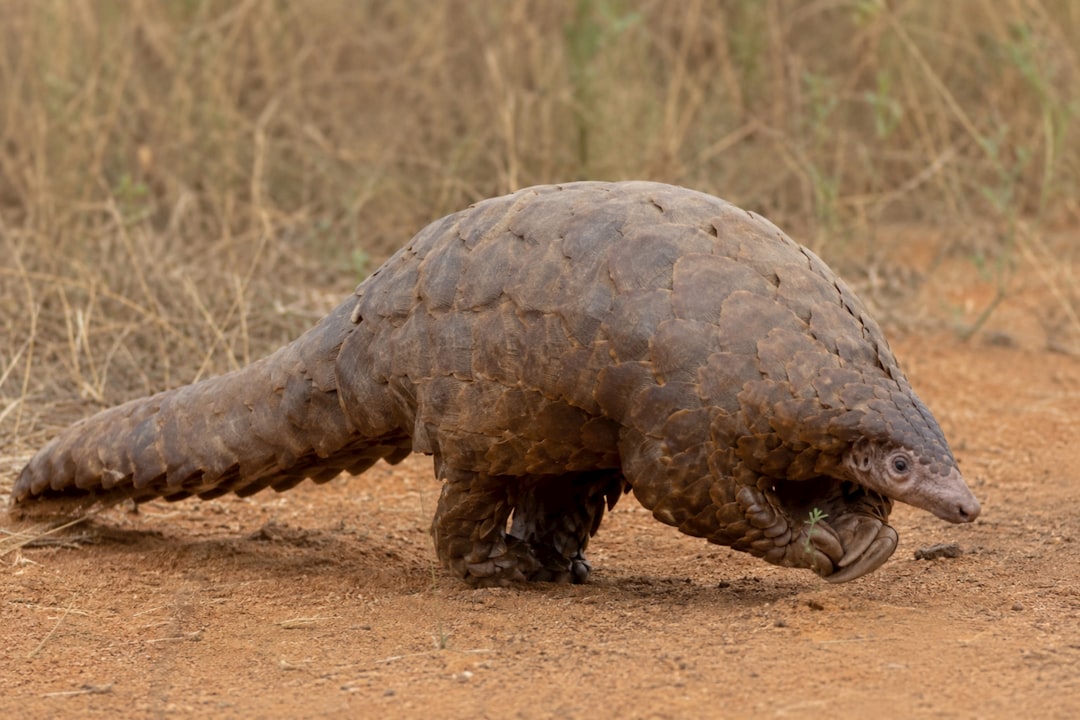
The Sunda Pangolin’s body is almost entirely covered by overlapping scales, roughly 1,000 scales on an individual, that cover the entire dorsal and lateral surface of the head, body, limbs, and tail. Only the ventral surface (belly), the inner limb surfaces, and the muzzle are scale-free, with sparse reddish-brown hair.
The scales are made of keratin, the same structural protein that forms human fingernails and hair, and grow continuously, being replaced as they wear, like the equivalent structure in reptiles.
Individual scales are large, curved, and keeled (ridged), overlapping like roof tiles and protecting against the bites and claws of predators. When the pangolin curls into a ball, the scales interlock and their sharp edges are presented outward, creating a nearly impenetrable barrier. The muscular tail is curled over the head and tightly gripped, sealing the ball closed.
A predator attempting to unroll the ball encounters resistance from the pangolin’s powerful trunk muscles in addition to the physical difficulty of gripping smooth, sharp-edged scales.
The head is small and conical, tapering to a blunt snout. The nostrils are muscularly sealable. The eyes are small but functional. The ears are simple slits with no external pinnae, also muscularly closeable. The tongue is extraordinarily long, reaching up to 40 centimetres beyond the mouth when extended, and is anchored in the chest, attached near the xiphoid process of the sternum.
This unusual anatomical attachment, found also in the anteaters and echidnas, provides the muscular support needed to project the tongue with enough force to penetrate the galleries of termite mounds.
Habitat and Range
Manis javanica inhabits primary and secondary tropical rainforest across Southeast Asia. Its range encompasses Thailand and Myanmar (where populations have been severely depleted), the Indochina peninsula (Vietnam, Laos, Cambodia, all heavily hunted), Peninsular Malaysia, Borneo (Malaysia’s Sabah and Sarawak, and Indonesian Kalimantan), Sumatra, Java, and many smaller Indonesian islands. The species has been completely extirpated from Singapore.
Within these countries, the Sunda Pangolin shows a preference for forest with structural complexity, old-growth or mature secondary forest with abundant dead wood, leaf litter, and large ant and termite populations. It also occurs in forest-edge habitats, scrubland, and, with decreasing frequency, oil palm plantations adjacent to forested areas, where some ant species associated with plantation agriculture can provide food.
The species is nocturnal and primarily solitary. It spends the day in hollow logs or self-excavated burrows, emerging at night to forage. Home ranges vary between individuals and habitats but are estimated at 4 to 35 square kilometres in field telemetry studies.
Diet and the Myrmecophagous Niche
The Sunda Pangolin is an obligate myrmecophage, its diet consists exclusively of ants and termites. This dietary specialisation is reflected in every aspect of its anatomy: the elongated, toothless skull; the enormous tongue with its adhesive mucous coat; the sealable nostrils and ear canals that prevent insect invasion; and the specialised stomach with its muscular walls and keratinous grinding ridges.
Prey is located primarily through olfaction. The pangolin’s olfactory capability is highly developed, and it can detect ant and termite colonies from above-ground by following chemical signals emanating from nest openings or foraging trails.
Once a nest is located, the pangolin excavates the outer structure with its powerful front claws, inserts its snout, and sweeps the tongue through the galleries at high speed, collecting insects adhering to the mucous surface. Nasal muscles seal the nostrils during the process, and the thick eyelid skin protects the eyes from swarming defenders.
A single foraging session may involve multiple nest visits, and the pangolin may travel several kilometres in a single night. Annual insect consumption is estimated at approximately 70 million ants and termites per individual, a pest-control ecosystem service with real economic value in the agricultural landscapes adjacent to the forests that pangolins inhabit.
The Wildlife Trade Crisis
The scale of the illegal wildlife trade in pangolins is staggering. Since 2000, seizure records indicate that over 800,000 pangolins have been confiscated from the illegal trade, and these figures represent only a fraction of total trade, as enforcement intercepts only a proportion of shipments. The actual number of individuals traded per year is estimated to be far higher.
The trade is driven by two primary markets:
Scales for traditional Chinese medicine: Pangolin scales are used in traditional Chinese medicine for an array of conditions including rheumatism, skin diseases, and improving lactation. The scales have no biologically plausible mechanism of action for any of these uses; they are pure keratin, chemically equivalent to a fingernail, and no clinical evidence of efficacy has been published. Nevertheless, demand is strong, and scales command prices of $3,000 per kilogram in Chinese markets.
Meat for luxury consumption: Pangolin meat is considered a delicacy in China and Vietnam, consumed at banquets as a sign of wealth. A single live pangolin may sell for \(2,000 to \)3,000 in high-end Vietnamese restaurants.
All eight pangolin species have been listed on CITES Appendix I since 2016, prohibiting all international commercial trade. China removed pangolin scales from the official list of approved Traditional Chinese Medicine ingredients in 2020, a significant policy change, though enforcement challenges remain. Demand reduction campaigns targeting the key consumer markets are ongoing.
Conservation Status and Efforts
The Sunda Pangolin is classified as Critically Endangered by the IUCN, with population declines estimated at greater than 80% over the past three generations (approximately 21 years). The population trend is assessed as decreasing.
Conservation efforts include:
Anti-poaching and trade enforcement: Increased investment in enforcement at forest patrol, border inspection, and market surveillance levels has resulted in significant seizures but has not yet reversed the trade trend.
Captive breeding: The Sunda Pangolin has proven almost impossible to breed in captivity at population-sustaining scales. Captive individuals typically die within weeks from stress-related wasting, inappropriate diet, and respiratory infections. A small number of facilities, primarily in Vietnam and China, have achieved limited breeding success, but the difficulty of providing the specialised diet and environmental conditions required makes captive breeding an insufficient tool for conservation.
Habitat protection: Protecting remaining forest areas with viable pangolin populations is the most effective conservation intervention. Key areas include the forests of Sabah (Malaysian Borneo), Sumatra’s remaining primary forest patches, and protected areas in Thailand and Vietnam.
Community engagement: Programmes that provide alternative livelihoods to communities that have historically hunted pangolins, combined with education on the conservation status of the species, have shown promise in reducing hunting pressure at local scales.
Related Reading
- Short-Beaked Echidna (Tachyglossus aculeatus): another insectivorous mammal with armour as its primary defence
- Sunda Pangolin (Manis javanica) trades to: Honey Badger (Mellivora capensis): an active predator with a very different approach to defence
- Naked Mole-Rat (Heterocephalus glaber): another mammal with extreme dietary specialisation
References
Challender, D.W.S., Harrop, S.R. & MacMillan, D.C. (2015). Understanding markets to conserve trade-threatened species in CITES. Biological Conservation, 187, 249-259. https://doi.org/10.1016/j.biocon.2015.04.015
Mohd-Azlan, J. & Engkamat, L. (2006). Camera trapping and conservation in Lanjak Entimau Wildlife Sanctuary, Sarawak, Borneo. Oryx, 40(2), 240-246. https://doi.org/10.1017/S0030605306000597
Pantel, S. & Chin, S.Y. (eds.) (2009). Proceedings of the Workshop on Trade and Conservation of Pangolins Native to South and Southeast Asia. TRAFFIC Southeast Asia, Petaling Jaya.
Shepherd, C.R. & Shepherd, L.A. (2012). A database of seizures of pangolins (Manis spp.). TRAFFIC Bulletin, 24(1), 11-14.
Gaubert, P. & Antunes, A. (2005). Assessing the taxonomic status of the Palawan pangolin Manis culionensis (Pholidota) using discrete morphological characters. Journal of Mammalogy, 86(6), 1068-1074. https://doi.org/10.1644/1545-1542(2005)86[1068:ATTSOT]2.0.CO;2
Zhou, Z.M., Liu, J.K., Lim, N.T.L. & Ma, G. (2014). In the Spotlight: Sunda Pangolin Manis javanica. TRAFFIC, Cambridge.
Frequently Asked Questions
How big is the Sunda Pangolin?
The Sunda Pangolin is a medium-sized pangolin, with a body length of 40 to 65 centimetres and a tail of 35 to 56 centimetres, giving a total length of 75 to 120 centimetres. Body weight ranges from 2 to 10 kilograms, with males typically larger than females. In comparison to other pangolin species, the Sunda Pangolin is mid-sized, larger than the Chinese Pangolin but smaller than the African Giant Pangolin.
What do Sunda Pangolins eat?
Sunda Pangolins feed exclusively on ants and termites, detected by smell, their olfactory capability is highly developed, and captured using the extraordinarily long sticky tongue. They raid ant nests in soil and in decaying wood, and termite mounds of various sizes. A single individual is estimated to consume approximately 70 million insects per year.
They do not consume any other food type; captive animals are extremely difficult to maintain in part because of the challenge of providing an adequate supply of appropriate insect prey.
Where do Sunda Pangolins live?
The Sunda Pangolin is found in Southeast Asia, with its range encompassing Thailand, Myanmar, Vietnam, Laos, Cambodia, Malaysia (Peninsular Malaysia, Sabah, Sarawak), Indonesia (Sumatra, Java, Kalimantan, and adjacent smaller islands), and Brunei. It has been extirpated from Singapore. The species inhabits primary and secondary tropical rainforest, forest edges, scrubland adjacent to forest, and, with decreasing frequency, oil palm plantations.
How long do Sunda Pangolins live?
Wild Sunda Pangolins are estimated to live up to approximately 20 years, based on growth rates, reproductive data, and comparison with other pangolin species. However, this lifespan estimate is poorly constrained because the species has never been successfully maintained in captivity for extended periods, almost all captive individuals die within weeks to months of capture from stress, dehydration, and respiratory disease.
Wild individuals are rarely radio-tracked for long enough to provide robust lifespan data.
How do Sunda Pangolins reproduce?
After a gestation of approximately 130 to 150 days, the female gives birth to a single pup, which is born with soft, pliable scales that harden within a few days. The pup rides on the mother’s tail for three to four months, clinging to the base of the tail scales. When the mother rolls into a defensive ball, the pup tucks inside the curled body.
Weaning occurs at approximately three months, and young pangolins become independent at around six months, though they may remain in loose association with the mother for somewhat longer.
Why is the Sunda Pangolin the most trafficked mammal?
The Sunda Pangolin is trafficked primarily for its scales, which are used in traditional Chinese medicine despite having no scientifically demonstrated pharmaceutical activity (they are pure keratin, chemically identical to human fingernails). The meat is also consumed as a luxury food in China and Vietnam.
The combination of high demand in Chinese and Vietnamese markets, accessible wild populations in Southeast Asia, and relatively weak enforcement of wildlife laws has driven an enormous illegal trade. An estimated 100,000 to 200,000 pangolins across all eight species are trafficked annually, making them the most-seized wild mammal globally.
Is the Sunda Pangolin endangered?
The Sunda Pangolin is classified as Critically Endangered by the IUCN, the highest category before extinction, reflecting population declines estimated at greater than 80% over the past three generations due to hunting and trade. It is listed on CITES Appendix I, which prohibits all international commercial trade, but enforcement is limited and the trade continues at high levels.
In 2016, all eight pangolin species were up-listed to CITES Appendix I, closing a loophole that had allowed trade in some specimens.
Can pangolin scales protect them from bullets?
No. The keratin scales of pangolins are effective against the bites and claws of natural predators, providing genuine physical protection that makes the rolled-up pangolin very difficult for a lion, leopard, or hyena to unroll and penetrate. However, scales provide no protection against human hunting methods, particularly snares, nets, and firearms.
The pangolin’s defensive behaviour of rolling into a ball, an effective strategy against all its natural predators, actually facilitates human capture, as the rolled pangolin is easy to pick up and carry.