
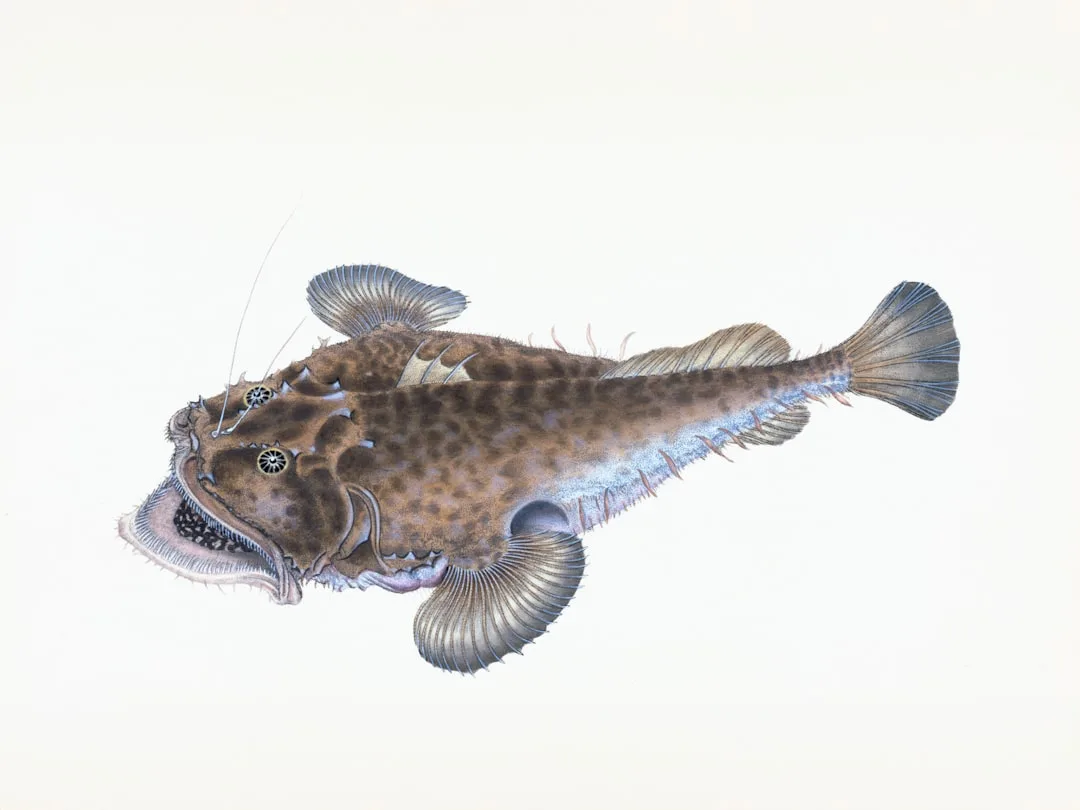
What is an anglerfish?
Anglerfish are deep-sea predatory fish with bioluminescent lures extending from their heads that they use to attract prey in total darkness. The lure is actually a modified dorsal fin spine called an illicium, with a bulbous tip called an esca that glows through symbiotic bacteria.
The Fishing Rod on Its Head
In total darkness a kilometer below the ocean surface, a small glowing light bobs gently in the water. A curious lanternfish approaches, drawn by what looks like food or a potential mate. The light is attached to a slender stalk. Above the stalk hangs something much larger - unseen in the darkness, invisible against the black water.
When the lanternfish gets close enough, the shadow explodes. A massive mouth opens, sharp teeth angled inward. The lanternfish vanishes, swallowed whole in under 10 milliseconds. The glowing light returns to its slow gentle bobbing. The anglerfish waits for the next meal.
This is deep-sea hunting taken to its logical extreme - a predator that has become mostly mouth, equipped with a living fishing rod that glows through symbiotic bacteria, sitting motionless in the darkest parts of the ocean waiting for victims to come to it.
The Animals
Anglerfish (order Lophiiformes) comprise approximately 200 species distributed across the world's oceans. Different species look strikingly different, but all share key features: large mouths, sharp teeth, and a modified dorsal fin spine that functions as a lure.
Deep-sea anglerfish (families Melanocetidae, Ceratiidae, and others):
- Sizes: typically 10-100 cm
- Depth: 200-2,000+ meters
- Known for elaborate bioluminescent lures
- Include species used in popular "monster fish" imagery
Shallow-water anglerfish (including monkfish, family Lophiidae):
- Sizes: up to 2 meters
- Depth: 50-500 meters
- Often live on sea floor rather than in mid-water
- Commercially fished for food
Frogfish (family Antennariidae):
- Small (5-30 cm)
- Live on coral reefs and shallow rocky bottoms
- Exceptional camouflage
- Also use lures despite being in daylight waters
The Lure
The anglerfish's defining feature is its bioluminescent lure.
Anatomy:
The lure consists of two parts:
Illicium - a modified dorsal fin spine that projects forward from the head. This is the "fishing rod."
Esca - a bulbous tip at the end of the illicium. This is the bait.
The esca contains pocket-like structures housing bioluminescent bacteria (typically Vibrio or Photobacterium species). The bacteria produce light through biochemical reactions similar to those in fireflies.
Why light underwater?
In the deep sea, bioluminescence is everywhere. Many deep-sea animals produce their own light or are attracted to light. An anglerfish's lure is essentially a false version of the signals that many deep-sea animals normally use to find mates, prey, or communicate.
Small fish approaching the lure may think they are approaching:
- A smaller prey item (a glowing shrimp or plankton)
- A potential mate signaling its presence
- A school mate's bioluminescent marker
Any of these misidentifications bring the victim within striking range.
Control:
Anglerfish can control their lures. They can:
- Move the lure forward, backward, up, and down
- Wiggle it to simulate movement
- Dim or brighten the bacteria (by controlling blood flow and oxygen supply)
- Turn it off entirely when predators are near
The Strike
When prey gets close enough, the anglerfish strikes.
The mechanism:
The anglerfish's mouth opens explosively. Negative pressure created inside the mouth cavity sucks water (and whatever is in it) into the mouth. Inward-angled teeth trap the prey. The mouth closes.
Speed:
High-speed video shows strikes completing in 6-10 milliseconds - faster than a human can perceive. This is among the fastest predatory strikes in any fish.
Capacity:
Anglerfish have extremely expandable stomachs. Some species can swallow prey twice their own body length. The prey item may be visibly bulging from the anglerfish's abdomen for days while digestion proceeds.
This extreme capacity adapts to food-scarce deep-sea environments. When meals come rarely, anglerfish must consume as much as possible when opportunity presents.
Sexual Parasitism
The most bizarre aspect of deep-sea anglerfish is their reproductive strategy.
Sexual dimorphism:
In many deep-sea anglerfish species, females are dramatically larger than males. A female might be 30 cm long while her mate is 3 cm. The size difference is among the most extreme in vertebrates.
The parasitic bond:
When a male deep-sea anglerfish finds a female, he bites her body and attaches permanently. Over weeks or months:
- His skin fuses with hers
- Their circulatory systems merge
- He loses his eyes, fins, and most internal organs
- He essentially becomes a sperm-producing appendage attached to the female
Multiple males:
A single female can carry multiple attached males. Specimens have been documented with 3-6 males fused to different parts of the female's body. Each remains functional as a reproductive organ indefinitely.
Why this works:
The deep sea is enormous and dark. Finding a mate once requires enormous effort. Once found, never separating ensures that reproduction can occur at any time without the need to search again.
The male's total dependence on the female is complete. He cannot feed himself. He cannot swim away. He is permanently committed to the partnership.
Not universal:
Not all anglerfish species have sexual parasitism. Some use more conventional reproduction. But the parasitic strategy represents one of the most extreme adaptations to deep-sea life ever documented.
Life in Permanent Darkness
Deep-sea anglerfish live in environments where no sunlight penetrates.
Depths:
Most anglerfish live between 200 and 2,000 meters deep. The mesopelagic zone (200-1,000 m) has very faint sunlight; the bathypelagic zone (1,000-4,000 m) has absolutely no sunlight.
Conditions:
- Pressure: up to 200+ atmospheres (20+ times higher than surface)
- Temperature: 2-4 degrees Celsius (just above freezing)
- Oxygen: low but sufficient
- Food: extremely scarce
Adaptations:
Deep-sea anglerfish have evolved specific adaptations:
- Soft, flexible bodies (withstand pressure without rigid skeletons breaking)
- Large mouths (catch rare prey efficiently)
- Slow metabolism (survive long fasting periods)
- Specialized cellular chemistry (function in extreme pressure)
- Bioluminescent lures (create prey rather than search for it)
Fragile at surface:
When deep-sea anglerfish are brought to the surface, their soft bodies collapse under their own weight (which their deep-sea buoyancy systems normally counteract). Most specimens reach the surface already dead, which is why anglerfish in photographs often look different from live specimens.
Anglerfish and Humans
Most anglerfish species have essentially no interaction with humans.
Deep-sea species:
Rare encounters occur through:
- Deep-sea trawl fishing (bycatch)
- Scientific submersible expeditions
- Oceanographic research
- Accidental strandings on beaches
Commercial species:
Monkfish and a few related shallow-water anglerfish are commercially important:
- Common monkfish (Lophius piscatorius): European food fish
- American monkfish (L. americanus): North Atlantic food fish
- Known as "poor man's lobster" for firm white meat
- Prized in French and Mediterranean cuisine
Cultural presence:
Anglerfish have become cultural icons of deep-sea strangeness. The 2003 film "Finding Nemo" featured an anglerfish as a menacing deep-sea encounter. Deep-sea documentaries frequently showcase anglerfish as examples of bizarre evolutionary solutions.
Why Anglerfish Matter
Beyond their strangeness, anglerfish represent important biological concepts.
Evolution by extreme adaptation:
Anglerfish show how natural selection produces dramatic anatomical and behavioral changes when environmental pressures are extreme. The deep sea is harsh enough that species adapted to it barely resemble their surface relatives.
Symbiosis:
The bacteria-anglerfish partnership in lure illumination is one of the most visible examples of host-microbe symbiosis in vertebrates. The bacteria cannot survive outside the esca; the anglerfish cannot hunt without the bacteria. Each needs the other.
Reproductive diversity:
Sexual parasitism shows that reproduction can take radically different forms in different lineages. Mammalian reproduction, with separate male and female individuals, is one strategy among many. Anglerfish demonstrate that male-female fusion is also a viable solution under appropriate conditions.
Deep-sea biology:
Anglerfish are ambassadors for deep-sea ecosystems that remain largely unexplored. Despite covering most of Earth's surface, the deep ocean is less familiar to science than the Moon's surface. Each new anglerfish species discovered expands our understanding of life's range on our own planet.
Sexual Parasitism in Deep-Sea Anglerfish
Perhaps the most extraordinary feature of deep-sea anglerfish is the mating system. In many species, the tiny male attaches permanently to the much larger female using hook-like teeth, then fuses his tissues with hers. He loses his eyes, digestive system, and independent identity, becoming essentially a pair of gonads supplied by her bloodstream. Our research team finds this one of the most extreme sexual arrangements in the animal kingdom.
"Anglerfish sexual parasitism required evolving an entirely unique immune system. Vertebrates normally reject foreign tissue. For a male to fuse with a female, the anglerfish had to lose much of the adaptive immune system that other vertebrates rely on. They are the only vertebrates known to have functional immunity without B cells, T cells, or MHC-based rejection mechanisms." - Dr. Jeremy Swann, Max Planck Institute [1]
Anglerfish Male-Female Size Disparities
| Species | Female length | Male length | Size ratio |
|---|---|---|---|
| Ceratias holboelli | Up to 77 cm | 4-16 cm | 5-20x |
| Linophryne lucifer | 25 cm | 1 cm | 25x |
| Photocorynus spiniceps | 46 cm | 6 mm | 76x (world record) |
| Cryptopsaras couesii | 30 cm | 2 cm | 15x |
| Haplophryne mollis | 15 cm | 5 mm | 30x |
| Typical bony fish | N/A | N/A | 1-2x |
Photocorynus spiniceps holds the record for the smallest vertebrate: a 6.2 mm parasitic male. Among the most extreme size disparities in any animal kingdom sexual system.
The Bioluminescent Lure
Deep-sea anglerfish lures use a bioluminescent symbiosis - the light is produced by bacteria (Photobacterium and related genera) housed in a specialized organ called the esca. The bacteria convert nutrients from the anglerfish's bloodstream into light via luciferase enzymes. The anglerfish can control the light output by restricting blood flow to the esca or exposing/hiding it through the escal skin.
"The lure is a living light. The fish does not produce the bioluminescence itself - it maintains a bacterial culture in a specialized organ and uses the bacteria's metabolism as a lantern. This is one of the best-studied bioluminescent symbioses in the ocean, and it has been evolving for at least 130 million years." - Dr. Edith Widder, ORCA [2]
Anglerfish Lure Species Comparison
| Species | Lure location | Shape | Typical prey |
|---|---|---|---|
| Humpback anglerfish | Forehead | Bioluminescent bulb | Small fish, squid |
| Goosefish (shallow) | Above mouth | Worm-like appendage (not bioluminescent) | Fish, birds |
| Illicium anglerfish | Dorsal | Branched glowing tip | Shrimp, fish |
| Triplewart seadevil | Chin and dorsal | Multiple small lures | Shrimp, small fish |
| Football fish | Dorsal | Round glowing ball | Mid-water prey |
Notable Research Findings
- There are approximately 170 known anglerfish species across 12 families, though most known species live on continental shelves at 100-500 m, not in the deep abyss where the iconic female-male parasitic arrangements occur.
- Anglerfish have one of the largest gapes relative to body size of any fish. The humpback anglerfish can swallow prey more than twice its own body length by distending its jaws and stomach extraordinarily.
- The fangtooth anglerfish has needle-like teeth so long relative to the head that the fish evolved special skull sockets to accommodate them when the mouth closes.
- Our research team notes that anglerfish were among the first deep-sea fishes ever photographed alive in their natural habitat, in 2014, by a team led by Ted Pietsch of the University of Washington.
- Female anglerfish produce millions of eggs in a single spawning event, released into the water column as gelatinous ribbons. This mass reproduction offsets the very low encounter rate between males and females in the vast, sparse deep ocean.
- Multiple males can attach to a single female in some anglerfish species. Females of Ceratias holboelli have been documented with up to 8 parasitic males fused simultaneously, each providing genetic material for fertilization over the female's extended reproductive life.
- Young anglerfish are planktonic and live in surface waters for their larval stage before descending to the deep sea. This vertical migration between life stages is a common pattern for deep-sea fish species.
- Our research team notes that anglerfish are essentially never seen alive at the surface because the pressure difference between their deep-sea habitat and surface waters is typically fatal. Nearly all specimens examined in museums were collected from trawl nets, which often damage or kill the animals during the ascent.
- The IUCN Red List has not formally assessed most deep-sea anglerfish species due to insufficient data, a common issue for deep-ocean animals. The International Deep-Sea Minerals Association has proposed that deep-sea mining activities should trigger precautionary assessments of affected ecosystems.
Anglerfish Habitat Depths
| Species type | Typical depth range | Lifestyle |
|---|---|---|
| Shallow (goosefish family) | 0-500 m | Continental shelf bottom dwellers |
| Mesopelagic | 200-1,000 m | Mid-water ambush |
| Bathypelagic | 1,000-4,000 m | Deep mid-water (most ceratioids) |
| Abyssopelagic | 4,000-6,000 m | Deep abyssal zones |
| Hadal | 6,000-11,000 m | Rarely observed, specialized species |
Many ceratioid anglerfish species have never been observed alive. Most of our understanding comes from individual specimens recovered during deep-sea expeditions and from the 2014 Monterey Bay Aquarium Research Institute recordings of a black seadevil (Melanocetus johnsonii) filmed in its natural habitat at 600 meters. The MBARI footage was the first ever high-quality recording of a live bathypelagic anglerfish and triggered significant revisions to textbook descriptions of their behavior.
Deep-Sea Discovery Rate
Our research team notes that approximately 10 new deep-sea fish species are described each year, and anglerfish contribute several of those. The pace of discovery has accelerated as remotely operated vehicles (ROVs) and autonomous underwater vehicles (AUVs) have improved in capability. The 2020 discovery of a new humpback anglerfish species off the coast of Portugal, for example, was made possible by deep-water ROV surveys that would have been impossible a decade earlier.
Ocean exploration budgets remain a tiny fraction of space exploration budgets despite the deep ocean occupying a much larger volume of accessible unknown space. As of 2023, approximately 80% of the ocean remains unexplored by high-resolution survey, and most deep-sea anglerfish species remain known only from handfuls of preserved specimens.
Why Do Deep Sea Creatures Have Sharp Teeth?
Deep-sea predators evolved oversized, inward-angled teeth because prey in the abyss is scarce and unpredictable - every potential meal must be captured on the first attempt. Anglerfish (order Lophiiformes) can swallow prey up to twice their own body length, and their teeth angle backward into the throat so trapped prey cannot escape during the swallowing process.
The strike itself is extraordinarily fast: an anglerfish's mouth closes on prey in under 10 milliseconds, using vacuum suction combined with the physical barrier of teeth. Viperfish, fangtooth, and gulper eels follow similar logic.
In the oxygen-minimum and bathypelagic zones where food is sparse, missing any opportunity means potential starvation, so natural selection heavily rewards overbuilt prey-retention anatomy. Approximately 200 anglerfish species share this ambush strategy, combined with bioluminescent lures that attract prey close enough to strike.
References
[1] Swann, J. B., Holland, S. J., Petersen, M., Pietsch, T. W., & Boehm, T. (2020). The immunogenetics of sexual parasitism. Science, 369(6511), 1608-1615. DOI: 10.1126/science.aaz9445
[2] Widder, E. A. (2010). Bioluminescence in the ocean: Origins of biological, chemical, and ecological diversity. Science, 328(5979), 704-708.
[3] Pietsch, T. W. (2009). Oceanic Anglerfishes: Extraordinary Diversity in the Deep Sea. University of California Press.
[4] Freed, L. L., Easson, C., Baker, L. J., et al. (2019). Characterization of the microbiome and bioluminescent symbionts across life stages of Ceratioid Anglerfishes of the Gulf of Mexico. FEMS Microbiology Ecology, 95(10), fiz146.
[5] Pietsch, T. W., & Orr, J. W. (2007). Phylogenetic relationships of deep-sea anglerfishes of the suborder Ceratioidei (Teleostei: Lophiiformes) based on morphology. Copeia, 2007(1), 1-34.
Related Articles
- Deep Sea Creatures: Life in the Eternal Darkness
- Bioluminescence: How Animals Make Light
- The Mariana Trench: Life at Earth's Deepest Point
Frequently Asked Questions
What is an anglerfish?
Anglerfish are deep-sea predatory fish with bioluminescent lures extending from their heads that they use to attract prey in total darkness. The lure is actually a modified dorsal fin spine called an illicium, with a bulbous tip called an esca that glows through symbiotic bacteria. Approximately 200 species of anglerfish exist, ranging from small species a few centimeters long to larger species reaching 1 meter.
They live in the deep ocean at depths of 200-2,000+ meters where no sunlight penetrates. Anglerfish have enormous mouths full of sharp teeth that angle inward to prevent prey from escaping. Some species can swallow prey larger than themselves, stretching their stomachs dramatically. They are poor swimmers, relying on lures rather than pursuit to catch food in the food-scarce deep ocean environment.
How do anglerfish hunt in the dark?
Anglerfish hunt using their bioluminescent lure as bait. The glowing tip attracts curious smaller fish and invertebrates who mistake it for food or a mate. The anglerfish remains motionless with the lure dangling above its massive mouth. When prey approaches close enough, the anglerfish strikes with extraordinary speed - capturing prey in as little as 6 milliseconds, among the fastest predatory strikes ever measured.
The lure’s light comes from symbiotic bioluminescent bacteria living in the esca. Different species produce different colors and flash patterns, which may be tuned to attract specific prey types. Some anglerfish species can dim or brighten their lures, turning them off during daylight or when predators are near.
The hunting strategy is perfect for environments where active swimming is metabolically expensive - the anglerfish expends minimal energy waiting for prey to come to it.
Why do male anglerfish fuse to females?
Deep-sea anglerfish use one of the strangest reproductive strategies in nature - sexual parasitism. Males are tiny (often less than 3 cm long) compared to females (reaching 1 meter). When a male finds a female, he bites her body and attaches permanently. Over weeks, his skin fuses with hers, their circulatory systems merge, and most of his organs atrophy. He becomes essentially a reproductive organ living off the female’s blood.
A single female may carry multiple permanently attached males. This bizarre adaptation solves the problem of finding mates in the vast, dark deep ocean - once mates meet, they never separate. The male provides sperm whenever the female is ready to reproduce, which can be any time. The female retains her organs, hunts for both, and controls reproduction.
This strategy is found only in some deep-sea anglerfish species - others use more conventional reproduction.
How deep do anglerfish live?
Different anglerfish species live at different depths, ranging from 200 meters to over 2,000 meters below the surface. The deep-sea species with the most famous lures typically live in the mesopelagic zone (200-1,000 meters) and bathypelagic zone (1,000-4,000 meters) where no sunlight penetrates. At these depths, water pressure exceeds 100 atmospheres, temperatures hover just above freezing, and food availability is extremely limited.
Anglerfish have evolved specific adaptations for deep-sea life: pressure-resistant body structures, slow metabolism to survive long fasting periods, large mouths to catch rare prey, and flexible stomachs to accommodate any meal found. The deepest anglerfish species, Melanocetus johnsonii, has been recorded at depths exceeding 1,000 meters. Above 200 meters, anglerfish cannot survive because their bodies are adapted for high pressure and cold temperatures.
Are anglerfish dangerous to humans?
Anglerfish are not dangerous to humans because they live at depths far below any human swimming range. No anglerfish has ever attacked a human. The largest species (about 1 meter) might theoretically bite a diver but divers cannot reach anglerfish habitat without submersibles. Humans are far more dangerous to anglerfish than anglerfish are to humans - deep-sea trawling fisheries catch anglerfish as bycatch and damage deep-sea ecosystems.
Some anglerfish species are commercially fished in shallow waters, particularly the monkfish (Lophius species) which are closely related anglerfish that live in shallower waters up to 500 meters deep. Monkfish are popular in European cuisine, prized for their firm white flesh.
The popular image of anglerfish as terrifying monsters comes from their appearance - large mouths, sharp teeth, weird lures - but their small size and deep-sea habitat make them completely harmless to humans.