
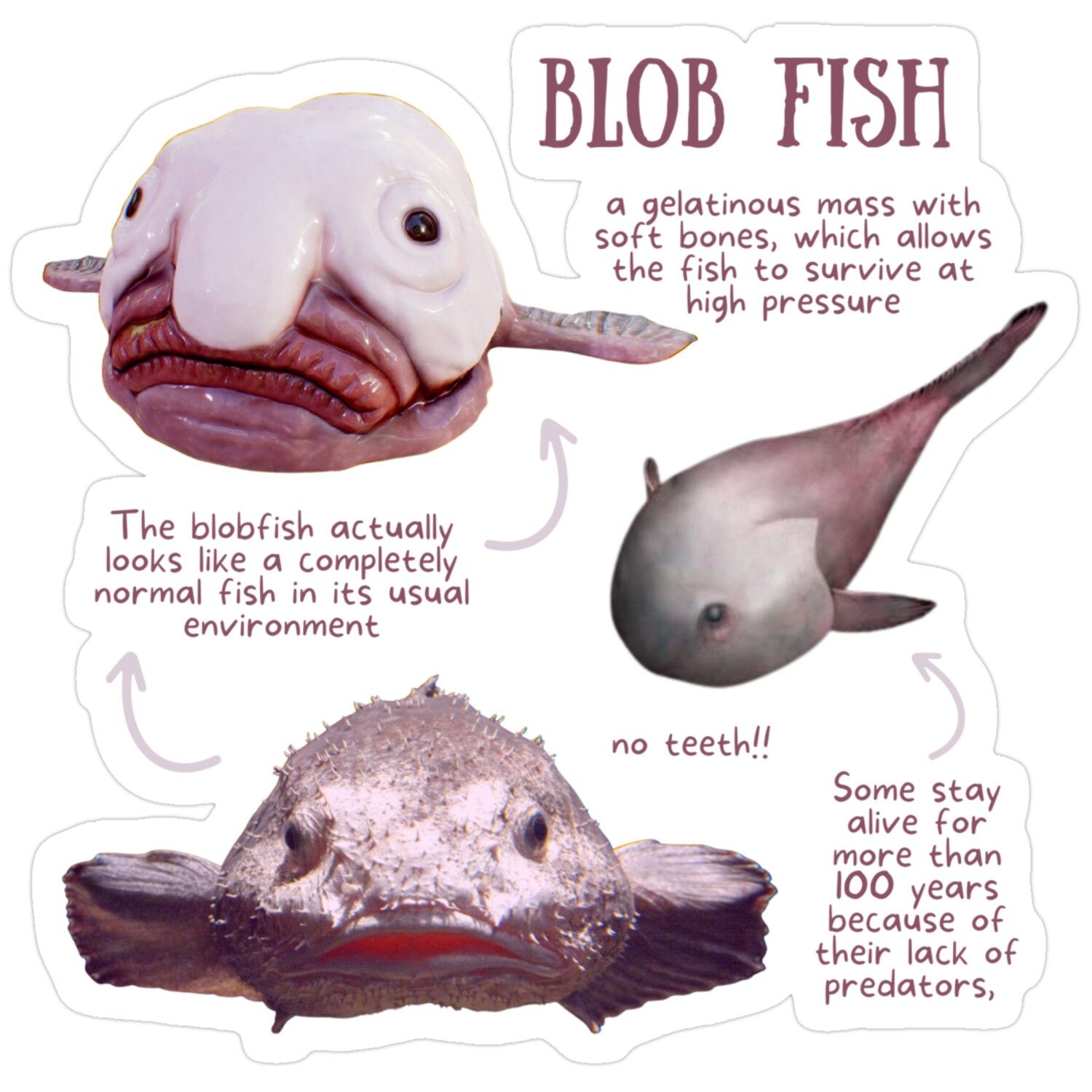
Why do blobfish look so ugly?
Blobfish (Psychrolutes marcidus) only look deformed when brought to the surface - underwater in their natural habitat, they look like normal fish. The famous 'ugly' appearance is caused by decompression damage. Deep-sea fish evolve to withstand pressures up to 100x surface pressure. When brought to the surface rapidly, the pressure change causes their tissues to swell, distort, and appear gelatinous.
A Pressure Casualty Made Famous
In 2013, a small, gelatinous, sad-looking fish became the most famous ugly animal on the internet. Its downturned mouth, droopy nose-like protrusion, and blob-like body won the Ugly Animal Preservation Society's "Ugliest Animal in the World" contest. That single photograph became a meme viewed by millions.
The fish in the photograph is dead, decompressed, and nothing like what living blobfish actually look like.
In their natural habitat, 1,000 meters below the ocean surface, blobfish look like ordinary fish. The famous "ugliness" is entirely an artifact of being brought to the surface, where pressure changes destroy their normal appearance. The blobfish, perhaps more than any other animal, demonstrates how misleading surface observations of deep-sea creatures can be.
What Blobfish Actually Look Like
Underwater, blobfish look normal. Out of water, they look famously weird.
In their habitat (1,000m depth):
- Firm, torpedo-shaped body
- Normal fish proportions
- Pale pink or grayish color
- Swimming normally
- Looks similar to other deep-sea fish
At the surface (decompressed):
- Gelatinous, saggy body
- Downturned "frowning" mouth
- Bulbous nose-like projection
- Overall melted appearance
- The famous "ugly" look
The difference:
Pressure. Deep-sea fish live under 100+ atmospheres of pressure. Their bodies are adapted to this pressure, soft, gelatinous tissues that would collapse in air. When rapidly brought to surface, the pressure change expands gas in tissues, distorts internal structures, and produces the characteristic melted appearance.
Living photos:
Research submersibles have photographed living blobfish in their natural habitat. These photos show normal-looking fish, completely different from the famous "ugly" image.
The Species
Blobfish comprise several species, not just one.
The famous blobfish:
Psychrolutes marcidus (smooth-head blobfish) is the species typically seen in famous photos.
Related species:
- Psychrolutes phrictus (blob sculpin)
- Psychrolutes microporos (Japan deepwater sculpin)
- Several other Psychrolutidae family members
Family:
Psychrolutidae, the fathead sculpin family:
- All deep-sea bottom-dwellers
- All have gelatinous soft bodies
- All look distorted when brought to surface
- Vary in body shape and distribution
Size:
Adult blobfish reach approximately 30 cm in length. Not large, but substantial for a deep-sea fish.
Living Under Extreme Pressure
Deep-sea pressure creates unique biological requirements.
Pressure at blobfish depth (1,000m):
- 100 atmospheres (100x surface pressure)
- Equivalent to 100 car tires' worth of pressure
- Crushing to unprotected surface-adapted tissues
Adaptations:
Blobfish bodies are designed for this pressure:
Gelatinous tissue:
- Approximately 95% water
- Very low bone and muscle mass
- Flexible under pressure
- Maintains shape through water pressure, not skeletal rigidity
No swim bladder:
- Surface fish use gas-filled swim bladders for buoyancy
- Deep-sea fish often lack these (would collapse or explode with depth changes)
- Blobfish achieve near-neutral buoyancy through tissue density
- Their body is slightly less dense than surrounding water
Reduced skeleton:
- Minimal bone structure
- Reduces energy cost of building and maintaining
- Works only because pressure supports body shape
Slow metabolism:
- Low oxygen demands
- Minimal food requirements
- Energy-efficient lifestyle
Tissue chemistry:
- Proteins adapted to fold correctly under pressure
- Enzymes work efficiently at cold temperatures (2-9°C)
- Cell membranes stable at extreme conditions
Why Surface-Brought Specimens Look "Ugly"
The famous "ugliness" is decompression damage.
What happens during retrieval:
When a blobfish is caught in a trawl net and brought to surface:
- Pressure drops rapidly (100 atm to 1 atm in minutes)
- Gas dissolved in tissues expands
- Cell membranes rupture
- Proteins denature
- Body loses structural support
- Gelatinous tissues collapse under their own weight in air
The fish is essentially dying from pressure change, not just looking "weird."
Analogy:
Imagine squeezing a water balloon and then releasing it rapidly. The balloon doesn't return to its original shape; it might burst, distort, or look strange. Blobfish tissues are similar to this, but biologically more complex.
Why the dead body looks sad:
The downturned mouth and droopy face aren't signs of sadness, they're gravity pulling on gelatinous tissues that normally kept their shape through water pressure. Without that support, gravity makes everything "frown."
How They Were Discovered
Blobfish were known scientifically long before becoming internet famous.
Scientific discovery:
- First described in the 1920s from specimens caught in trawl nets
- Formally classified as Psychrolutes marcidus species
- Studied primarily by Australian marine biologists
- Habitat studied through deep-sea trawls
Pre-fame status:
Before 2013, blobfish were:
- Obscure deep-sea fish known mainly to specialists
- Rarely seen by public
- Not considered remarkable beyond typical deep-sea biology
- Occasional subjects of academic papers
The 2013 virality:
The Ugly Animal Preservation Society:
- Founded by biologist Simon Watt
- Goal: raise awareness for less charismatic species
- 2013 public vote for ugliest animal
- Blobfish winning image went viral
- Became society mascot
Post-fame status:
After winning:
- Millions of images online
- Subject of memes, t-shirts, merchandise
- Featured in documentaries
- Part of popular culture references
- Children's books and educational materials
Where They Live
Blobfish have a limited geographic range.
Distribution:
- Off southeastern Australia
- Tasmania
- Pacific waters around New Zealand
Depth range:
- 600-1,200 meters
- Mid-continental slope habitats
- Cold water (2-9°C)
- Dark (no sunlight penetrates)
Habitat:
- Soft mud and silt bottoms
- Near continental slopes
- Areas with some current (brings food)
- Stable deep-water conditions
Not found:
- Most global ocean basins
- Atlantic Ocean
- Pacific basin center
- Arctic waters
- Shallow waters
Their limited range makes them vulnerable to regional threats.
Diet
Blobfish are passive eaters.
Food sources:
- Crustaceans (shrimp, crabs, isopods)
- Bivalves (clams, mussels)
- Small fish (rarely)
- Dead organic matter
- Marine snow drifting past
Feeding strategy:
Not active hunting, they:
- Drift near seafloor
- Wait for food to drift close
- Open mouth when prey approaches
- Suck in whatever is near
This passive approach:
- Saves energy (critical in deep sea)
- Matches sparse food availability
- Works for specific deep-sea niches
- Doesn't require complex sensory systems
Feeding frequency:
Likely eat only periodically:
- Once every few days
- Sometimes less often during lean periods
- Rely on stored fat between meals
- Slow metabolism enables long fasts
Reproduction
Blobfish reproduction is poorly understood.
What is known:
- Eggs laid in batches on seafloor
- Parents may guard eggs (some species)
- Slow development
- Low reproductive rate
What isn't known:
- Specific breeding seasons
- Courtship behaviors
- Egg incubation details
- Juvenile development
- Sexual maturity age
Why limited data:
- Deep-sea habitat makes observation nearly impossible
- Most captured specimens are single adults
- Captive breeding not attempted
- Submersible time limited
Implications:
Low reproductive rate means:
- Populations recover slowly from damage
- Vulnerable to overfishing bycatch
- Extended recovery from depletion
- Conservation urgency
Conservation
Blobfish face specific threats.
Status:
Not formally assessed by IUCN in detail. Considered vulnerable by conservation groups.
Primary threats:
Deep-sea trawling:
- Orange roughy and deep-sea fisheries
- Bycatch mortality (decompression kills caught specimens)
- Bottom trawling destroys deep-sea ecosystem
- Sustainable harvest impossible at current practices
Climate change:
- Deep-sea temperature changes
- Food web disruptions
- Oxygen availability changes
- Range contraction possibilities
Deep-sea mining:
- Proposed mining operations in Pacific
- Would destroy habitat
- No recovery mechanism
- Blobfish particularly vulnerable
Habitat limitations:
Because blobfish only live in specific Australian/Tasmanian deep waters, threats to this region affect nearly the entire species.
Conservation challenges:
- Difficult to monitor populations
- Impossible to relocate captured fish
- Limited public awareness beyond the "ugly" meme
- Most people don't realize they're vulnerable
Cultural Significance
Blobfish have become pop culture icons.
Viral fame:
Since 2013:
- Millions of images online
- Viral video compilations
- Meme templates
- Internet celebrity among animals
Merchandise:
Blobfish products include:
- T-shirts
- Stuffed toys
- Mugs and dishes
- Phone cases
- Children's books
Educational use:
Schools use blobfish to teach:
- Ocean pressure
- Evolution and adaptation
- Conservation importance
- Scientific misconception correction
Cultural value:
The blobfish demonstrates:
- Appearances can be misleading
- Conservation needs extend beyond "cute" animals
- Public perception shapes protection priorities
- Science should inform conservation
The Irony of "Ugly"
The blobfish's fame has created a remarkable irony.
The perception:
Public believes blobfish are naturally ugly. This view drives:
- Viral sharing for "weird animal" content
- Merchandise featuring the "ugly" pose
- Cultural shorthand for unusual/unattractive things
- General recognition of the species
The reality:
Blobfish in their natural habitat look like normal fish. The famous "ugly" appearance represents:
- A decompressed, dying specimen
- Not typical appearance
- Pressure damage, not natural look
- An artifact of surface observation
The result:
The blobfish is famous specifically for what it looks like dead and decompressing. It's as if humans were famous for how we look after freezing in a glacier, not representative of our actual biology.
Scientific pushback:
Some marine biologists argue the "ugly" fame, while raising awareness, perpetuates misunderstanding. The real blobfish is a fascinating deep-sea specialist, not a comedic figure.
Research and Study
Blobfish remain understudied relative to their fame.
Research gaps:
- Basic biology (reproduction, lifespan, etc.)
- Population estimates
- Habitat requirements detail
- Climate change responses
- Full life cycle
Research opportunities:
Blobfish offer insights into:
- Deep-sea pressure adaptations
- Gelatinous body biomechanics
- Low-energy lifestyle physiology
- Ocean food webs in their habitat
Challenges:
- Deep-sea habitat access
- Specimens die in collection
- No captive populations
- Limited research funding
Future directions:
- ROV observations in natural habitat
- Genetic studies from retrieved specimens
- Physiological research on decompressed tissue
- Climate change impact modeling
Other "Ugly" Deep-Sea Fish
Blobfish aren't alone in looking different at surface.
Similar decompression effects:
Many deep-sea fish show distorted appearance when brought to surface:
- Fangtooth: also looks "scary" due to decompression
- Gulper eel: dramatically different proportions
- Barreleye fish: transparent head collapses
- Various anglerfish: body distortion
- Deep-sea dragonfish: altered appearance
The common pattern:
All deep-sea fish, with soft gelatinous bodies adapted to high pressure, look "wrong" at the surface. They are, effectively, identically affected by the same pressure-change biology.
Selective fame:
Blobfish became famous because:
- One good photograph went viral
- The "sad face" appealed to humor
- Simple and memorable name
- Fit the "ugly animal" contest framing
Other equally weird-looking deep-sea fish remain obscure.
The Lesson of the Blobfish
Beyond memes, blobfish teach real lessons.
About science:
- Appearance isn't everything
- Context determines interpretation
- Pressure changes biology fundamentally
- Deep sea remains largely unknown
About conservation:
- "Ugly" species deserve protection too
- Endangered status matters more than aesthetics
- Viral fame can raise awareness
- But fame doesn't guarantee protection
About public perception:
- Memes can spread misinformation
- Popular images oversimplify
- Education requires effort
- Reality often more interesting than fiction
About deep-sea biology:
- Pressure shapes everything
- Soft bodies work underwater
- Evolution produces unexpected solutions
- Extreme environments breed extreme adaptations
Why Blobfish Matter
Despite their comedic fame, blobfish represent important biology.
They demonstrate that:
- Deep-sea animals require specific pressure to look and function normally
- Animals can thrive in environments hostile to humans
- Low-energy, passive lifestyles work in specific niches
- Gelatinous body plans succeed where skeletal rigidity fails
- Scientific fame doesn't equal scientific respect
Every blobfish meme shared is an animal misrepresented. Every viral post reinforces that "ugly" is somehow an inherent feature rather than an artifact of violating the animal's habitat requirements.
The actual blobfish, swimming naturally at 1,000 meters depth in cold Australian waters, is a biological marvel, an animal that has solved the problem of deep-sea life through soft-tissue engineering and metabolic economy that nothing in the shallower ocean could accomplish.
Their conservation challenges are real. Deep-sea trawling damages their ecosystem. Climate change is altering their habitat. Public awareness, despite the fame, rarely translates into actual protection efforts.
The blobfish we see in memes is a dead, decompressed specimen, an accidental martyr for deep-sea biology awareness. The living blobfish below continues doing what it always has: drifting quietly on muddy deep-sea floor, eating whatever comes within reach, surviving in conditions that would kill us instantly.
We laugh at the meme. We should also protect the living animal.
Pressure Physiology of the Deep Sea
The blobfish's distinctive appearance when brought to the surface is a perfect demonstration of the profound physiological differences between surface and deep-sea organisms. The ocean's pressure increases by approximately 1 atmosphere for every 10 meters of depth. A fish living at 800 meters experiences 80 times the pressure we experience at sea level.
"Deep-sea fish are not unusual because they tolerate pressure. They are unusual because their entire biochemistry is adapted to function specifically under pressure. Removing them from that environment is not just uncomfortable - it is fundamentally biologically incompatible with life as we know it. The blobfish we see in photographs is essentially a decompressed biological machine that was never designed to function at surface pressure." - Dr. Andrew Stewart, Museum of New Zealand Te Papa [1]
Pressure at Various Depths
| Depth (meters) | Pressure (atmospheres) | Notable species at this depth |
|---|---|---|
| 0 | 1 | Surface fish |
| 200 | 21 | Twilight zone begins |
| 500 | 51 | Many anglerfish species |
| 800 | 81 | Blobfish habitat |
| 1,000 | 101 | Sperm whale hunting depth |
| 2,000 | 201 | Colossal squid habitat |
| 4,000 | 401 | Abyssal plain |
| 6,000 | 601 | Hadal zone begins |
| 11,000 | 1,101 | Mariana Trench floor |
The blobfish family (Psychrolutidae) contains approximately 35 species globally. Many of them are morphologically similar to the famous blobfish, with reduced skeletal structure and high gelatinous content, all adapted to their specific pressure environments.
Commercial Fisheries Bycatch
The blobfish (Psychrolutes marcidus) became famous not because it was sought after but because it was caught accidentally. Its range overlaps with the deep-water fishery for orange roughy (Hoplostethus atlanticus), an extremely long-lived fish that has been severely overfished since the 1980s. Trawl nets dragged along the seafloor at 600-1,200 meters off Australia and New Zealand bring up whatever is in their path, including blobfish.
"Orange roughy fisheries have been catastrophic for deep-sea ecosystems. These are slow-growing communities with species that live for decades or centuries. When you drag heavy trawl gear across seamount tops, you destroy coral communities that took thousands of years to form and pull up species like blobfish that we barely understood before they started appearing in nets." - Dr. Malcolm Clark, NIWA New Zealand [2]
Bycatch Species from Orange Roughy Fisheries
| Species | Ecological role | Conservation concern |
|---|---|---|
| Blobfish (Psychrolutes marcidus) | Ambush predator, slow-moving | Unassessed, likely vulnerable |
| Oreo dories (Allocyttus spp.) | Mid-water predators | Overfished in some areas |
| Black cardinalfish | Mid-water school fish | Concerns about stocks |
| Deep-sea chimaeras | Slow-growing elasmobranchs | Near Threatened |
| Deep-sea corals (various) | Ecosystem engineers | Hundreds of years to recover |
| Deep-sea sharks | Top predators | Extremely slow growth |
Orange roughy can live to 150 years, and bottom trawls destroy their deep-sea coral habitat in ways that take centuries to recover. The blobfish and many other species are caught as bycatch in this fishery, not as targeted species.
Notable Research Findings
- Blobfish have essentially no muscles. Their body is composed largely of a gelatinous substance slightly less dense than seawater, allowing them to float just above the sea floor without active swimming.
- Most blobfish never travel more than a few meters per day. They are primarily ambush predators that wait for prey to drift within reach.
- A 2011 estimate suggested that the commercial trawl fishery for orange roughy had depleted blobfish populations in the New South Wales region by 30-50%, though precise figures are impossible without targeted surveys.
- Our research team notes that the Blobfish won the "World's Ugliest Animal" vote organized by the Ugly Animal Preservation Society in 2013, a campaign specifically designed to draw attention to unusual-looking species that lack conservation charisma. The campaign worked: the Australian Institute of Marine Science and several conservation organizations now use the blobfish as a mascot for deep-sea bycatch issues.
Why Are Deep Sea Creatures So Ugly?
They usually are not - deep-sea creatures often look perfectly normal in their natural habitat. The blobfish (Psychrolutes marcidus) famously won the Ugly Animal Preservation Society's 2013 contest, but the iconic "ugly" photograph shows a dead, decompressed specimen brought to the surface from around 1,000 meters down.
In its natural environment at 100+ atmospheres of pressure, the blobfish has a firm, torpedo-shaped body in pink or grayish tones that looks like any ordinary fish. When rapidly brought to the surface, the pressure drop causes gas expansion in tissues and collapse of soft, gelatinous structures that evolved to resist crushing pressure - producing the melted, frowning appearance.
Living photos from research submersibles show perfectly normal fish. The same pressure-collapse effect distorts many other deep-sea species including anglerfish, fangtooths, and gulper eels when recovered by trawl nets.
References
[1] Stewart, A. L. (2015). Psychrolutes marcidus and related species: A taxonomic review. Tuhinga, 26, 15-28.
[2] Clark, M. R., Althaus, F., Schlacher, T. A., et al. (2016). The impacts of deep-sea fisheries on benthic communities: A review. ICES Journal of Marine Science, 73(suppl_1), i51-i69.
[3] Koslow, J. A., Boehlert, G. W., Gordon, J. D. M., et al. (2000). Continental slope and deep-sea fisheries: Implications for a fragile ecosystem. ICES Journal of Marine Science, 57(3), 548-557.
[4] IUCN Red List. (2022). Psychrolutes marcidus assessment. International Union for Conservation of Nature.
Related Articles
- Anglerfish: The Deep Sea Predator With a Glowing Lure
- Dumbo Octopus: The Cutest Creature in the Deep Sea
- Vampire Squid From Hell
Frequently Asked Questions
Why do blobfish look so ugly?
Blobfish (Psychrolutes marcidus) only look deformed when brought to the surface - underwater in their natural habitat, they look like normal fish. The famous ‘ugly’ appearance is caused by decompression damage. Deep-sea fish evolve to withstand pressures up to 100x surface pressure. When brought to the surface rapidly, the pressure change causes their tissues to swell, distort, and appear gelatinous.
Their soft bodies, adapted to support minimal weight underwater, collapse without water pressure to maintain shape. The famous ‘blobfish’ photo (that won Ugliest Animal contest in 2013) shows a decompressed specimen that had been pulled from 1,200 meters depth. At normal depths, blobfish look like other fish - firm, solid, swimming normally. Scientists have photographed and filmed live blobfish underwater showing completely normal fish-like appearances.
The viral ‘ugly’ image is essentially the fish in its distressed, decomposing state - not a natural appearance at all.
Where do blobfish live?
Blobfish live in deep waters off southeastern Australia and Tasmania at depths of 600-1,200 meters (2,000-4,000 feet). They prefer continental slope habitats where cold, dense water creates specific ecological conditions. Their distribution is relatively limited compared to other deep-sea fish - they don’t occur in the Atlantic or Pacific equivalent depths. Temperature at their depths hovers around 2-9°C.
Water pressure at 1,000 meters is approximately 100 atmospheres - 100x surface pressure. This makes recreational or casual observation essentially impossible; only deep-sea trawling or research submersibles encounter them. They are caught as bycatch in orange roughy and deep-sea fisheries, which accidentally destroys them due to pressure change during retrieval.
Their habitat requirements are specific enough that climate change could significantly affect them - deep-water temperature changes, oxygen availability, and food supply could all impact their limited range.
What do blobfish eat?
Blobfish are deep-sea scavengers and opportunistic feeders. They eat whatever drifts within reach, including crustaceans (shrimp, crabs), bivalves (clams, mussels), small fish, and various dead organic matter. They have extremely low metabolism and don’t actively hunt - they drift near the seafloor and simply consume anything that moves close to their mouth.
Their gelatinous body allows them to remain nearly motionless while still catching passing prey or debris. They have relatively poor vision (typical for deep-sea fish) but use chemical sensing to detect food. Their strategy is energy-efficient: minimize movement, eat whatever comes. This suits their deep-sea environment where food is scarce and active hunting would be metabolically expensive.
They can go long periods between meals, subsisting on stored body fat during lean times. Research suggests individual blobfish may eat only once every few days or even weekly, depending on prey availability in their specific habitat area.
Why did the blobfish win ugliest animal?
In 2013, the Ugly Animal Preservation Society held a public vote for ‘Ugliest Animal in the World’ to raise awareness for unusual species. The blobfish won decisively, becoming the society’s official mascot. The winning image - showing a decompressed specimen with its characteristic downturned mouth and gelatinous appearance - went viral worldwide. The image has become one of the most recognized animal pictures on the internet.
However, the vote was essentially based on the decompressed, surface-brought specimen, not the actual underwater appearance. Critics have noted this is akin to judging animals by their corpses. The publicity did accomplish the society’s goal - blobfish have become educational tools teaching about pressure, deep-sea adaptation, and why we should protect all species regardless of appearance.
They’ve appeared on t-shirts, memes, documentaries, and in children’s books. Despite their ‘ugly’ fame, blobfish biology is remarkable - their ability to survive extreme pressure while maintaining gelatinous bodies with no swim bladders represents exceptional evolutionary engineering.
Are blobfish endangered?
Blobfish are considered vulnerable, though formal IUCN assessment is limited due to sparse data. The primary threat is deep-sea trawling, which catches them as bycatch in commercial fisheries targeting orange roughy and other deep-sea species.
Trawling depletes blobfish populations through: direct mortality (most caught blobfish die from pressure change), habitat disruption (bottom trawling destroys deep-sea ecosystems), and prey loss (trawling reduces the small creatures blobfish eat). Blobfish have very low reproductive rates - they mature slowly and produce few offspring per reproductive event. Their limited Australian range means they lack population refuges globally.
Deep-sea mining, planned in some ocean regions, could threaten their habitat. Climate change is warming deep waters and affecting food webs. Conservation efforts are hampered by their inaccessible habitat and limited commercial awareness - most people know blobfish as ‘ugly animals’ rather than as vulnerable species.
Some Australian fisheries regulations now require deep-sea bycatch reduction, but enforcement is limited and practical protection is challenging in deep-sea environments.