
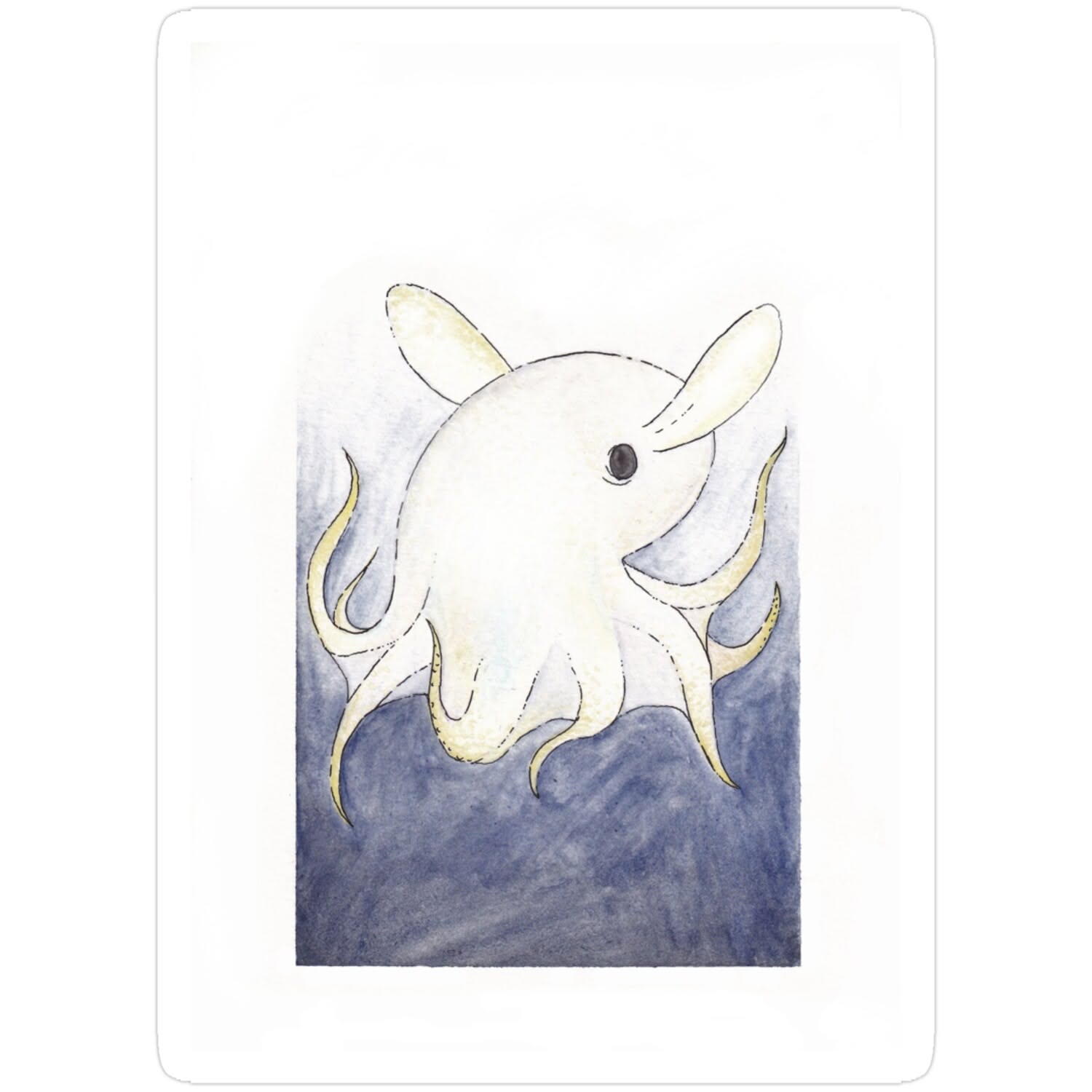
What is a dumbo octopus?
Dumbo octopuses are small deep-sea octopuses in the genus Grimpoteuthis, named for their large ear-like fins that resemble Disney's Dumbo elephant character. They live at depths from 400 meters to over 7,000 meters, making them the deepest-living octopus genus. There are approximately 17 known species, all under 20-30 cm typical length though some reach 1. 5 meters.
Flying Through 7,000 Meters of Darkness
Seven thousand meters below the ocean surface, in absolute darkness with 700 atmospheres of pressure, a small animal flaps its way through the water. Two large ear-like fins beat gently on either side of its round body. Eight webbed arms pump rhythmically below. Its translucent pink skin glows faintly in the submarine's lights.
This is a dumbo octopus, named for its resemblance to Disney's flying elephant, and it lives deeper than any other octopus species on Earth.
The Animal
Dumbo octopuses (genus Grimpoteuthis) are small deep-sea octopuses with distinctive features.
Physical characteristics:
- Length: typically 20-30 cm, some species up to 1.5 m
- Body: rounded, bell-like
- Fins: two large lateral fins resembling elephant ears
- Arms: eight, with extensive webbing
- Skin: translucent pink, white, or reddish
- Eyes: large, adapted to dim light
Named for Dumbo:
The common name references Walt Disney's 1941 animated film "Dumbo" about a flying elephant with oversized ears. The octopus's large fins and apparent "flying" motion through water inspired the name.
Depth Records
Dumbo octopuses hold the depth record for octopus species.
Typical range:
400-5,000 meters
Record deepest sighting:
6,957 meters off Java, Indonesia (2020), confirmed via deep-sea vehicle footage.
For perspective:
- Olympic swimming pool: 3 m deep
- Great Barrier Reef: maximum 35 m
- Typical SCUBA limit: 30 m
- Open-ocean diving records: ~200 m
- Continental shelf edge: 200 m
- Typical abyssal plain: 3,000-6,000 m
- Mariana Trench deepest: 11,034 m
- Dumbo octopus deepest: 6,957 m
What extreme depth means:
At 7,000 meters depth:
- Water pressure: 700 atmospheres (crushing force)
- Temperature: 2-4°C (just above freezing)
- Light: zero natural light
- Dissolved oxygen: very low
- Food density: extremely sparse
Dumbo octopuses thrive in conditions that would kill nearly any surface-adapted animal.
Swimming Style
Dumbo octopuses swim unlike any other octopus.
The wing-fin combination:
Two large lateral fins flap on either side of the body, driving the animal forward. Simultaneously, webbed arms pump water to provide additional thrust.
Speed:
Dumbo octopuses are slow, typically a few centimeters per second. They are not built for pursuit. They rely on deep-sea patience.
Maneuverability:
Despite slow speed, dumbo octopuses can:
- Hover in place indefinitely
- Turn sharply
- Reverse direction
- Rise or descend precisely
- Stop instantly
The bell position:
Some species can spread their webbed arms wide and pulse them like a jellyfish bell, producing additional propulsion. This is an alternative swimming mode.
Contrast with other octopuses:
Shallow-water octopuses primarily jet-propel through water by squeezing their bodies and expelling water through a funnel. Dumbo octopuses use minimal jet propulsion. Their fin-and-arm approach is energy-efficient for the deep sea where every calorie matters.
Feeding
Dumbo octopuses eat slow-moving deep-sea prey.
Prey:
- Worms
- Crustaceans (amphipods, isopods, copepods)
- Sea cucumbers
- Small bivalves
- Deep-sea snails
- Occasional dead organic matter
Feeding method:
Unlike shallow-water octopuses with their powerful beaks, dumbo octopuses swallow prey whole:
- Detect prey (via sight or touch)
- Drop down onto it from above
- Wrap arms/webbing around prey
- Swallow or engulf whole
- Digest slowly over hours to days
Their reduced beak:
Dumbo octopuses have evolved reduced beaks and radulae (tongue-like structures) compared to other octopuses. They rely less on tearing prey apart; they just swallow what fits.
Food scarcity:
Deep-sea food is rare. Organic matter falling from surface waters is the primary food source. Dumbo octopuses likely eat only occasionally, perhaps once every few days to weeks.
Species Diversity
Approximately 17 known species of dumbo octopus exist.
Notable species:
- Grimpoteuthis discoveryi: found in North Atlantic
- Grimpoteuthis abyssicola: deepest-living species
- Grimpoteuthis boylei: North Atlantic
- Grimpoteuthis greeni: New Zealand
- Grimpoteuthis mawsoni: Antarctic waters
Distribution:
Dumbo octopuses live in all oceans:
- All Pacific Ocean (especially deep trenches)
- Atlantic Ocean (both hemispheres)
- Indian Ocean
- Antarctic waters
- Arctic waters
Why diverse:
Different species have evolved to exploit different deep-sea conditions:
- Some prefer steep continental slopes
- Others live on abyssal plains
- Some specialize in seamounts
- A few inhabit trenches
Reproduction
Dumbo octopus reproduction is poorly understood.
What is known:
- Mode: likely continuous reproduction (eggs at various developmental stages simultaneously)
- Egg size: relatively large (5-8 mm)
- Egg laying: on hard substrates in deep water
- Brooding: limited evidence, some species may brood, others release eggs
Unusual aspect:
Unlike most octopus species that reproduce once and die, some dumbo octopus females appear to produce eggs continuously throughout life. This matches their long-lived, slow-reproduction deep-sea lifestyle.
Young:
Newly-hatched dumbo octopuses resemble adults at reduced scale. Unlike many marine animals, they don't have a planktonic larval stage in surface waters; they remain deep throughout their lives.
Adaptations
Living at extreme depth requires specialized biology.
Pressure tolerance:
- Soft, flexible body without rigid structures that could crush
- Specialized cellular membranes that maintain function at pressure
- Modified proteins that fold correctly under deep-sea conditions
Cold tolerance:
- Modified cellular enzymes work at 2-4°C
- Lipid-based cell membranes remain fluid at low temperatures
- Slow metabolism reduces enzyme demands
Oxygen efficiency:
- Copper-based blood (hemocyanin) efficient at low temperatures
- Slow circulatory system matches reduced activity
- Efficient oxygen extraction from sparse deep-sea water
Energy economy:
- Low metabolic rate
- Minimal activity except during hunting
- Can survive long periods without eating
- Store energy efficiently
Discovery
Dumbo octopuses have been known to science for over a century but remained obscure until recently.
First description:
The genus Grimpoteuthis was established in 1932, though specimens had been collected since the 19th century.
Modern observations:
Deep-sea submersibles began regularly encountering dumbo octopuses starting in the 1960s. Research dives by the Woods Hole Oceanographic Institution and similar organizations documented their behavior.
Video footage:
Beginning in the 1990s, remote-operated vehicles (ROVs) started capturing high-quality video of dumbo octopuses in their natural habitat. The resulting footage brought public attention to the species.
Viral moments:
Specific dumbo octopus videos have become internet viral phenomena:
- A 2005 NOAA expedition video showing a dumbo swimming gracefully
- A 2016 deep-sea expedition filming a dumbo approaching the camera
- Multiple 2020-2023 observations during Schmidt Ocean Institute expeditions
Cultural Popularity
Dumbo octopuses have become social media favorites.
Why people love them:
Several features contribute to their mass appeal:
- Neotenic features: large head, prominent "ears," small mouth, features associated with infant mammals
- Graceful movement: slow, gentle swimming rather than quick or aggressive
- Disney reference: the Dumbo name creates instant cultural connection
- Deep-sea mystery: they live somewhere most humans will never see
- Pink color: rare and appealing
- Solitary nature: emotional narrative of isolation
Educational value:
Dumbo octopuses have become "charismatic ambassadors" for deep-sea conservation. Their appeal helps raise awareness about:
- Deep-sea ecosystems
- Ocean exploration
- Climate change impacts on deep oceans
- Deep-sea mining threats
- Marine conservation funding
Marine biologists have documented that public interest in dumbo octopuses often translates into support for ocean research and conservation.
Conservation
Deep-sea species face specific conservation challenges.
Current status:
No formal conservation assessment exists for most dumbo octopus species. They are considered Data Deficient.
Threats:
- Deep-sea mining: proposed operations would damage habitat
- Bottom trawling: damages seafloor ecosystems
- Climate change: ocean chemistry changes affect deep waters too
- Plastic pollution: microplastics reach deep ocean depths
- Mining-related sediment plumes: cloud water at depth
Particularly vulnerable because:
- Slow reproduction means slow recovery
- Habitat cannot be easily restored
- No population baseline data exists
- Many species known from single specimens
Protection challenges:
- Deep-sea protection requires international cooperation
- Most species are unknown to the general public
- Economic interests in deep-sea mining are significant
- Monitoring compliance is difficult
What Dumbo Octopuses Teach Us
The deep sea is vast, mostly unexplored, and contains creatures adapted to conditions that would kill surface organisms.
Dumbo octopuses are perhaps the most photogenic deep-sea animals. Their Disney-inspired appearance and graceful movement have made them cultural ambassadors for a habitat most humans will never see.
But they represent something more: evidence that octopus intelligence and adaptability has successfully colonized even the most extreme ocean environments. Octopuses appeared in shallow waters 300 million years ago. Since then, their lineage has radiated into every ocean habitat, from tropical reefs to Arctic seas to the deepest ocean depths where dumbo octopuses now live.
Each dumbo octopus floating through darkness 7,000 meters down is part of a lineage success story. Their ancestors figured out how to adapt to pressure that should have been impossible. They figured out how to find prey in near-empty waters. They figured out how to reproduce in conditions that prevent most reproduction.
And they did it with a body plan that still looks recognizable as "octopus" eight arms, a round head, the chromatophores that let them change color, the tentacles. They are clearly octopuses, despite their unusual fins and swimming style. Evolution took the octopus template and fitted it for deep-sea life.
If evolution hadn't produced dumbo octopuses, the deep ocean would not have had the animal that now swims there. And the deep ocean, covering two-thirds of Earth's volume, would be incomplete.
Cirrate Octopuses: An Evolutionary Lineage
The dumbo octopus is a member of the suborder Cirrata (cirrate octopuses), a group distinguished from the more familiar incirrate octopuses by the presence of fin-like ear flaps (cirri) and the lack of an ink sac. Our research team finds this distinction taxonomically important because cirrate octopuses represent a deep evolutionary split from typical shallow-water octopuses.
"Cirrate octopuses are not just incirrates that live deeper. They are a morphologically and behaviorally distinct group that diverged at least 75 million years ago. They have been evolving in parallel with typical octopuses for nearly as long as mammals have been diverging from reptiles. Treating them as variants of the common octopus is taxonomically inaccurate." - Dr. Michael Vecchione, Smithsonian National Museum of Natural History [1]
Cirrate Octopus Species Highlights
| Species | Habitat depth | Notable feature |
|---|---|---|
| Grimpoteuthis spp. | 400-7,000 m | The classic "dumbo octopus" |
| Opisthoteuthis californiana | 500-1,100 m | Pacific flapjack octopus |
| Cirroctopus glacialis | Antarctic, 200-2,000 m | Cold-water specialist |
| Stauroteuthis syrtensis | 500-4,000 m | Bioluminescent suckers |
| Luteuthis dentatus | 2,000-3,000 m | Very rarely observed |
| Vampyroteuthis infernalis | 600-1,200 m | Sister group (vampire squid) |
The bioluminescence in Stauroteuthis is particularly notable because it is the only octopus with glowing suckers. The suckers have lost their attachment function entirely and serve as photophores for luring small prey. This is a complete repurposing of the basic octopus anatomy.
Life in the Hadal Zone
Dumbo octopuses have been filmed at 7,000 meters depth, placing them among the deepest-living cephalopods known. At these depths, water pressure exceeds 700 atmospheres and temperatures hover near 2 C. The animals must also contend with extreme food scarcity, since very little organic matter reaches these depths from the productive surface waters above.
Our research team has followed the emerging literature on hadal ecosystem biology. Recent deep-sea expeditions using high-resolution ROVs and autonomous landers have documented more active biological communities at hadal depths than previously assumed.
"Every expedition that goes below 6,000 meters returns with observations that redefine what we think lives there. The dumbo octopus at 7,000 meters is not the deepest cephalopod species, but it is among the most frequently filmed, and each sighting teaches us something about how animals of this body plan survive at these pressures." - Dr. Alan Jamieson, Newcastle University, deep-sea ecologist [2]
Depth Records for Selected Cephalopods
| Species | Maximum documented depth | Method of observation |
|---|---|---|
| Dumbo octopus (Grimpoteuthis) | 7,000 m | ROV footage |
| Giant squid | 900 m | Camera trap |
| Vampire squid | 1,500 m | Submersible |
| Atlantic squid (various) | 2,000 m | Trawl recovery |
| Colossal squid | 2,200 m | Adult specimen depth estimates |
| Cirrate octopus (some) | 7,000+ m | ROV footage |
| Glass squid | 1,500 m | Camera trap |
Notable Research Findings
- Dumbo octopuses swim by pulsing water with their parachute-like arms and webbing, aided by the ear-flap fins. This swimming mode is slower but more energetically efficient than jet propulsion at the low temperatures and sparse food of the deep sea.
- Unlike most octopuses, dumbo octopuses retain internal shell remnants - a cartilaginous U-shaped structure in the mantle that provides support for the fins. This ancestral feature has been lost in most other octopus lineages.
- The "ears" of dumbo octopuses are hydrodynamic fins that can rotate in multiple directions. They are more similar to pectoral fins in fish than to the short swimming fins on squid.
- Dumbo octopuses lay relatively few large eggs, which they attach to rocks or coral structures. Embryonic development takes several years at deep-sea temperatures - one of the longest incubation periods documented in any cephalopod.
- Our research team notes that despite their wide distribution, dumbo octopuses have been filmed alive only a few dozen times in total across all deep-sea expeditions combined. Most of what we know about them comes from dead specimens recovered from deep-sea trawls.
- There are at least 17 described species of Grimpoteuthis, all loosely called "dumbo octopuses" in popular discourse. They are distributed in deep waters around the world, from the Gulf of Maine to New Zealand to the Indian Ocean.
- The name "dumbo octopus" comes from the 1941 Disney film Dumbo, which featured a flying baby elephant with large ears. The resemblance between the cartoon character and the octopus's fin-flapping swimming style has driven the common name since the first popular-science references in the 1990s.
- Dumbo octopuses have relatively fewer suckers than incirrate octopuses, a consequence of having simpler arms adapted for swimming rather than grasping complex substrates. Their suckers are also arranged in single rows rather than double rows, another cirrate distinguishing feature.
References
[1] Vecchione, M., & Young, R. E. (2008). Cirrate octopuses from the Gulf of Mexico and the Caribbean Sea. Bulletin of Marine Science, 82(1), 161-172.
[2] Jamieson, A. J. (2015). The Hadal Zone: Life in the Deepest Oceans. Cambridge University Press.
[3] Collins, M. A., & Villanueva, R. (2006). Taxonomy, ecology and behaviour of the cirrate octopods. Oceanography and Marine Biology: An Annual Review, 44, 277-322.
[4] Johnsen, S., Balser, E. J., & Fisher, E. C. (1999). Bioluminescence in the deep-sea cirrate octopod Stauroteuthis syrtensis. Biological Bulletin, 197(1), 26-39.
Related Articles
- Giant Squid: The Real Kraken
- Octopus Intelligence: The Smartest Invertebrates
- Anglerfish: The Deep Sea Predator With a Glowing Lure
Frequently Asked Questions
What is a dumbo octopus?
Dumbo octopuses are small deep-sea octopuses in the genus Grimpoteuthis, named for their large ear-like fins that resemble Disney’s Dumbo elephant character. They live at depths from 400 meters to over 7,000 meters, making them the deepest-living octopus genus. There are approximately 17 known species, all under 20-30 cm typical length though some reach 1.5 meters. They swim by flapping their fins like bird wings combined with pumping their webbed arms.
Unlike shallow-water octopuses, dumbo octopuses live solitary lives in absolute darkness at extreme pressure. They were first described in 1997 but have appeared in deep-sea exploration footage since the 1960s. Their distinctive appearance - rounded translucent body with two large flapping fins - makes them one of the most recognizable deep-sea creatures and popular in marine biology education.
They remain poorly understood because direct observation requires expensive submersible missions to great depths.
How deep do dumbo octopuses live?
Dumbo octopuses live at depths ranging from 400 meters to 7,000 meters, with the record deepest sighting at 6,957 meters off Java, Indonesia in 2020. This makes them by far the deepest-living octopus group on Earth. At 7,000 meters, water pressure exceeds 700 atmospheres - 700 times greater than surface pressure, equivalent to stacking 7 kilometers of water vertically above the animal.
Temperatures at these depths hover just above freezing (2-4 degrees Celsius). Sunlight never reaches them. Despite these extreme conditions, dumbo octopuses thrive and reproduce at these depths. Their soft, flexible bodies withstand pressure that would crush rigid structures. They have specialized cellular chemistry that maintains function in extreme cold and pressure.
Their metabolism runs very slowly, allowing survival on the minimal food available in deep oceans. Studies of dumbo octopuses are transforming our understanding of what deep-sea life can tolerate - their survival at 7,000 meters suggests octopus species could potentially inhabit even the Mariana Trench (11,000 meters), though this has not been confirmed.
How do dumbo octopuses swim?
Dumbo octopuses have a unique swimming style using two large ear-like fins that they flap like wings, combined with pumping their webbed arms. This is completely different from shallow-water octopuses that swim primarily by jet propulsion (squeezing water through their funnel). Their bird-like wing flapping allows graceful, controlled movement in three dimensions.
The webbed arms can also be deployed as a bell-like structure that pumps water for additional propulsion. In some species, the webbing between arms is so extensive that they resemble jellyfish when viewed from certain angles. Their swimming is much slower than active octopuses - typically just a few centimeters per second. This slow pace suits their deep-sea lifestyle where food is scarce and high-speed pursuit is unnecessary.
They can hover, turn precisely, reverse direction, and rise or descend at will. The combination of fin flapping and arm pumping gives them unusual maneuverability for such a simple body plan. Their graceful movement is one reason they’ve become popular in deep-sea documentaries.
What do dumbo octopuses eat?
Dumbo octopuses eat slow-moving deep-sea prey including worms, crustaceans, sea cucumbers, and small bivalves. Unlike shallow-water octopuses that use their beaks to tear prey apart, dumbo octopuses swallow their prey whole - their beak and radula are reduced, reflecting adaptation to eating whatever is available in food-scarce deep waters. They’re thought to ambush prey that crawls across the seafloor or drifts in deep currents.
Their swimming style allows them to drop onto prey from above or hover over it while engulfing it with their webbed arms. In some species, the entire meal consists of the prey being wrapped in the extensive arm webbing and digested slowly over hours or days. Their digestive systems are adapted for low-quality, intermittent meals - deep-sea prey is rare and usually small.
Research on dumbo octopus stomach contents has revealed they eat whatever they can find, from small crustaceans to sea cucumbers many times their body volume. Adults appear to eat only occasionally, matching their low-metabolism lifestyle.
Why are dumbo octopuses so cute?
Dumbo octopuses have several features that humans find appealing: large rounded heads with small mouths, prominent ear-like fins that resemble Disney character features, graceful slow movements, and large proportional eyes. These traits match what psychologists call ‘neoteny’ - features typically associated with infant mammals that trigger protective/affectionate responses in humans.
The ear-fins specifically resemble Dumbo the flying elephant from the 1941 Disney animated film, creating an immediate cultural reference that makes them memorable. Their slow, deliberate swimming seems playful rather than threatening. Their translucent pink or white skin color appears soft and delicate. Their apparent solitude in vast deep ocean darkness creates an emotional narrative - they seem to need protection or companionship.
Social media has amplified these perceptions through viral footage of dumbo octopuses in various underwater expeditions. Marine biologist Craig McClain has written about how dumbo octopuses have become ‘charismatic ambassadors’ for deep-sea conservation - their appeal helps people care about a habitat most never see or think about.