
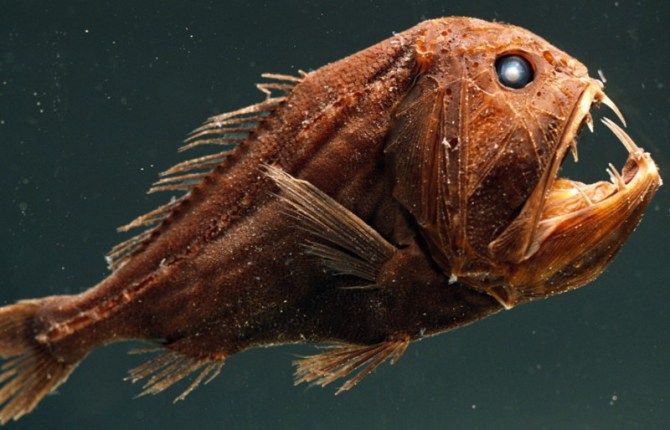
What is a fangtooth fish?
Fangtooth fish (Anoplogaster cornuta) are deep-sea predators with proportionally the largest teeth of any vertebrate animal. Their fangs are so large relative to body size that the fish cannot close its mouth completely - special sockets in its skull accommodate the massive teeth when the mouth is closed. Adults reach 16-18 cm in length but have fangs 4+ cm long.
Skull Sockets for Fangs
A fangtooth fish is 16 centimeters long. Its fangs are 4 centimeters long. These teeth are so enormous relative to the fish's body that they don't fit inside the mouth when closed, the fish has evolved special sockets in its skull to accommodate the massive teeth.
This is the fangtooth (Anoplogaster cornuta), which holds the record for largest teeth proportional to body size in any vertebrate. In the food-scarce deep sea, every hunt must succeed, and fangtooth evolution has produced teeth that make escape essentially impossible.
Size and Appearance
Fangtooth fish are compact deep-sea predators.
Dimensions:
- Length: 16-18 cm for adults
- Weight: up to 340 grams
- Fang length: 4+ cm (up to 25% of body length)
- Body: dark brown/black
- Scales: ornate, covering most surfaces
Two species:
- Common fangtooth (A. cornuta): wider distribution, more studied
- Shorthorn fangtooth (A. brachycephala): slightly different body shape
The Record Teeth
Fangtooth have proportionally the largest teeth in the vertebrate kingdom.
Proportions:
The fangs take up significant portion of body:
- 25% of body length
- Visible even when mouth closed
- Don't fit inside mouth normally
- Require special skull accommodations
Skull sockets:
Evolution solved the big-tooth problem with:
- Specialized sockets in upper jaw (for lower fangs)
- Complementary sockets in lower jaw (for upper fangs)
- Teeth interlock when mouth closes
- Teeth protrude outside when mouth opens
Shape:
- Slightly curved backwards
- Sharp at tips
- Strong at bases
- Perfect for piercing and holding
Replacement:
Like other fish, fangtooth continuously replace teeth throughout life. New teeth grow behind existing ones and move forward as older teeth fall out.
Why Such Big Teeth
Deep-sea hunting drives extreme tooth evolution.
The deep-sea problem:
- Food extremely scarce
- Prey scattered across vast water columns
- Hours to days between potential meals
- Few second chances if prey escapes
Fangtooth solution:
- Maximum tooth length for minimum prey escape chances
- Strike once, hold on, consume
- No need for fast, repeated strikes
- Patience combined with decisive capture
Mouth flexibility:
To take large prey:
- Mouth opens nearly 180 degrees
- Jaws unhinge significantly
- Can swallow prey larger than head
- Teeth prevent escape during consumption
Result:
Each successful hunt provides substantial nutrition, offsetting long fasting periods between meals.
Deep-Sea Hunting
Fangtooth fish are patient ambush predators.
Hunting strategy:
- Wait: motionless in water column
- Sense: detect prey through multiple senses
- Orient: turn toward prey
- Strike: rapid lunge with mouth open
- Capture: fangs pierce and hold
- Consume: swallow whole, even if large
Prey:
- Small fish (lanternfish common)
- Squid
- Crustaceans
- Shrimp
Size of prey:
Fangtooth can handle surprisingly large prey:
- Prey up to 50% of body size
- Occasionally larger
- Expandable stomach accommodates big meals
Frequency:
- May eat only weekly or monthly
- Long fasts between successful hunts
- Stored energy sustains them
Sensing in Darkness
Fangtooth have multiple senses for deep-sea life.
Large eyes:
- Detect bioluminescence
- Sensitive to dim light
- Adapt to near-darkness
- Can see moving prey silhouettes
Lateral line:
- Runs along body
- Detects water pressure changes
- Senses prey movement vibrations
- Works in complete darkness
Chemical sensing:
- Detects dissolved chemicals
- Smells prey from distance
- Follows scent plumes
- Complements other senses
Sound detection:
- Internal ear structures
- Detects subtle vibrations
- Part of multisensory hunting package
Life Cycle
Fangtooth reproduction follows deep-sea patterns.
Reproduction:
- Details poorly understood
- External fertilization probably
- Eggs released into water column
- Drift with currents
Development:
- Larvae spend early stage shallower (200-1,000m)
- Gradual descent as they mature
- Adults live at maximum depths
- Juveniles look different from adults
Juvenile appearance:
- Smaller fangs (relative to body)
- Lighter coloration
- Different body proportions
- Gradually transform to adult form
Lifespan:
Unknown but likely 5-10+ years in wild.
Where They Live
Fangtooth distribution is global.
Range:
- All major oceans
- Tropical to temperate latitudes
- Avoid polar regions
- Most widespread deep-sea fish
Depth:
- 500-5,000 meters
- Peak abundance: 1,500-2,500 meters
- Juveniles shallower
- Adults deeper
Habitat:
- Open ocean water column
- Not bottom-dwelling
- Follow specific depth preferences
- Isolated individuals mostly
Physical Adaptations
Fangtooth biology serves deep-sea life.
Pressure tolerance:
- Soft tissues designed for high pressure
- No swim bladder (would collapse)
- Near-neutral buoyancy through fat
- Stable at target depths
Cold tolerance:
- Adapted to 2-8°C water
- Slow metabolism
- Efficient energy use
- Antifreeze-like tissue chemistry
Oxygen use:
- Low oxygen requirements
- Efficient gas exchange
- Slow breathing
- Minimal energy expenditure
Appearance in Photos
Fangtooth fish appear distorted in surface photos.
Surface pressure change:
Like most deep-sea fish:
- Tissues expand during rapid ascent
- Body distorts
- Eyes may bulge
- Coloration changes
What's visible in photos:
- Even more intimidating appearance than living
- Massive teeth emphasized
- Dark coloration dramatic
- Scales stand out
The living fish:
Underwater, fangtooth look:
- More compact
- Teeth less prominent (relative)
- Normal coloration
- Unremarkable for deep-sea fish
Research and Study
Fangtooth are subjects of deep-sea research.
Research areas:
- Deep-sea fish biology
- Predator-prey dynamics
- Evolution of extreme adaptations
- Ocean food webs
- Global distribution patterns
Research challenges:
- Difficult to observe alive
- Deep habitat limits study
- Specimens die at surface
- Laboratory conditions don't replicate habitat
Notable discoveries:
- Recent genetic studies clarified species differences
- Distribution mapping through deep trawls
- Sensory biology research
- Teeth mechanics studies
Conservation
Fangtooth status is largely unstudied.
IUCN status:
Not formally assessed.
Population:
- Relatively common in suitable habitat
- Widespread distribution
- Not targeted by fisheries
- Occasional bycatch
Threats:
- Deep-sea trawling (impact unknown)
- Climate change affecting deep waters
- Deep-sea mining proposals
- Pollution reaching deep ocean
Protection:
- No specific protections
- Benefits from general deep-sea research
- Environmental assessments rarely consider them
- Deep-sea protection movement slowly emerging
Cultural Significance
Fangtooth have appeared in popular culture.
Names:
- Fangtooth: most common
- Ogrefish: reference to appearance
- Common fangtooth: scientific shorthand
Appearances:
- Nature documentaries
- "Strange deep-sea animals" media
- Popular science articles
- Educational materials
Public perception:
- Recognized as "scary" deep-sea fish
- Often compared to mythical monsters
- Used as example of deep-sea strangeness
- Appears in "ugliest" or "scariest" lists
Why Fangtooth Matter
Fangtooth fish demonstrate evolution's extreme solutions.
They represent:
- Proportional gigantism in specific features (teeth)
- Solutions to deep-sea food scarcity
- Patience and patience-based predation
- Wide geographic distribution combined with specialized niche
Their teeth, so large they required special skull sockets to evolve, are monuments to what natural selection can produce when survival pressure concentrates on specific traits.
In the deep ocean, the fangtooth continues waiting. Motionless in dark water kilometers below the surface. Waiting for prey. Waiting for meals that may come weeks or months apart. Equipped with teeth that ensure success when opportunity arrives.
They've been doing this for millions of years. They'll continue doing it, barring dramatic deep-sea changes, for millions more. Most humans will never see a living fangtooth. But across the world's oceans, thousands or millions of them are currently hunting in darkness, their record teeth ready for the next meal that drifts within striking distance.
Fangtooth Anatomy and Skull Architecture
Our research team finds the skull adaptation in fangtooth fish (Anoplogaster cornuta) to be one of the most extreme examples of morphological specialization in any vertebrate. The teeth are proportionally so large that ordinary skull closure is physically impossible. Evolution has solved this problem with two pocket-like sockets in the roof of the mouth that accommodate the lower jaw teeth when the mouth closes.
"The fangtooth skull is essentially a case study in dental gigantism. Every structural aspect of the head has been reshaped by the need to accommodate those teeth. The sockets on either side of the brain capsule are one of the most unusual skeletal features in any bony fish." - Dr. Jorgen Nielsen, Natural History Museum of Denmark, who described the skull modifications in detail [1]
Teeth-Body Size Ratios in Fish
| Species | Body length | Tooth length | Ratio |
|---|---|---|---|
| Common fangtooth (Anoplogaster cornuta) | 16-18 cm | 2 cm | 1:8-9 (largest known) |
| Viperfish (Chauliodus sloani) | 30 cm | 3 cm | 1:10 |
| Sabertooth fish (Evermannella indica) | 15 cm | 1.2 cm | 1:12 |
| Barracuda (Sphyraena barracuda) | 150 cm | 1.5 cm | 1:100 |
| Great white shark | 500-600 cm | 6-7 cm | 1:70-85 |
| Piranha | 20-50 cm | 0.4 cm | 1:50-125 |
By this ratio, fangtooths have proportionally the largest teeth of any fish relative to body size.
Ambush Predation in the Deep Sea
Fangtooth fish are ambush predators that hunt by letting prey come to them. They are not fast swimmers. Their metabolism is slow, allowing them to survive long periods between meals - a necessity in the food-poor deep ocean.
"Deep-sea predators face a fundamental economics problem: food is rare, energy is precious, and failed hunts are expensive. The fangtooth has evolved a body plan that commits everything to the single moment of prey capture. The mouth is enormous, the teeth are oversized, the stomach is elastic, and virtually nothing is wasted on features that are not related to eating." - Dr. Paul Yancey, Whitman College, deep-sea fish physiologist [2]
Deep-Sea Fish Adaptations to Food Scarcity
| Adaptation | Function |
|---|---|
| Oversized mouths | Catch prey too big for normal fish |
| Distensible stomachs | Store large meals when available |
| Reduced muscle mass | Lower metabolic costs |
| Slow metabolism | Survive between rare meals |
| Large eyes or lures | Maximize detection of rare prey |
| Long lifespans | Spread reproductive effort across many years |
| Few, large eggs | Each offspring has survival chance |
Notable Research Findings
- Juvenile fangtooth fish look completely different from adults. Early naturalists placed them in a separate genus (Caulolepis) because juveniles lack the characteristic teeth, have different body proportions, and live at shallower depths. The mistake was corrected only in the 1950s.
- Fangtooth fish are distributed throughout tropical and temperate oceans at depths of 200 to 5,000 meters, making them one of the most widespread deep-sea predators.
- The fangtooth feeds primarily on crustaceans (shrimp, copepods) and small fish. Its oversized teeth are effective for catching prey approaching one-third of its own body length.
- Our research team notes that the related deep-sea fish genus Hoplostethus (including orange roughy) has been far more commercially impacted by fishing than Anoplogaster, which is rarely caught in commercial trawls and remains relatively unknown to fishing industries.
- Two species of fangtooth are currently recognized: the common fangtooth (Anoplogaster cornuta) with cosmopolitan distribution, and the shorthorn fangtooth (Anoplogaster brachycera), known only from a handful of specimens from tropical oceans.
- Fangtooth fish perform diel vertical migrations in some ocean regions, rising from deeper daytime habitats to shallower depths at night. This behavior is shared with many deep-sea species and represents part of the "deep scattering layer" visible on sonar.
- Young fangtooth have long spines on their heads that disappear as they mature. These spines were originally thought to belong to a different species, and the juveniles were called Caulolepis longidens until Nielsen's 1973 revision united the species.
Evolutionary Position and Relatives
The fangtooth is a member of the family Anoplogastridae within the order Beryciformes. The Beryciformes are a relatively small group of approximately 200 species that includes pineapplefish, squirrelfish, flashlight fish, and orange roughy. Many beryciforms have distinctive features - bioluminescent organs, large eyes, and unusual body forms - that reflect their evolution in deep-sea and reef environments.
"Beryciforms are a kind of 'transition zone' group between the ray-finned fishes of shallow waters and the highly specialized deep-sea families. They retain some ancestral features while incorporating deep-sea adaptations, making them useful for understanding how fish evolved to colonize the deep ocean." - Dr. William Smith, University of Kansas, ichthyology researcher [5]
Order Beryciformes Representatives
| Family | Example species | Typical habitat |
|---|---|---|
| Anoplogastridae (fangtooth) | Common fangtooth | Deep pelagic, 200-5,000 m |
| Trachichthyidae (roughies) | Orange roughy | Continental slope, 400-1,500 m |
| Anomalopidae (flashlight fish) | Anomalops katoptron | Shallow tropical reefs at night |
| Monocentridae (pineapplefish) | Cleidopus gloriamaris | Reef dwellers |
| Holocentridae (squirrelfish) | Many species | Reef dwellers, nocturnal |
| Berycidae (alfonsinos) | Beryx splendens | Seamounts and slopes |
Deep-Sea Fish Metabolism
Deep-sea fish like the fangtooth typically have metabolic rates 10 to 100 times lower than surface fish of similar size. This is partly due to the cold temperature (1-4 C in deep waters), partly due to reduced oxygen demand, and partly due to energy-efficient tissue composition.
The fangtooth's body contains high concentrations of gelatinous, lipid-rich tissues that reduce overall density and eliminate the need for a gas-filled swim bladder - which would be crushed at depth or require enormous energy to maintain. Instead, buoyancy is managed through tissue composition. This is typical of deep-sea fish.
A typical fangtooth eats perhaps once per week or less. Each meal is relatively large to compensate for the long intervals. The oversized mouth and distensible stomach are adaptations for these feast-and-famine feeding dynamics.
Our research team has compiled representative metabolic rates across fish to show the depth-metabolism relationship. The pattern is clear: deeper species consume proportionally less oxygen per gram of body weight, enabling survival at the low food densities characteristic of the deep ocean.
"We have only just begun to understand how deep-sea fish compensate for their very low energy budgets. The fangtooth and its relatives are living demonstrations of what a vertebrate body can become when freed from the need to move constantly and given the option of waiting for food to come to it." - Dr. Paul Yancey, Whitman College [2]
[5] Smith, W. L., & Wheeler, W. C. (2006). Venom evolution widespread in fishes: A phylogenetic road map for the bioprospecting of piscine venoms. Journal of Heredity, 97(3), 206-217.
References
[1] Nielsen, J. G. (1973). A review of the genus Anoplogaster (Pisces, Trachichthyidae). Steenstrupia, 3, 85-98.
[2] Yancey, P. H. (2005). Organic osmolytes as compatible, metabolic and counteracting cytoprotectants in high osmolarity and other stresses. Journal of Experimental Biology, 208(15), 2819-2830.
[3] Kotlyar, A. N. (1996). Beryciform Fishes of the World Ocean. VNIRO Publishing.
[4] Pietsch, T. W., & Van Duzer, J. P. (1980). Systematics and distribution of ceratioid anglerfishes of the family Melanocetidae. Copeia, 1980(1), 125-144.
Related Articles
- Anglerfish: The Deep Sea Predator With a Glowing Lure
- Vampire Squid From Hell
- Blobfish: The World's Ugliest Animal
Frequently Asked Questions
What is a fangtooth fish?
Fangtooth fish (Anoplogaster cornuta) are deep-sea predators with proportionally the largest teeth of any vertebrate animal. Their fangs are so large relative to body size that the fish cannot close its mouth completely - special sockets in its skull accommodate the massive teeth when the mouth is closed. Adults reach 16-18 cm in length but have fangs 4+ cm long. Their bodies are dark brown to black with ornate scales covering most surfaces.
They live in deep ocean waters (500-5,000 meters depth) globally, making them one of the most widely distributed deep-sea fish. Despite their intimidating appearance, they are small, slow-moving predators that hunt smaller deep-sea organisms. Their appearance has earned them nicknames like ‘ogrefish’ in various cultures. Two species exist: the common fangtooth (A. cornuta) and the shorthorn fangtooth (A. brachycephala).
Why are fangtooth fish teeth so big?
Fangtooth teeth are disproportionately large because deep-sea hunting requires catching prey on first contact - there are few second chances at depth. The deep ocean has sparse food, so any prey encountered must be captured immediately. The long fangs maximize the probability that a strike will pierce and hold prey. Smaller teeth would give prey better chances to escape.
The fangs are slightly curved backwards, making escape impossible once prey is pierced. Their mouth opens extremely wide (nearly 180 degrees), allowing them to take prey larger than their own head. The specialized skull sockets that accommodate the fangs when closed show how evolution solved the anatomical problem of having such large teeth. Fangtooth prey includes fish, squid, and crustaceans - often quite large relative to the fangtooth’s size.
Without their massive fangs, they could not reliably capture these meals in the food-scarce deep sea.
How do fangtooth fish find prey in darkness?
Fangtooth fish locate prey in deep-sea darkness using multiple specialized sensory systems. Their large eyes are highly sensitive to bioluminescent light - many deep-sea creatures produce their own light, which fangtooth can detect at significant distances. They have acute lateral lines (water pressure sensors) that detect movement even in complete darkness. Their chemical sensors help track prey by smell through water currents.
Some evidence suggests they may use electroreception (detecting electrical fields from prey), though this is less well documented. Their hunting strategy often involves waiting motionless in the water column, detecting prey by the bioluminescent flashes of approaching lanternfish or small squid, then striking with their enormous fangs.
The slow metabolism and extreme patience of deep-sea life means fangtooth may go weeks or months between successful hunts, but each catch can provide substantial nutrition due to their ability to eat prey larger than themselves.
Are fangtooth fish dangerous?
Fangtooth fish pose no danger to humans. They are small (16-18 cm), live at depths humans cannot reach without submersibles, and have no aggressive behavior toward anything except their specific deep-sea prey. Despite their intimidating appearance, they are essentially harmless beyond their tiny prey range.
Their fame comes from photographs showing the distorted fish after being brought to surface during trawling - like other deep-sea fish, they look weirder in photos than they do alive in their habitat. No human has ever been injured by a fangtooth fish, and their habitat depths make any encounter essentially impossible outside of research operations.
They are occasionally caught as bycatch in deep-sea commercial fisheries, but no commercial fishery specifically targets them. Aquariums cannot keep them alive - surface pressure kills them within hours. Their conservation status is not assessed formally, but deep-sea fishing activities may threaten local populations. The fearsome appearance is purely evolutionary adaptation to deep-sea hunting needs, not any aggressive intent toward humans.
Where do fangtooth fish live?
Fangtooth fish live at deep ocean depths worldwide, making them one of the most geographically widespread deep-sea species. Their range includes the Atlantic, Pacific, and Indian Oceans at tropical, subtropical, and temperate latitudes. They inhabit depths of 500-5,000 meters, with peak abundance around 1,500-2,500 meters.
Their vertical distribution varies by life stage - young fangtooth fish may stay shallower (200-1,000 meters) while adults descend deeper. They are mesopelagic to bathypelagic fish, spending their entire lives in the open water column (not on the seafloor). Their widespread distribution may reflect their ability to tolerate a wide range of deep-sea conditions and their reproductive strategy of releasing eggs that drift with ocean currents.
Fangtooth fish have been collected from waters off every major coastline south of Arctic temperatures. Their populations in specific regions are not well-documented, but they’re considered relatively common in suitable habitat. Climate change affecting deep-water currents may impact their populations, though the deep sea remains poorly studied for population dynamics.