
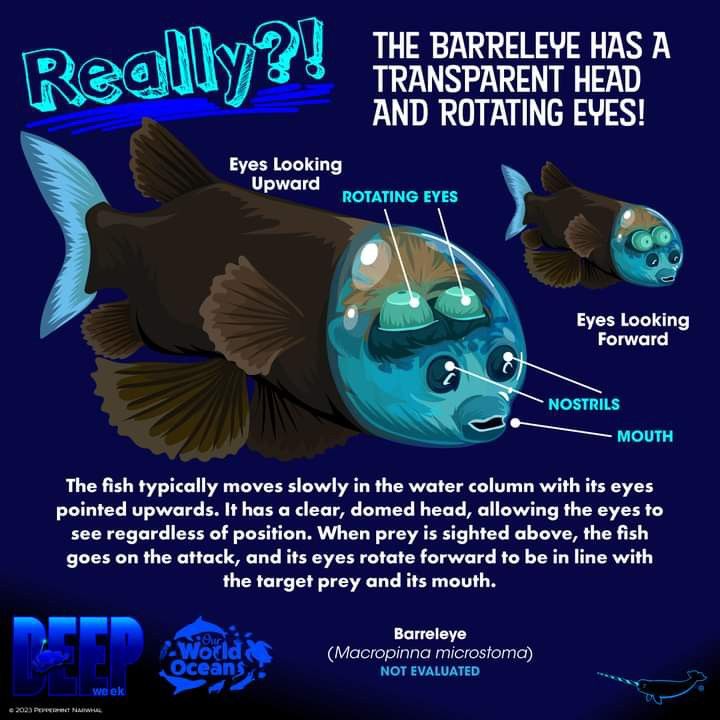
Why is the barreleye fish's head transparent?
The barreleye fish (Macropinna microstoma) has a completely transparent, dome-shaped head that allows its tube-shaped eyes to rotate inside its skull. The transparency protects the extremely sensitive eyes while allowing them freedom to point in different directions. Through the transparent dome, researchers can see the green barrel-shaped eyes pointing either upward (to detect prey silhouetted against the dim upper light).
Eyes That Rotate Inside a Transparent Skull
A small fish hovers in the dim twilight of deep ocean 700 meters below the Pacific surface. Its body is normal-fish-shaped. But its entire head is transparent, a clear dome through which you can see two large green barrel-shaped eyes. As you watch, the eyes rotate inside the dome. First they point straight up toward whatever faint light remains above.
Then they rotate forward to focus on something ahead. The entire process is visible because there's no skull in the way, just a clear fluid-filled chamber.
This is the barreleye fish (Macropinna microstoma). Its rotating-eye mechanism was unknown to science until 2009.
The Animal
Barreleye fish are small deep-sea fish with remarkable anatomy.
Physical features:
- Length: 15 cm typical
- Body: small, flattened, normal fish shape
- Head: completely transparent dome
- Eyes: barrel-shaped, green, rotate within head
- Mouth: tiny (hence scientific name "microstoma" = small mouth)
- Fins: standard fish arrangement
The transparency:
The dome that forms the head is:
- Clear and see-through
- Fluid-filled inside
- Flexible
- Protective of internal structures
The Rotating Eyes
Barreleye eyes are among nature's strangest designs.
Eye structure:
- Large, barrel or tube-shaped
- Green colored (from pigments for detecting specific light)
- Significantly bigger than typical fish eyes
- Highly light-sensitive
The rotation:
- Eyes can rotate within the transparent dome
- Point upward: spot prey against surface light
- Point forward: focus on prey ahead during attack
- Various positions between
- Happens smoothly and rapidly
Why this matters:
For hunting, barreleye fish need:
- Detect distant prey (eyes up)
- Focus close for capture (eyes forward)
- React quickly (rapid rotation)
- Avoid moving the whole body (energy efficient)
The rotating eyes solve all these challenges with one mechanism.
The 2009 Discovery
How barreleye eyes worked remained mysterious for nearly 80 years.
Scientific knowledge before 2009:
Barreleye fish had been:
- First described in 1939
- Known from dead specimens
- Photographed many times
- Textbook subjects
But something was missing:
Researchers couldn't determine:
- Did the eyes rotate?
- How did they see prey at close range?
- Why the transparent head?
- Complete picture of hunting
The 2009 breakthrough:
Researchers Bruce Robison and Kim Reisenbichler at Monterey Bay Aquarium Research Institute (MBARI):
- Used remote-operated vehicles (ROVs) at barreleye depths
- Observed live specimens in natural habitat
- Filmed eye rotation for first time
- Published results revealing the rotating eyes
Why it took so long:
- Barreleye fish die quickly at surface (pressure change)
- Dead specimens can't show living eye movement
- Previous photographs showed still images only
- Behavioral observation required advanced equipment
The 2009 observations changed textbook understanding of the species.
The Transparent Dome
Barreleye heads solve multiple biological problems.
Why transparent:
- Protects eyes: from damage while allowing light
- Reduces weight: compared to solid skull
- Provides space: for rotating eyes
- Maintains shape: flexibility allows rotation
What's inside:
- Fluid-filled chamber
- Two large rotating eyes
- Light-sensitive tissue
- Optical nerves to brain
- Support structures
The olfactory organs:
What appear to be "eyes" in photos of barreleye fish are actually:
- Nostrils/olfactory organs
- On the outside of the dome
- Used for smell
- Completely separate from the actual eyes
Many early photos mistook these for eyes, the real eyes are inside the dome.
Hunting Strategy
Barreleye fish have unusual feeding behaviors.
Kleptoparasitism:
Their most remarkable habit is stealing food from jellyfish:
- Approach siphonophore jellyfish
- Siphonophore has captured prey in tentacles
- Barreleye positions near the captured prey
- Steals the prey without being stung
- Transparent head protects eyes from stings
Why it works:
The transparent head provides:
- No traditional bony protection around eyes
- But complete physical protection
- Stinging cells can't penetrate tough tissue
- Fish eats safely
Other hunting:
Barreleye fish also:
- Hunt small fish directly
- Eat squid and crustaceans
- Detect prey silhouetted above
- Approach stealthily
Feeding mechanics:
- Small mouth limits prey size
- Typically eat animals under 5 cm
- Suck prey in through specialized jaw
- Swallow whole
Where They Live
Barreleye fish have a Pacific-restricted distribution.
Range:
- Pacific Coast of North America (most common observations)
- Monterey Bay, California (best-studied population)
- Alaskan waters
- Japanese Pacific coast
- Various other Pacific locations
Depth:
- 400-800 meters typical
- Mesopelagic zone
- Where faint sunlight still reaches
- Supports their upward-hunting strategy
Habitat preferences:
- Moderate currents
- Presence of siphonophore jellyfish (for food stealing)
- Stable temperature
- Appropriate depth light levels
Why mesopelagic:
Unlike many deep-sea fish that live in total darkness, barreleyes need:
- Some filtered sunlight from above
- Silhouette prey against this light
- Visible prey to hunt effectively
- Therefore shallower than abyss species
Biology
Barreleye fish have specialized physiology.
Eyes:
- Extremely light-sensitive
- Green-colored photoreceptors (for specific wavelengths)
- Large rod cells
- Effective in dim conditions
Swimming:
- Slow and deliberate
- Energy-efficient
- Low metabolism
- Suits deep-sea lifestyle
Pressure adaptation:
- Soft tissues (including transparent head)
- No swim bladder
- Near-neutral buoyancy
- Standard deep-sea pressure tolerance
Body design:
- Normal fish body (compared to head)
- Standard fin arrangement
- Sensory organs beyond eyes (lateral line, etc.)
- Breathing and feeding systems typical
Discovery History
Barreleye fish have been known to science for 80+ years.
1939: First description:
- Dead specimen examined
- Morphology documented
- Species name assigned
- Transparent head noted
1940s-1970s:
- Occasional specimens in deep-sea nets
- Photos of preserved specimens
- Eye structure studied
- Behavior unknown
1980s-2000s:
- Improved deep-sea research capabilities
- Occasional ROV observations
- Understanding slowly expanded
- Rotating eyes still unknown
2009:
- MBARI researchers finally observed rotating eyes
- First video footage
- Textbook understanding updated
- Viral social media sharing
2010s-present:
- Continued research
- More observations
- Behavior better understood
- Some specimens kept briefly in aquariums
Cultural Impact
Barreleye fish became internet-famous in 2009.
Viral 2009:
The first videos of living barreleyes with rotating eyes:
- Went viral on video platforms
- Changed public perception of the species
- Featured in nature documentaries
- Educational materials updated
Public perception:
- "That weird fish with the transparent head"
- Example of deep-sea strangeness
- Often cited in articles about unusual animals
- Symbol of ongoing scientific discovery
Recent observations:
Each new video of barreleye fish:
- Gets shared extensively online
- Raises public interest in deep-sea biology
- Supports funding for continued research
- Educates new generations
Scientific Significance
Barreleye fish teach multiple biological lessons.
Evolution:
- Extreme adaptation to deep-sea life
- Solution to light-detection challenges
- Specialized hunting in specific niche
- Unique body plan development
Deep-sea biology:
- Different strategies for deep-sea life
- Mesopelagic zone adaptations
- Kleptoparasitic relationships
- Sensory specialization
Anatomy:
- Transparent tissue in vertebrates
- Specialized sensory organs
- Protective structures
- Internal eye rotation mechanisms
Research methods:
- Importance of ROV observation
- Limitations of dead specimens
- Need for non-invasive research
- Deep-sea exploration priorities
Conservation
Barreleye fish status is largely unassessed.
Population:
- Exact numbers unknown
- Appear relatively common in suitable habitat
- Restricted geographic range (Pacific)
- No specific population data
Threats:
- Deep-sea fishing bycatch
- Climate change affecting deep oceans
- Potentially deep-sea mining
- Ocean acidification impacts
IUCN status:
Not formally assessed.
Conservation concerns:
- Limited distribution (only Pacific)
- Specialized habitat requirements
- Dependence on siphonophore populations
- Vulnerable to disruption of mesopelagic zone
Why They Matter
Barreleye fish represent the ongoing discovery of deep-sea biology.
What they teach us:
- Deep sea still surprises: 80 years after discovery, we learned something new
- Direct observation matters: dead specimens can't tell complete stories
- Unique solutions exist: nature produces unexpected answers to challenges
- Conservation applies broadly: even small, obscure species deserve protection
Biological significance:
- Evolution of transparent tissue in vertebrates
- Kleptoparasitic relationships
- Mesopelagic zone ecology
- Specialized visual systems
Public engagement:
- Helps people appreciate deep-sea biology
- Educational value in their unusual features
- Gateway to interest in marine conservation
- Inspirational research successes
The Transparent Hunter
Every barreleye fish in Pacific deep waters is a living example of evolution's creativity.
When you see footage of a barreleye rotating its green eyes inside its transparent dome, you're watching an animal using features no other fish has developed. The combination of transparent head + rotating eyes + small mouth + kleptoparasitic feeding + mesopelagic hunting represents a unique evolutionary package.
They didn't exist before approximately 20 million years ago. They evolved in the specific deep-sea niche they now inhabit. They'll likely continue thriving if their Pacific deep waters remain healthy.
Each barreleye fish is hunting right now, thousands of meters deep in Pacific waters. Its transparent head is letting light reach eyes that rotate to track potential meals. Its small mouth is ready to steal food from nearby siphonophores. And almost no one will ever see it doing this, except when research submersibles happen by.
In 2009, we finally saw them properly. What else in the deep sea remains hidden, waiting for the next scientific discovery to reveal behaviors that have existed for millions of years?
The 2009 Discovery in Context
The publication that transformed barreleye biology came from Bruce Robison and Kim Reisenbichler of the Monterey Bay Aquarium Research Institute, who captured the first clear video of a living Macropinna microstoma in 2008 using the ROV Tiburon at approximately 600 meters depth.
Their 2009 paper in Copeia documented what no previous specimen had revealed: the fish's eyes are not fixed looking upward as had been assumed from dead specimens [1]. Instead, the eyes rotate forward inside the transparent head to look at prey the fish is about to consume.
"When we got the footage back to the lab and saw those tubular eyes rotating inside the transparent dome, it was one of those moments that reminds you how much we still do not know about deep-sea animals. Every dead specimen had the eyes pointing straight up. We had all assumed that was their natural position. The living fish showed us it was just what happens to the eyes after death." - Dr. Bruce Robison, MBARI [1]
The misunderstanding had persisted for over 70 years. Barreleye fish had been collected from net trawls since the 1930s, but the transparent head dome collapses when the fish is removed from deep-water pressure. What scientists saw in preserved specimens was a partially-damaged fish with rigid tubular eyes stuck pointing upward.
Deep-Sea Fish Specimen Recovery Challenges
| Structure | At depth | After trawl recovery |
|---|---|---|
| Transparent head dome | Intact, clear | Collapsed, damaged |
| Tubular eye position | Rotates freely | Stuck in fixed position |
| Soft tissues | Normal | Damaged by decompression |
| Gas bladder (if present) | Functional | Often ruptured |
| Stomach contents | Visible | Often evacuated |
| Coloration | True | Often faded |
| Bioluminescent tissue | Active | Inactive or damaged |
Barreleye Family Diversity
Our research team notes that Macropinna microstoma is the most famous barreleye but only one of approximately 19 species in the family Opisthoproctidae. All share the basic body plan of elongated body, small mouth, and highly specialized tubular eyes. Different species have adapted the basic plan to different depths and feeding strategies.
Barreleye Species Summary
| Species | Habitat depth | Special feature | Notes |
|---|---|---|---|
| Macropinna microstoma | 600-800 m | Transparent head dome | Most famous, filmed in 2008 |
| Opisthoproctus soleatus | 500-700 m | Sole-like flat belly | Has species-specific luminous organ |
| Dolichopteryx longipes | 400-2,500 m | Eyes with mirrors (not just lenses) | First vertebrate with mirror eyes |
| Bathylychnops exilis | 400-800 m | Secondary lens system | Multiple focal planes |
| Rhynchohyalus natalensis | 100-300 m | Shallowest barreleye | Found off southern Africa |
The 2009 discovery of reflective mirror-based vision in Dolichopteryx longipes by Hans-Joachim Wagner and colleagues was another major revision of vertebrate visual biology [2]. Mirror-based image formation had previously been considered a feature of invertebrates only. Dolichopteryx uses both traditional lens-based vision and specialized diverticula with a reflective crystal layer to form a second, complementary image, effectively giving the fish multiple simultaneous visual channels.
"The mirror eye of Dolichopteryx is the first documented vertebrate visual system using reflection rather than refraction for image formation. This was a textbook-level discovery about what vertebrate eyes can do. We had to revise what we thought was possible in our own lineage." - Dr. Hans-Joachim Wagner, University of Tuebingen [2]
Notable Research Findings
- Barreleye fish are stealthy predators that steal food from siphonophore colonies. They hang motionless beneath the siphonophore's hanging tentacles, watching for prey the siphonophore has captured, then rise up to take the prey before the siphonophore can digest it.
- The barreleye's transparent head serves multiple functions: it protects the tubular eyes from direct contact with siphonophore stinging cells, and it allows the rotated eyes to see in multiple directions without external obstructions.
- Our research team notes that barreleye fish have two small pigmented spots on the front of the head that look exactly like eyes but are actually olfactory nostrils. This visual confusion fooled early taxonomists about the fish's anatomy for decades.
- Barreleye fish reach only about 15 cm in length as adults. Despite their small size, their tubular eyes are proportionally enormous, each taking up a significant fraction of the head cavity.
- The tubular eye design of barreleyes is optimized for detecting faint silhouettes against the dim downwelling light from above. Their visual sensitivity is calculated to be up to 100 times greater than a typical surface-dwelling fish of the same size.
- MBARI's continuing ROV work in Monterey Bay has produced additional rare barreleye sightings since the 2008 discovery, confirming that the species is widespread across the North Pacific at bathypelagic depths.
References
[1] Robison, B. H., & Reisenbichler, K. R. (2008). Macropinna microstoma and the paradox of its tubular eyes. Copeia, 2008(4), 780-784. DOI: 10.1643/CG-07-082
[2] Wagner, H. J., Douglas, R. H., Frank, T. M., Roberts, N. W., & Partridge, J. C. (2009). A novel vertebrate eye using both refractive and reflective optics. Current Biology, 19(2), 108-114. DOI: 10.1016/j.cub.2008.11.061
[3] Warrant, E. J., & Locket, N. A. (2004). Vision in the deep sea. Biological Reviews, 79(3), 671-712. DOI: 10.1017/s1464793103006420
[4] Herring, P. J. (2002). The Biology of the Deep Ocean. Oxford University Press.
Related Articles
- Giant Isopod: The 50-Centimeter Deep Sea Roach
- Fangtooth Fish: Teeth Too Big for Its Own Mouth
- Gulper Eel: The Deep Sea Fish With an Umbrella for a Mouth
Frequently Asked Questions
Why is the barreleye fish's head transparent?
The barreleye fish (Macropinna microstoma) has a completely transparent, dome-shaped head that allows its tube-shaped eyes to rotate inside its skull. The transparency protects the extremely sensitive eyes while allowing them freedom to point in different directions.
Through the transparent dome, researchers can see the green barrel-shaped eyes pointing either upward (to detect prey silhouetted against the dim upper light) or forward (to track and capture prey). Before 2009 discovery of their rotating eye mechanism, researchers thought their eyes were fixed pointing upward. Submersible observations finally showed the rotating capability.
The transparent head contains a fluid-filled chamber that protects the eyes during feeding - they can steal prey from jellyfish (whose stinging tentacles would blind normal fish eyes) without risk. The head transparency and eye rotation combination represents one of the most unusual sensory adaptations in any fish.
How did barreleye fish evolve transparent heads?
Barreleye fish evolved transparent heads through gradual selection for better vision in deep-sea darkness and better protection for sensitive eyes. Their deep-sea habitat (600-800 meters depth) receives only minimal light from surface. Their primary hunting strategy involves spotting prey silhouetted against this dim light from above.
Large, highly sensitive eyes maximize light detection, but large eyes create mechanical problems - they’re heavy, fragile, and take up significant space. The transparent head solved multiple problems: protection from physical damage while allowing light to reach the eyes, reduced head mass compared to solid bone protection, and space for eye rotation (which in turn maximized detection in multiple directions). This combination is unique among fish.
Their ancestors likely had more conventional fish heads but gradually selected for thinner, more transparent tissue over millions of years until the current arrangement evolved. The transparent fluid-filled chamber inside the head provides perfect protection while allowing full eye function.
What do barreleye fish eat?
Barreleye fish are opportunistic deep-sea predators that eat smaller fish, squid, crustaceans, and specifically target prey caught in jellyfish tentacles. Their unusual hunting strategy involves swimming slowly near siphonophores (colonial jellyfish-like organisms) that have caught small prey in their tentacles.
The barreleye fish approaches these captured prey, positions itself carefully, and steals the food without being stung itself - its transparent head protects its eyes from the jellyfish stinging cells. They then use their upward-pointing eyes to detect prey silhouetted against dim surface light, rotate the eyes forward as they approach prey, and capture food with precise jaw movements.
Their small mouth (the specific name ‘microstoma’ means ‘small mouth’) limits them to relatively small prey. This kleptoparasitic relationship with jellyfish is unusual among fish and represents a specialized ecological niche. They benefit from jellyfish catching prey while avoiding the stinging cells that would harm other animals attempting similar theft.
How did we discover the rotating eyes?
The rotating eyes of barreleye fish remained unknown until 2009, when researchers at the Monterey Bay Aquarium Research Institute (MBARI) captured the first live observations. Before 2009, barreleye fish had been known to science since the 1930s based on dead specimens in fishing nets.
Their eye structure was visible, but the rotating mechanism was unknown because it required intact transparent heads that didn’t survive the pressure changes of being brought to surface. MBARI researchers Bruce Robison and Kim Reisenbichler used remotely operated vehicles (ROVs) at 600-800 meter depths to film living barreleye fish. Their video footage revealed the eyes rotating within the transparent dome for the first time.
The footage went viral online and fundamentally changed understanding of this species. The ROV’s ability to maintain ambient pressure and gentle observation made this breakthrough possible. Before their discovery, textbooks showed barreleye fish with fixed upward-pointing eyes - an incorrect depiction that persisted for decades because no one had seen the rotating eyes.
Where do barreleye fish live?
Barreleye fish (Macropinna microstoma) inhabit deep ocean waters of the Pacific Ocean, primarily along the Pacific coast of North America and in the North Pacific. They’ve been observed in California waters (especially Monterey Bay), Alaskan waters, and parts of the Japanese Pacific. Their typical depth range is 600-800 meters - shallower than many deep-sea fish and in the mesopelagic zone where some filtered sunlight reaches.
This depth preference matches their upward-looking hunting strategy, as they need some light from above to silhouette prey. They are not found in Atlantic or Indian Oceans, making them a relatively restricted geographic species. Research on their distribution has been limited by the challenges of deep-sea observation, and their actual range may be wider than currently documented.
They appear to prefer deep waters with moderate currents that bring plankton and small prey - supporting their kleptoparasitic relationship with jellyfish-like siphonophores. Climate change may affect their populations, but specific impacts remain to be studied.