
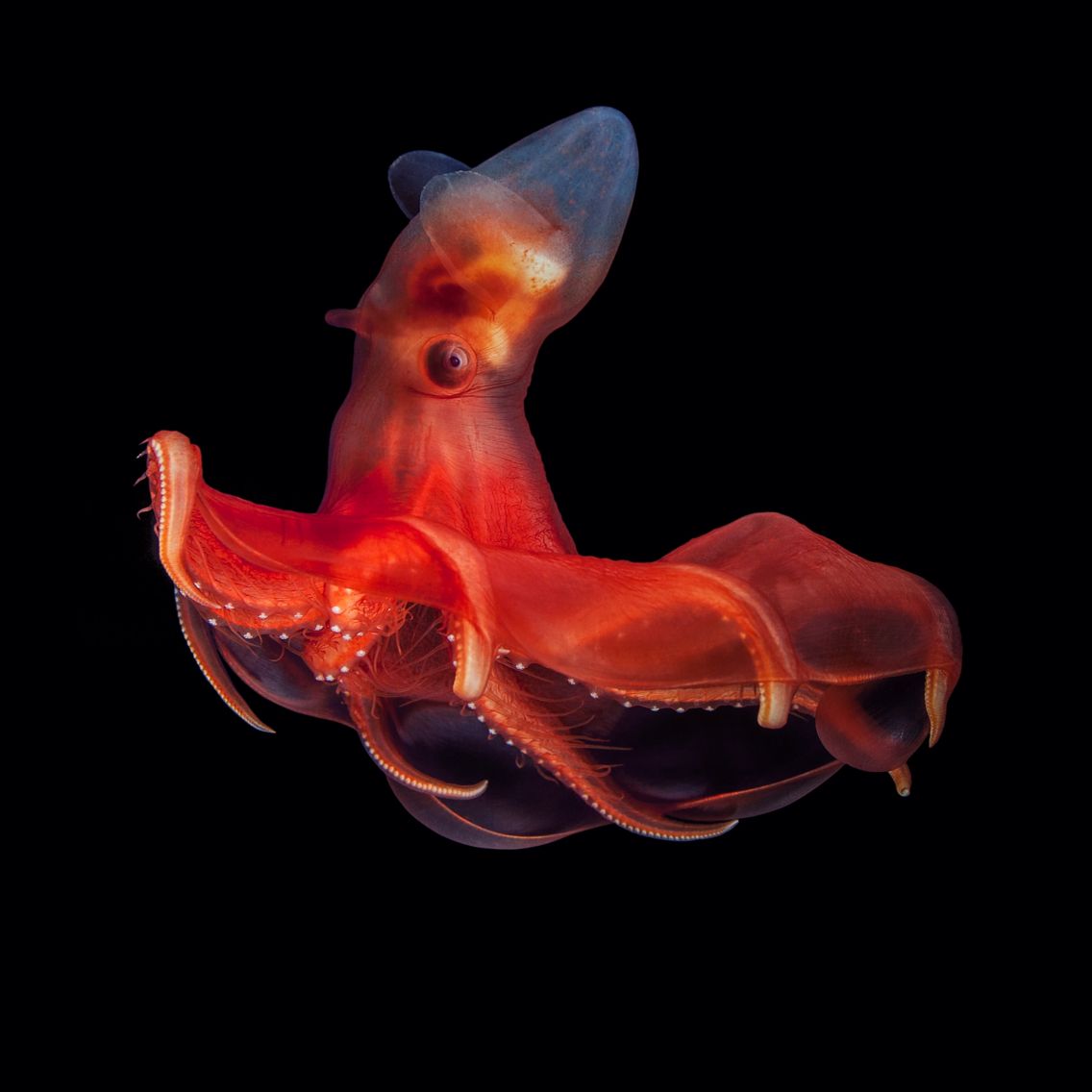
What is a vampire squid?
The vampire squid (Vampyroteuthis infernalis, meaning 'vampire squid from hell') is a deep-sea cephalopod that lives in the ocean's oxygen minimum zone at depths of 600-3,000 meters. Despite its intimidating name, it's small (30 cm) and completely harmless, eating only marine snow - falling dead organic material from surface waters.
The Cephalopod That Doesn't Hunt
The name "vampire squid from hell" suggests something out of a horror movie, a bloodthirsty deep-sea predator with glowing red eyes. The Latin name Vampyroteuthis infernalis only reinforces this.
The reality is one of the most peaceful creatures in the ocean. Vampire squid are 30 centimeters long, live quietly in the darkest parts of the ocean, and eat nothing but falling dead matter. They don't hunt. They don't fight. They're essentially the deep sea's gentlest residents, wrapped in the most intimidating possible packaging.
The Animal
Vampire squid (Vampyroteuthis infernalis) are a unique cephalopod species.
Physical features:
- Length: up to 30 cm (about the size of a football)
- Color: dark red to jet black
- Eyes: proportionally huge, appear glowing red
- Body: soft, gelatinous
- Arms: 8, connected by webbing (like octopuses)
- Filaments: 2 specialized feeding tentacles (retractable)
The "cloak":
The webbing between the arms forms a cape-like structure when spread. When the squid is swimming, it looks exactly like a vampire's outstretched cloak.
Cirri:
Small tooth-like projections on the arms. These look like tiny teeth or fangs, adding to the vampiric appearance. They're actually sensory organs used for feeding, not teeth.
Photophores:
Light-producing organs scattered across the skin. They can:
- Flash bright blue patterns
- Produce glowing mucus clouds
- Create confusing light displays
Why It's Named That Way
German biologist Carl Chun named the species in 1903.
The naming:
Chun studied specimens from deep-ocean expeditions. The combination of features overwhelmed him:
- Dark red-black color
- Cape-like webbing
- Glowing red eyes
- Small "fangs"
- Exists in the ocean's darkest depths
He named it Vampyroteuthis infernalis:
- Vampyro-: vampire
- teuthis: squid
- infernalis: from hell/infernal
The misleading appearance:
Despite the dramatic name, vampire squid are completely harmless:
- Don't feed on blood
- Don't hunt live prey
- Never encountered humans until deep-sea submersibles
- Can't move fast enough to be threatening
Cultural impact:
The name has made vampire squid famous in:
- Nature documentaries
- Educational media
- Online content about "scary" ocean creatures
- Goth/gothic merchandise
The mismatch between frightening name and peaceful behavior has become a classic example of how animal names can mislead.
Living in the Death Zone
Vampire squid inhabit the ocean's oxygen minimum zone (OMZ).
The OMZ:
A layer of ocean water where oxygen levels drop drastically:
- Depth: typically 600-1,000 meters
- Oxygen concentration: less than 10% of normal ocean water
- Sometimes as low as 0.5%
- Kills most animals that enter
Why the OMZ exists:
- Sunlight doesn't penetrate
- No photosynthesis occurs
- Bacteria consume available oxygen decomposing falling organic matter
- Water at these depths isn't well-mixed with surface (oxygen-rich) water
Vampire squid adaptations:
To thrive in the OMZ, vampire squid have:
Specialized blood:
- Uses hemocyanin (copper-based) not hemoglobin (iron-based)
- More efficient oxygen binding at low concentrations
- Blue color instead of red
Slow metabolism:
- Among the slowest of any cephalopod
- Minimal energy requirements
- Can essentially enter torpor
Reduced muscle activity:
- Drifts rather than swims actively
- Uses fins for minimal propulsion
- Slow reflexes compared to other cephalopods
Gill efficiency:
- Large gill surfaces relative to body
- Optimized oxygen extraction
- Lower metabolic oxygen demand
Unique Feeding
Vampire squid are the only known cephalopods that don't hunt.
Diet: Marine snow
Marine snow refers to the constant shower of dead organic material falling from surface waters to the deep ocean:
- Dead plankton
- Invertebrate larvae
- Fecal pellets
- Particles of dead animals
- Bacterial aggregates
This "snow" reaches the deep ocean continuously, providing food for deep-sea detritivores.
Feeding mechanism:
Vampire squid have two specialized filaments (not present in other cephalopods):
- Extension: Filaments extend up to 8x body length
- Trapping: Sticky projections along filaments catch marine snow
- Retraction: Filaments contract, drawing captured food toward body
- Cleaning: Arms scrape particles off filaments into mucus ball
- Consumption: Mucus ball moves to mouth for ingestion
Feeding duration:
Research suggests vampire squid feed almost continuously during their active periods:
- Filaments extend for hours
- Capture happens throughout extension period
- Periodic cleaning and ingestion
- Continuous rather than discrete meals
Evolutionary significance:
No other cephalopod is a detritivore. This dietary shift represents a specialized adaptation to:
- The OMZ environment (active prey scarce)
- Marine snow abundance (constant food supply)
- Low-energy lifestyle compatible with OMZ biochemistry
Defense Mechanisms
Despite peaceful habits, vampire squid have sophisticated defenses.
Body inversion:
When threatened, vampire squid turn themselves inside out:
- Pulls webbing up and over the body
- Spines and cirri now face outward
- Looks like a spiny ball
- Confuses and intimidates predators
This defense is called "pumpkin posture" or "pineapple posture" by researchers.
Bioluminescent defense:
Photophores across the body can produce:
Flash displays:
- Bright blue flashes to startle predators
- Can produce multiple flash sequences
- Apparent signaling to confuse
Glowing mucus:
- Released into surrounding water
- Creates luminous cloud
- Squid escapes while predator is distracted
- Similar to octopus ink but glowing
Arm autotomy:
- Can drop arms if grabbed
- Arms regenerate over time
- Similar to lizard tail sacrifice
Color change:
- Can darken or lighten slightly
- Not as dramatic as other cephalopods
- Contributes to camouflage
The Living Fossil
Vampire squid are genuine living fossils.
Lineage age:
Vampire squid belong to a cephalopod lineage approximately 400 million years old:
- Predates dinosaurs
- Predates mammals
- Predates flying insects
- Among the oldest surviving complex animal lineages
Evolutionary position:
The order Vampyromorpha (vampire squid order):
- Separated from octopuses ~200 million years ago
- Separated from squids/cuttlefish even earlier
- Represents transitional cephalopod features
- Only one living species (V. infernalis)
Preserved features:
Vampire squid retain ancient cephalopod traits:
- Eight arms plus two filaments (octopuses have 8 arms; squids have 8+2 tentacles; vampire squid have 8+2 different-shaped appendages)
- Fin and body shape similar to fossil ancestors
- Distinctive sensory organs common in extinct lineages
- Body plan showing early cephalopod design
Mass extinction survivor:
Vampire squid ancestors survived:
- Devonian extinction (375 million years ago)
- Permian extinction (250 million years ago), killed 95% of marine life
- Triassic-Jurassic extinction (200 million years ago)
- K-Pg extinction (66 million years ago), killed non-avian dinosaurs
Through all these extinctions, vampire squid lineage persisted, largely unchanged.
Distribution
Vampire squid live in deep waters globally.
Range:
- All major oceans
- Tropical and temperate waters primarily
- Occasional records from polar oceans
- Particularly abundant in:
- Monterey Bay, California
- Gulf of California
- Off Japan and Taiwan
- Deep Atlantic basins
Depth:
- Most common: 600-1,500 meters
- Range: 500-3,000 meters
- Follows the OMZ layer in each ocean
Population:
- Exact numbers unknown
- Relatively common in suitable habitat
- Not considered rare where OMZ exists
- Population trends unstudied
Research and Discovery
Vampire squid have been subjects of intensive research.
Early discovery:
- 1898: First specimens collected in deep-sea nets
- 1903: Carl Chun formally describes the species
- Early 20th century: Additional specimens from research expeditions
Modern research:
- 1990s-present: ROV (remotely operated vehicle) observations
- Monterey Bay Aquarium Research Institute: major research program
- NOAA deep-sea research: frequent observations
- Japanese deep-sea institutes: extensive studies
Key research areas:
Feeding ecology:
- Discovery of their detritivore diet (revolutionary finding)
- Filament structure and function
- Food web role in deep sea
Oxygen adaptation:
- How they survive OMZ conditions
- Applications to medicine (hypoxia research)
- Climate change implications
Evolutionary biology:
- Phylogenetic position
- Ancient feature preservation
- Comparison with fossil vampiropod groups
Behavior:
- Defensive postures
- Bioluminescent displays
- Swimming mechanics
Climate Change Implications
Vampire squid may be expanding with climate change.
OMZ expansion:
Climate change is expanding the ocean's oxygen minimum zones:
- Warmer water holds less oxygen
- Increased stratification reduces oxygen mixing
- Nutrient pollution increases microbial oxygen consumption
Expected effects:
As OMZs expand:
- Vampire squid habitat may grow
- Populations may increase
- Range may extend vertically and horizontally
- Could benefit at the expense of other species
Monitoring importance:
Vampire squid serve as indicators of:
- OMZ health and extent
- Deep-sea ecosystem changes
- Ocean chemistry shifts
- Food web stability
Research priorities:
Understanding vampire squid response to climate change:
- Population trends
- Range shifts
- Behavioral adaptations
- Ecosystem impact
Why They Matter
Vampire squid represent multiple biological significance areas.
Evolution:
As 400-million-year survivors, they illustrate:
- Persistent lineages through mass extinctions
- Conservative evolution success strategies
- Importance of stable niches
- Transitional biology between cephalopod groups
Ecology:
- Only detritivorous cephalopod (unique diet)
- Major participant in deep-sea food webs
- Carbon cycling between surface and deep ocean
- Biomarker for OMZ ecosystem health
Physiology:
- Extreme low-oxygen adaptation
- Energy efficiency at metabolic limits
- Insights into hypoxia tolerance
- Applications to medicine and biology
Conservation:
- Indicators of ocean health
- Benchmark for deep-sea biology
- Climate change monitoring
- Deep-sea mining impact assessments
Cultural significance:
- Viral internet star
- Example of misleading animal names
- Popular educational species
- Aesthetic fascination
Misleading Beauty
The vampire squid is perhaps nature's most elegant example of appearance deceiving behavior.
Its name promises horror. Its red-black body suggests menace. Its glowing eyes evoke fear. Its cape-like form recalls stories of vampires and darkness.
Yet nothing about its life matches this image. It drifts quietly in the deepest darkness, filter-feeding on falling dead matter, conserving every bit of oxygen it can extract from water that kills other animals. It has never attacked anything. Its defensive "threats" involve inflating itself or flashing lights, pure bluffing.
It is, essentially, one of the quietest and most specialized animals on Earth, wearing one of nature's most dramatic costumes.
This mismatch makes vampire squid endlessly fascinating. Each encounter with a live specimen (via deep-sea submersible) reveals an animal that looks exactly like its terrifying name suggests while behaving in ways that completely contradict that appearance.
For deep-sea biology, vampire squid represent the best kind of discovery, one where the actual biology is far more interesting than any horror movie imagination could have predicted. A 400-million-year lineage, eating falling ocean snow in near-anoxic water, using blue copper blood to breathe, that's more remarkable than any vampire fiction.
The vampire squid will likely continue surviving as it has for hundreds of millions of years. Climate change may actually expand its habitat. Future human encounters, through improving technology, will likely increase our understanding. But the animal itself - peaceful, ancient, alien - will continue doing what vampire squid have always done: drifting quietly in the ocean's death zone, eating whatever drifts down from above, occasionally producing beautiful light displays that no human sees.
The Oxygen Minimum Zone
Vampire squid (Vampyroteuthis infernalis) occupy a specific and unusual ocean zone: the oxygen minimum zone (OMZ), where dissolved oxygen drops to less than 10% of surface saturation. Our research team finds this habitat choice remarkable because it excludes most competitors. Few animals can thrive in water this oxygen-poor, which gives the vampire squid exclusive access to organic debris sinking from the productive layers above.
"Vampire squid have evolved one of the most efficient oxygen extraction systems documented in any cephalopod. They maintain full metabolic function in oxygen concentrations that would be lethal to most marine animals. Their hemocyanin has extraordinarily high oxygen affinity, and their body metabolism is reduced to a baseline that most cephalopods could not sustain." - Dr. Brad Seibel, University of South Florida, deep-sea physiologist [1]
Ocean Oxygen Zones
| Zone | Depth | Oxygen saturation | Typical species |
|---|---|---|---|
| Surface mixed layer | 0-50 m | 90-100% | Most marine life |
| Main thermocline | 50-500 m | 70-90% | Most fish, squid |
| Oxygen minimum zone | 500-1,000 m | 5-20% | Specialists (vampire squid, some others) |
| Deep oxygen-rich water | 1,000-4,000 m | 50-80% | Bathypelagic life |
| Abyssal zone | 4,000-6,000 m | 70-85% | Abyssal specialists |
Taxonomic Position: Neither Octopus Nor Squid
The vampire squid belongs to its own order, Vampyromorphida, containing just one living species. Genetic and morphological analysis places it as the sister group to the octopuses (Octopoda), together forming a clade distinct from squids. Despite the name, the vampire squid is more closely related to octopuses.
"The vampire squid is a taxonomic orphan. It is the only living representative of a lineage that was once more diverse. The closest fossil relatives, from roughly 200 million years ago, show similar body plans, suggesting this form has been evolutionary stable for an extraordinarily long time. Vampire squid are cephalopod living fossils as much as nautiluses are." - Dr. Henk-Jan Hoving, GEOMAR Helmholtz Centre for Ocean Research [2]
Cephalopod Order Classification
| Order | Living species | Adult features |
|---|---|---|
| Nautilida | 6-8 (all nautiluses) | External shell |
| Sepiida | ~120 (cuttlefish) | Internal cuttlebone |
| Teuthida (squid) | ~300 | Internal pen, 10 appendages |
| Octopoda | ~300 (octopuses) | 8 arms, no shell |
| Vampyromorphida | 1 (vampire squid) | 8 arms + 2 filaments |
Notable Research Findings
- Vampire squid are detritivores, not active predators. Research by Henk-Jan Hoving and colleagues published in Proceedings of the Royal Society B in 2012 showed that vampire squid eat marine snow - the continuous rain of organic debris falling from surface waters - rather than live prey [3].
- The vampire squid's two long filamentous appendages, previously assumed to be hunting tentacles, turn out to be specialized detritus-collection organs. They are sticky and coated with mucus that traps organic particles.
- Vampire squid have multiple bioluminescent organs distributed across their body, including on the fins, tentacles, and body surface. They can produce a sticky bioluminescent mucus that they eject when threatened, creating a cloud of glowing particles that confuse predators.
- Our research team notes that vampire squid have the deep blue to reddish-black coloration that characterizes many midwater animals. Many predators at this depth are red-bodied because red light does not penetrate to their habitat, making red animals effectively invisible.
- Vampire squid reach sexual maturity at 2 to 3 years, have relatively long lives of up to 8 years, and appear to reproduce multiple times during their lives - a pattern unusual for cephalopods and more typical of the long-lived deep-sea species they cohabit with.
Why Deep Sea Creatures Have Eyes?
Deep-sea creatures retain eyes despite living in near-total darkness because traces of sunlight still reach down to roughly 1,000 meters, and bioluminescence - produced by an estimated 76 percent of deep-sea organisms - fills the deeper zones with biological light.
The vampire squid (Vampyroteuthis infernalis), living at 600-3,000 meters in the oxygen minimum zone, has proportionally huge red-appearing eyes optimized to detect faint flashes from prey and predators. These eyes perceive bioluminescent signals at specific blue wavelengths (around 470-490 nm) that travel farthest through seawater.
The vampire squid's own photophores can flash blue patterns or produce sticky bioluminescent mucus clouds. Many deep-sea predators are red-bodied because red wavelengths do not penetrate to these depths, making red animals effectively invisible - except to those with eyes specialized to detect them.
References
[1] Seibel, B. A., Thuesen, E. V., & Childress, J. J. (1999). Flight of the vampire: Ontogenetic gait-transition in Vampyroteuthis infernalis. Journal of Experimental Biology, 202(16), 2217-2224.
[2] Hoving, H. J. T., Perez, J. A. A., Bolstad, K. S. R., et al. (2014). The study of deep-sea cephalopods. Advances in Marine Biology, 67, 235-359.
[3] Hoving, H. J. T., & Robison, B. H. (2012). Vampire squid: Detritivores in the oxygen minimum zone. Proceedings of the Royal Society B, 279(1747), 4559-4567. DOI: 10.1098/rspb.2012.1357
[4] Robison, B. H. (2004). Deep pelagic biology. Journal of Experimental Marine Biology and Ecology, 300(1-2), 253-272.
Related Articles
- Giant Squid: The Real Kraken
- Dumbo Octopus: The Cutest Creature in the Deep Sea
- Anglerfish: The Deep Sea Predator With a Glowing Lure
Frequently Asked Questions
What is a vampire squid?
The vampire squid (Vampyroteuthis infernalis, meaning ‘vampire squid from hell’) is a deep-sea cephalopod that lives in the ocean’s oxygen minimum zone at depths of 600-3,000 meters. Despite its intimidating name, it’s small (30 cm) and completely harmless, eating only marine snow - falling dead organic material from surface waters. It represents an ancient lineage of cephalopods, preserving features that existed before octopuses and squids diverged.
Its body is dark red to black with webbing between its eight arms like an octopus, but it also has two specialized filaments that extend and retract for feeding. Its skin contains photophores (light-producing organs) that can produce bioluminescent flashes for defense. When threatened, it turns itself inside out, exposing spiny projections and confusing predators.
It lives in such low-oxygen water that most other animals cannot survive there, giving it a near-competitor-free niche.
Why is it called the vampire squid?
The vampire squid got its dramatic name from its appearance: dark red body, cape-like webbing between arms that resembles a vampire’s cloak, glowing red eyes, and small tooth-like cirri (projections). German biologist Carl Chun named it Vampyroteuthis infernalis in 1903 - literally ‘vampire squid from hell.’ The name perfectly captured its gothic appearance.
However, the name is entirely misleading about its behavior: vampire squid don’t feed on blood, don’t hunt live prey, and are completely harmless to anything except the tiny marine snow particles they consume. Their ‘cloak’ is actually webbing that connects their arms for efficient swimming. Their ‘teeth’ are cirri - sensory projections used in feeding.
Despite their demonic appearance and name, vampire squid are one of the most peaceful creatures in the deep sea. The dramatic mismatch between appearance, name, and actual biology makes the vampire squid a favorite example of how animal names can profoundly mislead public perception.
How does a vampire squid survive without oxygen?
Vampire squid live in the ocean’s oxygen minimum zone (OMZ) where oxygen concentrations drop below 1% - conditions that kill virtually all other animals.
They survive through multiple adaptations: specialized blue-blood hemocyanin (copper-based, not iron-based) that binds oxygen efficiently at extremely low concentrations, slow metabolism requiring minimal oxygen, reduced muscle activity for lower oxygen demand, ability to essentially enter torpor during oxygen shortages, and specialized gill surfaces that maximize oxygen extraction.
Their body chemistry has been thoroughly studied as a model for extreme-environment biology. Research has also shown their cells produce less heat per unit of activity, reducing metabolic oxygen needs. This ability to thrive in near-anoxic conditions gives them access to a niche where few predators can pursue them and few competitors can survive.
The OMZ, while hostile to most life, provides abundant marine snow (dead organic matter drifting down from above) which vampire squid exploit as their primary food source.
What do vampire squid eat?
Vampire squid are the only known cephalopods that don’t hunt live prey - they eat marine snow, the falling particles of dead organic matter from ocean surface waters. Their diet includes fragments of dead plankton, invertebrate larvae, fecal pellets, and other particulate organic matter. They use two specialized retractable filaments that extend up to 8 times their body length to capture floating particles.
Their filaments have tiny, sticky projections that trap marine snow like flypaper. Once caught, the filaments retract and the sticky particles are scraped off into a mucus-covered ball in a groove along the arms. This mucus ball is then moved to the mouth for consumption. Research suggests they filter-feed for hours continuously, consuming hundreds of thousands of particles per day.
This passive feeding strategy matches their low-energy deep-sea lifestyle perfectly - they don’t need to pursue prey because their food comes to them. Their detritivore diet also explains how they thrive in the oxygen minimum zone where active prey would be scarce.
How long have vampire squid existed?
Vampire squid belong to an ancient cephalopod lineage that has existed for approximately 400 million years - predating dinosaurs by 150 million years. They are the only surviving member of their order (Vampyromorpha), making them true ‘living fossils.’ Fossil evidence shows vampire squid ancestors with nearly identical body structures from the Paleozoic era.
They represent a transitional form between octopuses and squids, preserving features from a time before these groups diverged. Their eight arms plus two filaments (instead of octopus’s eight or squid’s eight+two tentacles) show evolutionary features that were later lost in modern cephalopods. Their fin and body shape preserves early cephalopod design.
They outlasted countless other cephalopod groups including ammonites (extinct 66 million years ago) and belemnites (extinct at same time). Their conservative evolutionary strategy - maintaining ancient body plans in a stable deep-sea niche - contrasts with the rapid evolution of surface-dwelling cephalopods like squid. Vampire squid are living windows into cephalopod biology from hundreds of millions of years ago.