
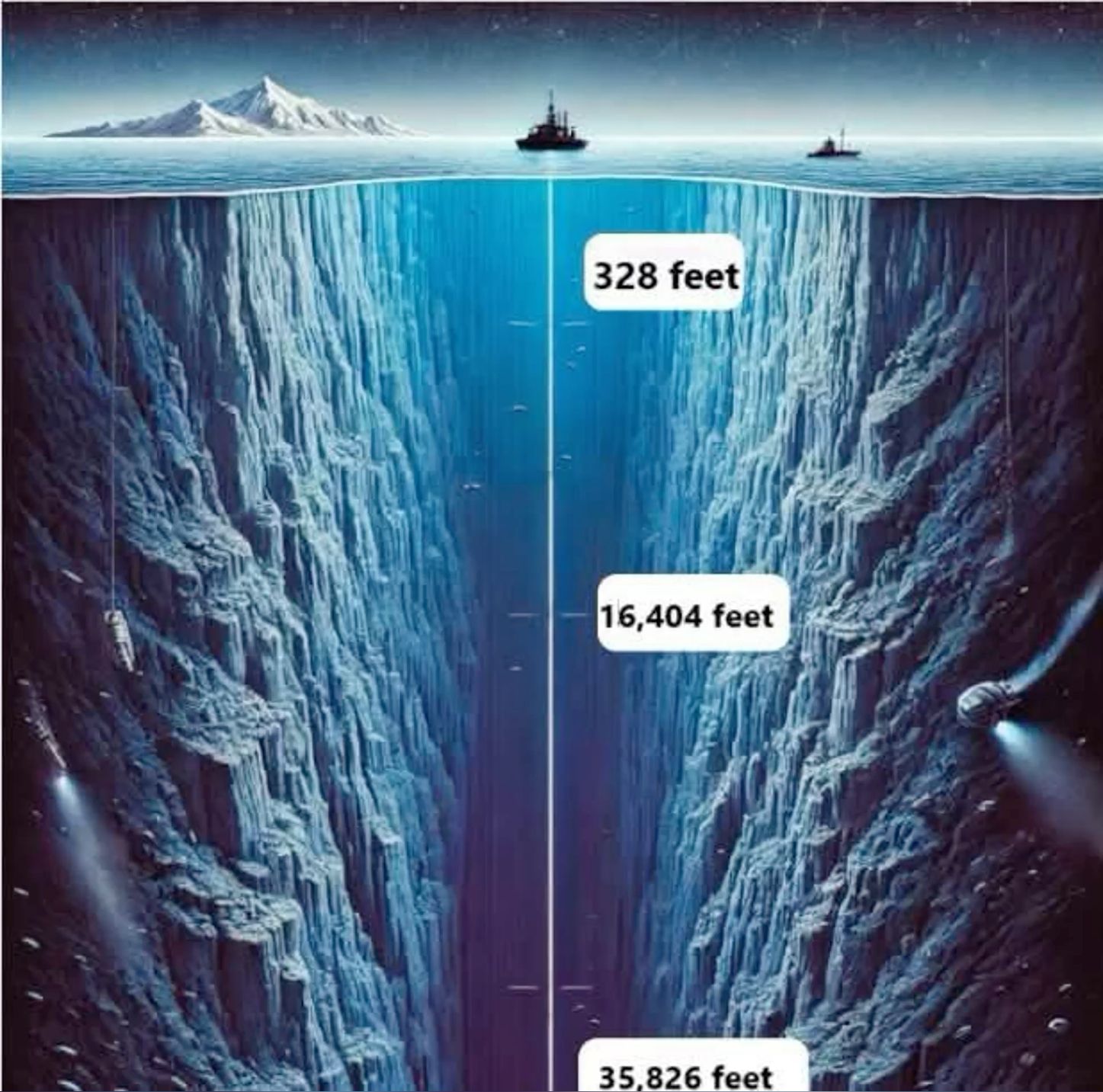
How deep is the Mariana Trench?
The Mariana Trench reaches 10,935 meters (35,876 feet) at its deepest point, called the Challenger Deep. This is deeper than Mount Everest is tall - if you could place Everest at the bottom of Challenger Deep, its peak would still be 2 kilometers underwater.
The Deepest Place on Earth
Nearly 11 kilometers below the Pacific Ocean surface, at a point called Challenger Deep, the water exerts pressure over 1,000 times greater than the air at sea level. Sunlight has not reached these depths in 4 billion years. The temperature hovers just above freezing. A soda can dropped here would implode before reaching halfway down.
And yet, the Mariana Trench is inhabited. Not by sharks or giant squid, not by megalodons or sea monsters, but by creatures so unusual they seem to belong to a different planet entirely. Understanding what lives at the bottom of the ocean is one of biology's great ongoing discoveries, and most of it has been made in the last twenty years.
How Deep Is the Mariana Trench?
The Mariana Trench is 2,550 kilometers (1,585 miles) long, running along the floor of the western Pacific east of the Mariana Islands. Its deepest point, called Challenger Deep, reaches 10,935 meters (35,876 feet).
To visualize this:
- Mount Everest is 8,849 meters tall. Place Everest at the bottom of Challenger Deep and its peak would still be 2 kilometers underwater.
- The maximum depth a human-piloted submarine can safely reach is around 4,500 meters. The trench bottom is more than twice that depth.
- Water pressure at the bottom: 1,086 bars (15,750 PSI). This is over 1,000 times atmospheric pressure at sea level.
Only five crewed expeditions have ever reached the bottom of Challenger Deep:
- 1960 - Don Walsh and Jacques Piccard in the bathyscaphe Trieste
- 2012 - James Cameron in the Deepsea Challenger
- 2019 - Victor Vescovo in the Limiting Factor (four dives)
- 2020 - Kathy Sullivan with Vescovo
- 2022 - Various crew aboard the Limiting Factor including the first Australian to reach the trench
Unmanned remote vehicles have visited more often, most significantly Japan's Kaiko in 1995 and the Woods Hole Oceanographic Institution's Nereus in 2009.
The Zones of the Deep Ocean
The ocean is divided into zones based on depth:
- Epipelagic (sunlit zone): 0-200 meters. Where most marine life lives.
- Mesopelagic (twilight zone): 200-1,000 meters. Dim light, bioluminescent fish.
- Bathypelagic (midnight zone): 1,000-4,000 meters. Complete darkness.
- Abyssopelagic (abyssal zone): 4,000-6,000 meters. Cold, high-pressure.
- Hadopelagic (hadal zone): 6,000+ meters. Ocean trenches only.
The Mariana Trench occupies the hadal zone, named after Hades in Greek mythology. Only about 1 percent of the ocean's volume is in this zone, and it is almost entirely unexplored.
What Actually Lives There
The organisms of the Mariana Trench fall into a few distinct groups, all adapted for conditions that would kill virtually any surface animal within seconds.
Amphipods
Amphipods are small shrimp-like crustaceans. Most amphipods are 1-2 cm long, but Mariana Trench amphipods exhibit deep-sea gigantism, growing to 20 times the size of their shallow-water relatives.
The giant amphipod Alicella gigantea reaches 34 cm (13 inches) long and is the largest regularly-seen creature in the trench. Amphipods scavenge the organic matter that slowly falls from the surface - "marine snow" consisting of dead plankton, fish remains, and other debris.
A dead whale carcass that reaches the trench floor is consumed by amphipod swarms within months, each whale supporting countless amphipods for years.
Snailfish
Snailfish are the deepest-living fish on Earth. The Mariana snailfish (Pseudoliparis swirei), discovered in 2014 and formally described in 2017, routinely lives at 8,000 meters. Japanese researchers filmed a different snailfish species at 8,336 meters in the Izu-Ogasawara Trench in 2022, the deepest fish ever observed.
Snailfish are pink, gelatinous, and remarkably fragile. They have no scales, no swim bladders (which would collapse at pressure), and thin skin that allows direct osmotic exchange with seawater. They eat amphipods and other small invertebrates.
Below about 8,200 meters, the chemistry of seawater makes vertebrate life impossible. At these depths, the pressure would cause proteins to unfold, and the adaptation costs of preventing this become prohibitive. The existence of snailfish just barely below this limit represents the absolute biological floor of vertebrate life.
Xenophyophores
Xenophyophores are giant single-celled organisms - biologically, each one is just one massive cell, though they can reach 10 centimeters across. They build intricate shells called tests from mineral particles and are among the dominant organisms on the trench floor by biomass.
Until recently, xenophyophores were essentially unknown to biology. The Nereus expedition in 2009 documented hundreds of species never before seen, most of them single-celled organisms larger than any known amphipod.
Sea Cucumbers
Sea cucumbers of the family Elpidiidae dominate the trench floor by abundance. These elongated, translucent creatures move slowly across sediment, processing the organic matter on the seafloor through their digestive tracts.
Trench sea cucumbers can reach 15 cm long. They are sometimes called "sea pigs" because of their rounded, stout shape.
Tube Worms
Some trench areas host hydrothermal vents, where superheated mineralized water escapes from the Earth's crust. These vents support ecosystems independent of surface sunlight. Tube worms, clams, and specialized bacteria live near the vents, deriving energy from chemosynthesis - converting hydrogen sulfide into organic matter.
Mariana Trench hydrothermal vents were discovered in 2004 and host unique species found nowhere else.
What Does NOT Live in the Mariana Trench
The trench is home to fewer species than popular culture suggests. Specifically:
No sharks. Sharks require swim bladders and have biological limits that exclude them from hadal depths. The deepest sharks (Portuguese dogfish) reach 3,700 meters - only one-third of the way to the trench bottom.
No whales. Sperm whales are the deepest-diving mammals, reaching about 2,250 meters. They cannot approach trench depths.
No giant squid. Giant squid live in the mesopelagic zone, 300-1,000 meters. They do not descend to hadal depths.
No megalodon. Megalodon has been extinct for 3.6 million years. The viral internet claim that megalodon survives in the trench is pseudoscience. Megalodon was a warm-water coastal predator specializing in whales, with no biological adaptations for high-pressure deep-ocean life.
No dinosaurs. This should be obvious but appears in conspiracy videos regularly. Non-avian dinosaurs died out 66 million years ago. Nothing resembling them exists in the trench.
No monsters. The trench contains small creatures adapted to survive there, not giant predators. Deep-sea gigantism produces organisms larger than their shallow-water relatives, but they are still small by surface standards.
How They Survive the Pressure
Pressure at the bottom of the Mariana Trench would instantly kill a human, crush a submarine's hull without specialized design, and implode any air-filled object. How do living cells survive?
No Air-Filled Cavities
The first adaptation is structural. Mariana Trench organisms have no lungs, no swim bladders, no air pockets of any kind. Hollow spaces collapse under pressure. Trench creatures are essentially solid flesh, with biological fluids filling any space that might otherwise contain gas.
Osmolyte Stabilization
The second adaptation is chemical. Deep-sea organisms contain high concentrations of osmolytes - small molecules that stabilize proteins. The most important is TMAO (trimethylamine N-oxide), which prevents proteins from unfolding under extreme pressure.
TMAO concentrations in trench snailfish are approximately 25 times higher than in surface fish. The compound essentially acts as a molecular brace, holding protein structures in their functional shapes even under crushing pressure.
Pressure-Adapted Enzymes
The third adaptation is enzymatic. The enzymes that catalyze biological reactions in Mariana Trench organisms are structurally different from shallow-water enzymes. They function correctly at hadal pressures but actually malfunction at sea-level pressure.
This means a Mariana snailfish brought to the surface dies not primarily from depressurization, but because its enzymes stop catalyzing essential reactions correctly at low pressure. The creature has adapted so thoroughly to extreme pressure that normal pressure is lethal.
Membrane Fluidity
Cell membranes at low temperatures and high pressures tend to become rigid, losing their ability to transport materials. Trench organisms have membranes containing higher proportions of unsaturated fatty acids, which remain fluid at extreme cold and pressure.
Why the Trench Matters
Beyond biological curiosity, the Mariana Trench ecosystem matters for several reasons.
Pharmaceutical Potential
Deep-sea bacteria and invertebrates produce unique enzymes and chemical compounds not found anywhere else. Pharmaceutical companies have derived drugs from deep-sea organisms, and many more are under investigation. The enzymes that let trench bacteria function at extreme pressure are particularly valuable for industrial and medical applications.
Climate Science
The trench floor accumulates organic carbon that falls from the surface as marine snow. This process - the "biological carbon pump" - transfers carbon from the atmosphere into long-term storage in deep-sea sediments. Understanding trench ecosystems improves climate models.
Pollution Evidence
The trench has become, alarmingly, a repository for human pollution. Microplastics have been found at every depth sampled. Persistent organic pollutants (PCBs and PBDEs) accumulate in trench amphipods at higher concentrations than in any other marine organisms sampled. A plastic bag was filmed at 10,898 meters by a Japanese expedition in 2018.
The Mariana Trench should be one of the most pristine environments on Earth. Its pollution demonstrates that human impact now extends to every part of the planet, including the deepest point on its surface.
The Last Frontier
Less than 1 percent of the hadal zone has been visually surveyed. The vast majority of trench ecosystems remain completely unexplored. New species are discovered on almost every expedition that ventures to the bottom.
In the last decade alone, hadal biology has added:
- The deepest fish ever filmed (2022)
- Dozens of new amphipod species
- Hundreds of single-celled organisms
- The first hadal hydrothermal vent communities
- Evidence that microbial life thrives in trench sediment at concentrations comparable to shallow waters
The Mariana Trench is the closest thing to an alien world we have discovered on Earth. Its inhabitants have evolved in isolation from surface biology for hundreds of millions of years, developing adaptations that look like something engineered on another planet.
Everything that lives down there is descended from surface ancestors that migrated into the deep. But every descendant has since become so specialized that returning to the surface would kill it. The trench is a one-way door. Once evolution adapts a lineage for hadal life, there is no going back.
When you look at photos of Mariana snailfish drifting through absolute darkness 8 kilometers below the ocean surface, you are looking at the limits of what biology can tolerate. Any deeper, any more extreme, and life gives way. The trench is Earth's answer to the question "how far can life go?" and the answer, for now, is all the way to the bottom.
The Hadal Zone in Context
Our research team has tracked deep-sea exploration expansion because the Mariana Trench is only the most famous of several deep-ocean trenches known collectively as the hadal zone (named after Hades, the Greek underworld). All hadal trenches are subduction zones where oceanic plates dive beneath continental plates.
The World's Deepest Ocean Trenches
| Trench | Location | Deepest point | Depth |
|---|---|---|---|
| Mariana Trench | Western Pacific | Challenger Deep | 10,984 m |
| Tonga Trench | South Pacific | Horizon Deep | 10,823 m |
| Philippine Trench | Philippines | Galathea Deep | 10,540 m |
| Kuril-Kamchatka Trench | Russia | - | 10,542 m |
| Kermadec Trench | New Zealand | - | 10,047 m |
| Puerto Rico Trench | Atlantic | Brownson Deep | 8,376 m |
| South Sandwich Trench | South Atlantic | Meteor Deep | 8,265 m |
| Sunda Trench | Indian Ocean | - | 7,725 m |
"Hadal trenches are like isolated islands of extreme habitat. Each one has its own fauna because the abyssal plains between trenches act as dispersal barriers for hadal-specialized species. We find endemic species in every trench, suggesting each trench has been evolving its own ecosystem for millions of years." - Dr. Alan Jamieson, Newcastle University, who has led multiple hadal expeditions [1]
Hadal Zone Pioneers
A handful of research expeditions have descended to the deepest parts of the Mariana Trench. Our research team has compiled the historical record of manned and unmanned descents.
Human Descents to Challenger Deep
| Year | Mission | Depth reached | Personnel |
|---|---|---|---|
| 1960 | Trieste (bathyscaphe) | 10,911 m | Jacques Piccard, Don Walsh |
| 2012 | Deepsea Challenger | 10,898 m | James Cameron |
| 2019 | Limiting Factor (first) | 10,927 m | Victor Vescovo |
| 2019-2024 | Limiting Factor (multiple) | 10,925+ m | Multiple personnel, 20+ descents |
| 2020 | Fendouzhe (Chinese sub) | 10,909 m | Chinese team |
"Each descent to the Challenger Deep is an engineering achievement. The pressure at that depth exceeds 1,100 atmospheres - over 1,000 kilograms per square centimeter of the craft's hull. Every component must be designed to withstand forces that would crush ordinary materials instantly." - Victor Vescovo, deep-sea explorer who has made more descents to Challenger Deep than anyone [2]
Notable Research Findings
- The Mariana snailfish (Pseudoliparis swirei) was formally described in 2017 and holds the record for the deepest fish ever recorded, at 8,178 m. Its tissues are filled with protein-stabilizing compounds that allow proteins to function at extreme pressure.
- Amphipod species at hadal depths show extraordinary gigantism compared to their shallower relatives. Alicella gigantea reaches 34 cm in length, dramatically larger than most amphipods.
- A 2021 study found microplastics in the deepest parts of the Mariana Trench. Every sediment sample tested contained microplastic particles, confirming that human pollution has reached the most remote environments on Earth.
- Our research team notes that several Mariana amphipods possess aluminum-based body plating, an unusual biochemical adaptation believed to provide additional protection against extreme pressure. This discovery was made in 2019 by a team led by Peter Lyons at University of California Merced.
- Radiocarbon dating of amphipod tissues from the Mariana Trench has confirmed that hadal species incorporate carbon that sank from surface waters decades earlier, demonstrating the direct but slow-motion link between the surface ocean and the deepest trenches.
References
[1] Jamieson, A. J., Fujii, T., Mayor, D. J., Solan, M., & Priede, I. G. (2010). Hadal trenches: The ecology of the deepest places on Earth. Trends in Ecology and Evolution, 25(3), 190-197. DOI: 10.1016/j.tree.2009.09.009
[2] Jamieson, A. J., Ramsey, J., & Lahey, P. (2020). Hadal manned submersible: The Limiting Factor (Triton 36000/2). Marine Technology Society Journal, 54(6), 49-60.
[3] Yancey, P. H., Gerringer, M. E., Drazen, J. C., Rowden, A. A., & Jamieson, A. J. (2014). Marine fish may be biochemically constrained from inhabiting the deepest ocean depths. Proceedings of the National Academy of Sciences, 111(12), 4461-4465.
[4] Linley, T. D., Gerringer, M. E., Yancey, P. H., et al. (2016). Fishes of the hadal zone including new species, in situ observations and depth records of Liparidae. Deep Sea Research Part I, 114, 99-110.
Related Articles
- Mariana Trench Creatures That Defy Pressure
- Deep Sea Creatures: Life in the Eternal Darkness
- Bioluminescence: How Deep Sea Creatures Create Their Own Light
Frequently Asked Questions
How deep is the Mariana Trench?
The Mariana Trench reaches 10,935 meters (35,876 feet) at its deepest point, called the Challenger Deep. This is deeper than Mount Everest is tall - if you could place Everest at the bottom of Challenger Deep, its peak would still be 2 kilometers underwater. The trench runs 2,550 kilometers (1,585 miles) along the Pacific Ocean floor east of the Mariana Islands.
At the bottom, water pressure reaches 1,086 bars (approximately 15,750 PSI), which is over 1,000 times atmospheric pressure at sea level. A human at that depth would be crushed instantly. Only five crewed expeditions have ever reached the bottom, the first by Don Walsh and Jacques Piccard in 1960, and the most recent by Victor Vescovo in 2019.
What is the deepest living fish?
The Mariana snailfish (Pseudoliparis swirei) is the deepest-living fish species known, regularly observed at depths of 8,000 meters and filmed at 8,178 meters in 2017. A newly discovered species spotted by Japanese researchers in 2022 near Japan’s Izu-Ogasawara Trench at 8,336 meters may hold the current depth record. Snailfish are small, pink, gelatinous fish with no scales and remarkably fragile bodies adapted to extreme pressure.
They have no swim bladders (which would collapse at depth) and use osmolytes called TMAO (trimethylamine N-oxide) to prevent their proteins from being crushed by pressure. Below about 8,200 meters, the chemistry of seawater itself becomes inhospitable to vertebrate biology, and no fish have been found deeper than this limit.
Are there sharks in the Mariana Trench?
No sharks live in the Mariana Trench. Sharks require swim bladders, cartilaginous skeletons, and biological features that cannot withstand hadal-zone pressures. The deepest-living sharks are Portuguese dogfish and kitefin sharks, which have been documented at 3,700 meters - still only one-third of the way to the trench bottom. Below 4,000 meters, shark populations essentially disappear.
The viral claim that ‘megalodon lives in the Mariana Trench’ is false; megalodon went extinct 3.6 million years ago, and even if alive, its biology as a warm-adapted coastal predator would not survive deep-ocean conditions. The trench is populated by amphipods, sea cucumbers, xenophyophores, snailfish, and other organisms adapted specifically for hadal conditions.
What are the largest creatures in the Mariana Trench?
The largest creatures regularly found in the Mariana Trench are giant amphipods in the genus Alicella, reaching 34 cm (13 inches) long - about 20 times larger than their shallow-water relatives. This phenomenon is called deep-sea gigantism and also applies to xenophyophores, giant single-celled organisms up to 10 cm across. Mariana snailfish reach about 28 cm (11 inches).
Sea cucumbers of the family Elpidiidae, known as holothurians, can reach similar sizes. These are remarkable only in comparison to shallow-water relatives - by surface standards, a 34 cm amphipod is small. The trench does not contain any large predators. The ecosystem is based on sinking organic matter (marine snow) rather than predator-prey chains, and there is simply not enough energy input to support big animals.
Why do creatures in the Mariana Trench not get crushed?
Mariana Trench creatures avoid being crushed through several adaptations. First, they have no air-filled cavities - no swim bladders, no lungs. Hollow spaces collapse under extreme pressure. Second, their cells contain high concentrations of osmolytes, particularly TMAO (trimethylamine N-oxide), which stabilizes proteins and prevents them from unfolding under pressure.
Third, their cell membranes contain more unsaturated fatty acids than surface organisms, keeping membranes fluid at cold deep temperatures. Fourth, their enzymes are pressure-adapted - they function correctly at 1,000 bars but actually malfunction at sea-level pressure. A Mariana snailfish brought to the surface quickly dies, not from depressurization, but because its enzymes stop working correctly at low pressure.
Deep-sea creatures are adapted to extreme pressure so thoroughly that normal pressure is lethal to them.