
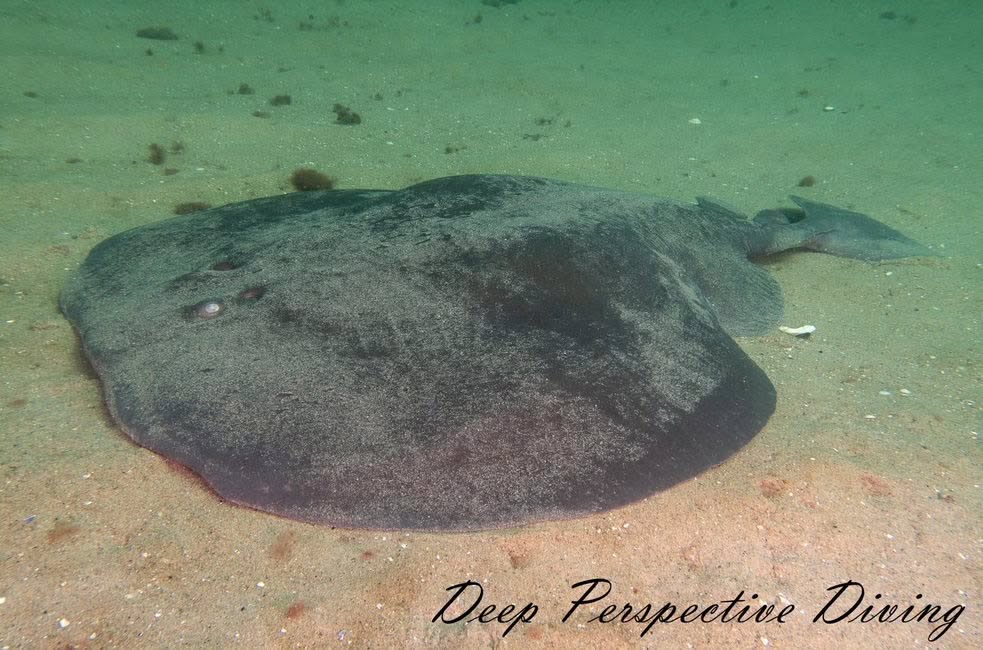
The Atlantic torpedo ray is one of the most electrifying animals in the sea, in both the literal and the figurative sense. A large, disc-shaped cartilaginous fish capable of discharging up to 220 volts at 45 amps in a single pulse, Torpedo nobiliana produces one of the strongest electric shocks ever measured in a living organism.
It is also one of the oldest documented sources of applied medical electricity: Greek and Roman physicians were pressing live torpedo rays to patients' foreheads more than two thousand years before anyone understood what electricity actually was.
This guide covers every aspect of Atlantic torpedo ray biology and ecology: size and anatomy, electric organs, hunting behaviour, reproduction, range and habitat, conservation status, and the long cultural relationship between these fish and the humans who have studied, feared, and treated each other with them. It is a reference entry, not a summary - so expect specifics: volts, amps, depths, kilograms, and verified records.
Etymology and Classification
The scientific name Torpedo nobiliana was first applied by the Italian naturalist Charles Lucien Bonaparte in 1835. The genus name, Torpedo, comes directly from the Latin verb torpere, meaning to be stiff, numb, or stunned. This is exactly the sensation ancient Mediterranean fishermen reported the instant they laid bare hands on one caught in their nets. Pliny the Elder, Aristotle, and a long line of Greek and Roman writers used this same Latin root to describe the fish.
The naval weapon we now call a torpedo was named after the ray, not the other way around. Robert Fulton and later developers of self-propelled underwater weapons consciously adopted the name because these devices "stunned" enemy ships the way the fish stunned unwary humans.
Taxonomically, the Atlantic torpedo belongs to the order Torpediniformes, a group containing roughly forty species of electric rays distributed across the family Torpedinidae and several closely related families. Like all rays, torpedoes are cartilaginous fish (class Chondrichthyes), sharing a skeleton made of cartilage rather than bone with sharks, skates, and chimaeras. Within the order, T. nobiliana is the largest species and one of the most widely distributed.
Common names vary by region. In English it is called the Atlantic torpedo, the electric ray, or the black torpedo. In Italian it is torpedine nera, in Spanish tremielga, and in French torpille noire. Many older English fishing records simply list it as the "numbfish" - another reminder of the sensation that defines the animal.
Size and Physical Description
The Atlantic torpedo is by far the largest member of its order. A mature adult can reach:
- Total length: up to 1.8 metres from snout to tail tip
- Disc width: typically 60-90 per cent of total length
- Weight: up to 90 kilograms
Females grow larger than males on average. Most adults encountered in commercial bycatch fall in the 60 to 120 centimetre range. Newborn pups measure roughly 20 to 25 centimetres across and weigh less than half a kilogram.
The body shape is striking and instantly recognisable. The pectoral fins are fused with the head and trunk to form a near-circular flat disc, with the eyes, spiracles, and small mouth located on the upper surface and the gill slits and nostrils on the underside. The tail is short, thick, and muscular, tipped with a well-developed caudal fin - a shape quite unlike the whip-tails of stingrays.
The skin is smooth and lacks the dermal denticles (tooth-like scales) found in most sharks and skates. Colour is usually uniform dark brown, slate grey, or near-black on the upper surface, fading to pale cream or off-white below. This countershading helps the fish blend with muddy and sandy bottoms.
Two enormous kidney-shaped electric organs sit on either side of the disc, one under each "shoulder", visible on dissection as a pair of pale, honeycombed structures. Together these organs occupy roughly one-sixth of the fish's total body mass. In a large 90-kilogram adult that means roughly 15 kilograms of dedicated biological battery.
The Electric Organ
Everything else about the torpedo ray - its anatomy, its behaviour, even its evolutionary history - is built around its electric organ. This is one of the most elegant pieces of cellular engineering in the entire animal kingdom.
Each organ is built from stacked columns of specialised cells called electrocytes. Electrocytes are modified branchial muscle cells that have lost their contractile machinery and retained only the ion-pumping membrane system that normally drives muscle action potentials. When the ray's nervous system triggers the organ, every electrocyte in the column fires simultaneously.
Each individual cell produces only a tiny voltage, on the order of 0.1 volts, but the columns stack the cells in series like the plates of a voltaic pile, and the two organs wire many columns in parallel.
The arithmetic is simple:
- Cells per column: roughly 500-1000, stacked in series
- Columns per organ: hundreds to low thousands, in parallel
- Peak voltage across the whole stack: up to 220 V
- Peak current through the external water path: up to 45 A
- Peak instantaneous power: close to 1 kilowatt
A single full-strength pulse lasts only a few milliseconds, but that is more than enough to stun or kill a fish of comparable size. Energy stored in the organ is limited, so after roughly a dozen maximum discharges the fish needs hours of rest to regenerate ion gradients and recharge. Lower-intensity pulses for navigation or communication can be produced more or less continuously.
Electric organs in torpedo rays are not unique. Strong or weak electric organs have evolved independently in electric eels (Electrophorus), electric catfish (Malapterurus), stargazers (Astroscopus), skates (Rajidae), and elephantfish (Mormyridae). Biologists consider this one of the clearest examples of convergent evolution in vertebrates: at least six separate lineages have hit on the same basic cellular trick.
The torpedo's organs drew the attention of eighteenth- and nineteenth-century physicists as soon as Europeans started seriously studying electricity. John Walsh demonstrated in 1773 that the shock of a live torpedo could be conducted through a chain of people holding hands, identical to the effect of a Leyden jar. Henry Cavendish modelled the fish's output mathematically.
Alessandro Volta explicitly invoked the layered anatomy of the torpedo organ as an inspiration for the design of the first battery. Michael Faraday later confirmed that the torpedo's output obeyed the same laws as any other electrical source. In a very real sense, the torpedo ray helped build physics.
Hunting and Diet
Torpedo rays are ambush predators built around a single decisive move: approach, contact, discharge, engulf. They feed primarily on bony fish and occasionally on other prey items:
Primary prey:
- Flatfish - flounder, sole, plaice
- Mullet and mackerel
- Herring, sardines, and similar schooling fish
- Small sharks and dogfish
- Eels and conger
Secondary and opportunistic prey:
- Crustaceans (less common)
- Cephalopods such as octopus and squid
- Occasionally other rays and small skates
Hunting technique:
- Burial and waiting. The ray settles on a sandy or muddy bottom and vibrates its disc edges to work loose sediment over its back until only the eyes and spiracles are exposed. It may remain like this for hours.
- Detection. Both vision (limited in murky water) and electroreception via the ampullae of Lorenzini scattered across the disc detect the weak bioelectric fields of nearby fish. The ray does not need to see its prey - it can sense a heartbeat at close range.
- Discharge. When a fish passes within striking range, the ray lunges upward and contacts the prey with its disc, firing a short burst of full-strength pulses. Fish of comparable or smaller size are stunned or killed instantly.
- Engulfment. The disc wraps forward around the stunned prey and funnels it toward the ventral mouth, where it is swallowed whole.
Large torpedoes have been recorded eating prey over half their own length. Because the entire hunting sequence depends on a short electrical burst rather than a sustained chase, the ray can afford a lifestyle built on low oxygen demand, low metabolic rate, and long rest periods between meals.
The electric organ is used for defence as well as hunting. A torpedo that is stepped on, netted, or harassed by a larger predator will release a burst of pulses to drive the threat away. This is why wading fishermen and divers in the Mediterranean have accidentally triggered shocks for millennia.
Life Cycle and Reproduction
Atlantic torpedo reproduction is ovoviviparous: eggs develop and hatch inside the mother's body and the young are released live. There is no external egg case (unlike the related skates) and no placental connection to the mother (unlike some sharks). The developing embryos are nourished first by their yolk and later, in the final weeks of gestation, by a thick nutritional secretion produced in the uterine wall.
Reproductive cycle:
- Mating season: April to early July in most of the range
- Gestation: approximately 12 months
- Pupping season: late spring to early summer of the following year
- Typical litter size: 60 or more pups
- Size at birth: 20-25 cm disc width
Litter sizes are striking by vertebrate standards. Where a comparable shark might produce 4 to 10 young, and a stingray commonly delivers 2 to 7, a torpedo ray may release more than 60 fully functional pups in one birthing event. The trade-off is size: each pup is a small fraction of the mother's mass, and there is no parental care after birth.
Newborn pups are miniature replicas of the adult, already capable of delivering a functional electric shock. Pups have been measured producing pulses strong enough to stun a herring within hours of birth. They must begin hunting immediately, and mortality in the first year is thought to be very high, though direct data are sparse.
Males reach sexual maturity at roughly 60 to 80 centimetres total length, typically around 4 to 6 years of age. Females mature later and larger, typically at 80 to 110 centimetres and 6 to 8 years. Adults likely reproduce every one to two years once mature.
Habitat, Range, and Movement
The Atlantic torpedo is one of the most widely distributed electric rays in the world. Its range spans both sides of the Atlantic and the entire Mediterranean basin.
Eastern Atlantic range:
- North: southern Norway and Scotland
- Central: entire European Atlantic coast, Bay of Biscay, Iberian Peninsula
- South: West Africa to South Africa
- Mediterranean: throughout, including Adriatic, Ionian, Aegean, and Levantine basins
Western Atlantic range:
- North: Nova Scotia and the Gulf of Maine
- Central: U.S. eastern seaboard, Gulf of Mexico, Caribbean
- South: northern Brazil
Depth and habitat:
| Metric | Value |
|---|---|
| Typical depth range | 2-800 m |
| Juvenile depth preference | Shallow coastal waters, under 50 m |
| Adult depth preference | 50-350 m, upper continental slope |
| Preferred substrate | Sand, mud, shelly gravel |
| Temperature range | Roughly 6-20 degrees Celsius |
Torpedo rays are largely sedentary. Individuals tracked with acoustic tags tend to occupy small home ranges of a few square kilometres for weeks at a time, interrupted by occasional longer movements along the continental shelf or between depth zones. Juveniles often remain in shallow bays where food is dense and larger predators are fewer, moving offshore as they mature.
Unlike many pelagic rays, torpedoes do not undertake long migrations. Some seasonal movement tracks water temperature: populations in the northern edges of the range move to deeper, warmer water in winter. Populations in the Mediterranean appear to remain on the continental slope year-round.
Predators, Defence, and Human Encounters
Fully grown Atlantic torpedoes have very few natural enemies. Their electric organ is such an effective deterrent that even large sharks typically avoid them after a single shocking encounter. Documented predators are limited to a few very large species:
- Large sharks, particularly mako and some requiem sharks
- Large cod and other very large demersal bony fish
- Grey seals, occasionally, where ranges overlap
- Orcas, rarely, in offshore waters
Juveniles and injured adults are more vulnerable and are taken by a wider range of predators.
Against humans the ray is almost never aggressive, but accidental encounters are common. Wading fishermen, commercial trawler crews, divers, and anyone handling catch bare-handed can trigger a discharge. Reports of accidental shocks date back at least two thousand years in the Mediterranean.
A full-strength pulse will not typically kill a healthy adult human, but it is extraordinarily painful, causes involuntary muscle contraction and temporary loss of coordination, and can drown a wading person caught off balance.
Torpedo shocks were so well-known in the ancient world that they became metaphor. Plato's dialogues describe Socrates as "like the torpedo fish" because his questions numbed the certainty of his opponents. The metaphor only works because everyone in the audience already knew, directly or by reputation, what a torpedo ray felt like.
Ancient Medicine and the Origins of Electrotherapy
The Atlantic torpedo occupies a unique place in the history of medicine. It is the earliest documented source of applied therapeutic electrical stimulation - the direct ancestor of modern TENS units, defibrillators, and electroconvulsive therapy.
The earliest clearly medical prescription survives in the writings of Scribonius Largus, physician to the Roman emperor Claudius, around 46 AD. In his medical compendium Compositiones, Scribonius recommended live torpedo rays as a treatment for chronic headaches and gout.
The protocol was direct: the patient stood in shallow water with the fish pressed against the affected body part, held there until numbness set in. Scribonius specified that the ray must be alive and the contact must continue until the tissue was dulled - essentially a dose prescription for a living electric device. Similar treatments appear in Greek medical tradition and in the later Arabic and medieval European pharmacopoeias.
This ancient practice was not magic and not placebo. The basic mechanism is identical to what modern physiotherapists do with electrical stimulation machines today: a repeated pulse of current across inflamed or painful tissue interrupts pain signalling and can produce real, measurable relief. The Romans had no theory for why it worked, but they had an effective clinical tool.
Medical interest in the torpedo continued into the Enlightenment. Eighteenth-century physicians and natural philosophers - most famously John Walsh, Henry Cavendish, and Benjamin Franklin - studied live torpedo rays to understand both the medical effect and the physical phenomenon of electricity itself. The line from these experiments to modern electrotherapy devices is unbroken.
Conservation Status and Threats
The IUCN Red List currently classifies the Atlantic torpedo ray as Least Concern, reflecting its large geographical range, apparently stable populations in most regions, and the absence of targeted commercial fisheries. This status should not be read as indifference. Like all slow-growing cartilaginous fish, T. nobiliana is vulnerable to population-level pressures that do not show up immediately in catch statistics.
Known and likely threats:
- Bycatch. Atlantic torpedoes are caught incidentally in bottom trawls, longlines, and gillnets across their range. Because they have no commercial value in most regions, bycaught rays are usually discarded, often dead or dying.
- Habitat degradation. Bottom trawling damages the sandy and muddy substrates that torpedoes depend on for ambush hunting. Coastal development and dredging reduce juvenile habitat.
- Pollution. Persistent organic chemicals and heavy metals accumulate in large predators. The Mediterranean population is particularly exposed to coastal pollution.
- Climate-driven shifts. Warming seawater temperatures are pushing many fish ranges northward. Local impacts on torpedo populations are unclear but are under study.
- Overfishing of prey species. Depletion of flatfish, mullet, and small sharks removes key food items from the torpedo's diet.
Because cartilaginous fish typically mature late, reproduce slowly despite large litter sizes, and have low adult mortality in the absence of fishing, they recover slowly from population crashes. Several related torpedo species in other parts of the world are already listed as Vulnerable or Endangered by the IUCN, suggesting that complacency about T. nobiliana would be premature.
The Torpedo Ray and Science
Few animals have contributed as much to basic biology and physics as the torpedo ray. A partial list of scientific milestones built on direct study of torpedo rays:
- Identification of animal electricity as a real, measurable phenomenon (John Walsh, 1773)
- Confirmation that animal electric discharge follows the same laws as static electricity (Henry Cavendish, 1776)
- Inspiration for Alessandro Volta's voltaic pile, the first chemical battery (Volta, 1800)
- Early demonstration of bioelectric conduction through tissue (Michael Faraday, 1838)
- Isolation of acetylcholine receptors at the neuromuscular junction, using torpedo electric organs as rich source tissue (multiple labs, 1970s)
- Cloning and sequencing of the first voltage-gated sodium channels (Numa and colleagues, 1984)
The electric organ turned out to be a uniquely rich preparation for neuroscience because it is essentially a huge, densely packed sheet of nerve-like cells with a very simple job and very clean signals. Many of the molecules now targeted by drugs for epilepsy, chronic pain, and heart arrhythmias were first characterised in torpedo ray tissue.
Related Reading
- Manta Ray
- Stingray
- Rays and Skates: The Graceful Gliders of the Ocean
- Manta Rays: Gentle Giants of the Ocean
References
Relevant peer-reviewed and governmental sources consulted for this entry include IUCN Red List assessments for Torpediniformes (most recent), FAO species catalogues for rays and skates, and published research in the Journal of Experimental Biology, Nature, Zoological Journal of the Linnean Society, and classical historical sources including Scribonius Largus Compositiones, Pliny Naturalis Historia, and the collected electrophysiological correspondence of John Walsh, Henry Cavendish, and Alessandro Volta.
Voltage and current figures reflect peak values recorded from healthy adult specimens under controlled conditions.
Frequently Asked Questions
How strong is the electric shock of an Atlantic torpedo ray?
A healthy adult Torpedo nobiliana can generate pulses of up to 220 volts at roughly 45 amps, producing peak outputs approaching 1 kilowatt for a fraction of a second. This is among the strongest electric discharges recorded in any living animal, exceeding the output of electric catfish and rivalling the voltage of the South American electric eel.
The shock can stun a grown fish instantly, and in shallow water it is strong enough to knock a wading human off balance. Fatal incidents in humans are extremely rare, but the experience is reported as extraordinarily painful and disorienting.
Where do Atlantic torpedo rays live?
Torpedo nobiliana occurs throughout the eastern and western Atlantic Ocean, including the entire Mediterranean Sea. In the east it ranges from Scotland and southern Norway down along Europe and West Africa to South Africa. In the west it reaches from Nova Scotia south to Florida, Cuba, and northern Brazil. The species is benthic, preferring soft sandy or muddy bottoms where it can partially bury itself.
Depth range runs from shallow coastal waters around 2 metres down to the upper continental slope at 800 metres. Juveniles tend to stay in shallower inshore waters while mature adults move offshore.
How does the electric ray produce electricity?
The ray has two large kidney-shaped electric organs, one on each side of its disc-shaped body, derived from modified branchial muscle tissue. Each organ is built from stacked columns of specialised cells called electrocytes, which work like natural biological batteries. When the ray’s nervous system triggers them, ion pumps in the electrocyte membranes release a coordinated flow of sodium and potassium ions, producing a voltage difference across each cell.
The cells are wired in series and parallel so that their tiny individual voltages add together into a single massive pulse. A full discharge involves hundreds of thousands of electrocytes firing within a millisecond.
What do Atlantic torpedo rays eat?
Torpedo rays are ambush predators that feed primarily on bony fish, including flatfish, mullet, mackerel, herring, small sharks, and even eels. They lie partially buried in sediment and wait for prey to swim within range, then release a short burst of electricity that stuns or kills the fish outright. The ray wraps its broad pectoral disc around the stunned prey and funnels it toward the mouth, swallowing it whole.
Large adults have been recorded taking prey more than half their own length. Because hunting relies on ambush rather than chase, torpedo rays can afford low-oxygen, low-energy lifestyles.
Why is it called a torpedo ray?
The name comes directly from the Latin verb ‘torpere’, meaning to be stiff, numb, or stunned - the exact sensation ancient Mediterranean fishermen reported when they touched one in their nets. Roman naturalists including Pliny the Elder called the fish ‘torpedo’ for precisely this reason, and the word passed unchanged into medieval Latin and modern European languages.
When Robert Fulton and others developed self-propelled underwater weapons in the nineteenth century, they deliberately adopted the name because these weapons ‘stunned’ enemy ships the way the fish stunned unwary humans. In other words, the naval torpedo is named after the ray, not the other way around.
Did ancient doctors really use electric rays as medicine?
Yes. The physician Scribonius Largus, writing in Rome around 46 AD, prescribed live torpedo rays as treatment for chronic headaches and gout, instructing the patient to press the living fish against the affected body part until numbness set in. Earlier Greek physicians in the Hippocratic tradition recommended similar uses. Applications spread across the Mediterranean and survived in folk practice into the Middle Ages.
The torpedo ray is therefore considered the earliest documented source of therapeutic electrical stimulation, a direct ancestor of modern TENS units, defibrillators, and electroconvulsive therapy. Eighteenth-century European scientists studying the ray were trying to understand both electricity itself and the medical tradition built around it.
How do electric rays reproduce?
Torpedo nobiliana is ovoviviparous, meaning that eggs develop and hatch inside the mother’s body and the young are born live. Gestation lasts roughly one year. Litter sizes are remarkable: healthy females routinely produce 60 or more pups per litter, and documented records include litters in the 60 to 80 range.
Newborn pups are miniature replicas of the adult, around 20 to 25 centimetres across, and they can deliver a functional electric shock from the moment of birth. They receive no parental care after delivery and must hunt independently immediately. Mating takes place in spring and early summer, with most pupping occurring the following year in the same season.
Are electric rays endangered?
The International Union for Conservation of Nature (IUCN) currently lists the Atlantic torpedo ray as Least Concern, reflecting its wide geographical range and reasonably stable populations across most of its distribution. However, the species faces localised pressures including bycatch in bottom trawl and longline fisheries, habitat disturbance from dredging and coastal development, and pollution in the Mediterranean and coastal Atlantic.
Because the torpedo is a slow-growing, late-maturing cartilaginous fish with high energetic investment per litter despite large numbers, populations recover slowly when depleted. Continued monitoring is recommended, particularly in heavily fished regional subpopulations.