
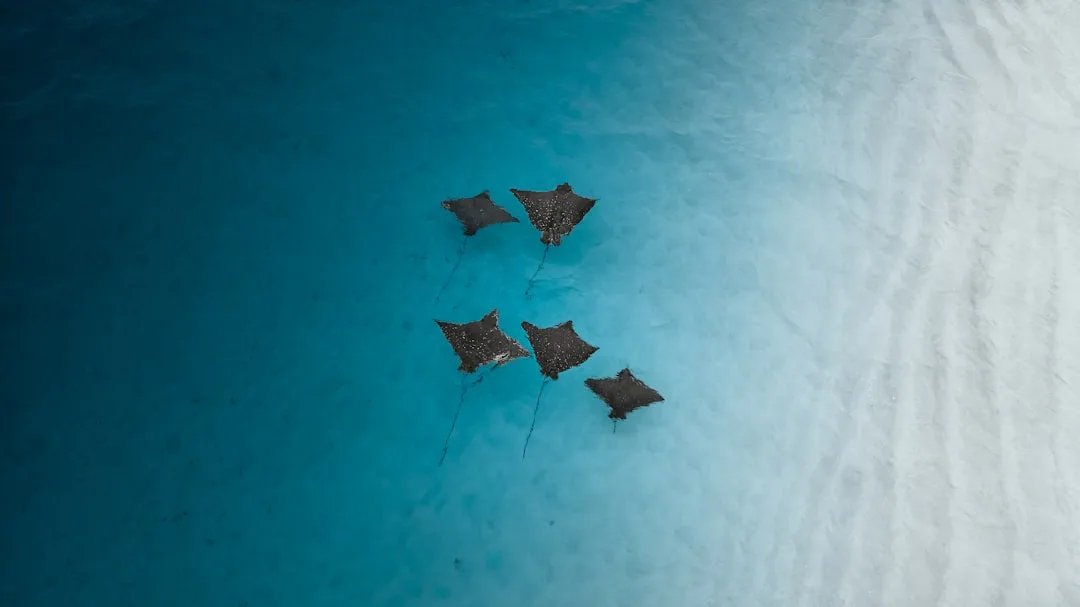
How big are manta rays?
Giant manta rays (Mobula birostris) reach wingspans up to 7 meters (23 feet) and weigh up to 2,000 kg (4,400 pounds), making them the largest rays on Earth. The smaller reef manta (Mobula alfredi) reaches wingspans of about 5 meters and weights of 1,400 kg.
Seven Meters of Wing
A giant manta ray rises from the depths of a tropical reef, spreading wings that span seven meters from tip to tip - wider than a family car is long. The animal weighs as much as a pickup truck. As it passes a snorkeler, it pauses, circles, and makes eye contact before continuing on.
The encounter is memorable for the human. It may also be memorable for the manta. Research increasingly suggests these enormous fish recognize individual divers, remember interactions across years, and form something like relationships with specific humans they encounter repeatedly at cleaning stations and feeding grounds.
Manta rays are among the largest fish in the ocean, completely harmless to humans, extraordinarily graceful in motion, and - it turns out - probably smarter than any other fish on Earth.
The Size
Two species of manta ray exist:
Giant manta ray (Mobula birostris):
- Wingspan: up to 7 meters (23 feet)
- Weight: up to 2,000 kg (2 tons)
- Habitat: open ocean, occasionally near coasts
Reef manta ray (Mobula alfredi):
- Wingspan: up to 5 meters (16 feet)
- Weight: up to 1,400 kg
- Habitat: coastal reefs, lagoons, and shallow waters
Both species belong to the family Mobulidae, along with smaller relatives called devil rays. The manta genus was recently reorganized - what used to be called Manta is now classified within the broader Mobula genus based on genetic analysis.
Comparison to other fish:
Manta rays are among the largest fish in the ocean, exceeded only by whale sharks (which reach 12 meters) and basking sharks (10 meters). All three of the largest fish species are filter feeders on plankton - a remarkable pattern suggesting that extreme size is achievable in the ocean through plankton consumption, but not through predation on faster prey.
Filter Feeding
Despite their enormous size, manta rays eat some of the smallest animals in the ocean.
Diet:
Mantas eat zooplankton - tiny drifting animals including:
- Copepods (small crustaceans, 1-2 mm)
- Krill (larger crustaceans, 1-2 cm)
- Fish larvae and eggs
- Other microscopic drifters
An adult manta consumes up to 60 kg of plankton per day during peak feeding seasons.
Feeding anatomy:
Several specialized structures make manta feeding work:
Cephalic fins. Two forward-extending lobes at the front of the head. During feeding, mantas unfold these fins to funnel water toward the mouth. At rest, the fins roll up into horn-like projections - the source of the alternate common name "devil ray."
Massive mouth. The manta's mouth can open 1 meter wide during feeding. Water flows in through the mouth and out through the gill slits.
Gill rakers. Inside the mouth, filter structures called gill rakers trap plankton while allowing water to pass through. These rakers are dense plates of tissue with fine projections that catch particles down to a few millimeters in size.
Feeding behaviors:
Manta rays perform a variety of distinctive feeding behaviors:
Barrel rolling: A manta somersaults backward through a plankton cloud, passing through the dense food mass multiple times in quick succession.
Chain feeding: Multiple mantas form a line, each following the head of the next, swimming in a tight circle. This concentrates plankton in the center of the circle while each manta gets a turn through the densest portion.
Cyclone feeding: Ten or more mantas rotate together in a tight vertical vortex, sometimes reaching dozens of individuals coordinating together. This may be the most socially sophisticated feeding behavior ever documented in a fish.
Surface feeding: Mantas feed at the water surface, often with part of their bodies above water. The mouth remains submerged while cephalic fins break the surface, funneling surface plankton into the mouth.
Bottom feeding: Mantas also feed near the seafloor where dense plankton concentrations form.
The Big Fish Brain
Manta rays have the largest brains of any fish, both absolutely and relative to body size.
Brain statistics:
- Giant manta brain weight: up to 200 grams
- Brain-to-body weight ratio: higher than any other fish
- Brain regions: particularly developed areas associated with learning, memory, and social behavior
For comparison:
Most fish have tiny brains relative to body size. A large tuna might have a brain weighing 3-4 grams for a 200 kg body. A shark's brain is larger but still modest. Manta brains approach the mass of some small mammal brains.
Cognitive capabilities:
Mantas demonstrate a range of sophisticated cognitive abilities:
Mirror self-recognition. In a 2016 study, manta rays were presented with mirrors. They performed behaviors consistent with self-recognition: making repetitive movements while watching the mirror, examining their bodies in ways only possible through mirror use, and showing interest in the reflected image rather than treating it as another manta.
Mirror self-recognition has been demonstrated in only a handful of species: great apes, bottlenose dolphins, elephants, Eurasian magpies, and now manta rays. If the manta result is confirmed, it adds a fish to this exclusive cognitive club.
Long-term memory. Individual mantas have been identified repeatedly at the same cleaning stations over years, showing they remember specific locations and their significance.
Social recognition. Mantas in high-interaction areas recognize individual human divers, distinguishing between people they have encountered before and strangers.
Play behavior. Mantas engage in apparently playful activities: repeated breaching (leaping from the water), acrobatic somersaults with no apparent feeding purpose, and interactive behaviors with divers.
Cooperative feeding. The coordinated feeding behaviors (chain feeding, cyclone feeding) suggest sophisticated social learning and coordination.
Cleaning Stations
Cleaning stations are specific locations where larger fish come to have parasites and dead skin removed by smaller fish called cleaners.
How they work:
Small wrasses or cleaner shrimp set up at specific reef locations. Larger fish approach, stop, and allow the cleaners to inspect their bodies and remove parasites. Cleaners benefit by getting food; larger fish benefit by getting rid of parasites.
Manta behavior at cleaning stations:
Manta rays have specific cleaning stations they visit repeatedly. A single manta may return to the same station daily or weekly for years. They cue up in loose queues, waiting their turn with other mantas at crowded stations.
Navigation:
Mantas remember the exact locations of cleaning stations across enormous areas. Some individuals have been tracked maintaining visits to the same station despite wide-ranging travel across hundreds of kilometers of ocean.
Social gatherings:
Cleaning stations become social gathering points. Multiple mantas congregate, interact, and sometimes mate at or near cleaning stations. The ritual of cleaning has become embedded in broader manta social life.
Reproduction
Manta rays reproduce slowly, a fact that makes them vulnerable to population pressures.
Sexual maturity:
Female mantas reach maturity at approximately 10 years old. Males mature somewhat earlier, around 6-8 years.
Courtship:
Mating involves elaborate courtship. Males follow females in "trains" of multiple suitors. The female ultimately selects one male to mate with, typically by outswimming or outmaneuvering the others.
Gestation:
After mating, females carry developing pups internally for approximately 12-13 months. Mantas give live birth rather than laying eggs.
Offspring:
Females typically give birth to a single pup every 2-5 years. Pups are born at approximately 1.5 meters wingspan - already larger than most adult fish.
Slow reproduction:
This breeding pace is extraordinarily slow for an animal of this size. Combined with late maturity, it means populations cannot recover quickly from any significant mortality pressure.
Threats
Despite being harmless to humans, manta rays face serious threats.
Targeted fishing:
The primary threat to mantas is commercial fishing for their gill rakers. These filter structures are used in traditional Chinese medicine as treatments for various ailments, despite having no demonstrated medical value.
The global market for manta gill rakers exceeds $30 million annually. A single large manta can sell for $500-4,000 depending on size.
Problematic demand:
Demand is concentrated in parts of Asia, particularly southern China. Conservation organizations have worked to reduce demand through public education campaigns, though progress has been slow.
Bycatch:
Mantas are often caught accidentally in tuna and swordfish fishing operations. Long lines, gillnets, and purse seines can all entangle mantas. Even if released, injured mantas often die from their wounds.
Marine plastic:
Mantas feeding by swimming through water with mouths open are particularly vulnerable to ingesting microplastics. Studies show manta populations in heavily polluted regions contain significant amounts of plastic in their digestive systems.
Boat strikes:
In tourism areas with heavy boat traffic, manta rays occasionally collide with boat hulls and propellers. Scars from such encounters are visible on many mantas in popular tourism zones.
Climate change:
Warming oceans and changing plankton patterns may disrupt manta feeding grounds. Coral reef decline also affects reef manta populations dependent on reef cleaning stations.
Conservation Status
Manta rays are formally protected under multiple international conventions.
IUCN status:
- Giant manta (M. birostris): Endangered
- Reef manta (M. alfredi): Vulnerable
Both species are declining globally.
CITES protection:
Both manta species are listed in CITES Appendix II, which restricts international trade. This listing (added in 2013) has made legal trade in manta products much more difficult.
Protected areas:
Several countries have created marine protected areas specifically for mantas:
- Mexico: Revillagigedo Islands Biosphere Reserve
- Maldives: extensive manta protected areas
- Indonesia: Raja Ampat Marine Park
- Palau: national shark (and manta) sanctuary
- Hawaii: manta ray protected areas
Tourism value:
Manta ray tourism generates far more revenue than manta ray fishing. A single living manta is estimated to produce $1 million in tourism revenue over its lifetime through diving and snorkeling encounters. This economic argument has convinced many coastal communities to protect mantas rather than fish them.
Diving With Mantas
Manta encounters with humans provide some of the most memorable wildlife experiences in the ocean.
Popular sites:
- Kona, Hawaii (night diving with plankton-feeding mantas drawn to dive lights)
- Maldives (cleaning stations and feeding aggregations)
- Indonesia (Komodo, Raja Ampat)
- Mexico (Revillagigedo, Socorro Island)
- Australia (Great Barrier Reef, Ningaloo Reef)
Behavior with divers:
Mantas often approach divers voluntarily, showing curiosity. They may circle, pass close overhead, or pause to observe. Some individual mantas become known to researchers and repeat tourists through distinctive color patterns on their underside.
Etiquette:
Responsible manta diving follows specific rules:
- Do not touch mantas (their slime coat protects against infection; contact can damage it)
- Stay below or beside, never above (being over a manta can feel like predator threat)
- Do not chase or block their path
- Maintain quiet, calm behavior
- Use red filtered dive lights at night to minimize disturbance
Following these rules, divers can have extended encounters with mantas that benefit both participants - humans get extraordinary experiences, mantas apparently enjoy the interaction (or at least tolerate it without apparent stress).
What Mantas Tell Us About Intelligence
Manta rays challenge assumptions about the relationship between fish and intelligence.
Fish are often dismissed as simple, reflex-driven creatures with limited cognitive capacity. Laboratory studies on small fish have generally confirmed this stereotype for many species.
Manta rays upend the narrative. Their brains are larger than many mammals'. Their behavior shows learning, memory, social coordination, self-awareness, and possibly emotional responses. They form something like relationships with specific humans. They play. They explore.
The implication is not that all fish are secretly intelligent but that intelligence has evolved multiple times in the oceans. Dolphins developed it from their mammal lineage. Cephalopods (octopuses, squids, cuttlefish) developed it completely independently from a mollusk ancestor. Manta rays - and possibly their relatives like giant oceanic manta rays and some sharks - represent another independent evolution of intelligence in vertebrate fish.
Large-brained animals require large food resources, long lives to justify the developmental investment, and social or environmental challenges that reward cognitive solutions. Manta rays meet all these criteria. They live for decades, feed on globally distributed plankton resources that require navigation and memory to exploit, and maintain complex social lives involving cleaning stations, mating aggregations, and coordinated feeding.
What they do with their brains is still being discovered. Each new study reveals cognitive capabilities previously unrecognized. The manta ray is a reminder that the ocean still holds minds we are only beginning to understand.
Manta Ray Species and Close Relatives
The manta rays belong to the genus Mobula within the family Mobulidae, which was reorganized in 2017 when Manta was reclassified as part of Mobula based on molecular phylogenetic evidence. The family contains 10 recognized species, of which two are the true mantas and eight are the smaller devil rays. Our research team has summarized the current Mobulidae taxonomy.
| Species | Common Name | Max Disc Width | IUCN Status | Range |
|---|---|---|---|---|
| Mobula birostris | Oceanic manta ray | 7 m | Endangered | Circumtropical |
| Mobula alfredi | Reef manta ray | 5 m | Vulnerable | Indo-Pacific coastal |
| Mobula mobular | Giant devil ray | 5.2 m | Endangered | Mediterranean, E. Atlantic |
| Mobula japanica | Spinetail devil ray | 3.1 m | Endangered | Pacific, Indian |
| Mobula thurstoni | Bentfin devil ray | 1.8 m | Endangered | Circumtropical |
| Mobula tarapacana | Chilean devil ray | 3.7 m | Endangered | Tropical oceans |
| Mobula eregoodootenkee | Pygmy devil ray | 1.1 m | Endangered | Indo-West Pacific |
| Mobula hypostoma | Lesser devil ray | 1.2 m | Endangered | W. Atlantic |
| Mobula rochebrunei | Guinean devil ray | 1.3 m | Vulnerable | E. Atlantic |
| Mobula kuhlii | Shortfin devil ray | 1.2 m | Endangered | Indo-West Pacific |
The 2017 genetic study by White and colleagues, published in the Zoological Journal of the Linnean Society, demonstrated that the two true manta species are more closely related to several devil ray species than either is to each other, necessitating the taxonomic merger [1].
Feeding Biology and Filter Mechanics
Manta rays are ram filter feeders, swimming continuously with their mouths open to sieve plankton through specialized gill rakers called branchial filter plates. A 2018 study by Misty Paig-Tran and colleagues published in Science Advances revealed that manta filter plates operate through a novel hydrodynamic mechanism called ricochet separation, which uses induced vortices to spin plankton away from escape routes and into the mouth [2].
"The manta ray filter is not a passive sieve. It is an actively engineered fluid dynamic structure that uses vortex-induced particle separation to capture plankton particles far smaller than the apparent pore size of the filter itself. Engineers are now using this design as a template for industrial filtration systems that avoid the fouling problems of traditional sieves." - Dr. Misty Paig-Tran, California State University Fullerton [2]
Adult manta rays filter between 27,000 and 60,000 liters of seawater per hour during active feeding, extracting copepods, krill, small fish larvae, and chaetognaths. In productive feeding locations such as Hanifaru Bay in the Maldives, chain-feeding and cyclone-feeding aggregations of 100 or more mantas form intricate spiral patterns that further concentrate plankton in the water column.
Migration and Satellite Tracking
Since 2008, satellite tagging programs run by the Manta Trust and partners have documented individual oceanic manta rays traveling over 4,500 kilometers annually, with some individuals crossing entire ocean basins. A 2014 study published in PLOS ONE tracked oceanic mantas off Mozambique moving 1,100 kilometers north to tropical cleaning stations and returning on the same seasonal cycle [3].
"Manta ray migrations are some of the longest documented in any cartilaginous fish, comparable to the movements of the largest tuna and billfish species. These long-distance movements make manta conservation a fundamentally international problem - a single protected area, no matter how well managed, cannot secure a species whose individuals travel between multiple national jurisdictions every year." - Dr. Andrea Marshall, co-founder of the Marine Megafauna Foundation [4]
Individual mantas can be identified by the unique patterns of white and black coloration on their bellies, allowing Manta Trust researchers to build longitudinal sighting records spanning decades. As of 2024, over 20,000 individual mantas have been catalogued in the Manta Trust's global photo-identification database.
References
- White, W. T., Corrigan, S., Yang, L., et al. (2018). Phylogeny of the manta and devilrays (Chondrichthyes: Mobulidae), with an updated taxonomic arrangement for the family. Zoological Journal of the Linnean Society, 182(1), 50-75. DOI: 10.1093/zoolinnean/zlx018
- Divi, R. V., Strother, J. A., & Paig-Tran, E. W. M. (2018). Manta rays feed using ricochet separation, a novel nonclogging filtration mechanism. Science Advances, 4(9), eaat9533. DOI: 10.1126/sciadv.aat9533
- Marshall, A. D., Dudgeon, C. L., & Bennett, M. B. (2011). Size and structure of a photographically identified population of manta rays Manta alfredi in southern Mozambique. Marine Biology, 158(5), 1111-1124. DOI: 10.1007/s00227-011-1635-5
- Stewart, J. D., Beale, C. S., Fernando, D., et al. (2016). Spatial ecology and conservation of Manta birostris in the Indo-Pacific. Biological Conservation, 200, 178-183. DOI: 10.1016/j.biocon.2016.05.016
Related Articles
- Whale Sharks: The Largest Fish in the Ocean
- Octopus Intelligence: The Smartest Invertebrates
- Ocean Giants: The Largest Animals in the Sea
Frequently Asked Questions
How big are manta rays?
Giant manta rays (Mobula birostris) reach wingspans up to 7 meters (23 feet) and weigh up to 2,000 kg (4,400 pounds), making them the largest rays on Earth. The smaller reef manta (Mobula alfredi) reaches wingspans of about 5 meters and weights of 1,400 kg. Manta rays are the largest fish in the family Mobulidae and among the largest fish in the ocean.
Despite their enormous size, mantas are completely harmless to humans - they lack stingers, teeth for biting, or any aggressive behaviors toward swimmers. Their large size is an adaptation for filter-feeding on tiny zooplankton, allowing them to process enormous volumes of water efficiently. A single feeding manta may swim through thousands of cubic meters of water per day, straining out the plankton.
Their wingspan is approximately twice as wide as a medium-sized car, and their mouths can open 1 meter wide during feeding.
Are manta rays intelligent?
Yes, manta rays are remarkably intelligent. They have the largest brain-to-body ratio of any fish, with brains weighing up to 200 grams - particularly developed in regions associated with learning, memory, and social behavior. Manta rays have passed the mirror self-recognition test, meaning they appear to recognize themselves in mirrors - a cognitive ability previously demonstrated only in great apes, dolphins, elephants, and magpies.
They form long-term social bonds, remember specific cleaning stations across enormous ocean territories, and engage in playful behaviors including breaching, acrobatic somersaults, and apparent play with divers. Researchers have documented mantas recognizing and approaching familiar divers who have been gentle with them in the past. They coordinate group feeding behaviors, with multiple individuals swimming in formation to maximize plankton concentration.
Their intelligence rivals that of dolphins in some tests, making them one of the smartest marine animals and the smartest known fish.
What do manta rays eat?
Manta rays are filter feeders, eating almost exclusively small zooplankton including copepods, krill, fish larvae, and other microscopic animals drifting in ocean water. An adult manta can consume 60 kg (130 pounds) of plankton daily during peak feeding seasons. They feed by swimming through plankton-rich water with their mouths wide open, using two forward-extending flaps called cephalic fins to funnel water into their mouths.
Modified gill structures called gill rakers trap plankton while allowing water to pass through. When feeding, mantas perform distinctive behaviors including barrel rolling (somersaults through plankton clouds), chain feeding (following each other in circles to concentrate food), and cyclone feeding (multiple mantas rotating together like a vortex). These feeding strategies suggest social learning and coordination.
Unlike many large ocean predators, mantas cannot hunt fast prey. Their entire physiology - massive mouth, filter structure, efficient cruising speed - is specialized for eating the smallest marine animals in enormous quantities.
Are manta rays dangerous?
No, manta rays are completely harmless to humans. Despite their enormous size, they lack stingers (unlike stingrays), teeth capable of biting, or any aggressive behaviors. The barbed tail of stingrays is absent in mantas - their tails are smooth whips used only for steering. Manta rays are curious about humans and often approach snorkelers and divers voluntarily.
Tourism sites around the world offer snorkeling and diving experiences with mantas, with zero history of serious injuries. Mantas have been observed approaching divers who appear to be in distress, and some researchers speculate about a limited sense of empathy based on these behaviors.
The only theoretical risk from manta rays is accidental contact from their enormous wingspan - being struck by a 2-ton fin could cause injury - but this is extraordinarily rare and mantas actively avoid such contact. They are sometimes compared to elephants for their size, intelligence, and gentle nature.
Why are manta rays endangered?
Manta rays are listed as Vulnerable (reef manta) and Endangered (giant manta) by the IUCN, primarily due to targeted fishing for their gill rakers. These filtering structures are used in traditional Chinese medicine, despite having no proven medical value. The global market for manta gill rakers exceeds $30 million annually.
A single manta can sell for $500-4,000 depending on size, making targeted fishing commercially viable despite the species’ slow reproduction. Mantas have extremely slow reproductive rates - females give birth to just 1 pup every 2-5 years after reaching maturity at 10 years of age. This slow reproduction means populations cannot recover quickly from fishing pressure.
Additional threats include accidental capture in tuna and swordfish fisheries, entanglement in ghost nets, ingestion of microplastics, boat strikes in tourism areas, and habitat degradation from coastal development. Conservation efforts include international trade protections under CITES, marine protected areas around manta aggregation sites, and campaigns to reduce demand for gill raker products.